






中国农业科学 ›› 2026, Vol. 59 ›› Issue (13): 2975-2992.doi: 10.3864/j.issn.0578-1752.2026.13.017
• 畜牧·兽医 • 上一篇
赵薇1( ), 田进理1, 陈丝雨1, 杨丽娟1, 马丽娜1, 张国俊2, 张虎2, 胡伟龙3, 余海荣3, 张海波3, 张娟1()
收稿日期:2025-12-05
接受日期:2026-03-24
出版日期:2026-07-01
发布日期:2026-07-01
通信作者:
联系方式:
赵薇,Tel:15709616397;E-mail:z1729921403w@163.com。
基金资助:
ZHAO Wei1(), TIAN JinLi1, CHEN SiYu1, YANG LiJuan1, MA LiNa1, ZHANG GuoJun2, ZHANG Hu2, HU WeiLong3, YU HaiRong3, ZHANG HaiBo3, ZHANG Juan1()
Received:2025-12-05
Accepted:2026-03-24
Published:2026-07-01
Online:2026-07-01
摘要: 【背景】静原鸡作为宁夏地方鸡品种,具有肉质鲜美、风味独特等优势,但存在生长速度慢、肌内脂肪(intramuscular fat,IMF)沉积不均等问题。前期研究发现,日粮中添加0.6%鲜食玉米萃取物(fresh corn extract, FCE)可显著改善静原鸡肉品质,但FCE影响静原鸡肉品质的关键候选基因尚不清晰。【目的】深入挖掘FCE影响静原鸡肉品质的关键候选基因,为改善静原鸡肉品质、优化肉鸡饲养策略提供科学依据。【方法】前期研究选取了相同饲养水平的135日龄(1.5±0.2) kg的静原鸡120只,将其分为4个组,对照组饲喂基础日粮,试验组分别在基础日粮中添加0.3%、0.6%和0.9%的FCE。经过45 d的饲喂后到达180日龄,采集胸肌测定了肉品质,筛选出了最适宜添加量0.6% FCE。基于前期研究结果,将对照组和0.6%FCE组静原鸡血清和胸肌进行脂质因子的测定,并利用加权共表达网络分析(weighted gene co-expression network analysis, WGCNA)对胸肌转录组测序数据进行深入分析,挖掘与肉品质显著相关的关键候选基因。【结果】0.6% FCE组血清中的TG和VLDL的含量显著高于对照组(P<0.05);0.6% FCE组胸肌组织中的TG、TC和HDL的含量显著升高(P<0.05)。通过WGCNA分析共得到19个共表达模块,共筛选出与肉品质显著相关的6个目标模块,包括purple、midnightblue、lightgreen、cyan、grey60和salmon(|R 2|≥0.5,P<0.5)。对6个目标模块内的枢纽基因进行KEGG通路富集分析和GO功能富集分析发现,purple模块枢纽基因极显著富集在胰岛素信号传导通路、线粒体自噬-动物等途径;midnightblue模块枢纽基因富集在嘧啶代谢、嘌呤代谢等途径;lightgreen 模块枢纽基因富集在内质网中的蛋白质加工、MAPK信号传导通路等途径;cyan模块枢纽基因主要富集在细胞黏附分子、吞噬体等途径;grey60模块枢纽基因通路有血管平滑肌收缩、肌动蛋白细胞骨架调控等途径;salmon模块枢纽基因富集在MAPK信号传导通路、p53信号传导通路等途径。通过枢纽基因与差异表达基因(differently expressed genes, DEGs)比较分析,筛选出10个重叠基因。通过蛋白互作分析和功能富集分析鉴定出CLDN18、NKX2-1和TRIB1是影响肉品质的关键候选基因。【结论】研究最终筛选出CLDN18、NKX2-1和TRIB1等影响肉品质的关键候选基因。为解析FCE调控肉品质的分子机制提供了参考,并为地方鸡种肉品质改良提供了新视角。
赵薇, 田进理, 陈丝雨, 杨丽娟, 马丽娜, 张国俊, 张虎, 胡伟龙, 余海荣, 张海波, 张娟. 基于加权基因共表达网络分析挖掘影响静原鸡肉品质相关候选基因[J]. 中国农业科学, 2026, 59(13): 2975-2992.
ZHAO Wei, TIAN JinLi, CHEN SiYu, YANG LiJuan, MA LiNa, ZHANG GuoJun, ZHANG Hu, HU WeiLong, YU HaiRong, ZHANG HaiBo, ZHANG Juan. Exploration of Candidate Genes Affecting Meat Quality of Jingyuan Chicken Based on Weighted Gene Co-expression Network Analysis[J]. Scientia Agricultura Sinica, 2026, 59(13): 2975-2992.
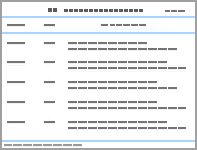
表1
基础日粮的成分与营养水平"
| 日粮组成 Ration composition | 含量 Content (%) | 日粮组成 Ration composition | 含量 Content (%) | |
|---|---|---|---|---|
| 配料 Ingredients | 营养成分含量Nutritional levels | |||
| 玉米 Corn | 52.00 | 水分水分Moisture | 13.00 | |
| 豆粕 Soybean meal | 26.00 | 粗蛋白crude protein (CP) | 17.00 | |
| 豆油Soybean oil | 4.85 | 粗纤维Crude fibre (CF) | 8.00 | |
| 玉米蛋白粉Corn protein powder | 6.00 | 粗灰分Crude Ash (Ash) | 16.00 | |
| 石粉Stone powder | 8.00 | 总磷Total Phosphorus (TP) | 0.50 | |
| 磷酸氢钙 Calcium hydrogen phosphate (CaHPO4) | 1.30 | 钙Calcium (Ca) | 3.00 | |
| 食用盐Edible salt (NaCl) | 0.65 | 食用盐Edible salt (NaCl) | 0.65 | |
| 赖氨酸Lysine (Lys) | 0.84 | 赖氨酸Lysine (Lys) | 0.84 | |
| 蛋氨酸Methionine (Met) | 0.36 | 蛋氨酸Methionine (Met) | 0.36 | |
| 总计Total | 100.00 |
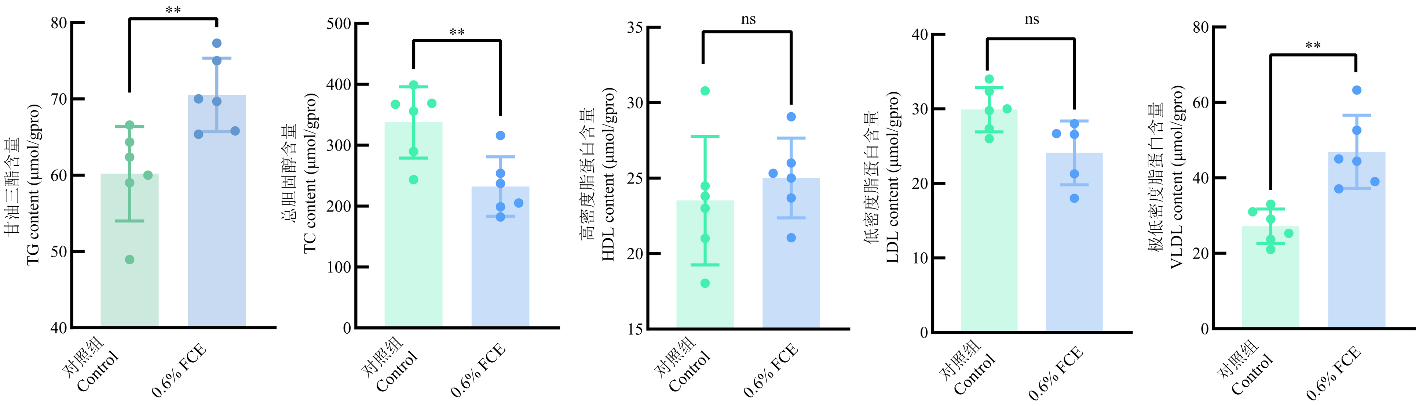
图1
血清中脂质因子含量"
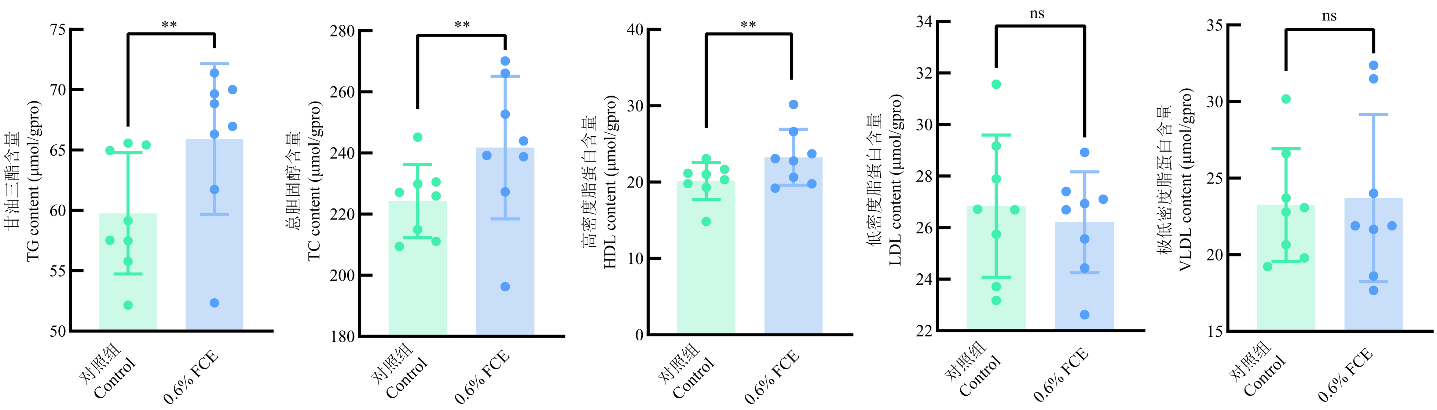
图2
胸肌中脂质因子含量"
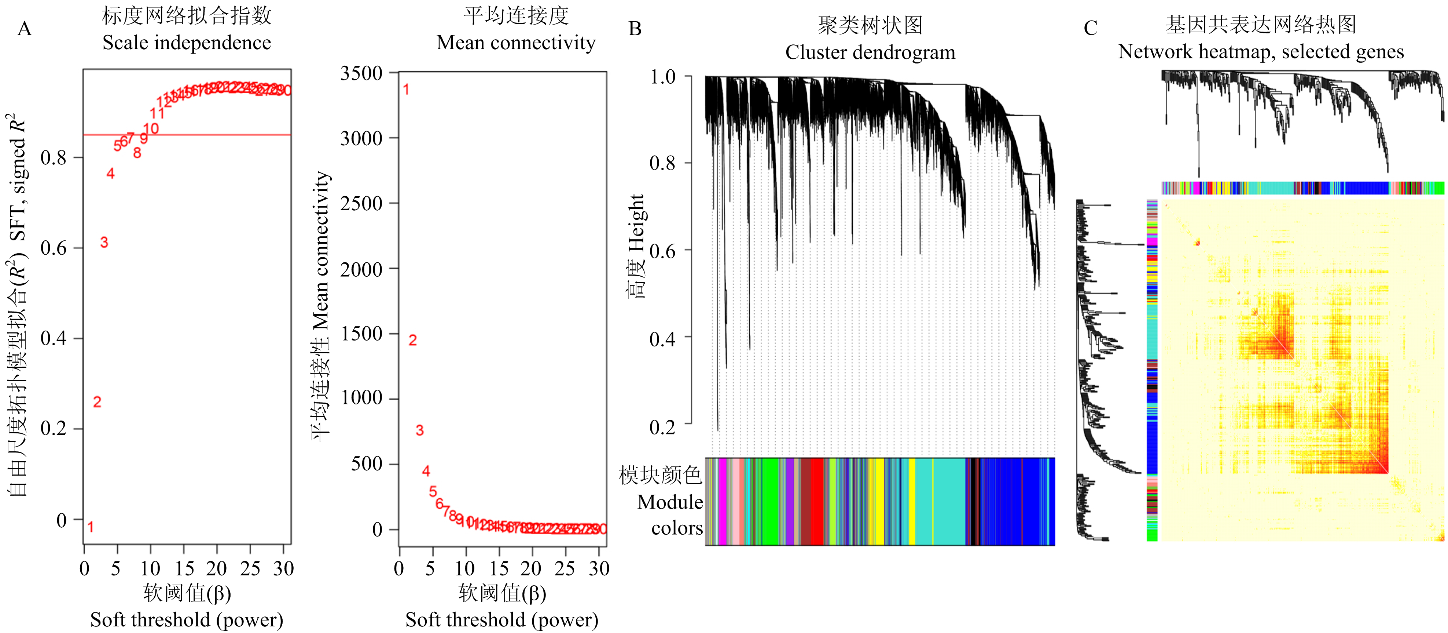
图3
加权基因共表达网络的构建 A:加权基因共表达软阈值的筛选;B:基因聚类树和模块构建;C:基因共表达网络热图"
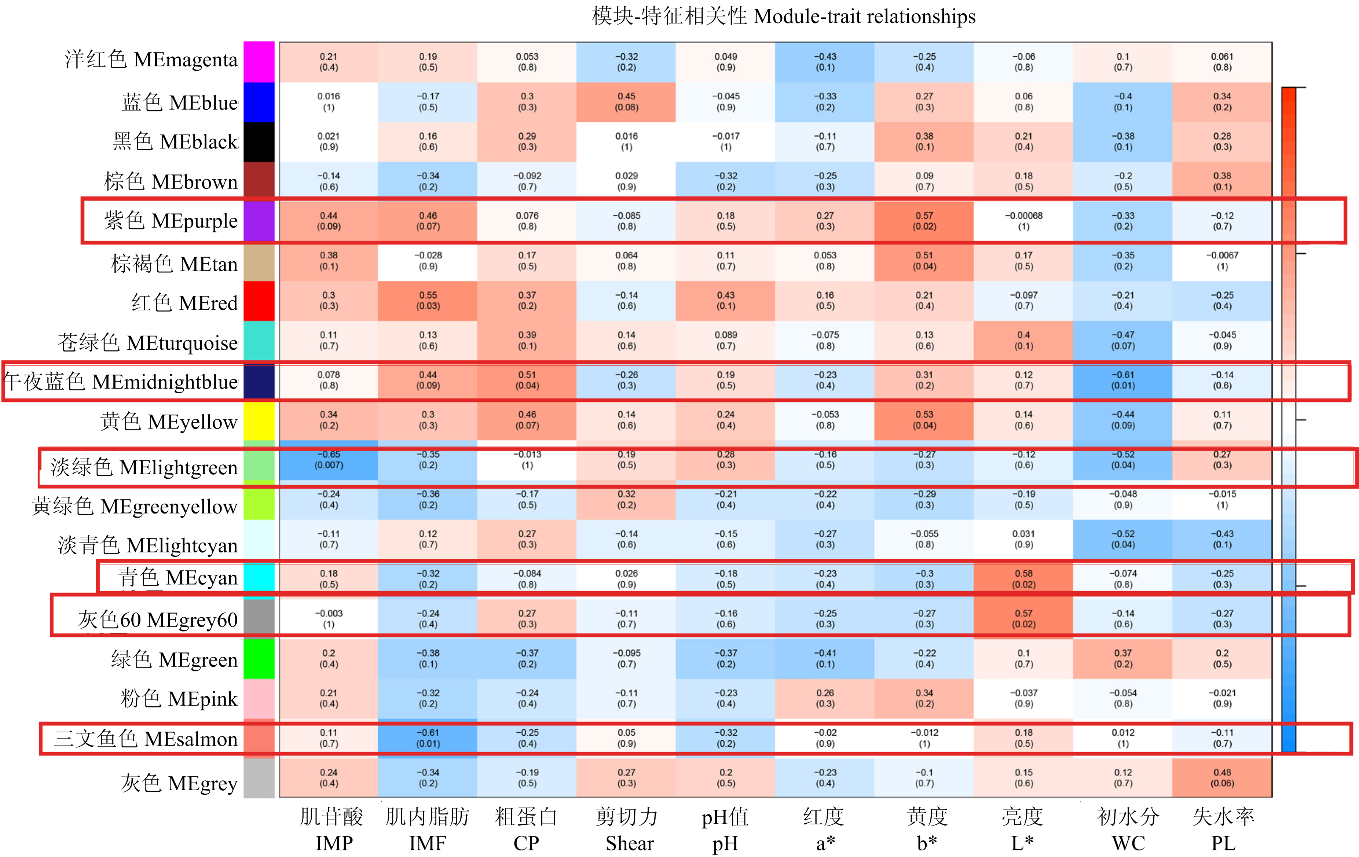
图4
模块与肉品质的相关性热图 横坐标为肉品质指标,纵坐标为模块。红色代表正相关,蓝色代表负相关"
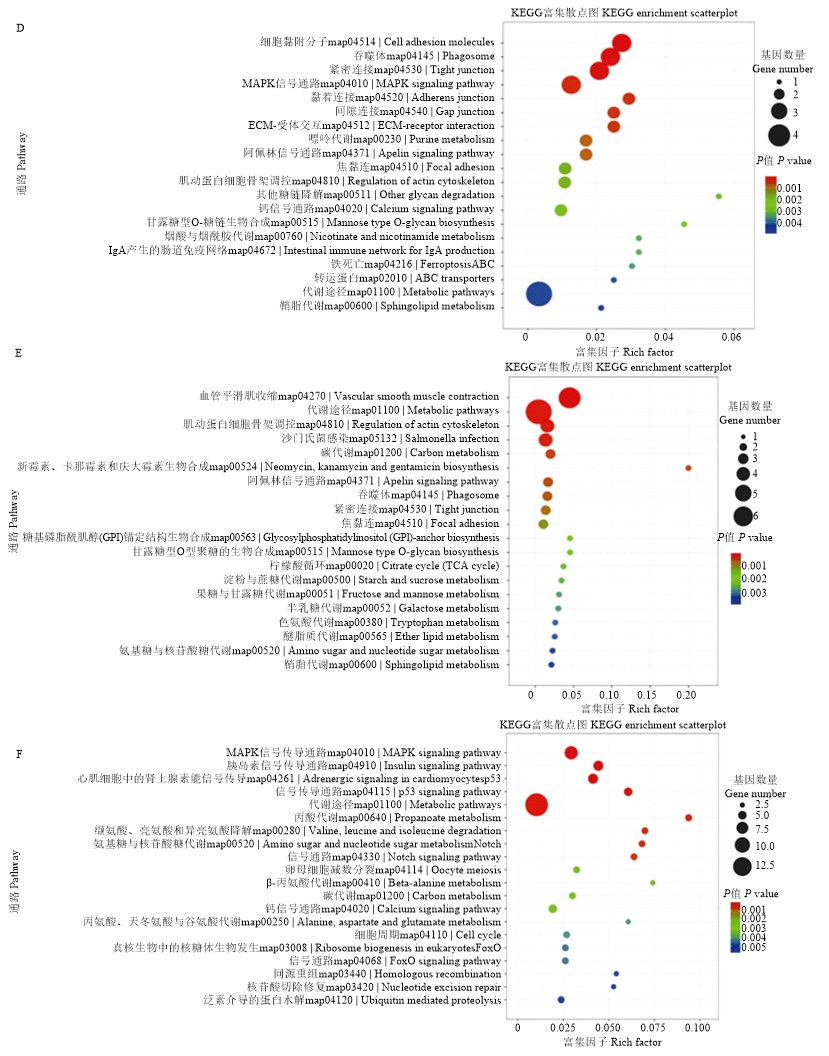
图5
枢纽基因的KEGG通路富集分析 A—F:分别为purple、midnightblue、lightgreen、cyan、grey60和salmon模块内枢纽基因的P值最小的前20条通路富集分析"
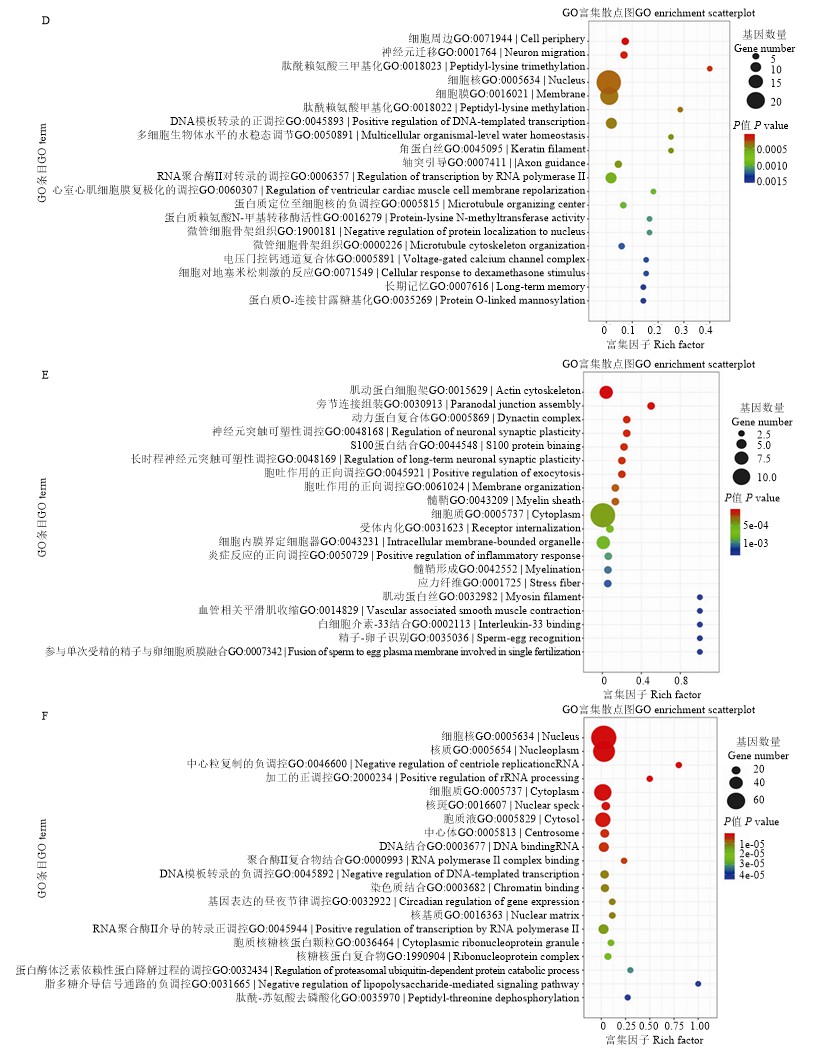
图6
枢纽基因的GO功能富集分析 A—F:分别为purple、midnightblue、lightgreen、cyan、grey60和salmon模块内枢纽基因的P值最小的前20条GO条目"
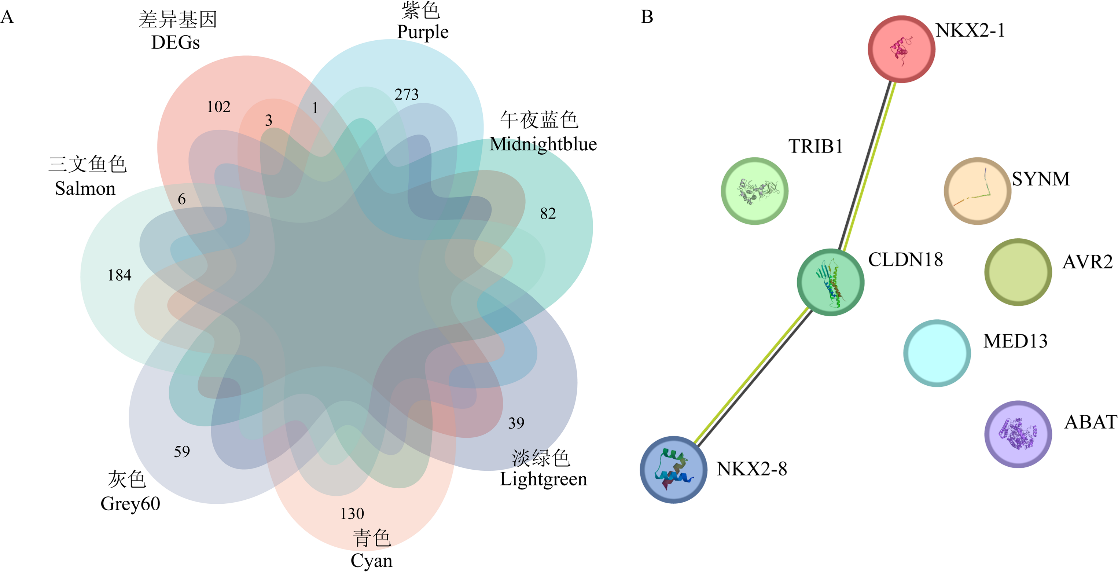
图7
差异基因与6个目标模块中枢纽基因的分析 A:韦恩图展示DEGs与purple、midnightblue、lightgreen、cyan、grey60和salmon模块中的枢纽基因的重叠关系;B:蛋白互作网络展示8个重叠基因的相互作用关系"
表2
关键候选基因的通路和功能分析"
| 基因名称 Gene name | 类型 Type | KEGG通路 KEGG pathway | GO功能 GO function |
|---|---|---|---|
| AVR2 | 下调Down | — | 胞外区域Extracellular region;生物素结合Biotin binding;生物素转运Biotin transport |
| NKX2-1 | 上调 Up | — | RNA聚合酶II对转录的负调控Negative regulation of transcription by RNA polymerase II;转录顺式调控区结合Transcription cis-regulatory region binding; RNA聚合酶II转录调控区序列特异性DNA结合RNA polymerase II transcription regulatory region sequence-specific DNA binding;RNA聚合酶II顺式调控区序列特异性DNA结合RNA polymerase II cis-regulatory region sequence-specific DNA binding;DNA结合转录因子活性DNA-binding transcription factor activity;RNA聚合酶II特异性RNA polymerase II-specific;内含子转录调控区序列特异性DNA结合Intronic transcription regulatory region sequence-specific DNA binding;神经元迁移Neuron migration;DNA结合DNA binding;DNA结合转录因子活性DNA-binding transcription factor activity;细胞核Nucleus;转录调控复合体Transcription regulator complex;DNA模板转录调控Regulation of DNA-templated transcription;RNA聚合酶II介导的转录调控Regulation of transcription by RNA polymerase II;磷脂代谢过程Phospholipid metabolic process;模式决定过程Pattern specification process;轴突引导Axon guidance;脑发育Brain development;内胚层发育Endoderm development;运动行为Locomotory behavior;激素反应Response to hormone;动物器官形态发生Animal organ morphogenesis;基因表达Gene expression;基因表达的正调控Positive regulation of gene expression;上皮-间质转化的负调控Negative regulation of epithelial to mesenchymal transition;酶结合Enzyme binding;大脑发育Telencephalon development;苍白球发育Globus pallidus development;海马体发育Hippocampus development;大脑皮质细胞迁移Cerebral cortex cell migration;前脑背腹模式形成Forebrain dorsal/ventral pattern formation;下丘脑发育Hypothalamus development;前脑神经元命运决定Forebrain neuron fate commitment;前脑神经元分化Forebrain neuron differentiation;大脑皮质γ-氨基丁酸能中间神经元分化Cerebral cortex GABAergic interneuron differentiation;大脑皮质神经元分化Cerebral cortex neuron differentiation;垂体发育Pituitary gland development;大脑皮质细胞迁移Telencephalon cell migration;肺发育Lung development;细胞迁移的负调控Negative regulation of cell migration;转化生长因子β受体信号通路的负调控Negative regulation of transforming growth factor beta receptor signaling pathway;甲状腺发育Thyroid gland development;前脑发育Forebrain development;发育诱导Developmental induction;睾丸间质干细胞分化Leydig cell differentiation;昼夜节律的正调控Positive regulation of circadian rhythm;序列特异性DNA结合Sequence-specific DNA binding;DNA模板转录的负调控Negative regulation of DNA-templated transcription;DNA模板转录的正调控Positive regulation of DNA-templated transcription;RNA聚合酶II介导的转录正调控Positive regulation of transcription by RNA polymerase II;参与形态发生过程的解剖结构形成Anatomical structure formation involved in morphogenesis;神经元命运决定Neuron fate commitment;少突胶质细胞分化Oligodendrocyte differentiation;肺囊泡发育Lung saccule development;上皮管分支在肺形态发生中的作用Epithelial tube branching involved in lung morphogenesis;支气管上皮细胞分化Club cell differentiation;Ⅱ型肺泡细胞分化Type II pneumocyte differentiation;RNA聚合酶Ⅱ特异性DNA结合转录因子结合RNA polymerase II-specific DNA-binding transcription factor binding;γ-氨基丁酸能神经元分化GABAergic neuron differentiation;中间神经元迁移Interneuron migration |
| CLDN18 | 上调 Up | 细胞黏附分子Cell adhesion molecules; 紧密连接Tight junction | 蛋白质定位至细胞核Protein localization to nucleus;骨吸收的负调节Negative regulation of bone resorption;消化道发育Digestive tract development;TNFSF11介导的信号传导通路TNFSF11-mediated signaling pathway;蛋白质定位至细胞核的负调节Negative regulation of protein localization to nucleus;破骨细胞发育的负调节Negative regulation of osteoclast development |
| 基因名称 Gene name | 类型 Type | KEGG通路 KEGG pathway | GO功能 GO function |
| NKX2-8 | 上调Up | — | — |
| TRIB1 | 上调 Up | — | 蛋白激酶活性Protein kinase activity;蛋白激酶抑制剂活性Protein kinase inhibitor activity;ATP结合ATP binding;细胞核Nucleus;细胞质Cytoplasm;蛋白质磷酸化Protein phosphorylation;蛋白激酶活性的负调控Negative regulation of protein kinase activity;JNK级联反应JNK cascade;平滑肌细胞迁移的负调控Negative regulation of smooth muscle cell migration;丝裂原活化蛋白激酶激酶结合Mitogen-activated protein kinase kinase binding;泛素蛋白连接酶结合Ubiquitin protein ligase binding;脂多糖介导信号通路的负调控Negative regulation of lipopolysaccharide- mediated signaling pathway;蛋白酶体泛素依赖性蛋白分解过程的正向调控Positive regulation of proteasomal ubiquitin-dependent protein catabolic process;脂多糖应答Response to lipopolysaccharide;MAP激酶活性的调控Regulation of MAP kinase activity;DNA结合转录因子活性的负向调控Negative regulation of DNA-binding transcription factor activity;嗜酸性粒细胞分化的正向调控Positive regulation of eosinophil differentiation;巨噬细胞分化的正向调控Positive regulation of macrophage differentiation;中性粒细胞分化的负向调控Negative regulation of neutrophil differentiation;平滑肌细胞增殖的负向调控Negative regulation of smooth muscle cell proliferation;泛素-蛋白转移酶调节活性Ubiquitin-protein transferase regulator activity;RNA聚合酶II特异性DNA结合转录因子结合RNA polymerase II-specific DNA-binding transcription factor binding |
| ENSGALG00010008091 | 上调up | — | — |
| MED13 | 上调Up | — | 转录共调节因子活性Transcription coregulator activity;细胞核Nucleus;核质Nucleoplasm;介导复合物Mediator complex;胆固醇稳态Cholesterol homeostasis;DNA结合转录因子活性的负调控Negative regulation of DNA-binding transcription factor activity;DNA模板转录的正调控Positive regulation of DNA-templated transcription;RNA聚合酶II介导的转录正调控Positive regulation of transcription by RNA polymerase II;核内甲状腺激素受体结合Nuclear thyroid hormone receptor binding;甘油三酯稳态Triglyceride homeostasis |
| ABAT | 上调Up | 丙氨酸、天冬氨酸和谷氨酸代谢Alanine, aspartate and glutamate metabolism; 缬氨酸、亮氨酸和异亮氨酸降解Valine, leucine and isoleucine degradation; β-丙氨酸代谢Beta-Alanine metabolism;丙酸代谢Propanoate metabolism; 丁酸代谢Butanoate metabolism | 催化活性Catalytic activity;4-氨基丁酸转氨酶活性4-aminobutyrate transaminase activity;线粒体Mitochondrion;转氨酶活性Transaminase activity;γ-氨基丁酸代谢过程Gamma-aminobutyric acid metabolic process;转移酶活性Transferase activity;吡哆醛磷酸结合Pyridoxal phosphate binding;4-氨基丁酸转氨酶复合物4-aminobutyrate transaminase complex;4-氨基丁酸:2-酮戊二酸转氨酶活性4-aminobutyrate:2-oxoglutarate transaminase activity;神经递质分解代谢过程Neurotransmitter catabolic process;同源蛋白结合Identical protein binding;(S)-3-氨基-2-甲基丙酸转氨酶活性(S)-3-amino-2-methylpropionate transaminase activity;对可卡因的行为反应Behavioral response to cocaine; behavioral response to cocaine |
| SYNM | 上调Up | — | 细胞骨架的结构组成部分Structural constituent of cytoskeleton;中间纤维Intermediate filament;肌肉的结构组成部分Structural constituent of muscle;膜Membrane;粘着蛋白结合Vinculin binding;中间纤维结合Intermediate filament binding;快缩型骨骼肌纤维收缩Fast-twitch skeletal muscle fiber contraction;肌膜Sarcolemma;肌膜骨膜复合体Costamere;中间纤维细胞骨架Intermediate filament cytoskeleton |
| ENSGALG00010026583 | 上调Up | — | — |
| [1] |
|
| [2] |
禹保军, 邓占钊, 辛国省, 蔡正云, 顾亚玲, 张娟. 静原鸡肌肉组织肌苷酸特异性沉积相关LNC_003828-gga-miR-107-3p-MINPP1的关联分析[J]. 中国农业科学, 2021, 54(19): 4229-4242. DOI : 10.3864/j.issn.0578-1752.2021.19.017.
|
|
|
|
| [3] |
黄华云, 隋雨乐, 孔熠, 梁忠, 杨苗苗, 刘星, 韩威. FTO基因对鸡肌内脂肪细胞脂沉积的调控作用[J]. 中国农业科学, 2025, 58(22): 4786-4796. DOI: 10.3864/j.issn.0578-1752.2025.22.017.
|
|
|
|
| [4] |
|
| [5] |
杨晓忱, 李朋亮, 吴旭妍, 刘敬科. 玉米理化指标与鸟害的相关性分析[J]. 中国农学通报, 2023, 39(36): 132-139.
|
|
|
|
| [6] |
|
| [7] |
|
| [8] |
|
| [9] |
巨晓军, 章明, 单艳菊, 姬改革, 屠云洁, 刘一帆, 邹剑敏, 束婧婷. 鸡肉品质分析及关键风味物质和基因的筛选[J]. 中国农业科学, 2023, 56(9): 1813-1826. DOI: 10.3864/j.issn.0578-1752.2023.09.016.
|
|
|
|
| [10] |
高腾飞, 杨鑫, 李亚莉, 张媛, 黄昀巍, 陈亚萍, 郭彦, 孙天原, 张俊珍. 共轭亚油酸对边鸡生长性能、血清生化指标、肉品质和抗氧化能力以及其在肌肉中富集的影响[J]. 动物营养学报, 2025, 37(1): 320-329.
|
|
|
|
| [11] |
郝丹妮, 刘丽萍, 屠晓航, 郭诗雨, 闫俊书, 王道营, 徐为民, 李鹏鹏. 生物发酵饲料对黄羽肉鸡宰后成熟过程中骨骼肌细胞铁死亡及肉品质的影响[J]. 肉类研究, 2026, 40(1): 18-27.
|
|
|
|
| [12] |
|
| [13] |
|
| [14] |
姬改革, 陈智武, 单艳菊, 刘一帆, 屠云洁, 邹剑敏, 章明, 巨晓军, 束婧婷, 张海涛, 唐燕飞, 蒋华莲. 基于转录组测序研究调控黄羽肉鸡干毛性状关键基因和信号通路[J]. 中国农业科学, 2024, 57(1): 204-215. DOI: 10.3864/j.issn.0578-1752.2024.01.014.
|
|
|
|
| [15] |
|
| [16] |
方子怡, 何政肖, 杨卫芳, 王永丽, 陈彦汲, 蔡日春, 余洋, 贾亚雄, 赵桂苹. 基于加权共表达网络分析(WGCNA)鉴定乌鸡中影响黑色素合成的候选代谢物[J]. 中国家禽, 2025, 47(10): 1-7.
|
|
|
|
| [17] |
王继英, 李菁璇, 王彦平, 郭建凤, 蔺海朝, 赵雪艳. 通过加权基因共表达网络分析揭示影响猪脂肪沉积的候选基因[J]. 中国农业科学, 2025, 58(9): 1845-1855. DOI: 10.3864/j.issn.0578-1752.2025.09.013.
|
|
|
|
| [18] |
吴鹏飞, 夏树立, 于海涛, 赵向华, 王康. 基于WGCNA挖掘天津猴鸡裸颈性状相关基因[J]. 江苏农业学报, 2024, 40(5): 881-889.
|
|
|
|
| [19] |
倪彬, 张康, 朱莉, 唐琳, 李昕鹏, 苟潇, 孔小艳. 基于WGCNA方法挖掘影响建水黄褐鸭肉质性状的功能基因[J]. 饲料研究, 2025, 48(10): 80-84.
|
|
|
|
| [20] |
杨光, 赵亚慧, 刘叶青, 张高威, 王科, 卢欣宇, 苏湘谭, 孙佳乐, 陈纪薇, 高爱琴. 枯草芽孢杆菌和壳寡糖及其联合添加对肉鸡生长性能、肉品质及盲肠菌群多样性的影响[J]. 畜牧兽医学报, 2026, 57(3): 1534-1548.
|
|
|
|
| [21] |
|
| [22] |
|
| [23] |
|
| [24] |
|
| [25] |
|
| [26] |
|
| [27] |
|
| [28] |
|
| [29] |
|
| [30] |
|
| [31] |
|
| [32] |
|
| [33] |
|
| [34] |
|
| [35] |
|
| [36] |
|
| [37] |
|
| [38] |
|
| [39] |
|
| [1] | 管书萍, 李可, 解凯东, 段耀园, 王婷婷, 周志虎, 伍小萌, 郭文武. ‘温州蜜柑+桃叶橙’胞质杂种果实增大的生理基础及相关基因发掘[J]. 中国农业科学, 2026, 59(8): 1748-1759. |
| [2] | 杨丽娟, 陈丝雨, 赵薇, 朱玲, 郭磊, 马丽娜, 马瑞敏, 张娟. 全基因组重测序揭示静原鸡羽色的遗传机制[J]. 中国农业科学, 2026, 59(6): 1348-1360. |
| [3] | 王少华, 范秋丽, 杨锦昌, 孙煜杰, 余纽, 蒋守群. 米老排叶片饲喂水平对黄羽肉鸡生长性能、免疫功能、抗氧化能力、胴体品质和肉品质的影响[J]. 中国农业科学, 2026, 59(5): 1111-1127. |
| [4] | 郭富强, 彭治鑫, 李得瑞, 林木森, 许立峰, 张成省. 2-辛基-3-异噻唑啉酮抗烟草赤星病菌的生物活性及作用机制[J]. 中国农业科学, 2026, 59(13): 2841-2852. |
| [5] | 杨菁华, 孙娥, 刘小欢, 张盼, 戴莹葆, 王文辉, 董涵, 左存武. 类受体激酶基因PbeCRLK2正调控梨腐烂病抗性[J]. 中国农业科学, 2026, 59(10): 2165-2180. |
| [6] | 董雪, 刘佳乐, 邵晋, 陈梦秋, 吴学友, 唐培安. 多组学揭示粳稻脂质在长期低温储藏中的稳定机制[J]. 中国农业科学, 2026, 59(10): 2249-2264. |
| [7] | 王忠妮, 雷月, 李佳丽, 宫彦龙, 朱速松. ABC转运蛋白OsARG1调控水稻抽穗期的功能[J]. 中国农业科学, 2026, 59(1): 1-16. |
| [8] | 王思琪, 邹利人, 白瑞雯, 闫可, 王思洋, 齐晓光, 申海林, 温景辉. 赤霉素调控‘蜜汁’葡萄穗轴硬化关键基因的挖掘[J]. 中国农业科学, 2026, 59(1): 179-189. |
| [9] | 张义茹, 韩雪, 姚鑫杰, 冯军, 魏爱丽, 李文超, 张彬, 韩渊怀, 李红英. 基于多组学解析谷子后熟米色变化的分子机制[J]. 中国农业科学, 2025, 58(9): 1702-1718. |
| [10] | 潘丽媛, 王永军, 李海军, 侯富, 李菁, 李丽丽, 孙苏阳. 基于转录组和WGCNA筛选小麦籽粒蛋白质累积相关调控基因[J]. 中国农业科学, 2025, 58(6): 1065-1082. |
| [11] | 邹晓威, 夏蕾, 朱晓敏, 孙辉, 周琦, 齐霁, 张亚封, 郑岩, 姜兆远. 基于转录组测序的玉米瘤黑粉菌UM01240过表达菌株诱导玉米抗病性分析[J]. 中国农业科学, 2025, 58(6): 1116-1130. |
| [12] | 孙萍, 朱文灿, 林贤锐, 吴嘉颀, 曹译文, 陈辰斐, 王轶, 朱建锡, 贾惠娟, 钱敏杰, 沈建生. 基于代谢组和转录组解析多雨寡照对桃果皮着色和类黄酮积累的影响[J]. 中国农业科学, 2025, 58(6): 1173-1194. |
| [13] | 谢露露, 李福, 张思远, 高建昌. 基于跨物种转录组解析影响不定根发生的保守基因[J]. 中国农业科学, 2025, 58(6): 1195-1209. |
| [14] | 高岩浩, 王婷婷, 白卫卫, 杜兴杰, 刘贤, 秦本源, 付彤, 孙宇, 高腾云, 张天留. 脂质组与转录组联合揭示南阳牛不同肌肉组织脂质特征的差异表达模式[J]. 中国农业科学, 2025, 58(6): 1239-1258. |
| [15] | 王凡, 刘陈玮, 陆红臣, 徐仁超, 卞晓春. 蚕豆响应交链格孢侵染的转录组分析及VfPR4的抗病功能验证[J]. 中国农业科学, 2025, 58(22): 4656-4672. |
|
||
