






中国农业科学 ›› 2026, Vol. 59 ›› Issue (11): 2387-2404.doi: 10.3864/j.issn.0578-1752.2026.11.007
胡紫钰( ), 张文慧, 周晓通, 王新怡, 张云鹤, 田雍祺, 张建萍(), 蔡志平()
收稿日期:2026-02-09
接受日期:2026-03-23
出版日期:2026-06-01
发布日期:2026-06-03
通信作者:
联系方式:
胡紫钰,E-mail:2834716477@qq.com。
基金资助:
HU ZiYu(), ZHANG WenHui, ZHOU XiaoTong, WANG XinYi, ZHANG YunHe, TIAN YongQi, ZHANG JianPing(), CAI ZhiPing()
Received:2026-02-09
Accepted:2026-03-23
Published:2026-06-01
Online:2026-06-03
摘要:
【目的】探讨不同害虫管理模式对棉田节肢动物群落多样性的影响,为建立以生态防控为核心的棉田绿色管理模式提供理论依据。【方法】在新疆棉田分别设置生态防控、不防控和化学防控3种管理模式,采用6种方法(目测法、马氏网集虫法、扫网法、黄板诱集法、盆拍法和陷阱法)系统调查棉田节肢动物的种类与数量,分析3种管理模式下棉田节肢动物群落组成的差异、节肢动物各功能群结构特征和多样性特征、节肢动物多样性指数的时序变化以及群落益害比。【结果】3种管理模式下,棉田节肢动物种类和数量各有差异,其中不防控棉田最多(12目61科85 426头),生态防控棉田次之(14目78科75 072头),化学防控棉田最少(10目48科41 237头);半翅目蚜科和缨翅目蓟马科均为3种棉田的优势类群。肉食性类群在生态防控棉田较多(34科),在不防控棉田(23科)和化学防控棉田(20科)相对较少;植食性类群在生态防控棉田较多(30科),不防控棉田次之(26科),化学防控棉田较少(19科)。生态防控棉田的节肢动物物种丰富度在棉花全生育期维持最高水平,多样性指数、集中性和均匀度在3种模式下的变化趋势一致,优势度则与上述3项指标呈相反变化规律,且生态防控对节肢动物物种丰富度和多样性指数的提升作用在棉花蕾期最为显著。此外,生态防控棉田的肉食性类群与植食性类群的个体数比(1﹕0.882)和科数比(1﹕16.825)均为3种模式中最高。【结论】生态防控可增加棉田节肢动物丰度和天敌数量进而控制棉田害虫数量,对调控棉田节肢动物群落结构具有一定的促进作用。
胡紫钰, 张文慧, 周晓通, 王新怡, 张云鹤, 田雍祺, 张建萍, 蔡志平. 不同害虫管理模式对棉田节肢动物群落结构的影响[J]. 中国农业科学, 2026, 59(11): 2387-2404.
HU ZiYu, ZHANG WenHui, ZHOU XiaoTong, WANG XinYi, ZHANG YunHe, TIAN YongQi, ZHANG JianPing, CAI ZhiPing. Effects of Different Pest Management Strategies on the Community Structure of Arthropods in Cotton Fields[J]. Scientia Agricultura Sinica, 2026, 59(11): 2387-2404.
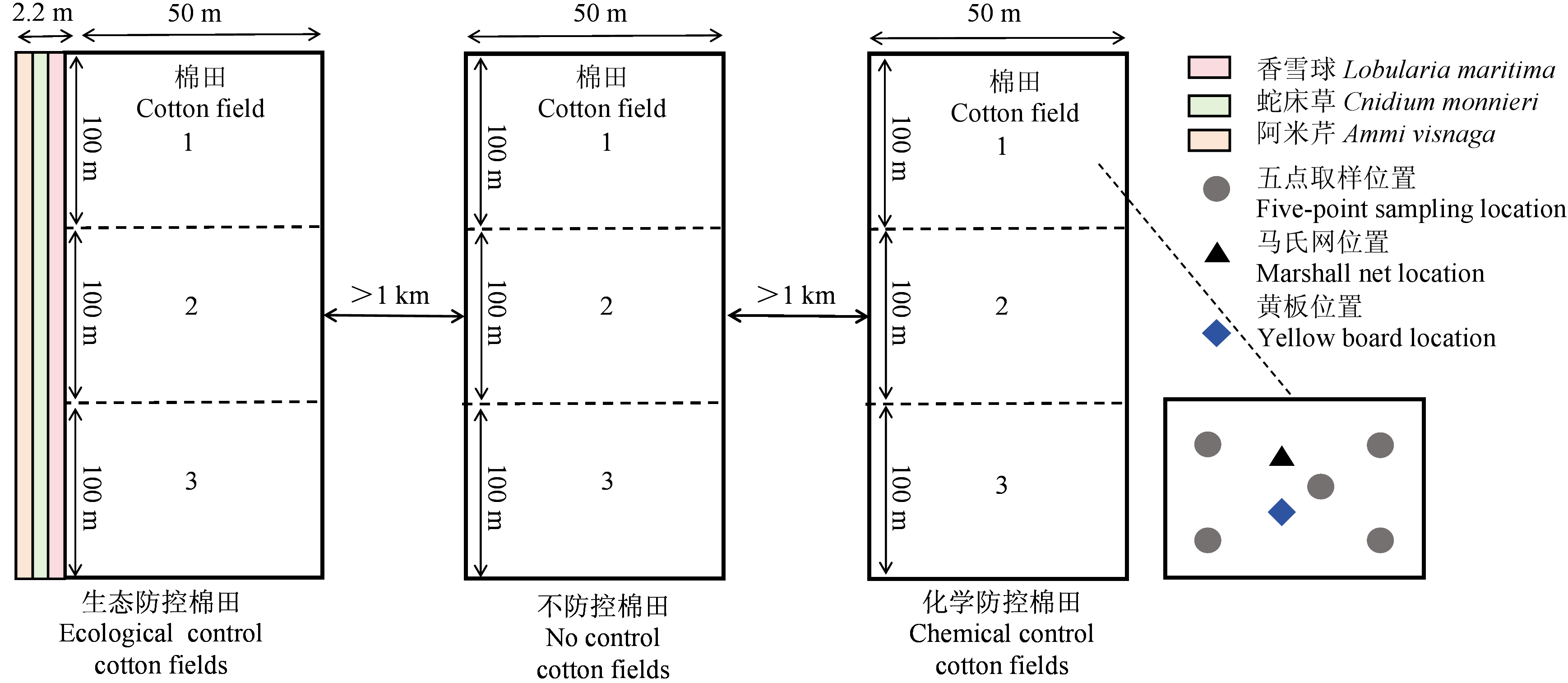
图1
3种管理模式棉田小区布局"

表1
化学防控棉田用药水平"
| 棉花生育期 Cotton growing period | 日期 Date (m-d) | 施用农药名称 Name of pesticide applied | 生产厂家 Manufacturer | 有效成分含量 Active ingredient content | 使用浓度 Usage concentration |
|---|---|---|---|---|---|
| 苗期 Seedling stage | 05-06 | 高效氯氰菊酯 Beta-cypermethrin | 河北安格诺农化有限公司 Hebei Angeno Agrochemical Co., Ltd. | 4.5% | 375 mL·hm-2 |
| 甲哌鎓 Mepiquat chloride | 山东戴盟得生物科技有限公司 Shandong Daimengde Biotechnology Co., Ltd. | 98% | 46.5 g·hm-2 | ||
| 05-14 | 甲哌鎓 Mepiquat chloride | 山东戴盟得生物科技有限公司 Shandong Daimengde Biotechnology Co., Ltd. | 98% | 46.5 g·hm-2 | |
| 啶虫脒 Acetamiprid | 河北中天邦正生物科技股份公司 Hebei Zhongtian Bangzheng Biotechnology Co., Ltd. | 20% | 75 g·hm-2 | ||
| 阿维菌素 Abamectin | 河北润达农药化工有限公司 Hebei Runda Pesticide & Chemical Co., Ltd. | 5% | 180 mL·hm-2 | ||
| 05-29 | 阿维菌素 Abamectin | 河北润达农药化工有限公司 Hebei Runda Pesticide & Chemical Co., Ltd. | 5% | 180 mL·hm-2 | |
| 啶虫脒 Acetamiprid | 河北中天邦正生物科技股份公司 Hebei Zhongtian Bangzheng Biotechnology Co., Ltd. | 20% | 75 g·hm-2 | ||
| 高氯·甲维盐 Emamectin·benzoate | 河南波尔森农业科技有限公司 Henan Borsen Agricultural Technology Co., Ltd. | 3.8% | 750 g·hm-2 | ||
| 苗期-蕾期 Seedling- budding stage | 06-09 | 啶虫脒 Acetamiprid | 河北中天邦正生物科技股份公司 Hebei Zhongtian Bangzheng Biotechnology Co., Ltd. | 20% | 75 g·hm-2 |
| 阿维菌素 Abamectin | 河北润达农药化工有限公司 Hebei Runda Pesticide & Chemical Co., Ltd. | 5% | 180 mL·hm-2 | ||
| 06-18 | 烯啶虫胺 Nitenpyram | 青岛海纳生物科技有限公司 Qingdao Haina Biotechnology Co., Ltd. | 10% | 150 mL·hm-2 | |
| 高氯·甲维盐 Emamectin·benzoate | 河南波尔森农业科技有限公司 Henan Borsen Agricultural Technology Co., Ltd. | 3.8% | 750 g·hm-2 | ||
| 乙螨唑 Etoxazole | 青岛中达农业科技有限公司 Qingdao Zhongda Agricultural Technology Co., Ltd. | 20% | 120 mL·hm-2 | ||
| 甲哌鎓 Mepiquat chloride | 山东戴盟得生物科技有限公司 Shandong Daimengde Biotechnology Co., Ltd. | 98% | 46.5 g·hm-2 | ||
| 蕾期 Budding stage | 06-26 | 啶虫脒 Acetamiprid | 河北中天邦正生物科技股份公司 Hebei Zhongtian Bangzheng Biotechnology Co., Ltd. | 20% | 75 g·hm-2 |
| 乙螨唑 Etoxazole | 青岛中达农业科技有限公司 Qingdao Zhongda Agricultural Technology Co., Ltd. | 20% | 120 mL·hm-2 | ||
| 阿维菌素 Abamectin | 河北润达农药化工有限公司 Hebei Runda Pesticide & Chemical Co., Ltd. | 5% | 180 mL·hm-2 | ||
| 高氯·甲维盐 Emamectin·benzoate | 河南波尔森农业科技有限公司 Henan Borsen Agricultural Technology Co., Ltd. | 3.8% | 750 g·hm-2 | ||
| 甲哌鎓 Mepiquat chloride | 山东戴盟得生物科技有限公司 Shandong Daimengde Biotechnology Co., Ltd. | 98% | 46.5 g·hm-2 | ||
| 07-04 | 烯啶虫胺 Nitenpyram | 青岛海纳生物科技有限公司 Qingdao Haina Biotechnology Co., Ltd. | 10% | 150 mL·hm-2 | |
| 螺螨酯 Spirodiclofen | 拜耳作物科学(中国)有限公司 Bayer Crop Science (China) Co., Ltd. | 240 g·L-1 | 150 mL·hm-2 | ||
| 高氯·甲维盐 Emamectin·benzoate | 河南波尔森农业科技有限公司 Henan Borsen Agricultural Technology Co., Ltd. | 3.8% | 750 g·hm-2 | ||
| 甲哌鎓 Mepiquat chloride | 山东戴盟得生物科技有限公司 Shandong Daimengde Biotechnology Co., Ltd. | 98% | 46.5 g·hm-2 | ||
| 蕾期-花铃期 Budding- Flower bud stage | 07-10 | 啶虫脒 Acetamiprid | 河北中天邦正生物科技股份公司 Hebei Zhongtian Bangzheng Biotechnology Co., Ltd. | 20% | 75 g·hm-2 |
| 阿维菌素 Abamectin | 河北润达农药化工有限公司 Hebei Runda Pesticide & Chemical Co., Ltd. | 5% | 180 mL·hm-2 | ||
| 氯虫苯甲酰胺 Chlorantraniliprole | 深圳诺普信作物科学股份有限公司 Shenzhen Nopxin Crop Science Co., Ltd. | 5% | 450 mL·hm-2 | ||
| 花铃期 Flower bud stage | 07-20 | 烯啶虫胺 Nitenpyram | 青岛海纳生物科技有限公司 Qingdao Haina Biotechnology Co., Ltd. | 10% | 150 mL·hm-2 |
| 乙螨唑 Etoxazole | 青岛中达农业科技有限公司 Qingdao Zhongda Agricultural Technology Co., Ltd. | 20% | 120 mL·hm-2 | ||
| 高氯·甲维盐 Emamectin Benzoate | 河南波尔森农业科技有限公司 Henan Borsen Agricultural Technology Co., Ltd. | 3.8% | 750 g·hm-2 | ||
| 07-30 | 螺螨酯 Spirodiclofen | 拜耳作物科学(中国)有限公司 Bayer Crop Science (China) Co., Ltd. | 240 g·L-1 | 150 mL·hm-2 | |
| 08-18 | 乙螨唑 Etoxazole | 青岛中达农业科技有限公司 Qingdao Zhongda Agricultural Technology Co., Ltd. | 20% | 120 mL·hm-2 | |
| 高氯·甲维盐 Emamectin·benzoate | 河南波尔森农业科技有限公司 Henan Borsen Agricultural Technology Co., Ltd. | 3.8% | 750 g·hm-2 | ||
| 联苯肼酯 Bifenazate | 浙江新安化工集团股份有限公司 Zhejiang Xin’an Chemical Group Co., Ltd. | 43% | 180 mL·hm-2 | ||
| 吡蚜酮 Pymetrozine | 陕西上格之路生物科学有限公司 Shaanxi Shangge Road Biological Sciences Co., Ltd. | 25% | 240 mL·hm-2 | ||
| 吐絮初期 Early stage of cotton boll opening | 08-28 | 氯虫苯甲酰胺 Chlorantraniliprole | 深圳诺普信作物科学股份有限公司 Shenzhen Nopxin Crop Science Co., Ltd. | 5% | 450 mL·hm-2 |
| 阿维菌素 Abamectin | 河北润达农药化工有限公司 Hebei Runda Pesticide & Chemical Co., Ltd. | 5% | 180 mL·hm-2 | ||
| 啶虫脒 Acetamiprid | 河北中天邦正生物科技股份公司 Hebei Zhongtian Bangzheng Biotechnology Co., Ltd. | 20% | 75 g·hm-2 | ||
| 乙螨唑 Etoxazole | 青岛中达农业科技有限公司 Qingdao Zhongda Agricultural Technology Co., Ltd. | 20% | 120 mL·hm-2 |
表2
3种害虫管理模式棉田节肢动物群落组成"
| 目 Order | 科 Family | 生态防控棉田 个体数 Individual number of ecological control cotton fields | 所占比例Proportion (%) | 化学防控棉田 个体数 Individual number of chemical control cotton fields | 所占比例Proportion (%) | 不防控棉田个体数 Individual number of no control cotton fields | 所占比例Proportion (%) | 类群 Community |
|---|---|---|---|---|---|---|---|---|
| 脉翅目 Neuroptera | 草蛉科Chrysopidae | 353 | 0.466 | 124 | 0.301 | 211 | 0.247 | 肉食性Carnivorous |
| 缨翅目 Thysanoptera | 蓟马科Thripinae | 15874 | 20.969 | 18939 | 45.927 | 17354 | 20.315 | 植食性Phytophagous |
| 纹蓟马科Aeolothripidae | 243 | 0.321 | 115 | 0.279 | 198 | 0.232 | 肉食性Carnivorous | |
| 管蓟马科Phlaeothripidae | 19 | 0.025 | 8 | 0.019 | 23 | 0.027 | 植食性Phytophagous | |
| 鞘翅目 Coleoptera | 瓢甲科Coccinellidae | 2607 | 3.444 | 731 | 1.773 | 2077 | 2.431 | 肉食性Carnivorous |
| 步甲科Carabidae | 2 | 0.003 | 1 | 0.002 | 0 | 0 | 肉食性Carnivorous | |
| 叶甲科Chrysomelidae | 95 | 0.125 | 2 | 0.005 | 12 | 0.014 | 植食性Phytophagous | |
| 薪甲科Latridiidae | 12 | 0.016 | 20 | 0.049 | 13 | 0.015 | 植食性Phytophagous | |
| 隐翅甲科Staphylinidae | 2 | 0.003 | 1 | 0.002 | 1 | 0.001 | 肉食性Carnivorous | |
| 金龟甲科Scarabaeoidae | 11 | 0.015 | 2 | 0.005 | 8 | 0.009 | 其他Other | |
| 半翅目 Hemiptera | 盲蝽科Miridae | 204 | 0.269 | 32 | 0.078 | 224 | 0.262 | 肉食性Carnivorous |
| 盲蝽科Miridae | 65 | 0.086 | 17 | 0.041 | 61 | 0.071 | 植食性Phytophagous | |
| 姬蝽科Nabidae | 1 | 0.001 | 0 | 0 | 0 | 0 | 肉食性Carnivorous | |
| 长蝽科Lygaeidae | 2 | 0.003 | 0 | 0 | 1 | 0.001 | 肉食性Carnivorous | |
| 小花蝽科Anthocoridae | 297 | 0.392 | 22 | 0.053 | 209 | 0.245 | 肉食性Carnivorous | |
| 猎蝽科Reduviidae | 1 | 0.001 | 0 | 0 | 0 | 0 | 肉食性Carnivorous | |
| 蚜科Aphididae | 54333 | 71.772 | 20329 | 49.298 | 62790 | 73.502 | 植食性Phytophagous | |
| 叶蝉科Cicadellidae | 49 | 0.065 | 12 | 0.029 | 42 | 0.049 | 植食性Phytophagous | |
| 飞虱科Delphacidae | 9 | 0.012 | 10 | 0.024 | 4 | 0.005 | 植食性Phytophagous | |
| 木虱科Psyllidae | 6 | 0.008 | 1 | 0.002 | 0 | 0 | 植食性Phytophagous | |
| 蝽科Pentatomidae | 7 | 0.009 | 1 | 0.002 | 2 | 0.002 | 植食性Phytophagous | |
| 姬蝽科Nabidae | 4 | 0.005 | 0 | 0 | 0 | 0 | 肉食性Carnivorous | |
| 划蝽科Corixidae | 0 | 0 | 1 | 0.002 | 0 | 0 | 植食性Phytophagous | |
| 网蝽科Tingidae | 0 | 0 | 0 | 0 | 1 | 0.001 | 植食性Phytophagous | |
| 蜘蛛目 Araneida | 蟹蛛科Thomisidae | 12 | 0.016 | 0 | 0 | 12 | 0.014 | 肉食性Carnivorous |
| 狼蛛科Lycosidae | 5 | 0.007 | 5 | 0.012 | 2 | 0.002 | 肉食性Carnivorous | |
| 跳蛛科Salticidae | 1 | 0.001 | 1 | 0.002 | 7 | 0.008 | 肉食性Carnivorous | |
| 皿蛛科Linyphiidae | 7 | 0.009 | 1 | 0.002 | 14 | 0.016 | 肉食性Carnivorous | |
| 园蛛科Araneidae | 1 | 0.001 | 0 | 0 | 0 | 0 | 肉食性Carnivorous | |
| 平腹蛛科Gnaphosidae | 0 | 0 | 0 | 0 | 1 | 0.001 | 肉食性Carnivorous | |
| 膜翅目 Hymenoptera | 茧蜂科Braconidae | 27 | 0.036 | 8 | 0.019 | 2 | 0.002 | 肉食性Carnivorous |
| 蚜茧蜂科Braconidae | 175 | 0.231 | 87 | 0.211 | 134 | 0.157 | 肉食性Carnivorous | |
| 寄生蜂总科Platygaster sp. | 3 | 0.004 | 4 | 0.010 | 0 | 0 | 肉食性Carnivorous | |
| 跳小蜂科Encyrtidae | 1 | 0.001 | 0 | 0 | 0 | 0 | 肉食性Carnivorous | |
| 榕小蜂科Agaonidae | 1 | 0.001 | 1 | 0.002 | 2 | 0.002 | 植食性Phytophagous | |
| 旗腹蜂科Evaniidae | 1 | 0.001 | 0 | 0 | 0 | 0 | 肉食性Carnivorous | |
| 姬蜂科Ichneumonidae | 32 | 0.042 | 26 | 0.063 | 3 | 0.004 | 肉食性Carnivorous | |
| 金小蜂科Pteromalidae | 3 | 0.004 | 2 | 0.005 | 0 | 0 | 肉食性Carnivorous | |
| 隧蜂科Halictidae | 2 | 0.003 | 0 | 0 | 0 | 0 | 植食性Phytophagous | |
| 蜜蜂总科Apoidea | 1 | 0.001 | 0 | 0 | 3 | 0.004 | 植食性Phytophagous | |
| 叶蜂科Tenthredinidae | 1 | 0.001 | 0 | 0 | 2 | 0.002 | 植食性Phytophagous | |
| 小蜂科Chalcididae | 33 | 0.044 | 0 | 0 | 27 | 0.032 | 肉食性Carnivorous | |
| 细蜂科Proctotrupidae | 75 | 0.099 | 0 | 0 | 69 | 0.081 | 肉食性Carnivorous | |
| 长尾小蜂科Torymidae | 1 | 0.001 | 0 | 0 | 0 | 0 | 植食性Phytophagous | |
| 树蜂科Siricidae | 1 | 0.001 | 0 | 0 | 0 | 0 | 植食性Phytophagous | |
| 蚁科Formicidae | 22 | 0.029 | 7 | 0.017 | 17 | 0.020 | 其他Other | |
| 瘿蜂科Cynipidae | 0 | 0 | 0 | 0 | 33 | 0.039 | 植食性Phytophagous | |
| 双翅目 Diptera | 食蚜蝇科Syrphidae | 17 | 0.022 | 3 | 0.007 | 9 | 0.011 | 肉食性Carnivorous |
| 寄蝇科Tachinidae | 9 | 0.012 | 0 | 0 | 7 | 0.008 | 肉食性Carnivorous | |
| 水虻科Stratiomyidae | 1 | 0.001 | 2 | 0.005 | 4 | 0.005 | 其他Other | |
| 长足虻科Dolichopodidae | 5 | 0.007 | 0 | 0 | 0 | 0 | 肉食性Carnivorous | |
| 实蝇科Tephritidae | 61 | 0.081 | 18 | 0.044 | 36 | 0.042 | 植食性Phytophagous | |
| 潜蝇科Agromyzidae | 3 | 0.004 | 1 | 0.002 | 1 | 0.001 | 植食性Phytophagous | |
| 果蝇科Drosophilidae | 30 | 0.040 | 7 | 0.017 | 35 | 0.041 | 植食性Phytophagous | |
| 叶蝇科Milichiidae | 1 | 0.001 | 0 | 0 | 1 | 0.001 | 植食性Phytophagous | |
| 蚊科Culicidae | 14 | 0.018 | 0 | 0 | 15 | 0.018 | 植食性Phytophagous | |
| 眼蕈蚊科Sciaridae | 4 | 0.005 | 1 | 0.002 | 1 | 0.001 | 植食性Phytophagous | |
| 瘿蚊科Cecidomyiidae | 30 | 0.040 | 20 | 0.049 | 50 | 0.059 | 植食性Phytophagous | |
| 菌蚊科Mycetophilidae | 5 | 0.007 | 0 | 0 | 1 | 0.001 | 植食性Phytophagous | |
| 大蚊科Tipulidae | 1 | 0.001 | 0 | 0 | 0 | 0 | 其他Other | |
| 蝇科Muscidae | 24 | 0.032 | 1 | 0.002 | 4 | 0.005 | 肉食性Carnivorous | |
| 秆蝇科Chloropidae | 2 | 0.003 | 0 | 0 | 4 | 0.005 | 植食性Phytophagous | |
| 秆蝇科Chloropidae | 12 | 0.016 | 16 | 0.039 | 61 | 0.071 | 其他Other | |
| 花蝇科Anthomyiidae | 43 | 0.057 | 0 | 0 | 83 | 0.097 | 植食性Phytophagous | |
| 丽蝇科Calliphoridae | 1 | 0.001 | 1 | 0.002 | 1 | 0.001 | 其他Other | |
| 蚤蝇科Phoridae | 708 | 0.935 | 624 | 1.513 | 1450 | 1.697 | 其他Other | |
| 摇蚊科Chironomidae | 16 | 0.021 | 7 | 0.017 | 14 | 0.016 | 其他Other | |
| 水蝇科Hydrocoridae | 1 | 0.001 | 0 | 0 | 0 | 0 | 植食性Phytophagous | |
| 寡脉蝇科Asteiidae | 2 | 0.003 | 0 | 0 | 0 | 0 | 其他Other | |
| 缟蝇科Lauxaniidae | 8 | 0.011 | 2 | 0.005 | 3 | 0.004 | 其他Other | |
| 尖翅蝇科Lonchopteridae | 25 | 0.033 | 0 | 0 | 3 | 0.004 | 其他Other | |
| 鼓翅蝇科epsidae | 2 | 0.003 | 0 | 0 | 1 | 0.001 | 其他Other | |
| 斑蝇科Physiphora | 1 | 0.001 | 0 | 0 | 1 | 0.001 | 其他Other | |
| 革翅目 Dermaptera | 蠼螋科Labiduridae | 50 | 0.066 | 15 | 0.036 | 40 | 0.047 | 肉食性Carnivorous |
| 球螋科Forficulidae | 5 | 0.007 | 1 | 0.002 | 2 | 0.002 | 肉食性Carnivorous | |
| 蜻蜓目Odonata | 蟌科Coenagrionidae | 1 | 0.001 | 0 | 0 | 0 | 0 | 肉食性Carnivorous |
| 螳螂目Mantodea | 螳螂科Mantodea | 2 | 0.003 | 0 | 0 | 0 | 0 | 肉食性Carnivorous |
| 鳞翅目 Lepidoptera | 粉蝶科Pieridae | 1 | 0.001 | 0 | 0 | 0 | 0 | 植食性Phytophagous |
| 夜蛾科Noctuidae | 9 | 0.012 | 3 | 0.007 | 13 | 0.015 | 植食性Phytophagous | |
| 螟蛾科Pyralidae | 0 | 0 | 1 | 0.002 | 0 | 0 | 植食性Phytophagous | |
| 等足目Isopoda | 鼠妇科Porcellionidae | 4 | 0.005 | 2 | 0.005 | 3 | 0.004 | 其他Other |
| 啮虫目 Corrodentia | 半啮科Hemibrycon | 2 | 0.003 | 2 | 0.005 | 21 | 0.025 | 肉食性Carnivorous |
| 直翅目 Orthoptera | 蟋蟀科Gryllidae | 1 | 0.001 | 0 | 0 | 0 | 0 | 植食性Phytophagous |
| 蜚蠊目Blattaria | 斑蠊科Blattidae | 0 | 0 | 0 | 0 | 3 | 0.004 | 植食性Phytophagous |
| 总计Total | 75072 | 41237 | 85426 |
表3
3种害虫管理模式棉田节肢动物群落各功能类群组成"
| 类群 Group | 生态防控棉田 Ecological control cotton fields | 化学防控棉田 Chemical control cotton fields | 不防控棉田 No control cotton fields | ||||||
|---|---|---|---|---|---|---|---|---|---|
| 数量 Number | 百分比 Percent (%) | 数量 Number | 百分比 Percent (%) | 数量 Number | 百分比 Percent (%) | ||||
| 肉食性类群 Carnivorous group | 科数Family | 34 | 43.59 | 20 | 41.67 | 23 | 37.70 | ||
| 个体数Individual | 1402±1798a | 5.56 | 393±173c | 2.87 | 1091±246b | 3.83 | |||
| 植食性类群Phytophagous group | 科数Family | 30 | 38.46 | 19 | 39.58 | 26 | 42.62 | ||
| 个体数Individual | 23594±2573b | 93.36 | 13130±3166c | 95.52 | 26862±1366a | 94.34 | |||
| 其他类群 Other group | 科数Family | 14 | 17.95 | 9 | 18.75 | 12 | 19.67 | ||
| 个体数Individual | 271±26b | 1.08 | 221±22b | 1.61 | 522±125a | 1.83 | |||
表4
3种害虫管理模式棉田节肢动物群落的多样性特征"
| 类群 Group | 处理 Treatment | 物种丰富度 Species richness | 香农多样性指数 Shannon-Wiener index | 优势集中性 Simpon index | 优势度 Dominance index | 均匀度 Evenness index |
|---|---|---|---|---|---|---|
| 肉食性类群 Carnivorous group | 生态防控棉田Ecological control cotton field | 3.955±0.239a | 1.537±0.068a | 0.596±0.040a | 0.404±0.010a | 0.435±0.012a |
| 化学防控棉田Chemical control cotton field | 2.686±0.128b | 1.421±0.043a | 0.590±0.013a | 0.410±0.026a | 0.472±0.011a | |
| 不防控棉田No control cotton field | 2.718±0.087b | 1.457±0.047a | 0.579±0.034a | 0.421±0.021a | 0.464±0.020a | |
| 植食性类群 Phytophagous group | 生态防控棉田Ecological control cotton field | 2.597±0.053a | 0.588±0.035b | 0.359±0.011b | 0.641±0.028a | 0.173±0.004b |
| 化学防控棉田Chemical control cotton field | 1.701±0.065c | 0.719±0.023a | 0.503±0.015a | 0.498±0.028b | 0.244±0.012a | |
| 不防控棉田No control cotton field | 2.213±0.080b | 0.568±0.015b | 0.347±0.010b | 0.654±0.011a | 0.174±0.009b | |
| 其他类群 Other group | 生态防控棉田Ecological control cotton field | 1.749±0.066a | 0.601±0.023a | 0.220±0.020a | 0.780±0.023b | 0.232±0.024a |
| 化学防控棉田Chemical control cotton field | 1.078±0.071c | 0.309±0.017b | 0.108±0.003b | 0.892±0.019a | 0.146±0.021b | |
| 不防控棉田No control cotton field | 1.357±0.064b | 0.354±0.029b | 0.132±0.003b | 0.868±0.034ab | 0.146±0.005b | |
| 总群落 Total arthropod community | 生态防控棉田Ecological control cotton field | 6.945±0.123a | 0.895±0.018a | 0.436±0.039ab | 0.720±0.057a | 0.206±0.007b |
| 化学防控棉田Chemical control cotton field | 4.518±0.020c | 0.928±0.037a | 0.543±0.019a | 0.494±0.034b | 0.240±0.009a | |
| 不防控棉田No control cotton field | 5.549±0.003b | 0.836±0.021a | 0.415±0.036b | 0.737±0.027a | 0.202±0.007b |
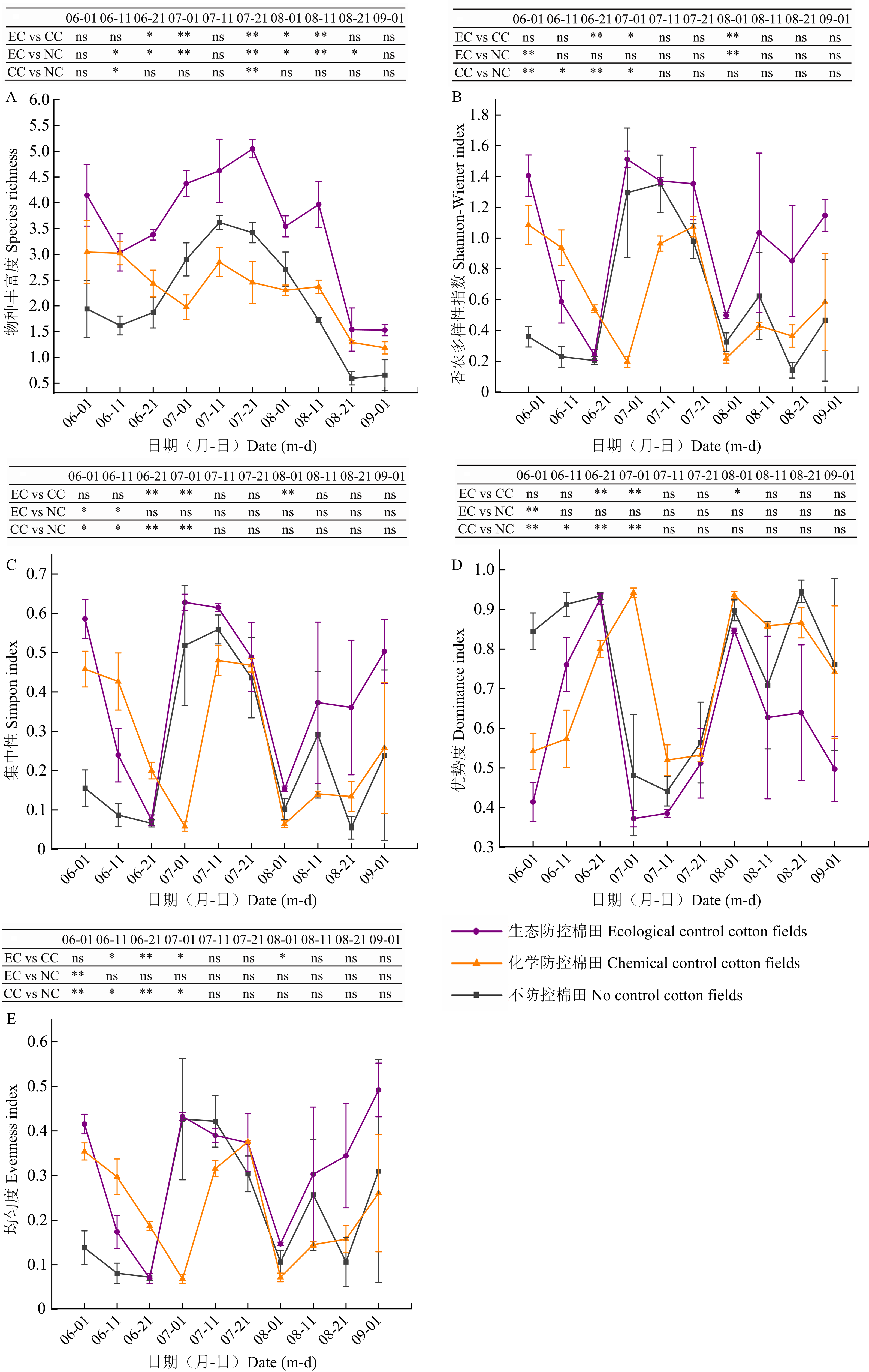
图2
3种害虫管理模式棉田节肢动物群落多样性指数时序变化 EC、CC、NC分别为生态防控棉田、化学防控棉田、不防控棉田;*和**分别为邓肯氏新复极差测验P<0.05和P<0.01差异显著水平,ns为无显著性差异"
| [1] |
doi: 10.1111/pbi.14529 pmid: 39636291 |
| [2] |
马俊良. 新疆植棉区棉花生育期模型比较与密度及水氮优化模拟研究[D]. 乌鲁木齐: 新疆农业大学, 2025.
|
|
|
|
| [3] |
赵世航, 宋萍, 王新星, 马允冲, 王勤英. 生物防治对苹果园节肢动物群落结构的影响. 中国植保导刊, 2025, 45(8): 51-54.
|
|
|
|
| [4] |
门兴元, 戈峰. 基于农田景观的害虫生态防控方法与实践. 植物保护, 2025, 51(5): 257-266, 355.
|
|
|
|
| [5] |
李娜. 不同杀虫剂对新疆棉田蚜虫及天敌种群发生的影响[D]. 乌鲁木齐: 新疆农业大学, 2021.
|
|
|
|
| [6] |
戈峰. 昆虫生态学原理与方法. 北京: 高等教育出版社, 2008: 201-223.
|
|
GE F. Principles and Methods of Insect Ecology. Beijing: Higher Education Press, 2008: 201-223. (in Chinese)
|
|
| [7] |
doi: 10.1127/entomologia/2025/3010 |
| [8] |
doi: 10.1038/s42003-024-06027-6 pmid: 38499741 |
| [9] |
doi: 10.1146/ento.2022.67.issue-1 |
| [10] |
doi: 10.1890/1051-0761(2006)016[1619:petcos]2.0.co;2 pmid: 16937822 |
| [11] |
杨泉峰, 欧阳芳, 门兴元, 戈峰. 功能植物的作用原理、方式及研究展望. 应用昆虫学报, 2020, 57(1): 41-48.
|
|
|
|
| [12] |
doi: 10.1002/ps.v77.1 |
| [13] |
|
| [14] |
pmid: 16968206 |
| [15] |
doi: 10.11594/jtls |
| [16] |
|
| [17] |
葛有茂, 卢刚, 张宏. 施用杀虫剂对泽泻田节肢动物群落的影响研究. 福建农业学报, 2008, 22(4): 20-24.
|
|
|
|
| [18] |
王向阳, 邹运鼎, 孟庆雷, 章炳旺, 代海敏. 两种除草剂对棉田节肢动物群落多样性指数的影响. 应用生态学报, 2005, 16(3): 514-518.
|
|
|
|
| [19] |
吕昭智, 陈键, 吴志勇, 马桂龙. 新疆棉区主要有害生物与可持续发展. 干旱区研究, 1999, 16(3): 28-32.
doi: 10.13866/j.azr.1999.03.006 |
|
|
|
| [20] |
游帅. 两种邻作模式对棉田天敌多样性的影响及其在棉蚜防控减药中的作用评价[D]. 阿拉尔: 塔里木大学, 2024.
|
|
|
|
| [21] |
doi: 10.1002/ps.v77.2 |
| [22] |
武宁宁, 梁沛. 昆虫抗药性机制研究进展. 应用昆虫学报, 2025, 62(5): 1496-1507.
|
|
|
|
| [23] |
雒珺瑜, 张帅, 朱香镇, 姬继超, 张开心, 王春义, 张利娟, 王丽, 李春花, 崔金杰. 蓖麻诱集带对棉田节肢动物群落及生物多样性的影响. 中国棉花, 2018, 45(8): 9-11, 19.
doi: 10.11963/1000-632X.ljycjj.20180817 |
|
|
|
| [24] |
吴怡瑄, 刘至幸, 张家辉, 潘光凤, 东方龙, 李晓维, 黄俊, 吕要斌, 饶琼, 张治军. 西兰花-小麦间作对田间天敌群落及生态防控作用的影响. 应用昆虫学报, 2025, 62(3): 638-645.
|
|
|
|
| [25] |
doi: 10.1111/jen.v147.7 |
| [26] |
doi: 10.1146/ento.2021.66.issue-1 |
| [27] |
doi: 10.1016/S2095-3119(20)63318-4 |
| [28] |
乔浪, 李德昊, 杨佳乐, 李玲, 李艳艳, 张文兵, 韩海斌, 谭瑶. 诱集植物的研究进展及在紫花苜蓿害虫治理中的应用前景. 应用昆虫学报, 2025, 62(2): 271-287.
|
|
|
|
| [29] |
彭佳敏, 帕提玛·乌木尔汗, 郭小虎, 库尔班妮萨古丽·奥布力喀斯木, 杨世平, 李泰峰, 王新翠, 朱丽华, 马德英. 棉田诱集植物对棉蚜及捕食性天敌种群动态的影响. 中国生物防治学报, 2023, 39(5): 1038-1048.
doi: 10.16409/j.cnki.2095-039x.2022.11.030 |
|
|
|
| [30] |
范千千, 杨淑珂, 李凡, 徐晓辉, 郝超峰, 孙红炜. 转基因抗虫耐除草剂玉米LP026-2对田间节肢动物群落多样性的影响. 生物安全学报, 2025, 34(4): 361-368.
|
|
|
|
| [31] |
顾伟, 马玲, 丁新华, 张静, 韩争伟. 扎龙湿地不同生境的昆虫多样性. 应用生态学报, 2011, 22(9): 2405-2412.
|
|
|
|
| [32] |
宋备舟, 王美超, 孔云, 姚允聪, 吴红英, 胡竞辉, 亓丽萍, 毕宁宁. 梨园芳香植物间作区节肢动物群落的结构特征. 中国农业科学, 2010, 43(4): 769-779. doi: 10.3864/j.issn.0578-1752.2010.04.014.
|
|
|
|
| [33] |
薛正轩. 田边甘草对棉田多异瓢虫保育功能的探究[D]. 石河子: 石河子大学, 2022.
|
|
|
|
| [34] |
米莹莹, 杨亚洁, 王甦, 金振宇, 李姝. 基于捕食性天敌及害虫种群动态筛选功能植物的研究. 环境昆虫学报, 2024, 46(2): 489-497.
|
|
|
|
| [35] |
李海强, 张建萍, 陆宴辉. 果棉间作对棉田节肢动物群落结构的影响. 植物保护, 2021, 47(2): 233-238.
|
|
|
|
| [36] |
李琼, 李强, 张晓明. 大豆/玉米间作密度对大豆田节肢动物群落多样性和稳定性的影响. 南方农业学报, 2019, 50(6): 1247-1255.
|
|
|
|
| [37] |
田耀加, 梁广文, 曾玲, 陆永跃. 间作对甜玉米田主要害虫与天敌动态的影响. 植物保护学报, 2012, 39(1): 1-6.
|
|
|
|
| [38] |
doi: 10.1016/j.baae.2021.02.011 |
| [39] |
缪勇, 高希武, 江俊起, 王云. 甘蓝与大蒜间作对甘蓝田主要害虫及节肢动物群落的影响. 华南农业大学学报, 2013, 34(3): 352-355.
|
|
|
|
| [40] |
潘云飞. 南疆农田景观组成与农药使用对棉田天敌发生及其控蚜功能的影响[D]. 北京: 中国农业科学院, 2020.
|
|
|
|
| [41] |
苏丽, 戈峰, 刘向辉. 化学防治对不同类型棉田害虫和捕食性天敌群落多样性的影响. 昆虫学报, 2002, 45(6): 777-784.
|
|
|
|
| [42] |
周浩辉, 张大为, 刘沛林, 王森山, 陆宴辉. 张掖地区不同施药强度苹果园节肢动物群落结构及种群动态. 植物保护, 2025, 51(2): 237-244.
|
|
|
|
| [43] |
高晓阳. 生境对棉田节肢动物群落结构与功能的影响[D]. 合肥: 安徽农业大学, 2016.
|
|
|
|
| [44] |
陆宴辉, 赵紫华, 蔡晓明, 崔丽, 张浩男, 肖海军, 李振宇, 张礼生, 曾娟. 我国农业害虫综合防治研究进展. 应用昆虫学报, 2017, 54(3): 349-363.
|
|
|
|
| [45] |
pmid: 10761575 |
| [46] |
doi: 10.1016/j.biocontrol.2013.06.013 |
| [47] |
彭雪凡, 周晓通, 维尼热·买合木提, 上官一磊, 戈峰, 张建萍, 蔡志平. 不同功能植物对棉花蚜虫及其捕食性天敌的影响. 植物保护学报, 2024, 51(1): 39-49.
|
|
|
|
| [48] |
潘洪生, 姜玉英, 王佩玲, 刘建, 陆宴辉. 新疆棉花害虫发生演替与综合防治研究进展. 植物保护, 2018, 44(5): 42-50.
|
|
|
|
| [49] |
doi: 10.1016/j.ecoleng.2016.10.080 |
| [50] |
|
| [51] |
doi: 10.1127/entomologia/2022/1545 |
| [52] |
雒珺瑜, 张帅, 王春义, 吕丽敏, 李春花, 崔金杰. 不同诱集作物对棉田刺吸性害虫及其天敌的生态作用比较. 中国棉花, 2014, 41(8): 14-16.
doi: 10.11963/issn.1000-632X.20140805 |
|
|
|
| [53] |
胡竞辉, 王美超, 孔云, 姚允聪, 魏巍, 宋备舟, 李振茹. 梨园芳香植物间作区节肢动物群落多样性时序特征. 中国农业科学, 2010, 43(5): 1007-1016. doi: 10.3864/j.issn.0578-1752.2010.05.016.
|
|
|
|
| [54] |
陈明. 间作豆科牧草对棉田节肢动物群落结构和动态的影响[D]. 兰州: 兰州大学, 2008.
|
|
|
|
| [55] |
尤民生, 刘雨芳, 侯有明. 农田生物多样性与害虫综合治理. 生态学报, 2004, 24(1): 117-122.
|
|
|
|
| [56] |
霍丽慧. 具有年龄结构的捕食者猎物模型的研究[D]. 杨凌: 西北农林科技大学, 2010.
|
|
|
|
| [57] |
王巧. 南疆农田景观中核桃黑斑蚜天敌发生动态及其生物控害功能[D]. 北京: 中国农业科学院, 2024.
|
|
|
|
| [58] |
|
| [1] | 谢海鹏, 林俊旭, 刘勇, 麦贤俊, 罗丰, 王学武, 谢文, 李少卡, 孔祥义, 吴小燕. 施用不同有机肥对贝莱斯芽孢杆菌SD13防控豇豆枯萎病的影响[J]. 中国农业科学, 2025, 58(21): 4405-4420. |
| [2] | 陈会鲜, 何文, 阮丽霞, 黄小娟, 兰秀, 蔡兆琴, 李恒锐, 黄珍玲, 韦婉羚, 梁振华, 李天元, 曹升, 李喜弟, 韦均参. 间作大豆对木薯生长及连作土壤特性的影响[J]. 中国农业科学, 2025, 58(11): 2176-2189. |
| [3] | 夏芊蔚,陈浩,姚宇阗,笪达,陈健,石志琦. “优标”水稻体系对稻田土壤环境的影响[J]. 中国农业科学, 2022, 55(17): 3343-3354. |
| [4] | 王开丽,杨合龙,肖红,孙伟,戎郁萍. 施氮与刈割留茬高度对草场生产力及植物群落组成的影响[J]. 中国农业科学, 2020, 53(13): 2625-2636. |
| [5] | 刘海洋, 王伟, 张仁福, 热西达·阿不都热合曼, 姚举. 黄萎病不同发生程度棉田土壤中的真菌群落特征分析[J]. 中国农业科学, 2019, 52(3): 455-465. |
| [6] | 李冠楠,苗昌见,李为争,王高平,刘晓岚,郭线茹,闫凤鸣. 吡虫啉悬浮种衣剂对玉米田节肢动物群落及主要非靶标害虫的影响[J]. 中国农业科学, 2017, 50(24): 4735-4746. |
| [7] | 任振涛,沈文静,刘标,薛堃. 转基因玉米对田间节肢动物群落多样性的影响[J]. 中国农业科学, 2017, 50(12): 2315-2325. |
| [8] | 付晓伟,吴孔明. 迁飞性昆虫对全球气候变化的响应[J]. 中国农业科学, 2015, 48(S): 1-15. |
| [9] | 张前兵,杨玲,张旺锋,罗宏海,张亚黎,王进. 农艺措施对干旱区棉田土壤有机碳及微生物量碳含量的影响[J]. 中国农业科学, 2014, 47(22): 4463-4474. |
| [10] | 姚宝林,李光永,李发永. 南疆滴灌棉田休闲期土壤入渗特性研究[J]. 中国农业科学, 2014, 47(22): 4453-4462. |
| [11] | 顾美英,刘洪亮,李志强,刘晓伟,唐光木,徐万里. 新疆连作棉田施用生物炭对土壤养分及微生物群落多样性的影响[J]. 中国农业科学, 2014, 47(20): 4128-4138. |
| [12] | 陈万权1, 康振生2, 马占鸿3, 徐世昌1, 金社林4, 姜玉英5. 中国小麦条锈病综合治理理论与实践[J]. 中国农业科学, 2013, 46(20): 4254-4262. |
| [13] | 张林森1, 刘富庭1, 张永旺1, 李雪薇1, 李丙智1, 胥生荣1, 谷洁2, 韩明玉1. 不同覆盖方式对黄土高原地区苹果园土壤 有机碳组分及微生物的影响[J]. 中国农业科学, 2013, 46(15): 3180-3190. |
| [14] | 靳振江, 邰继承, 潘根兴, 李恋卿, 宋祥云, 谢添, 刘晓雨, 王丹. 荆江地区湿地与稻田有机碳、微生物多样性及土壤酶活性的比较[J]. 中国农业科学, 2012, 45(18): 3773-3781. |
| [15] | 冯敏, 王春晓, 刘延琳. 利用微卫星多态性揭示酿酒酵母菌株遗传多样性[J]. 中国农业科学, 2012, 45(12): 2537-2543. |
|
||
