






中国农业科学 ›› 2025, Vol. 58 ›› Issue (24): 5234-5246.doi: 10.3864/j.issn.0578-1752.2025.24.010
房康睿1( ), 丁世杰2, 陈雨珊1, 杨秉庚1, 郭腾飞2, 徐新朋1, 赵士诚1, 王秀斌1, 黄绍敏2,*(), 仇少君1,*(), 何萍1, 周卫1
收稿日期:2025-01-22
接受日期:2025-03-17
出版日期:2025-12-22
发布日期:2025-12-22
通信作者:
联系方式:
房康睿,E-mail:2583009347@qq.com。
基金资助:
FANG KangRui1(), DING ShiJie2, CHEN YuShan1, YANG BingGeng1, GUO TengFei2, XU XinPeng1, ZHAO ShiCheng1, WANG XiuBin1, HUANG ShaoMin2,*(), QIU ShaoJun1,*(), HE Ping1, ZHOU Wei1
Received:2025-01-22
Accepted:2025-03-17
Published:2025-12-22
Online:2025-12-22
摘要:
【目的】有机无机肥配施能够提高作物产量和培肥土壤,但有机无机肥配施中有机养分释放率及其影响因素尚不明确。因此,明确有机养分释放率能够为提高养分利用效率、科学管理有机养分提供依据。【方法】研究依托 2013 年在潮土上建立的有机无机肥配施长期定位试验,采用随机区组设计,选取其中 5 个处理,分别为化肥不减量(F-0%,N-P2O5-K2O= 210-120-60)、化肥不减量配施有机肥(MF-0%)以及化肥减量20%、30%、40%并配施有机肥(MF-20%、MF-30%、MF-40%)。在小麦成熟期,对各处理的产量、土壤养分和微生物特性等指标进行测定,并分析有机肥氮、磷释放率及其影响因素。【结果】在有机无机肥配施的4个处理中,MF-30%处理的2023、2024年及两年平均产量分别为8.6、8.6、8.6 t·hm-2,较F-0%(化肥不减量)处理分别增加0.3、0.1、0.1 t·hm-2。同时,MF-30%处理显著(P<0.05)提高了土壤有机碳、易氧化有机碳、矿质氮、有效磷、微生物量碳、微生物量磷的含量。有机肥氮、磷释放率随化肥施用量的增加而降低,有机肥氮素释放范围为11.1%—60.7%,平均为37.7%,有机肥磷素释放范围为8.3%—54.4%,平均为30.4%。偏最小二乘模型分析结果表明,外源肥料投入(C、N)、土壤养分(易氧化有机碳和矿质态氮)对有机肥氮释放率有直接且极显著(P<0.01)的正效应,效应值分别为3.054、1.230;外源肥料投入计量比(C/N、C/P)对有机肥氮养分释放率有直接且极显著(P<0.01)的负效应,效应值为-1.377;外源肥料投入(N、P)和外源肥料投入计量比(N/P、C/P)对有机肥磷释放率有直接且显著(P<0.05)的负效应,效应值分别为-1.758、-0.640。【结论】潮土中有机肥氮、磷平均释放率分别为37.7%、30.4%,氮、磷释放率随化肥投入量增加而降低,外源肥料投入及其计量比对有机肥氮、磷释放率有直接且显著的影响。
房康睿, 丁世杰, 陈雨珊, 杨秉庚, 郭腾飞, 徐新朋, 赵士诚, 王秀斌, 黄绍敏, 仇少君, 何萍, 周卫. 有机无机肥配施下典型潮土小麦季有机肥氮磷的当季释放率[J]. 中国农业科学, 2025, 58(24): 5234-5246.
FANG KangRui, DING ShiJie, CHEN YuShan, YANG BingGeng, GUO TengFei, XU XinPeng, ZHAO ShiCheng, WANG XiuBin, HUANG ShaoMin, QIU ShaoJun, HE Ping, ZHOU Wei. In-Season Release Rate of Nitrogen and Phosphorus in Manure Fertilizers During the Wheat Season in Typical Fluvo-Aquic Soil Under the Combined Application of Chemical and Manure Fertilizers[J]. Scientia Agricultura Sinica, 2025, 58(24): 5234-5246.
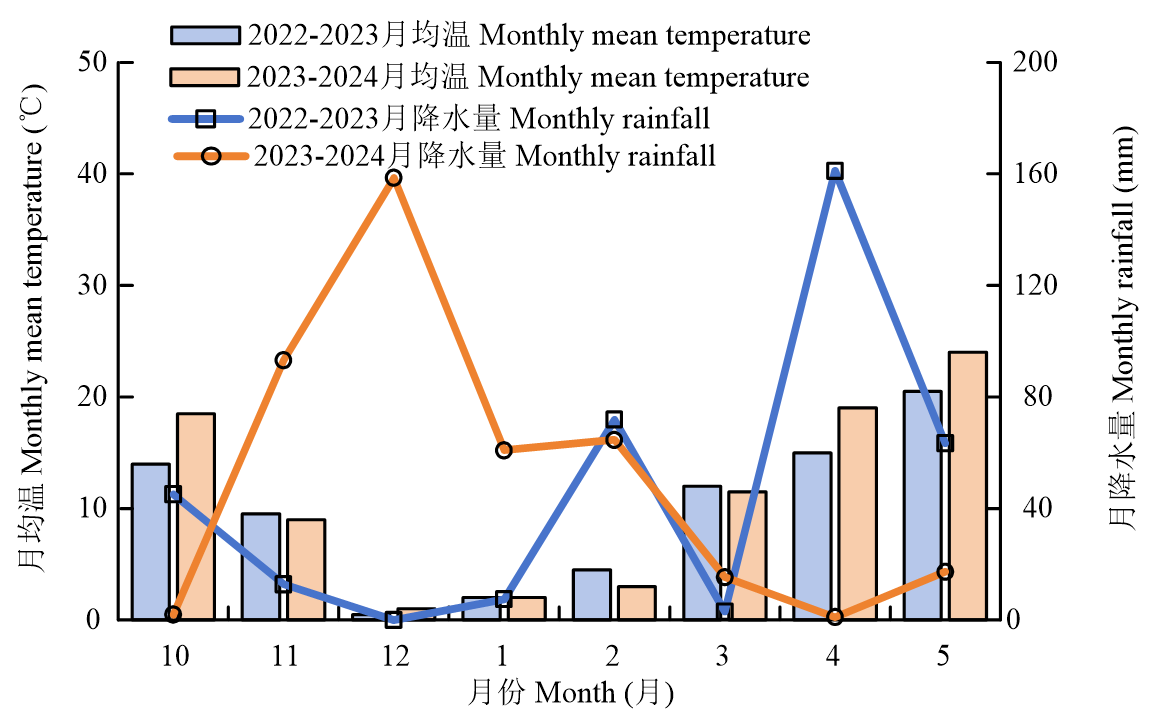
图1
2022—2023、2023—2024年小麦生育期月降水量和月平均温度"

表1
不同施肥处理养分投入量"
| 处理 Treatment | 化肥投入 Fertilizer input (kg·hm-2) | 有机肥投入 Manure input (kg·hm-2) | |||||
|---|---|---|---|---|---|---|---|
| N | P2O5 | K2O | N | P2O5 | K2O | ||
| 化肥不减量F-0% | 210 | 120 | 60 | 0 | 0 | 0 | |
| 化肥不减量配施有机肥MF-0% | 210 | 120 | 60 | 112.5 | 91 | 102 | |
| 化肥减量20%配施有机肥MF-20% | 168 | 96 | 48 | 112.5 | 91 | 102 | |
| 化肥减量30%配施有机肥MF-30% | 147 | 84 | 42 | 112.5 | 91 | 102 | |
| 化肥减量40%配施有机肥MF-40% | 126 | 72 | 36 | 112.5 | 91 | 102 | |
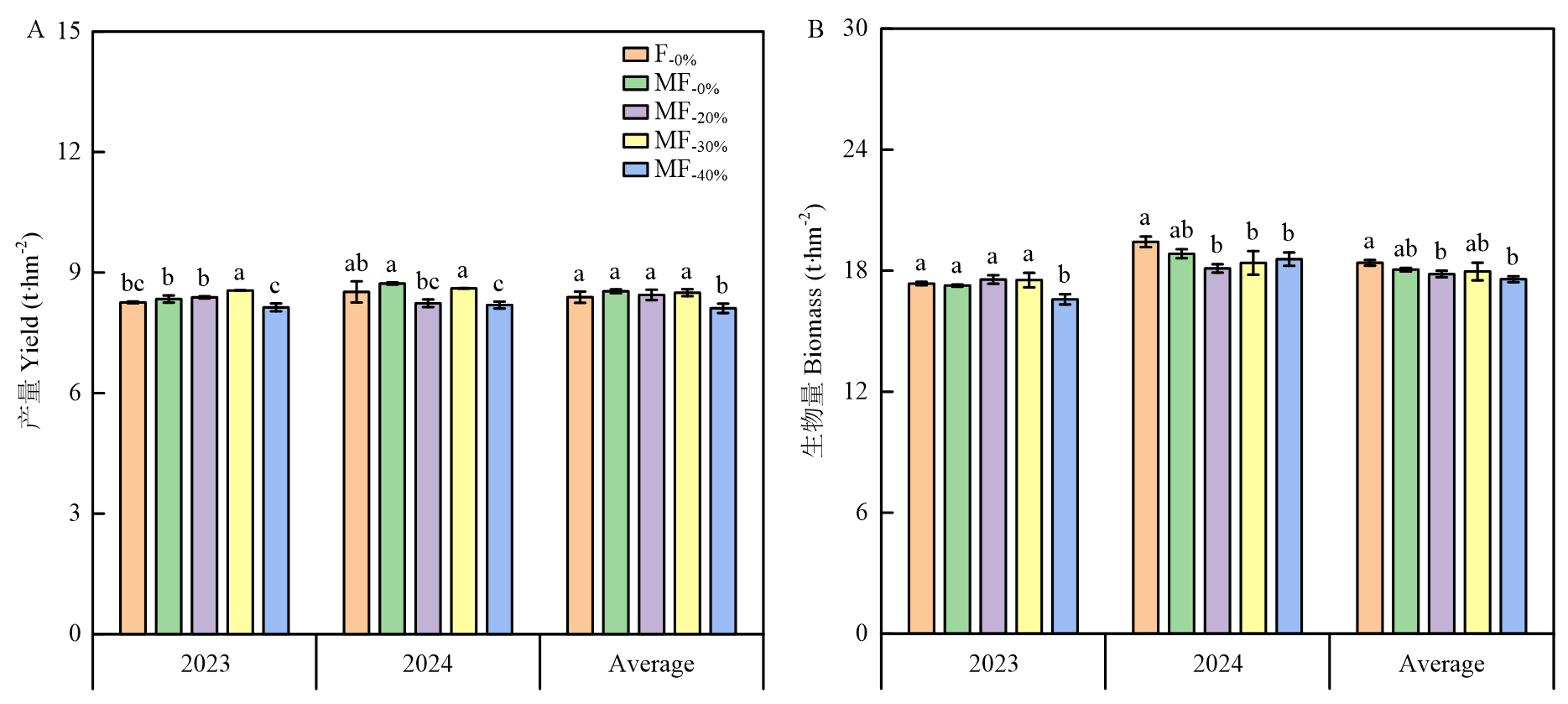
图2
2023和2024年各处理小麦产量和地上部生物量 不同小写字母表示同一年份中不同处理间达0.05显著水平(P<0.05)。下同"
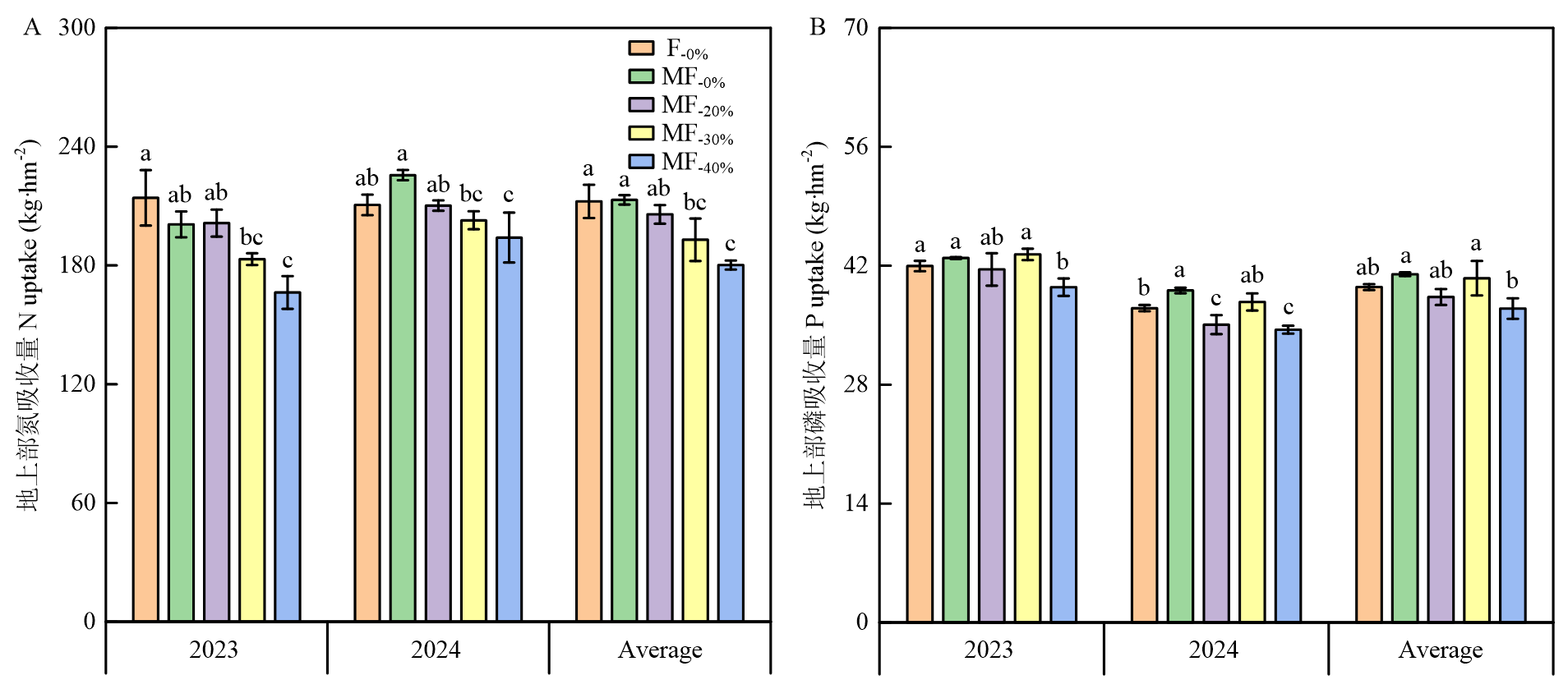
图3
2023和2024年各处理小麦地上部养分吸收"
表2
化肥处理产量、地上部生物量、籽粒氮磷吸收量及地上部氮磷吸收量"
| 年份 Year | 处理 Treatment | 产量 Yield (t ·hm-2) | 地上部生物量 Biomass (t·hm-2) | 籽粒氮吸收 Grain N uptake (kg·hm-2) | 籽粒磷吸收 Grain P uptake (kg·hm-2) | 地上部氮吸收 Aboveground N uptake (kg·hm-2) | 地上部磷吸收 Aboveground N uptake (kg·hm-2) |
|---|---|---|---|---|---|---|---|
| 2023 | F-20% | 8.0 | 16.1 | 144.2 | 30.9 | 167.9 | 34.8 |
| F-30% | 7.4 | 14.5 | 126.2 | 29.9 | 144.9 | 33.5 | |
| F-40% | 7.3 | 14.3 | 129.6 | 23.6 | 148.5 | 32.2 | |
| 2024 | F-20% | 7.9 | 18.7 | 143.1 | 29.6 | 181.2 | 33.1 |
| F-30% | 7.3 | 15.7 | 135.1 | 26.7 | 168.3 | 29.1 | |
| F-40% | 7.3 | 16.5 | 135.1 | 25.1 | 170.2 | 27.9 | |
| 平均 Mean | F-20% | 8.0 | 17.4 | 143.7 | 30.3 | 174.6 | 34.0 |
| F-30% | 7.4 | 15.1 | 130.6 | 28.3 | 156.6 | 31.3 | |
| F-40% | 7.3 | 15.4 | 132.3 | 26.9 | 159.4 | 30.1 |

图4
有机肥氮、磷释放率(A)及有机肥养分释放率与化肥氮磷施用量的关系(B)"
表3
小麦成熟期土壤碳氮磷钾含量、微生物量及酶学特征"
| 处理 Treatment | 土壤全量和有效养分 Total and available nutrients | 土壤生物特性Soil microbial characteristics | ||||||||||||||
|---|---|---|---|---|---|---|---|---|---|---|---|---|---|---|---|---|
| 有机碳 SOC (g·kg-1) | 全氮 TN (g·kg-1) | 全磷 TP (g·kg-1) | 全钾 TK (g·kg-1) | 易氧化有机碳 EOC (g·kg-1) | 矿质氮 Nmin (mg·kg-1) | 有效磷Olsen P (mg·kg-1) | 速效钾 Available K (mg·kg-1) | 微生物量碳 MBC (mg·kg-1) | 微生物量氮 MBN (mg·kg-1) | 微生物量磷 MBP (mg·kg-1) | β-葡萄糖苷酶 BG (µmol·g-1·h-1) | 氨基肽酶 LAP (µmol·g-1·h-1) | 几丁质酶 NAG (µmol·g-1·h-1) | 酸性磷酸酶 AP (µmol·g-1·h-1) | ||
| F-0% | 10.8b | 1.3b | 0.38a | 13.4a | 6.5c | 12.4d | 29.3b | 344.5a | 313.1c | 27.4a | 21.0c | 167.2b | 455.5c | 14.1b | 376.3b | |
| MF-0% | 11.8ab | 1.3b | 0.34a | 10.3a | 8.5a | 16.9a | 43.2a | 348.5a | 343.5bc | 21.9ab | 63.4b | 209.9a | 703.5a | 22.8a | 433.4a | |
| MF-20% | 12.7a | 1.5a | 0.4a | 14.5a | 8.0b | 17.0a | 44.4a | 330.5a | 361.0bc | 21.5ab | 75.5a | 125.8d | 598.8b | 17.4ab | 400.1ab | |
| MF-30% | 11.9a | 1.4b | 0.4a | 13.4a | 7.9b | 15.7b | 44.9a | 339.3a | 429.0a | 16.1b | 73.1ab | 161.4bc | 618.0b | 17.0ab | 410.7ab | |
| MF-40% | 11.7ab | 1.3b | 0.3b | 12.3a | 7.8b | 14.8c | 33.9b | 315.8a | 406.4ab | 14.7b | 70.2ab | 132.7cd | 616.0b | 14.0b | 362.5b | |
表4
小麦成熟期土壤养分和生物学特性化学计量比"
| 处理 Treatment | 养分计量比 Soil nutrients stoichiometric ratio | 生物计量比Microbial stoichiometric ratio | |||||||||||
|---|---|---|---|---|---|---|---|---|---|---|---|---|---|
| SOC:TN | SOC:TP | TN:TP | EOC:Nmin | EOC:OP | Nmin:OP | MBC:MBN | MBC:MBP | MBN:MBP | EC:N | EC:P | EN:P | ||
| F-0% | 8.3b | 29.0b | 3.5b | 521.5a | 230.4a | 0.44a | 11.6c | 14.9a | 1.30a | 0.84a | 0.86ab | 1.03b | |
| MF-0% | 9.1a | 34.7b | 3.8b | 505.6ab | 197.3a | 0.39a | 16.5b | 5.4b | 0.35b | 0.81b | 0.88a | 1.08a | |
| MF-20% | 8.4b | 34.1b | 4.1b | 469.0b | 179.9a | 0.38a | 16.9b | 4.8b | 0.29b | 0.75d | 0.81d | 1.07a | |
| MF-30% | 8.6ab | 34.0b | 3.9b | 504.0ab | 176.6a | 0.35a | 26.7a | 5.9b | 0.22b | 0.79c | 0.84bc | 1.07a | |
| MF-40% | 8.9ab | 42.6a | 4.8a | 531.1a | 238.7a | 0.45a | 28.0a | 5.8b | 0.21b | 0.75d | 0.83cd | 1.09a | |
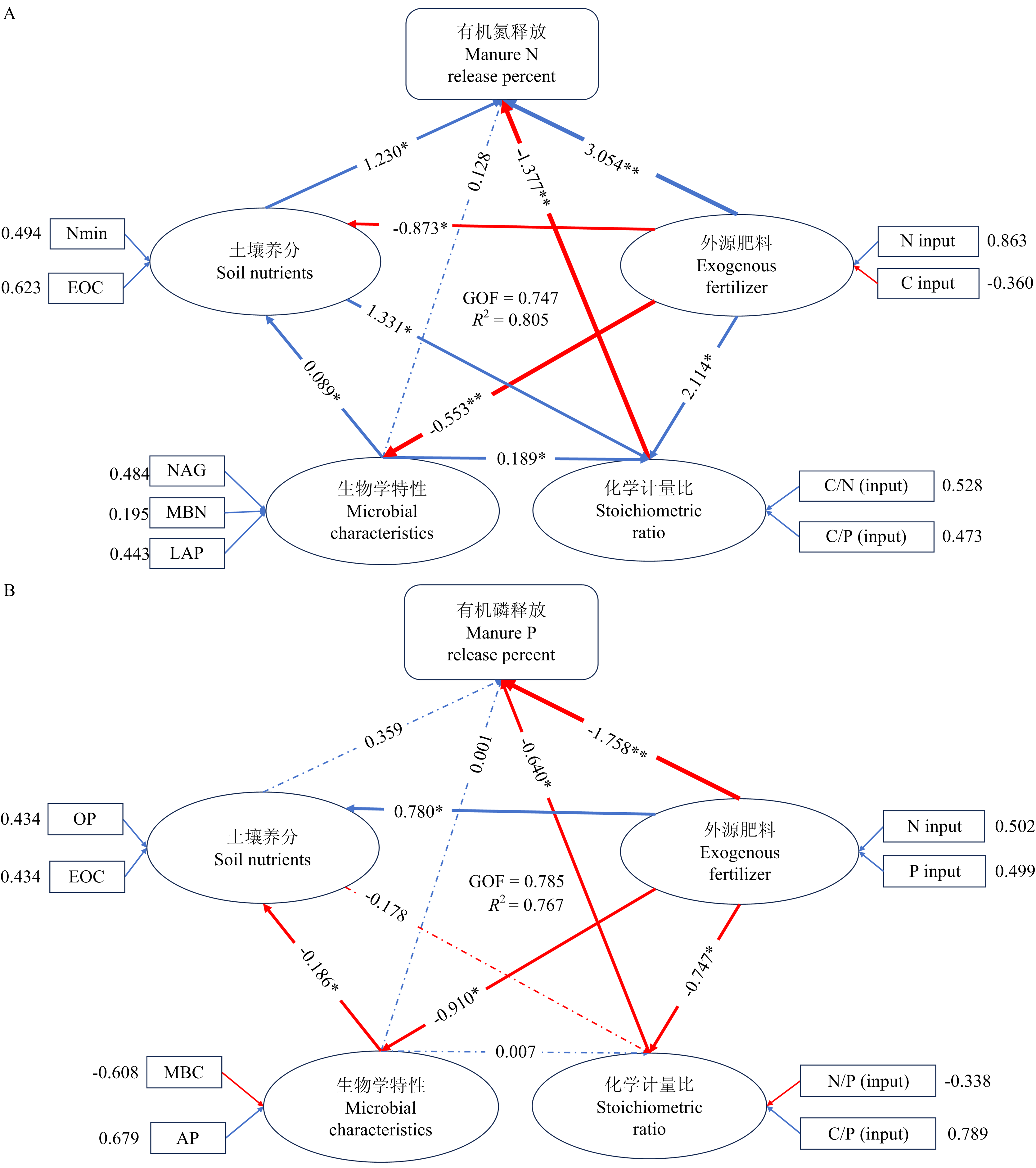
图5
有机肥氮磷养分释放率与外源肥料投入、土壤养分、生物学特性和化学计量比之间的偏最小二乘路径模型分析 C input指外源碳投入(包括有机肥碳和秸秆碳),N input指肥料氮投入(包括有机肥氮和化肥氮),P input指肥料磷(P2O5)投入(包括有机肥磷和化肥磷);C/N (input)指外源投入的碳氮比,C/P (input) 指外源投入的碳磷比,N/P (input)指外源投入的氮磷比;NRR、PRR分别代表有机肥氮、磷素释放率。红色箭头表示负相关,蓝色箭头表示正相关;虚线表示非显著系数路径;箭头处的数字为路径系数;R2表示解释方差;GOF为拟合优度统计量;*和**分别表示在0.05和0.01水平上显著相关"
| [1] |
蔡美芳, 刘晓伟, 吴孝情, 吴仁人, 陈中颖, 卢文洲. 基于土壤养分平衡的畜禽养殖承载力研究. 土壤学报, 2018, 55(6): 1431-1440.
|
|
|
|
| [2] |
鲁伟丹, 李俊华, 罗彤, 陈丽丽, 张磊, 刘硕康. 连续三年不同有机肥替代率对小麦产量及土壤养分的影响. 植物营养与肥料学报, 2021, 27(8): 1330-1338.
|
|
|
|
| [3] |
龚雪蛟, 秦琳, 刘飞, 刘东娜, 马伟伟, 张厅, 刘晓, 罗凡. 有机类肥料对土壤养分含量的影响. 应用生态学报, 2020, 31(4): 1403-1416.
doi: 10.13287/j.1001-9332.202004.025 |
|
doi: 10.13287/j.1001-9332.202004.025 |
|
| [4] |
doi: 10.1016/j.catena.2020.104617 |
| [5] |
申长卫, 袁敬平, 李新华, 张帅垒, 任秀娟, 王菲, 刘星, 张影, 欧行奇, 陈锡岭. 有机肥氮替代20%化肥氮提高豫北冬小麦氮肥利用率和土壤肥力. 植物营养与肥料学报, 2020, 26(8): 1395-1406.
|
|
|
|
| [6] |
doi: 10.1038/s41598-021-87851-2 pmid: 33883629 |
| [7] |
doi: 10.1016/j.scitotenv.2023.168627 |
| [8] |
doi: 10.1038/srep21488 pmid: 26898121 |
| [9] |
doi: 10.1016/j.geoderma.2020.114752 |
| [10] |
doi: 10.1016/j.catena.2024.108135 |
| [11] |
doi: 10.1016/j.apsoil.2021.104115 |
| [12] |
doi: 10.1016/j.soilbio.2007.02.003 |
| [13] |
|
| [14] |
doi: 10.1016/j.jenvman.2021.114155 |
| [15] |
doi: 10.3832/ifor1196-008 |
| [16] |
doi: 10.1038/nature08632 |
| [17] |
杜映妮, 李天阳, 何丙辉, 贺小容, 付适. 长期施肥和耕作下紫色土坡耕地土壤C、N、P和K化学计量特征. 环境科学, 2020, 41(1): 394-402.
|
|
|
|
| [18] |
许淼平, 任成杰, 张伟, 陈正兴, 付淑月, 刘伟超, 杨改河, 韩新辉. 土壤微生物生物量碳氮磷与土壤酶化学计量对气候变化的响应机制. 应用生态学报, 2018, 29(7): 2445-2454.
doi: 10.13287/j.1001-9332.201807.041 |
|
|
|
| [19] |
doi: 10.1038/s41467-024-52160-5 pmid: 39271672 |
| [20] |
赵明, 赵征宇, 蔡葵, 王玉洲. 畜禽有机肥料当季速效氮磷钾养分释放规律. 山东农业科学, 2004, 36(5): 59-61.
|
|
|
|
| [21] |
徐久凯, 袁亮, 温延臣, 张水勤, 李燕婷, 李海燕, 赵秉强. 畜禽有机肥氮在冬小麦季对化肥氮的相对替代当量. 中国农业科学, 2023, 56(2): 300-313. doi: 10.3864/j.issn.0578-1752.2023.02.008.
|
|
|
|
| [22] |
徐久凯, 袁亮, 温延臣, 张水勤, 林治安, 李燕婷, 李海燕, 赵秉强. 畜禽有机肥磷素在冬小麦上替代化肥磷当量研究. 中国农业科学, 2021, 54(22): 4826-4839. doi: 10.3864/j.issn.0578-1752.2021.22.010.
|
|
|
|
| [23] |
鲍士旦. 土壤农化分析. 3版. 北京: 中国农业出版社, 2000.
|
|
|
|
| [24] |
doi: 10.1146/ecolsys.2012.43.issue-1 |
| [25] |
姜桂英. 中国农田长期不同施肥的固碳潜力及预测[D]. 北京: 中国农业科学院, 2013.
|
|
|
|
| [26] |
doi: 10.1016/j.geoderma.2019.06.037 |
| [27] |
李红星, 高飞, 任佰朝, 赵斌, 刘鹏, 张吉旺. 夏玉米秸秆还田量和施氮量对冬小麦产量和氮素利用的影响. 植物营养与肥料学报, 2022, 28(7): 1260-1270.
|
|
|
|
| [28] |
李炎龙, 季荣博, 吴云, 秦泽峰, 彭懿, 盖京苹, 冯固. 我国北方3种典型土壤-作物体系中微生物量磷库特征. 生态学报, 2022, 42(8): 3325-3332.
|
|
|
|
| [29] |
doi: 10.1016/S0038-0717(01)00158-4 |
| [30] |
夏梦洁, 陈竹君, 刘占军, 周建斌. 黄土高原旱地夏季休闲期15N标记硝态氮的去向. 土壤学报, 2017, 54(5): 1230-1239.
|
|
|
|
| [31] |
张璐, 张文菊, 徐明岗, 蔡泽江, 彭畅, 王伯仁, 刘骅. 长期施肥对中国3种典型农田土壤活性有机碳库变化的影响. 中国农业科学, 2009, 42(5): 1646-1655. doi: 10.3864/j.issn.0578-1752.2009.05.018.
|
|
|
|
| [32] |
朱兆良, 文启孝. 中国土壤氮素. 南京: 江苏科学技术出版社, 1992.
|
|
|
|
| [33] |
|
| [34] |
doi: 10.1016/j.crope.2022.08.001 |
| [35] |
doi: 10.1016/j.jenvman.2024.123675 |
| [36] |
沈其荣, 沈振国, 史瑞和. 有机肥氮素的矿化特征及与其化学组成的关系. 南京农业大学学报, 1992, 15(1): 59-64.
|
|
|
|
| [37] |
doi: 10.1016/j.scitotenv.2023.164899 |
| [1] | 朱琦, 贾振鹏, Tahir SHAH, 徐晨晟, 李芷琦, 吕会帅, 朱鹏超, 韦小敏, 黄冬琳, 孙艳妮, 曹卫东, 高亚军, 王朝辉, 张达斌. 绿肥配施增效产品降低旱地麦田温室气体排放及碳足迹[J]. 中国农业科学, 2026, 59(7): 1507-1522. |
| [2] | 魏圆慧, 余益辉, 李子钧, 丁文杰, 涂文龙, 毛艳玲. 长期施肥对黄泥田土壤有机碳化学结构与固碳细菌群落结构的影响[J]. 中国农业科学, 2026, 59(5): 1020-1033. |
| [3] | 严艳鸽, 张水勤, 许猛, 徐久凯, 李燕婷, 赵秉强, 袁亮. 葡聚糖改性尿素在潮土中的转化特征[J]. 中国农业科学, 2026, 59(5): 1048-1059. |
| [4] | 钱瑾, 李映雪, 吴芳, 邹晓晨. 集成光谱降维的冬小麦叶片磷含量估算[J]. 中国农业科学, 2026, 59(4): 781-792. |
| [5] | 孔媛, 崔沙沙, 李美, 李健, 杨思雨, 房锋, 刘帅帅, 刘明平, 曾艳, 高兴祥, 柏连阳. 黄淮海冬小麦田多花黑麦草等5种禾本科杂草时空分布变化规律[J]. 中国农业科学, 2026, 59(4): 807-823. |
| [6] | 咸青林, 肖鉴珂, 高阿庆, 郜利闯, 刘杨. 种植方式结合测墒补灌下冬小麦产量及水分利用效率[J]. 中国农业科学, 2026, 59(3): 589-601. |
| [7] | 延廷霖, 杜娅丹, 胡笑涛, 王贺, 李晓雁, 王玉明, 牛文全, 谷晓博. 加气滴灌下氮肥有机替代对亏缺灌溉棉花产量和水分利用效率的影响[J]. 中国农业科学, 2026, 59(3): 602-618. |
| [8] | 王仁卓, 李玥颖, 黄绍敏, 姜桂英, 张琦, 刘超麟, 杨锦, 王梦茹, 王贝贝, 刘芳, 郭斗斗, 介晓磊, 宋练, 刘世亮. 长期有机无机肥配施对潮土细菌群落结构、生态网络及关键物种的影响[J]. 中国农业科学, 2026, 59(2): 354-367. |
| [9] | 吕旭东, 孙世媛, 李亚楠, 刘玉龙, 王艳群, 付鑫, 张佳英, 宁鹏, 彭正萍. 智能机械化分层施肥对麦田根-土养分分布和小麦产量的影响[J]. 中国农业科学, 2026, 59(1): 129-146. |
| [10] | 蒲丽霞, 张佳芮, 叶建萍, 黄秀兰, 樊高琼, 杨洪坤. 二氢赤霉素与秸秆覆盖对旱地小麦分蘖成穗与产量的影响[J]. 中国农业科学, 2025, 58(9): 1735-1748. |
| [11] | 韦文华, 李盼, 邵冠贵, 樊志龙, 胡发龙, 范虹, 何蔚, 柴强, 殷文, 赵连豪. 西北灌区青贮玉米产量及品质对减量灌水与有机无机肥配施的响应[J]. 中国农业科学, 2025, 58(8): 1521-1534. |
| [12] | 陈桂平, 李盼, 邵冠贵, 吴霞玉, 殷文, 赵连豪, 樊志龙, 胡发龙. 减量灌水与有机无机肥配施对青贮玉米吐丝期后叶片持绿特性的调控作用[J]. 中国农业科学, 2025, 58(7): 1381-1396. |
| [13] | 史帆, 李文广, 易树生, 杨娜, 陈玉萌, 郑伟, 张雪辰, 李紫燕, 翟丙年. 有机无机肥配施下旱地麦田土壤有机碳组分含量的变化特征[J]. 中国农业科学, 2025, 58(4): 719-732. |
| [14] | 佘映军, 周子哲, 伍明, 郭魏, 师昌健, 胡超, 李平. 地下水埋深和施氮对土壤水盐分布及冬小麦养分吸收利用的影响[J]. 中国农业科学, 2025, 58(20): 4285-4304. |
| [15] | 郭斗斗, 张珂珂, 黄绍敏, 宋晓, 张水清, 岳克, 丁世杰, 郭腾飞. 长期不同施肥对潮土磷吸附解吸特性的影响[J]. 中国农业科学, 2025, 58(14): 2805-2820. |
|
||
