






中国农业科学 ›› 2019, Vol. 52 ›› Issue (21): 3794-3805.doi: 10.3864/j.issn.0578-1752.2019.21.008
梁颖博,李泽,邱德文,曾洪梅,李广悦,杨秀芬( )
)
收稿日期:2019-05-22
接受日期:2019-06-28
出版日期:2019-11-01
发布日期:2019-11-12
联系方式:
梁颖博,E-mail: Lyingbo16@163.com。
基金资助:
LIANG YingBo,LI Ze,QIU DeWen,ZENG HongMei,LI GuangYue,YANG XiuFen()
Received:2019-05-22
Accepted:2019-06-28
Published:2019-11-01
Online:2019-11-12
摘要:
目的 通过RNA-Seq筛选本生烟(Nicotiana benthamiana)响应大丽轮枝菌(Verticillium dahliae)蛋白激发子PevD1的差异表达基因(differentially expressed gene,DEG),分析PevD1诱导植物产生抗病性的潜在分子机制。方法 用10 μmol·L -1的PevD1蛋白液渗入4周龄的本生烟叶片,分别在处理后6、12和24 h取样提取RNA,构建mRNA文库后采用BGISEQ-500平台进行测序。筛选各时间点的差异表达基因进行GO和KEGG分析;重点分析与诱导抗病相关的富含亮氨酸重复序列类受体蛋白激酶(leucine-rich repeats RLKs,LRR-RLKs)、转录因子(transcription factor,TF)以及病程相关蛋白(pathogenesis related protein,PR蛋白)家族差异表达基因;采用qRT-PCR对差异表达基因进行定量验证。 结果 GO功能富集以及KEGG通路富集分析表明,PevD1诱导6 h后的差异表达基因主要与细胞识别、光合作用、光收割等功能相关,显著富集在光合作用-天线蛋白通路、萜类化合物合成通路、黄酮和黄酮醇等次生代谢产物合成相关通路中;12 h和24 h的差异表达基因主要与细胞识别和胞内激酶等生物学功能相关,显著富集在植物-病原互作通路、倍半萜和三萜生物合成通路、黄酮和黄酮醇生物合成通路、亚麻酸代谢等次生代谢产物合成相关通路中。与光合作用相关的差异表达基因主要呈下调趋势,与萜类、黄酮类等抗病相关次生代谢产物合成通路相关的差异表达基因主要呈上调趋势。PevD1诱导后大量的LRR-RLKs、TF以及PR蛋白家族基因显著上调表达,这些基因与激发子识别、基因转录调控和抗病性相关。经qRT-PCR验证后,所检测基因的表达趋势与转录组测序结果一致。结论 PevD1诱导本生烟中大量基因转录重排,大量LRR-RLKs、TF和PR蛋白家族基因上调表达,激活了植物免疫系统,使植物产生抗病性。研究结果可为今后深入探讨PevD1诱导植物免疫的机理提供依据。
梁颖博,李泽,邱德文,曾洪梅,李广悦,杨秀芬. 本生烟响应蛋白激发子PevD1的差异表达基因鉴定与分析[J]. 中国农业科学, 2019, 52(21): 3794-3805.
LIANG YingBo,LI Ze,QIU DeWen,ZENG HongMei,LI GuangYue,YANG XiuFen. Identification and Analysis of Differentially Expressed Genes Induced by Protein Elicitor PevD1 in Nicotiana benthamiana[J]. Scientia Agricultura Sinica, 2019, 52(21): 3794-3805.

表1
待测差异表达基因的定量验证引物"
| 基因ID Gene ID | 基因名称Gene name | 正向引物Forward primer | 反向引物Reverse primer |
|---|---|---|---|
| Niben101Scf00245g03004 | LHCA4 | CTCCTACTTATCTTGATGGAA | CACTGGTGAGAACCTCAG |
| Niben101Scf01094g03014 | PTI5 | TTCCCAGAAATGTCCTTC | GCTTCTTCTGCTGTTTCA |
| Niben101Scf01297g04006 | WRKY7 | GGTCTCCTATCAGTAAGTC | GCTTGTGGTTTGAACTAC |
| Niben101Scf01426g00001 | ERF3 | CTTCGAGCTGGATCTCAC | GTCGCCACAAAGAATCAA |
| Niben101Scf02430g03006 | WRKY8 | CCTACTGAACTCTTGGAC | CTGCTCTTCCAGTTAAAAG |
| Niben101Scf03160g01004 | NAC90 | TGTCGAGTTTACGTCATA | TCAGCTGCTAATTCTTGA |
| Niben101Scf03816g01001 | SOBIR1 | CACCAGAATACCATCAGA | GATCCTCAGAAGTCATTACA |
| Niben101Scf04504g03008 | LHCB3 | CCAAGTAGTGCTAATGGG | AGTGGGTCAAAGTACTGG |
| Niben101Scf06017g02002 | MYB4 | CACCCACTTGAAGAAGAG | CTTGGATGTTGTTAAAATTGTG |
| Niben101Scf06509g02006 | RLK5 | GCTGTTAAGAGGATTTGG | GCAACAAAGCAGTTTTAC |
| Niben101Scf10735g00018 | PR10 | CTGGAAATGGAGGATGTA | AACGGTCTTGAAAAGTTC |
| Niben101Scf18667g01002 | MKS1 | GCTTCTCTTCCACCTATA | GGGCTAGATAAATAACTGTG |
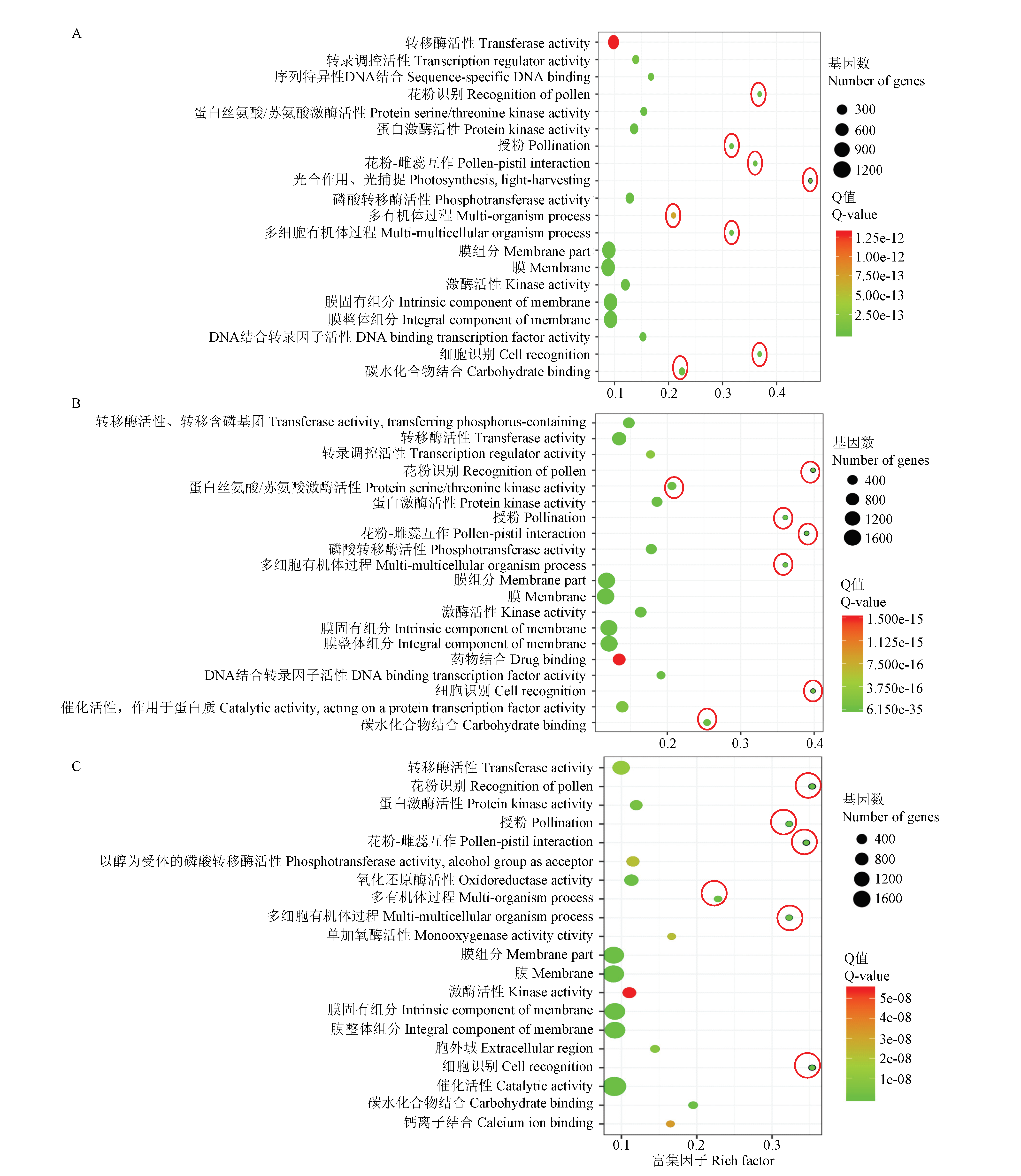
图1
各时间点差异表达基因的GO富集分析 A、B、C分别代表差异表达基因在6、12、24 h各时间点的GO富集结果,结果仅显示Q-value值最小的前20个富集条目。红圈标注的通路为Rich factor>0.2和Q-value<0.05的阈值下显著富集的条目"
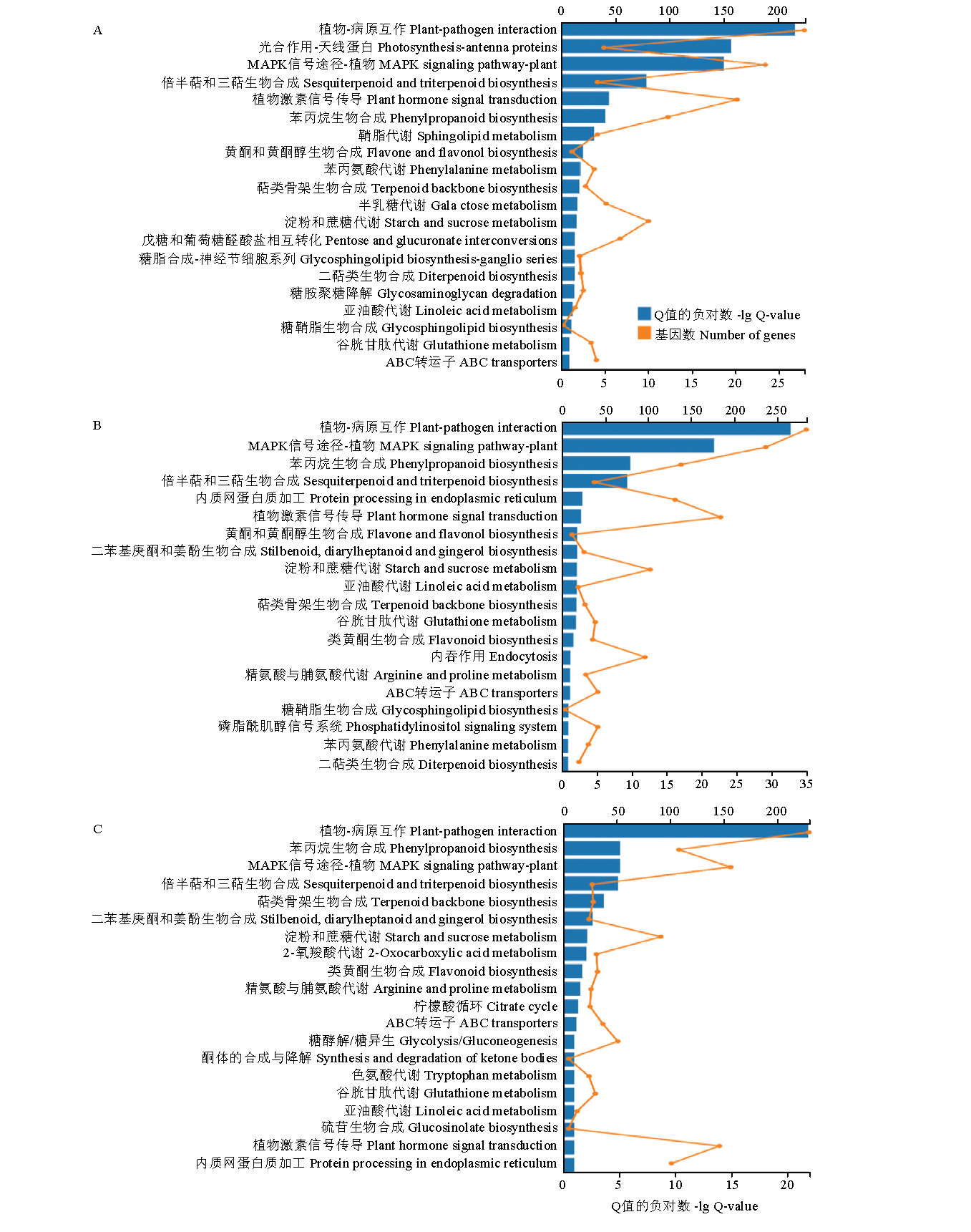
图2
各时间点差异表达基因的KEGG富集"
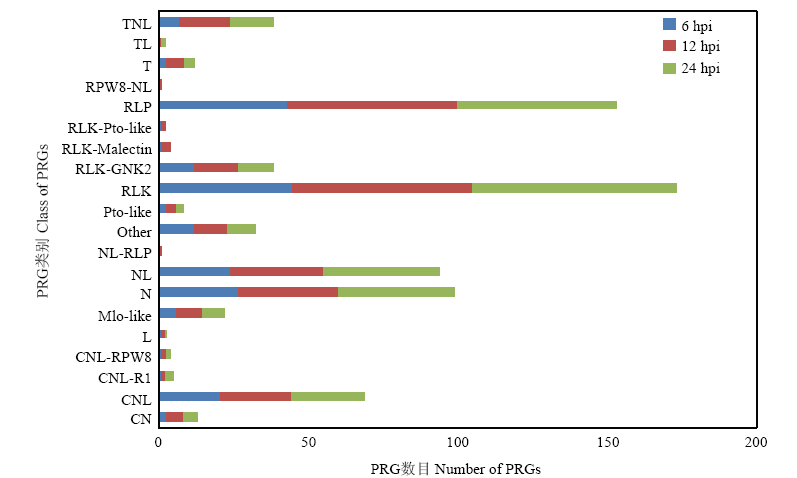
图3
PevD1处理后各时间点差异表达基因注释到PRG的数目"
表2
差异表达基因中LRR-RLKs的筛选"
| Unigene ID | log2FC | 蛋白特性 Protein property | ||
|---|---|---|---|---|
| 6 hpi | 12 hpi | 24 hpi | ||
| Niben101Scf00160g06027 | 2.80 | 3.42 | 2.12 | Putative receptor-like protein kinase At3g47111 |
| Niben101Scf00182g06001 | — | 5.47 | — | Pollen receptor-like kinase 2 |
| Niben101Scf00245g00006 | 10.00 | 6.88 | 4.19 | Probable LRR receptor-like serine/threonine-protein kinase At1g74361 |
| Niben101Scf00742g01037 | — | 2.35 | — | Protein STRUBBELIG-RECEPTOR FAMILY 3-like isoform X4 |
| Niben101Scf00744g08015 | 2.10 | 1.82 | — | Receptor-like protein kinase HAIKU3 |
| Niben101Scf00887g04011 | 1.80 | 2.26 | — | Putative receptor-like protein kinase At3g47111 |
| Niben101Scf00953g00004 | 2.65 | 3.06 | 1.66 | Receptor-like protein kinase HAIKU3 |
| Niben101Scf01203g01002 | 2.12 | 4.39 | 2.65 | Probable LRR receptor-like serine/threonine-protein kinase At3g47570 isoform X2 |
| Niben101Scf01205g02008 | -2.00 | — | -2.10 | Probable LRR receptor-like serine/threonine-protein kinase At4g36181 |
| Niben101Scf01225g04031 | 2.51 | 2.85 | 2.08 | Probably inactive leucine-rich repeat receptor-like protein kinase At5g48381 |
| Niben101Scf01278g09008 | — | 2.04 | 1.54 | Probable LRR receptor-like serine/threonine-protein kinase At1g56130 isoform X3 |
| Niben101Scf01673g02002 | — | 6.26 | — | Probable LRR receptor-like serine/threonine-protein kinase RLK |
| Niben101Scf01819g01001 | 1.31 | 2.21 | — | Phytosulfokine receptor 2 |
| Niben101Scf02217g05010 | 1.65 | 2.29 | — | Receptor-like protein kinase HSL2 |
| Niben101Scf02531g00007 | — | 2.88 | — | LRR receptor-like serine/threonine-protein kinase EFR |
| Niben101Scf02862g00007 | -1.90 | -2.80 | — | Probable LRR receptor-like serine/threonine-protein kinase At4g36181 |
| Niben101Scf03374g08019 | 3.80 | 3.71 | 1.10 | Probable LRR receptor-like serine/threonine-protein kinase At3g47571 |
| Niben101Scf03816g01001 | 2.03 | 2.07 | 1.39 | AHW85126.2//leucine-rich repeat receptor-like kinase |
| Niben101Scf04053g03008 | 2.06 | 2.50 | 1.79 | Receptor-like protein kinase HAIKU3 |
| Niben101Scf04099g05004 | 2.38 | 2.35 | 1.72 | Leucine-rich repeat receptor-like serine/threonine/tyrosine-protein kinase SOBIR2 |
| Niben101Scf05349g01040 | 1.30 | 2.32 | 2.20 | Protein STRUBBELIG-RECEPTOR FAMILY 5 isoform X2 |
| Niben101Scf05928g03007 | 5.32 | 6.75 | 3.32 | Probable LRR receptor-like serine/threonine-protein kinase At1g74361 |
| Niben101Scf06509g02006 | 5.34 | 5.87 | 2.71 | Receptor-like protein kinase 6 |
| Niben101Scf08137g01034 | 2.82 | 3.29 | — | Putative receptor-like protein kinase |
| Niben101Scf08564g00001 | 1.15 | 3.10 | — | Probable LRR receptor-like serine/threonine-protein kinase At1g56141 |
| Niben101Scf10381g03006 | — | 3.10 | 2.42 | Probable LRR receptor-like serine/threonine-protein kinase At4g08851 |
| Niben101Scf20124g00014 | 2.27 | 2.20 | 1.73 | Leucine-rich repeat receptor-like tyrosine-protein kinase PXC4 |
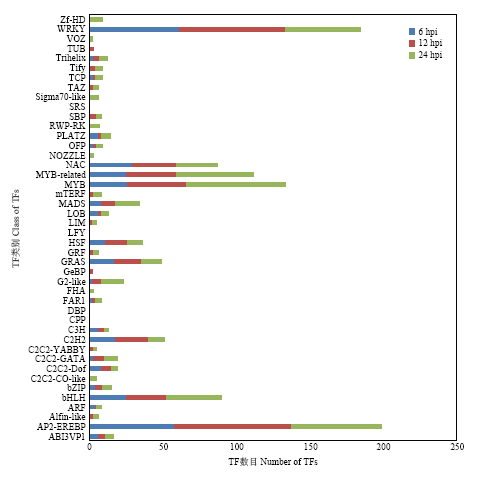
图4
转录因子分析"
表3
PevD1诱导病程相关蛋白家族差异表达基因的筛选"
| PR 家族基因 PR family gene | Unigene ID | log2 Ratio (WT_PevD1/WT_CK) | 蛋白特性 Protein property | ||
|---|---|---|---|---|---|
| 6 hpi | 12 hpi | 24 hpi | |||
| PR1 | Niben101Scf00107g03008 | -2.10 | 2.38 | 4.32 | Pathogenesis-related protein 1A |
| Niben101Scf00953g03008 | — | 5.98 | 3.86 | Basic form of pathogenesis-related protein 1 | |
| Niben101Scf00953g03009 | 4.60 | 7.73 | 5.58 | Basic form of pathogenesis-related protein 1-like | |
| Niben101Scf01999g07002 | — | 3.17 | 2.58 | Pathogenesis-related protein 1C-like | |
| Niben101Scf03376g03004 | -6.50 | 2.87 | 6.24 | Pathogenesis-related protein 1A | |
| Niben101Scf04053g02006 | 1.64 | 5.47 | 3.81 | Basic form of pathogenesis-related protein 1-like | |
| Niben101Scf04053g02007 | 5.23 | 8.30 | 6.87 | Basic form of pathogenesis-related protein 1 | |
| PR2 | Niben101Ctg13736g00004 | — | 3.09 | 4.15 | Glucan endo-1,3-beta-glucosidase |
| Niben101Scf01001g00003 | — | 2.86 | 3.91 | Glucan endo-1,3-beta-glucosidase | |
| Niben101Scf01001g00004 | — | 2.86 | 3.91 | Glucan endo-1,3-beta-glucosidase | |
| Niben101Scf01001g00005 | — | 2.86 | 3.91 | Glucan endo-1,3-beta-glucosidase | |
| Niben101Scf01001g00006 | — | — | 3.70 | Glucan endo-1,3-beta-glucosidase | |
| Niben101Scf01934g02004 | — | 5.40 | 3.21 | Glucan endo-1,3-beta-glucosidase | |
| Niben101Scf03905g02017 | 1.32 | 5.13 | 2.91 | Glucan endo-1,3-beta-glucosidase | |
| Niben101Scf04869g03002 | — | 3.25 | 3.39 | Glucan endo-1,3-beta-glucosidase | |
| PR3 | Niben101Scf02041g00002 | — | 1.57 | 3.85 | Acidic endochitinase Q |
| Niben101Scf03200g01014 | — | 2.22 | 2.15 | Endochitinase A | |
| Niben101Scf03949g00023 | — | 4.49 | 1.38 | Endochitinase 3 | |
| Niben101Scf07491g00003 | — | 4.87 | 3.48 | Endochitinase A | |
| PR4 | Niben101Scf01015g01002 | 1.84 | 4.45 | — | Wound-induced protein WIN1-like |
| Niben101Scf02171g00007 | 2.01 | 5.84 | 3.06 | Endochitinase PR4-like | |
| Niben101Scf12045g06025 | 1.41 | 4.73 | 6.29 | Pathogenesis-related protein PR-4B | |
| PR5 | Niben101Scf03937g02019 | — | — | 1.69 | Pathogenesis-related protein 5-like |
| Niben101Scf05732g04031 | — | — | 4.88 | Pathogenesis-related protein 5-like | |
| PR6 | Niben101Scf04053g01004 | — | — | 6.66 | Pathogenesis-related leaf protein 6-like |
| PR10 | Niben101Scf10735g00018 | 1.36 | 2.10 | 2.50 | Pathogenesis-related protein PR-10 |
| PR11 | Niben101Scf01789g04010 | 2.80 | 3.62 | 2.77 | Chitotriosidase-1-like |
| Niben101Scf06295g04023 | 1.91 | 2.85 | 2.19 | Chitotriosidase-1-like | |
| PR17 | Niben101Scf03385g02011 | — | 2.02 | 3.33 | Uncharacterized protein LOC104232799 |
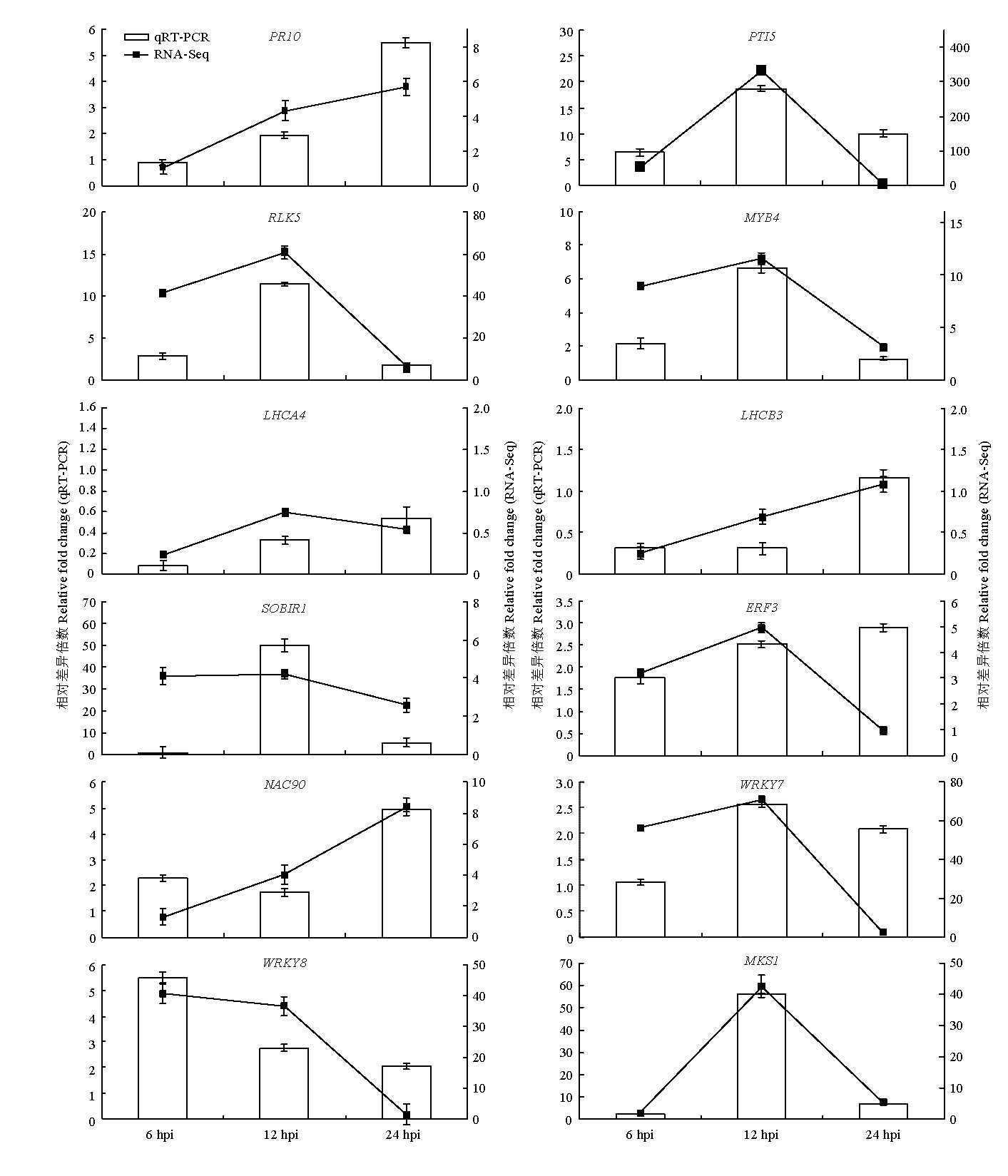
图5
差异表达基因的qRT-PCR验证"
| [1] | BARBARA D J, CLEWES E . Plant pathogenic Verticillium species: How many of them are there? Molecular Plant Pathology, 2003,4(4):297-305. |
| [2] | DURESSA D, ANCHIETA A, CHEN D, KLIMES A ,GARCIA-PEDRAJAS M D,DOBINSON K F,KLOSTERMAN S J. RNA-seq analyses of gene expression in the microsclerotia of Verticillium dahliae. BMC Genomics, 2013,14:607. |
| [3] | CARROLL C L, CARTER C A, GOODHUE R E ,LAWELL C C L, SUBBARAO K V. A review of control options and externalities for Verticillium wilts. Phytopathology, 2018,108(2):160-171. |
| [4] | 邱德文 . 我国植物病害生物防治的现状及发展策略. 植物保护, 2010,36(4):15-18. |
| QIU D W . Current status and development strategy for biological control of plant diseases in China. Plant Protection, 2010,36(4):15-18. (in Chinese) | |
| [5] | WANG B, YANG X, ZENG H, LIU H, ZHOU T, TAN B, YUAN J, GUO L, QIU D . The purification and characterization of a novel hypersensitive-like response-inducing elicitor from Verticillium dahliae that induces resistance responses in tobacco. Applied Microbiology and Biotechnology, 2012,93(1):191-201. |
| [6] | 王炳楠, 杨秀芬, 曾洪梅, 邱德文 . 大丽轮枝菌分泌蛋白激发子的分离纯化及生物功能研究. 生物技术通报, 2011(11):166-171. |
| WANG B N, YANG X F, ZENG H M, QIU D W . Purification and its bioassay of secreted elicitor protein fromVerticillium dahliae. Biotechnology Bulletin, 2011(11):166-171 (in Chinese) | |
| [7] | 卜冰武, 邱德文, 曾洪梅, 郭立华, 袁京京, 杨秀芬 . 大丽轮枝菌蛋白激发子PevD1诱导棉花抗病性及作用机理. 植物病理学报, 2014,44(3):254-264. |
| BU B W, QIU D W, ZENG H M, GUO L H, YUAN J J, YANG X F . Induced resistance and mechanism of protein elicitor PevD1 against Verticillium dahliae in cotton. Acta Phytopathologica Sinica, 2014,44(3):254-264. (in Chinese) | |
| [8] | ZHANG Y, GAO Y, LIANG Y, DONG Y, YANG X, QIU D . Verticillium dahliae PevD1, an Alt a 1-like protein, targets cotton PR5-like protein and promotes fungal infection. Journal of Experimental Botany, 2019,70(2):613-626. |
| [9] | WANG L K, FENG Z X, WANG X, WANG X W, ZHANG X G . DEGseq: An R package for identifying differentially expressed genes from RNA-seq data. Bioinformatics, 2010,26(1):136-138. |
| [10] | SCHMITTGEN T D, LEE E J, JIANG J . High-throughput real-time PCR. Methods in Molecular Biology, 2008,429:89-98. |
| [11] | SAIJO Y, LOO E P, YASUDA S . Pattern recognition receptors and signaling in plant-microbe interactions. The Plant Journal, 2018,93(4):592-613. |
| [12] | LIANG X, ZHOU J M . Receptor-like cytoplasmic kinases: Central players in plant receptor kinase-mediated signaling. Annual Review of Plant Biology, 2018,69:267-299. |
| [13] | SU J, YANG L, ZHU Q, WU H, HE Y, LIU Y, XU J, JIANG D, ZHANG S . Active photosynthetic inhibition mediated by MPK3/MPK6 is critical to effector-triggered immunity. PLoS Biology, 2018,16(5):e2004122. |
| [14] | CHINCHILLA D, ZIPFEL C, ROBATZEK S, KEMMERLING B , NÜRNBERGER T, JONES J D, FELIX G, BOLLER T. A flagellin- induced complex of the receptor FLS2 and BAK1 initiates plant defence. Nature, 2007,448(7152):497-500. |
| [15] | SCHULZE B, MENTZEL T, JEHLE A K, MUELLER K, BEELER S, BOLLER T, FELIX G, CHINCHILLA D . Rapid heteromerization and phosphorylation of ligand-activated plant transmembrane receptors and their associated kinase BAK1. The Journal of Biological Chemistry, 2010,285(13):9444-9451. |
| [16] |
LIEBRAND T W ,VAN DEN BURG H A, JOOSTEN M H. Two for all: Receptor-associated kinases SOBIR1 and BAK1. Trends in Plant Science, 2014,19(2):123-132.
doi: 10.1016/j.tplants.2013.10.003 |
| [17] | ZIPFEL C, KUNZE G, CHINCHILLA D, CANIARD A, JONES J D, BOLLER T, FELIX G . Perception of the bacterial PAMP EF-Tu by the receptor EFR restricts Agrobacterium-mediated transformation. Cell, 2006,125(4):749-760. |
| [18] | NG D W K, ABEYSINGHE J K, KAMALI M . Regulating the regulators: The control of transcription factors in plant defense signaling. International Journal of Molecular Sciences, 2018,19(12):3737. |
| [19] | DIETZ K J, VOGEL M O, VIEHHAUSER A . AP2/EREBP transcription factors are part of gene regulatory networks and integrate metabolic, hormonal and environmental signals in stress acclimation and retrograde signalling. Protoplasma, 2010,245(1/4):3-14. |
| [20] | GAUTAM J K, NANDI A K . APD1, the unique member of Arabidopsis AP2 family influences systemic acquired resistance and ethylene-jasmonic acid signaling. Plant Physiology and Biochemistry, 2018,133:92-99. |
| [21] | JIN Y, PAN W, ZHENG X, CHENG X, LIU M, MA H, GE X . OsERF101, an ERF family transcription factor, regulates drought stress response in reproductive tissues. Plant Molecular Biology, 2018,98(1/2):51-65. |
| [22] | PANDEY S P, SOMSSICH I E . The role of WRKY transcription factors in plant immunity. Plant Physiology, 2009,150(4):1648-1655. |
| [23] | ZHENG Z, QAMAR S A, CHEN Z, MENGISTE T . Arabidopsis WRKY33 transcription factor is required for resistance to necrotrophic fungal pathogens. The Plant Journal, 2006,48(4):592-605. |
| [24] | CHUJO T, TAKAI R, AKIMOTO-TOMIYAMA C, ANDO S, MINAMI E, NAGAMURA Y, KAKU H, SHIBUYA N, YASUDA M, NAKASHITA H, UMEMURA K, OKADA A, OKADA K, NOJIRI H, YAMANE H . Involvement of the elicitor-induced gene OsWRKY53 in the expression of defense-related genes in rice. Biochimica et Biophysica Acta (BBA)-Gene Structure and Expression, 2007,1769(7/8):497-505. |
| [25] | DUBOS C, STRACKE R, GROTEWOLD E, WEISSHAAR B, MARTIN C, LEPINIEC L . MYB transcription factors in Arabidopsis. Trends in Plant Science, 2010,15(10):573-581. |
| [26] | LIU J, OSBOURN A, MA P . MYB transcription factors as regulators of phenylpropanoid metabolism in plants. Molecular Plant, 2015,8(5):689-708. |
| [27] | MA Q H, WANG C, ZHU H H . TaMYB4 cloned from wheat regulates lignin biosynthesis through negatively controlling the transcripts of both cinnamyl alcohol dehydrogenase and cinnamoyl-CoA reductase genes.Biochimie, 2011,93(7):1179-1186. |
| [28] | HUANG Y, LI T, XU Z S, WANG F, XIONG A S, HUANG Y, LI T, XU Z S, WANG F, XIONG A S . Six NAC transcription factors involved in response to TYLCV infection in resistant and susceptible tomato cultivars. Plant Physiology and Biochemistry, 2017,120:61-74. |
| [29] | YAN J, TONG T, LI X, CHEN Q, DAI M, NIU F, YANG M, DEYHOLOS M K, YANG B, JIANG Y Q . A novel NAC-type transcription factor, NAC87, from oilseed rape modulates reactive oxygen species accumulation and cell death. Plant and Cell Physiology, 2018,59(2):290-303. |
| [30] | WANG G, ZHANG S, MA X, WANG Y, KONG F, MENG Q . A stress-associated NAC transcription factor (SlNAC35) from tomato plays a positive role in biotic and abiotic stresses. Physiologia Plantarum, 2016,158(1):45-64. |
| [31] | VAN LOON L C, REP M, PIETERSE C M J . Significance of inducible defense-related proteins in infected plants. Annual Review of Phytopathology, 2006,44:135-162. |
| [32] | ANTONIW J F, RITTER C E, PIERPONT W S ,VAN LOON L C. Comparison of three pathogenesis-related proteins from plants of two cultivars of tobacco infected with TMV. Journal of General Virology, 1980,47(1):79-87. |
| [33] | VAN LOON L C . Regulation of changes in proteins and enzymes associated with active defence against virus infection//Active Defense Mechanisms in Plants, 1982,37:247-273. |
| [34] | LAGRIMINI L M, BURKHART W, MOYER M, ROTHSTEIN S . Molecular cloning of complementary DNA encoding the lignin- forming peroxidase from tobacco: Molecular analysis and tissue- specific expression. Proceedings of the National Academy of Sciences of the United States of America, 1987,84(21):7542-7546. |
| [35] | 李瑞博, 崔秀明, 刘玉忠, 吴志刚, 林淑芳, 申业, 黄璐琦 . 三七病程相关蛋白1基因的克隆与表达分析. 药学学报, 2014,49(1):124-130. |
| LI R B, CUI X M, LIU Y Z, WU Z G, LIN S F, SHEN Y, HUANG L Q . Cloning and expression analysis of pathogenesis-related protein 1 gene of Panax notoginseng. Acta Pharmaceutica Sinica, 2014,49(1):124-130. (in Chinese) | |
| [36] | MELCHERS L S, APOTHEKER-DE GROOT M,VAN DER KNAAP J A, PONSTEIN A S, SELA-BUURLAGE M B, BOL J F, CORNELISSEN B J, VAN DEN ELZEN P J, LINTHORST H J. , A new class of tobacco chitinases homologous to bacterial exo-chitinases displays antifungal activity. The Plant Journal, 1994,5(4):469-480. |
| [37] |
OKUSHIMA Y, KOIZUMI N, KUSANO T, SANO H . Secreted proteins of tobacco cultured BY2 cells: Identification of a new member of pathogenesis-related proteins. Plant Molecular Biology, 2000,42(3):479-488.
doi: 10.1023/A:1006393326985 |
| [1] | 李元晶, 袁瑞祥, 李永泰, 孙天歌, 刘峰, 李艳军, 张新宇. 棉花黄萎病菌β-葡萄糖苷酶基因的鉴定及其在致病中的功能[J]. 中国农业科学, 2026, 59(7): 1380-1399. |
| [2] | 曹海顺, 周东源, 王瑞, 施招婉, 吴廷全, 张长远. 弱光胁迫短下胚轴黄瓜种质鉴定及其遗传位点挖掘[J]. 中国农业科学, 2026, 59(6): 1286-1301. |
| [3] | 韦萍, 潘炬忠, 朱德平, 邵胜雪, 陈珊珊, 韦雅倩, 高维维. OsDREB1J调控水稻籽粒大小的功能研究[J]. 中国农业科学, 2025, 58(8): 1463-1478. |
| [4] | 王梦园, 魏倩睿, 李海艳, 杨巧敏, 宇军, 黄炜, 逯明辉. 辣椒MADS-box转录因子基因CaAGL61的耐热功能分析[J]. 中国农业科学, 2025, 58(8): 1604-1616. |
| [5] | 潘丽媛, 王永军, 李海军, 侯富, 李菁, 李丽丽, 孙苏阳. 基于转录组和WGCNA筛选小麦籽粒蛋白质累积相关调控基因[J]. 中国农业科学, 2025, 58(6): 1065-1082. |
| [6] | 刁邓超, 李云丽, 孟祥宇, 季颂涵, 孙玉晨, 马学红, 李杰, 冯永佳, 李春莲, 吴建辉, 曾庆东, 韩德俊, $\boxed{\hbox{王长发}}$, 郑炜君. 小麦TaGRAS34-5A的克隆及耐热功能研究[J]. 中国农业科学, 2025, 58(4): 617-634. |
| [7] | 张林琳, 宫瑞, 崔彦玲, 钟雄辉, 李烨, 李然红, 潜宗伟. 利用VIGS分析SmWRKY30在茄子抗青枯病中的作用[J]. 中国农业科学, 2025, 58(3): 548-563. |
| [8] | 邹霈怡, 刘美艳, 王颖, 李然红. 狗枣猕猴桃AkNAC2的克隆及功能研究[J]. 中国农业科学, 2025, 58(19): 3985-3999. |
| [9] | 阮桥君, 毛苗苗, 张媛媛, 林晓蓉, 陈忠正. 茶树‘英红9号’乙胺合成关键酶基因CsAlaDC转录因子的筛选[J]. 中国农业科学, 2025, 58(12): 2427-2438. |
| [10] | 姜兴林, 于连伟, 付涵, 艾妞, 崔荧钧, 李好海, 夏子豪, 袁虹霞, 李洪连, 杨雪, 施艳. 转录因子NbMYB1R1通过促进活性氧积累抑制病毒侵染[J]. 中国农业科学, 2024, 57(8): 1490-1505. |
| [11] | 熊楚雯, 郭智滨, 周强华, 程艳波, 马启彬, 蔡占东, 年海. 大豆转录因子NAC1耐低磷胁迫的功能研究[J]. 中国农业科学, 2024, 57(3): 442-453. |
| [12] | 胡丹丹, 罗润琪, 梁瑞英, 汪磊, 梁琳, 司红彬, 丁家波, 汤新明. ApiAP2转录因子家族调控弓形虫生长发育的研究进展[J]. 中国农业科学, 2024, 57(13): 2687-2697. |
| [13] | 赵卫松, 郭庆港, 崔钠淇, 鹿秀云, 李社增, 马平. 外源添加L-脯氨酸对棉花黄萎病发生及其根际土壤微生物群落的影响[J]. 中国农业科学, 2024, 57(11): 2143-2160. |
| [14] | 姬改革, 陈智武, 单艳菊, 刘一帆, 屠云洁, 邹剑敏, 章明, 巨晓军, 束婧婷, 张海涛, 唐燕飞, 蒋华莲. 基于转录组测序研究调控黄羽肉鸡干毛性状关键基因和信号通路[J]. 中国农业科学, 2024, 57(1): 204-215. |
| [15] | 李慧, 张雨峰, 李晓刚, 王中华, 蔺经, 常有宏. 全基因组DNA甲基化和转录组联合分析鉴定杜梨耐盐相关转录因子[J]. 中国农业科学, 2023, 56(7): 1377-1390. |
|
||
