






中国农业科学 ›› 2026, Vol. 59 ›› Issue (21): 4882-4903.doi: 10.3864/j.issn.0578-1752.2026.21.013
强小嫚( ), 刘胜星, 张现波, 王景雷, 王春婷, 朱恬恬, 王博娟, 刘浩()
收稿日期:2026-04-16
接受日期:2026-06-03
出版日期:2026-11-01
发布日期:2026-11-06
通信作者:
联系方式:
强小嫚,E-mail:qiangxiaoman@caas.cn。
基金资助:
QIANG XiaoMan(), LIU ShengXing, ZHANG XianBo, WANG JingLei, WANG ChunTing, ZHU TianTian, WANG BoJuan, LIU Hao()
Received:2026-04-16
Accepted:2026-06-03
Published:2026-11-01
Online:2026-11-06
摘要:
【目的】探究灌溉水平和营养液浓度对椰糠袋培番茄生长特性、产量、品质及水肥利用效率的影响,明确椰糠袋培番茄适宜的营养液水肥管理模式,为设施椰糠袋培番茄水肥精准管理提供参考依据。【方法】设置灌溉下限和营养液浓度2个因素,灌溉下限设3个水平,椰糠袋持水量(FC)的60%(W1)、70%(W2)和80%(W3);营养液浓度设3个水平,霍格兰配方的0.8倍剂量(F1)、1.0倍剂量(F2)和1.2倍剂量(F3)。系统分析不同处理对番茄生长发育、光合特性、养分积累与利用、产量、品质、水分利用效率及肥料偏生产力的影响,结合熵权法、层次分析法(AHP)和TOPSIS法构建综合评价体系,优化灌溉和营养液管理指标。【结果】灌溉水平和营养液浓度均显著影响番茄株高、叶面积指数、地上部生物量、光合参数及氮磷钾养分积累。提高灌溉水平可显著促进植株生长与光合能力提升;在中高灌溉条件下适当提高营养液浓度有利于养分吸收和生物量积累。两年试验中,W3F3、W3F2和W2F2处理产量均处于较高水平,且处理间差异不显著(P>0.05),其中,W2F2处理在保持较高产量的同时,水分利用效率两年均达到最高,肥料偏生产力和综合品质表现较优。TOPSIS综合评价表明,W2F2处理两年的相对贴近度分别为0.7654和0.8177,排名第一。【结论】本试验条件下,灌溉下限为70%FC并配施1.0倍剂量霍格兰营养液的W2F2处理,能够较好协调番茄产量、品质和资源利用效率,可作为设施椰糠袋培番茄较优的营养液灌施管理模式。
强小嫚, 刘胜星, 张现波, 王景雷, 王春婷, 朱恬恬, 王博娟, 刘浩. 灌溉水平与营养液浓度对椰糠袋培番茄产量、品质及水肥利用效率的影响[J]. 中国农业科学, 2026, 59(21): 4882-4903.
QIANG XiaoMan, LIU ShengXing, ZHANG XianBo, WANG JingLei, WANG ChunTing, ZHU TianTian, WANG BoJuan, LIU Hao. Effects of Irrigation Level and Nutrient Solution Concentration on Yield, Quality, and Water-Fertilizer Use Efficiency of Tomato Growing in Coconut Coir Bag Culture[J]. Scientia Agricultura Sinica, 2026, 59(21): 4882-4903.
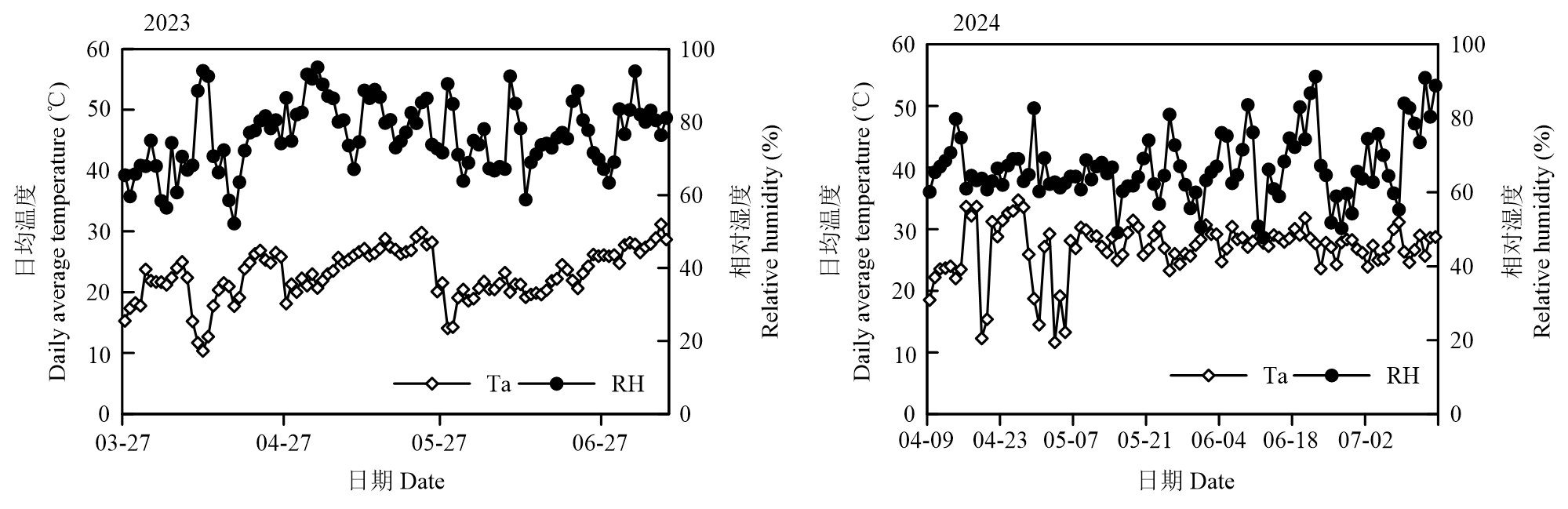
图1
2023、2024年温室内日平均温度及相对湿度变化过程"

图2
椰糠袋培番茄种植示意图及小型蒸渗仪称重系统"
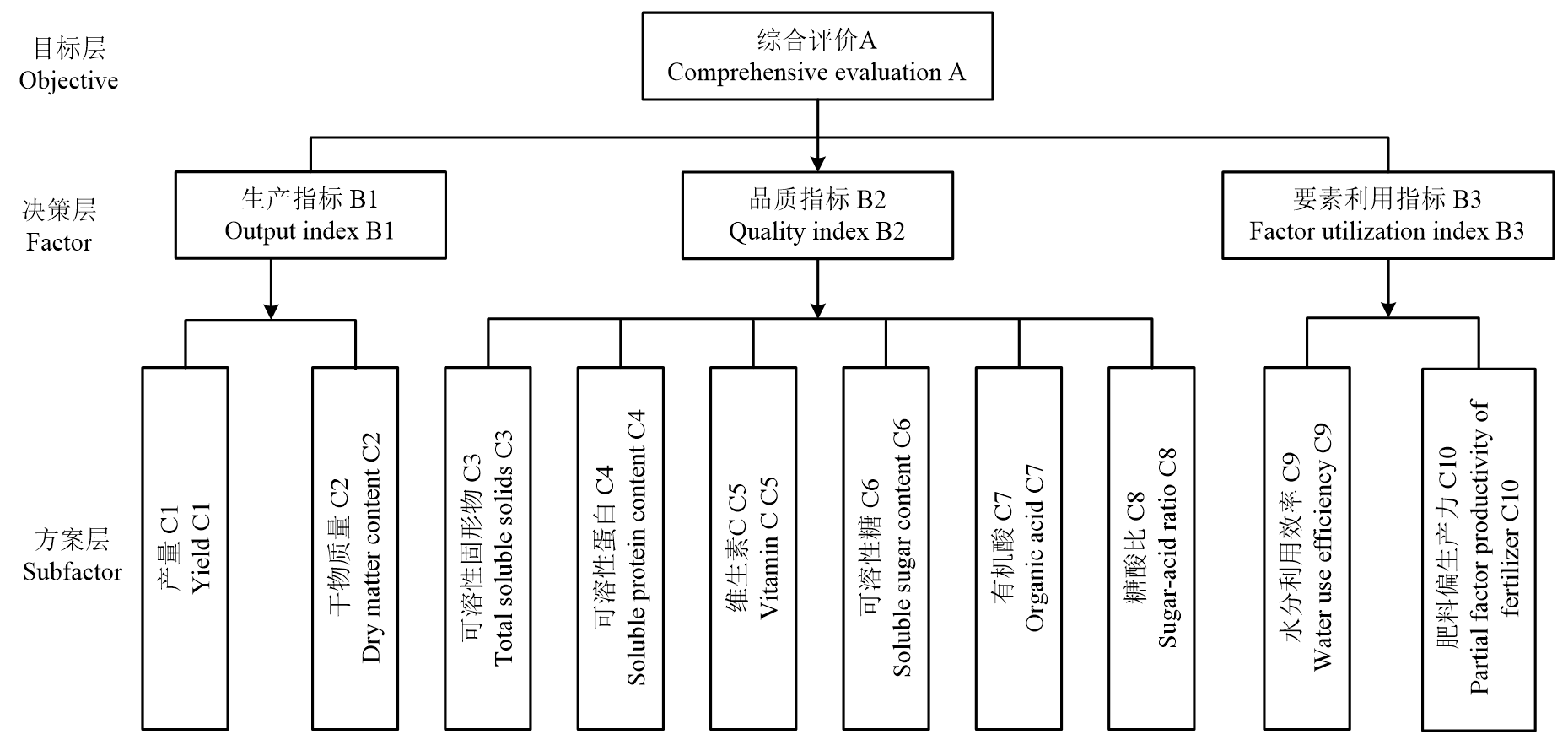
图3
层次分析结构模型"
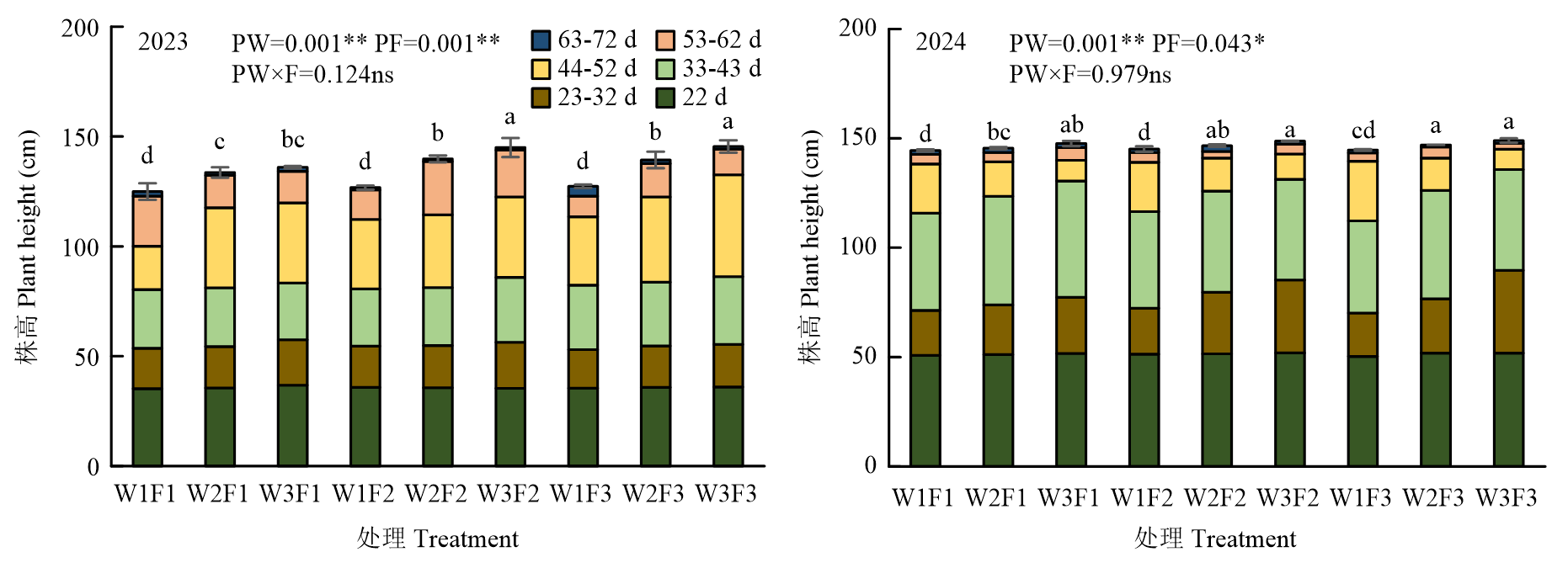
图4
不同处理下椰糠袋培番茄植株的株高 不同小写字母表示处理间差异显著(P<0.05)。下同"
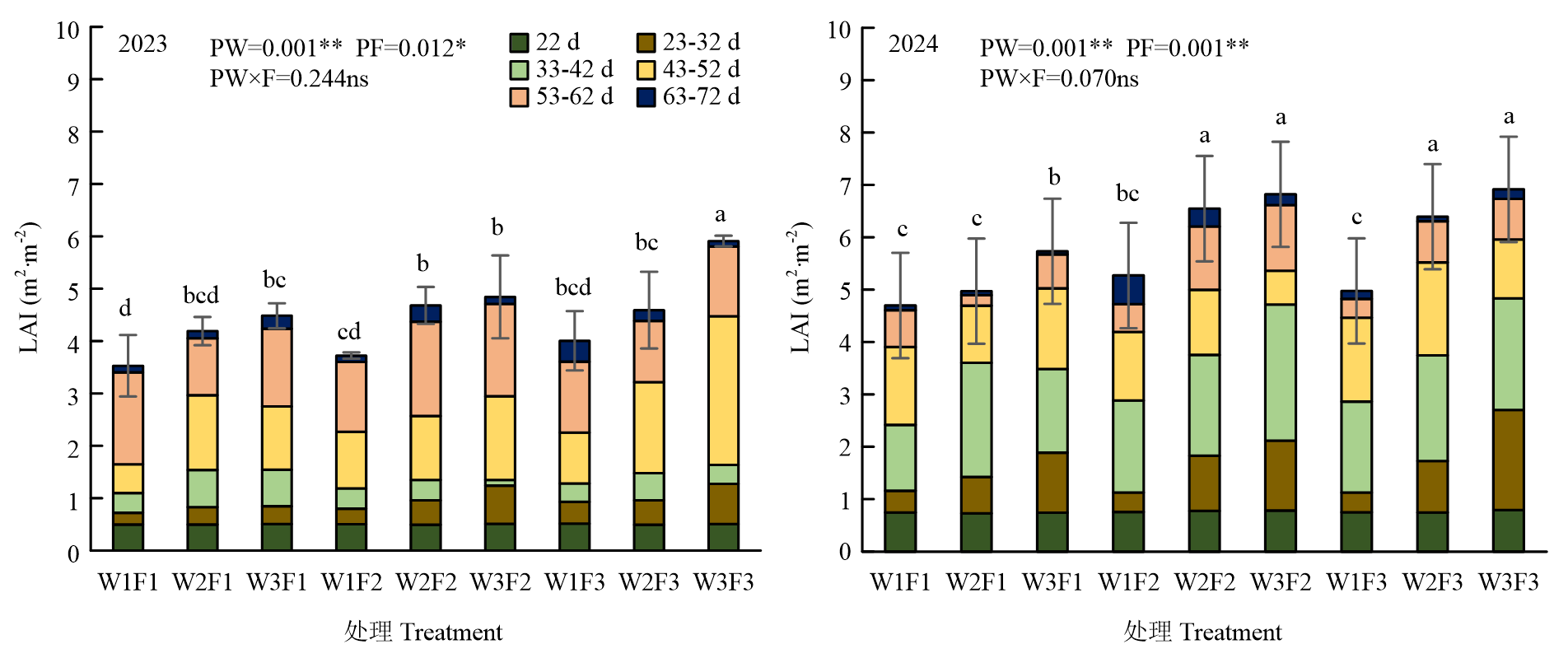
图5
不同处理下椰糠袋培番茄叶面积指数变化过程"
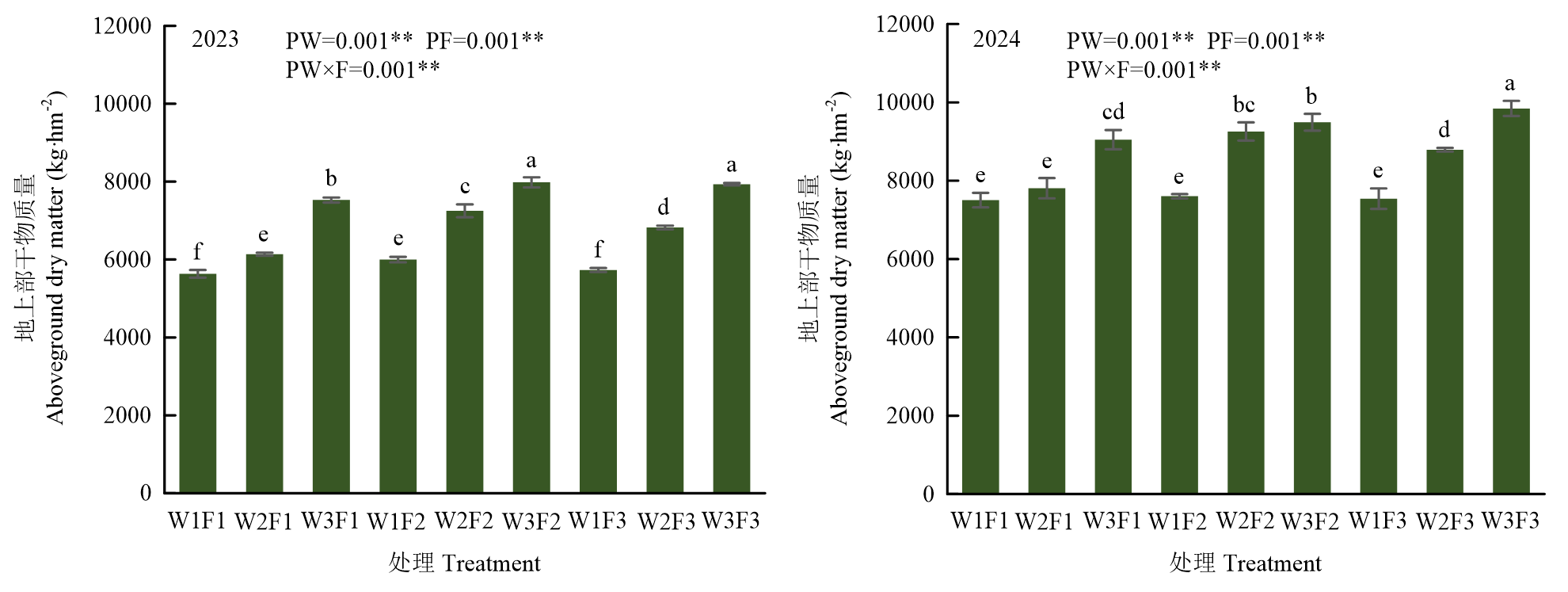
图6
不同处理下椰糠袋培番茄地上部干物质量变化过程"
表1
不同处理椰糠袋培番茄收获指数"
| 处理 Treatment | 收获指数 Harvest index (%) | |
|---|---|---|
| 2023 | 2024 | |
| W1F1 | 45.57c | 38.19d |
| W2F1 | 46.95b | 41.10c |
| W3F1 | 43.85c | 41.15c |
| W1F2 | 49.61ab | 40.56c |
| W2F2 | 51.80a | 46.15a |
| W3F2 | 47.10b | 43.10b |
| W1F3 | 44.35c | 40.48c |
| W2F3 | 49.49ab | 43.01b |
| W3F3 | 48.34b | 42.56b |
表2
不同处理对椰糠袋培番茄净光合速率、气孔导度和蒸腾速率的影响"
| 处理Treatment | 净光合速率 Net photosynthetic rate (μmol·m-2·s-1) | 气孔导度 Stomatal conductance (mol·m-2·s-1) | 蒸腾速率 Transpiration rate (mmol·m-2·s-1) | |||||||||
|---|---|---|---|---|---|---|---|---|---|---|---|---|
| 2023 | 2024 | 2023 | 2024 | 2023 | 2024 | |||||||
| 开花坐果期Flowering and fruit- setting stage | 成熟期Maturity stage | 开花坐果期Flowering and fruit- setting stage | 成熟期Maturity stage | 开花坐果期Flowering and fruit- setting stage | 成熟期Maturity stage | 开花坐果期Flowering and fruit- setting stage | 成熟期Maturity stage | 开花坐果期Flowering and fruit- setting stage | 成熟期Maturity stage | 开花坐果期Flowering and fruit- setting stage | 成熟期Maturity stage | |
| W1F1 | 19.86c | 12.42f | 25.20c | 13.39e | 0.43b | 0.46d | 0.52de | 0.30e | 7.18c | 9.82f | 10.04d | 6.87b |
| W2F1 | 22.32b | 14.17e | 26.88ab | 19.61bc | 0.62a | 0.61c | 0.64c | 0.35cd | 9.63ab | 10.63e | 11.69ab | 8.34a |
| W3F1 | 22.98b | 14.94d | 26.98ab | 20.11bc | 0.64a | 0.70b | 0.73b | 0.34d | 9.64ab | 10.72e | 11.64ab | 8.64a |
| W1F2 | 19.49cd | 14.13e | 25.65bc | 18.43c | 0.44b | 0.50d | 0.56d | 0.37b | 7.25c | 11.44d | 10.84c | 8.30a |
| W2F2 | 23.04b | 19.26b | 27.07ab | 20.45ab | 0.60a | 0.65c | 0.64c | 0.38ab | 9.32b | 13.44bc | 11.57b | 8.41a |
| W3F2 | 23.22b | 20.30a | 27.92a | 21.28ab | 0.61a | 0.77a | 0.75ab | 0.38ab | 9.50ab | 14.04ab | 11.63ab | 8.57a |
| W1F3 | 18.14d | 14.98d | 24.66c | 16.05d | 0.46b | 0.49d | 0.49e | 0.34d | 6.76c | 10.64e | 10.86c | 6.58b |
| W2F3 | 23.32b | 18.60c | 27.92a | 21.19ab | 0.61a | 0.64c | 0.66c | 0.34bc | 9.33b | 13.04c | 11.86ab | 8.39a |
| W3F3 | 25.26a | 20.77a | 28.24a | 22.24a | 0.64a | 0.78a | 0.77ab | 0.39a | 9.87a | 14.17a | 11.92a | 9.16a |
| 显著性检验F值 F value | ||||||||||||
| W | 167.22** | 405.03** | 25.49** | 72.42** | 74.38** | 206.09** | 217.94** | 24.39** | 230.21** | 99.33** | 130.07** | 23.56** |
| F | 1.87ns | 377.34** | 1.41ns | 15.18** | 0.68ns | 8.85** | 1.64ns | 49.25** | 0.80ns | 131.97** | 13.60** | 2.33ns |
| W×F | 11.27** | 26.83** | 1.52ns | 4.62** | 0.31ns | 0.49ns | 4.83** | 5.02** | 2.14ns | 10.15** | 6.56** | 4.68** |
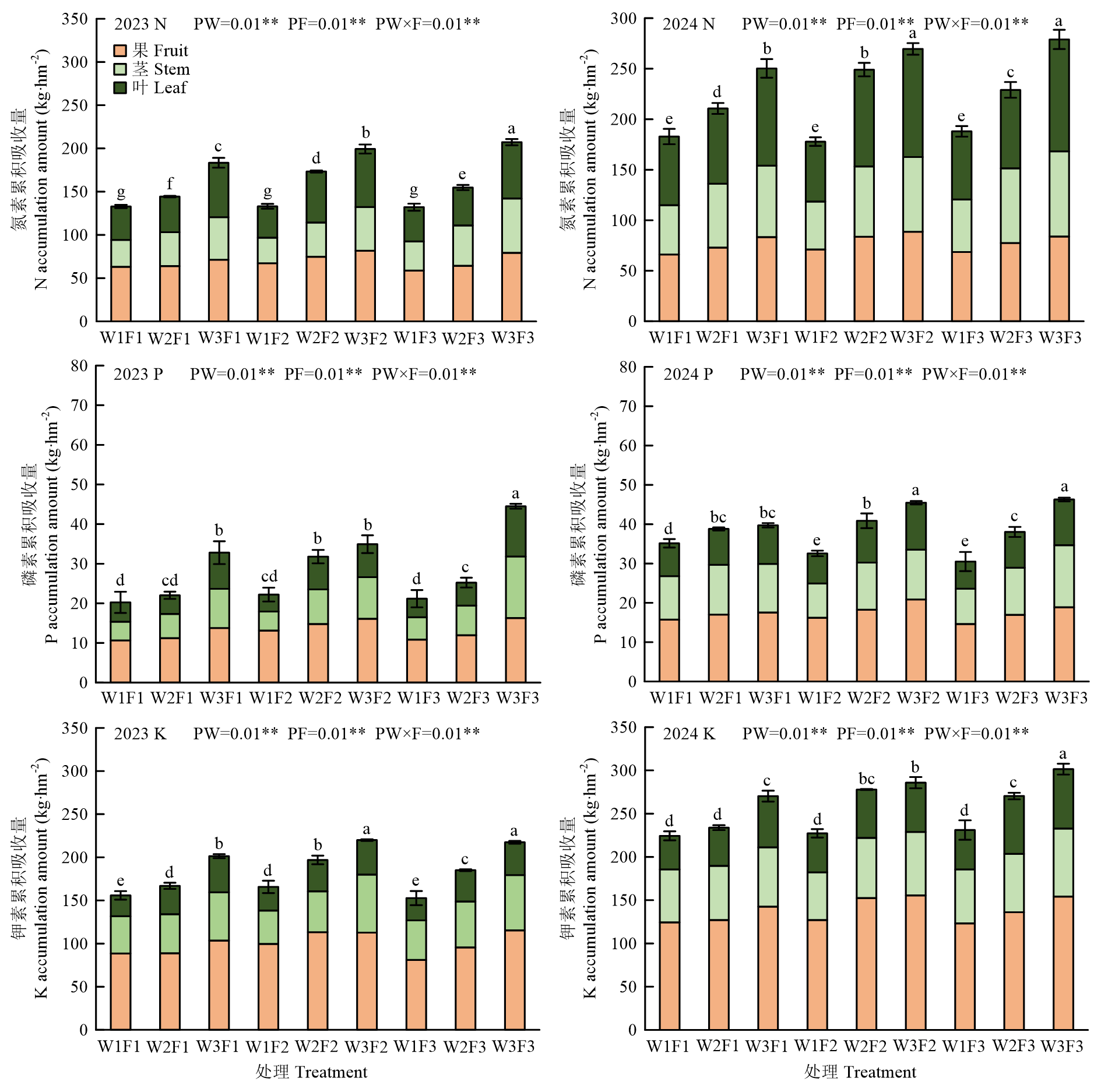
图7
不同处理下椰糠袋培番茄养分积累过程"
表3
不同处理对椰糠袋培番茄养分内部利用效率的影响"
| 处理Treatment | N (kg·kg-1) | P2O5 (kg·kg-1) | K2O (kg·kg-1) | |||
|---|---|---|---|---|---|---|
| 2023 | 2024 | 2023 | 2024 | 2023 | 2024 | |
| W1F1 | 390.47bc | 287.61b | 2588.55a | 1495.34cd | 332.85ab | 234.13bcd |
| W2F1 | 379.01cd | 270.50cd | 2486.09a | 1468.79d | 327.74b | 243.71ab |
| W3F1 | 314.55e | 235.95f | 1766.70b | 1485.73cd | 286.46c | 218.41e |
| W1F2 | 426.72a | 324.75a | 2563.71a | 1773.00a | 342.88a | 254.06a |
| W2F2 | 367.44d | 270.33cd | 2007.17b | 1650.06b | 323.51b | 242.25ab |
| W3F2 | 320.12e | 253.42de | 1830.89b | 1502.72cd | 290.02c | 239.03bc |
| W1F3 | 398.33b | 286.62bc | 2498.87a | 1771.87a | 344.71a | 233.20bcd |
| W2F3 | 385.25c | 266.30d | 2367.00a | 1602.72bc | 322.22b | 225.45cd |
| W3F3 | 313.82e | 246.46ef | 1461.76c | 1484.20cd | 299.16c | 227.93cde |
| 显著性检验F值 F value | ||||||
| W | 379.45** | 78.12** | 62.24** | 19.64** | 98.42** | 7.61** |
| F | 4.67* | 10.52** | 2.72ns | 16.10** | 1.63ns | 14.66** |
| W×F | 11.61** | 4.47** | 4.10* | 4.52** | 1.67ns | 4.16* |

图8
不同处理对椰糠袋培番茄产量、水分利用效率及肥料偏生产力的影响"
表4
水肥供应与产量的回归响应分析"
| 年份 Year | 因变量 Dependent variable, Z | 回归方程 Regression equation | R² | Z最大时处理组合 Water and fertilizer combination at maximum Z | ||
|---|---|---|---|---|---|---|
| x (mm) | y (kg·hm-2) | Zmax | ||||
| 2023 | 产量Yield (t·hm-2) | Z=-99.58+1.59928x-0.00040y+0.00092xy-0.00673x2-0.00007y2 | 0.923 | 207.58 | 1296.27 | 66.28 |
| 2024 | 产量Yield (t·hm-2) | Z=-368.66+4.16055x-0.14651y+0.00155xy-0.01252x2-0.00008y2 | 0.928 | 270.67 | 1691.14 | 71.98 |
表5
不同处理对椰糠袋培番茄品质的影响"
| 年份Year | 处理 Treatment | 可溶性固形物 Soluble solids (%) | 可溶性蛋白 Soluble protein (mg·g-1) | 维生素C Vitamin C (mg·kg-1) | 可溶性糖 Soluble sugar (%) | 有机酸 Organic acid (%) | 糖酸比 Sugar-acid ratio |
|---|---|---|---|---|---|---|---|
| 2023 | W1F1 | 5.38abc | 2.89cd | 142.34e | 2.71a | 0.57ab | 4.76ab |
| W2F1 | 5.29abc | 3.32b | 152.65d | 2.50b | 0.58a | 4.30d | |
| W3F1 | 4.91d | 3.19b | 162.06b | 2.28d | 0.55bc | 4.18d | |
| W1F2 | 5.41ab | 3.81a | 158.78c | 2.67a | 0.55abc | 4.83a | |
| W2F2 | 5.12bcd | 3.84a | 166.49a | 2.58b | 0.54bc | 4.75ab | |
| W3F2 | 5.10cd | 2.67d | 134.96f | 2.38c | 0.53c | 4.52c | |
| W1F3 | 5.51a | 3.05bc | 157.89c | 2.72a | 0.56ab | 4.85a | |
| W2F3 | 5.37abc | 3.26b | 134.42f | 2.56b | 0.56ab | 4.58bc | |
| W3F3 | 4.52e | 3.62a | 128.57g | 1.96e | 0.47d | 4.13d | |
| W | 34.33** | 9.40** | 204.75** | 247.04** | 28.04** | 43.32** | |
| F | 6.20** | 9.09** | 304.34** | 16.51** | 12.99** | 12.49** | |
| W×F | 6.39** | 30.99** | 478.88** | 24.27** | 6.08** | 3.52* | |
| 2024 | W1F1 | 5.33bcd | 3.83b | 126.93d | 2.80b | 0.46c | 6.15a |
| W2F1 | 5.20cde | 4.30ab | 127.34d | 2.63c | 0.43d | 6.06a | |
| W3F1 | 5.10de | 3.97b | 147.13b | 2.42d | 0.44d | 5.55c | |
| W1F2 | 5.55b | 3.60b | 141.84c | 3.16a | 0.51a | 6.17a | |
| W2F2 | 5.51b | 5.07a | 153.36a | 3.14a | 0.51a | 6.13a | |
| W3F2 | 5.10de | 3.84b | 106.32e | 2.71bc | 0.46bc | 5.86b | |
| W1F3 | 5.85a | 3.51b | 152.96a | 2.84b | 0.52a | 5.43c | |
| W2F3 | 5.38bc | 3.82b | 126.59d | 2.65c | 0.48b | 5.55c | |
| W3F3 | 5.05e | 4.37ab | 98.06f | 2.15e | 0.47bc | 4.61d | |
| W | 32.83** | 6.42** | 286.71** | 103.65** | 36.89** | 74.75** | |
| F | 7.00** | 0.84ns | 39.52** | 90.62** | 72.04** | 143.76** | |
| W×F | 4.76** | 3.37* | 322.25** | 4.60** | 6.79** | 7.28** |
表6
熵权法确定番茄各项指标权重"
| 年份Year | 产量Yield (C1) | 干物质量 Dry matter accumulation (C2) | 可溶性固形物 Soluble solids (C3) | 可溶性蛋白Soluble protein (C4) | 维生素C Vitamin C (C5) | 可溶性糖 Soluble sugar (C6) | 有机酸 Organic acid (C7) | 糖酸比 Sugar-acid ratio (C8) | WUE (C9) | PFP (C10) |
|---|---|---|---|---|---|---|---|---|---|---|
| 2023 | 0.117 | 0.138 | 0.056 | 0.091 | 0.101 | 0.057 | 0.051 | 0.104 | 0.135 | 0.150 |
| 2024 | 0.101 | 0.149 | 0.130 | 0.120 | 0.071 | 0.061 | 0.118 | 0.048 | 0.122 | 0.080 |
表7
AHP法确定番茄各项指标权重"
| 判断矩阵 Judgment matrix | 局部权重 Local weight | 最终权重 Ultimate weight | 一致性检验 Consistency parameters | |||||||
|---|---|---|---|---|---|---|---|---|---|---|
| B1 | B2 | B3 | ||||||||
| 目标层A General goal A | B1 | 1 | 1 | 1 | 0.333 | 0.333 | CR=0.0002<0.1 λmax=3.0002 | |||
| B2 | 1 | 1 | 1 | 0.333 | 0.333 | |||||
| B3 | 1 | 1 | 1 | 0.333 | 0.333 | |||||
| C1 | C2 | CR=0<0.1 λmax=2.0000 | ||||||||
| 生产指标B1 Output index B1 | C1 | 1 | 4 | 0.800 | 0.267 | |||||
| C2 | 0.25 | 1 | 0.200 | 0.067 | ||||||
| C3 | C4 | C5 | C6 | C7 | C8 | CR=0.001<0.1 λmax=6.009 | ||||
| 品质指标B2 Quality index B2 | C3 | 1 | 3 | 1.5 | 1 | 3 | 3 | 0.271 | 0.090 | |
| C4 | 0.333 | 1 | 0.5 | 0.333 | 1 | 1 | 0.090 | 0.030 | ||
| C5 | 0.667 | 2 | 1 | 0.5 | 2 | 2 | 0.173 | 0.058 | ||
| C6 | 1 | 3 | 2 | 1 | 3 | 3 | 0.285 | 0.095 | ||
| C7 | 0.333 | 1 | 0.5 | 0.333 | 1 | 1 | 0.090 | 0.030 | ||
| C8 | 0.333 | 1 | 0.5 | 0.333 | 1 | 1 | 0.090 | 0.030 | ||
| C9 | C10 | CR=0<0.1 λmax=2.0000 | ||||||||
| 要素利用指标B3 Factor utilization index B3 | C9 | 1 | 1 | 0.500 | 0.167 | |||||
| C10 | 1 | 1 | 0.500 | 0.167 | ||||||
表8
综合权重计算"
| 年份 Year | 指标 Index | 客观权重值 Objective weight value | 主观权重值 Subjective weighting value | 综合权重值 Combined weight value |
|---|---|---|---|---|
| 2023 | 产量 Yield (C1) | 0.117 | 0.267 | 0.280 |
| 干物质量 Dry matter accumulation (C2) | 0.138 | 0.067 | 0.083 | |
| 可溶性固形物 Soluble solids (C3) | 0.056 | 0.090 | 0.045 | |
| 可溶性蛋白 Soluble protein (C4) | 0.091 | 0.030 | 0.025 | |
| 维生素C Vitamin C (C5) | 0.101 | 0.058 | 0.052 | |
| 可溶性糖 Soluble sugar (C6) | 0.057 | 0.095 | 0.048 | |
| 有机酸 Organic acid (C7) | 0.051 | 0.030 | 0.014 | |
| 糖酸比Sugar-acid ratio (C8) | 0.104 | 0.030 | 0.028 | |
| WUE (C9) | 0.135 | 0.167 | 0.202 | |
| PFP (C10) | 0.150 | 0.167 | 0.223 | |
| 2024 | 产量 Yield (C1) | 0.101 | 0.267 | 0.266 |
| 干物质量 Dry matter accumulation (C2) | 0.149 | 0.067 | 0.099 | |
| 可溶性固形物 Soluble solids (C3) | 0.130 | 0.090 | 0.117 | |
| 可溶性蛋白 Soluble protein (C4) | 0.120 | 0.030 | 0.036 | |
| 维生素C Vitamin C (C5) | 0.071 | 0.058 | 0.040 | |
| 可溶性糖 Soluble sugar (C6) | 0.061 | 0.095 | 0.058 | |
| 有机酸 Organic acid (C7) | 0.118 | 0.030 | 0.035 | |
| 糖酸比Sugar-acid ratio (C8) | 0.048 | 0.030 | 0.014 | |
| WUE (C9) | 0.122 | 0.167 | 0.202 | |
| PFP (C10) | 0.080 | 0.167 | 0.132 |
表9
基于TOPSIS的椰糠袋培番茄综合指标评价结果"
| 处理 Treatment | 2023 | 2024 | ||
|---|---|---|---|---|
| Ci | 排名Ranking | Ci | 排名Ranking | |
| W1F1 | 0.47131189 | 6 | 0.36591396 | 9 |
| W2F1 | 0.41463743 | 7 | 0.37875061 | 8 |
| W3F1 | 0.49574163 | 5 | 0.40645193 | 6 |
| W1F2 | 0.59618812 | 2 | 0.48296109 | 5 |
| W2F2 | 0.76536295 | 1 | 0.81772144 | 1 |
| W3F2 | 0.49942929 | 4 | 0.48859225 | 4 |
| W1F3 | 0.33953186 | 9 | 0.39134891 | 7 |
| W2F3 | 0.40165597 | 8 | 0.49685063 | 3 |
| W3F3 | 0.50177811 | 3 | 0.53594042 | 2 |
表10
不同生产目标情景下椰糠袋培番茄TOPSIS综合评价排名"
| 年份 Year | 处理 Treatment | S1 | S2 | S3 | |||
|---|---|---|---|---|---|---|---|
| Ci | 排名Ranking | Ci | 排名Ranking | Ci | 排名Ranking | ||
| 2023 | W1F1 | 0.4016260 | 7 | 0.49612902 | 4 | 0.5182525 | 3 |
| W2F1 | 0.3765976 | 8 | 0.4463619 | 7 | 0.4214148 | 7 | |
| W3F1 | 0.5020034 | 5 | 0.49625129 | 3 | 0.4897459 | 4 | |
| W1F2 | 0.5638779 | 4 | 0.66123922 | 2 | 0.6826799 | 2 | |
| W2F2 | 0.7488171 | 1 | 0.73903628 | 1 | 0.6902059 | 1 | |
| W3F2 | 0.5739612 | 3 | 0.48671010 | 5 | 0.4352891 | 6 | |
| W1F3 | 0.2976215 | 9 | 0.41318643 | 9 | 0.3034854 | 9 | |
| W2F3 | 0.4367597 | 6 | 0.43128466 | 8 | 0.3422981 | 8 | |
| W3F3 | 0.5770874 | 2 | 0.45947624 | 6 | 0.4624740 | 5 | |
| 2024 | W1F1 | 0.3136673 | 9 | 0.38003330 | 8 | 0.40231931 | 8 |
| W2F1 | 0.3503793 | 7 | 0.37670400 | 9 | 0.40629161 | 7 | |
| W3F1 | 0.4209347 | 6 | 0.38900040 | 7 | 0.40923752 | 6 | |
| W1F2 | 0.4334601 | 5 | 0.52294120 | 2 | 0.49315400 | 4 | |
| W2F2 | 0.8262928 | 1 | 0.80218160 | 1 | 0.8253623 | 1 | |
| W3F2 | 0.5647440 | 3 | 0.45387690 | 6 | 0.44050531 | 5 | |
| W1F3 | 0.3420456 | 8 | 0.46130070 | 5 | 0.36273802 | 9 | |
| W2F3 | 0.5049749 | 4 | 0.48305360 | 3 | 0.50188214 | 3 | |
| W3F3 | 0.6055426 | 2 | 0.47343090 | 4 | 0.52636890 | 2 | |
| [1] |
农业农村部. 关于发展现代设施农业的指导意见[Z]. 农计财发[2023]10号, 2023-06-20.
|
|
Ministry of agriculture and rural affairs of the people's republic of China. Guiding opinions on developing modern protected horticulture[Z]. Nongjicaifa, [2023] No.10, 2023-06-20. (in Chinese)
|
|
| [2] |
卢维宏, 张乃明, 包立, 张丽, 秦太峰. 我国设施栽培连作障碍特征与成因及防治措施的研究进展[J]. 土壤, 2020, 52(4): 651-658.
|
|
|
|
| [3] |
刘红叶, 宋汶珈, 杨尧钰, 张锡岩, 母玉祥, 魏珉, 张大龙. 设施蔬菜土壤障碍特征、诱因及其生态防控技术研究进展[J]. 中国蔬菜, 2025(5): 32-43.
|
|
|
|
| [4] |
李天来. 设施蔬菜产业发展(一) 我国设施蔬菜产业发展现状及展望[J]. 中国蔬菜, 2023(9): 1-6.
|
|
|
|
| [5] |
王文选, 刘明池, 陈婕, 武占会, 丁海凤, 王宝驹, 王丽萍, 季延海. 栽培基质和供液方式对番茄产量、品质及根区离子积累的影响[J]. 植物营养与肥料学报, 2025, 31(1): 176-187.
|
|
|
|
| [6] |
张婧, 吴慧, 程云霞, 陈奕琳, 燕存尧, 贾凯, 彭宇. 椰糠复合基质对番茄穴盘幼苗生长效应的综合评价[J]. 土壤通报, 2021, 52(5): 1156-1164.
|
|
|
|
| [7] |
李瑞珍. 椰糠基质对设施番茄产量和品质的提升效应研究[J]. 安徽农学通报, 2025, 31(20): 42-44.
doi: 10.16377/j.cnki.issn1007-7731.2025.20.010 |
|
doi: 10.16377/j.cnki.issn1007-7731.2025.20.010 |
|
| [8] |
doi: 10.1007/s43621-025-00933-3 |
| [9] |
doi: 10.3390/agronomy9060298 |
| [10] |
胡晓辉, 高子星, 马永博, 薛建康, 谢志龙, 李雪, 张林阳, 王君正, 马雪强, 屈锋, 张佼. 基于产量品质及水肥利用率的袋培辣椒水肥耦合方案[J]. 农业工程学报, 2020, 36(17): 81-89.
|
|
|
|
| [11] |
张玉鑫, 蒯佳琳, 马彦霞, 王晓巍, 康恩祥, 张俊峰. 非耕地日光温室番茄基质栽培灌溉制度研究[J]. 干旱地区农业研究, 2025, 43(2): 215-225.
|
|
|
|
| [12] |
张佳丽, 路希, 李建明. 灌溉量与有机营养液配方耦合对设施番茄产量、品质及水分利用效率的影响[J]. 应用生态学报, 2025, 36(5): 1431-1439.
doi: 10.13287/j.1001-9332.202505.016 |
|
doi: 10.13287/j.1001-9332.202505.016 |
|
| [13] |
柳美玉, 曹红霞, 杜贞其, 杜娅丹, 王萍. 营养液浓度对番茄营养生长期干物质累积及养分吸收的影响[J]. 西北农林科技大学学报(自然科学版), 2017, 45(4): 119-126, 133.
|
|
|
|
| [14] |
doi: 10.1016/j.scienta.2011.04.020 |
| [15] |
赵文举, 马锋, 曹伟, 马芳芳, 韩丽. 水肥耦合对基质栽培番茄产量及品质的影响[J]. 农业工程学报, 2022, 38(2): 95-101.
|
|
|
|
| [16] |
doi: 10.1016/j.agwat.2024.108741 |
| [17] |
王振华, 陈潇洁, 吕德生, 李文昊, 王天宇, 魏驰林. 水肥耦合对加气滴灌加工番茄产量及品质的影响[J]. 农业工程学报, 2020, 36(19): 66-75.
|
|
|
|
| [18] |
张帆, 陈梦茹, 邢英英, 党菲菲, 李源, 王秀康. 基于熵权法和TOPSIS对马铃薯施肥和滴灌量组合的优化[J]. 植物营养与肥料学报, 2023, 29(4): 732-744.
|
|
|
|
| [19] |
郭芮萤, 王成霞, 孙虎. 番茄基质栽培营养液配方筛选[J]. 安徽农学通报, 2022, 28(2): 80-81, 135.
|
|
|
|
| [20] |
王柳, 丁小明, 李恺, 张凌风, 裴庆余, 尹义蕾, 王春辉, 侯永, 潘守江, 田婧, 鲁少尉. 椰糠条栽培番茄的蒸腾反馈智能灌溉系统研制[J]. 农业工程学报, 2021, 37(8): 133-142.
|
|
|
|
| [21] |
doi: 10.3390/plants13060893 |
| [22] |
刘浩, 孙景生, 段爱旺, 孙磊, 梁媛媛. 基于AutoCAD软件确定番茄与青椒叶面积的简易方法[J]. 中国农学通报, 2009, 25(5): 287-293.
|
|
doi: 10.11924/j.issn.1000-6850.2008-1244 |
|
| [23] |
doi: 10.1016/j.eja.2022.126615 |
| [24] |
李欢欢, 宋嘉雯, 孙景生, 王景雷, 强小嫚, 刘浩, 郑明, 娄玉军. 不同水氮供应对温室番茄各穗层果实养分和产量构成的影响[J]. 灌溉排水学报, 2023, 42(6): 1-9.
|
|
|
|
| [25] |
doi: 10.1016/j.envexpbot.2022.104855 |
| [26] |
doi: 10.1016/j.scienta.2018.02.072 |
| [27] |
|
| [28] |
doi: 10.1016/j.agwat.2019.105787 |
| [29] |
doi: 10.1016/j.lwt.2012.06.013 |
| [30] |
doi: 10.1016/j.agwat.2015.07.010 |
| [31] |
doi: 10.1016/j.scienta.2023.112352 |
| [32] |
doi: 10.1007/s11069-021-04744-3 |
| [33] |
农业农村部, 国家发展改革委, 科技部, 自然资源部, 生态环境部, 国家林草局. “十四五”全国农业绿色发展规划[Z]. 农规发[2021]8号, 2021-08-23.
|
|
Ministry of Agriculture and Rural Affairs, National Development and Reform Commission, Ministry of Science and Technology, Ministry of Natural Resources, Ministry of Ecology and Environment, National Forestry and Grassland Administration. The 14th Five-Year Plan for National Agricultural Green Development[Z]. Nongguifa[2021]No. 8, 2021-08-23. (in Chinese)
|
|
| [34] |
农业农村部, 国家发展改革委, 财政部, 自然资源部. 全国现代设施农业建设规划(2023—2030年)[Z]. 农计财发[2023]6号, 2023-06-09.
|
|
Ministry of Agriculture and Rural Affairs, National Development and Reform Commission, Ministry of Finance, Ministry of Natural Resources. National Modern Facility Agriculture Construction Plan (2023-2030) [Z]. Nongjicaifa[2023]No. 6, 2023-06-09. (in Chinese)
|
|
| [35] |
周罕觅, 马林爽, 孙旗立, 陈佳庚, 李纪琛, 苏裕民, 陈诚, 吴奇. 基于多目标综合评价的苹果水氮综合调控[J]. 中国农业科学, 2024, 57(18): 3654-3670. DOI: 10.3864/j.issn.0578-1752.2024.18.011.
|
|
|
|
| [36] |
何诗行, 何堤, 许春林, 赵立军, 权龙哲, 陈亚. 岩棉短程栽培模式中营养液对番茄生长及果实品质的影响[J]. 农业工程学报, 2017, 33(18): 188-195.
|
|
|
|
| [37] |
赵文举, 吴克倩, 俞海英, 王之君, 马宏. 水肥耦合对炭基质栽培番茄产量品质的影响及驱动因子[J]. 农业工程学报, 2025, 41(3): 199-207.
|
|
|
|
| [38] |
王鹏勃, 李建明, 丁娟娟, 刘国英, 潘铜华, 杜清洁, 常毅博. 水肥耦合对温室袋培番茄品质、产量及水分利用效率的影响[J]. 中国农业科学, 2015, 48(2): 314-323. DOI: 10.3864/j.issn.0578-1752.2015.02.11.
|
|
|
|
| [39] |
孙茜, 王湛, 徐凡, 郭文忠, 姚宇升, 李灵芝, 王保明. 设施番茄营养液调控技术研究现状与展望[J]. 中国瓜菜, 2023, 36(4): 12-18.
|
|
|
|
| [40] |
白振涛, 张红鑫, 范军亮, 曹红霞, 李志军, 张富仓. 滴灌水量和灌溉频率对温室番茄光合荧光特性与产量品质的影响[J]. 农业机械学报, 2025, 56(12): 677-686.
|
|
|
|
| [41] |
蔡东升, 李建明, 樊翔宇, 李惠, 孔政, 张鑫. 基质栽培营养液氮磷钾补充水平对番茄养分吸收及产量品质影响[J]. 东北农业大学学报, 2017, 48(1): 7-14.
|
|
|
|
| [42] |
张小兰, 徐阳, 张金伟, 吴晓阳, 孙周平. 不同配比的控释肥对日光温室袋培番茄基质养分及其生长、产量和品质的影响[J]. 水土保持学报, 2018, 32(3): 309-314.
|
|
|
|
| [43] |
王军伟, 黄科, 毛舒香, 徐浩然, 吴秋云. 基质栽培番茄营养液中氮、钾最佳浓度研究[J]. 植物营养与肥料学报, 2019, 25(11): 2019-2028.
|
|
|
|
| [44] |
张文静, 吴春祥, 徐东波, 吴润, 郭再华, 田宇佳, 余德芳. 优化灌溉施肥对设施番茄产量、品质及水肥利用的影响[J]. 灌溉排水学报, 2025, 44(11): 10-17.
|
|
|
|
| [45] |
doi: 10.1016/j.scienta.2025.114604 |
| [46] |
李建明, 于雪梅, 王雪威, 张俊威, 焦晓聪, 黄茜. 基于产量品质和水肥利用效率西瓜滴灌水肥制度优化[J]. 农业工程学报, 2020, 36(9): 75-83.
|
|
|
|
| [47] |
doi: 10.3390/w13111532 |
| [48] |
doi: 10.3390/w14203262 |
| [1] | 白晶晶, 章宇辰, 倪子捷, 高佳勇, 刘伟洋, 盖东升, 王雨行, 何佳庆, 张强, 邵玺文, 吴莹, 耿艳秋, 郭丽颖. 不同灌溉量对东北地区水稻抗倒伏特性及产量的影响[J]. 中国农业科学, 2026, 59(9): 1848-1868. |
| [2] | 蔡巧红, 周甜, 苏明, 洪自强, 李翻过, 李彤, 汪华, 康建宏, 吴宏亮. 宁夏引黄灌区减氮增钾施肥模式对玉米光合荧光特性及光合产物积累的影响[J]. 中国农业科学, 2026, 59(9): 1869-1886. |
| [3] | 祝培, 赵耀, 白岩, 张金盔, 李莓, 龙金佳, 杨龙, 罗丽娅, 许本波, 徐劲松, 张学昆. 氟唑菌酰羟胺对油菜的生理调控作用及其与咪鲜胺的复配效应[J]. 中国农业科学, 2026, 59(9): 1903-1915. |
| [4] | 王志高, 李刘滨, 许颖, 鞠澄辉, 何荣. 基于图像处理的玉米破损比例检测方法及其品质变化同步分析[J]. 中国农业科学, 2026, 59(9): 1987-2001. |
| [5] | 王小玮, 杜佛力, 闫红财, 郎正东, 党志娟, 李葆春, 汪军成, 马小乐, 王化俊, 张宏, 姚立蓉. 396份春小麦灌浆期和成熟期抗旱性评价[J]. 中国农业科学, 2026, 59(8): 1608-1621. |
| [6] | 陈宣伊, 郭星星, 张向前, 路战远, 刘凌悦, 罗方, 李金龙, 张传玲, 张志青, 车曼青. 间作行比对玉米冠层光环境异质性和光合物质生产的影响[J]. 中国农业科学, 2026, 59(8): 1653-1671. |
| [7] | 侯慧芝, 尹嘉德, 马明生, 刘晓伟, 柳燕兰, 雷康宁. 耕作与增施有机肥对陇东马铃薯-玉米一年两熟制作物产量和水分利用的影响[J]. 中国农业科学, 2026, 59(8): 1672-1685. |
| [8] | 彭廷燊, 陆久焱, 吴美林, 严雨欣, 刘宏周, 南文斌, 秦小健, 李明, 龚俊义, 梁永书. 多年生水稻黄糯2号和长白7号产量相关性状的QTL分析[J]. 中国农业科学, 2026, 59(7): 1361-1379. |
| [9] | 崔节浩, 张萌, 王沁, 于佳妍, 林琨, 李尚泽, 兰恒, 耿艳秋, 张强, 郭丽颖, 邵玺文. 粳稻资源抗倒伏性评价与生理机制[J]. 中国农业科学, 2026, 59(7): 1420-1438. |
| [10] | 王玉萍, 符质, 孙佳莹, 穆晓萌, 刘慧淋, 郭进云, 宋文菁, 侯雷平, 赵海亮. 苗期施用褪黑素对番茄短期低温胁迫的缓解作用与应用效果评价[J]. 中国农业科学, 2026, 59(7): 1523-1535. |
| [11] | 王佳诺, 陈桂平, 李盼, 王丽萍, 南运有, 何蔚, 樊志龙, 胡发龙, 柴强, 殷文, 赵连豪. 免耕地膜两年覆盖提高绿洲灌区玉米产量的灌浆期光合生理机制[J]. 中国农业科学, 2026, 59(6): 1189-1202. |
| [12] | 周新杰, 任昊, 陈应龙, 张吉旺, 赵斌, 任佰朝, 刘鹏, 王洪章. 过氧化钙对渍涝农田夏玉米根系形态及产量形成的影响[J]. 中国农业科学, 2026, 59(6): 1203-1216. |
| [13] | 何继航, 张擎, 吕相月, 薛吉全, 徐淑兔, 刘建超. 不同保绿型玉米杂交种氮效率评价[J]. 中国农业科学, 2026, 59(6): 1217-1230. |
| [14] | 吴媛媛, 吕书文, 张子君, 王涛, 张逸鸣, 卜令超, 邹庆道, 姜晶. 番茄果实果脐大小性状主基因+多基因遗传分析[J]. 中国农业科学, 2026, 59(5): 1060-1069. |
| [15] | 岳丽昕, 王清华, 王振宝, 尼玛琼吉, 刘泽洲, 孔素萍, 张立峰, 高莉敏. 基于广靶代谢组学分析藏葱和细香葱营养品质及黄酮类代谢产物差异[J]. 中国农业科学, 2026, 59(5): 1070-1086. |
|
||
