






中国农业科学 ›› 2026, Vol. 59 ›› Issue (21): 4854-4864.doi: 10.3864/j.issn.0578-1752.2026.21.011
姚益1( ), 张思宇1, 郝思祺1, 李双异1, 孙良杰1, 陈晶瑜2, 安婷婷1(), 汪景宽1
收稿日期:2025-12-31
接受日期:2026-04-03
出版日期:2026-11-01
发布日期:2026-11-06
通信作者:
联系方式:
姚益,E-mail:18708552926@163.com。
基金资助:
YAO Yi1(), ZHANG SiYu1, HAO SiQi1, LI ShuangYi1, SUN LiangJie1, CHEN JingYu2, AN TingTing1(), WANG JingKuan1
Received:2025-12-31
Accepted:2026-04-03
Published:2026-11-01
Online:2026-11-06
摘要:
【目的】明确松嫩平原旱地土壤有机质(SOM)组分的空间分布特征及其影响因素,以期为东北地区土壤有机质提升和黑土地保护提供依据。【方法】以旱地土壤为研究对象,于2023年6月在松嫩平原区采集200个旱地表层(0—20 cm)土壤样品,利用粒径分组方法将土壤有机质分为颗粒态有机质(POM)和矿物结合态有机质(MAOM)。结合经典统计学方法、随机森林等方法研究SOM组分的分布情况,探讨气候、地形、土壤属性以及植被对其的影响。【结果】MAOM和POM平均含量分别为24.7和5.71 g·kg-1,占土壤有机质比例的平均值分别为70.9%和17.1%。在松嫩平原区,两组分均呈现由东北向西南降低的趋势。MAOM(r分别为0.93、0.66和0.51)和POM(r分别为0.75、0.25和0.36)含量均与SOM、黏粒和海拔呈极显著(P<0.01)正相关关系。MAOM(r分别为-0.33、-0.57、-0.79、-0.73和-0.40)和POM(r分别为-0.21、-0.26、-0.55、-0.58和-0.24)含量均与pH、容重、年均温、有效积温和归一化植被指数呈极显著(P<0.01)负相关关系。随机森林模型分析表明,有效积温、年均温和黏粒含量极显著(P<0.01)影响MAOM变化,其解释度分别为33.7%、32.7%和23.8%;有效积温、年均温和有效磷极显著(P<0.01)影响POM变异,其解释度分别为26.1%、25.2%和22.8%。【结论】松嫩平原区旱地土壤有机质组分呈明显的东北部高、西南部低空间分布格局,且年均温和有效积温是驱动其空间分异的关键因子。
姚益, 张思宇, 郝思祺, 李双异, 孙良杰, 陈晶瑜, 安婷婷, 汪景宽. 松嫩平原旱地土壤有机质组分空间分异特征及其影响因素[J]. 中国农业科学, 2026, 59(21): 4854-4864.
YAO Yi, ZHANG SiYu, HAO SiQi, LI ShuangYi, SUN LiangJie, CHEN JingYu, AN TingTing, WANG JingKuan. Spatial Variation Characteristics and Influencing Factors of Soil Organic Matter Fractions in Drylands of the Songnen Plain[J]. Scientia Agricultura Sinica, 2026, 59(21): 4854-4864.

图1
研究区地理位置及采样点分布图"

表1
松嫩平原土壤有机质组分的描述性分析"
| 指标 Indicator | 最小值 Minimum | 最大值 Maximum | 平均值 Mean | 标准差 Standard deviation | 变异系数 Coefficient of variation (%) |
|---|---|---|---|---|---|
| 土壤有机质SOM (g·kg-1) | 6.31 | 82.8 | 34.50 | 14.8 | 43.0 |
| 矿物结合态有机质MAOM (g·kg-1) | 3.96 | 49.8 | 24.70 | 11.3 | 46.0 |
| 颗粒有机质POM (g·kg-1) | 1.04 | 25.8 | 5.71 | 3.26 | 57.1 |
| 矿物结合态有机质占有机质比例MAOM/SOM (%) | 47.00 | 92.0 | 70.90 | 11.00 | 15.6 |
| 颗粒有机质占有机质比例POM/SOM (%) | 5.00 | 34.0 | 17.10 | 6.16 | 35.9 |
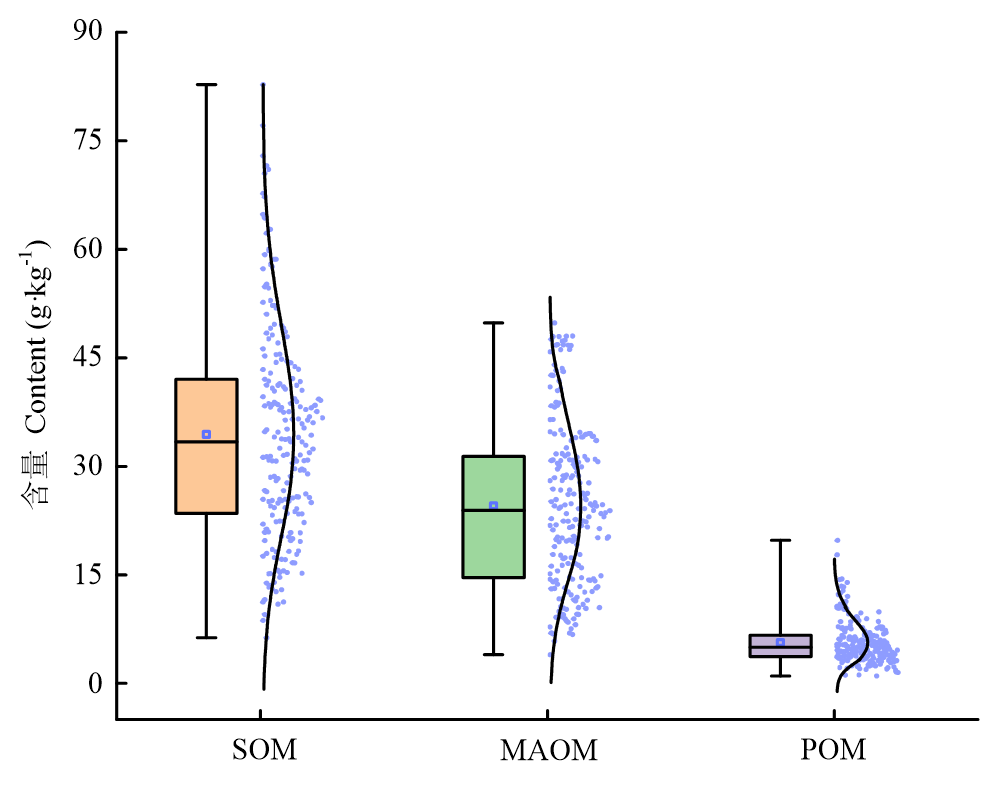
图2
松嫩平原土壤有机质及其组分含量分布 SOM:土壤有机质;POM:颗粒有机质;MAOM:矿物结合态有机质"

图3
松嫩平原土壤有机质组分含量的空间分布"
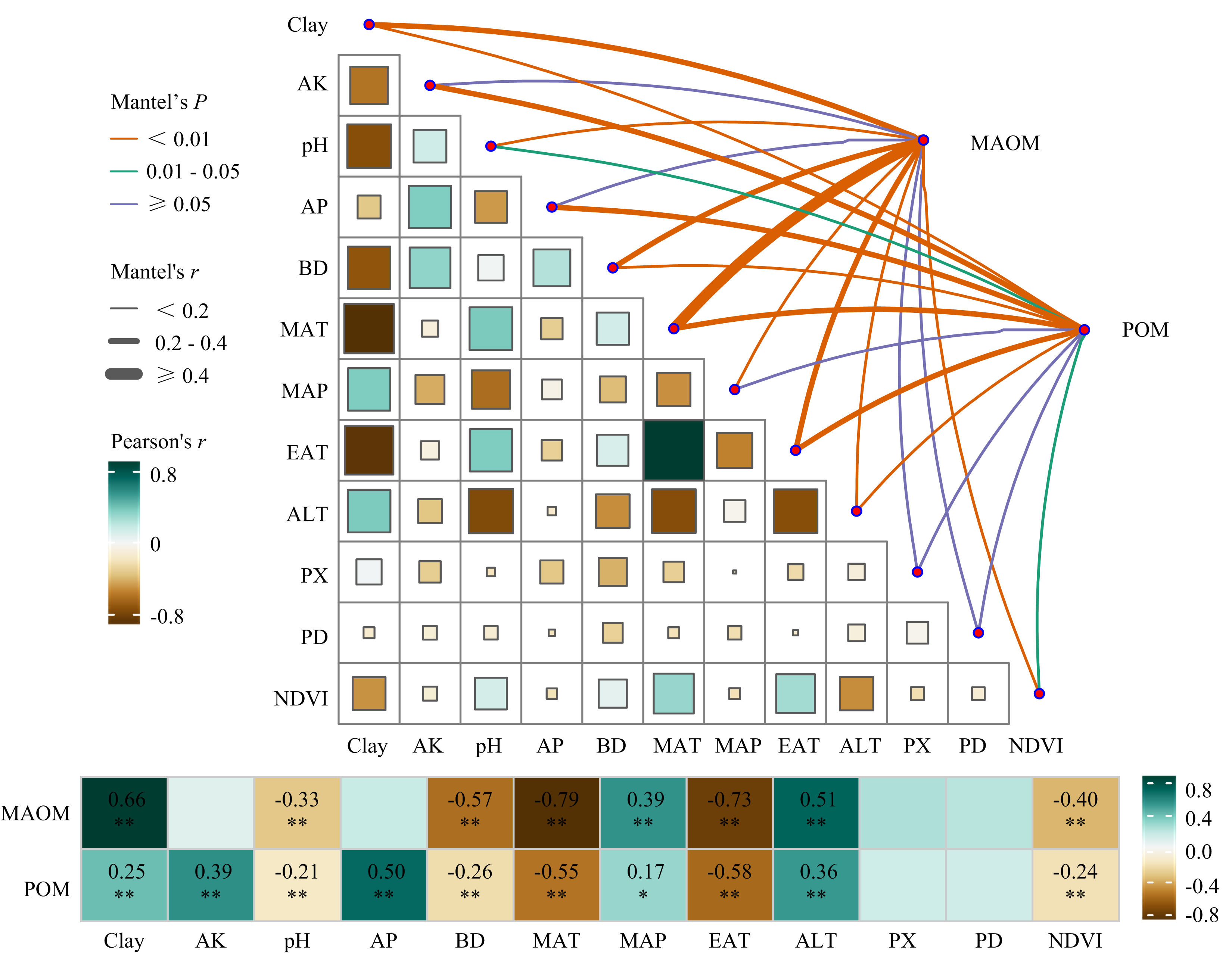
图4
松嫩平原区土壤有机质组分与各影响因素间的相关性分析 Clay:黏粒;AK:速效钾;AP:有效磷;BD:容重;MAT:年均温;MAP:年均降雨量;EAT:有效积温;ALT:海拔;PX:坡向;PD:坡度;NDVI:归一化指数。Pearson 相关系数用于评估变量相关性。*和**分别表示显著水平为P<0.05和P<0.01。下同"
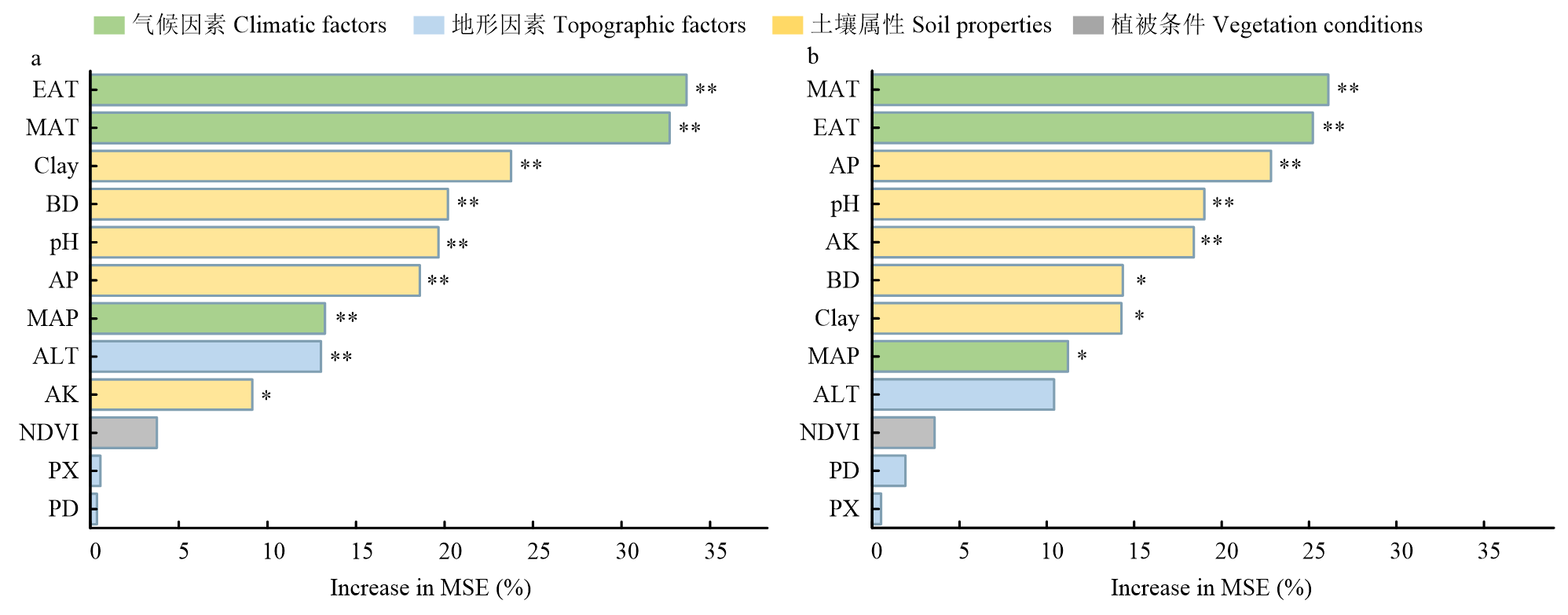
图5
松嫩平原环境变量对土壤有机质组分影响的相对重要性 a和b图分别为MAOM和POM中环境变量的相对重要性"
| [1] |
李保国, 刘忠, 黄峰, 杨晓光, 刘志娟, 万炜, 汪景宽, 徐英德, 李子忠, 任图生. 巩固黑土地粮仓保障国家粮食安全[J]. 中国科学院院刊, 2021, 36(10): 1184-1193.
|
|
|
|
| [2] |
崔裕敬, 宋春威. 松嫩平原典型黑土区土壤养分空间分布特征[J]. 现代农业科技, 2023(14): 174-177.
|
|
|
|
| [3] |
范益恺, 黎烨, 陈增明, 张楠, 丁维新. 三江平原旱作黑土质量演变及其驱动因子分析[J]. 农业工程学报, 2025, 41(20): 247-257.
|
|
|
|
| [4] |
doi: 10.2136/sssaj1992.03615995005600030017x |
| [5] |
doi: 10.1111/gcb.14859 pmid: 31587451 |
| [6] |
doi: 10.1038/ngeo2520 |
| [7] |
doi: 10.1111/gcb.16588 pmid: 36607159 |
| [8] |
doi: 10.1038/s41467-021-24192-8 pmid: 34226560 |
| [9] |
doi: 10.1016/j.scitotenv.2021.148569 |
| [10] |
doi: 10.1007/s40974-016-0034-7 |
| [11] |
doi: 10.1007/s11368-020-02809-7 |
| [12] |
doi: 10.1111/gcb.12113 pmid: 23504877 |
| [13] |
doi: 10.1111/gcb.14482 pmid: 30338884 |
| [14] |
doi: 10.1038/s41467-022-32681-7 pmid: 36038568 |
| [15] |
doi: 10.1016/j.geoderma.2018.05.024 |
| [16] |
doi: 10.1007/s10533-016-0247-z pmid: 32355381 |
| [17] |
doi: 10.1016/j.soilbio.2007.03.007 |
| [18] |
马红亮, 陈灿灿, 尹云锋, 高人. 森林土壤不同粒径颗粒的碳矿化研究[J]. 土壤学报, 2024, 61(5): 1247-1259.
|
|
|
|
| [19] |
杨之江, 陈效民, 景峰, 郭碧林, 林高哲. 基于GIS和地统计学的稻田土壤养分与重金属空间变异[J]. 应用生态学报, 2018, 29(6): 1893-1901.
doi: 10.13287/j.1001-9332.201806.036 |
|
|
|
| [20] |
张阳, 屠乃美, 谢会雅, 陈舜尧, 邓浏平, 傅雪平, 王旋, 何伟. 茶陵县烟稻复种区土壤养分时空变异特征[J]. 土壤通报, 2021, 52(2): 297-305.
|
|
doi: 10.1046/j.1365-2389.2001.00380.x |
|
| [21] |
秦诗涵, 孙继光, 常坤, 徐英德, 汪景宽. 松嫩平原黑土区土壤有机质含量时空变化及其影响因素[J]. 农业资源与环境学报, 2025, 42(1): 120-129.
|
|
|
|
| [22] |
doi: 10.1016/S1002-0160(09)60285-X |
| [23] |
田春花, 梅秀文, 姚益, 郝思祺, 张思宇, 李双异, 安婷婷, 汪景宽. 东北典型黑土区旱地土壤有机质组分的纬度分布特征及其影响因素[J]. 环境科学, 2026, 47(6): 4066-4072.
|
|
|
|
| [24] |
李洪义, 贺任彬, 谢模典, 习梦琴, 刘玉婷, 邓婉茗, 王俊婕, 胡碧峰, 陈颂超, 史舟. 自然和人为因素对耕地土壤有机质含量影响的研究[J]. 土壤通报, 2023, 54(5): 1050-1059.
|
|
|
|
| [25] |
李英姿, 李子君, 郑树伟, 林锦阔, 杨舒媛, 赵蕾, 张新新. 沂河流域土壤有机质空间分异及其影响因素[J]. 环境科学, 2025, 46(6): 3865-3876.
|
|
|
|
| [26] |
doi: 10.1016/j.catena.2025.109751 |
| [27] |
王冰洁, 秦诗涵, 李德成, 胡文友, 姜军, 迟凤琴, 张超, 张久明, 徐英德, 汪景宽. 黑龙江省嫩江市土壤容重空间分布格局及传递函数构建[J]. 中国农业科学, 2025, 58(9): 1791-1803. DOI: 10.3864/j.issn.0578-1752.2025.09.009.
|
|
|
|
| [28] |
申哲, 张认连, 龙怀玉, 王转, 朱国龙, 石乾雄, 喻科凡, 徐爱国. 基于3种空间预测方法的黄土区土壤颗粒组成空间分布研究: 以宁夏海原县为例[J]. 中国农业科学, 2020, 53(18): 3716-3728. DOI: 10.3864/j.issn.0578-1752.2020.18.008.
|
|
|
|
| [29] |
申哲, 张认连, 龙怀玉, 徐爱国. 基于机器学习方法的宁夏南部土壤质地空间分布研究[J]. 中国农业科学, 2022, 55(15): 2961-2972. DOI: 10.3864/j.issn.0578-1752.2022.15.008.
|
|
|
|
| [30] |
徐英德, 裴久渤, 李双异, 邹洪涛, 汪景宽, 张佳宝. 东北黑土地不同类型区主要特征及保护利用对策[J]. 土壤通报, 2023, 54(2): 495-504.
|
|
|
|
| [31] |
doi: 10.1007/s11442-017-1431-3 |
| [32] |
杨娥女, 王宝荣, 姚宏佳, 黄懿梅, 安韶山. 黄土高原生物土壤结皮发育过程中颗粒态和矿物结合态有机碳变化特征[J]. 水土保持研究, 2023, 30(1): 25-33, 40.
|
|
|
|
| [33] |
冯玉杰, 张巍, 陈桥, 马程慧. 松嫩平原盐碱化草原土壤理化特性及微生物结构分析[J]. 土壤, 2007, 39(2): 301-305.
|
|
|
|
| [34] |
赵仁竹. 吉林西部盐碱水田不同土壤质地酶活性与有机碳的变化规律及关系研究[D]. 长春: 吉林大学, 2016.
|
|
|
|
| [35] |
吴建国, 艾丽, 田自强, 常学向. 祁连山中部土壤颗粒组分有机质碳含量及其与海拔和植被的关系[J]. 生态环境, 2008, 17(6): 2358-2365.
|
|
|
|
| [36] |
王冰洁. 松嫩平原黑土地土壤“变硬”关键要素空间变异及传递函数构建[D]. 沈阳: 沈阳农业大学, 2025.
|
|
|
|
| [37] |
doi: 10.1038/s41561-023-01354-5 |
| [38] |
doi: 10.1038/s41467-022-31540-9 pmid: 35778395 |
| [39] |
doi: 10.1016/j.geoderma.2024.116942 |
| [40] |
doi: 10.2136/sssaj2011.0340 |
| [41] |
陈颖洁, 房凯, 秦书琪, 郭彦军, 杨元合. 内蒙古温带草地土壤有机碳组分含量和分解速率的空间格局及其影响因素[J]. 植物生态学报, 2023, 47(9): 1245-1255.
doi: 10.17521/cjpe.2023.0028 |
|
doi: 10.17521/cjpe.2023.0028 |
|
| [42] |
doi: 10.1128/AEM.02775-08 pmid: 19151179 |
| [43] |
doi: 10.1016/j.geoderma.2020.114234 |
| [44] |
胡培. 土壤颗粒组成与有机质含量对水稻土容重的影响[J]. 农村经济与科技, 2021, 32(19): 48-51.
|
|
|
|
| [45] |
易树生. 长期有机无机肥配施对西北旱地麦田土壤物理性质的影响[D]. 杨凌: 西北农林科技大学, 2024.
|
|
|
|
| [46] |
doi: 10.1016/j.catena.2017.03.019 |
| [47] |
doi: 10.1111/gcb.2008.14.issue-10 |
| [48] |
doi: 10.1016/S1002-0160(18)60032-3 |
| [49] |
张祎, 李鹏, 肖列, 赵宾华, 时鹏. 黄土高原丘陵区地形和土地利用对土壤有机碳的影响[J]. 土壤学报, 2019, 56(5): 1140-1150.
|
|
|
|
| [50] |
王朔林, 王改兰, 赵旭, 陈春玉, 黄学芳. 长期施肥对栗褐土有机碳含量及其组分的影响[J]. 植物营养与肥料学报, 2015, 21(1): 104-111.
|
|
|
|
| [51] |
杨熳, 张丽敏, 武亚楠, 严令斌, 袁冬梅, 喻理飞. 荔波茂兰喀斯特植被恢复中土壤有机碳稳定性变化[J]. 山地农业生物学报, 2022, 41(3): 28-33, 79.
|
|
|
| [1] | 罗海琴, 罗仁林, 刘廷辉, 郭伟龙, 曾子贤, 朱博. 禾本科作物抗倒伏研究进展、瓶颈与应对策略[J]. 中国农业科学, 2026, 59(8): 1587-1607. |
| [2] | 田立文, 张胜, 田聪华, 马婷, 崔建平, 房彦飞, 罗宏海, 娄善伟. 新疆棉花产业现状及其影响因素分析与对策[J]. 中国农业科学, 2026, 59(21): 4784-4801. |
| [3] | 王思翔, 刘亚龙, 王萍, 汪景宽. 东北地区近30年农资投入驱动的碳排放时空格局演化特征[J]. 中国农业科学, 2026, 59(12): 2686-2696. |
| [4] | 王冰洁, 秦诗涵, 李德成, 胡文友, 姜军, 迟凤琴, 张超, 张久明, 徐英德, 汪景宽. 黑龙江省嫩江市土壤容重空间分布格局及传递函数构建[J]. 中国农业科学, 2025, 58(9): 1791-1803. |
| [5] | 牟树佳, 董莉霞, 李广, 燕振刚, 逯玉兰. 基于鲸鱼算法的旱地春小麦农田土壤N2O排放模型参数优化[J]. 中国农业科学, 2025, 58(3): 537-547. |
| [6] | 田云, 王骁睿, 尹忞昊, 张蕙杰. 中国农业净碳汇再测算:现状特征、时空格局及其影响因素[J]. 中国农业科学, 2024, 57(22): 4507-4521. |
| [7] | 李思奇, 王志慧, 常玉瑶, 吉艳芝, 郭艳杰, 刘俊, 张丽娟, 王娅静. 河北永定河流域葡萄园土壤硝态氮空间分布特征[J]. 中国农业科学, 2023, 56(17): 3399-3411. |
| [8] | 田云, 尹忞昊, 张蕙杰. 我国农村能源碳排放时空格局、影响因素及空间溢出效应[J]. 中国农业科学, 2023, 56(13): 2547-2562. |
| [9] | 余维宝, 李楠, 寇一泓, 曹新有, 司纪升, 韩守威, 李豪圣, 张宾, 王法宏, 张海林, 赵鑫, 李华伟. 山东省强筋小麦品质评价及与气象因子关系分析[J]. 中国农业科学, 2022, 55(22): 4383-4397. |
| [10] | 申哲,张认连,龙怀玉,徐爱国. 基于机器学习方法的宁夏南部土壤质地空间分布研究[J]. 中国农业科学, 2022, 55(15): 2961-2972. |
| [11] | 李少华,王云鹏,王荣成,尹萍,李向东,郑方强. 玉米田桃蛀螟幼虫的空间分布型与抽样技术[J]. 中国农业科学, 2022, 55(10): 1961-1970. |
| [12] | 任俊波, 杨雪丽, 陈平, 杜青, 彭西红, 郑本川, 雍太文, 杨文钰. 种间距离对玉米-大豆带状套作土壤理化性状及根系空间分布的影响[J]. 中国农业科学, 2022, 55(10): 1903-1916. |
| [13] | 李方杰,任建强,吴尚蓉,陈仲新,张宁丹. 河南省冬小麦种植频率时空变化及影响因素分析[J]. 中国农业科学, 2020, 53(9): 1773-1794. |
| [14] | 田云,王梦晨. 湖北省农业碳排放效率时空差异及影响因素[J]. 中国农业科学, 2020, 53(24): 5063-5072. |
| [15] | 魏启航,任艳芳,何俊瑜,李兆君. 畜禽养殖废弃物堆肥过程中微生物除臭研究进展[J]. 中国农业科学, 2020, 53(15): 3134-3145. |
|
||
