






中国农业科学 ›› 2026, Vol. 59 ›› Issue (19): 4277-4288.doi: 10.3864/j.issn.0578-1752.2026.19.007
包雨凡1( ), 珠娜1, 张敬敏1, 赵曼2, 刘嘉慧1, 罗玉红1, 李乐1, 徐诺1, 闫玉春1()
收稿日期:2025-11-25
接受日期:2026-03-12
出版日期:2026-10-01
发布日期:2026-10-10
通信作者:
联系方式:
包雨凡,E-mail:1244172698@qq.com。
基金资助:
BAO YuFan1(), ZHU Na1, ZHANG JingMin1, ZHAO Man2, LIU JiaHui1, LUO YuHong1, LI Le1, XU Nuo1, YAN YuChun1()
Received:2025-11-25
Accepted:2026-03-12
Published:2026-10-01
Online:2026-10-10
摘要:
【目的】探究内蒙古典型草原开垦后长期耕种及退耕后造林对土壤氮、磷养分的影响,以期为草地合理利用和可持续发展提供科学依据。【方法】于2020年8月选择内蒙古锡林郭勒典型草原的天然草地、耕地(连续耕种60年)以及灌木林地(退耕造林17—18年)进行土壤采样,分层采集0—50 cm土层土样,测定不同利用方式下土壤全氮(TN)、全磷(TP)、铵态氮(NH4+-N),硝态氮(NO3--N)以及速效磷(AP)的含量,并计算、比较、分析用地类型变化对土壤氮、磷养分含量的影响。【结果】天然草地开垦和退耕造林对土壤氮、磷养分有显著影响:(1)天然草地开垦并长期耕种显著减少了0—10 cm土层全氮、全磷和铵态氮的含量,显著增加了0—30 cm土层速效磷的含量。(2)退耕并种植灌木后,土壤全氮和铵态氮含量没有显著变化,而土壤硝态氮含量(0—50 cm)、土壤全磷(20—50 cm土层)、土壤速效磷(0—30 cm土层)含量均显著下降。(3)土壤硝态氮和速效磷等速效养分对土地利用变化的响应更为剧烈。【结论】天然草地开垦后使土壤全氮、全磷含量下降,而当前以豆科灌木造林配合林下草本刈割的管理模式,难以在短期内实现土壤养分的有效恢复,甚至会加剧磷素的缺乏。
包雨凡, 珠娜, 张敬敏, 赵曼, 刘嘉慧, 罗玉红, 李乐, 徐诺, 闫玉春. 连续耕种和退耕造林对典型草原氮、磷养分的影响[J]. 中国农业科学, 2026, 59(19): 4277-4288.
BAO YuFan, ZHU Na, ZHANG JingMin, ZHAO Man, LIU JiaHui, LUO YuHong, LI Le, XU Nuo, YAN YuChun. Effects of Continuous Cultivation and Cropland Afforestation on Nitrogen and Phosphorus Nutrients in Typical Steppe[J]. Scientia Agricultura Sinica, 2026, 59(19): 4277-4288.

表1
样地基本特征"
| 样地1 Site1 | 样地2 Site2 | 样地3 Site3 | 样地4 Site4 | 样地5 Site5 | ||||||
|---|---|---|---|---|---|---|---|---|---|---|
| 草地 Grassland | 优势种 Dominant species | 糙隐子草、羊草、苔草、克氏针茅 Cleistogenes squarrosa, Leymus chinensis, Carex duriuscula, Stipa krylovii | ||||||||
| 管理方式 Management | 放牧 Grazing | 放牧 Grazing | 刈割 Mowing | 刈割 Mowing | 刈割 Mowing | |||||
| 耕地 Cropland | 开垦年限 Cultivation duration (a) | 60 | 60 | 60 | 60 | 60 | ||||
| 作物类型 Crop type | 向日葵 Helianthus annuus | 小麦 Triticum aestivum | 小麦 Triticum aestivum | 小麦 Triticum aestivum | 苜蓿 Medicago sativa | |||||
| 管理方式 Management | 1960-2013:小麦-燕麦轮作 2013-2020:小麦-燕麦-向日葵轮作 灌溉 施肥 Triticum aestivum-Avena sativa rotation from1960 to 2013, Triticum aestivum-Avena sativa and Helianthus annuus rotation after 2013 Irrigation Fertilization | 1960-2020:小麦-燕麦轮作 施肥 Triticum aestivum-Avena sativa rotation from1960 to 2020 Fertilization | 1960-2020:小麦-燕麦轮作 施肥 Triticum aestivum-Avena sativa rotation from1960 to 2020 Fertilization | 1960-2020:小麦-燕麦轮作 施肥 Triticum aestivum-Avena sativa rotation from1960 to 2020 Fertilization | 1960-2017:小麦 2017-2020:苜蓿 灌溉 施肥 Triticum aestivum planting from 1960 to 2017, Medicago sativa planting after 2017 Irrigation Fertilization | |||||
| 灌木林地 Shrubland | 土地利用历史 Land use history | 开垦43年后退耕造林17年 Afforestation for 17 years following a 43-year cultivation | 开垦43年后退耕造林17年 Afforestation for 17 years following a 43-year cultivation | 开垦43年后退耕造林17年 Afforestation for 17 years following a 43-year cultivation | 开垦43年后退耕造林17年 Afforestation for 17 years following a 43-year cultivation | 开垦42年后退耕造林18年 Afforestation for 18 years following a 42-year cultivation | ||||
| 林下草地优势种 Understory dominant species | 黄蒿Artemisia scoparia 披碱草Elymus dahuricus 糙隐子草Cleistogenes squarrosa | 大籽蒿Artemisia sieversiana 黄蒿Artemisia scoparia | 糙隐子草Cleistogenes squarrosa 黄蒿Artemisia scoparia 无芒雀麦Bromus inermis | 羊草Leymus chinensis 黄蒿Artemisia scoparia | 羊草Leymus chinensis 阿尔泰狗娃花Heteropappus altaicus | |||||
| 管理方式 Management | 刈割 Mowing | 刈割 Mowing | 放牧 Grazing | 刈割 Mowing | 放牧 Grazing | |||||
表2
用地类型、土层以及样点对土壤氮、磷养分的影响"
| 变量 Variable | 全氮 Total nitrogen, TN | 全磷 Total phosphorus, TP | 铵态氮 Ammonium nitrogen | 硝态氮 Nitrate nitrogen | 速效磷 Available phosphorus | 铵态氮/全氮 Ammonium nitrogen/TN | 硝态氮/全氮 Nitrate nitrogen/TN | 速效磷/全磷 Available phosphorus/TP | ||||||||
|---|---|---|---|---|---|---|---|---|---|---|---|---|---|---|---|---|
| F | Sig. | F | Sig. | F | Sig. | F | Sig. | F | Sig. | F | Sig. | F | Sig. | F | Sig. | |
| 用地类型 Land-use type | 53.512 | *** | 48.436 | *** | 10.335 | *** | 71.255 | *** | 71.747 | *** | 11.716 | *** | 58.027 | *** | 53.167 | *** |
| 土层Soil layer | 125.073 | *** | 24.866 | *** | 7.442 | *** | 16.498 | *** | 30.032 | *** | 31.246 | *** | 2.522 | * | 8.489 | *** |
| 样点Site | 104.697 | *** | 28.8 | *** | 9.841 | *** | 0.537 | NS | 25.589 | *** | 47.637 | *** | 14.011 | *** | 17.217 | *** |
| 用地类型×土层 Land-use type× Soil layer | 6.012 | *** | 1.006 | NS | 1.694 | 0.07 | 2.433 | *** | 9.551 | *** | 5.014 | *** | 0.671 | NS | 8.007 | *** |
| 用地类型×样点 Land-use type×Site | 2.048 | * | 4.1 | *** | 15.657 | *** | 2.479 | *** | 6.983 | *** | 18.487 | *** | 6.343 | *** | 7.098 | *** |
| 土层×样点 Soil layer×Site | 3.923 | *** | 1.993 | * | 1.174 | 0.292 | 1.322 | NS | 2.156 | ** | 3.999 | *** | 1.248 | NS | 1.062 | NS |
| 用地类型×土层×样点 Land-use type× Soil layer×Site | 1.414 | * | 0.709 | NS | 0.989 | 0.501 | 1.618 | * | 1.072 | NS | 2.197 | *** | 1.966 | ** | 0.968 | NS |
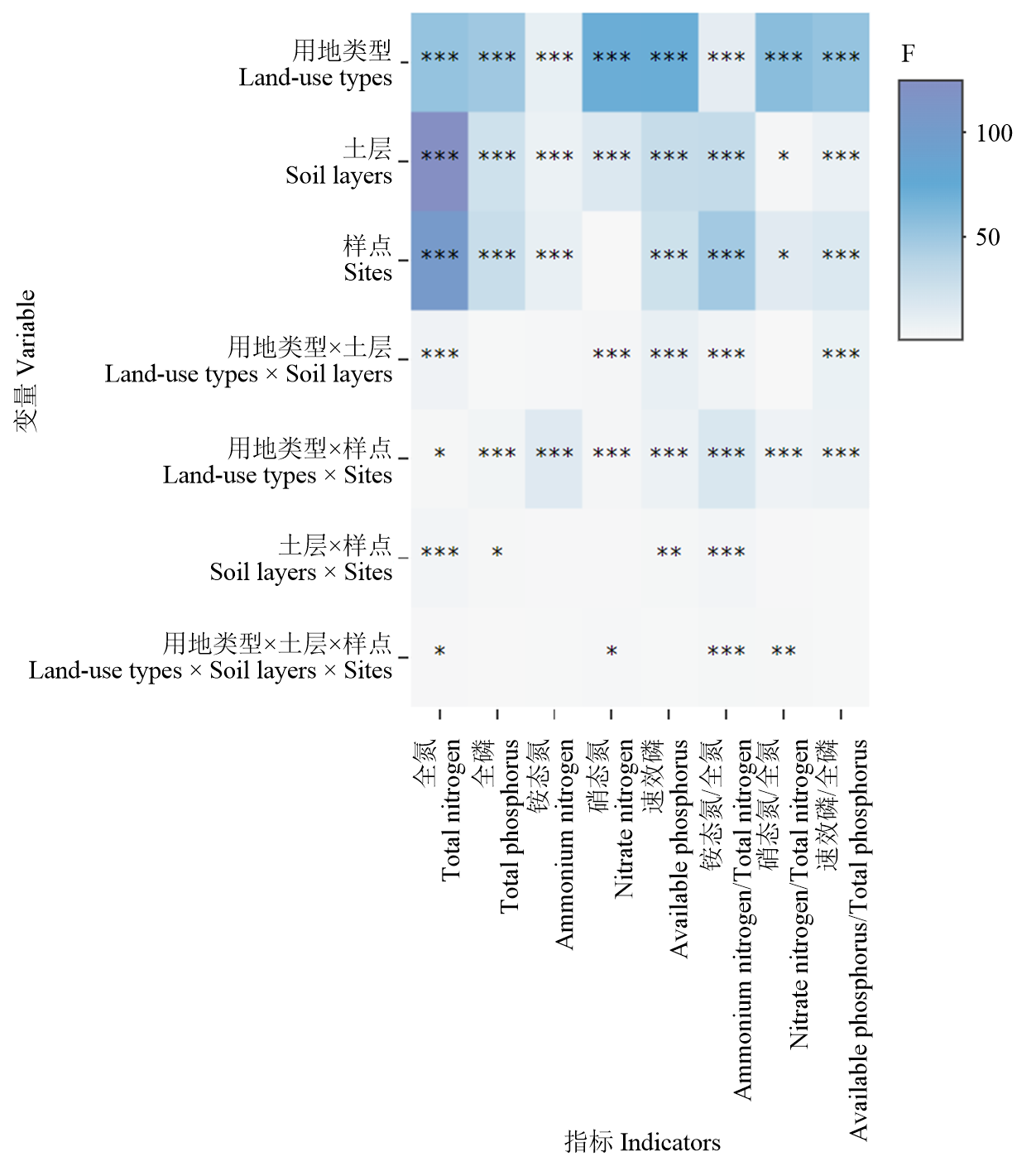
图1
用地类型、土层以及样点对土壤氮、磷养分的影响 *:P<0.05, **:P<0.01, ***P<0.001"
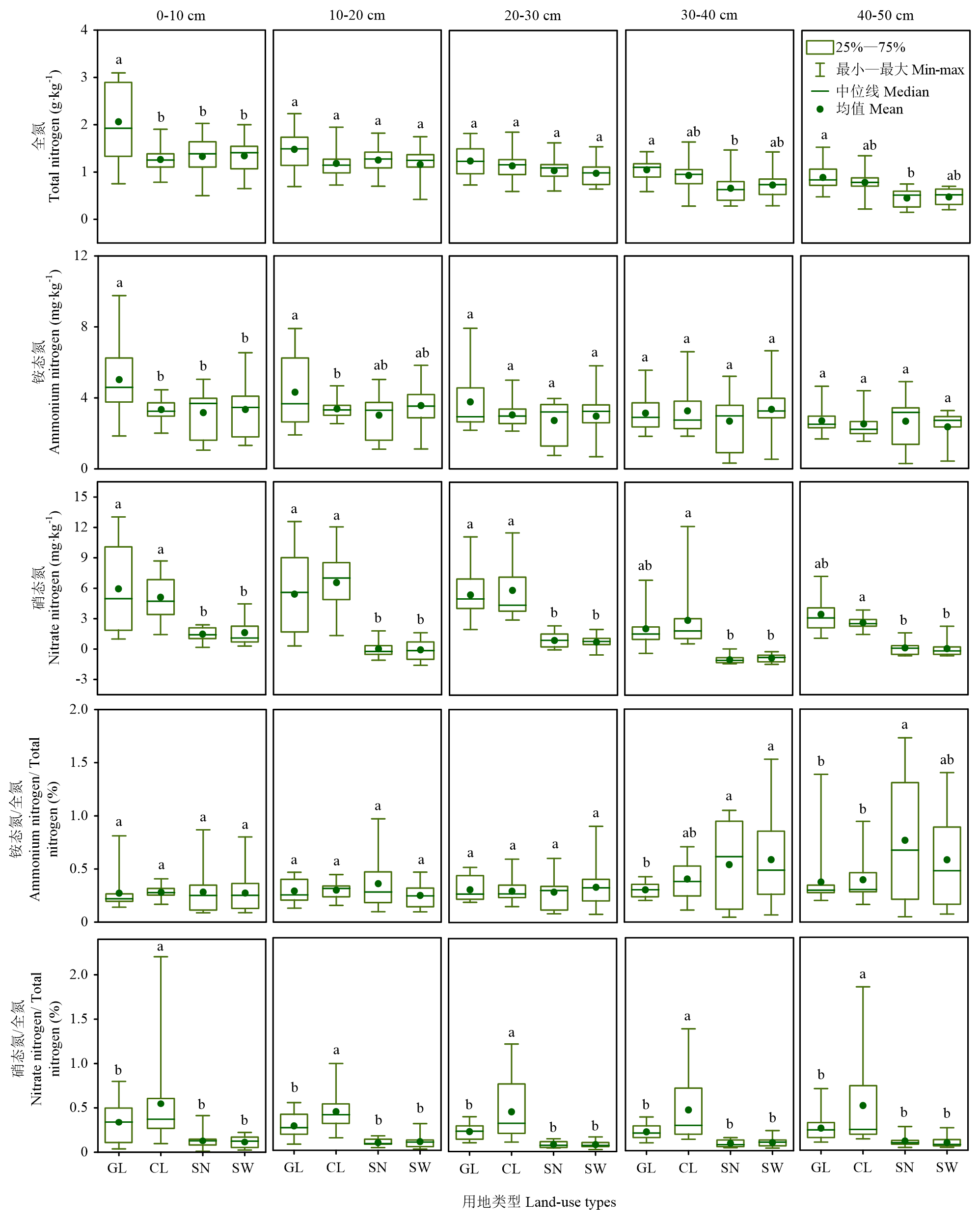
图2
不同土层、用地类型中土壤全氮、铵态氮和硝态氮含量及其比例 GL:草地,CL:耕地,SN:窄行距灌木林地,SW:宽行距灌木林地。不同小写字母表示用地类型间的显著差异(P<0.05)。下同"
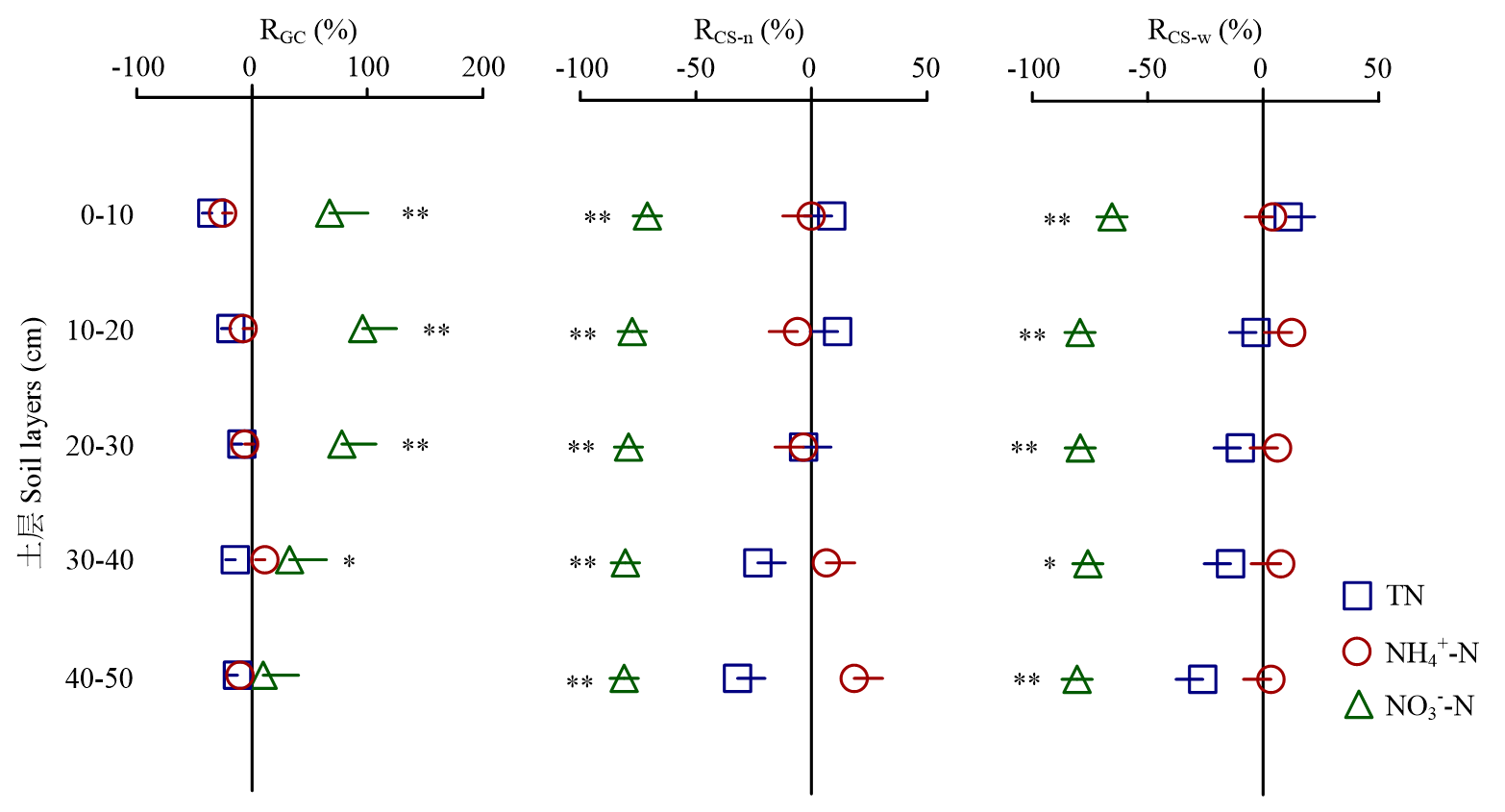
图3
不同土层下不同用地类型土壤全氮、铵态氮和硝态氮含量的变化比 RGC:天然草地改变为耕地,RCS-n:耕地改变为窄行距灌木林地,RCS-w:耕地改变为宽行距灌木林地。下同 *表示全氮、铵态氮和硝态氮的变化比差异显著(*: P<0.05, **: P<0.01)"
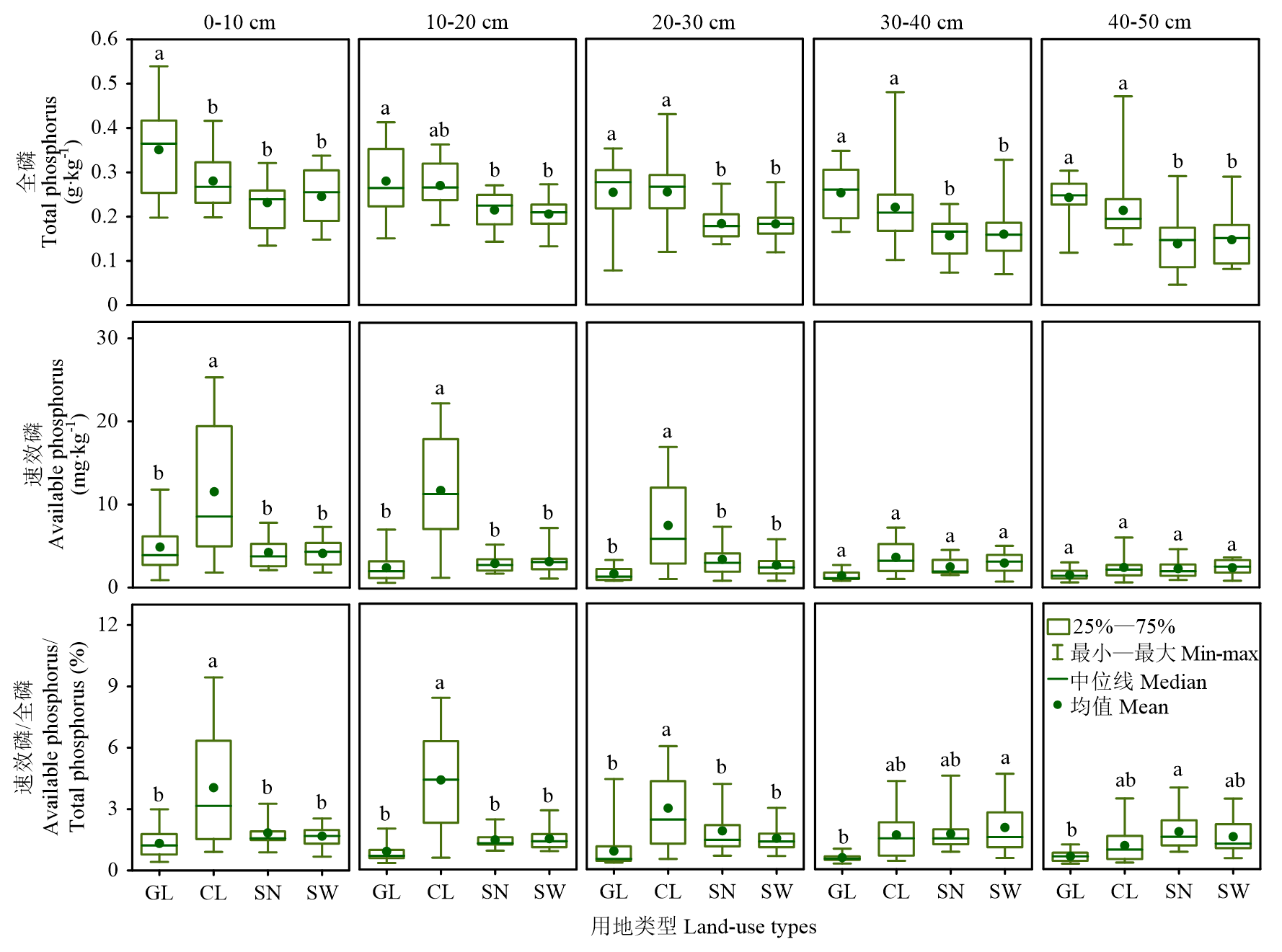
图4
不同土层下不同用地类型中土壤全磷和速效磷的含量及其比例"
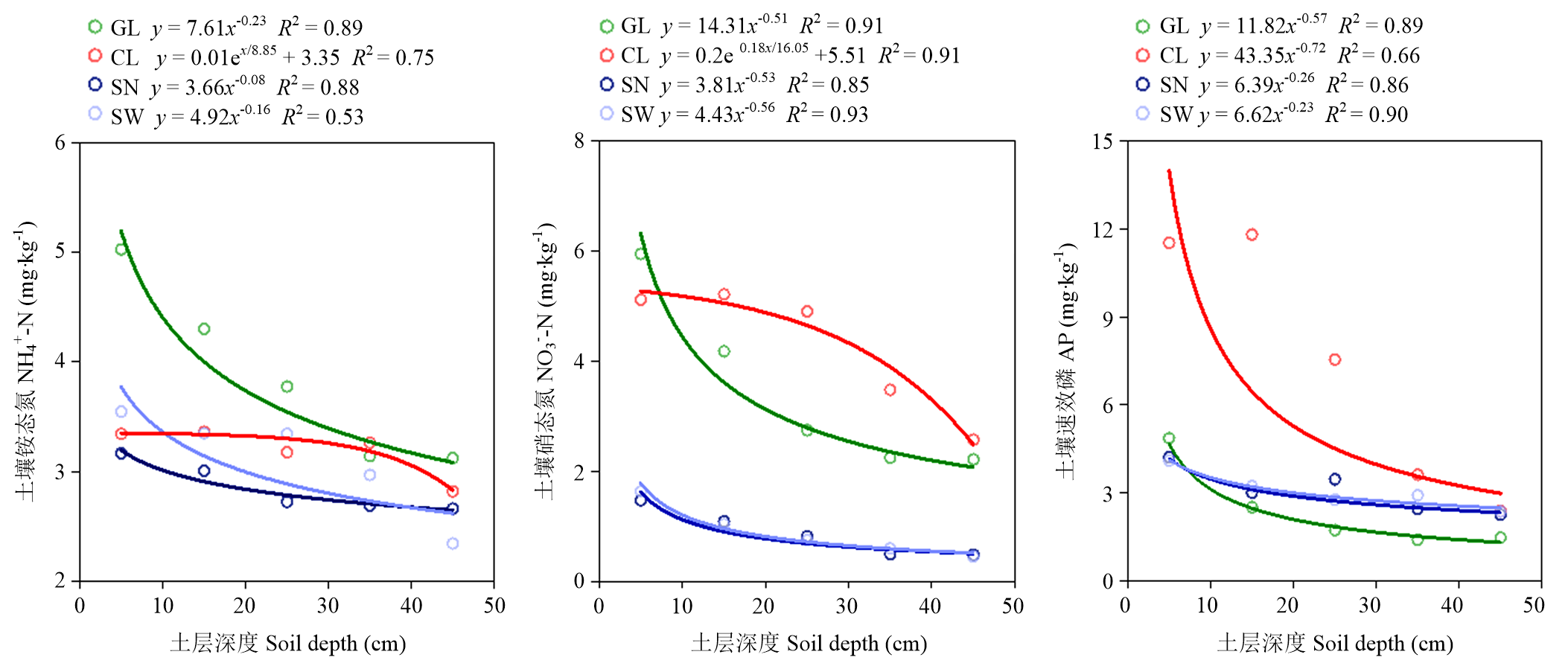
图5
不同用地类型中土壤铵态氮、硝态氮和速效磷随土层深度的变化"
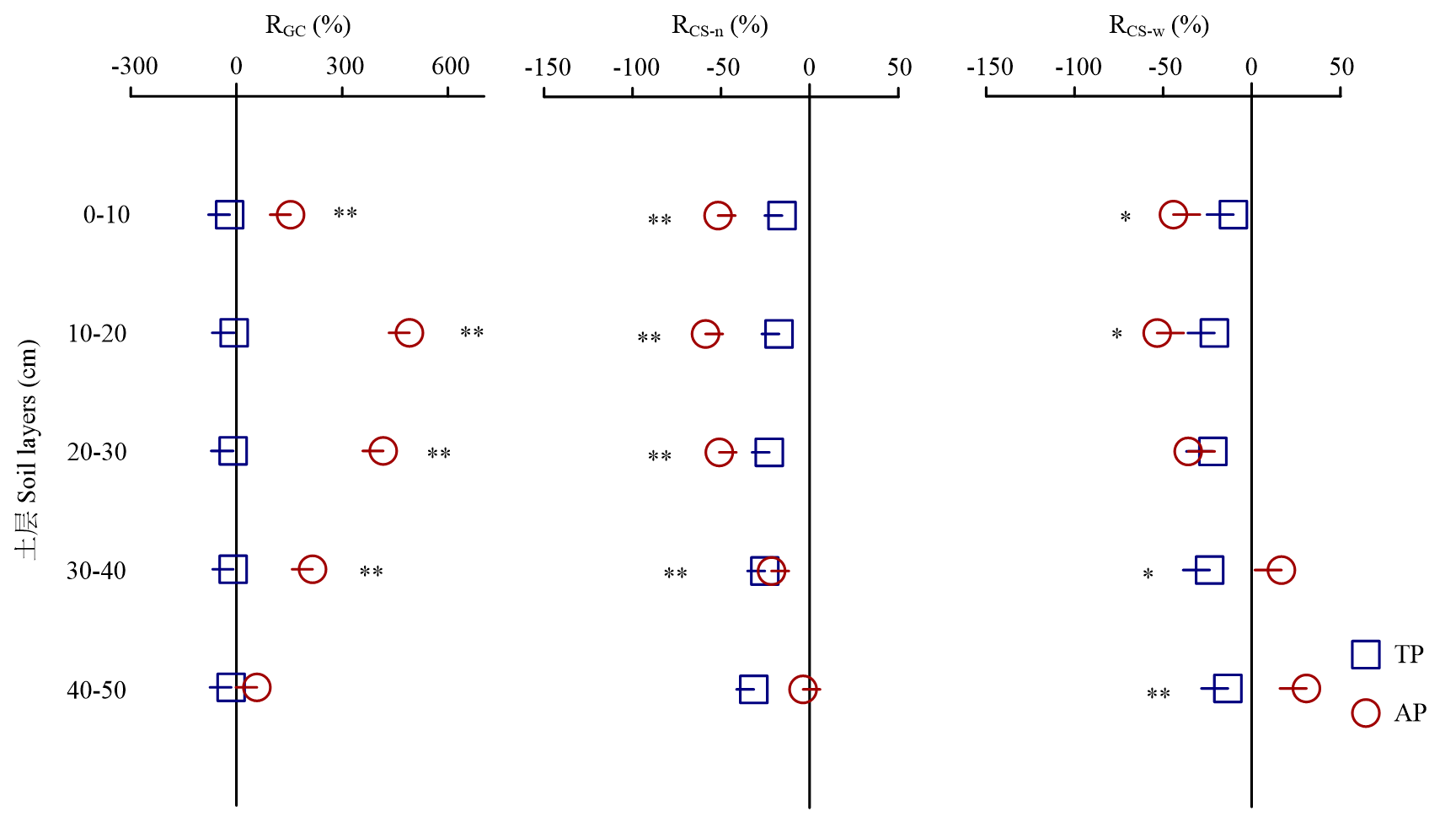
图6
用地类型变化后不同土层土壤全磷、速效磷含量的变化比 *表示全磷与速效磷含量变化比差异显著"
| [1] |
沈海花, 朱言坤, 赵霞, 耿晓庆, 高树琴, 方精云. 中国草地资源的现状分析[J]. 科学通报, 2016, 61(2): 139-154.
|
|
|
|
| [2] |
刘纪远, 匡文慧, 张增祥, 徐新良, 秦元伟, 宁佳, 周万村, 张树文, 李仁东, 颜长珍, 吴世新, 史学正, 江南, 于东升, 潘贤章, 迟文峰. 20世纪80年代末以来中国土地利用变化的基本特征与空间格局[J]. 地理学报, 2014, 69(1): 3-14.
doi: 10.11821/dlxb201401001 |
|
doi: 10.11821/dlxb201401001 |
|
| [3] |
doi: 10.1016/j.fcr.2015.10.013 |
| [4] |
孙根年, 王美红. 内蒙古植被覆盖与土地退化关系及空间结构研究[J]. 干旱区资源与环境, 2008, 22(2): 140-144.
|
|
|
|
| [5] |
贾幼陵. 草原退化原因分析和草原保护长效机制的建立[J]. 中国草地学报, 2011, 33(2): 1-6.
|
|
|
|
| [6] |
|
| [7] |
doi: 10.1016/S0378-1127(02)00304-3 |
| [8] |
doi: 10.3390/su13052554 |
| [9] |
doi: 10.1071/SR14151 |
| [10] |
doi: 10.4141/S01-026 |
| [11] |
doi: 10.1515/intag-2015-0003 |
| [12] |
夏文建, 张丽芳, 刘增兵, 张文学, 蓝贤瑾, 刘秀梅, 刘佳, 刘光荣, 李祖章, 王萍. 长期施用化肥和有机肥对稻田土壤重金属及其有效性的影响[J]. 环境科学, 2021, 42(5): 2469-2479.
|
|
|
|
| [13] |
|
| [14] |
王百群, 吴金水, 赵世伟. 子午岭林区植被类型对土壤氮素的效应[J]. 水土保持通报, 2002, 22(6): 23-25.
|
|
|
|
| [15] |
沈有信, 张彦东, 刘文耀. 泥石流多发干旱河谷区植被恢复研究[J]. 山地学报, 2002, 20(2): 188-193.
|
|
|
|
| [16] |
盛才余, 刘伦辉, 刘文耀. 云南南涧干热退化山地人工植被恢复初期生物量及土壤环境动态[J]. 植物生态学报, 2000, 24(5): 575-580.
|
|
|
|
| [17] |
doi: 10.1002/ldr.v28.1 |
| [18] |
|
| [19] |
doi: 10.1641/B580909 |
| [20] |
doi: 10.1038/379718a0 |
| [21] |
张涛, 刘阳, 袁航, 张岩, 侯扶江. 开垦种草对高寒草甸土壤理化性质的影响[J]. 草业科学, 2012, 29(11): 1655-1659.
|
|
|
|
| [22] |
doi: 10.1007/s11104-010-0292-7 |
| [23] |
doi: 10.2136/sssaj1988.03615995005200040034x |
| [24] |
doi: 10.1016/j.foreco.2007.01.087 |
| [25] |
doi: 10.1007/s10533-014-9980-3 |
| [26] |
李世清, 李生秀. 半干旱地区农田生态系统中硝态氮的淋失. 应用生态学报, 2000, 11(2): 240-242.
pmid: 11767604 |
|
pmid: 11767604 |
|
| [27] |
寇长林, 巨晓棠, 张福锁. 三种集约化种植体系氮素平衡及其对地下水硝酸盐含量的影响[J]. 应用生态学报, 2005, 16(4): 660-667.
|
|
|
|
| [28] |
doi: 10.2307/2405251 |
| [29] |
邹元春, 吕宪国, 姜明. 不同开垦年限湿地土壤铁变化特征研究[J]. 环境科学, 2008, 29(3): 814-818.
|
|
|
|
| [30] |
doi: 10.1007/s10021-001-0067-3 |
| [31] |
doi: 10.1016/j.soilbio.2014.11.022 |
| [32] |
doi: 10.1016/j.ecoleng.2012.12.061 |
| [33] |
廖圣祥, 任运涛, 袁晓波, 李旭东, 郭丁, 李金博, 傅华. 围封对黄土高原草地土壤铵态氮和硝态氮的影响[J]. 草业科学, 2016, 33(6): 1044-1053.
|
|
|
|
| [34] |
doi: 10.1111/nph.14494 pmid: 28262951 |
| [35] |
doi: 10.1111/jec.2017.105.issue-5 |
| [36] |
doi: 10.1007/s10533-009-9332-x |
| [37] |
doi: 10.1016/j.foreco.2010.03.027 |
| [38] |
doi: 10.1111/gcb.2011.17.issue-4 |
| [39] |
doi: 10.1073/pnas.0509038103 pmid: 16614072 |
| [1] | 陈桂平, 韦金贵, 郭瑶, 李盼, 王菲儿, 仇海龙, 冯福学, 殷文. 宽窄行与增密对绿洲灌区玉米光合特性及资源利用的协同效应[J]. 中国农业科学, 2026, 59(2): 278-291. |
| [2] | 吕旭东, 孙世媛, 李亚楠, 刘玉龙, 王艳群, 付鑫, 张佳英, 宁鹏, 彭正萍. 智能机械化分层施肥对麦田根-土养分分布和小麦产量的影响[J]. 中国农业科学, 2026, 59(1): 129-146. |
| [3] | 李帅兵, 李晨欣, 任丽, 于晓娜, 耿赛男, 盛开, 张银杰, 王宜伦. 种植大豆促进后茬小麦磷吸收和土壤磷形态转化[J]. 中国农业科学, 2025, 58(19): 3932-3945. |
| [4] | 罗玉红, 黄予姝, 珠娜, 李乐, 程延彬, 刘嘉慧, 张敬敏, 包雨凡, 徐诺, 闫玉春. 锡林郭勒盟典型草原区草地开垦及退耕造林对土壤粒径分布和养分的影响[J]. 中国农业科学, 2024, 57(24): 4919-4932. |
| [5] | 贾兵丽, 李艳行, 杨文杰, 于杰, 苑爱静, 李宁娜, 邱炜红, 王朝辉. 不同降水年型磷肥对旱地冬小麦产量及磷素吸收利用的影响[J]. 中国农业科学, 2024, 57(16): 3192-3206. |
| [6] | 王箫璇, 张敏, 张鑫尧, 魏鹏, 柴如山, 张朝春, 张亮亮, 罗来超, 郜红建. 不同磷肥对砂姜黑土和红壤磷库转化及冬小麦磷素吸收利用的影响[J]. 中国农业科学, 2023, 56(6): 1113-1126. |
| [7] | 张锦源,李彦生,于镇华,谢志煌,刘俊杰,王光华,刘晓冰,吴俊江,Stephen J Herbert,金剑. 作物-土壤氮循环对大气CO2浓度和温度升高响应的研究进展[J]. 中国农业科学, 2021, 54(8): 1684-1701. |
| [8] | 王新媛,赵思达,郑险峰,王朝辉,何刚. 秸秆还田和氮肥用量对冬小麦产量和氮素利用的影响[J]. 中国农业科学, 2021, 54(23): 5043-5053. |
| [9] | 盖霞普,刘宏斌,杨波,王洪媛,翟丽梅,雷秋良,武淑霞,任天志. 不同施肥年限下作物产量及土壤碳氮库容对增施有机物料的响应[J]. 中国农业科学, 2019, 52(4): 676-689. |
| [10] | 李若楠,黄绍文,史建硕,王丽英,唐继伟,张怀志,袁硕,翟凤芝,任燕利,郭丽. 日光温室冬春茬黄瓜滴灌的肥水优化管理[J]. 中国农业科学, 2019, 52(20): 3648-3660. |
| [11] | 奚雅静,汪俊玉,李银坤,武雪萍,李晓秀,王碧胜,李生平,宋霄君,刘彩彩. 滴灌水肥一体化配施有机肥对土壤N2O排放与酶活性的影响[J]. 中国农业科学, 2019, 52(20): 3611-3624. |
| [12] | 王 慧,刘金山,惠晓丽,戴 健,王朝辉. 旱地土壤有机碳氮和供氮能力对长期不同氮肥用量的响应[J]. 中国农业科学, 2016, 49(15): 2988-2998. |
| [13] | 张亦涛,任天志,刘宏斌,雷秋良,翟丽梅,王洪媛,刘申,尹昌斌,张继宗. 玉米大豆间作降低小麦玉米轮作体系 土壤氮残留的效应与机制[J]. 中国农业科学, 2015, 48(13): 2580-2590. |
| [14] | 关连珠, 禅忠祥, 张金海, 张广才, 张昀. 炭化玉米秸秆对棕壤磷素组分及有效性的影响[J]. 中国农业科学, 2013, 46(10): 2050-2057. |
| [15] | 黄景, 顾明华, 徐世宏, 杨为芳, 江立庚. 稻草还田免耕抛秧对土壤剖面氮、磷、钾含量的影响[J]. 中国农业科学, 2012, 45(13): 2648-2657. |
|
||
