






中国农业科学 ›› 2026, Vol. 59 ›› Issue (14): 3185-3202.doi: 10.3864/j.issn.0578-1752.2026.14.014
段瑞培( ), 夏双梅, 张艺, 郭玉杰, 张兴(), 张春晖
收稿日期:2025-12-19
接受日期:2026-04-27
出版日期:2026-07-16
发布日期:2026-07-21
通信作者:
联系方式:
段瑞培,E-mail:1738958080@qq.com。
基金资助:
DUAN RuiPei(), XIA ShuangMei, ZHANG Yi, GUO YuJie, ZHANG Xing(), ZHANG ChunHui
Received:2025-12-19
Accepted:2026-04-27
Published:2026-07-16
Online:2026-07-21
摘要:
【目的】明确培养肉(cultured meat,CM)与鸡胸肉(chicken breast,CB)、鸡腿肉(chicken thigh,CT)营养品质和加工品质的差异,利用蛋白组学技术解析造成培养肉与鸡胸肉、鸡腿肉品质差异的原因,为培养肉的食品化加工提供理论依据。【方法】评估培养肉与鸡胸肉、鸡腿肉在蛋白质、水分、脂肪、维生素、矿物质、脂肪酸、氨基酸方面的组成差异,并对培养肉的以上营养品质进行评价;测定培养肉与鸡胸肉、鸡腿肉的pH、色差、保水性,并对培养肉的以上加工品质进行评价;最后利用蛋白组学对培养肉与鸡胸肉、鸡腿肉差异表达的蛋白质进行探究,通过Gene Ontology(GO)和Kyoto Encyclopedia of Genes and Genomes(KEGG)方法注释差异蛋白的代谢通路,从而解释造成培养肉与鸡胸肉、鸡腿肉蛋白质组成差异的原因。【结果】培养肉水分含量较高,蛋白质含量偏低,培养肉的脂肪酸、维生素、氨基酸等营养成分与鸡胸肉、鸡腿肉存在差异。培养肉的主要脂肪酸为油酸(C18:1),其饱和脂肪酸(SFA)含量低于鸡胸肉、鸡腿肉;主要氨基酸为谷氨酸(99.55 mg/100 g),半胱氨酸、酪氨酸含量均高于鸡胸肉、鸡腿肉,但必需氨基酸的比例(34.99%)较低。培养肉中维生素B1含量(0.09 mg/100 g)介于鸡胸肉和鸡腿肉之间,维生素E含量(0.01 mg/100 g)低于鸡胸肉和鸡腿肉;钾含量低于鸡胸肉和鸡腿肉;铝、铁、硒含量高于鸡胸肉和鸡腿肉。加工品质中,培养肉的硬度、咀嚼性等低于鸡胸肉、鸡腿肉;离心损失率(53.53%)高于鸡胸肉(14.57%)和鸡腿肉(12.56%),蒸煮损失率与鸡胸肉基本持平,显著低于鸡腿肉(P<0.05)。从蛋白质组学的角度分析,根据VIP>1在CB、CT、CM之间筛选鉴定到的76种最具差异性的蛋白质主要包含与糖酵解、糖异生相关的果糖二磷酸醛缩酶(ALDOC)、肌球蛋白轻链(MYL1)等;培养肉中肌原纤维蛋白等结构性蛋白、与肌肉系统过程及骨骼肌组织发育相关的蛋白质下调表达;KANK1、TPM2、COL5A1等部分与纤维组织相关的蛋白质上调表达。【结论】培养肉与饲养肉的营养品质存在一定差距,其蛋白质和必需氨基酸比例较低,钠含量高于饲养肉,饱和脂肪酸(SFA)含量较低且含有不饱和脂肪酸;铁、硒等微量元素含量更高,具备营养强化潜力。培养肉质地较软,保水性与饲养肉也有一定差距,更适宜加工乳化香肠等肉糜类制品。质构差异的主要原因是培养肉中肌原纤维蛋白等结构性蛋白表达下调,导致其热凝胶形成能力与持水力较弱。
段瑞培, 夏双梅, 张艺, 郭玉杰, 张兴, 张春晖. 鸡源培养肉的营养与加工特性评价及蛋白质组学分析[J]. 中国农业科学, 2026, 59(14): 3185-3202.
DUAN RuiPei, XIA ShuangMei, ZHANG Yi, GUO YuJie, ZHANG Xing, ZHANG ChunHui. Nutritional and Processing Characteristic Evaluation and Proteomics Analysis of Chicken Cultured Meat[J]. Scientia Agricultura Sinica, 2026, 59(14): 3185-3202.
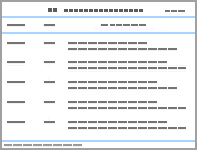
表1
流动相洗脱程序"
| 时间 Time (min) | B (%) |
|---|---|
| 0 | 8 |
| 1 | 17 |
| 5.5 | 45 |
| 7 | 99 |
| 8 | 99 |
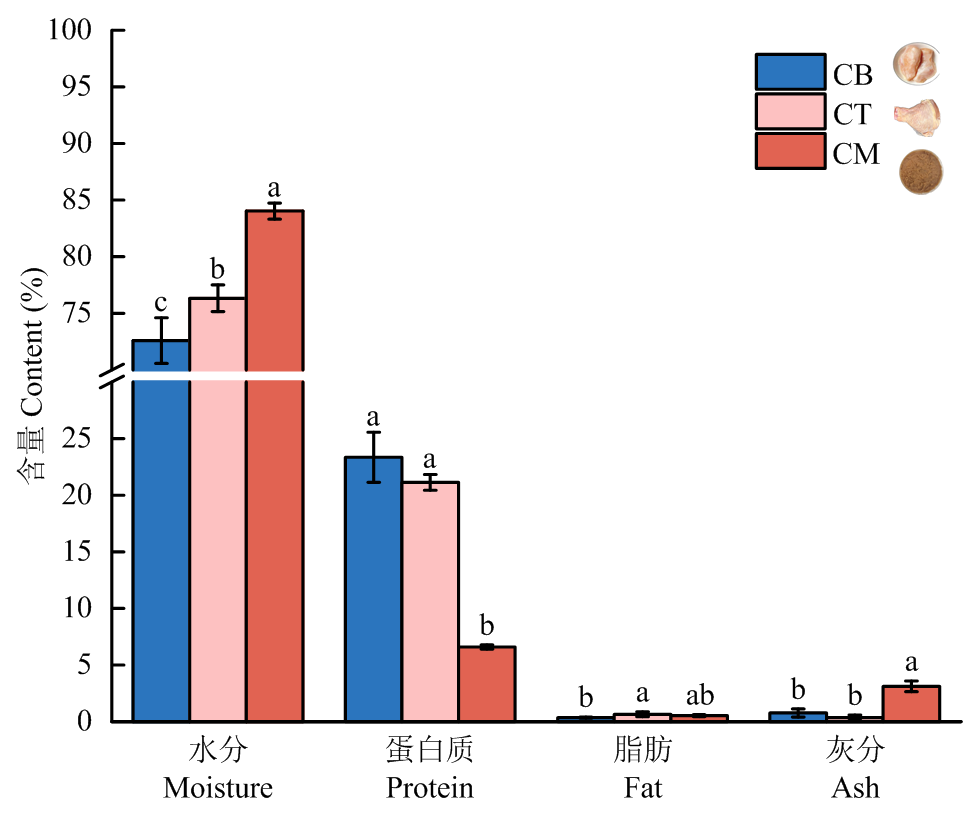
图1
鸡胸肉、鸡腿肉、培养肉基本营养成分对比 CB:鸡胸肉;CT:鸡腿肉;CM:培养肉。不同小写字母表示差异显著(P<0.05)。下同"
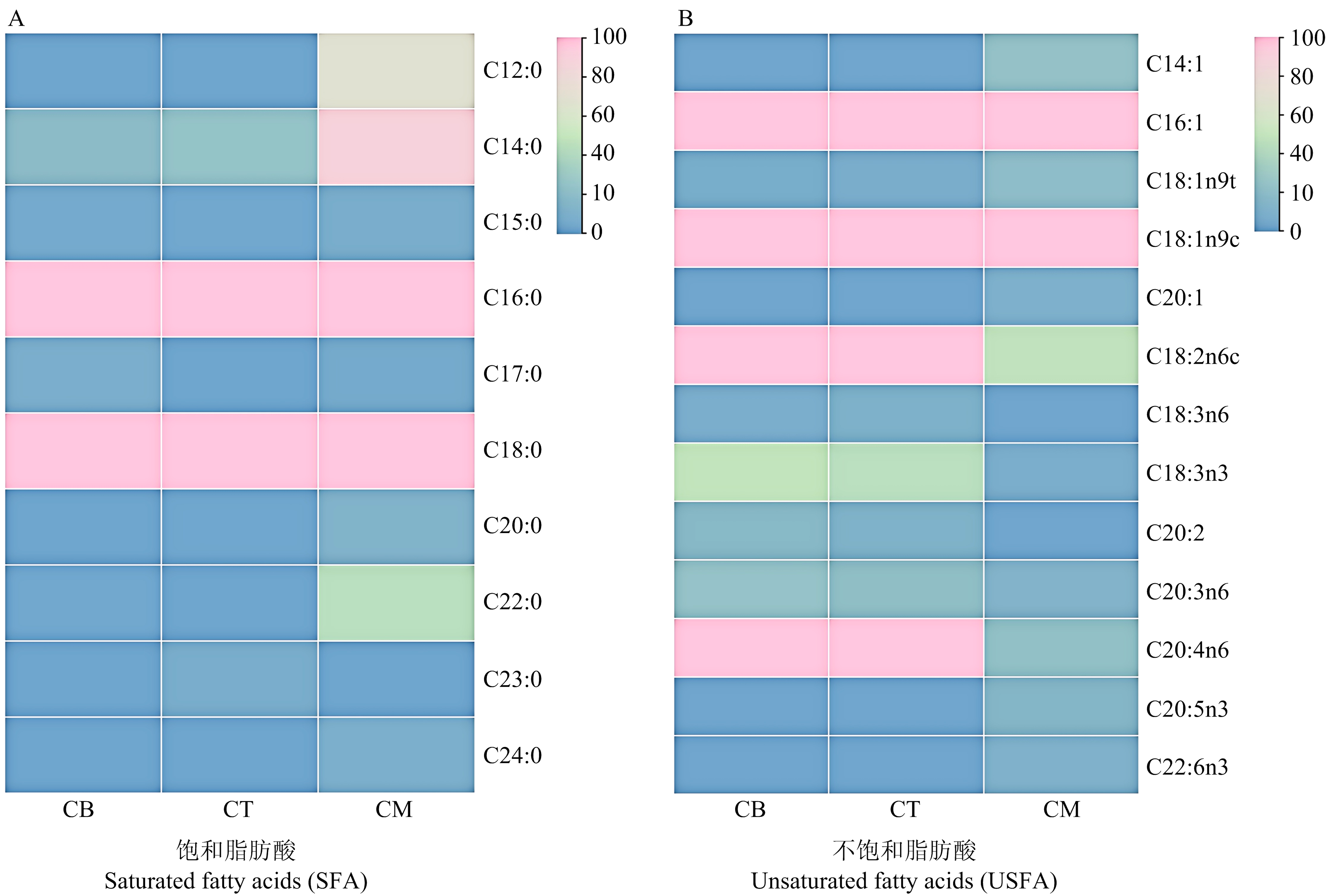
图2
鸡胸肉、鸡腿肉、培养肉的脂肪酸组成"
表2
鸡胸肉、鸡腿肉、培养肉的脂肪酸含量"
| 类型 Type | 含量 Content (mg/100 g) | ||
|---|---|---|---|
| CB | CT | CM | |
| 饱和脂肪酸Saturated fatty acids (SFA) | 1359.85±24.10a | 1239.24±3.42b | 953.14±6.79c |
| 单不饱和脂肪酸Monounsaturated fatty acids (MUFA) | 1745.26±11.9a | 1726.42±10.58a | 841.83±4.83b |
| 多不饱和脂肪酸Polyunsaturated fatty acids (PUFA) | 1487.78±5.40a | 1338.82±11.32b | 121.52±2.82c |
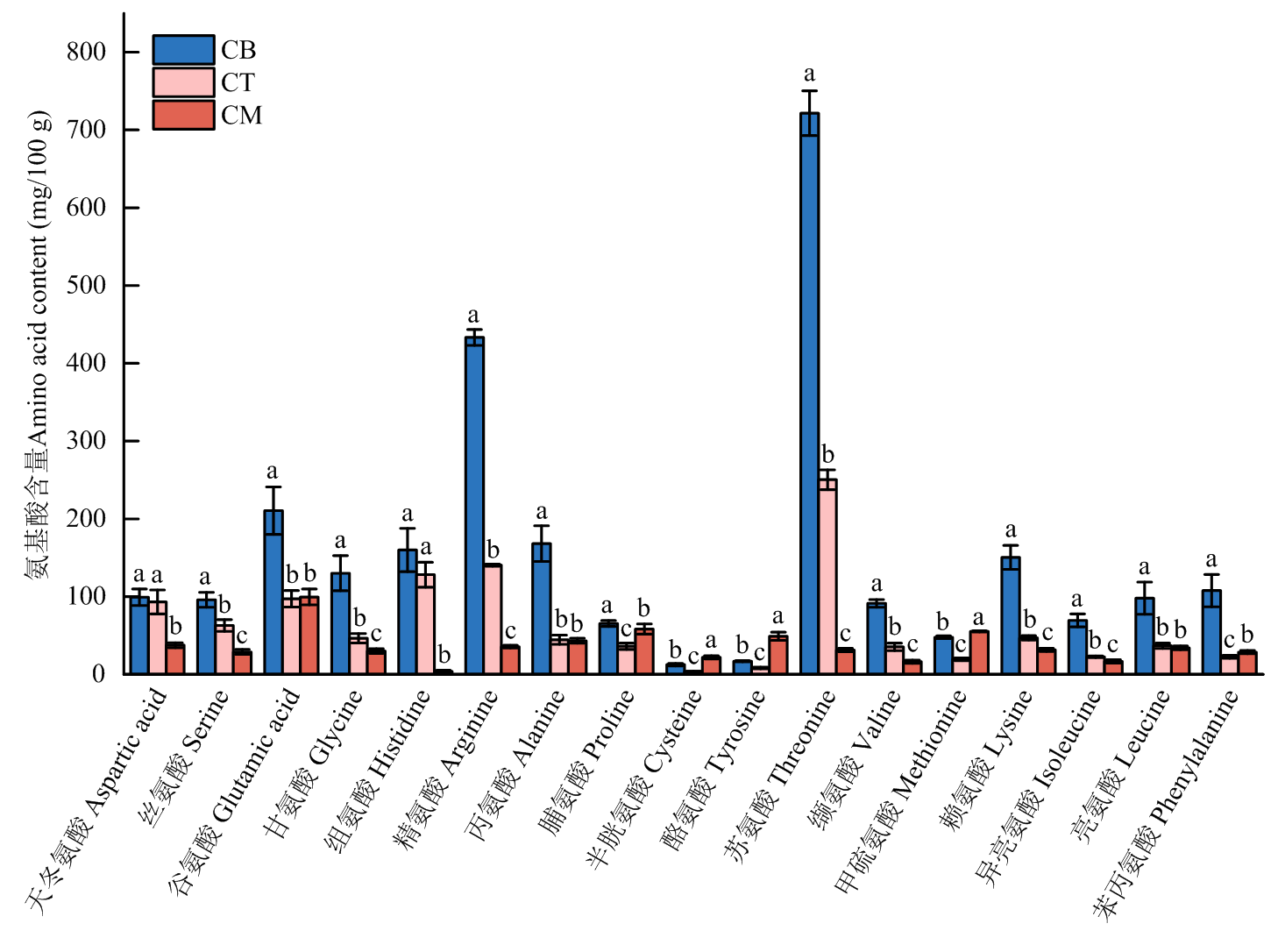
图3
鸡胸肉、鸡腿肉、培养肉的氨基酸组成"
表3
鸡胸肉、鸡腿肉、培养肉的维生素B1和维生素E组成"
| 类型 Type | 含量 Content (mg/100 g) | ||
|---|---|---|---|
| CB | CT | CM | |
| 维生素B1 Vitamin B1 | 0.04±0.00c | 0.15±0.00a | 0.09±0.00b |
| 维生素E Vitamin E | 0.60±0.01a | 0.38±0.00b | 0.01±0.00c |
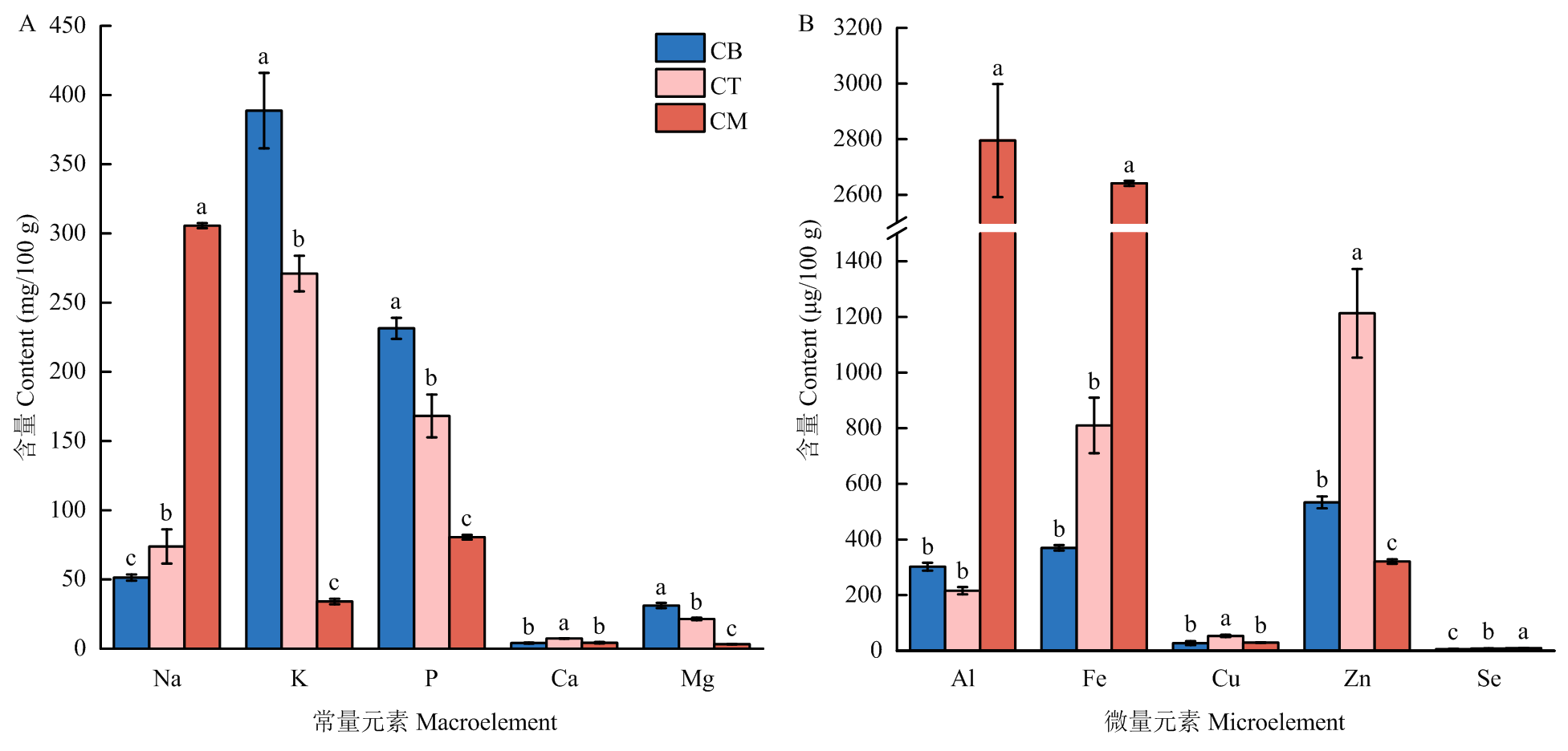
图4
鸡胸肉、鸡腿肉、培养肉的常量元素(A)和微量元素(B)"
表4
鸡胸肉、鸡腿肉、培养肉的pH及色泽"
| CB | CT | CM | |
|---|---|---|---|
| pH | 5.76±0.02c | 6.04±0.08b | 6.63±0.08a |
| L* | 50.34±0.26a | 47.49±0.20b | 45.06±0.38c |
| a* | 2.19 ±0.08c | 9.05 ±1.06b | 13.91±0.91a |
| b* | 13.82±0.25b | 10.14±0.28c | 38.98±0.42a |
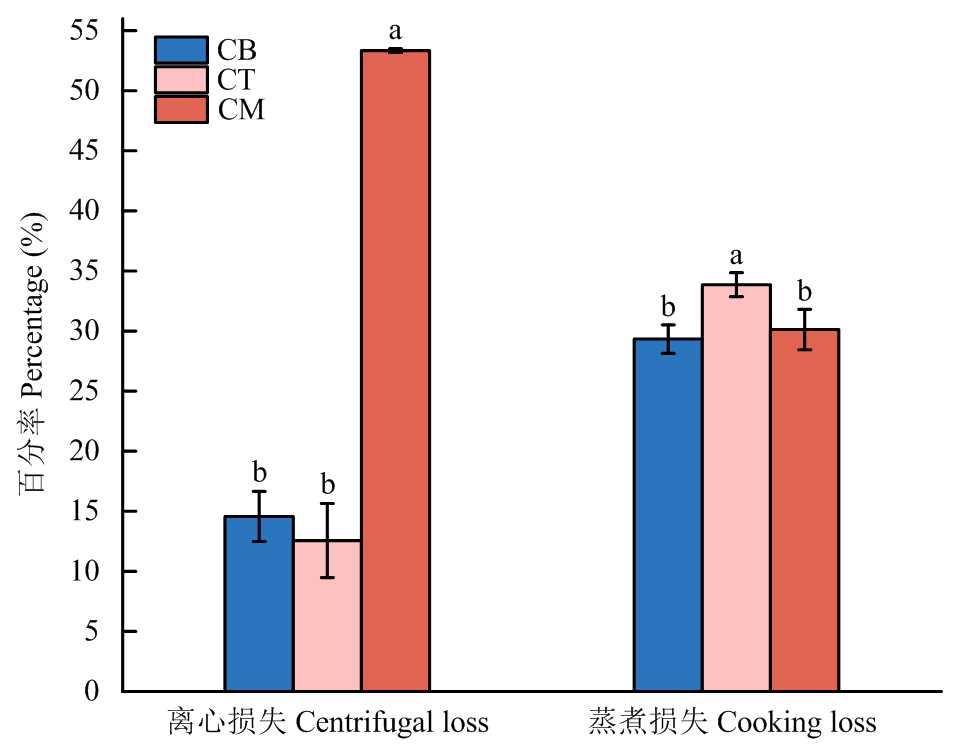
图5
鸡胸肉、鸡腿肉、培养肉的保水性"
表5
鸡胸肉、鸡腿肉、培养肉的质构特性"
| CB | CT | CM | |
|---|---|---|---|
| 硬度Hardness (N) | 85.78±6.88a | 43.00±1.83b | 1.44±0.18c |
| 内聚性Cohesiveness (%) | 0.61±0.08a | 0.57±0.08a | 0.37±0.12b |
| 弹性Springiness (mm) | 5.32±0.28a | 5.61±0.79a | 0.92±0.23b |
| 胶粘性Gumminess (N) | 42.48±3.22a | 24.15±1.81b | 0.52±0.12c |
| 咀嚼性Chewiness (mJ) | 281.72±10.63a | 131.59±26.88b | 0.46±0.02c |
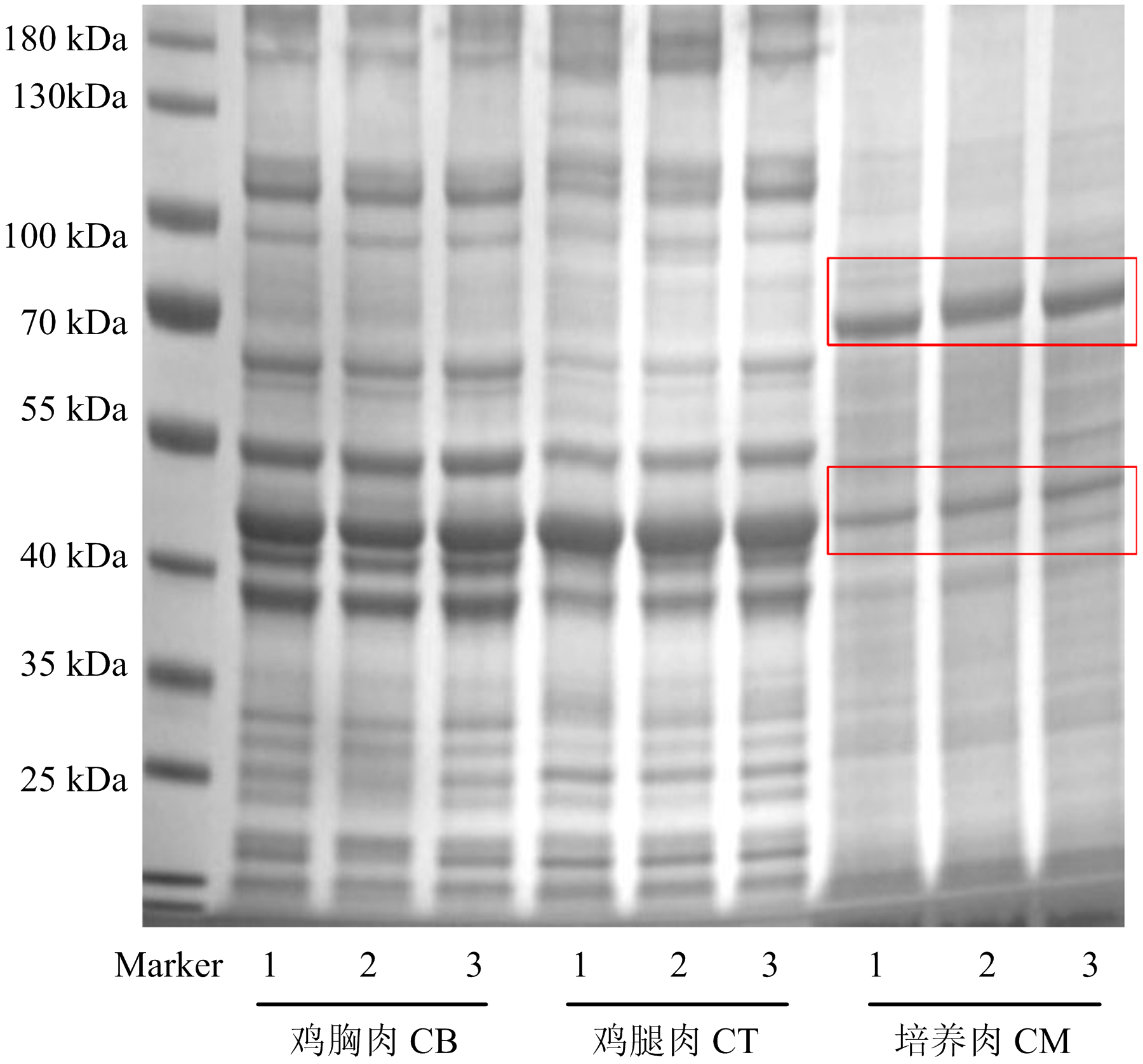
图6
鸡胸肉、鸡腿肉、培养肉的SDS-PAGE电泳图谱"

图7
肽段分布和数量(A)、肽段的覆盖率(B)和CB、CT与CM组之间的PCA评分图(C)"
表6
CM/CB和CM/CT组的差异表达蛋白"
| CM/CB | CM/CT | |
|---|---|---|
| 总差异表达蛋白 Differential expressed protein (DAPs) | 3779 | 3916 |
| 上调 Up-regulated | 2400 | 2483 |
| 下调 Down-regulated | 1379 | 1433 |

图8
不同对比组中差异蛋白质的韦恩图(A)和CM与CB(B)、CM与CT(C)比较的火山图"
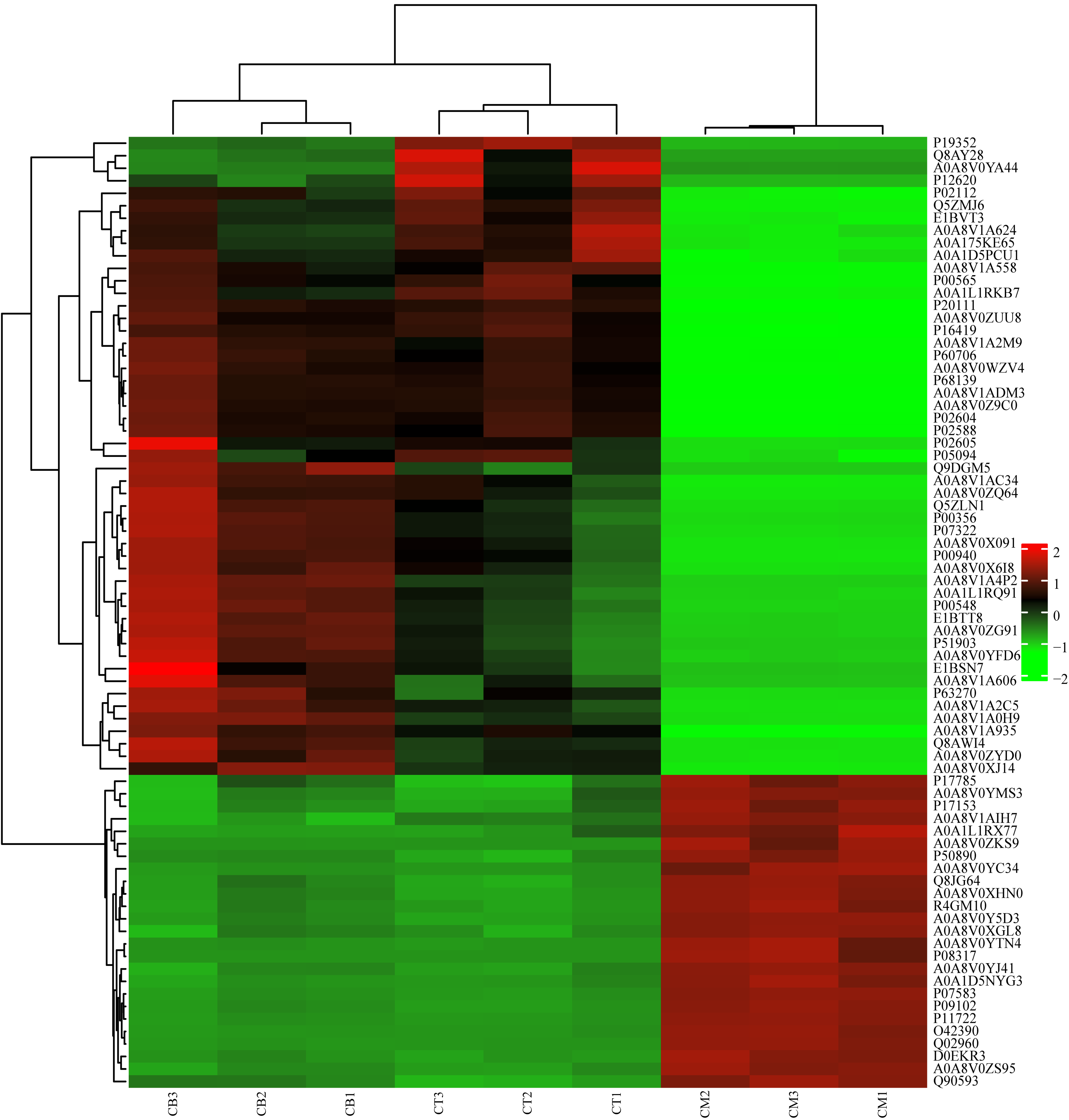
图9
差异蛋白质丰度的层次聚类分析"
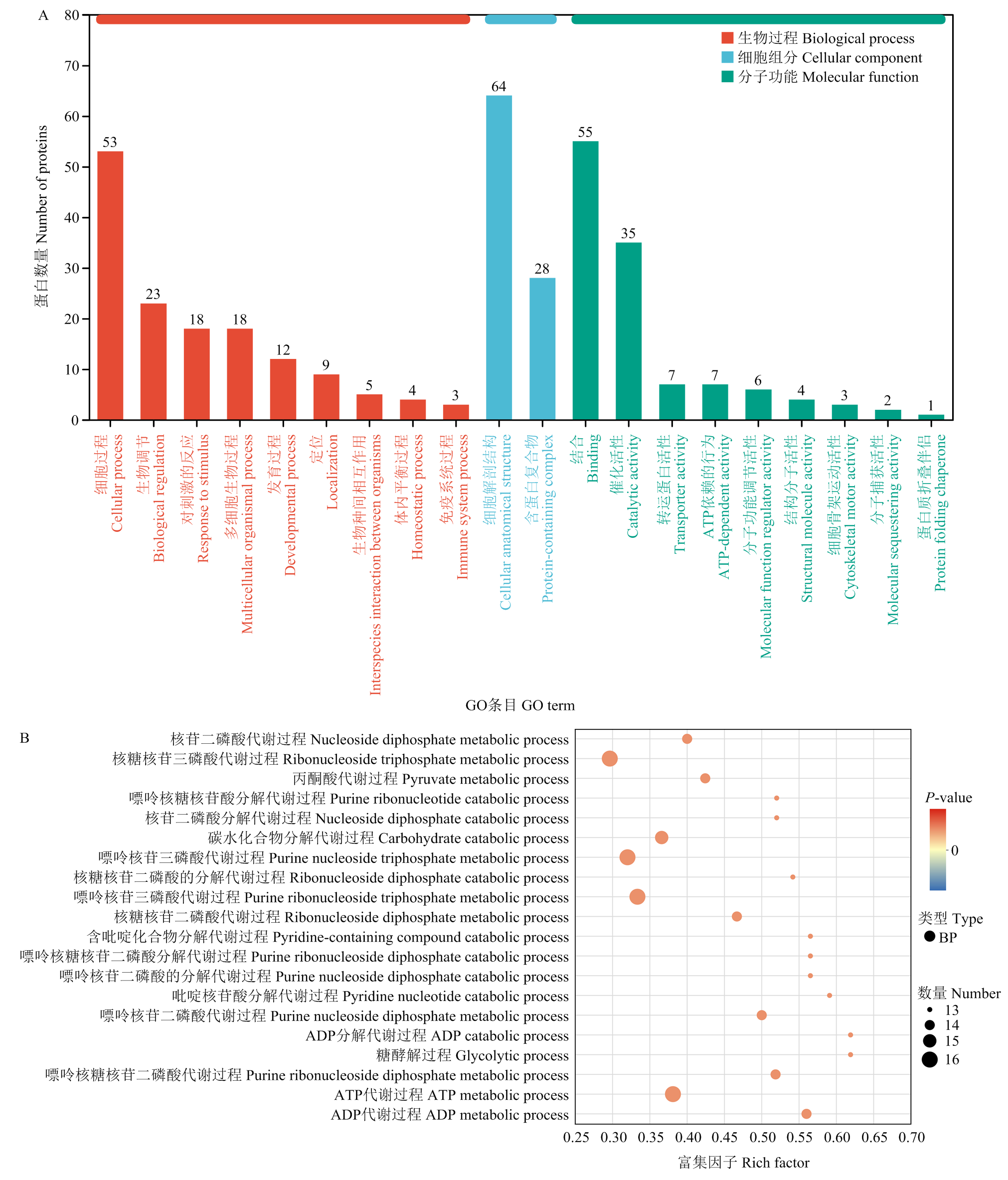
图10
差异蛋白质的GO注释(A)及GO富集分析(B)"
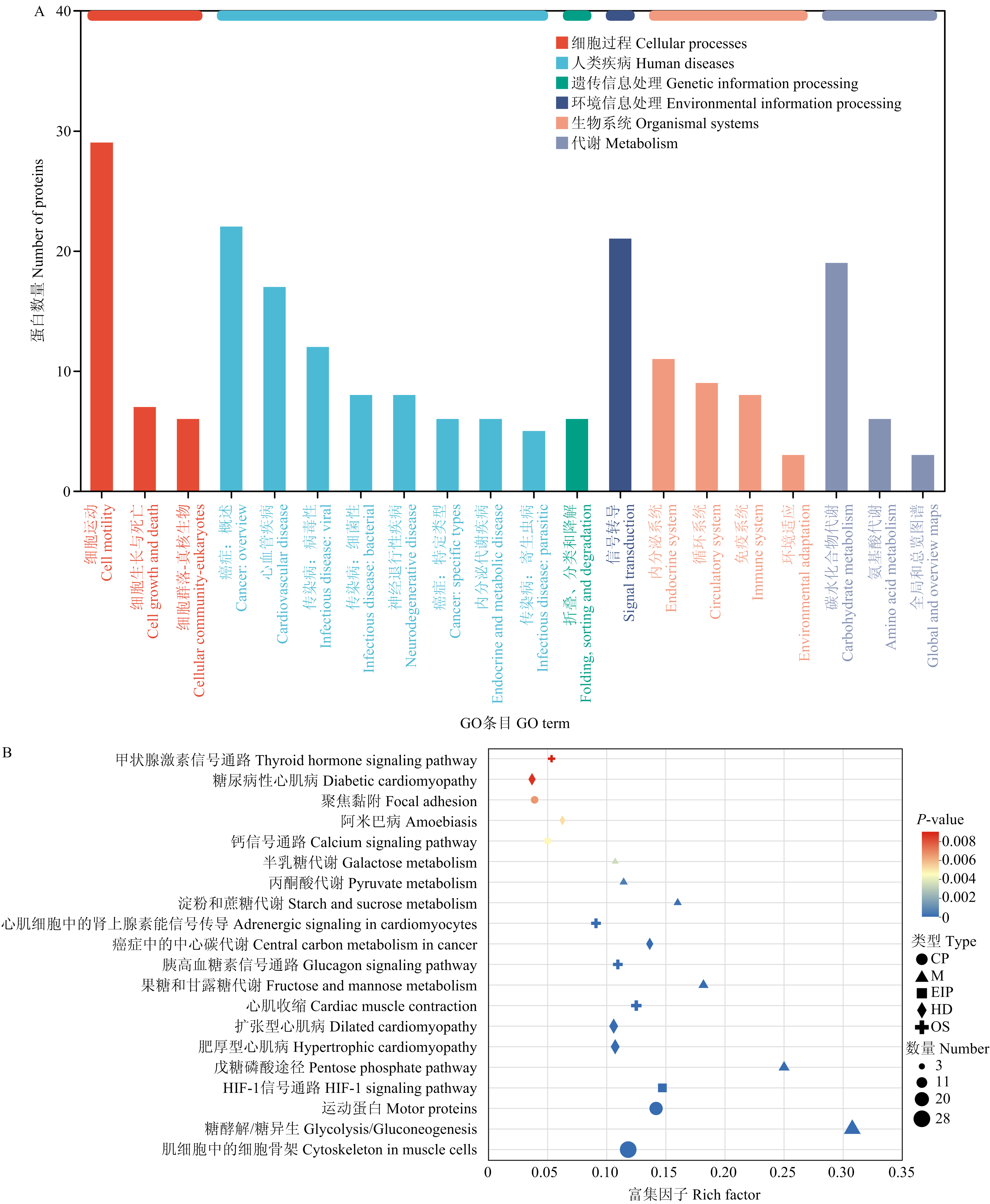
图11
差异蛋白质的KEGG注释(A)及KEGG富集分析(B)"
表7
与结构相关的差异蛋白质"
| GO术语Go terminology | Accession | Symbol | 蛋白质名称 Protein name | FC (CM/CB) | FC (CM/CT) |
|---|---|---|---|---|---|
| 肌肉系统过程 Muscular system process | Q05705 | BRT-2 | 原肌球蛋白β链 Tropomyosin beta chain | 5.1104 | 3.0844 |
| P19352 | TPM2 | 原肌球蛋白β链 Tropomyosin beta chain | 0.0287 | 0.0060 | |
| A0A8V0Y7H5 | TPM2 | 原肌球蛋白β链 Tropomyosin beta chain | 6.6361 | 3.7284 | |
| Q8AWI4 | TPM1 | 原肌球蛋白α链 Tropomyosin alpha chain | 0.0238 | 0.0439 | |
| P02588 | TNNC2 | 肌钙蛋白C Troponin C | 0.0012 | 0.0013 | |
| A0A8V1A2M9 | TNNI2 | 肌钙蛋白I Troponin I | 0.0017 | 0.0020 | |
| P12620 | TNNT3 | 肌钙蛋白T Troponin T | 0.0061 | 0.0018 | |
| A0A8V1A1P8 | TNNT3 | 肌钙蛋白T3 Troponin T3 | 0.0049 | 0.0053 | |
| A0A8V0ZYD0 | TPM1 | 原肌球蛋白1 Tropomyosin 1 | 0.0526 | 0.0900 | |
| P02565 | MYH1B | 肌球蛋白1B Myosin 1B | 0.0152 | 0.0094 | |
| Q8AY28 | N127 | 肌球蛋白重链HCIII Myosin heavy chain HCIII | 0.0090 | 0.0013 | |
| Q9DGM5 | — | 肌球蛋白重链亚型2 Myosin heavy chain isoform 2 | 0.0026 | 0.0071 | |
| A0A8V0WZV4 | MYLPF | 肌球蛋白轻链 Myosin light chain | 0.0018 | 0.0021 | |
| A0A8V0YH72 | MYLK2 | 肌球蛋白轻链激酶2 Myosin light chain kinase 2 | 0.0747 | 0.0680 | |
| A2NBE2 | — | 肌球蛋白轻链激酶2 Myosin light chain kinase 2 | 0.0033 | 0.0049 | |
| Q91006 | — | 原肌球调节蛋白 Tropomodulin | 0.0736 | 0.0291 | |
| A0A8V1AHA1 | TMOD4 | 原肌球调节蛋白4 Tropomodulin 4 | 0.0051 | 0.0067 | |
| P24797 | ATP1A2 | 钠/钾转运ATP酶亚基α-2 Sodium/potassium-transporting ATPase subunit alpha-2 | 0.0781 | 0.0522 | |
| 骨骼肌组织发育 Skeletal muscle tissue development | A0A8V0WZV4 | MYLPF | 肌球蛋白轻链 Myosin light chain | 0.0018 | 0.0021 |
| A0A088T337 | MSTN | 生长/分化因子8 Growth/differentiation factor 8 | 0.0017 | 0.0029 | |
| 纤维组织 Fibril organization | A0A8V0Y4B8 | KANK1 | — | 1401.1770 | 1401.1770 |
| A0A8V1A0T5 | VILL | — | 1204.3600 | 1204.3600 | |
| A0A8V1ADR4 | COL5A1 | 胶原蛋白V型α1链 Collagen type V alpha 1 chain | 761.8900 | 761.8900 | |
| A0A8V1A093 | — | 含GAR结构域蛋白 GAR domain-containing protein | 260.9450 | 260.9450 | |
| Q5ZKU6 | CNN2 | 钙调理蛋白 Calponin | 5.8619 | 10.1907 | |
| D5LPR1 | FSCN1 | 肌动蛋白结合蛋白1 Actin-binding protein 1 | 9.4542 | 10.1858 | |
| A0A8V1AB53 | MYO19 | 非常规肌球蛋白-XIX Unconventional myosin-XIX | 3.9571 | 4.8010 | |
| P18359 | DSTN | 肌动蛋白解聚因子 Actin-depolymerizing factor | 4.3293 | 4.7479 | |
| A0A1D5PM19 | MYH9 | 肌球蛋白9 Myosin 9 | 4.2076 | 3.6968 | |
| A0A8V0ZKF9 | MYL9 | 肌球蛋白轻链9 Myosin light chain 9 | 3.7640 | 3.3864 | |
| Q8AWI4 | TPM1 | 原肌球蛋白2 Tropomyosin 2 | 0.0238 | 0.0439 | |
| Q9DEH4 | — | 伴肌动蛋白 Nebulin | 0.0004 | 0.0019 | |
| A0A8V1AA47 | MYO1G | 肌球蛋白IG Myosin IG | 0.0011 | 0.0007 | |
| A0A8V0WZP8 | MYBPC2 | 肌球蛋白结合蛋白C Myosin-binding protein C | 0.0028 | 0.0005 |
| [1] |
仝西魁, 付云辉, 郑文云, 王阳敏, 马兴元. 动物细胞培育肉及其种子细胞优选与永生化策略[J]. 中国生物工程杂志, 2024, 44(5): 56-65.
|
|
|
|
| [2] |
刘东红, 利婕, 牛瑞浩, 忻启谱, 朱青青, 徐恩波. 细胞培养肉支架材料与组织成型研究进展[J]. 中国食品学报, 2022, 22(12): 14-24.
|
|
|
|
| [3] |
关欣, 周景文, 堵国成, 陈坚. 培育肉生产技术发展研究[J]. 中国工程科学, 2021, 23(6): 178-186.
doi: 10.15302/J-SSCAE-2021.06.018 |
|
doi: 10.15302/J-SSCAE-2021.06.018 |
|
| [4] |
|
| [5] |
doi: 10.1016/j.foodchem.2024.140696 |
| [6] |
doi: 10.1007/s10068-024-01720-y pmid: 39944668 |
| [7] |
|
| [8] |
关欣, 周景文, 王守伟, 李春保, 陈坚. 细胞培养肉高效合成的生物学基础与技术挑战[J]. 中国食品学报, 2024, 24(5): 103-125.
|
|
|
|
| [9] |
赵鑫锐, 张国强, 李雪良, 孙秀兰, 周景文, 堵国成, 陈坚. 人造肉大规模生产的商品化技术[J]. 食品与发酵工业, 2019, 45(11): 248-253.
doi: 10.13995/j.cnki.11-1802/ts.020859 |
|
doi: 10.13995/j.cnki.11-1802/ts.020859 |
|
| [10] |
doi: 10.1021/acsnano.4c15622 |
| [11] |
周倩, 惠腾, 刘毅, 戴瑞彤. 品种和部位对鸡肉原料特性及其加工性能影响的研究进展[J]. 肉类研究, 2017, 31(7): 57-61.
|
|
|
|
| [12] |
doi: 10.1016/j.jfutfo.2024.05.014 |
| [13] |
吴予灿, 张紫涵, 赵桂苹, 魏立民, 黄峰, 张春晖. 椰子汁煮制对文昌鸡食用品质的影响[J]. 中国农业科学, 2023, 56(16): 3199-3212. DOI: 10.3864/j.issn.0578-1752.2023.16.012.
|
|
|
|
| [14] |
王丽莎. 肌纤维类型组成对猪肉持水力的影响[D]. 北京: 中国农业科学院, 2020.
|
|
|
|
| [15] |
王静帆. 不同加热方式下猪肉保水性变化研究[D]. 北京: 中国农业科学院, 2021.
|
|
|
|
| [16] |
|
| [17] |
doi: 10.1021/acs.jafc.2c04207 |
| [18] |
朱丹实, 吴晓菲, 刘贺, 徐永霞, 励建荣. 水分对生鲜肉品品质的影响[J]. 食品工业科技, 2013, 34(16): 363-366.
|
|
|
|
| [19] |
doi: 10.1016/j.lwt.2013.09.023 |
| [20] |
doi: 10.1079/WPS200589 |
| [21] |
王梦阁, 何业春, 李进, 余沅, 刘红梅, 沈清武, 刘焱. 湖南石门县地方品种鸡肉氨基酸组成分析及蛋白质营养价值评价[J]. 食品安全质量检测学报, 2024, 15(1): 264-273.
|
|
|
|
| [22] |
doi: 10.1016/j.synbio.2024.03.001 pmid: 38510205 |
| [23] |
doi: 10.1016/j.meatsci.2022.109006 |
| [24] |
|
| [25] |
doi: 10.1038/s42003-025-08574-y |
| [26] |
doi: 10.1016/j.jfca.2024.106663 |
| [27] |
陈昌, 王鹏, 徐幸莲. 不同质量比鸡胸肉、鸡腿肉混合肌原纤维蛋白的热诱导凝胶特性[J]. 食品科学, 2012, 33(9): 58-63.
doi: 10.7506/spkx1002-6630-201209013 |
|
doi: 10.7506/spkx1002-6630-201209013 |
|
| [28] |
doi: 10.1038/s41538-024-00262-1 pmid: 38702314 |
| [29] |
孙树远, 何静, 吉日木图. 不同部位双峰驼肉的食用品质及营养成分分析[J]. 食品与生物技术学报, 2022, 41(9): 46-56.
|
|
|
|
| [30] |
doi: 10.3390/foods12193680 |
| [31] |
|
| [32] |
doi: 10.1016/j.psj.2023.103122 |
| [33] |
doi: 10.3389/fmolb.2021.719678 |
| [34] |
张静, 赵文秀, 司健芳, 曹松敏, 李亚蕾, 罗瑞明. 秦川牛宰后成熟过程中蛋白质DJ-1对肉品质变化的影响机制[J]. 食品科学, 2024, 45(22): 219-228.
|
|
|
|
| [35] |
丁世杰, 李春保, 周光宏. 细胞培养肉技术及产业化进展与挑战[J]. 中国食品学报, 2022, 22(12): 33-41.
|
|
|
|
| [36] |
doi: 10.1016/j.jprot.2023.104868 |
| [37] |
蔡露萌. 中国居民对人造肉的接受程度与支付意愿: 基于消费伦理视角[D]. 武汉: 华中农业大学, 2023.
|
|
|
| [1] | 岳丽昕, 王清华, 王振宝, 尼玛琼吉, 刘泽洲, 孔素萍, 张立峰, 高莉敏. 基于广靶代谢组学分析藏葱和细香葱营养品质及黄酮类代谢产物差异[J]. 中国农业科学, 2026, 59(5): 1070-1086. |
| [2] | 张利东, 郭一聪, 黄洪宇, 聂静, 王兵, 李梦雨, 李加旺, 眭晓蕾, 李愚鹤. 基于感官评价结合营养品质特征与风味物质特性关联分析黄瓜果实品质[J]. 中国农业科学, 2026, 59(5): 1087-1100. |
| [3] | 董金龙, 赵莹, 余海兵, 吕建晔, 秦佳琦, 梁晨, 明博, 李少昆. 多模型解析玉米籽粒容重的营养品质贡献度与区域异质性[J]. 中国农业科学, 2026, 59(5): 985-995. |
| [4] | 曾清苹, 刘涵, 聂堂杰, 蒋宣斌, 李红艳, 唐佳佳, 申玲, 陈丽洁, 罗小刚, 谢成伟, 童龙. 金佛山方竹鲜笋品质海拔分异及驱动因素分析[J]. 中国农业科学, 2026, 59(13): 2946-2961. |
| [5] | 季圣阳, 陆柏益, 李培武. 关于现代农产品品质学的若干思考[J]. 中国农业科学, 2025, 58(9): 1830-1844. |
| [6] | 任家辉, 孙娟娟, 郝莹璐, 王凤梧, 王靖宇, 张明伟, 李宝涵, 郑成忠, 何竹青, 王照兰. 内蒙古中部地区饲用燕麦品种筛选及青贮品质评价[J]. 中国农业科学, 2025, 58(19): 4026-4038. |
| [7] | 李子洪, 赵佳雯, 欧星雨, 李旭华, 丁小飞, 王伊朗, 黄正来, 马尚宇, 樊永惠, 张文静. 不同类型肥料及氮素水平对弱筋小麦氮素利用、产量及品质的影响[J]. 中国农业科学, 2025, 58(18): 3690-3709. |
| [8] | 唐佳灵, 张玉林, 杨勇, 方正锋, 韩国全, 惠腾. 日粮中添加酱油残渣压榨油脂对猪肉品质的影响[J]. 中国农业科学, 2025, 58(15): 3118-3133. |
| [9] | 赵甜甜, 袁剑龙, 卓峰琦, 唐振三, 徐杰, 张峰. 马铃薯全粉品质综合评价及品种筛选[J]. 中国农业科学, 2025, 58(13): 2522-2537. |
| [10] | 王荣荣, 徐宁璐, 黄修利, 赵凯男, 黄明, 王贺正, 付国占, 吴金芝, 李友军. 一次灌溉和氮肥运筹对旱地小麦籽粒产量和品质的影响[J]. 中国农业科学, 2025, 58(1): 43-57. |
| [11] | 赵博慧, 张影全, 景东林, 刘保华, 程媛媛, 苏玉环, 唐娜, 张波, 郭波莉, 魏益民. 基于多年定点的小麦籽粒质量稳定性研究[J]. 中国农业科学, 2024, 57(9): 1833-1844. |
| [12] | 王小军, 王金兰, 琚泽亮, 梁国玲, 贾志锋, 刘文辉, 马祥, 马金秀, 李文. 环青海湖地区不同饲用燕麦品种生产性能和营养品质综合评价[J]. 中国农业科学, 2024, 57(19): 3730-3742. |
| [13] | 巨晓军, 章明, 单艳菊, 姬改革, 屠云洁, 刘一帆, 邹剑敏, 束婧婷. 鸡肉品质分析及关键风味物质和基因的筛选[J]. 中国农业科学, 2023, 56(9): 1813-1826. |
| [14] | 郭雨晨, 董铭, 曾宪明, 田惠鑫, 尹家琪, 侯钰柯, 白云, 唐长波, 韩敏义, 徐幸莲. 分子动力学模拟解析脉冲电场对类PSE鸡肉肌球蛋白凝胶特性作用规律[J]. 中国农业科学, 2023, 56(4): 741-753. |
| [15] | 张文霞, 李盼, 殷文, 陈桂平, 樊志龙, 胡发龙, 范虹, 何蔚. 麦后复种绿肥及配施不同水平氮肥对小麦产量、品质及氮素利用的影响[J]. 中国农业科学, 2023, 56(17): 3317-3330. |
|
||
