






中国农业科学 ›› 2026, Vol. 59 ›› Issue (14): 3162-3184.doi: 10.3864/j.issn.0578-1752.2026.14.013
杨帅伶( ), 李文亭, 徐慧()
收稿日期:2025-12-29
接受日期:2026-04-07
出版日期:2026-07-16
发布日期:2026-07-21
通信作者:
联系方式:
杨帅伶,E-mail:yshling826@163.com。
基金资助:
YANG ShuaiLing(), LI WenTing, XU Hui()
Received:2025-12-29
Accepted:2026-04-07
Published:2026-07-16
Online:2026-07-21
摘要:
在全球可持续发展与健康饮食需求的双重驱动下,植物蛋白作为动物蛋白替代资源的重要性日益突出。然而,植物蛋白天然凝胶性能的不足严重制约了在高端食品及非食品领域的高附加值应用。本文旨在系统评述近年来植物蛋白凝胶性能强化的主要策略与作用机理研究进展,为开发高性能植物蛋白制品及相关理论研究提供参考,以推动其在更广泛领域的创新应用,助力可持续食品与材料体系的发展。为此,本研究系统检索了Web of Science、ScienceDirect、PubMed及CNKI数据库(2015—2025年),以“植物蛋白凝胶”“物理改性”“酶法改性”“多糖复合”等为核心关键词进行组合检索,并通过文献追溯与引用追踪补充关键文献,经筛选后纳入高质量研究进行系统梳理与分析。文章围绕植物蛋白凝胶的形成基础、多维评价方法与性能强化策略展开分析。重点剖析了3大类强化策略:物理改性(如热、超声、高压处理),化学与生物酶法改性(酰化、糖基化、转谷氨酰胺酶交联),多组分复合策略(与多糖、多酚结合)。此外,进一步探讨了深共晶溶剂工程、双网络/互穿网络结构、4D打印智能凝胶及导电/自愈合凝胶等新兴设计策略。这些策略分别通过能量输入、精准共价修饰与分子间互作,显著提升了凝胶的强度、稳定性和功能多样性,标志着该领域正从“被动的性能改良”转向“主动的功能创造”。不过,从实验室走向产业化仍面临平衡感官与营养、克服原料差异与工艺放大瓶颈等核心挑战。未来仍需深化凝胶化动力学的原位解析与凝胶性能的理性设计研究,推动多种策略的智能化集成,挖掘非传统植物蛋白资源(如微藻蛋白、土豆蛋白、藜麦蛋白等)并建立其改性策略与应用场景的匹配关系。通过跨学科协同与“产学研”融合,植物蛋白凝胶有望在生物医学、柔性电子及循环经济材料等领域发挥关键作用,为可持续食品与材料体系提供重要支撑。
杨帅伶, 李文亭, 徐慧. 植物蛋白凝胶性能的强化策略与机理研究进展[J]. 中国农业科学, 2026, 59(14): 3162-3184.
YANG ShuaiLing, LI WenTing, XU Hui. Advances in Reinforcement Strategies and Mechanisms of Plant- Based Protein Gel Properties[J]. Scientia Agricultura Sinica, 2026, 59(14): 3162-3184.

图1
植物蛋白凝胶化的主要机理示意图 凝胶由分子作用(疏水、二硫化物、氢、静电、共价交联)相互协同,形成三维网络结构,捕获水分子;其特性受蛋白质类型、浓度、pH、离子和加工过程的影响"

图2
植物蛋白凝胶的主要评价方法"
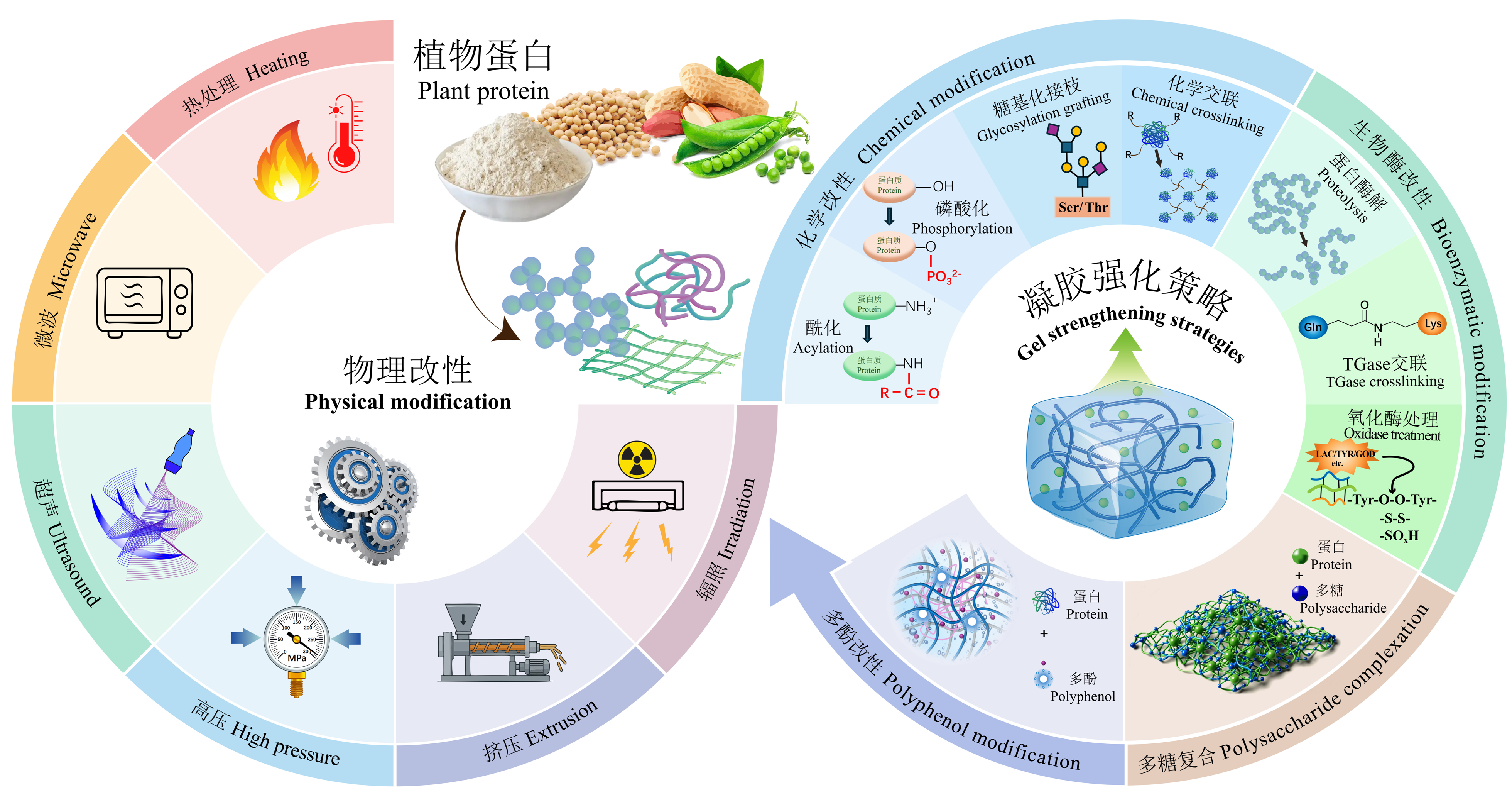
图3
植物蛋白改性方法及其凝胶性能强化策略"

表1
植物蛋白凝胶主要物理改性策略的作用机理与效果对比"
| 处理方法 Treatment method | 核心机理 Core mechanism | 对蛋白质结构的主要影响 Major effects on protein structure | 对凝胶性能的主要提升 Improvements in gel properties | 典型研究案例与效果 Typical research case and outcome |
|---|---|---|---|---|
| 热处理 Heating | 热能破坏氢键等非共价键 Thermal energy disrupts non-covalent bonds such as hydrogen bonds | 分子展开(变性),暴露疏水基团与巯基 Molecular unfolding (denaturation), exposing hydrophobic groups and thiol groups | 诱导形成基本凝胶网络,是多数凝胶化的基础 Induces the formation of a basic gel network, serving as the foundation for most gelation | 豌豆蛋白热凝胶形成三阶段(变性、聚集、凝胶化)的基础[ Forms the basis of the three-stage thermal gelation of pea protein (denaturation, aggregation, gelation)[ |
| 超声波 Ultrasound treatment | 空化效应与机械剪切 Cavitation effect and mechanical shear force | 破碎聚集体,提高溶解度;改变构象,增加表面疏水性 Breaks up aggregates, improves solubility; alters conformation and increases surface hydrophobicity | 显著提升硬度、弹性、持水性;形成致密均匀网络 Significantly enhances hardness, elasticity, and water-holding capacity; forms a compact and uniform network | 300 W超声使绿豆蛋白凝胶硬度、持水性显著提升[ 300 W ultrasound significantly increased the hardness and water-holding capacity of mung bean protein gel[ |
| 高压处理 High pressure processing | 静压或剪切力破坏非共价键 Hydrostatic pressure or shear force disrupts non-covalent bonds | 分子适度展开,暴露功能基团;高效乳化减小粒径 Moderate molecular unfolding and exposure of functional groups; efficient emulsification reduces particle size | 基于细乳液构建高强凝胶;改善凝胶质地 Constructs high-strength gels based on fine emulsions; improves gel texture | HPH处理豌豆蛋白乳液,凝胶强度与液滴尺寸负相关[ HPH-treated pea protein emulsions showed a negative correlation between gel strength and droplet size[ |
| 微波处理 Microwave treatment | 分子极化与离子传导产热 Heat generation via molecular polarization and ionic conduction | 快速、均匀加热,促进分子展开与重排 Rapid and uniform heating promotes molecular unfolding and rearrangement | 高效变性,改善凝胶性质,处理时间短 Efficient denaturation and improved gel properties with short processing time | 可用于辅助蛋白提取并改善凝胶性质[ Can be used to assist protein extraction and improve gel properties[ |
| 挤压处理 Extrusion treatment | 热、剪切、压力共同作用 Combined action of heat, shear, and pressure | 深度变性、定向展开与交联 Deep denaturation, oriented unfolding, and cross-linking | 形成纤维化、各向异性的结构化凝胶 Forms fibrous, anisotropic structured gels | 是生产仿肉组织化蛋白的核心工艺,构建宏观纤维质构[ Core process for producing meat-like textured proteins; constructs macroscopic fibrous texture[ |
| 辐照处理 Irradiation treatment | 电离辐射引发化学变化 Chemical changes induced by ionizing radiation | 肽链断裂/交联,氨基酸修饰 Peptide chain cleavage/cross-linking and amino acid modification | 可能增强网络强度与稳定性 May enhance network strength and stability | 是改变蛋白质结构并影响其功能特性的可行技术[ A feasible technique to modify protein structure and affect its functional properties[ |
表2
植物蛋白凝胶化学及酶法改性策略"
| 改性方法 Modification method | 核心机制 Core mechanism | 对蛋白质结构/性质的主要影响 Main effects on protein structure/properties | 对凝胶性能的提升效果 Improved gel properties | 典型研究案例 Typical research case |
|---|---|---|---|---|
| 化学改性 Chemical modification | 酰化 Acylation | 引入乙酰基/琥珀酰基,增加负电荷与空间位阻 Introduction of acetyl/succinyl groups, increasing negative charge and steric hindrance | 提升溶解度,形成更致密均匀的网络,增强凝胶强度与持水性 Improved solubility, formation of denser and more uniform networks. Enhanced gel strength and water-holding capacity | 琥珀酰化改善黑豆蛋白凝胶的分子构象与网络结构[ Succinylation improves molecular conformation and network structure of black soybean protein gel[ |
| 磷酸化 Phosphorylation | 引入带负电磷酸基团,增强亲水性 Introduction of negatively charged phosphate groups, enhancing hydrophilicity | 显著提升凝胶持水力、储能模量(G')和硬度 Significantly enhanced water-holding capacity, storage modulus (G'), and hardness | 磷酸化修饰促进花生蛋白形成强凝胶网络[ Phosphorylation promotes the formation of strong gel networks in peanut protein[ | |
| 糖基化接枝(美拉德反应) Glycosylation (Maillard reaction) | 蛋白质与糖发生共价结合,增加亲水链和空间位阻 Covalent conjugation between proteins and saccharides, increasing hydrophilic chains and steric hindrance | 改善溶解性、乳化性,增强凝胶基质稳定性,优化最终产品质构 Improved solubility and emulsifying properties. Enhanced stability of gel matrix and optimized texture of final products | 超声辅助制备SPI-菊粉复合物,提升鱼糜凝胶品质[ Ultrasound-assisted preparation of SPI-inulin complex improves surimi gel quality[ | |
| 化学交联 Chemical cross-linking | 通过化学交联剂(如戊二醛)形成分子间共价桥 Formation of intermolecular covalent bridges via chemical cross-linkers (e.g., glutaraldehyde) | 极大增强凝胶机械强度、韧性和热稳定性 Greatly enhanced mechanical strength, toughness, and thermal stability | 主要用于生物材料领域,食品应用受限[ Mainly used in biomaterials; limited application in food systems[ | |
| 生物酶法改性 Enzymatic modification | 蛋白酶解(限制性水解) Limited proteolysis | 切断特定肽键,产生小肽段,暴露更多功能基团 Cleavage of specific peptide bonds to produce peptides and expose functional groups | 改善溶解性和乳化性,为后续交联创造条件,制备可调控质构的凝胶 Improved solubility and emulsifying properties. Provides sites for further cross-linking; enables tunable gel texture | 胃蛋白酶水解产物增强大豆蛋白凝胶的强度和持水性[ Pepsin hydrolysates enhance the strength and water-holding capacity of soy protein gels[ |
| 转谷氨酰胺酶交联 Transglutaminase (TGase) cross- linking | 催化形成ε-(γ-谷氨酰)赖氨酸异肽键共价交联 Catalyzes formation of ε-(γ-glutamyl) lysine isopeptide bonds | 显著增强凝胶强度、弹性、持水性和热稳定性 Significantly enhanced gel strength, elasticity, water-holding capacity and thermal stability | TGase处理提升豌豆蛋白、绿豆蛋白的凝胶模量与硬度[ TGase treatment improves the gel modulus and hardness of pea protein and mung bean protein[ | |
| 氧化酶处理 Oxidase treatment | 催化特定氨基酸氧化,形成二硫键等交联 Catalyzes the oxidation of specific amino acids to form disulfide bonds and other cross-links | 改善凝胶强度、蛋白质膜性能 Improved gel strength and protein film performance | 漆酶与TGase协同改善豌豆蛋白凝胶性质[ Laccase synergizes with TGase to improve the gel properties of pea protein[ |
表3
植物蛋白凝胶新兴设计策略的核心特征与应用对比"
| 策略类别 Strategy category | 核心设计思想 Core design principle | 关键优势 Key advantages | 主要挑战与前沿方向 Major challenges & frontier directions | 典型应用领域 Typical application fields |
|---|---|---|---|---|
| 深共晶溶剂体系 Deep eutectic solvent (DES) system | 以DES替代水,构建“蛋白质-溶剂”强相互作用网络[ Using DES instead of water to construct a strong “protein-solvent” interaction network[ | 极限提升力学强度、韧性及热/环境稳定性[ Ultrahigh mechanical strength, toughness, and thermal/ environmental stability[ | DES组分的食品安全性评估;在复杂食品体系中的适用性 Food safety evaluation of DES components; applicability in complex food matrices | 高性能结构材料、极端环境稳定食品 High-performance structural materials, foods stable under extreme environments |
| 双网络/互穿网络凝胶 Double-network/ interpenetrating network gels | 将两种物性互补的网络在分子尺度互穿,协同增韧[ Interpenetrating two complementary networks at molecular scale for synergistic toughening[ | 突破强度-韧性权衡,实现质地与持水性的精准可调[ Breaking the strength-toughness trade-off; achieving precise tunability of texture and water- holding capacity[ | 多组分凝胶化动力学的精确时序控制与模拟 Accurate temporal control and simulation of multi-component gelation kinetics | 植物基仿肉(模拟肌间脂肪)、结构化食品 Plant-based meat analogs (simulating intramuscular fat), structured foods |
| 4D打印智能凝胶 4D-printed smart gels | 3D打印+刺激响应性,实现结构随时间动态演变[ Combining 3D printing with stimulus responsiveness to enable dynamic structural evolution over time[ | 实现食物外观、质地、风味及营养释放的个性化与程序化定制 Personalized and programmed customization of food appearance, texture, flavor, and nutrient release | 开发兼具优异打印性、强响应性和良好食感的多功能“生物墨水” Developing multifunctional “bio- inks” with excellent printability, high responsiveness, and desirable eating quality | 个性化营养食品、医疗膳食、互动体验食品 Personalized nutrition foods, medical diets, interactive experience foods |
| 智能化功能凝胶(导电/自愈合/ 黏附) Intelligent functional gels (conductive/ self-healing/ adhesive) | 引入功能组分或动态化学键,赋予凝胶感知、修复、黏合等“智能”[ Introducing functional components or dynamic chemical bonds to endow gels with sensing, self-repair, adhesion, and other “smart” functions[ | 拓展凝胶在非传统食品领域的应用,实现功能集成 Expanding applications in non- traditional food fields and achieving functional integration | 确保功能组分的安全性;维持智能特性与基质生物相容性的平衡 Ensuring safety of functional components; balancing intelligent properties and matrix biocompatibility | 可穿戴生物传感器、电子皮肤、生物医用胶黏剂与敷料 Wearable biosensors, electronic skin, biomedical adhesives and dressings |
| [1] |
doi: 10.1007/s10068-024-01712-y pmid: 39974856 |
| [2] |
夏佳钰, 樊胜根, 丁心悦, 陈志钢, 冯晓龙, 孟婷, 张玉梅. 中国可持续健康膳食发展思考[J]. 中国工程科学, 2023, 25(4): 120-127.
doi: 10.15302/J-SSCAE-2023.04.011 |
|
doi: 10.15302/J-SSCAE-2023.04.011 |
|
| [3] |
doi: 10.3390/foods13020306 |
| [4] |
Fortune Business Insights. Plant based food market size, share & industry analysis, and regional forecast, 2026-2034[R/OL]. 2026-06-22. https://www.fortunebusinessinsights.com/plant-based-food-market-115745.
|
| [5] |
周建中, 张晖. 植物蛋白凝胶及其应用研究进展[J]. 食品与生物技术学报, 2013, 32(11): 1128-1135.
|
|
|
|
| [6] |
潘雨洁, 王宇晶, 黄良宇, 杨晨. 植物蛋白凝胶的构建机理及食品领域的应用现状[J]. 中国食品添加剂, 2025, 36(10): 8-14.
|
|
|
|
| [7] |
doi: 10.1016/j.ultsonch.2025.107239 |
| [8] |
李鑫. 大豆蛋白凝胶性的提高及其在植物基模拟蛋中的应用[D]. 无锡: 江南大学, 2023.
|
|
|
|
| [9] |
|
| [10] |
doi: 10.1016/j.foodhyd.2023.109535 |
| [11] |
doi: 10.3390/gels11080569 |
| [12] |
doi: 10.1016/j.ijbiomac.2024.138234 |
| [13] |
doi: 10.1016/j.carbpol.2025.124153 |
| [14] |
doi: 10.1016/j.lwt.2023.115709 |
| [15] |
doi: 10.1016/j.foodhyd.2019.05.022 |
| [16] |
doi: 10.1007/BF02671468 |
| [17] |
doi: 10.1111/1541-4337.12925 pmid: 35182006 |
| [18] |
doi: 10.1038/s41467-025-63148-0 |
| [19] |
doi: 10.1122/1.550610 |
| [20] |
doi: 10.1038/s43016-019-0009-x pmid: 37127997 |
| [21] |
doi: 10.3390/foods10081967 |
| [22] |
doi: 10.3390/coatings13111899 |
| [23] |
张浩嘉, 朱秀清, 孙莹. 挤出参数控制对大豆蛋白微观构象的影响[J]. 食品科学, 2023, 44(15): 103-112.
|
|
doi: 10.7506/spkx1002-6630-20220721-246 |
|
| [24] |
doi: 10.1021/jf00079a038 |
| [25] |
doi: 10.1016/j.foodhyd.2020.105846 |
| [26] |
doi: 10.1021/acs.jafc.2c07507 pmid: 36722439 |
| [27] |
pmid: 10867183 |
| [28] |
doi: 10.3390/mi9110562 |
| [29] |
doi: 10.1016/j.foodchem.2017.08.087 |
| [30] |
doi: 10.1016/j.foodhyd.2023.108924 |
| [31] |
陈玲, 唐传核, 张业辉. 菜豆属豆类蛋白酶促凝胶性能比较研究[J]. 食品科学, 2010, 31(9): 62-66.
doi: 10.7506/spkx1002-6630-201009015 |
|
|
|
| [32] |
|
| [33] |
doi: 10.1016/j.foodhyd.2023.109002 |
| [34] |
doi: 10.1111/jtxs.12674 pmid: 35275412 |
| [35] |
doi: 10.1007/s11694-021-01151-x |
| [36] |
|
| [37] |
|
| [38] |
doi: 10.1016/j.jfca.2025.108020 |
| [39] |
|
| [40] |
doi: 10.1007/s11483-024-09908-9 |
| [41] |
doi: 10.1016/j.foodhyd.2025.111599 |
| [42] |
doi: 10.1016/j.fbio.2025.106987 |
| [43] |
doi: 10.1016/j.foostr.2025.100409 |
| [44] |
doi: 10.1016/j.foodchem.2025.147187 |
| [45] |
doi: 10.1016/j.foodchem.2025.147184 |
| [46] |
孙冰玉, 付雨欣, 黄雨洋, 刘琳琳, 吕铭守, 朱颖, 郭汝杞, 朱秀清. 绿豆蛋白的凝胶特性及应用研究进展[J]. 食品科学, 2025, 46(3): 318-327.
|
|
|
|
| [47] |
杜童申, 刘悦, 马骏骅, 王馨怡, 沈存宽, 杨华, 颜金鑫. 超声预处理对亚麻籽胶-大豆分离蛋白复合凝胶凝胶特性及结构的影响[J]. 食品工业科技, 2024, 45(13): 83-90.
|
|
|
|
| [48] |
王瑞雪. 绿豆蛋白凝胶特性的改善及其形成机理的研究[D]. 济南: 齐鲁工业大学, 2023.
|
|
|
|
| [49] |
马甜甜. pH偏移和热超声对钙诱导豌豆蛋白乳液填充凝胶形成的影响[D]. 无锡: 江南大学, 2022.
|
|
|
|
| [50] |
doi: 10.1039/d4sm00687a pmid: 39751842 |
| [51] |
doi: 10.1016/j.foodhyd.2020.106191 |
| [52] |
doi: 10.1111/jtxs.v52.5-6 |
| [53] |
doi: 10.1016/j.foodhyd.2023.108951 |
| [54] |
付晓航, 张顺亮, 赵燕, 梁二宏, 李素, 赵冰, 王守伟. 植物蛋白肉营养与安全性研究进展[J]. 食品科学, 2025, 46(20): 442-450.
|
|
|
|
| [55] |
doi: 10.1016/j.foodhyd.2025.111909 |
| [56] |
doi: 10.1111/1750-3841.16804 pmid: 37983750 |
| [57] |
doi: 10.1016/j.foodhyd.2024.109857 |
| [58] |
doi: 10.1021/acs.jafc.4c02232 pmid: 38973096 |
| [59] |
doi: 10.1111/1541-4337.12688 pmid: 33393195 |
| [60] |
doi: 10.1016/j.lwt.2010.03.016 |
| [61] |
doi: 10.1016/j.ijbiomac.2025.144157 |
| [62] |
胡方洋, 陈金玉, 郭晋廷, 李若涵, 张萱, 张颖璐, 张坤生. 豌豆抗性淀粉对磷酸化肌原纤维蛋白基乳液体外消化率及凝胶特性的影响[J]. 中国食品学报, 2023, 23(10): 108-117.
|
|
|
|
| [63] |
doi: 10.1016/j.foodres.2025.115959 |
| [64] |
doi: 10.1016/j.ultsonch.2025.107287 |
| [65] |
张志凯, 肖军霞, 牟瑶瑶, 黄国清. 大豆分离蛋白超声处理对其与木糖美拉德反应及产物乳化能力的影响[J]. 食品科学, 2018, 39(24): 41-47.
doi: 10.7506/spkx1002-6630-201824007 |
|
doi: 10.7506/spkx1002-6630-201824007 |
|
| [66] |
doi: 10.1177/0885328220979273 pmid: 33342347 |
| [67] |
doi: 10.1002/marc.v46.13 |
| [68] |
doi: 10.1007/s11947-022-02971-5 |
| [69] |
doi: 10.1039/D4FB00016A |
| [70] |
doi: 10.1016/j.foodchem.2024.139590 |
| [71] |
doi: 10.1016/j.foodhyd.2024.110158 |
| [72] |
doi: 10.1016/j.foodhyd.2024.110314 |
| [73] |
doi: 10.1016/j.foodhyd.2024.110659 |
| [74] |
doi: 10.1016/j.ijbiomac.2024.129296 |
| [75] |
doi: 10.1016/j.foodhyd.2021.107378 |
| [76] |
doi: 10.1016/j.foodres.2024.114474 |
| [77] |
doi: 10.1016/j.foodchem.2025.143561 |
| [78] |
doi: 10.1016/j.foodhyd.2023.108673 |
| [79] |
|
| [80] |
doi: 10.47836/ifrj |
| [81] |
doi: 10.1021/acs.jafc.5c11017 |
| [82] |
doi: 10.1515/biol-2022-0737 |
| [83] |
doi: 10.3390/gels10050301 |
| [84] |
朱秀清, 王源, 朱颖, 安月欣, 黄雨洋, 孙冰玉, 夏晓雨. 蛋白酶水解汉麻分离蛋白产物结构及功能特性比较[J]. 食品与发酵工业, 2023, 49(24): 111-117.
doi: 10.13995/j.cnki.11-1802/ts.035058 |
|
doi: 10.13995/j.cnki.11-1802/ts.035058 |
|
| [85] |
doi: 10.1016/j.foodhyd.2025.111557 |
| [86] |
doi: 10.1016/j.foodres.2024.115643 |
| [87] |
doi: 10.1016/j.foodhyd.2025.111168 |
| [88] |
doi: 10.1016/j.carbpol.2025.124762 |
| [89] |
doi: 10.1039/d0cs00908c pmid: 33595004 |
| [90] |
doi: 10.1016/j.foodres.2025.117305 |
| [91] |
doi: 10.1016/j.foodchem.2022.133685 |
| [92] |
doi: 10.3390/foods14142418 |
| [93] |
doi: 10.3390/foods12142772 |
| [94] |
doi: 10.1021/acs.nanolett.5c01270 |
| [95] |
doi: 10.1038/s41598-025-87890-z |
| [96] |
doi: 10.1002/adma.v37.38 |
| [97] |
doi: 10.1016/j.cis.2024.103113 |
| [98] |
doi: 10.1038/s41538-025-00648-9 |
| [99] |
doi: 10.1016/j.foodchem.2025.147038 |
| [100] |
doi: 10.1016/j.fochx.2025.102280 |
| [101] |
doi: 10.3390/gels11020094 |
| [102] |
doi: 10.1186/s12951-022-01483-w pmid: 35701848 |
| [103] |
doi: 10.1016/j.ijbiomac.2025.149709 |
| [104] |
doi: 10.1016/j.ijbiomac.2023.128566 |
| [105] |
doi: 10.1016/j.cej.2023.141774 |
| [106] |
doi: 10.1002/agt2.639 |
| [1] | 陈娟妮, 陈品璐, 李珏, 谢蒙潇, 李欣蓓, 丁伟. 纳米氧化镁诱导烟草抗青枯病的作用机理[J]. 中国农业科学, 2025, 58(16): 3327-3344. |
| [2] | 冯潇, 武朝升, 杨玉玲, 付丽霄, 陈龙薇, 汤晓智. 不同盐离子对藜麦蛋白凝胶特性及分子间作用力的影响[J]. 中国农业科学, 2023, 56(21): 4318-4329. |
| [3] | 冯潇,张帆,陈颖,成佳欣,岑凯悦,汤晓智. 藜麦蛋白Pickering乳液添加对鱼糜蛋白凝胶冻融稳定性的影响[J]. 中国农业科学, 2022, 55(10): 2038-2046. |
| [4] | 张兴,杨玉玲,马云,王静宇. pH对肌原纤维蛋白及其热诱导凝胶非共价键作用力与结构的影响[J]. 中国农业科学, 2017, 50(3): 564-573. |
| [5] | 王静宇,杨玉玲,康大成,汤晓智,张兴,马云,倪文溪. 超声波对肌原纤维蛋白热诱导凝胶化学作用力与保水性的影响[J]. 中国农业科学, 2017, 50(12): 2349-2358. |
| [6] | 赵佩, 王轲, 张伟, 杜丽璞, 叶兴国. 参与农杆菌侵染及T-DNA转运过程植物蛋白的研究进展和思考[J]. 中国农业科学, 2014, 47(13): 2504-2518. |
| [7] | 丁传雨, 乔焕英, 沈其荣, 冉炜, 陈巍. 生物有机肥对茄子青枯病的防治及其机理探讨[J]. 中国农业科学, 2012, 45(2): 239-245. |
| [8] | 张乃锋,刁其玉,李辉 . 植物蛋白对6—11日龄犊牛腹泻与血液指标的影响[J]. 中国农业科学, 2010, 43(19): 4094-4100 . |
| [9] | 韩敏义,费 英,徐幸莲,周光宏 . 低场NMR研究pH对肌原纤维蛋白热诱导凝胶的影响[J]. 中国农业科学, 2009, 42(6): 2098-2104 . |
| [10] | 马志卿,韩秀玲,冯俊涛,李广泽,张 兴. 松油烯-4-醇对粘虫几种代谢酶及酚氧化酶的影响[J]. 中国农业科学, 2008, 41(2): 437-442 . |
| [11] | 张俊涛,赵 冰,刘可星,廖宗文 . 促释型轻烧氧化镁的养分释放特性及其对番茄生长的影响[J]. 中国农业科学, 2008, 41(11): 3905-3912 . |
| [12] | 张 帅,曾鑫年,马莉敏,茹慧坤. 表鱼藤酮对映体杀虫作用机理的研究[J]. 中国农业科学, 2007, 40(12): 2747-2752 . |
| [13] | 王桂清,姬兰柱,张弘,王晓伟. 中国植物源杀虫剂研究进展[J]. 中国农业科学, 2006, 39(03): 510-517 . |
| [14] | 许梓荣,陈洪亮,肖日进. Ractopamine对肥育猪营养再分配作用机制的研究[J]. 中国农业科学, 1998, 31(06): 69-75 . |
| [15] | 邹江石,汤陵华,王才林. 论亚洲栽培粳稻的起源[J]. 中国农业科学, 1998, 31(05): 75-82 . |
|
||
