






中国农业科学 ›› 2026, Vol. 59 ›› Issue (11): 2434-2446.doi: 10.3864/j.issn.0578-1752.2026.11.010
林娇1,2( ), 牟廷森1,2, 陈俊1,2, 李想1,2, 袁思雨1,2, 刘乐1,2, 张振华1,2(), 夏银行1,2()
收稿日期:2025-07-01
接受日期:2025-08-26
出版日期:2026-06-01
发布日期:2026-06-03
通信作者:
联系方式:
林娇,E-mail:1503198528@qq.com。
基金资助:
LIN Jiao1,2(), MOU TingSen1,2, CHEN Jun1,2, LI Xiang1,2, YUAN SiYu1,2, LIU Le1,2, ZHANG ZhenHua1,2(), XIA YinHang1,2()
Received:2025-07-01
Accepted:2025-08-26
Published:2026-06-01
Online:2026-06-03
摘要:
【目的】土壤养分化学计量比是表征农田生态系统养分循环和元素平衡状态的关键指标,本文以湖南省典型红壤区为研究对象,探究不同土地利用方式对土壤碳氮磷化学计量特征的影响,进而揭示红壤区土壤养分变化规律,明确区域土壤养分限制类型与程度。【方法】选取湖南省从北向南5个县15对相邻水田、水旱轮作田和旱地耕层土壤,探究其碳氮磷化学计量比特征。【结果】相对于旱地土壤,水田和水旱轮作田土壤具有较高的有机碳、全氮含量以及土壤酶C﹕N(EC:N),较低的土壤C﹕N和微生物生物量C﹕N(MBC:MBN)比值,表明水田和水旱轮作田土壤氮素供应能力和有机碳矿化潜势相对较高。同时,水田具有较低的土壤全磷和速效磷含量以及土壤酶C﹕P(EC:P)和酶N﹕P(EN:P),较高的土壤C﹕P、N﹕P、AN﹕AP、微生物生物量C﹕P(MBC:MBP)和微生物生物量N﹕P(MBN:MBP),表明水田土壤磷素供应相对缺乏。然而,水旱轮作田并未显著改变土壤全磷含量以及EC:P和EN:P,但速效磷含量较低,暗示了水旱轮作在一定程度上能促进土壤全磷积累,而其有效性较低。通过相关性和冗余分析表明,有机碳、全氮和全磷是红壤区耕地土壤、微生物生物量和胞外酶碳氮磷化学计量比的关键影响因子。【结论】在湖南省典型红壤区,相对于旱地,水田和水旱轮作田土壤氮素供应相对充足,其有机碳本身矿化潜势高易被矿化,而淹水环境可能是其保持较高有机碳含量的主要原因;水旱轮作田土壤全磷含量相对较高,但其有效性有待提升。
林娇, 牟廷森, 陈俊, 李想, 袁思雨, 刘乐, 张振华, 夏银行. 湖南省典型红壤区不同土地利用方式农田土壤碳氮磷化学计量比特征[J]. 中国农业科学, 2026, 59(11): 2434-2446.
LIN Jiao, MOU TingSen, CHEN Jun, LI Xiang, YUAN SiYu, LIU Le, ZHANG ZhenHua, XIA YinHang. The Characteristics of Stoichiometric Ratios of Carbon, Nitrogen and Phosphorus in Farmland Soils Under Different Land Use Patterns in Typical Red Soil Regions of Hunan Province[J]. Scientia Agricultura Sinica, 2026, 59(11): 2434-2446.
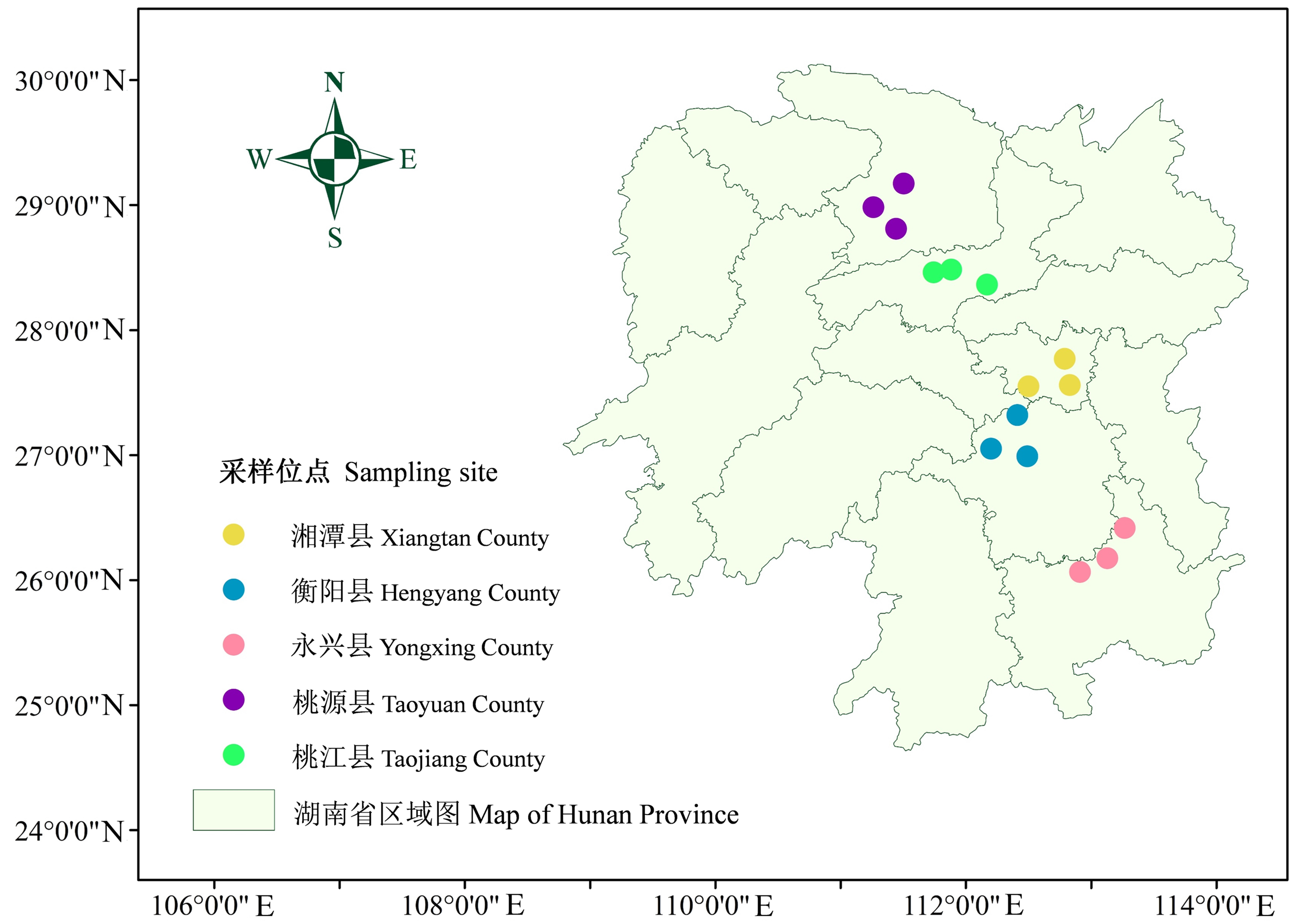
图1
湖南省红壤区土壤采样点分布图"
表1
取样点不同土地利用方式农田的当季施肥量"
| 类型 Type | 季节 Season | 施肥量Fertilizer application rate (kg·hm-2) | ||
|---|---|---|---|---|
| N | P2O5 | K2O | ||
| 水田 Paddy | 水稻季 Rice season | 150-180 | 60-84 | 105-129 |
| 水旱轮作 Paddy-upland rotation | 水稻季 Rice season | 150-180 | 60-84 | 105-129 |
| 油菜季 Rapeseed season | 120-150 | 45-60 | 75-90 | |
| 旱地 Upland | 玉米季 Corn season | 160-240 | 90-120 | 70-100 |
| 大豆季 Soybean season | 30-60 | 20-45 | 40-60 | |
| 花生季 Peanut season | 50-80 | 45-60 | 50-70 | |
| 油菜季 Rapeseed season | 120-150 | 45-60 | 75-90 | |
表2
土壤酶活性名称、底物和类型"
| 名称Name | 底物Substrate | 类型Type | |
|---|---|---|---|
| β-1,4-葡萄糖苷酶, BG | 4-Methylumbelliferyl β-D-glucopyranoside | 碳循环相关酶 C-cycling-enzyme | |
| β-1,4-木糖苷酶, BX | 4-Methylumbelliferyl β-D-xylopyranoside | 碳循环相关酶C-cycling-enzyme | |
| β-1,4-N-乙酰氨基葡萄糖苷酶, NAG | 4-Methylumbelliferyl N-acetyl-β-D-glucosaminide | 氮循环相关酶 N-cycling-enzyme | |
| 亮氨酸氨基肽酶, LAP | L-Leucine-7-amido-4-methylcoumarin hydrochloride | 氮循环相关酶N-cycling-enzyme | |
| 碱性磷酸酶, ALP | 4-Methylumbelliferyl phosphate | 磷循环相关酶P-cycling-enzyme | |
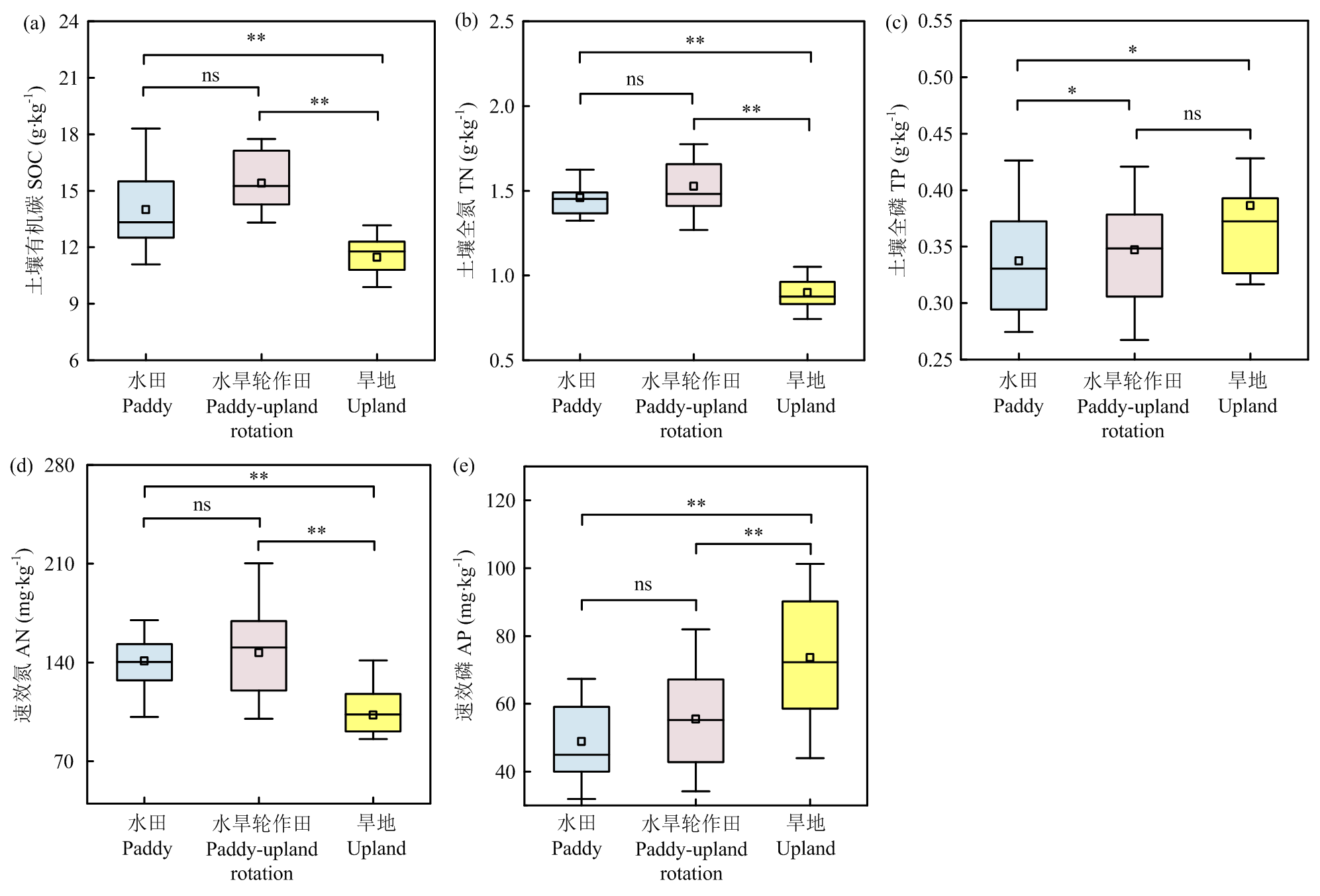
图2
不同土地利用方式下土壤碳氮磷含量 *表示P<0.05,**表示P<0.01,ns表示无显著差异;中间实线代表中位数,空心正方形“◽”为平均值;上下两条线分别代表75%和25%的置信区间。下同"
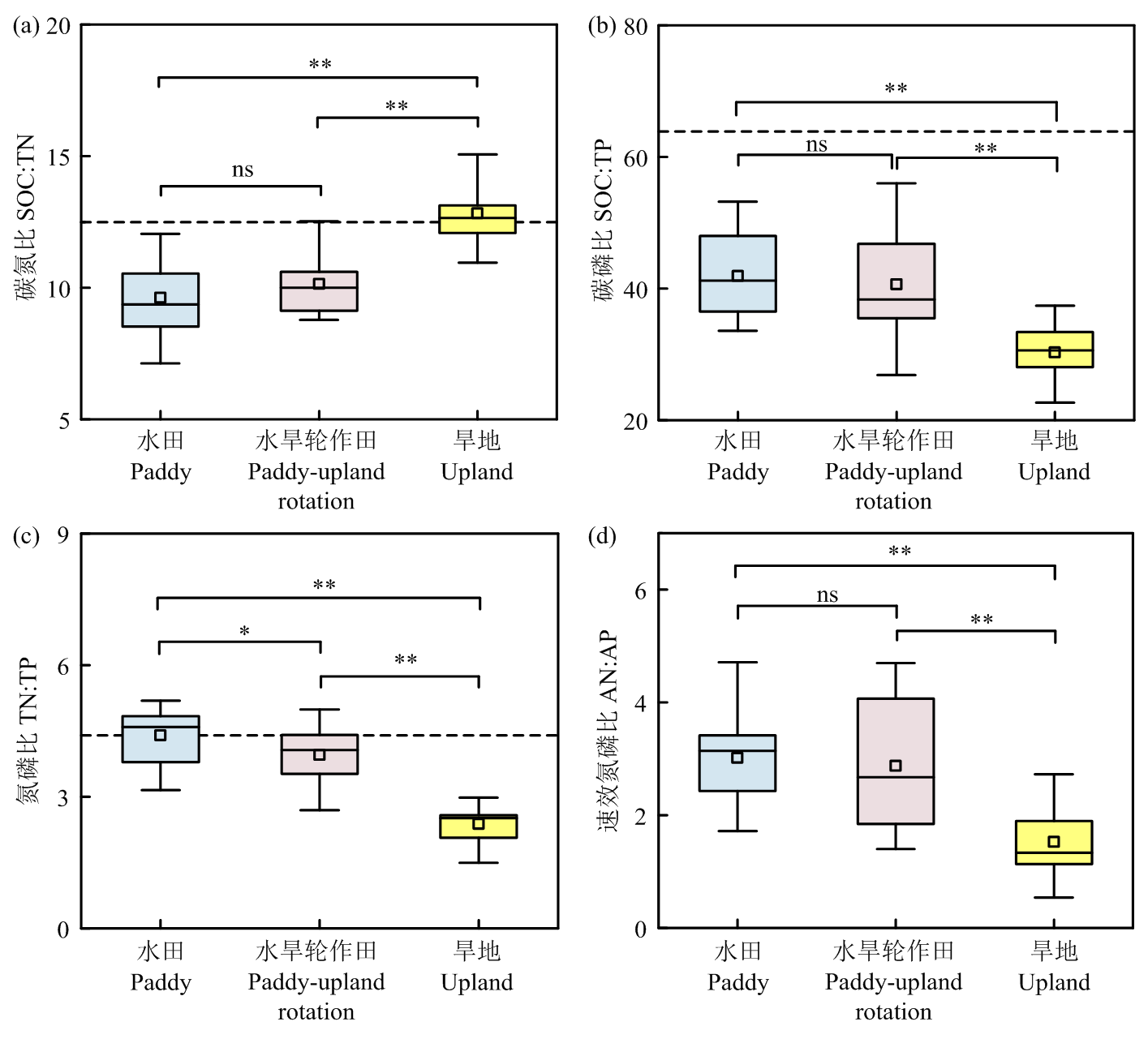
图3
不同土地利用方式下土壤碳氮磷化学计量比 虚线表示该比值的全球土壤平均值"
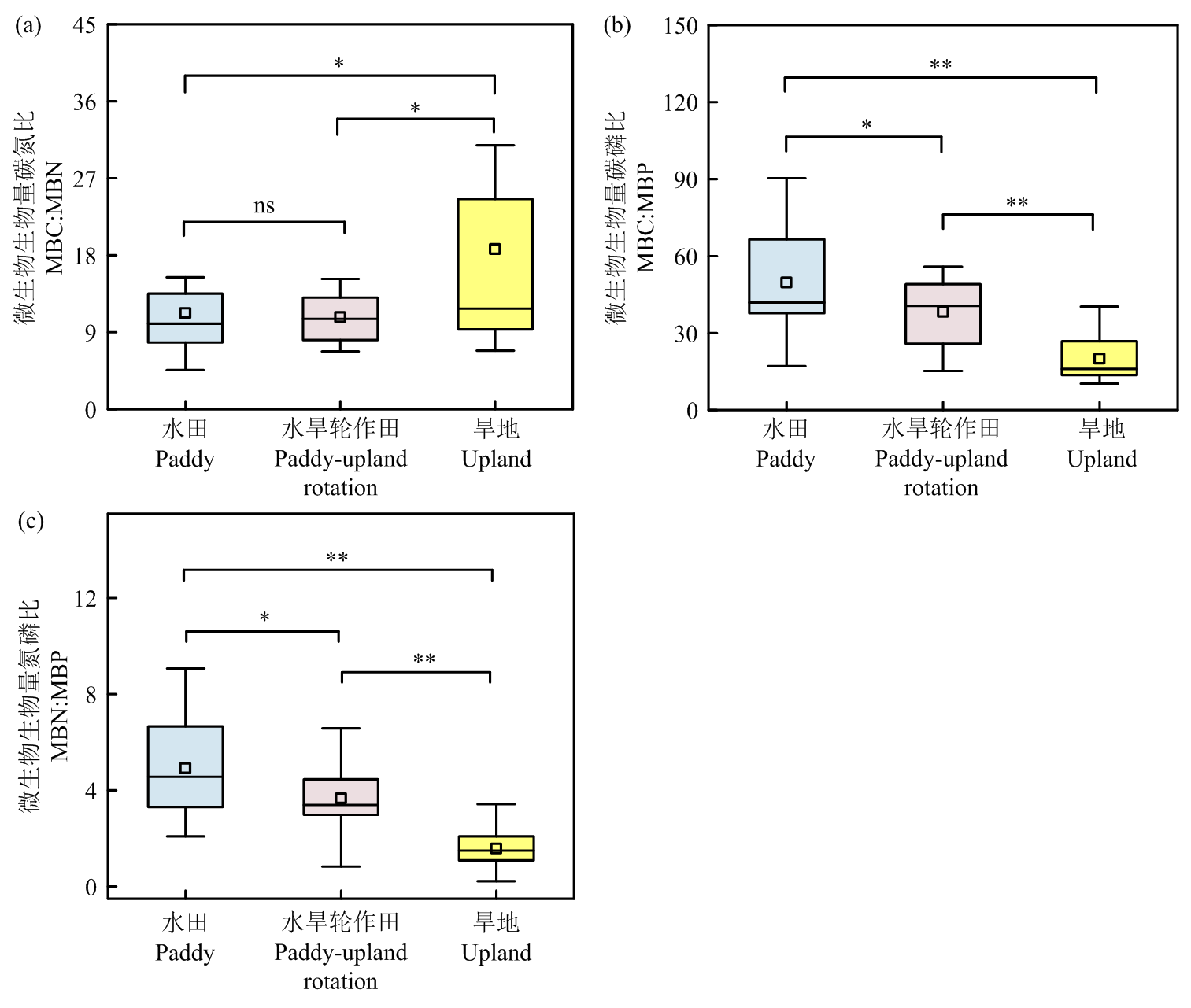
图4
不同土地利用方式下土壤微生物量碳氮磷化学计量比"
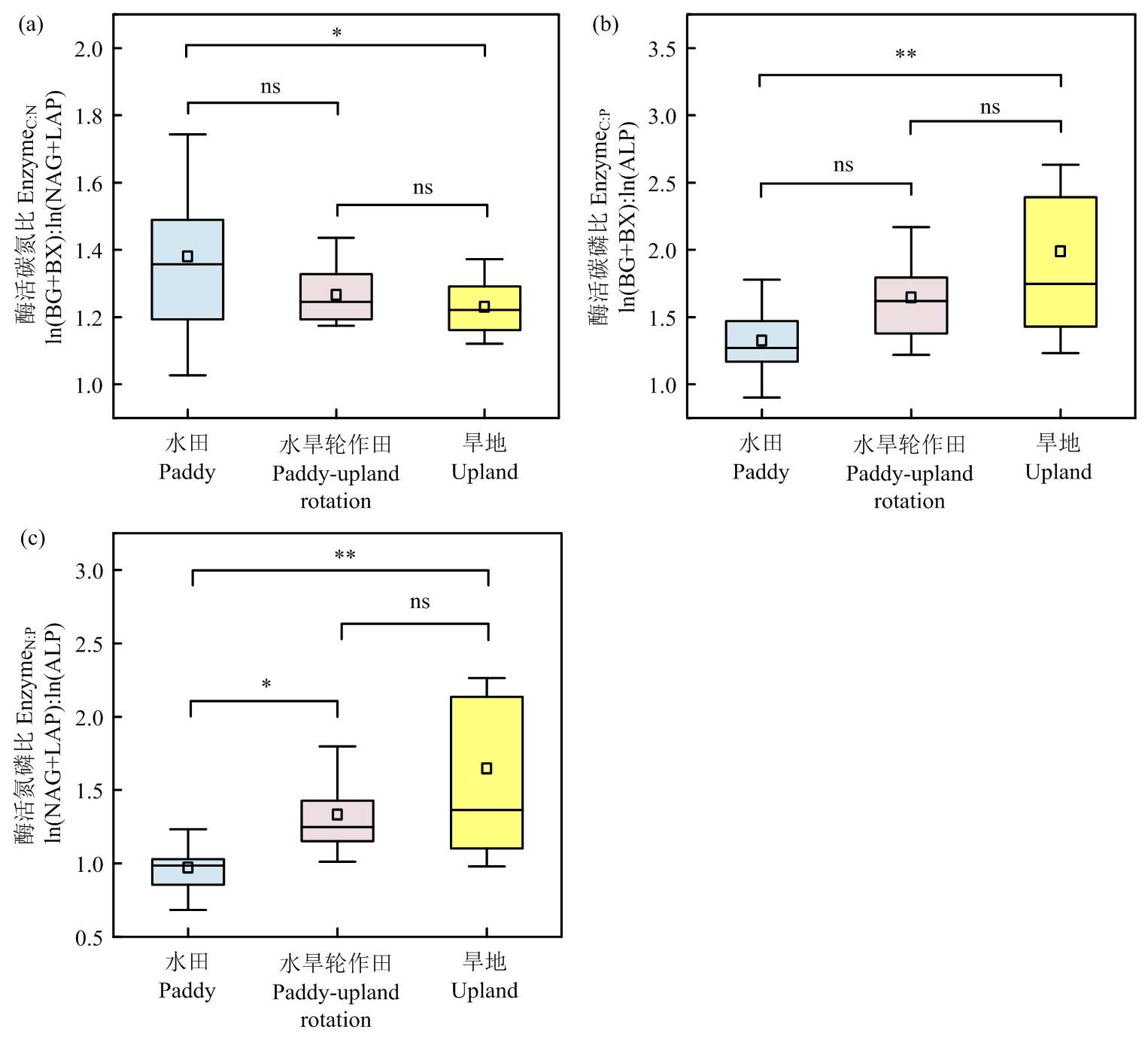
图5
不同土地利用方式下土壤酶活性化学计量比"
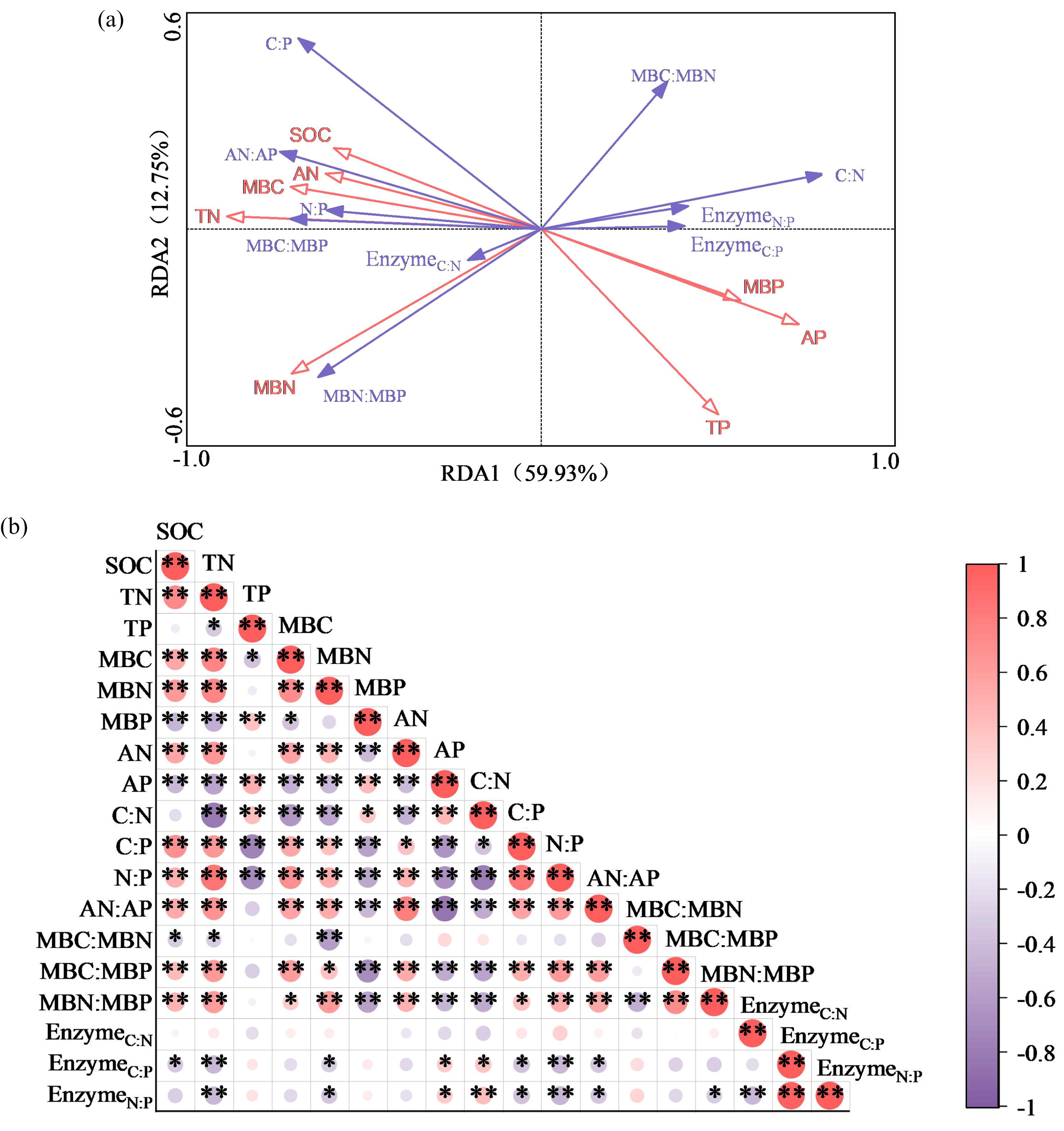
图6
土壤、微生物生物量、胞外酶及其化学计量比之间的冗余分析(a)和Pearson相关性分析(b) 冗余分析中红色线条为解释变量,紫色线条为响应变量"
| [1] |
doi: 10.1007/s11104-024-07031-9 |
| [2] |
马剑, 刘贤德, 金铭, 赵维俊, 敬文茂, 王荣新. 祁连山5种典型灌丛土壤生态化学计量特征. 西北植物学报, 2021, 41(8): 1391-1400.
|
|
|
|
| [3] |
doi: 10.1016/j.scitotenv.2024.175543 |
| [4] |
邹玛丽. 三峡库区环境因子对不同土地利用方式土壤碳氮磷化学计量比的影响[D]. 重庆: 西南大学, 2022.
|
|
|
|
| [5] |
向光明. 东北黑土氮素固持的微生物调控研究[D]. 新疆: 新疆农业大学, 2007.
|
|
|
|
| [6] |
doi: 10.1038/nature08632 |
| [7] |
卢巧露, 方晰, 范世才, 孙龙, 孙百慧, 梁婷婷, 李毅. 湘中丘陵区4个树种人工纯林土壤-微生物-胞外酶C:N:P化学计量特征. 水土保持学报, 2025, 39(1): 239-248.
|
|
|
|
| [8] |
doi: 10.1016/j.soilbio.2024.109331 |
| [9] |
doi: 10.1111/j.1461-0248.2008.01245.x pmid: 18823393 |
| [10] |
|
| [11] |
doi: 10.1016/j.still.2020.104903 |
| [12] |
|
| [13] |
doi: 10.3390/agronomy12051143 |
| [14] |
王修文, 于书霞, 史志华, 王玲. 南方红壤区生态系统服务权衡与协同关系演变对退耕还林的响应. 生态学报, 2021, 41(17): 7002-7014.
|
|
|
|
| [15] |
舒业勤, 彭复细, 雷文硕, 姜彤彤, 陈玉梅, 刘伟民, 张振华, 夏银行. 稻油复种不同措施下土壤有机碳组分积累及其稳定性特征. 土壤学报, 2025, 62(2): 495-503.
|
|
|
|
| [16] |
鲍士旦. 土壤农化分析. 3版. 北京: 中国农业出版社, 2000.
|
|
|
|
| [17] |
吴金水, 林启美, 黄巧云, 肖和艾. 土壤微生物生物量测定方法及其应用. 北京: 气象出版社, 2006.
|
|
|
|
| [18] |
doi: 10.1016/S0038-0717(02)00074-3 |
| [19] |
doi: 10.1016/j.soilbio.2009.02.029 |
| [20] |
doi: 10.1016/j.scitotenv.2023.169793 |
| [21] |
刘麟, 于金田, 王晶, 高雪芹, 伏兵哲. 施肥对苜蓿地土壤理化性质及其生态化学计量学特征的影响. 南方农业, 2021, 15(19): 1-6.
|
|
|
|
| [22] |
doi: 10.1016/j.geoderma.2021.115121 |
| [23] |
doi: 10.1111/gcb.15595 pmid: 33713528 |
| [24] |
doi: 10.1016/j.geoderma.2021.115424 |
| [25] |
王军, 许毅隽, 段勋, 涂强, 何寻阳, 张振华, 苏以荣, 陈香碧. 我国东部典型气候区土壤全磷及其活性组分含量特征. 农业现代化研究, 2025, 46(1): 174-181.
|
|
|
|
| [26] |
邱海华, 蒯磊鑫, 张璐, 刘立生, 文石林, 蔡泽江. 水田改旱地和菜地后红壤酸度和养分变化特征. 中国农业科学, 2024, 57(3): 525-538. doi: 10.3864/j.issn.0578-1752.2024.03.008.
|
|
|
|
| [27] |
doi: 10.1016/0038-0717(93)90249-B |
| [28] |
doi: 10.1016/j.catena.2017.06.023 |
| [29] |
黄正, 张琪, 周宁宁, 阿什日轨, 冯婷煜, 马鹏, 周林, 张荣萍. 油菜季施磷结合秸秆还田提高油菜-水稻轮作体系的产量和磷肥利用率. 植物营养与肥料学报, 2022, 28(8): 1409-1420.
|
|
|
|
| [30] |
|
| [31] |
doi: 10.1111/geb.12029 |
| [32] |
doi: 10.1016/j.soilbio.2023.108972 |
| [33] |
刘琪, 李宇虹, 李哲, 魏晓梦, 祝贞科, 吴金水, 葛体达. 不同水分条件和微生物生物量水平下水稻土有机碳矿化及其影响因子特征. 环境科学, 2021, 42(5): 2440-2448.
|
|
|
|
| [34] |
doi: 10.1016/j.agee.2024.109322 |
| [35] |
doi: 10.1016/j.scitotenv.2020.136852 |
| [36] |
doi: 10.1016/S1002-0160(10)60056-2 |
| [37] |
马原, 迟美静, 张玉玲, 范庆峰, 虞娜, 邹洪涛. 黑土旱地改稻田土壤水稳性团聚体有机碳和全氮的变化特征. 中国农业科学, 2020, 53(8): 1594-1605. doi: 10.3864/j.issn.0578-1752.2020.08.009.
|
|
|
|
| [38] |
陈健, 宋春梅, 刘云慧. 黄淮海平原旱田氮素损失特征及其环境影响研究. 中国生态农业学报, 2006, 14(2): 99-102.
|
|
|
|
| [39] |
迟旭雯, 杜春梅, 周红娟, 刘璐, 董锡文. 旱田改水田对黑土pH、电导率及酶活性的影响. 湖北农业科学, 2017, 56(11): 2045-2048.
|
|
|
|
| [40] |
崔宸阳, 严玉鹏, 王小明, 刘凡, 冯雄汉. 华中地区水旱轮作酸性土磷,铁形态转化及机理. 农业环境科学学报, 2022, 41(9): 1993-2003.
|
|
|
|
| [41] |
doi: 10.1016/j.agee.2025.109517 |
| [42] |
doi: 10.1016/j.agee.2021.107798 |
| [43] |
doi: 10.1016/j.tplants.2023.02.010 |
| [44] |
doi: 10.1016/j.soilbio.2024.109339 |
| [45] |
doi: 10.1007/s42773-024-00415-1 |
| [46] |
张露, 张水清, 任科宇, 李俊杰, 段英华, 徐明岗. 不同肥力潮土的酶活计量比特征及其与微生物量的关系. 中国农业科学, 2020, 53(20): 4226-4236. doi: 10.3864/j.issn.0578-1752.2020.20.011.
|
|
|
|
| [47] |
李雪, 周萍, 程爱武, 戴玉婷, 赖佳鑫, 李康祺, 盛浩, 吴金水. 长期化肥配施不同有机物料对亚热带稻田土壤微生物生物量及酶化学计量特征的影响. 植物营养与肥料学报, 2025, 31(2): 305-316.
|
|
|
|
| [48] |
淑敏, 同拉嘎, 红艳, 青云. 生物炭改良的风沙地植物-土壤-微生物生态化学计量特征及其内稳性. 干旱区研究, 2025, 42(4): 718-729.
doi: 10.13866/j.azr.2025.04.13 |
|
|
|
| [49] |
doi: 10.1016/j.soilbio.2016.10.020 |
| [50] |
平怀香, 崔建宇, 陈硕, 魏露露, 陈清, 张德龙. 施肥对农田土壤碳氮磷化学计量特征及相关酶活变化的影响. 华北农学报, 2022, 37(1): 112-120.
doi: 10.7668/hbnxb.20192592 |
|
|
|
| [51] |
doi: 10.1016/j.scitotenv.2022.152956 |
| [52] |
|
| [1] | 袁浩亮, 聂军, 黎鹏, 鲁艳红, 廖育林, 徐昌旭, 李忠义, 曹卫东, 张江林. 紫云英与稻草联合利用对南方稻区土壤磷库组成及磷素活化的影响[J]. 中国农业科学, 2026, 59(7): 1480-1491. |
| [2] | 王佳诺, 陈桂平, 李盼, 王丽萍, 南运有, 何蔚, 樊志龙, 胡发龙, 柴强, 殷文, 赵连豪. 免耕地膜两年覆盖提高绿洲灌区玉米产量的灌浆期光合生理机制[J]. 中国农业科学, 2026, 59(6): 1189-1202. |
| [3] | 严艳鸽, 张水勤, 许猛, 徐久凯, 李燕婷, 赵秉强, 袁亮. 葡聚糖改性尿素在潮土中的转化特征[J]. 中国农业科学, 2026, 59(5): 1048-1059. |
| [4] | 吕旭东, 孙世媛, 李亚楠, 刘玉龙, 王艳群, 付鑫, 张佳英, 宁鹏, 彭正萍. 智能机械化分层施肥对麦田根-土养分分布和小麦产量的影响[J]. 中国农业科学, 2026, 59(1): 129-146. |
| [5] | 陈桂平, 李盼, 邵冠贵, 吴霞玉, 殷文, 赵连豪, 樊志龙, 胡发龙. 减量灌水与有机无机肥配施对青贮玉米吐丝期后叶片持绿特性的调控作用[J]. 中国农业科学, 2025, 58(7): 1381-1396. |
| [6] | 吴欣珈, 薛玮, 严翊丹, 聂莹莹, 叶立明, 徐丽君. 呼伦贝尔土壤有机碳时空变异特征及其影响因素[J]. 中国农业科学, 2025, 58(6): 1145-1158. |
| [7] | 黄少辉, 杨慧敏, 杨军芳, 杨文方, 聂浩亮, 张静, 邢素丽, 王敬霞, 杨云马, 贾良良. 磷肥长期施用对石灰性褐土团聚体中磷形态及磷酸酶活性的影响[J]. 中国农业科学, 2025, 58(5): 943-955. |
| [8] | 李建昆, 彭超, 张子扬, 梁茜, 魏鸣康, 杨强, 李斌奇, Muhammad Moaaz Ali, Viola Kayima, 陈发兴, 邓红红. ‘皇冠’李果实空腔褐变与木质素积累的关系及其4CL基因家族鉴定[J]. 中国农业科学, 2025, 58(4): 759-778. |
| [9] | 吴文琪, 焦阳, 惠家祯, 王绪锋, 郭博森, 沈玉芳. 不同有机物料配施化肥对土壤肥力和玉米产量的影响[J]. 中国农业科学, 2025, 58(23): 4966-4978. |
| [10] | 张海睿, 贾昂元, 高奇奇, 韩哲群, 南珊珊, 段碧华, 武雪萍. 生物炭配施黄腐酸对滨海盐碱地土壤理化性质、酶活性和多功能性的影响[J]. 中国农业科学, 2025, 58(20): 4178-4188. |
| [11] | 吴东明, 徐靖, 袁佳美, 王珂璇, 李玉义, 何萍, 张建峰, 宋大利, 高淼, 周卫. 一株根际促生菌Myroides odoratimimus PJ-3的分离、鉴定及其耐盐碱和玉米促生性能评价[J]. 中国农业科学, 2025, 58(20): 4131-4143. |
| [12] | 宣泽鹏, 冯慧瑶, 陈美淇, 徐基胜, 刘梦璇, 赵炳梓, 张佳宝. 秸秆还田配施化肥对土壤生态系统多功能性的影响[J]. 中国农业科学, 2025, 58(14): 2821-2837. |
| [13] | 马玉洁, 李旭, 翟英芳, 李敬宇, 付鑫, 彭正萍. 秸秆还田方式和施氮量对土壤有机碳组分及酶活性的影响[J]. 中国农业科学, 2025, 58(12): 2397-2410. |
| [14] | 陈武荣, 肖霜霜, 肖峻, 陈丹. 喀斯特峰丛洼地利用方式对土壤有机碳及其活性组分的影响[J]. 中国农业科学, 2025, 58(10): 1969-1981. |
| [15] | 李澳归, 陈亚茹, 彭子洋, 茹靖益, 刘卫星. 不同降水强度的草原生态系统凋落物分解特征[J]. 中国农业科学, 2025, 58(1): 117-126. |
|
||
