






中国农业科学 ›› 2026, Vol. 59 ›› Issue (20): 4433-4446.doi: 10.3864/j.issn.0578-1752.2026.20.001
于洋1,3( ), 李梦婷2(), 刘丹1, 许庆芬1, 万子语1, 王停停3, 冯刚1, 王建贺1, 王从磊1(), 梁丹1()
收稿日期:2026-02-06
接受日期:2026-04-02
出版日期:2026-10-21
发布日期:2026-10-21
通信作者:
联系方式:
于洋,E-mail:yuyang0319@nwafu.edu.cn。李梦婷,E-mail:lmt0802@126.com。于洋和李梦婷为同等贡献作者。
基金资助:
YU Yang1,3(), LI MengTing2(), LIU Dan1, XU QingFen1, WAN ZiYu1, WANG TingTing3, FENG Gang1, WANG JianHe1, WANG CongLei1(), LIANG Dan1()
Received:2026-02-06
Accepted:2026-04-02
Published:2026-10-21
Online:2026-10-21
摘要:
【目的】ERF转录因子在调控植物非生物胁迫反应中发挥重要作用。研究小麦ERF转录因子基因TaERF1-A的耐盐功能,为小麦耐盐品种的培育提供有价值的基因资源和理论依据。【方法】使用qRT-PCR检测盐胁迫下TaERF1-A的表达模式;采用PlantCARE预测TaERF1-A启动子的顺式作用元件;利用烟草瞬时表达技术对TaERF1-A蛋白亚细胞定位进行分析;构建TaERF1-A小麦沉默载体和过表达载体,通过农杆菌介导的方法,获得小麦过表达和瞬时沉默株系;对转基因植株进行耐盐性鉴定和生理指标测定;通过酵母双杂交筛选TaERF1-A的互作蛋白,利用双分子荧光互补(BiFC)和荧光素酶互补(LCA)试验进一步验证互作关系;应用双荧光素酶(LUC)试验研究互作蛋白和TaERF1-A对胁迫相关基因启动子的影响。【结果】TaERF1-A启动子中含有多种与非生物胁迫相关的顺式调控元件,编码蛋白定位于细胞核。在盐胁迫下,TaERF1-A显著上调表达,沉默TaERF1-A小麦株系的MDA含量上升,而脯氨酸含量和抗氧化酶(POD、CAT和SOD)的活性均降低,胁迫响应(TaDREB1和TaERF3)和抗氧化酶基因(TaPOD、TaCAT和TaSOD)的表达被抑制;过表达TaERF1-A植株的MDA含量降低,而脯氨酸水平升高,POD、CAT和SOD活性增强,TaDREB1、TaERF3、TaPOD、TaCAT和TaSOD的表达水平上调,结果表明,在盐胁迫下,小麦TaERF1-A正向调控小麦耐盐性。通过酵母双杂交(Y2H)、双分子荧光互补(BiFC)和荧光素酶互补(LCA)试验,证实在酵母和烟草细胞中TaERF1-A和TaNAC48存在互作关系。TaNAC48的表达受到盐胁迫诱导,TaNAC48与TaERF1-A的共表达提高了胁迫相关基因启动子的激活活性。【结论】小麦TaERF1-A在盐胁迫过程中发挥正向调控作用,过表达和沉默TaERF1-A分别增强和减弱了转基因小麦的耐盐性;TaERF1-A可能与TaNAC48蛋白协作,调控胁迫相关基因表达,提高小麦耐盐性。
于洋, 李梦婷, 刘丹, 许庆芬, 万子语, 王停停, 冯刚, 王建贺, 王从磊, 梁丹. 小麦ERF转录因子基因TaERF1-A调控小麦耐盐性的功能研究[J]. 中国农业科学, 2026, 59(20): 4433-4446.
YU Yang, LI MengTing, LIU Dan, XU QingFen, WAN ZiYu, WANG TingTing, FENG Gang, WANG JianHe, WANG CongLei, LIANG Dan. Functional Characterization of the ERF Transcription Factor TaERF1-A in Salt Tolerance in Triticum aestivum L.[J]. Scientia Agricultura Sinica, 2026, 59(20): 4433-4446.

图1
TaERF1-A的特性分析 A:TaERF1-A的进化关系。Ta:小麦,Td:硬粒小麦,Aet:节节麦,Bd:二穗短柄草,Zm:玉米,Pv:柳枝稷,Nu:荷花,Vv:葡萄,Cc:柑橘,At:拟南芥,Pt:杨树;B:TaERF1-A的亚细胞定位;C:TaERF1-A启动子的顺式元件(ATG上游1500 bp)"
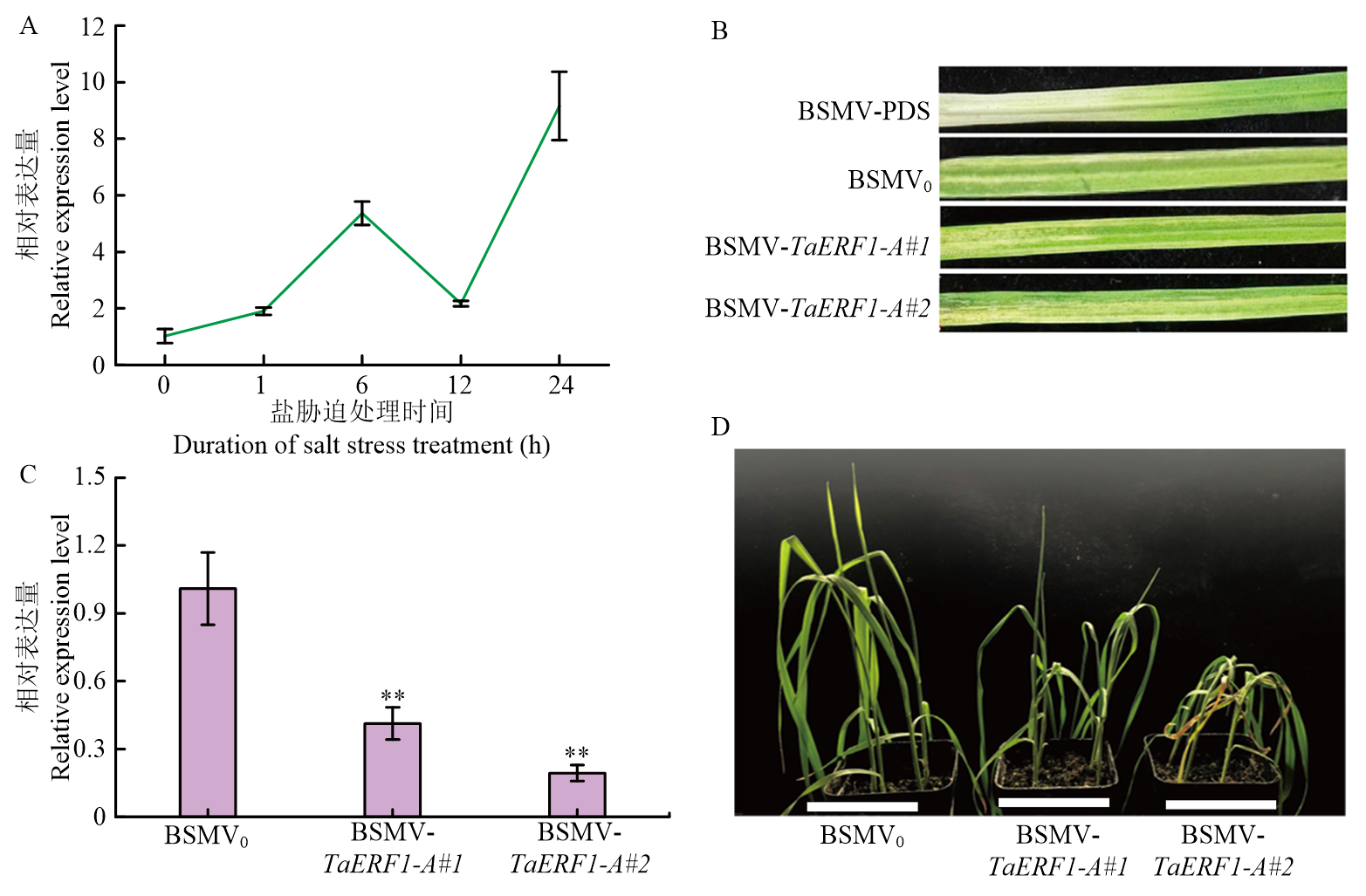
图2
TaERF1-A沉默小麦株系耐盐性分析 A:不同时间盐胁迫(200 mmol·L-1 NaCl)下小麦TaERF1-A对的表达;B:BSMV-VIGS 叶片发病图;C:TaERF1-A沉默效率检测;D:TaERF1-A沉默小麦株系在盐胁迫处理下的表型。**:差异极显著(P<0.01)。下同"
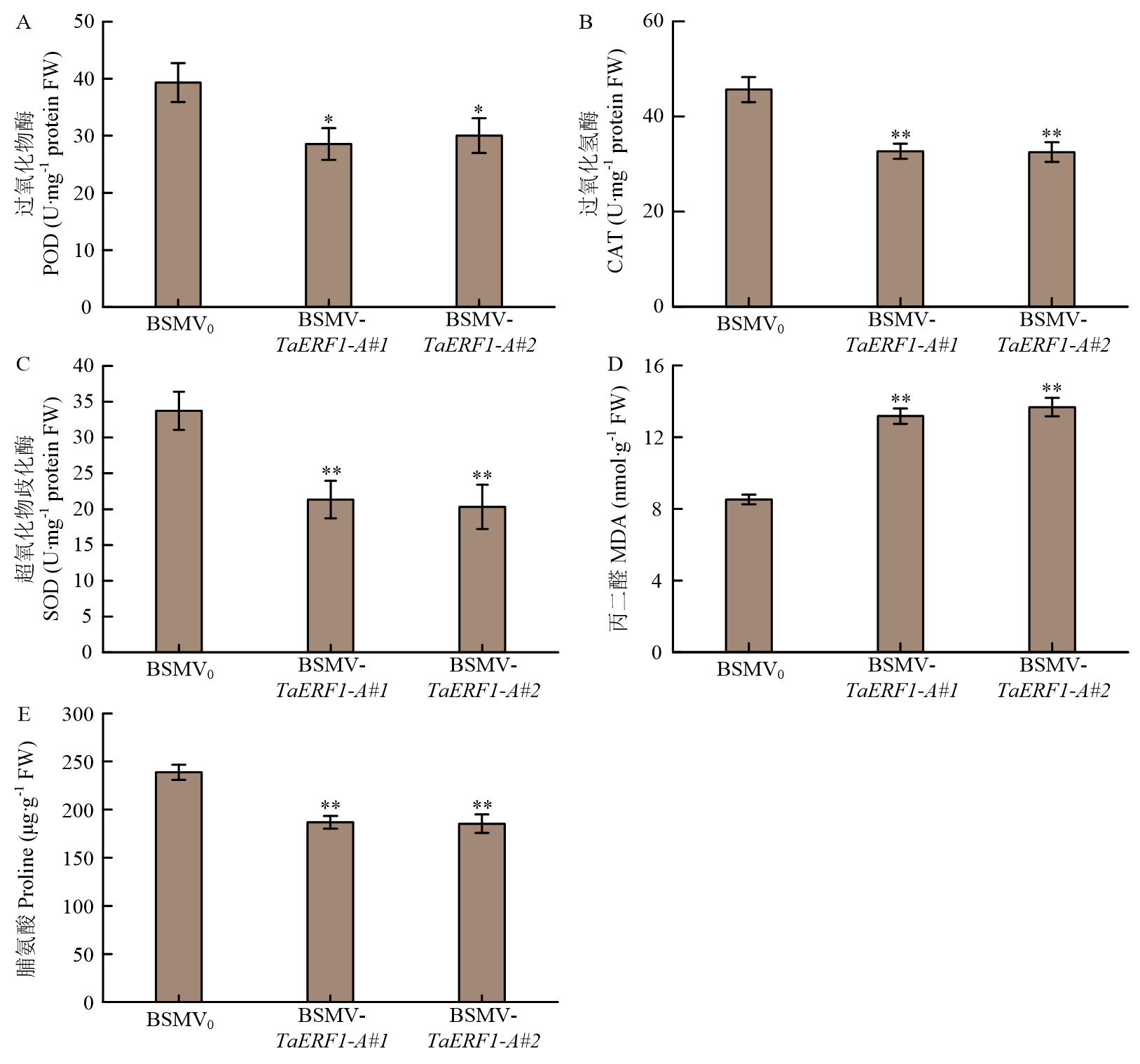
图3
盐胁迫后TaERF1-A沉默小麦株系生理指标的变化 A:过氧化物酶活性;B:过氧化氢酶活性;C:超氧化物歧化酶活性;D:丙二醛含量;E:脯氨酸含量。*:差异显著(P<0.05)。下同"
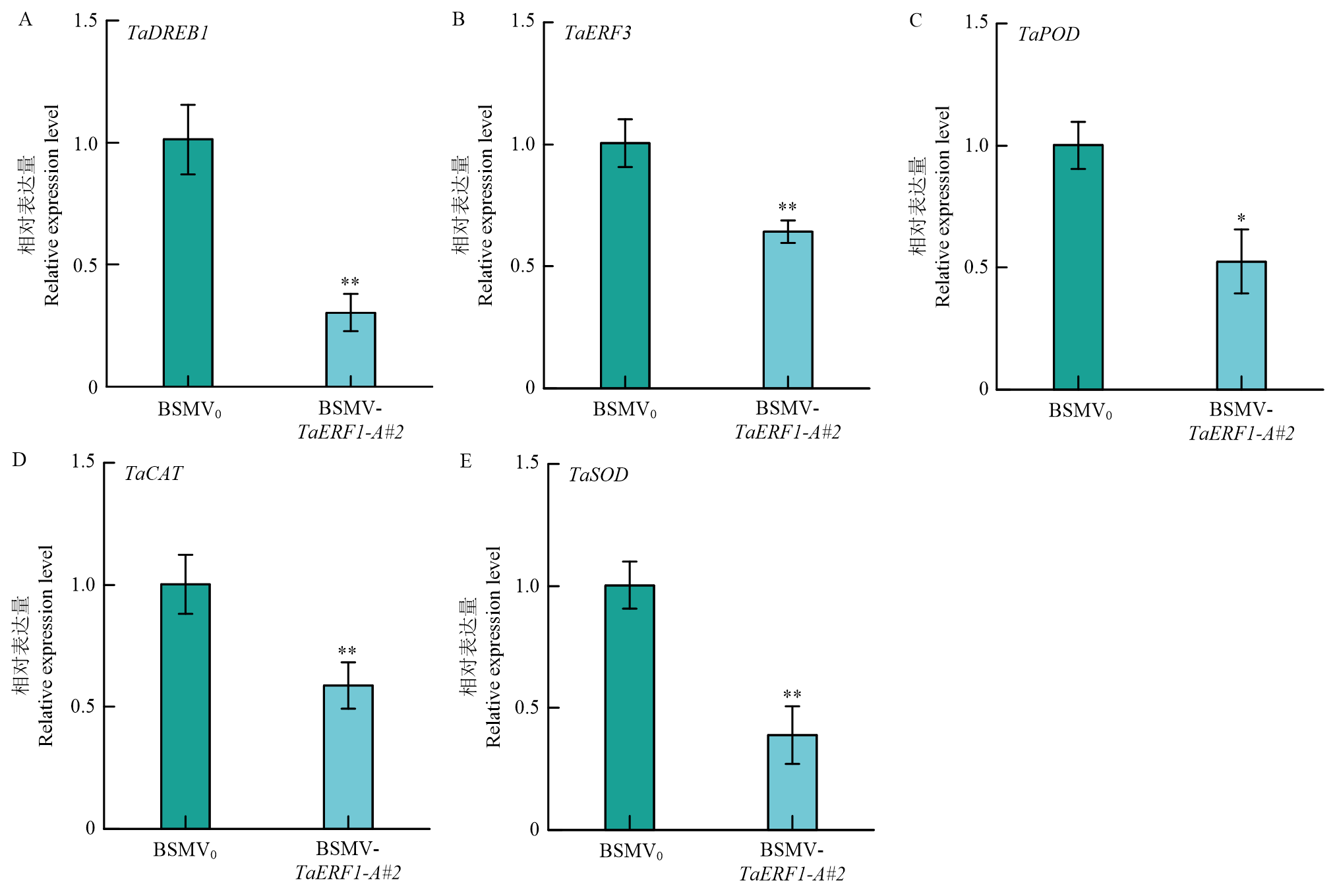
图4
TaERF1-A沉默小麦株系中相关耐逆基因的转录水平分析"

图5
过表达TaERF1-A小麦的耐盐性分析 A:过表达TaERF1-A小麦株系的qRT-PCR验证;B:过表达TaERF1-A小麦株系苗期耐盐表型分析"
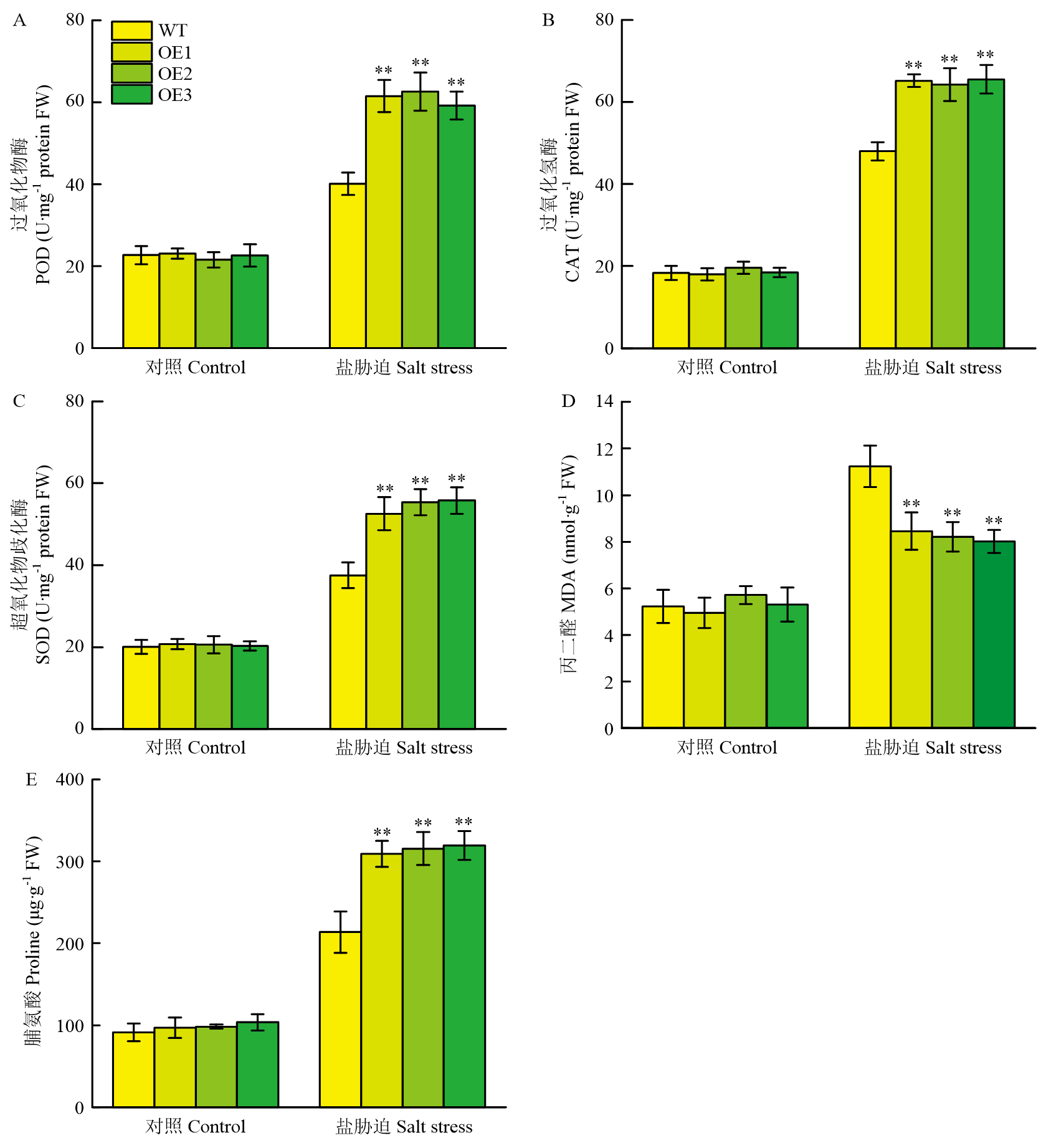
图6
盐胁迫下过表达TaERF1-A小麦株系生理指标的变化 A:过氧化物酶活性;B:过氧化氢酶活性;C:超氧化物歧化酶活性;D:丙二醛含量;E:脯氨酸含量"
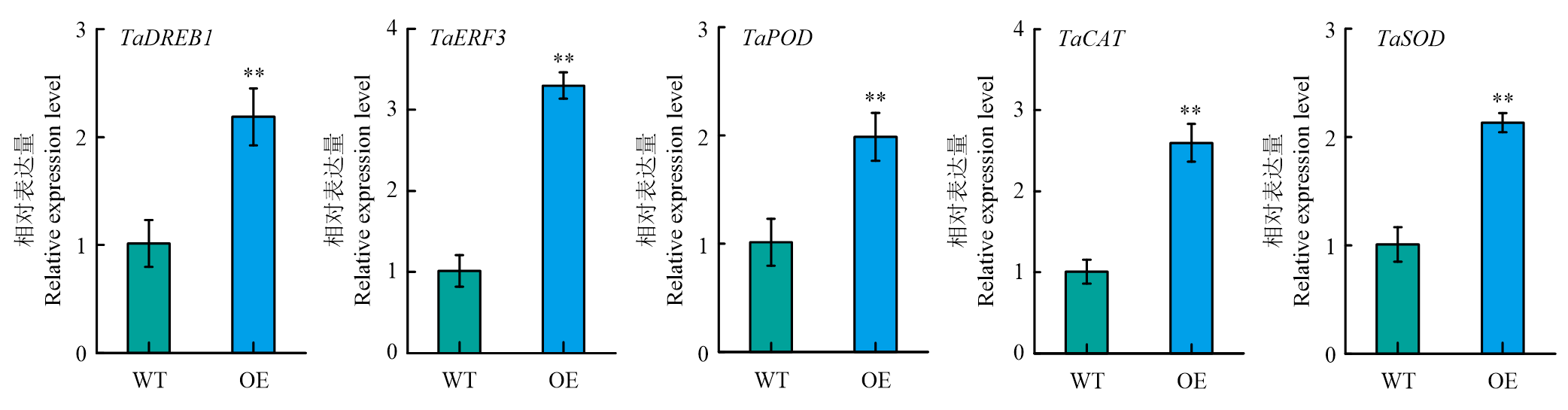
图7
盐胁迫下过表达TaERF1-A小麦株系中相关耐逆基因的转录水平分析"

图8
TaERF1-A互作蛋白的筛选与验证 A:筛选互作蛋白。红色框中菌落测序结果为TaNAC48;B:TaERF1-A和TaNAC48在烟草细胞中互作关系的验证;C:TaERF1-A与TaNAC48的LCA互作验证"
表1
TaERF1-6A互作蛋白注释信息"
| 基因Gene | 候选蛋白Putative protein | 登记号Accession |
|---|---|---|
| TaNAC48 | NAC结构域蛋白NAC domain-containing protein 48 | XM_044463398.1 |
| TaVDAC | 线粒体外膜孔道蛋白Mitochondrial outer membrane porin | XM_044532654.1 |
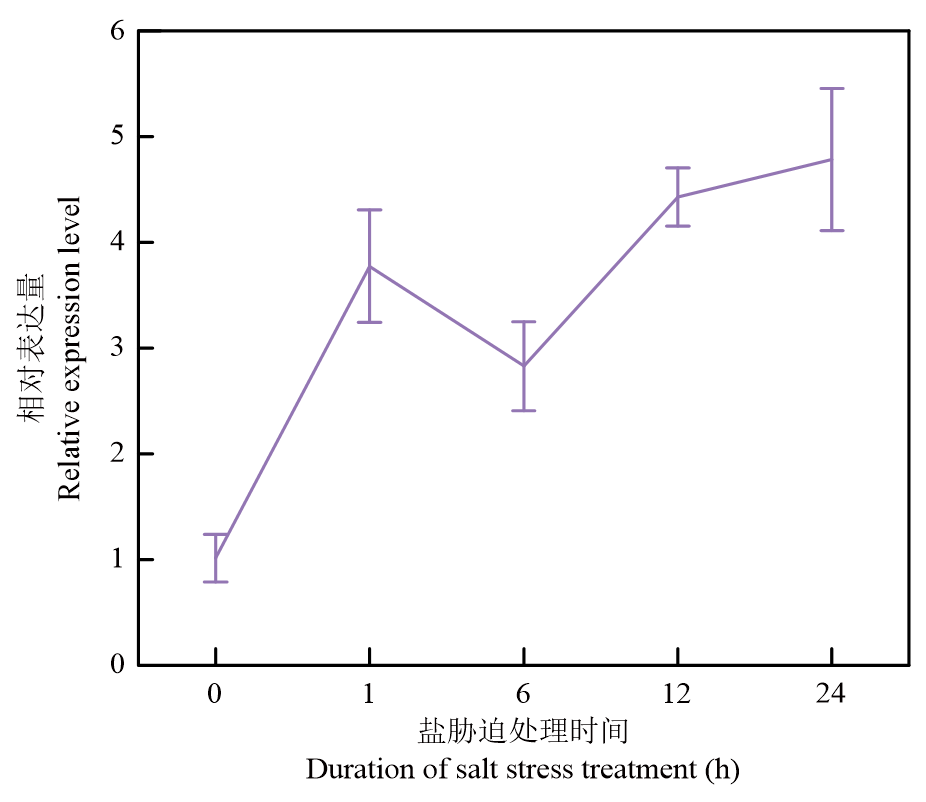
图9
小麦TaNAC48对盐胁迫的响应"
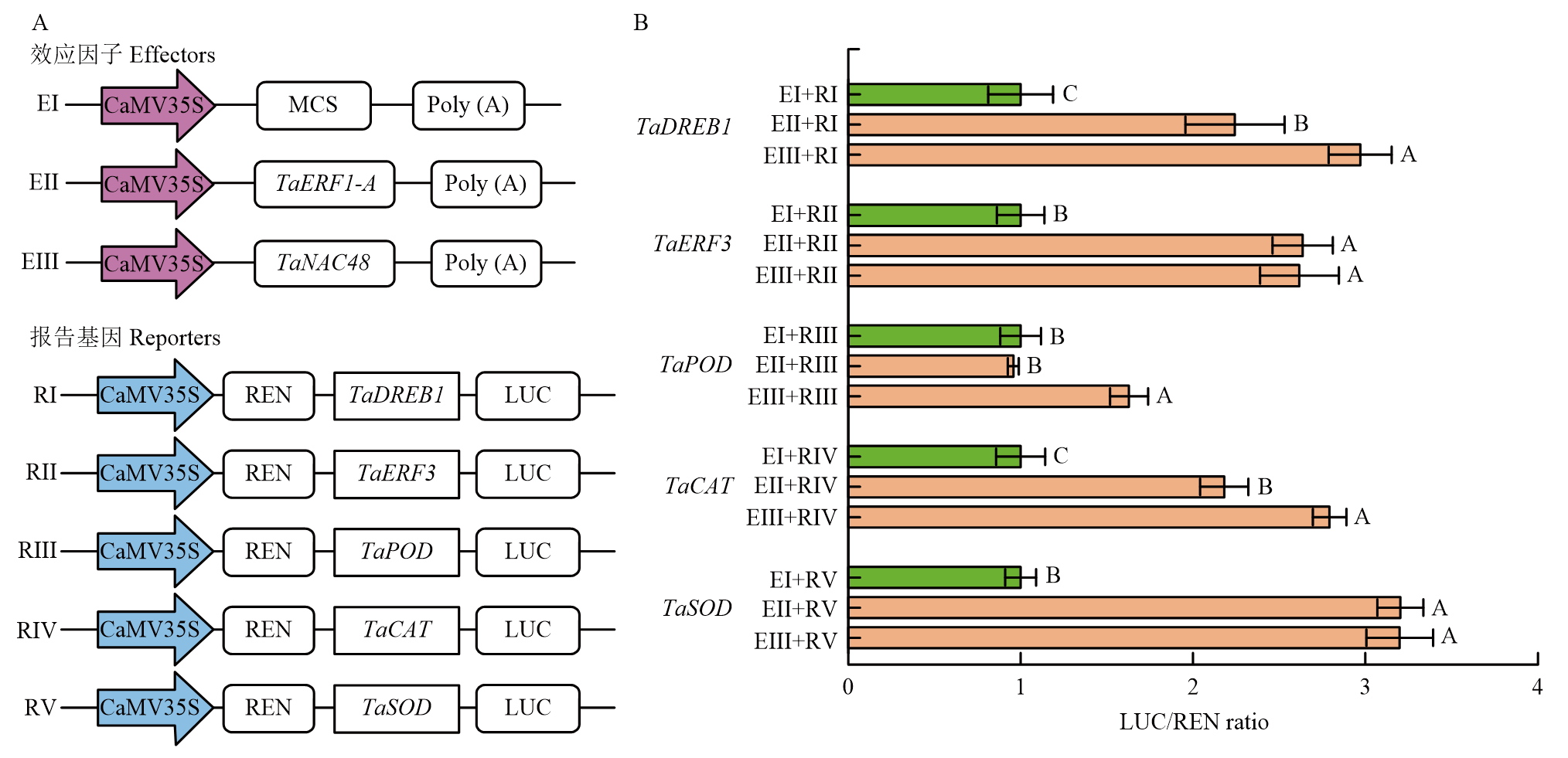
图10
TaNAC48与TaERF1-A蛋白协作对胁迫基因启动子激活能力的影响 A:双荧光素酶系统使用的报告子和效应子载体结构图谱;B:双荧光素酶报告试验。不同的字母表示差异性达到0.01%的显著水平"
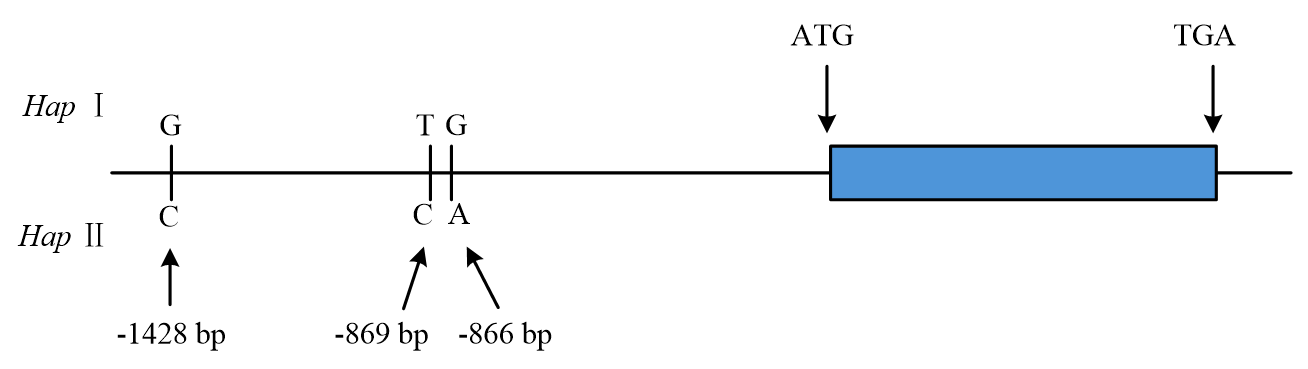
图11
小麦TaERF1-A的序列变异"
表2
TaERF1-A 2种等位变异类型在不同小麦品种中的分布"
| 单倍型 Haplotype | 国内品种 Domestic cultivars | 国外品种 Foreign cultivars | 品种数目 Cultivar number |
|---|---|---|---|
| HapⅠ | 周8425B、川麦104、济麦22、宁春4号 Zhou 8425B, Chuanmai 104, Jimai 22, Ningchun 4 | Alchemy, Julius, Landmark, Mace, Stanley | 9 |
| HapⅡ | 中国春、郑麦366、西农6028、矮抗58、小偃6号、北京8号、扬麦33、川麦48、扬麦158、邯6172、藏1817、济麦44、郑麦16、济麦47、郑麦22、克丰11、科农9024、石4185、苏麦3号 Chinese Spring, Zhengmai 366, Xinong 6028, Aikang 58, Xiaoyan 6, Beijing 8, Yangmai 33, Chuanmai 48, Yangmai 158, Han 6172, Zang 1817, Jimai 44, Zhengmai 16, Jimai 47, Zhengmai 22, Kefeng11, Kenong 9024, Shi 4185, Sumai 3 | ArinalrFor, Claire, Jagger, Kariega, Lancer, Norin61, Robigus, Sy Mattis | 27 |
| [1] |
doi: 10.1093/plcell/koad307 |
| [2] |
doi: 10.3389/fpls.2025.1535850 |
| [3] |
doi: 10.1104/pp.105.073783 |
| [4] |
doi: 10.4238/2013.May.13.1 pmid: 23766026 |
| [5] |
doi: 10.1186/s12864-025-11671-1 pmid: 40389830 |
| [6] |
doi: 10.1111/pbi.12153 pmid: 24393105 |
| [7] |
doi: 10.1111/nph.v237.1 |
| [8] |
doi: 10.1007/s11103-007-9237-9 pmid: 17874224 |
| [9] |
doi: 10.1104/pp.108.126813 pmid: 18945933 |
| [10] |
doi: 10.1007/s12033-025-01414-8 |
| [11] |
doi: 10.1111/tpj.2012.71.issue-2 |
| [12] |
doi: 10.1186/s12284-020-00405-4 |
| [13] |
doi: 10.1016/j.plaphy.2021.07.027 |
| [14] |
doi: 10.1186/s12870-023-04136-8 |
| [15] |
doi: 10.3390/plants14040621 |
| [16] |
doi: 10.1016/j.gene.2012.09.039 pmid: 23000066 |
| [17] |
doi: 10.3390/ijms23063272 |
| [18] |
doi: 10.3390/ijms19124020 |
| [19] |
doi: 10.1186/s40659-019-0222-y pmid: 30894225 |
| [20] |
doi: 10.1016/j.gene.2021.146031 |
| [21] |
doi: 10.1016/j.plantsci.2023.111894 |
| [22] |
doi: 10.1186/s12870-023-04709-7 pmid: 38172667 |
| [23] |
doi: 10.1093/aob/mcaf006 |
| [24] |
doi: 10.1186/s12864-025-12169-6 |
| [25] |
doi: 10.1186/s12864-025-11912-3 pmid: 40993519 |
| [26] |
|
| [27] |
doi: 10.1016/j.plaphy.2024.109035 |
| [28] |
doi: 10.1007/s00299-023-03079-6 pmid: 37812280 |
| [29] |
doi: 10.3390/genes14010194 |
| [30] |
doi: 10.3390/ijms26104921 |
| [31] |
doi: 10.3389/fpls.2022.1042084 |
| [32] |
doi: 10.3389/fpls.2015.01092 pmid: 26697045 |
| [33] |
doi: 10.1007/s00122-025-04823-0 pmid: 39899078 |
| [34] |
doi: 10.1002/tpg2.v17.4 |
| [35] |
doi: 10.1016/j.ijbiomac.2022.11.234 |
| [36] |
doi: 10.1111/ppl.v172.2 |
| [37] |
张惠媛, 刘永伟, 杨军峰, 张双喜, 于太飞, 陈隽, 陈明, 周永斌, 马有志, 徐兆师, 付金东. 小麦转录因子基因TaWRKY33的耐盐性分析[J]. 中国农业科学, 2018, 51(24): 4591-4602. DOI: 10.3864/j.issn.0578-1752.2018.24.001.
|
|
|
|
| [38] |
doi: 10.1111/pce.2012.35.issue-6 |
| [39] |
doi: 10.1111/nph.2017.215.issue-4 |
| [40] |
|
| [41] |
doi: 10.1111/pbi.v20.5 |
| [42] |
doi: 10.1111/tpj.16420 pmid: 37566437 |
| [1] | 王小玮, 杜佛力, 闫红财, 郎正东, 党志娟, 李葆春, 汪军成, 马小乐, 王化俊, 张宏, 姚立蓉. 396份春小麦灌浆期和成熟期抗旱性评价[J]. 中国农业科学, 2026, 59(8): 1608-1621. |
| [2] | 王彩玉, 刘小丽, 李文广, 杨文平, 杨珍平, 高志强. 有机肥不同替代比例对土壤多功能性的影响及微生物驱动机制[J]. 中国农业科学, 2026, 59(8): 1712-1726. |
| [3] | 朱琦, 贾振鹏, Tahir SHAH, 徐晨晟, 李芷琦, 吕会帅, 朱鹏超, 韦小敏, 黄冬琳, 孙艳妮, 曹卫东, 高亚军, 王朝辉, 张达斌. 绿肥配施增效产品降低旱地麦田温室气体排放及碳足迹[J]. 中国农业科学, 2026, 59(7): 1507-1522. |
| [4] | 叶美金, 吴雷, Lohani Md Nahibuzzaman, 尹丽, 胡欣荣, 刘亚西, 蒋云峰, 陈国跃, 蒲至恩, 李阳, 李婷, 邹亚亚, 吴佳怡, 马建. 基于GWAS的中国地方小麦成熟胚大小位点的鉴定及其遗传效应解析[J]. 中国农业科学, 2026, 59(6): 1157-1171. |
| [5] | 张志林, 刘荣, 宗绪晓, 郝晓鹏, 杨涛. 蚕豆多时期耐盐性综合评价与衣康酸缓解萌发期盐胁迫研究[J]. 中国农业科学, 2026, 59(6): 1172-1188. |
| [6] | 李文虎, 礼海风, 杜宇鹏, 丁玉兰, 罗一诺, 李宇珂, 佘文婷, 张丰, 滕宇, 张思琦, 黄翠, 李小涵, 刘金山, 王朝辉. 小麦锌吸收转移对土施锌肥响应的区域差异[J]. 中国农业科学, 2026, 59(5): 1034-1047. |
| [7] | 焦文娟, 何万龙, 耿洪伟, 白斌, 李剑峰, 程宇坤. 155份春小麦品种(系)条锈病抗性评价与抗病基因分子检测[J]. 中国农业科学, 2026, 59(5): 937-950. |
| [8] | 崔士友, 陈澎军, 缪源卿, 韩继军, 沈俊明. EMS诱变抗草甘膦小麦新种质的创制与大田评价[J]. 中国农业科学, 2026, 59(4): 723-733. |
| [9] | 钱瑾, 李映雪, 吴芳, 邹晓晨. 集成光谱降维的冬小麦叶片磷含量估算[J]. 中国农业科学, 2026, 59(4): 781-792. |
| [10] | 孔媛, 崔沙沙, 李美, 李健, 杨思雨, 房锋, 刘帅帅, 刘明平, 曾艳, 高兴祥, 柏连阳. 黄淮海冬小麦田多花黑麦草等5种禾本科杂草时空分布变化规律[J]. 中国农业科学, 2026, 59(4): 807-823. |
| [11] | 王勇胜, 牛丽, 王长杰, 马立花, 廉潇潇, 孟亚雄, 马小乐, 姚立蓉, 张宏, 杨轲, 李葆春, 王化俊, 司二静, 汪军成. 冬小麦千粒重的全基因组关联分析及候选基因预测[J]. 中国农业科学, 2026, 59(3): 499-514. |
| [12] | 李心怡, 李嘉宁, 杨文平, 夏清, 霍滢睿, 郝世航, 黄婷苗, 任永康, 陈杰, 高志强, 杨珍平. 彩粒小麦锌营养对花后叶面喷锌的响应[J]. 中国农业科学, 2026, 59(3): 515-527. |
| [13] | 咸青林, 肖鉴珂, 高阿庆, 郜利闯, 刘杨. 种植方式结合测墒补灌下冬小麦产量及水分利用效率[J]. 中国农业科学, 2026, 59(3): 589-601. |
| [14] | 张志勇, 谭世超, 熊淑萍, 马新明, 韦一昊, 王小纯. 水氮周年优化对豫北灌区小麦玉米轮作系统产量和氮迁移的影响[J]. 中国农业科学, 2026, 59(2): 336-353. |
| [15] | 杜瑞瑞, 黄学郡, 于洋, 孙萌萌, 李振磊, 蒋文娜, 刘小利, 甄文超, 王彦东. 海河平原冬小麦源库特征与品质性状的协同演变分析[J]. 中国农业科学, 2026, 59(19): 4235-4249. |
|
||
