






中国农业科学 ›› 2026, Vol. 59 ›› Issue (19): 4235-4249.doi: 10.3864/j.issn.0578-1752.2026.19.004
杜瑞瑞( ), 黄学郡, 于洋, 孙萌萌, 李振磊, 蒋文娜, 刘小利, 甄文超, 王彦东()
收稿日期:2026-02-03
接受日期:2026-05-18
出版日期:2026-10-01
发布日期:2026-10-10
通信作者:
联系方式:
杜瑞瑞,E-mail:2996019256@qq.com。
基金资助:
DU RuiRui(), HUANG XueJue, YU Yang, SUN MengMeng, LI ZhenLei, JIANG WenNa, LIU XiaoLi, ZHEN WenChao, WANG YanDong()
Received:2026-02-03
Accepted:2026-05-18
Published:2026-10-01
Online:2026-10-10
摘要:
【目的】探究海河平原冬小麦品种更替过程中源库特征与品质性状的协同演变规律,为协调高产与优质的小麦育种和栽培提供理论依据。【方法】以1950s至今审定的30个主栽冬小麦品种为试验材料,于2022—2025年3个小麦生长季在河北农业大学辛集试验站进行田间试验,测定源特性指标(叶面积指数、净光合速率等)、库特性指标(单位面积粒数、灌浆速率、产量等)及品质性状(蛋白组分、淀粉特性、加工品质等),并分析碳氮比与代谢酶活性,采用混合效应模型和Mantel检验探析源库特征与品质性状的演变规律及其相互关系。【结果】品种更替优化了源库特性,源活性(净光合速率)每10年提升0.66 μmol·m-2·s-1,库容(单位面积粒数)和库活性(平均灌浆速率)每10年分别增加626.56 grains/m2和0.03 mg/(grain·d),使库强度(产量)每10年提高551.77 kg·hm-2。然而,这一过程导致了明显的“碳稀释效应”,造成产量-品质失衡:支链淀粉含量每10年显著增加0.31%,而总蛋白含量每10年下降0.23%,沉降值和湿面筋含量等加工品质指标每10年分别显著降低0.96 mL和0.71%,且蛋白特性与源活性、库强度呈显著负相关关系。碳氮代谢相关酶活性表明,品种更替显著提高了蔗糖合成酶和谷氨酰胺合成酶等关键酶活性,使得籽粒碳氮比每10年增加1.44,而茎、叶碳氮比显著降低,进一步揭示品种更替导致了碳氮代谢分配格局的改变。【结论】现代高产品种通过源活性提升与库容扩大实现了产量突破,但籽粒氮素积累相对不足,使得产量与品质难以协同提升。建议通过开花期氮肥后移和灌浆期水分调控等栽培措施协调碳氮代谢,并结合选育高氮同化或高氮运移效率的品种,以缓解碳稀释效应,实现产量与品质的协同提升。
杜瑞瑞, 黄学郡, 于洋, 孙萌萌, 李振磊, 蒋文娜, 刘小利, 甄文超, 王彦东. 海河平原冬小麦源库特征与品质性状的协同演变分析[J]. 中国农业科学, 2026, 59(19): 4235-4249.
DU RuiRui, HUANG XueJue, YU Yang, SUN MengMeng, LI ZhenLei, JIANG WenNa, LIU XiaoLi, ZHEN WenChao, WANG YanDong. Evolution of Source-Sink Traits and End-Use Quality in Winter Wheat During Cultivar Replacement in the Haihe Plain[J]. Scientia Agricultura Sinica, 2026, 59(19): 4235-4249.

表1
海河平原不同年代主栽冬小麦品种"
| 年代Year | 审定年份Year of release | 品种名Cultivar name | 骨干亲本Founder parent |
|---|---|---|---|
| 1950s | 1956 | 石家庄407 Shijiazhuang 407 | 胜利麦/燕大1817 Shenglimai/Yanda 1817 |
| 1960s | 1969 | 泰山1号Taishan 1 | 欧柔Ourou |
| 1964 | 石家庄54 Shijiazhuang 54 | 碧蚂4号/早洋麦Bima 4/Zaoyangmai | |
| 1960 | 济南2号Jinan 2 | 碧蚂4号/早洋麦Bima 4/Zaoyangmai | |
| 1963 | 农大311 Nongda 311 | 胜利麦/燕大1817 Shenglimai/Yanda 1817 | |
| 1965 | 北京8号Beijing 8 | 碧蚂4号/早洋麦Bima 4/Zaoyangmai | |
| 1970s | 1973 | 冀麦3号Jimai 3 | 碧蚂4号/早洋麦Bima 4/Zaoyangmai |
| 1978 | 冀麦1号Jimai 1 | 欧柔Ourou | |
| 1977 | 冀麦7号Jimai 7 | 丰产3号Fengchan 3 | |
| 1976 | 冀麦2号Jimai 2 | 北京8号//H.H/欧柔Beijing 8//H.H/Ourou | |
| 1980s | 1988 | 冀麦26号Jimai 26 | 劳夫林10号Lovelin 10 |
| 1988 | 冀麦30号Jimai 30 | 欧柔Ourou | |
| 1990s | 1994 | 冀麦36号Jimai 36 | 碧蚂4号/早洋麦Bima 4/Zaoyangmai |
| 1997 | 衡4041 Heng 4041 | 劳夫林10号Lovelin 10 | |
| 1997 | 石4185 Shi 4185 | 劳夫林10号Lovelin 10 | |
| 1996 | 冀麦38号Jimai 38 | 劳夫林10号Lovelin 10 | |
| 1999 | 邯4589 Han 4589 | 邯4032 Han 4032 | |
| 1998 | 沧6001 Cang 6001 | 临汾6154/冀麦32 Linfen 6154/Jimai 32 | |
| 2000s | 2001 | 邯6172 Han 6172 | 邯4032 Han 4032 |
| 2001 | 衡95观26 Heng 95 Guan 26 | 劳夫林10号Lovelin 10 | |
| 2001 | 石家庄8号Shijiazhuang 8 | 劳夫林10号Lovelin 10 | |
| 2008 | 衡4399 Heng 4399 | 邯4032 Han 4032 | |
| 2004 | 衡观35 Hengguan 35 | 劳夫林10号Lovelin 10 | |
| 2006 | 济麦22 Jimai 22 | 丰产3号Fengchan 3 | |
| 2004 | 师栾02-1 Shiluan 02-1 | 临漳麦Linzhangmai | |
| 2005 | 石麦15 Shimai 15 | 劳夫林10号Lovelin 10 | |
| 2010s | 2011 | 石麦22 Shimai 22 | 劳夫林10号Lovelin 10 |
| 2014 | 石农086 Shinong 086 | 邯4032 Han 4032 | |
| 2020s | 2021 | 马兰1号Malan 1 | 丰产3号Fengchan 3 |
| 2020 | 马兰6号Malan 6 | 河农6425系选Selection from Henong 6425 |

图1
不同年代冬小麦品种的加工品质与年代之间的关系 红色实线表示显著增加或降低(P<0.05),红色虚线表示增加或降低不显著,黑色虚线为95%置信区间。下同"

图2
不同年代冬小麦品种的营养品质与年代之间的关系"
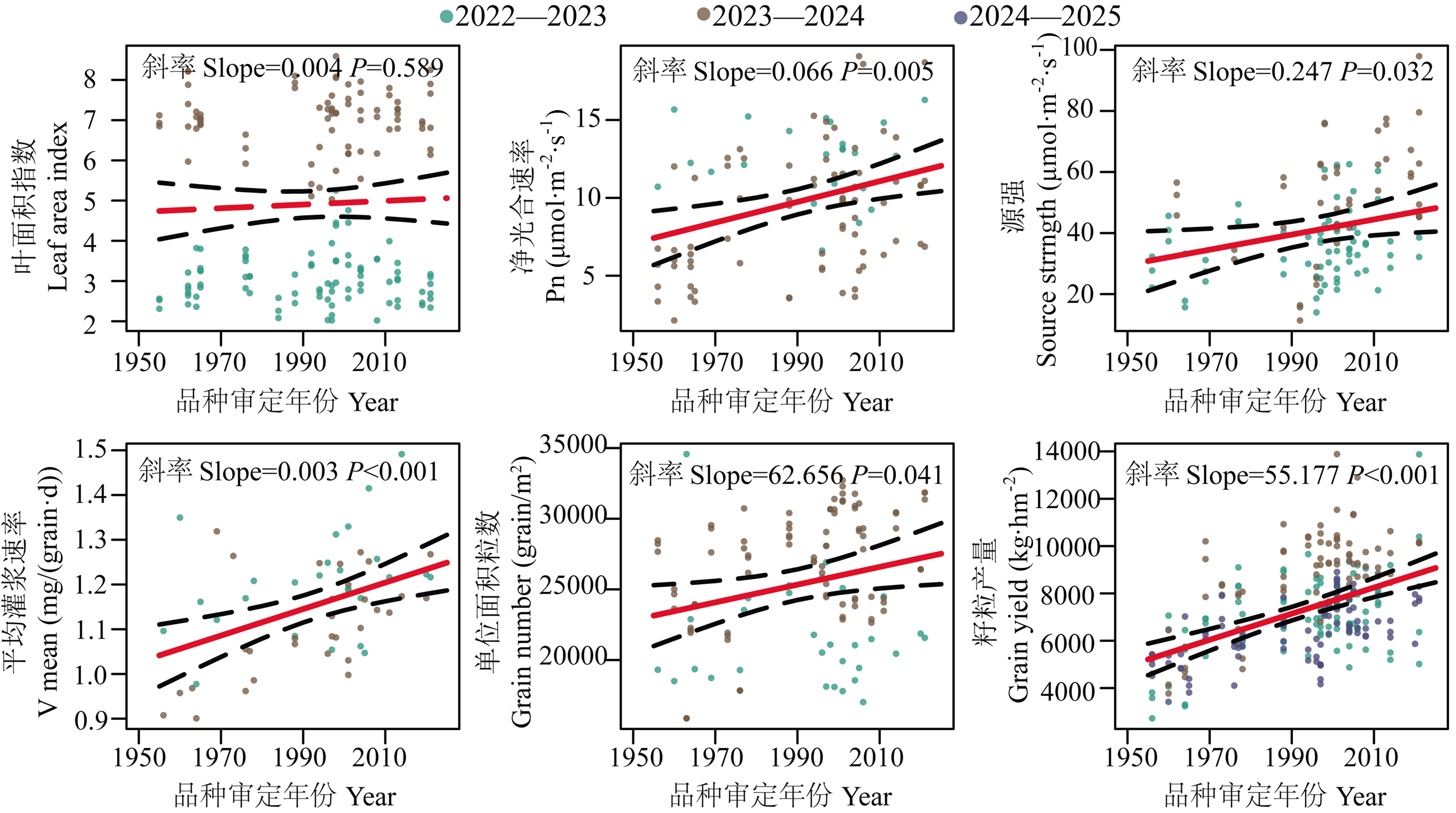
图3
不同年代冬小麦品种的源库特性与年代之间的关系"

图4
不同年代冬小麦品种的产量形成与年代之间的关系"
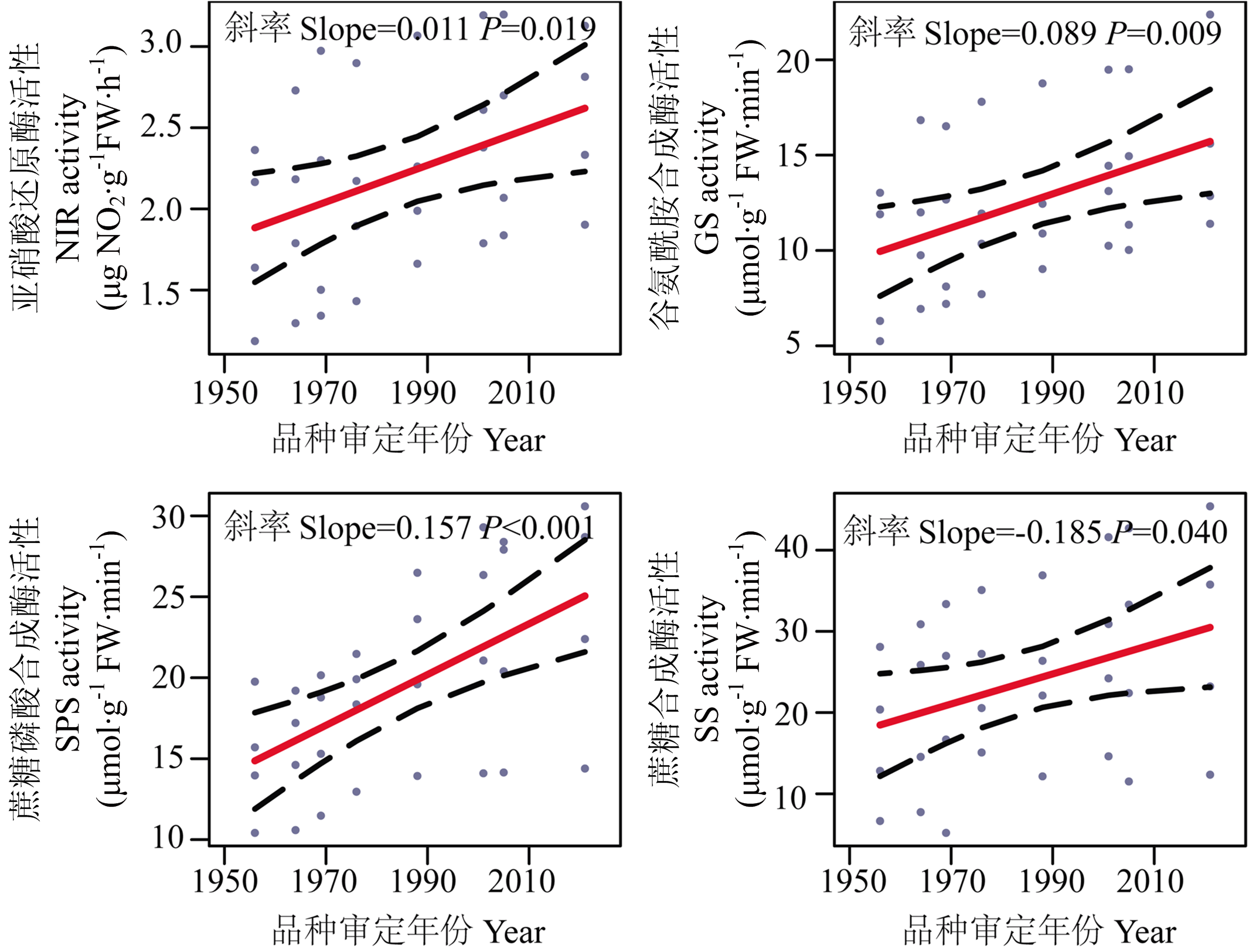
图5
不同年代冬小麦品种的碳氮代谢与年代之间的关系"

图6
不同年代冬小麦品种源库特征间的关系 图中连接线的颜色和宽度分别表示Mantel's r值和P值的大小。Spearman's r为小麦源库特征之间的相关性,*<0.05,** <0.01,***<0.001。PQ:加工品质;PC:蛋白特性;SC:淀粉特性;SA:源活性;SZS:源大小;SS:源强度;SK:库活性;SKS:库容;SKST:库强度;DMR:物质转运;HI:收获指数;S C/N:茎秆碳氮比;L C/N:叶碳氮比;G C/N:籽粒碳氮比"
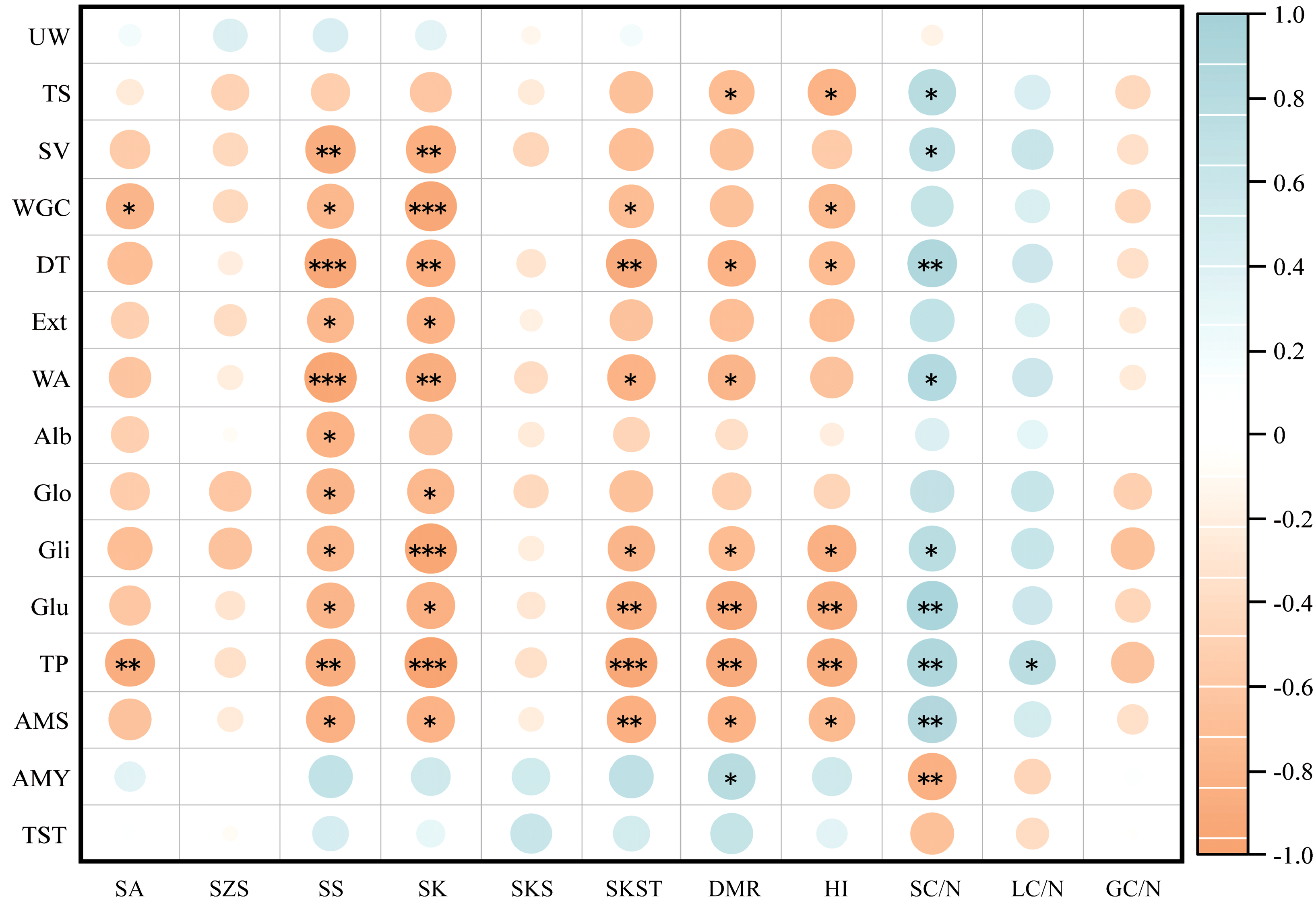
图7
不同年代冬小麦品种源库特征与品质特征的关系 Spearman's r反映了小麦源库特征与品质的相关性。UW:容重;TS:最大阻力;SV:沉降值;WGC:湿面筋含量;DT:形成时间;Ext:延伸性;WA:吸水率;Alb:清蛋白;Glo:球蛋白;Gli:醇溶蛋白;Glu:谷蛋白;TP:总蛋白;AMS:直链淀粉;AMY:支链淀粉;TST:总淀粉"
| [1] |
董玉琛, 曹永生, 张学勇, 刘三才, 王兰芬, 游光霞, 庞斌双, 李立会, 贾继增. 中国普通小麦初选核心种质的产生[J]. 植物遗传资源学报, 2003, 4(1): 1-8.
|
|
|
|
| [2] |
庄巧生. 中国小麦品种改良及系谱分析[M]. 北京: 中国农业出版社, 2003.
|
|
|
|
| [3] |
doi: 10.3390/su17030874 |
| [4] |
doi: 10.1016/j.jia.2023.11.015 |
| [5] |
doi: 10.3389/fpls.2018.00129 pmid: 29467787 |
| [6] |
doi: 10.1017/S0021859612000330 |
| [7] |
doi: 10.1016/j.jcs.2021.103211 |
| [8] |
|
| [9] |
王文静, 高松洁, 梁月丽, 王国杰. 不同穗型小麦品种灌浆期碳氮代谢特点及其与源库的关系[J]. 华北农学报, 2003(2): 29-32.
doi: 10.3321/j.issn:1000-7091.2003.02.008 |
|
doi: 10.3321/j.issn:1000-7091.2003.02.008 |
|
| [10] |
doi: 10.1111/gcb.2004.10.issue-10 |
| [11] |
doi: 10.1016/j.fcr.2023.109030 |
| [12] |
周琴, 姜东, 戴廷波, 荆奇, 曹卫星, 江海东. 源库改变对小麦籽粒淀粉和蛋白质积累及面粉品质的影响[J]. 麦类作物学报, 2006, 26(6): 95-99.
|
|
|
|
| [13] |
doi: 10.1016/j.rsci.2023.06.003 |
| [14] |
doi: 10.1016/j.agwat.2020.106200 |
| [15] |
doi: 10.1016/j.agwat.2020.106732 |
| [16] |
doi: 10.3389/fpls.2024.1374453 |
| [17] |
doi: 10.3389/fpls.2018.01889 pmid: 30619435 |
| [18] |
田纪春. 谷物品质测试理论与方法[M]. 北京: 科学出版社, 2006.
|
|
|
|
| [19] |
doi: 10.1002/csc2.v61.3 |
| [20] |
王义芹, 谭伟, 杨兴洪, 李滨, 童依平, 李振声. 不同年代小麦品种旗叶的光合特性及抗氧化酶活性研究[J]. 西北植物学报, 2007, 27(12): 2484-2490.
|
|
|
|
| [21] |
南瑞, 杨玉存, 石芳慧, 张礼宁, 米彤茜, 张立强, 李春艳, 孙风丽, 奚亚军, 张超. 小麦源库优异种质的鉴定与源库类型的划分[J]. 中国农业科学, 2023, 56(6): 1019-1034. DOI: 10.3864/j.issn.0578-1752.2023.06.001.
|
|
|
|
| [22] |
doi: 10.1093/jexbot/51.suppl_1.447 |
| [23] |
许为钢, 胡琳, 吴兆苏, 盖钧镒. 关中小麦品种同化物积累分配特性与源库构成遗传改良的研究[J]. 作物学报, 1999, 25(5): 548-555.
|
|
|
|
| [24] |
王庆源, 于振文, 石玉, 张永丽, 张振. 隔两年深松配合条旋耕显著提升冬小麦的氮素吸收利用效率和产量[J]. 植物营养与肥料学报, 2024, 30(5): 863-872.
|
|
|
|
| [25] |
杨龙龙, 王荣荣, 赫芳芳, 蒋桂英, 郭柔谷, 雷琪琪. 高产滴灌春小麦茎鞘非结构碳水化合物代谢及其对产量的贡献[J]. 麦类作物学报, 2024, 44(12): 1528-1540.
|
|
|
|
| [26] |
|
| [27] |
doi: 10.3389/fpls.2019.01786 pmid: 32082347 |
| [28] |
doi: 10.12944/CARJ |
| [29] |
徐瑶, 刘晓风, 杨月欣, 朱婧. 碳水化合物质量指标以及血糖生成指数影响因素的进展[J]. 食品工业科技, 2023, 44(18): 502-509.
|
|
|
|
| [30] |
doi: 10.3390/foods13101507 |
| [31] |
doi: 10.3390/agronomy14061164 |
| [32] |
doi: 10.1016/j.jfca.2023.105961 |
| [33] |
doi: 10.3390/foods10051058 |
| [34] |
范会平, 杜朝炜, 李真, 杨勇, 任广跃, 张德榜, 艾志录. 基于近红外光谱技术的小麦专用粉品质特性快速检测研究[J]. 轻工学报, 2025, 40(2): 51-60.
|
|
|
|
| [35] |
王荣荣, 徐宁璐, 黄修利, 赵凯男, 黄明, 王贺正, 付国占, 吴金芝, 李友军. 一次灌溉和氮肥运筹对旱地小麦籽粒产量和品质的影响[J]. 中国农业科学, 2025, 58(1): 43-57. DOI:10.3864/j.issn.0578-1752.2025.01.004.
|
|
|
|
| [36] |
doi: 10.1016/j.jcs.2020.102969 |
| [37] |
doi: 10.1016/j.jia.2023.09.006 |
| [38] |
doi: 10.1016/j.ocsci.2025.04.009 |
| [39] |
宋宇航, 张孟寒, 周瑞祥, 陈新宜, 华夏, 齐学礼, 汪月霞, 李艳. 灌浆期郑麦1860旗叶的光合速率及叶绿体超微结构分析[J]. 麦类作物学报, 2023, 43(6): 744-752.
|
|
|
|
| [40] |
姜东, 于振文, 李永庚, 余松烈. 施氮水平对鲁麦22籽粒淀粉合成的影响[J]. 作物学报, 2003, 29(3): 462-467.
|
|
|
|
| [41] |
胡宏, 盛婧, 郭文善, 朱新开, 封超年, 彭永欣. 氮素对弱筋小麦宁麦9号淀粉形成的调节效应[J]. 麦类作物学报, 2004, 24(2): 92-96.
|
|
|
|
| [42] |
doi: 10.1111/jipb.v66.3 |
| [43] |
沈彦俊, 郭英, 张传伟, 陈亚宁. 气候变化对华北平原农业生产的影响与应对策略[J]. 中国科学院院刊, 2026, 41(4): 644-655.
|
|
doi: 10.3724/j.issn.1000-3045.20260308001 |
|
| [44] |
杨晓琳, 王语萌, 石恒煜, 李庆祥, 王显国, 杜太生. 河北低平原适水粮饲模式构建及综合效益评价[J]. 中国农业大学学报, 2024, 29(7): 181-192.
|
|
|
|
| [45] |
doi: 10.1111/gcb.v31.7 |
| [46] |
doi: 10.1016/j.agrformet.2025.110567 |
| [47] |
段国辉, 高海涛, 张学品, 吴少辉, 温红霞, 余四平, 马飞, 李团飞. 河南省近15年小麦区试高产品种产量构成分析[J]. 河南农业科学, 2006, 35(10): 38-40.
doi: 10.3969/j.issn.1004-3268.2006.10.011 |
|
|
|
| [48] |
刘朝辉, 李江伟, 乔庆洲, 蒋志凯, 马华平, 付亮, 赵宗武. 黄淮南片小麦产量构成因素的相关分析[J]. 作物杂志, 2013(5): 58-61.
|
|
|
| [1] | 王小玮, 杜佛力, 闫红财, 郎正东, 党志娟, 李葆春, 汪军成, 马小乐, 王化俊, 张宏, 姚立蓉. 396份春小麦灌浆期和成熟期抗旱性评价[J]. 中国农业科学, 2026, 59(8): 1608-1621. |
| [2] | 王彩玉, 刘小丽, 李文广, 杨文平, 杨珍平, 高志强. 有机肥不同替代比例对土壤多功能性的影响及微生物驱动机制[J]. 中国农业科学, 2026, 59(8): 1712-1726. |
| [3] | 朱琦, 贾振鹏, Tahir SHAH, 徐晨晟, 李芷琦, 吕会帅, 朱鹏超, 韦小敏, 黄冬琳, 孙艳妮, 曹卫东, 高亚军, 王朝辉, 张达斌. 绿肥配施增效产品降低旱地麦田温室气体排放及碳足迹[J]. 中国农业科学, 2026, 59(7): 1507-1522. |
| [4] | 叶美金, 吴雷, Lohani Md Nahibuzzaman, 尹丽, 胡欣荣, 刘亚西, 蒋云峰, 陈国跃, 蒲至恩, 李阳, 李婷, 邹亚亚, 吴佳怡, 马建. 基于GWAS的中国地方小麦成熟胚大小位点的鉴定及其遗传效应解析[J]. 中国农业科学, 2026, 59(6): 1157-1171. |
| [5] | 李文虎, 礼海风, 杜宇鹏, 丁玉兰, 罗一诺, 李宇珂, 佘文婷, 张丰, 滕宇, 张思琦, 黄翠, 李小涵, 刘金山, 王朝辉. 小麦锌吸收转移对土施锌肥响应的区域差异[J]. 中国农业科学, 2026, 59(5): 1034-1047. |
| [6] | 焦文娟, 何万龙, 耿洪伟, 白斌, 李剑峰, 程宇坤. 155份春小麦品种(系)条锈病抗性评价与抗病基因分子检测[J]. 中国农业科学, 2026, 59(5): 937-950. |
| [7] | 崔士友, 陈澎军, 缪源卿, 韩继军, 沈俊明. EMS诱变抗草甘膦小麦新种质的创制与大田评价[J]. 中国农业科学, 2026, 59(4): 723-733. |
| [8] | 钱瑾, 李映雪, 吴芳, 邹晓晨. 集成光谱降维的冬小麦叶片磷含量估算[J]. 中国农业科学, 2026, 59(4): 781-792. |
| [9] | 孔媛, 崔沙沙, 李美, 李健, 杨思雨, 房锋, 刘帅帅, 刘明平, 曾艳, 高兴祥, 柏连阳. 黄淮海冬小麦田多花黑麦草等5种禾本科杂草时空分布变化规律[J]. 中国农业科学, 2026, 59(4): 807-823. |
| [10] | 王勇胜, 牛丽, 王长杰, 马立花, 廉潇潇, 孟亚雄, 马小乐, 姚立蓉, 张宏, 杨轲, 李葆春, 王化俊, 司二静, 汪军成. 冬小麦千粒重的全基因组关联分析及候选基因预测[J]. 中国农业科学, 2026, 59(3): 499-514. |
| [11] | 李心怡, 李嘉宁, 杨文平, 夏清, 霍滢睿, 郝世航, 黄婷苗, 任永康, 陈杰, 高志强, 杨珍平. 彩粒小麦锌营养对花后叶面喷锌的响应[J]. 中国农业科学, 2026, 59(3): 515-527. |
| [12] | 咸青林, 肖鉴珂, 高阿庆, 郜利闯, 刘杨. 种植方式结合测墒补灌下冬小麦产量及水分利用效率[J]. 中国农业科学, 2026, 59(3): 589-601. |
| [13] | 张志勇, 谭世超, 熊淑萍, 马新明, 韦一昊, 王小纯. 水氮周年优化对豫北灌区小麦玉米轮作系统产量和氮迁移的影响[J]. 中国农业科学, 2026, 59(2): 336-353. |
| [14] | 关攀锋, 李盟欣, 万紫栋, 葛帅, 汪欣燕, 崔东洁, 池青, 孙昊, 马若男, 李兵, 许航博, 张世洁, 郭淑卿, 卢家玲, 焦浈, 朱育攀, 魏文辉. 普通小麦旗叶大小QTL定位与候选基因分析[J]. 中国农业科学, 2026, 59(18): 3949-3972. |
| [15] | 于立强, 姚东泽, 费帅鹏, 李辉利, 郭宪瑞, 姚丹妤, 张宏军, 周阳, 肖永贵. 基于多时相冠层光谱的小麦适应性评价与高产稳产品种鉴选[J]. 中国农业科学, 2026, 59(18): 3989-4003. |
|
||
