






中国农业科学 ›› 2026, Vol. 59 ›› Issue (13): 2763-2775.doi: 10.3864/j.issn.0578-1752.2026.13.001
谭亚宁1( ), 张保龙1,2, 曹爱忠2,3, 任润生1,2()
收稿日期:2025-12-12
接受日期:2026-03-11
出版日期:2026-07-01
发布日期:2026-07-01
通信作者:
联系方式:
谭亚宁,E-mail:1397950241@qq.com。
基金资助:
TAN YaNing1(), ZHANG BaoLong1,2, CAO AiZhong2,3, REN RunSheng1,2()
Received:2025-12-12
Accepted:2026-03-11
Published:2026-07-01
Online:2026-07-01
摘要:
【目的】小麦是我国重要的粮食作物,其安全生产直接关系国家粮食安全。江苏省作为我国东部主要小麦产区,气候湿润、病害发生频繁,赤霉病、条锈病和白粉病是影响该地区小麦生产的主要病害,常导致严重的产量与品质损失。选育和推广多抗品种是防控病害最经济有效的途径。系统评估江苏省近十年来审定小麦品种对上述3种病害的综合抗性水平,并通过分子标记检测,明确其抗病基因的分布与聚合情况,为该地区抗病育种提供科学依据和优良亲本材料。【方法】基于2014—2023年江苏省品种审定数据,对185个小麦品种进行赤霉病、条锈病和白粉病抗性统计分析,筛选出至少对2种病害表现抗性的“兼抗”品种。进一步从49份兼抗品种中选取44份材料,利用特异性分子标记检测抗赤霉病基因Fhb1、抗白粉病基因Pm21,以及抗条锈病基因Yr5、Yr9、Yr15、Yr17、Yr18、Yr26和Yr30,并分析其分布与组合特征。【结果】根据审定数据,供试品种中分别有53.52%、43.92%和9.72%对赤霉病、条锈病和白粉病表现抗性。筛选出5个对3种病害均抗的广谱抗病品种(宁红麦618、盐麦1902、中研麦238、盐麦1903和宁麦资166)及49个兼抗2种病害的品种。分子检测显示,44份兼抗材料均携带多个抗病基因,Pm21、Yr5、Yr17、Yr18和Yr26的检出率为100%,Fhb1为84.1%,Yr15和Yr30分别达93.2%和88.6%,Yr9仅检出3份。其中,徐麦DH9和徐麦100聚合了全部9个测试基因,表现出优异的抗病遗传潜力,可作为多抗育种的理想亲本。【结论】证实了江苏审定小麦品种拥有丰富且独特的优质抗病基因资源,具有较高的育种利用潜力。其潜在的抗病基因库尚未完全开发。基于本研究筛选出的兼抗小麦品种资源,可作为后备种质库。
谭亚宁, 张保龙, 曹爱忠, 任润生. 江苏小麦品种的抗病基因分子检测[J]. 中国农业科学, 2026, 59(13): 2763-2775.
TAN YaNing, ZHANG BaoLong, CAO AiZhong, REN RunSheng. Molecular Detection of Disease Resistance Genes in Wheat Varieties Approved in Jiangsu Province[J]. Scientia Agricultura Sinica, 2026, 59(13): 2763-2775.
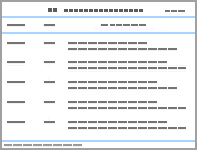
表1
本研究采用的分子标记及其引物"
| 基因 Gene | 染色体 Chromosome | 引物序列 Primer sequence (5′-3′) | 退火温度 Tm (℃) | 参考文献 References |
|---|---|---|---|---|
| Fhb1 | 3BS | F:ATGCGTGCGCTGTACTTG R:CGTCACAGAGTCCAGTGAAA | 65 | [ |
| Pm21 | 6V | F:GCCATTATAGTCAAGAGTGCACTAGCTGT R:AGCTCCTCTCGTTCTCCAATGCT | 58 | [ |
| Yr5 | 2BL | F:CAATAGTTAGGCAAATTACATCG R:TGCAAAGTACCTCATTTTGAGAA | 56 | [ |
| Yr9 | 1B | F:GGAGACATCATGAAACATTTG R:CTGTTGTTGGGCAGAAAG | 58 | [ |
| Yr15 | 1BS | F:ATTGGACGGACAGATGCTTT R:AGCAGTGAGGAAGGGGATC | 57 | [ |
| Yr17 | 2NS | F:AGGGGCTACTGACCAAGGCT R:TGCAGCTACAGCAGTATGTACACAAAA | 59 | [ |
| Yr18 | 7DS | F:GTTGGTTAAGACTGGTGATGG R:TGCTTGCTATTGCTGAATAGT | 57 | [ |
| Yr26 | 1B | F:GGGACAAGGGGAGTTGAAGC R:GAGAGTTCCAAGCAGAACAC | 60 | [ |
| Yr30 | 3BS | F:AAGGCGAATCAAACGGAATA R:GTTGCTTTAGGGGAAAAGCC | 61 | [ |
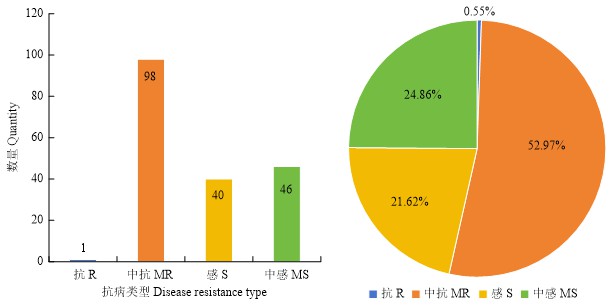
图1
185份审定小麦品种的赤霉病抗病类型统计及比例 R:抗;MR:中抗;S:感;MS:中感。下同"
表2
江苏省历年审定小麦品种赤霉病抗性水平统计"
| 年份 Year | 抗 R | 中抗 MR | 感 S | 中感 MS | 总计 Total |
|---|---|---|---|---|---|
| 2014 | / | 1 | 6 | 1 | 8 |
| 2015 | / | 1 | 4 | 2 | 7 |
| 2016 | / | 4 | / | 3 | 7 |
| 2017 | / | 4 | 1 | 5 | 10 |
| 2018 | 1 | 5 | 3 | 2 | 11 |
| 2019 | / | 8 | 3 | / | 11 |
| 2020 | / | 14 | 13 | 5 | 32 |
| 2021 | / | 21 | 1 | 7 | 29 |
| 2022 | / | 21 | 4 | 16 | 41 |
| 2023 | / | 19 | 5 | 5 | 29 |
| 总计Total | 1 | 98 | 40 | 46 | 185 |
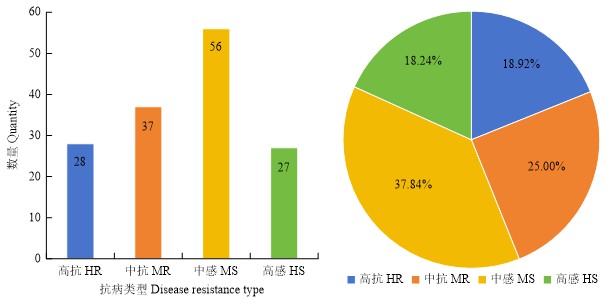
图2
148份审定小麦品种的条锈病抗病类型统计及比例 HR:高抗;HS:高感;下同"
表3
江苏省历年审定小麦品种条锈病抗病水平统计"
| 年份 Year | 高抗 HR | 中抗 MR | 中感 MS | 高感 HS | 总计 Total |
|---|---|---|---|---|---|
| 2014 | / | / | 1 | / | 1 |
| 2018 | 1 | 3 | / | 1 | 5 |
| 2019 | 7 | 3 | 1 | / | 11 |
| 2020 | 6 | 4 | 15 | 7 | 32 |
| 2021 | 1 | 3 | 14 | 11 | 29 |
| 2022 | 4 | 13 | 18 | 6 | 41 |
| 2023 | 10 | 11 | 7 | 1 | 29 |
| 总计Total | 29 | 37 | 56 | 26 | 148 |
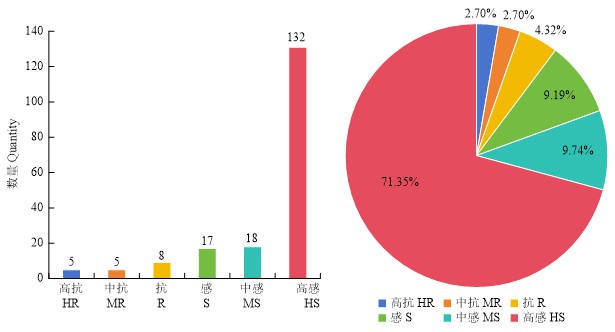
图3
185份审定小麦品种的白粉病抗性类型统计及比例"
表4
江苏省历年审定小麦品种白粉病抗性水平统计"
| 年份 Year | 高抗 HR | 中抗 MR | 抗 R | 感 S | 中感 MS | 高感 HS | 总计 Total |
|---|---|---|---|---|---|---|---|
| 2014 | / | / | 1 | 4 | 3 | / | 8 |
| 2015 | / | / | / | 1 | 2 | 4 | 7 |
| 2016 | / | / | / | 4 | / | 3 | 7 |
| 2017 | / | / | / | 1 | / | 9 | 10 |
| 2018 | / | / | / | 1 | 1 | 9 | 11 |
| 2019 | / | / | 1 | / | / | 10 | 11 |
| 2020 | 4 | 1 | 1 | 1 | 3 | 22 | 32 |
| 2021 | 1 | 1 | 3 | 1 | 1 | 22 | 29 |
| 2022 | / | 2 | / | 2 | 4 | 33 | 41 |
| 2023 | / | 1 | 2 | 2 | 4 | 20 | 29 |
| 总计Total | 5 | 5 | 8 | 17 | 18 | 132 | 185 |
表5
兼抗品种及对3种病害的抗性表现"
| 品种 Variety | 赤霉病抗性 Fusarium head blight resistance | 条锈病抗性 Stripe rust resistance | 白粉病抗性 Powdery mildew resistance |
|---|---|---|---|
| 宁红麦618 Ninghongmai 618 | MR | HR | R |
| 盐麦1902 Yanmai 1902 | MR | MR | R |
| 中研麦238 Zhongyanmai 238 | MR | MR | MR |
| 盐麦1903 Yanmai 1903 | MR | MR | MR |
| 宁麦资166 Ningmaizi 166 | MR | MR | R |
| 金丰麦4号 Jinfengmai 4 | MR | MR | MS |
| 华麦23 Huamai 23 | MR | HR | HS |
| 农麦988 Nongmai 988 | MR | HR | HS |
| 盐麦7号 Yanmai 7 | MR | MR | MS |
| 镇麦23 Zhenmai 23 | MR | MR | HS |
| 瑞华麦529 Ruihuamai 529 | MR | HR | HS |
| 宁麦42 Ningmai 42 | MR | MR | MS |
| 扬辐麦25 Yangfumai 25 | MR | HR | HS |
| 金丰麦5号 Jinfengmai 5 | MR | HR | HS |
| 辉丰麦156 Huifengmai 156 | MR | MR | S |
| 宁紫麦160 Ningzimai 160 | MR | HR | HS |
| 镇麦29 Zhenmai 29 | MR | MR | HS |
| 扬辐麦23 Yangfumai 23 | MR | MR | HS |
| 盛麦6号 Shengmai 6 | MR | MR | HS |
| 扬辐麦21 Yangfumai 21 | MR | MR | S |
| 宁麦37 Ningmai 37 | MR | MR | HS |
| 扬富麦106 Yangfumai 106 | MR | MR | HS |
| 扬辐麦20 Yangfumai 20 | MR | MR | HS |
| 镇麦25 Zhenmai 25 | MR | MR | HS |
| 镇麦21 Zhenmai 21 | MR | MR | HS |
| 宁麦38 Ningmai 38 | MR | MR | MS |
| 徐麦DH2 Xumai DH2 | MR | HR | HS |
| 瑞华麦595 Ruihuamai 595 | MR | HR | HS |
| 镇麦26 Zhenmai 26 | MR | MR | HS |
| 扬辐麦19 Yangfumai 19 | MR | MS | MR |
| 兴农麦9号 Xingnongmai 9 | MR | MR | HS |
| 宁丰麦1号 Ningfengmai 1 | MR | MS | MR |
| 扬辐麦13 Yangfumai 13 | MR | MS | HR |
| 华麦11 Huamai 11 | MR | MS | R |
| 徐麦100 Xumai 100 | MR | HR | HS |
| 连麦12 Lianmai 12 | MR | MR | HS |
| 扬糯麦2号 Yangnuomai 2 | MR | MS | R |
| 农麦180 Nongmai 180 | MR | HS | R |
| 续 | |||
| 品种 Variety | 赤霉病抗性 Fusarium head blight resistance | 条锈病抗性 Stripe rust resistance | 白粉病抗性 Powdery mildew resistance |
| 徐麦DH9 Xumai DH9 | MR | MR | HS |
| 泰麦901 Taimai 901 | MR | MR | HS |
| 宁麦33 Ningmai 33 | MR | MS | HR |
| 盐麦1号 Yanmai 1 | MR | MS | HR |
| 镇麦18 Zhenmai 18 | MR | MS | MR |
| 宁紫麦1号Ningzimai 1 | MR | MR | HS |
| 扬辐麦15 Yangfumai 15 | MR | MS | HR |
| 扬麦34 Yangmai 34 | MR | HS | HR |
| 扬麦30 Yangmai 30 | MR | HR | HS |
| 金丰麦1号 Jinfengmai 1 | MR | HR | HS |
| 江丰麦1号 Jiangfengmai 1 | MR | MR | HS |
| 农麦156 Nongmai 156 | MR | HR | HS |
| 瑞华麦596 Ruihuamai 596 | MR | HR | HS |
| 扬江麦586 Yangjiangmai 586 | MR | HS | R |
| 隆麦39 Longmai 39 | MR | MR | HS |
| 佳源麦1号Jiayuanmai 1 | MR | HR | HS |
表6
44份江苏小麦品系来源及抗病基因检测结果"
| 序号 No. | 品系 Line | 系谱 Pedigree | 基因检测 Gene detection |
|---|---|---|---|
| 1 | 宁红麦618 Ninghongmai 618 | 镇麦9号/扬08-4 Zhenmai 9/Yang 08-4 | Pm21, Yr5, Yr15, Yr17, Yr18, Yr26 |
| 2 | 盐麦1903 Yanmai 1903 | 生选6号/镇麦10号 Shengxuan 6/Zhenmai 10 | Fhb1, Pm21, Yr5, Yr15, Yr17, Yr18, Yr26, Yr30 |
| 3 | 农麦988 Nongmai 988 | 扬麦20/镇麦168 Yangmai 20/Zhenmai 168 | Fhb1, Pm21, Yr5, Yr15, Yr17, Yr18, Yr26, Yr30 |
| 4 | 镇麦23 Zhenmai 23 | 镇麦15系统选育 Breeding of Zhenmai 15 System | Fhb1, Pm21, Yr5, Yr15, Yr17, Yr18, Yr26 |
| 5 | 瑞华麦529 Ruihuamai 529 | 宁麦3号/瑞华麦590 Ningmai 3/Ruihuamai 590 | Fhb1, Pm21, Yr5, Yr15, Yr17, Yr18, Yr26, Yr30 |
| 6 | 宁麦42 Ningmai 42 | 生选6号/宁09130//宁09121 Shengxuan 6/Ning 09130//Ning 09121 | Fhb1, Pm21, Yr5, Yr15, Yr17, Yr18, Yr26, Yr30 |
| 7 | 扬辐麦23 Yangfumai 23 | (内麦9号/扬辐麦5号)F1种子辐照 (Seed irradiation of Neimai 9/Yangfumai 5) F1:Seed irradiation | Fhb1, Pm21, Yr5, Yr15, Yr17, Yr18, Yr26, Yr30 |
| 8 | 盛麦6号 Shengmai 6 | 扬麦16号/镇麦6号 Yangmai 16/Zhenmai No.6 | Fhb1, Pm21, Yr5, Yr9, Yr15, Yr17, Yr18, Yr26 |
| 9 | 扬辐麦21 Yangfumai 21 | 扬麦22/扬辐麦10-2559 Yangmai 22/Yangfumai 10-2559 | Pm21, Yr5, Yr15, Yr17, Yr18, Yr26, Yr30 |
| 10 | 宁麦37 Ningmai 37 | 宁麦13//宁麦13/扬麦20 Ningmai 13//Ningmai 13/Yangmai 20 | Fhb1, Pm21, Yr5, Yr15, Yr17, Yr18, Yr26, Yr30 |
| 11 | 扬富麦106 Yangfumai 106 | 镇麦4号变异株 Zhenmai 4 mutant | Pm21, Yr5, Yr15, Yr17, Yr18, Yr26 |
| 12 | 扬辐麦20 Yangfumai 20 | (扬麦22/镇麦9号)F2播前辐照 (Yangmai 22/ Zhenmai 9) F2 pre-sowing irradiation | Fhb1, Pm21, Yr5, Yr15, Yr17, Yr18, Yr26, Yr30 |
| 13 | 镇麦25 Zhenmai 25 | 扬辐麦8004/保计0601 Yangfumai 8004/Baoji 0601 | Fhb1, Pm21, Yr5, Yr15, Yr17, Yr18, Yr26, Yr30 |
| 14 | 镇麦21 Zhenmai 21 | 镇麦9号/镇麦8号 Zhenmai 9/Zhenmai 8 | Pm21, Yr5, Yr15, Yr17, Yr18, Yr26, Yr30 |
| 15 | 宁麦38 Ningmai 38 | 镇05185/生选6号 Zhen 05185/Shengxuan 6 | Fhb1, Pm21, Yr5, Yr15, Yr17, Yr18, Yr26, Yr30 |
| 16 | 镇麦26 Zhenmai 26 | 扬辐麦8004/保计0601 Yangfumai 8004/Baoji 0601 | Fhb1, Pm21, Yr5, Yr15, Yr17, Yr18, Yr26, Yr30 |
| 序号 No. | 品系 Line | 系谱 Pedigree | 基因检测 Gene detection |
| 17 | 扬辐麦19 Yangfumai 19 | (扬麦22/扬辐麦9244)F1辐照 (Yang mai 22/ Yangfumai 9244) F1 irradiation | Fhb1, Pm21, Yr5, Yr15, Yr17, Yr18, Yr26, Yr30 |
| 18 | 盐麦1号 Yanmai 1 | 071T-159/镇麦168 071T-159/Zhenmai 168 | Fhb1, Pm21, Yr5, Yr15, Yr17, Yr18, Yr26, Yr30 |
| 19 | 宁紫麦1号 Ningzimai 1 | 宁麦8号/宁0726 Ningmai 8/Ning 0726 | Fhb1, Pm21, Yr5, Yr15, Yr17, Yr18, Yr26, Yr30 |
| 20 | 徐麦DH9 Xumai DH9 | H35/矮抗58 BC2F1//徐麦1108 H35/Aikang 58 BC2F1//Xumai 1108 | Fhb1, Pm21, Yr5, Yr9, Yr15, Yr17, Yr18, Yr26, Yr30 |
| 21 | 华麦11 Huamai 11 | 淮麦19/扬麦13 Huaimai 19/Yangmai 13 | Fhb1, Pm21, Yr5, Yr15, Yr17, Yr18, Yr26, Yr30 |
| 22 | 扬辐麦13 Yangfumai 13 | (扬辐麦4号/镇麦9号)F1辐照 (Yangfumai 4/Zhenmai 9) F1 irradiation | Fhb1, Pm21, Yr5, Yr15, Yr17, Yr18, Yr26, Yr30 |
| 23 | 金丰麦1号 Jinfengmai 1 | 小簇麦/扬麦158//意大利(引5) Small cluster wheat/Young Mai 158 //Italian (cited 5) | Fhb1, Pm21, Yr5, Yr15, Yr17, Yr18, Yr26, Yr30 |
| 24 | 徐麦100 Xumai 100 | 徐麦30/徐麦114427 Xumai 30/Xumai 114427 | Fhb1, Pm21, Yr5, Yr9, Yr15, Yr17, Yr18, Yr26, Yr30 |
| 25 | 瑞华麦596 Ruihuamai 596 | 镇麦10号/扬麦20 Zhenmai 10/Yangmai 20 | Fhb1, Pm21, Yr5, Yr15, Yr17, Yr18, Yr26, Yr30 |
| 26 | 连麦12 Lianmai 12 | 刘虎98/西农4711//生选6号/漯38 Liu Hu 98/Xinong 4711//Shengxuan 6/Luo38 | Pm21, Yr5, Yr15, Yr17, Yr18, Yr26 |
| 27 | 宁麦资166 Ningmaizi 166 | IDO580-22/宁麦13//镇麦6号/3/偃高1号/烟农159//优繁5号/农大糯麦1号 IDO580-22/Ningmai 13//Zhenmai 6 /3/Yangao 1/Yannong 159// Youfan 5/Nongda Nuomai 1 | Fhb1, Pm21, Yr5, Yr15, Yr17, Yr18, Yr26, Yr30 |
| 28 | 扬麦30 Yangmai 30 | 扬09纹1009/扬麦18 Yang 09 Wen 1009/Yangmai 18 | Fhb1, Pm21, Yr5, Yr15, Yr17, Yr18, Yr26, Yr30 |
| 29 | 宁麦33 Ningmai 33 | 宁0798/宁麦14 Ning 0798/Ningmai 14 | Fhb1, Pm21, Yr5, Yr15, Yr17, Yr18, Yr26, Yr30 |
| 30 | 扬麦34 Yangmai 34 | 扬麦18//扬麦18/元友-2 Yangmai 18//Yangmai 18/Yuanyou -2 | Fhb1, Pm21, Yr5, Yr15, Yr17, Yr18, Yr26, Yr30 |
| 31 | 镇麦18 Zhenmai 18 | 镇麦168/扬麦11 Zhenmai 168/Yangmai 11 | Fhb1, Pm21, Yr5, Yr15, Yr17, Yr18, Yr26, Yr30 |
| 32 | 扬辐麦15 Yangfumai 15 | (镇麦9号/扬辐麦7298)F1辐照 (Zhenmai 9/Yangfumai 7298) F1 irradiation | Pm21, Yr5, Yr17, Yr18, Yr26, Yr30 |
| 33 | 盐麦1902 Yanmai 1902 | 宁麦21/扬辐麦9144 Ningmai 21/Yangfumai 9144 | Fhb1, Pm21, Yr5, Yr15, Yr17, Yr18, Yr26, Yr30 |
| 34 | 盐麦7号 Yanmai 7 | 扬麦18/镇麦9号 Yangmai 18/Zhenmai 9 | Pm21, Yr5, Yr15, Yr17, Yr18, Yr26, Yr30 |
| 35 | 宁紫麦160 Ningzimai 160 | 青海紫麦/宁0775 Qinghai Zimai/Ning 0775 | Fhb1, Pm21, Yr5, Yr15, Yr17, Yr18, Yr26, Yr30 |
| 36 | 镇麦29 Zhenmai 29 | 镇麦4号/豫麦29I系 Zhenmai 4/Yumai 29I Line | Fhb1, Pm21, Yr5, Yr15, Yr17, Yr18, Yr26, Yr30 |
| 37 | 宁丰麦1号 Ningfengmai 1 | 扬辐麦5242/镇05185 Yangfumai 5242/Zhen 05185 | Fhb1, Pm21, Yr5, Yr15, Yr17, Yr18, Yr26, Yr30 |
| 38 | 扬糯麦2号 Yangnuomai 2 | 镇麦9号2/4/扬麦18/3/宁麦142//IKE/白火麦 Zhenmai 9 2/4/Yangmai 18/3/Ningmai 142//IKE/Baihuomai | Fhb1, Pm21, Yr5, Yr15, Yr17, Yr18, Yr26, Yr30 |
| 39 | 农麦180 Nongmai 180 | 镇麦168/华麦5号 Zhenmai 168/Huamai 5 | Fhb1, Pm21, Yr5, Yr15, Yr17, Yr18, Yr26, Yr30 |
| 40 | 泰麦901 Taimai 901 | 镇麦9号/7408 Zhenmai 9/7408 | Fhb1, Pm21, Yr5, Yr15, Yr17, Yr18, Yr26, Yr30 |
| 41 | 江丰麦1号 Jiangfengmai 1 | 扬麦16/宁麦14 Yang Mai 16/Ningmai 14 | Fhb1, Pm21, Yr5, Yr15, Yr17, Yr18, Yr26, Yr30 |
| 42 | 农麦156 Nongmai 156 | 扬辐麦4号/扬麦16 Yangfumai 4/Yangmai 16 | Fhb1, Pm21, Yr5, Yr15, Yr17, Yr18, Yr26, Yr30 |
| 43 | 扬江麦586 Yangjiangmai 586 | 生选3号变异株系选 Selection of mutant strain Shengxuan No.3 | Fhb1, Pm21, Yr5, Yr17, Yr18, Yr26, Yr30 |
| 44 | 隆麦39 Longmai 39 | 内麦9号/扬辐麦5号F1辐照 Neimai 9/F1 irradiation of Yangfumai No.5 | Fhb1, Pm21, Yr5, Yr17, Yr18, Yr26, Yr30 |
| [1] |
王亚飞, 李世景, 徐萍, 张正斌, 景蕊莲. 黄淮和长江中下游冬麦区小麦品种(系)农艺性状及其聚类分析[J]. 中国生态农业学报(中英文), 2020, 28(3): 395-404.
|
|
|
|
| [2] |
康振生, 王晓杰, 赵杰, 汤春蕾, 黄丽丽. 小麦条锈菌致病性及其变异研究进展[J]. 中国农业科学, 2015, 48(17): 3439-3453. DOI: 10.3864/j.issn.0578-1752.2015.17.011.
|
|
|
|
| [3] |
陈万权, 康振生, 马占鸿, 徐世昌, 金社林, 姜玉英. 中国小麦条锈病综合治理理论与实践[J]. 中国农业科学, 2013, 46(20): 4254-4262. DOI: 10.3864/j.issn.0578-1752.2013.20.008.
|
|
|
|
| [4] |
|
| [5] |
吴佳文, 杨荣明, 朱凤, 田子华. 2015年江苏省小麦赤霉病发生特点与防控对策探讨[J]. 中国植保导刊, 2016, 36(10): 31-34, 49.
|
|
|
|
| [6] |
刘国涛, 贠超, 周其军, 杨春玲. 河南省小麦抗赤霉病研究展望[J]. 农业与技术, 2020, 40(17): 6-8.
|
|
|
|
| [7] |
|
| [8] |
|
| [9] |
|
| [10] |
|
| [11] |
|
| [12] |
|
| [13] |
|
| [14] |
|
| [15] |
|
| [16] |
|
| [17] |
|
| [18] |
|
| [19] |
|
| [20] |
|
| [21] |
朱展望, 徐登安, 程顺和, 高春保, 夏先春, 郝元峰, 何中虎. 中国小麦品种抗赤霉病基因Fhb1的鉴定与溯源[J]. 作物学报, 2018, 44(4): 473-482.
|
|
|
|
| [22] |
|
| [23] |
|
| [24] |
|
| [25] |
|
| [26] |
贾举庆, 雷孟平, 刘成, 李光蓉, 杨足君. 小麦抗条锈基因Yr17的新SCAR标记的建立与应用[J]. 麦类作物学报, 2010, 30(1): 11-16.
|
|
|
|
| [27] |
|
| [28] |
|
| [29] |
|
| [30] |
曹淑琳, 杨红福, 冷苏凤, 疏燕, 邓渊钰, 孙海燕, 张爱香, 张亚妮, 李伟, 陈怀谷. 江苏省主推及新育成小麦品种抗赤霉病评价及毒素积累分析[J]. 麦类作物学报, 2022, 42(8): 958-968.
|
|
|
|
| [31] |
徐晓欢, 唐金龙, 王凤涛, 蔺瑞明, 冯晶, 马东方. 江苏省121份小麦品种(品系)对条锈病的抗性评价[J]. 中国植保导刊, 2024, 44(9): 47-53.
|
|
|
|
| [32] |
汪尊杰, 胡文静, 高德荣, 赵仁慧, 张笑晴, 徐瑶, 王玲, 陈甜甜, 李东升, 李韬, 吴宏亚. 长江中下游小麦新品系赤霉病和白粉病抗性评估与抗病基因检测[J]. 麦类作物学报, 2025, 45(2): 175-187.
|
|
|
|
| [33] |
胡朝月, 王凤涛, 郎晓威, 冯晶, 李俊凯, 蔺瑞明, 姚小波. 小麦抗条锈病基因对中国条锈菌主要流行小种的抗性分析[J]. 中国农业科学, 2022, 55(3): 491-502. DOI: 10.3864/j.issn.0578-1752.2022.03.006.
|
|
|
|
| [34] |
张兴宗, 黄亮, 夏先全, 张华, 陈万权, 夏崇靖, 刘太国. 88份四川省小麦后备品系抗条锈性评价及抗性基因的分子检测[J]. 植物保护学报, 2024, 51(4): 764-773.
|
|
|
| [1] | 王小玮, 杜佛力, 闫红财, 郎正东, 党志娟, 李葆春, 汪军成, 马小乐, 王化俊, 张宏, 姚立蓉. 396份春小麦灌浆期和成熟期抗旱性评价[J]. 中国农业科学, 2026, 59(8): 1608-1621. |
| [2] | 王彩玉, 刘小丽, 李文广, 杨文平, 杨珍平, 高志强. 有机肥不同替代比例对土壤多功能性的影响及微生物驱动机制[J]. 中国农业科学, 2026, 59(8): 1712-1726. |
| [3] | 朱琦, 贾振鹏, Tahir SHAH, 徐晨晟, 李芷琦, 吕会帅, 朱鹏超, 韦小敏, 黄冬琳, 孙艳妮, 曹卫东, 高亚军, 王朝辉, 张达斌. 绿肥配施增效产品降低旱地麦田温室气体排放及碳足迹[J]. 中国农业科学, 2026, 59(7): 1507-1522. |
| [4] | 叶美金, 吴雷, Lohani Md Nahibuzzaman, 尹丽, 胡欣荣, 刘亚西, 蒋云峰, 陈国跃, 蒲至恩, 李阳, 李婷, 邹亚亚, 吴佳怡, 马建. 基于GWAS的中国地方小麦成熟胚大小位点的鉴定及其遗传效应解析[J]. 中国农业科学, 2026, 59(6): 1157-1171. |
| [5] | 李文虎, 礼海风, 杜宇鹏, 丁玉兰, 罗一诺, 李宇珂, 佘文婷, 张丰, 滕宇, 张思琦, 黄翠, 李小涵, 刘金山, 王朝辉. 小麦锌吸收转移对土施锌肥响应的区域差异[J]. 中国农业科学, 2026, 59(5): 1034-1047. |
| [6] | 焦文娟, 何万龙, 耿洪伟, 白斌, 李剑峰, 程宇坤. 155份春小麦品种(系)条锈病抗性评价与抗病基因分子检测[J]. 中国农业科学, 2026, 59(5): 937-950. |
| [7] | 崔士友, 陈澎军, 缪源卿, 韩继军, 沈俊明. EMS诱变抗草甘膦小麦新种质的创制与大田评价[J]. 中国农业科学, 2026, 59(4): 723-733. |
| [8] | 钱瑾, 李映雪, 吴芳, 邹晓晨. 集成光谱降维的冬小麦叶片磷含量估算[J]. 中国农业科学, 2026, 59(4): 781-792. |
| [9] | 孔媛, 崔沙沙, 李美, 李健, 杨思雨, 房锋, 刘帅帅, 刘明平, 曾艳, 高兴祥, 柏连阳. 黄淮海冬小麦田多花黑麦草等5种禾本科杂草时空分布变化规律[J]. 中国农业科学, 2026, 59(4): 807-823. |
| [10] | 王勇胜, 牛丽, 王长杰, 马立花, 廉潇潇, 孟亚雄, 马小乐, 姚立蓉, 张宏, 杨轲, 李葆春, 王化俊, 司二静, 汪军成. 冬小麦千粒重的全基因组关联分析及候选基因预测[J]. 中国农业科学, 2026, 59(3): 499-514. |
| [11] | 李心怡, 李嘉宁, 杨文平, 夏清, 霍滢睿, 郝世航, 黄婷苗, 任永康, 陈杰, 高志强, 杨珍平. 彩粒小麦锌营养对花后叶面喷锌的响应[J]. 中国农业科学, 2026, 59(3): 515-527. |
| [12] | 咸青林, 肖鉴珂, 高阿庆, 郜利闯, 刘杨. 种植方式结合测墒补灌下冬小麦产量及水分利用效率[J]. 中国农业科学, 2026, 59(3): 589-601. |
| [13] | 张志勇, 谭世超, 熊淑萍, 马新明, 韦一昊, 王小纯. 水氮周年优化对豫北灌区小麦玉米轮作系统产量和氮迁移的影响[J]. 中国农业科学, 2026, 59(2): 336-353. |
| [14] | 叶美金, 王同著, 陈斌, LOHANI Md Nahibuzzaman, 陈家婷, 胡欣荣, 尹丽, 王超, 张昊芃, 杨夏, 王佳琳, 姚琦馥, 丁浦洋, 王凤, 李小雨, 马建. 基于全基因组关联分析解析小麦茎节间长度的遗传基础及其效应[J]. 中国农业科学, 2026, 59(12): 2551-2562. |
| [15] | 张烨, 王文宁, 朱靓萍, 陈语涵, 韩燕, 张润泽, 胡昌录, 杨学云, 张树兰. 土壤管理措施对小麦产量影响的全球Meta分析[J]. 中国农业科学, 2026, 59(12): 2656-2670. |
|
||
