






中国农业科学 ›› 2026, Vol. 59 ›› Issue (14): 2993-3005.doi: 10.3864/j.issn.0578-1752.2026.14.001
马亚珺1( ), 严雅军2, 杨炜迪1, 杨天辉1, 王川1, 高婷1()
收稿日期:2025-12-10
接受日期:2026-02-07
出版日期:2026-07-16
发布日期:2026-07-21
通信作者:
联系方式:
马亚珺,E-mail:mayajun110@126.com。
基金资助:
MA YaJun1(), YAN YaJun2, YANG WeiDi1, YANG TianHui1, WANG Chuan1, GAO Ting1()
Received:2025-12-10
Accepted:2026-02-07
Published:2026-07-16
Online:2026-07-21
摘要:
资源短缺与粮食安全挑战日益严峻,开发利用农业次适宜区(边际土地)已成为保障全球食物供给的关键战略。小黑麦作为首个人工异源多倍体作物,兼具小麦的高产优质与黑麦的强大抗逆性,在边际土地农业开发中展现出独特优势。本文系统梳理小黑麦遗传演化、种质资源、抗逆机制和产业化利用的研究进展,重点评述六倍体小黑麦育种策略的优劣势,以期为挖掘其在生态修复、饲草保供和功能食品开发中的应用潜力提供理论参考。采用文献计量与系统性综述方法,全面检索并整合国内外小黑麦相关研究。从遗传进化维度,梳理育种重心由八倍体向六倍体转移的历史脉络与驱动因素;从资源保护维度,归纳全球种质收集现状和“低温低湿+定期更新”的保存策略;从生理机制维度,解析盐碱、干旱胁迫下的信号传导与分子调控网络;从产业应用维度,评析饲草轮作、生态修复和加工利用的研究成效;并对比传统表型选择与现代分子育种技术的研究进展。现有研究表明:(1)遗传演化:小黑麦育种策略已完成由细胞学不稳定的八倍体向遗传稳定的六倍体(如CIMMYT“Armadillo”系)的根本转变,但遗传背景狭窄及缺失小麦D基因组优异性状仍是主要瓶颈;(2)抗逆机制:小黑麦在边际土地适应性卓越,其耐盐性依赖于根系有机酸分泌螯合Na+等机制及“根>茎>叶”的离子区隔化策略,抗旱性则通过渗透调节物质积累和光系统Ⅱ(PSⅡ)活性维持实现;(3)产业应用:“青贮玉米-饲用小黑麦”复播模式土地当量比(LER)可达1.35以上,有效缓解饲草季节性短缺,在盐碱地生物修复和高膳食纤维功能食品开发中亦前景广阔;(4)育种技术:研究方式正由传统表型选择向“分子设计+高通量表型”跨越,SSR标记和GWAS挖掘抗逆QTL已成为热点方向。小黑麦的成功创制证实了外源R基因组导入是突破作物抗逆极限的有效途径。未来研究应确立“以麦为鉴、以麦补黑”(即以小麦D基因组补充小黑麦)的创新思路:利用六倍体小麦泛基因组信息解析小黑麦复杂性状遗传基础,通过染色体工程精准导入小麦D基因组中控制面筋强度、矮秆等优异基因,创制兼具抗逆与品质的“重组型”新种质;同时构建“粮饲兼用”与“生态修复”并行的二元产业结构,以充分实现其在韧性农业系统中的战略价值。
马亚珺, 严雅军, 杨炜迪, 杨天辉, 王川, 高婷. 饲用小黑麦种质资源创新与综合利用研究进展[J]. 中国农业科学, 2026, 59(14): 2993-3005.
MA YaJun, YAN YaJun, YANG WeiDi, YANG TianHui, WANG Chuan, GAO Ting. Research Progress on Germplasm Innovation and Comprehensive Utilization of Forage Triticale[J]. Scientia Agricultura Sinica, 2026, 59(14): 2993-3005.
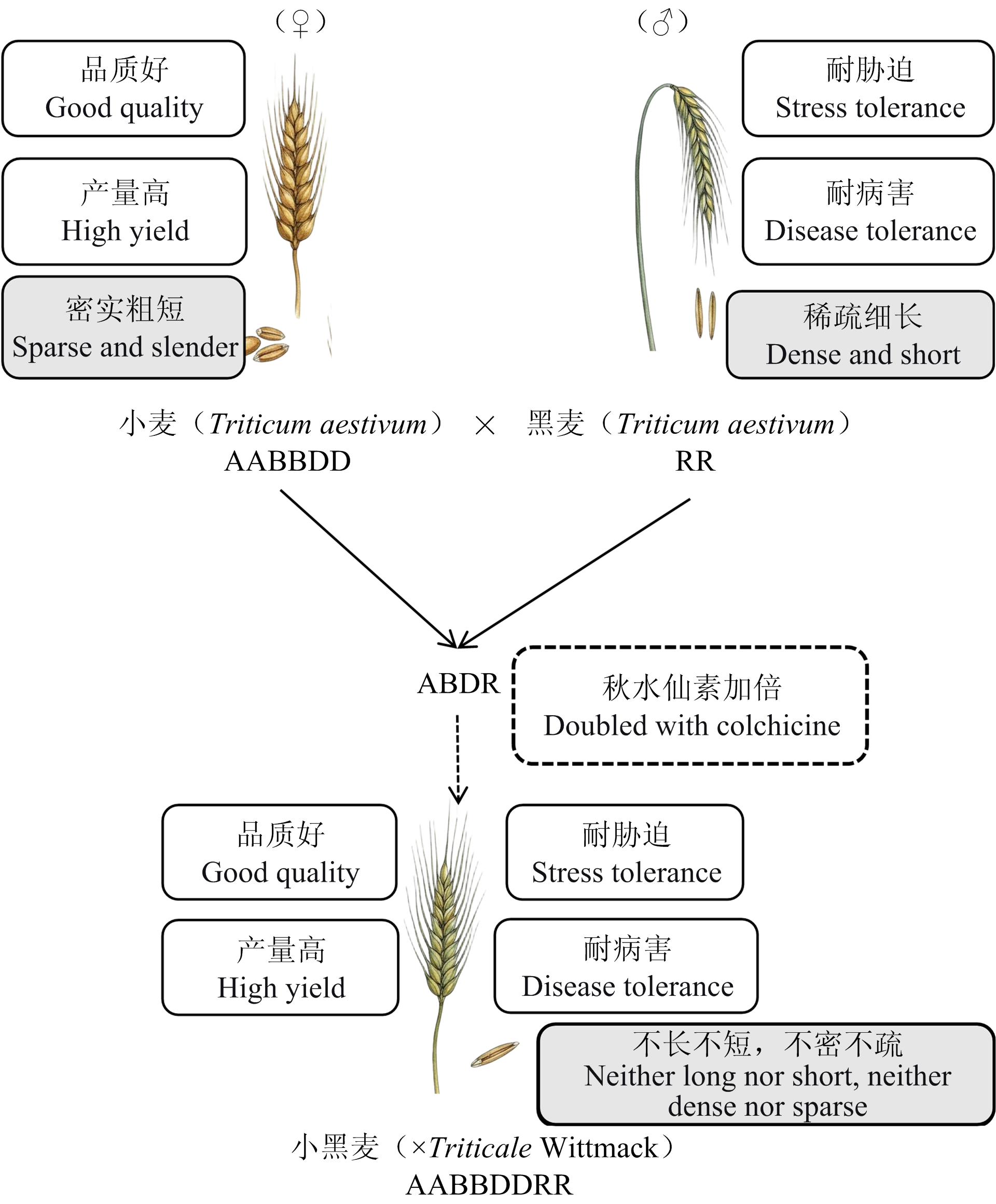
图1
小黑麦与其亲本小麦、黑麦的穗部形态对比"
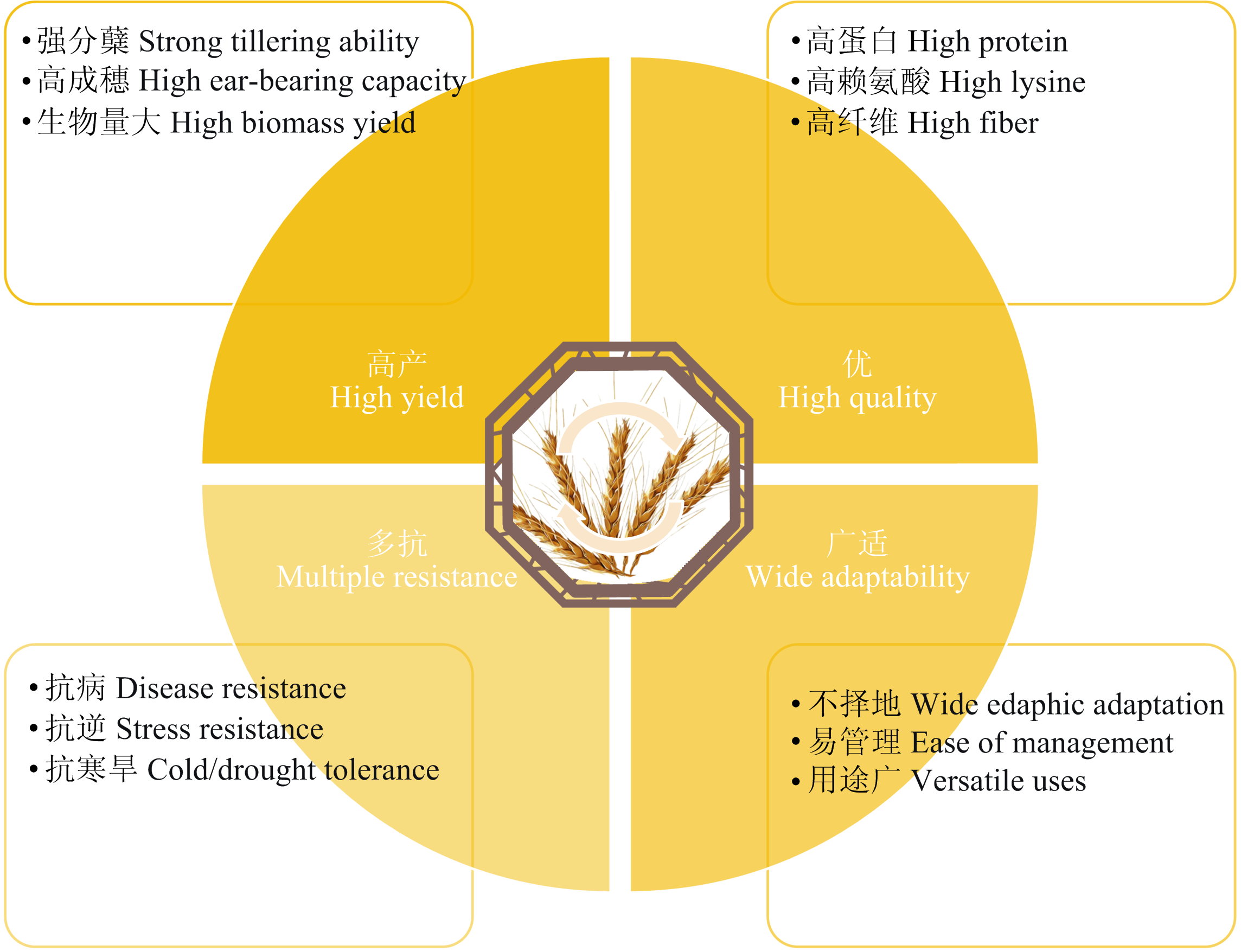
图2
小黑麦优势概图"
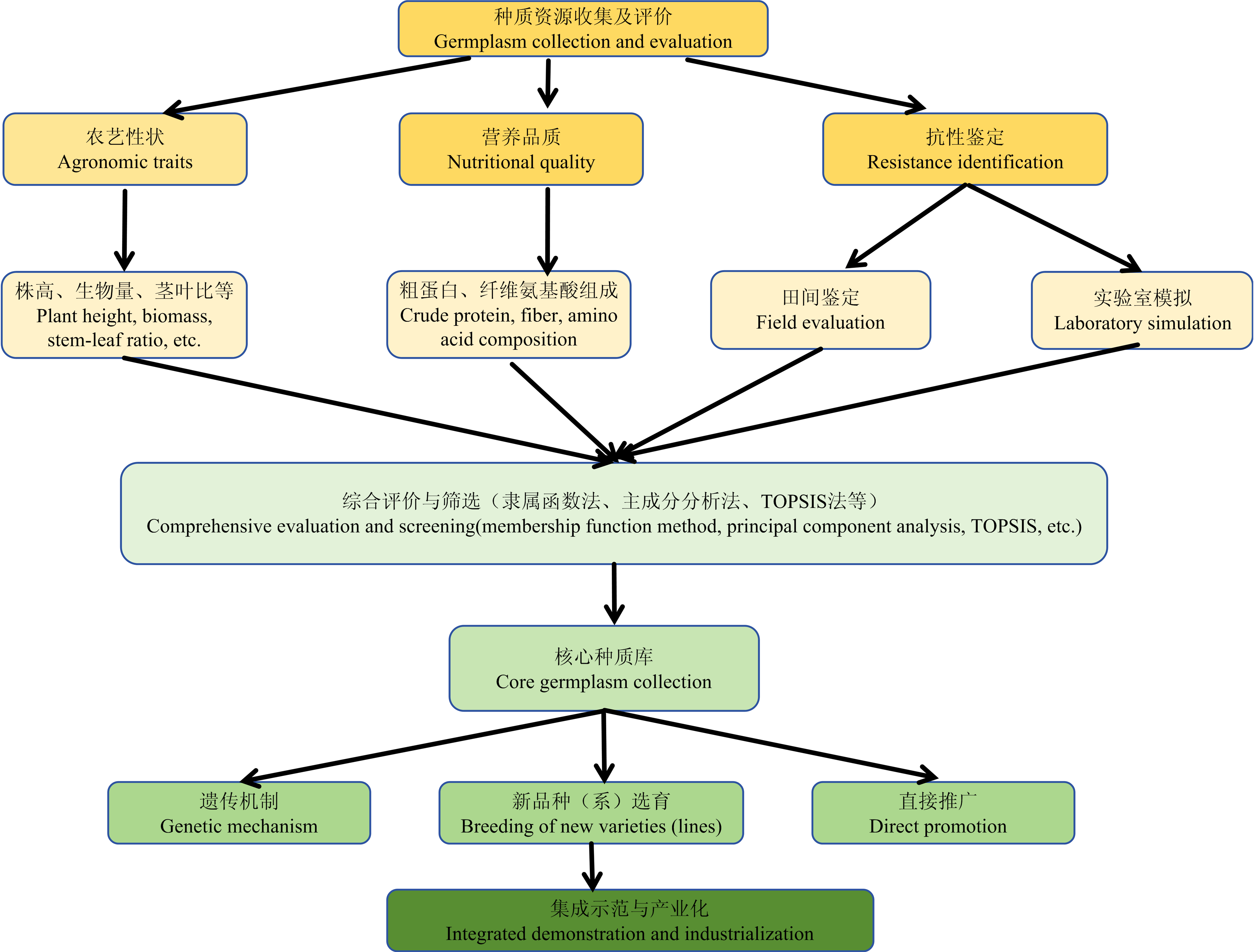
图3
饲用小黑麦种质资源系统性评价与利用技术路线图"
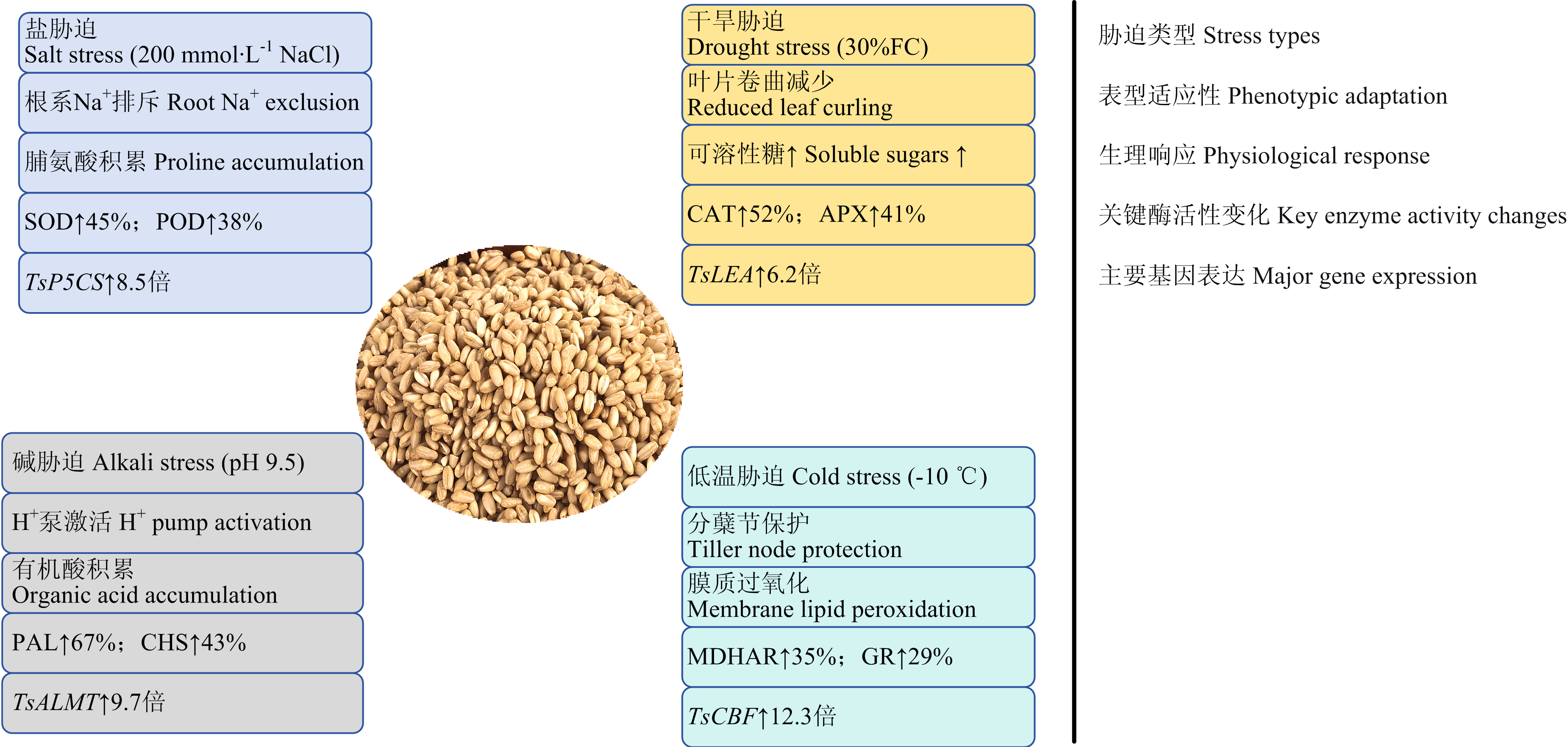
图4
小黑麦主要抗逆性生理响应机制"
表1
代表性饲用小黑麦品种(系)在宁夏盐碱地的性状表现"
| 品种 Variety | 株高 Plant height (cm) | 鲜草产量 Fresh forage yield (t·hm-2) | 干草产量 Hay yield (t·hm-2) | 蛋白含量 Protein content (%) | 相对饲用价 Relative feed value | 耐盐等级 Salt tolerance grade | 出苗率 Emergence rate (%) | 越冬率 Winter survival rate (%) |
|---|---|---|---|---|---|---|---|---|
| 中饲1048 Zhongsi 1048 | 145 | 75.2 | 18.5 | 16.8 | 142 | 强 High | 95.2 | 98.5 |
| 冀饲5号Jisi 5 | 138 | 68.9 | 17.2 | 15.9 | 135 | 中 Moderate | 92.1 | 96.2 |
| 晋饲草1号Jinsicao 1 | 152 | 72.1 | 19.1 | 17.2 | 148 | 强 High | 96.8 | 99.1 |
| 陇饲1号Longsi 1 | 141 | 69.8 | 17.8 | 16.3 | 138 | 中 Moderate | 93.5 | 97.3 |
| 宁饲1号Ningsi 1 | 136 | 65.4 | 16.9 | 15.7 | 132 | 中 Moderate | 91.7 | 95.8 |
表2
“青贮玉米+饲用小黑麦”复播模式经济效益分析"
| 项目 Item | 单位成本 Unit cost (yuan·hm-2) | 总成本 Total cost (10000 yuan) | 占比 Proportion (%) |
|---|---|---|---|
| 小黑麦种植成本Triticale planting cost | 4200 | 28.0 | 46.7 |
| 小黑麦产出收入Triticale output income | -9750 | -65.0 | 57.5 |
| 玉米种植成本Maize planting cost | 4800 | 32.0 | 53.3 |
| 玉米产出收入Maize output income | -7200 | -48.0 | 42.5 |
| 总成本Total cost | 9000 | 60.0 | 100.0 |
| 总收入Total income | -16950 | -113.0 | 100.0 |
| 净利润Net profit | 7950 | 53.0 | 46.7 |
| 土地当量比Land equivalent ratio | 1.35 | 1.35 | — |
| 投资回报率 Return on investment (%) | 88.3 | 88.3 | — |
表3
小黑麦功能性食品开发方向"
| 应用方向 Application area | 核心价值 Core value | 产品示例 Product examples | 技术要点/优势 Key technical points/advantages |
|---|---|---|---|
| 营养强化配粉 Nutritionally fortified flour blending | 高蛋白、高赖氨酸 High protein, high lysine | 营养强化面包、馒头、面条 Nutritionally enhanced bread, steamed buns, noodles | 复配比例20%—30%;需辅以食品改良剂优化质构 Blending ratio 20%-30%; requires food improvers to optimize texture |
| 酿造工业 Brewing industry | 高α-淀粉酶活性、高氮源 High α-amylase activity, high nitrogen source | 特种啤酒、麦芽、发酵醋 Specialty beer, malt, fermented vinegar | 简化糖化工艺,提升发酵效率,赋予独特风味 Simplifies saccharification process, enhances fermentation efficiency, imparts unique flavor |
| 功能性配料 Functional ingredients | 麸皮富含膳食纤维与多酚 Bran rich in dietary fiber and polyphenols | 高纤维饼干、益生元饮品、天然抗氧化剂 High-fiber biscuits, probiotic beverages, natural antioxidants | 提取利用副产物,提升产品健康属性,实现全籽粒利用 Extract and utilize by-products to enhance the health attributes of products and achieve whole-grain utilization |
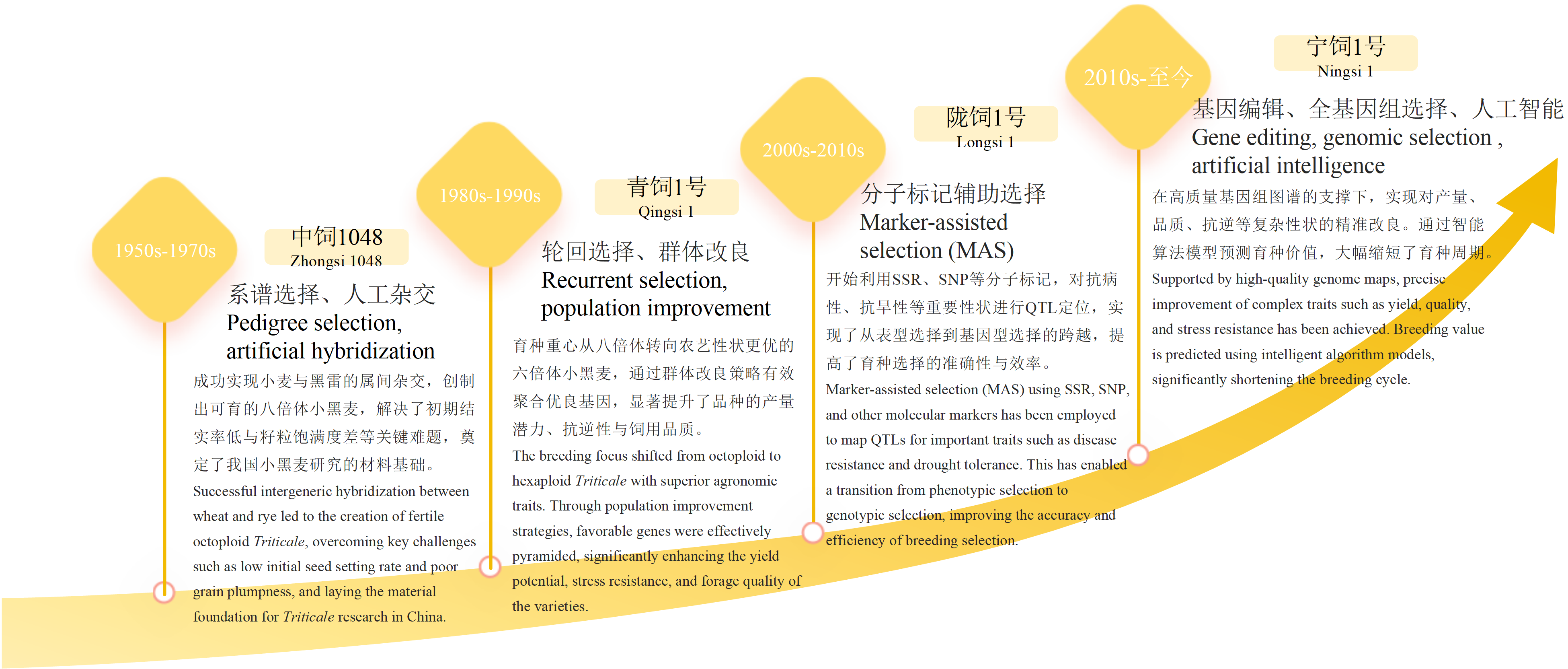
图5
国内小黑麦育种技术发展历程与成就"
| [1] |
|
| [2] |
doi: 10.1080/03746607309469536 |
| [3] |
|
| [4] |
doi: 10.1093/oxfordjournals.jhered.a104294 |
| [5] |
doi: 10.1093/genetics/25.4.401 |
| [6] |
|
| [7] |
doi: 10.1006/jcrs.2000.0329 |
| [8] |
鲍文奎. 植物育种中的几个遗传问题[J]. 种子, 1983, 2(3): 70-72.
|
|
|
|
| [9] |
王小军, 鲍文奎. 八倍体小黑麦耐盐细胞系产生的遗传机制[J]. 植物学报, 1998, 40(4): 330-336.
|
|
|
|
| [10] |
董永琴, 严育瑞, 鲍文奎. 八倍体小黑麦新品种的适宜播期范围与稳产性[J]. 作物学报, 1991, 17(1): 24-31.
|
|
|
|
| [11] |
孙元枢. 中国小黑麦遗传育种研究与应用[M]. 杭州: 浙江科学技术出版社, 2002.
|
|
|
|
| [12] |
张成合, 曹军, 鲍文奎. 小黑麦单倍体愈伤组织(n=28)耐碱和耐盐变异体的筛选与鉴定[J]. 综合植物生物学杂志, 1986(2): 137-144.
|
|
|
|
| [13] |
doi: 10.3390/ijms25179568 |
| [14] |
张晓娟, 孙权, 陈永伟, 马文礼, 马宏秀, 蒋鹏. 宁夏引黄灌区饲用小黑麦复种青贮玉米高效栽培技术[J]. 饲料工业, 2024, 45(6): 125-129.
|
|
|
|
| [15] |
崔建宁, 张敏, 徐灿, 陈永伟, 杨波, 哈蓉, 王昊, 靳韦, 杨宏波. 灵武农场秋播小黑麦后复种青贮玉米的种植效果分析[J]. 智慧农业导刊, 2024, 4(7): 35-38.
|
|
|
|
| [16] |
王伟, 奇明嘎, 王志军, 赵牧其尔, 格根图. 不同添加剂及混合比例对全株玉米与饲用小黑麦混合青贮品质的影响[J]. 草地学报, 2025, 33(9): 3077-3087.
doi: 10.11733/j.issn.1007-0435.2025.09.031 |
|
|
|
| [17] |
王清韵, 周丁扬, 安萍莉, 姜广辉. 自然保护地政策对区域生态环境质量的影响: 以三江源地区为例[J]. 应用生态学报, 2023, 34(5): 1349-1359.
doi: 10.13287/j.1001-9332.202305.023 |
|
doi: 10.13287/j.1001-9332.202305.023 |
|
| [18] |
薛风娟, 加羊吉, 张海英, 孙浩, 蒲小剑, 赵媛媛, 王伟, 徐成体. 不同饲用小黑麦种子萌发期耐盐碱性的综合评价[J]. 种子, 2025, 44(12): 55-65.
|
|
|
|
| [19] |
刘晶, 杜明川, 黄晓萍, 杨鑫光, 冯召扬, 杜文华. 小黑麦种质在青海不同地区的生产性能与营养价值综合评价[J]. 种子, 2023, 42(11): 106-111.
|
|
|
|
| [20] |
doi: 10.1017/S0021859605005290 |
| [21] |
|
| [22] |
蔺美玲, 张邦彦, 武晋民, 闫棣楷, 李腾飞, 刘盼婷, 许兴, 王彬. 宁夏平原中度盐碱地小黑麦种质资源适应性评价[J]. 草业科学, 2025, 42(1): 1-21.
|
|
|
|
| [23] |
代寒凌, 田新会, 杜文华, 吴建平. 甘南地区饲用型小黑麦草产量及营养品质研究[J]. 草原与草坪, 2019, 39(2): 66-72.
|
|
|
|
| [24] |
doi: 10.1002/glr2.v1.3 |
| [25] |
张帆, 杨青川. 紫花苜蓿育种历史、现状与展望[J]. 中国农业科学, 2025, 58(21): 4471-4481. DOI: 10.3864/j.issn.0578-1752.2025.21.016.
|
|
|
|
| [26] |
郎旭. 冬性小黑麦新种质选育及冬黑麦特异SSR标记筛选[D]. 哈尔滨: 哈尔滨师范大学, 2022.
|
|
|
|
| [27] |
卢新雄, 王力荣, 辛霞, 尹广鹍, 张金梅, 陈晓玲, 何娟娟, 刘运霞. 种质圃作物种质资源安全保存策略与实践[J]. 植物遗传资源学报, 2023, 24(1): 32-43.
doi: 10.13430/j.cnki.jpgr.20220602001 |
|
|
|
| [28] |
doi: 10.1126/science.1230935 |
| [29] |
徐翠莲, 王瑞清, 张俐敏, 田依轩, 胡文明. 小黑麦花粉干燥法超低温保存技术研究[J]. 湖北农业科学, 2015, 54(21): 5223-5226.
|
|
|
|
| [30] |
doi: S1674-2052(20)30008-3 pmid: 31981735 |
| [31] |
张银霞, 褚红丽, 赵方媛, 杜文华. 饲草型小黑麦品种(系)的抗寒生理生化指标评价[J]. 西北农业学报, 2024, 33(12): 2231-2243.
|
|
|
|
| [32] |
|
| [33] |
doi: 10.1016/j.envexpbot.2023.105585 |
| [34] |
|
| [35] |
doi: 10.1007/BF02706626 |
| [36] |
doi: 10.1093/jexbot/51.suppl_1.447 |
| [37] |
doi: 10.1016/j.isprsjprs.2025.02.011 |
| [38] |
doi: 10.3390/genes9010019 |
| [39] |
doi: 10.1002/glr2.v3.3 |
| [40] |
贾惠森, 李伟. 不同比例小黑麦青贮饲料替代苜蓿干草对奶牛生产性能、乳成分及瘤胃发酵参数的影响[J]. 中国饲料, 2025(18): 133-136.
|
|
|
|
| [41] |
张银霞, 刘翠, 郭蕊, 宋谦, 赵方媛, 杜文华. 陇东旱塬区小黑麦茬后复种青贮玉米品种的营养品质研究[J]. 草原与草坪, 2026, 46(2): 117-123.
|
|
|
|
| [42] |
|
| [43] |
doi: 10.1016/S0733-5210(09)80018-0 |
| [44] |
|
| [45] |
doi: 10.1094/CCHEM-12-14-0251-R |
| [46] |
doi: 10.1007/s11947-024-03654-z |
| [47] |
doi: 10.1016/j.lwt.2021.112771 |
| [48] |
|
| [49] |
任永康, 崔磊, 牛瑜琦, 杨峰, 郭庆, 唐朝晖, 逯成芳, 孙玉. 小黑麦新品种晋饲草1号的选育[J]. 中国种业, 2017(12): 59-60.
|
|
|
|
| [50] |
郭庆, 杨峰, 闫贵云, 任永康, 郭高明, 孙玉, 崔磊. 小黑麦新品种神农饲草1号的选育及应用[J]. 中国种业, 2024(5): 124-127.
|
|
|
|
| [51] |
doi: 10.1134/S0026893322060127 |
| [52] |
doi: 10.3390/biom14060614 |
| [1] | 陈敏氡, 裘波音, 黄昊, 李永平, 温庆放. 松花菜种质花球质地品质的评价[J]. 中国农业科学, 2026, 59(6): 1302-1316. |
| [2] | 陈敏, 焦紫岚, 乔承彬, 许昊, 张碧, 马东花, 孔维儒, 王敬文, 宋佳伟, 罗成科, 李培富, 田蕾. 不同亚种水稻种质资源对盐胁迫的形态生理响应及适应策略[J]. 中国农业科学, 2026, 59(4): 705-722. |
| [3] | 何治霖, 孙翠霞, 岳红丽, 谈月霞, 张耀海, 王福生, 刘思涛, 江东. 基于重测序枸橼、柠檬类种质资源的遗传多样性分析和别罗勒烯的全基因组关联分析[J]. 中国农业科学, 2026, 59(2): 386-401. |
| [4] | 谢永祥, 潘怡敏, 黄蕊, 秦慧彬, 侯森, 贺强, 凌亮, 穆志新, 王海岗. 山西谷子种质资源耐瘠性鉴定及综合评价[J]. 中国农业科学, 2026, 59(11): 2325-2339. |
| [5] | 张悦青, 张玉亭, 薛晨飞, 韩秦宇, 贺一容, 徐紫娟, 范秀梅, 王军娥, 罗丹, 冯雪, 孙胜. 364份樱桃番茄种质资源表型性状的遗传多样性分析及综合评价[J]. 中国农业科学, 2026, 59(11): 2468-2483. |
| [6] | 吕涛, 孙国清, 郭栋材, 陈全家, 蔡永生, 樊标星, 曲延英, 郑凯. 海岛棉纤维强度QTL紧密连锁InDel分子标记开发及效应评价[J]. 中国农业科学, 2025, 58(9): 1684-1701. |
| [7] | 陈彩锦, 马琳, 蒋庆雪, 刘金晖, 苗童, 张志鹏, 孟翔, 马晓冉, 周昕越, 张建, 刘文辉, 王学敏. 244份饲用燕麦种质资源表型性状遗传多样性分析[J]. 中国农业科学, 2025, 58(23): 4825-4836. |
| [8] | 陈天晓, 曹榕, 宋倩楠, 胡亮亮, 王素华, 王丽侠, 程须珍, 陈红霖. 小豆种质资源苗期耐盐性综合评价及耐盐种质筛选[J]. 中国农业科学, 2025, 58(21): 4317-4332. |
| [9] | 张帆, 杨青川. 紫花苜蓿育种历史、现状与展望[J]. 中国农业科学, 2025, 58(21): 4471-4481. |
| [10] | 陈永先, 陈瑞江, 都艺芝, 术钧捷, 陈晚霞, 赵梓含, 王季春, 杜康, 张凯. 耐旱甘薯种质资源的筛选与鉴定[J]. 中国农业科学, 2025, 58(2): 214-237. |
| [11] | 包明芳, 秦燕, 陈彩锦, 张尚沛, 张国辉, 沙晓弟. 111份紫花苜蓿种质资源苗期表型抗旱性鉴定评价[J]. 中国农业科学, 2025, 58(19): 3825-3836. |
| [12] | 孟姿诺, 付长青, 张玲玉, 高顺娟, 常金华, 崔江慧. 高粱芽苗期耐盐性评价及耐盐种质筛选[J]. 中国农业科学, 2025, 58(16): 3317-3326. |
| [13] | 郑敏华, 陈洛, 邢甲乐, 谢月兰, 姜先芽, 聂帅, 蔡甫格, 巫浩翔, 陆展华, 孙伟, 霍兴, 白嵩, 赵均良, 杨武. 华南籼稻稻瘟病抗性QTL鉴定与候选基因挖掘[J]. 中国农业科学, 2025, 58(14): 2707-2719. |
| [14] | 吴慧琴, 王静, 阳宜, 刘雪晴, 张凯旋, 王麓尧, 路佳伟, 翟源, 成妍. 96份辣椒种质资源的果实质地品质分析及评价[J]. 中国农业科学, 2025, 58(14): 2854-2868. |
| [15] | 李翔宇, 刘健茁, 胡丹丹, 刘耕瑜, 陈良宇, 李冰, 杜万里, 宋波. 玉米种质资源对瘤黑粉病的抗性评价及生理差异分析[J]. 中国农业科学, 2025, 58(13): 2504-2521. |
|
||
