






中国农业科学 ›› 2026, Vol. 59 ›› Issue (14): 3006-3021.doi: 10.3864/j.issn.0578-1752.2026.14.002
毛嘉琦1,2( ), 武棒棒1, 赵佳佳1, 郝宇琼1, 郑兴卫1, 吴建辉4, 曾庆东4, 刘敏捷3(), 郑军1()
收稿日期:2025-12-12
接受日期:2026-03-18
出版日期:2026-07-16
发布日期:2026-07-21
通信作者:
联系方式:
毛嘉琦,E-mail:18246756687@163.com。
基金资助:
MAO JiaQi1,2(), WU BangBang1, ZHAO JiaJia1, HAO YuQiong1, ZHENG XingWei1, WU JianHui4, ZENG QingDong4, LIU MinJie3(), ZHENG Jun1()
Received:2025-12-12
Accepted:2026-03-18
Published:2026-07-16
Online:2026-07-21
摘要:
【目的】条锈病和叶锈病是黄淮冬麦区小麦生产的主要病害,精准鉴定小麦品种资源的抗性,了解抗病基因分布,挖掘新的抗病基因/位点,为抗病品种的选育和推广奠定基础。【方法】利用当前条锈菌流行小种CYR32、CYR34,以及叶锈菌小种PHSH对326份山西小麦品种进行苗期抗性鉴定,利用分子标记和GBTS液相芯片技术进行检测,并通过16K SNP芯片进行全基因组关联分析挖掘抗锈病遗传位点。【结果】山西小麦品种苗期抗条锈病能力整体较好,其中,金麦919、云麦766和临黑199等97份品种苗期对CYR32和CYR34小种均表现出抗性;中旱110、泽优2号和石农086等15个(4.60%)品种苗期对CYR32表现免疫;晋农207、晋麦13和临黑199等14份(4.29%)品种苗期对CYR34表现免疫;山西小麦品种苗期抗叶锈病能力较差,仅12份品种苗期对叶锈病表现中抗。23个检测抗病基因中共检测到11个抗条锈病基因/QTL——QYrqin.nwafu-2AL(87.42%)、Yr78(27.30%)、Yr9(24.54%)、QYrsn.nwafu-3DL(15.95%)、Yr75(13.19%)、QYrhm.nwafu-2BC(10.73%)、Yr5(7.98%)、Yr80(2.76%)、QYr.nwafu-4BL(2.15%)、YrSP(1.84%)和Yr82(1.84%),7个抗叶锈病基因——Lr46(28.83%)、Lr1(22.09%)、Lr68(16.87%)、Lr26(16.56%)、Lr34(11.96%)、Lr13(5.83%)和Lr37(1.23%),未携带Yr15、Yr26、Lr10、Lr21和Lr80。对于多个抗病基因的聚合,聚合频率最高的是QYrqin.nwafu-2AL+QYrsn.nwafu-3DL和Lr46+Lr68组合。全基因组关联分析共检测到5个与条锈病抗性显著关联的位点,2B、5B和7A染色体上可能携带新的条锈病抗性位点;同时检测到14个与叶锈病抗性显著关联的位点,1B、4A和5A等染色体上可能携带新的叶锈病抗性位点。【结论】山西小麦苗期抗条锈病能力整体较好,但苗期抗叶锈病整体较差;在1B、2B和3B等13条染色体上共定位到19个与条锈/叶锈病抗性显著关联的位点,推测QYrs-2B、QLrs-2A和QLrs-4A等14个位点可能是新的锈病抗性位点。
毛嘉琦, 武棒棒, 赵佳佳, 郝宇琼, 郑兴卫, 吴建辉, 曾庆东, 刘敏捷, 郑军. 山西小麦品种苗期锈病抗性鉴定及抗病基因检测[J]. 中国农业科学, 2026, 59(14): 3006-3021.
MAO JiaQi, WU BangBang, ZHAO JiaJia, HAO YuQiong, ZHENG XingWei, WU JianHui, ZENG QingDong, LIU MinJie, ZHENG Jun. Evaluation of Rust Resistance in the Seedling Stage of Wheat Varieties and Disease-Resistant Gene Detection in Shanxi Province, China[J]. Scientia Agricultura Sinica, 2026, 59(14): 3006-3021.

表1
小麦抗锈病基因检测分子标记"
| 基因 Gene | 标记 Marker | 引物序列 Primer sequence (5′-3′) | 参考文献 References |
|---|---|---|---|
| Lr1 | WR003F | GGGACAGAGACCTTGGTGGA | [ |
| WR003R | GACGATGATGATTTGCTGCTGG | ||
| Lr10 | Lrk10D1 | GAAGCCCTTCGTCTCATCTG | [ |
| Lrk10D2 | TTGATTCATTGCAGATGAGATCACG | ||
| Lr21 | D14-L | CGCTTTTACCGAGATTGGTC | [ |
| D14-R | TCTGGTATCTCACGAAGCCTT | ||
| Lr26+ | ω-secalinF | ACCTTCCTCATCTTTGTCCT | [ |
| ω-secalinR | CCGATGCCTATACCACTACT | ||
| Lr26- | Glu-B3F | GGTACCAACAACAACAACCC | |
| Glu-B3R | GTTGCTGCTGAGGTTGGTTC | ||
| Lr34 | csLV34F | GTTGGTTAAGACTGGTGATGG | [ |
| csLV34R | TGCTTGCTATTGCTGAATAGT | ||
| Yr5 | S19M93-100-F | TAATTGGGACCGAGAGACG | [ |
| S19M93-100-R | TTCTTGCAGCTCCAAAACCT | ||
| Yr9 | H20-F | GTTGGAAGGGAGCTCGAGCTG | [ |
| H20-R | GTTGGGCAGAAAGGTCGACATC | ||
| Yr15 | uhw301R-F | GGAGATAGAGCACATTACAGAC | [ |
| uhw301R-R | TTTCGCATCCCACCCTACTG |

图1
山西不同小麦品种条锈/叶锈病表型鉴定及抗病水平 A:山西小麦部分品种接种CYR34苗期叶片发病情况;B:山西小麦部分品种接种PHSH苗期叶片发病情况;C:山西小麦条锈病苗期侵染型;D:山西小麦叶锈病苗期侵染型;E:山西小麦条锈/叶锈抗病水平统计。HS:高感;MS:中感;MR:中抗;HR:高抗;IM:免疫"
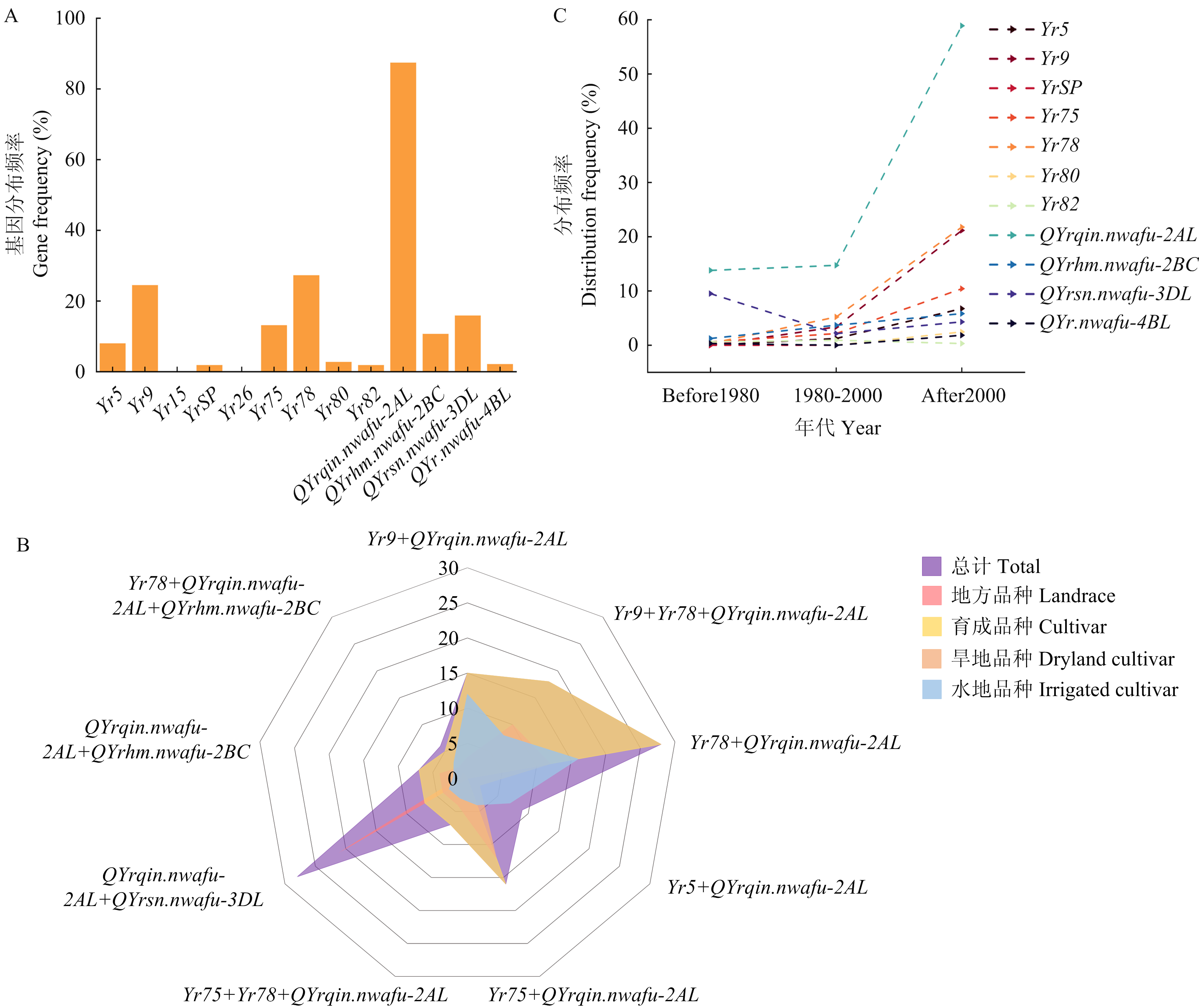
图2
山西小麦抗条锈病基因的分布频率 A:条锈病基因的分布;B:主要抗条锈病基因组合的分布;C:不同育成年份品种抗条锈病基因的分布频率"
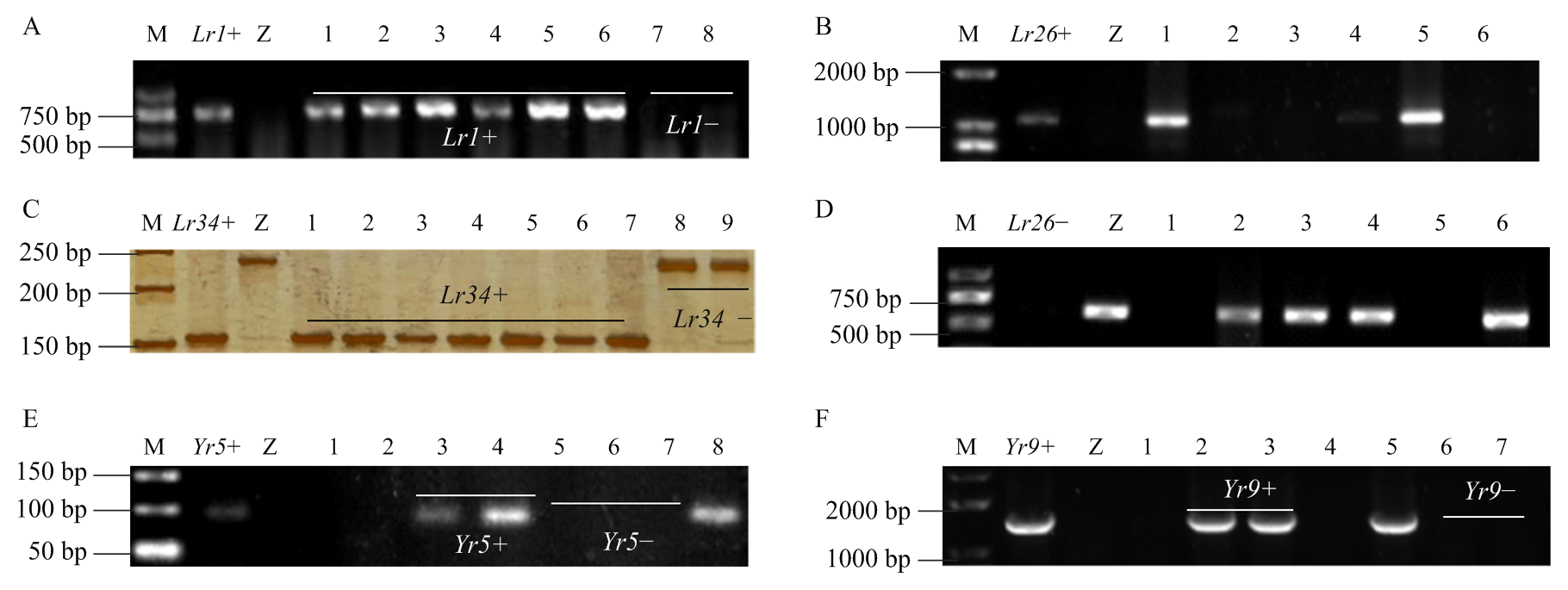
图3
部分抗条锈/叶锈基因的PCR检测标记电泳图 A:Lr1分子标记WR003,1:舜麦1718,2:NC206,3:晋麦102,4:临汾6410,5:运麦2064,6:圣麦104,7:晋麦17,8:晋麦38;B:Lr26分子标记ω-secalin,1:长6990,2:中麦247,3:临旱6号,4:临Y8161,5:中旱110,6:吕旱1608;C:Lr34分子标记csLV34,1:白火麦,2:假红麦,3:气死风,4:白壳红,5:四月黄,6:三月黄,7:红小麦,8:晋麦70,9:临汾139;D:Lr26分子标记Glu-B3,1:长6990,2:中麦247,3:临旱6号,4:临Y8161,5:中旱110,6:吕旱1608;E:Yr5分子标记S19M93-100,1:晋麦33,2:晋麦63,3:临麦5311,4:临黑199,5:临旱6号,6:晋麦37,7:晋春3号,8:石农086;F:Yr9分子标记H20,1:运旱1818,2:临旱5325,3:中麦110,4:临汾139,5:长麦3987,6:舜麦612,7:泽优1号。M代表Marker DL 50(C、E)和DL 5000(A-B、D和F)。+:含有抗病基因;-:不含抗病基因"
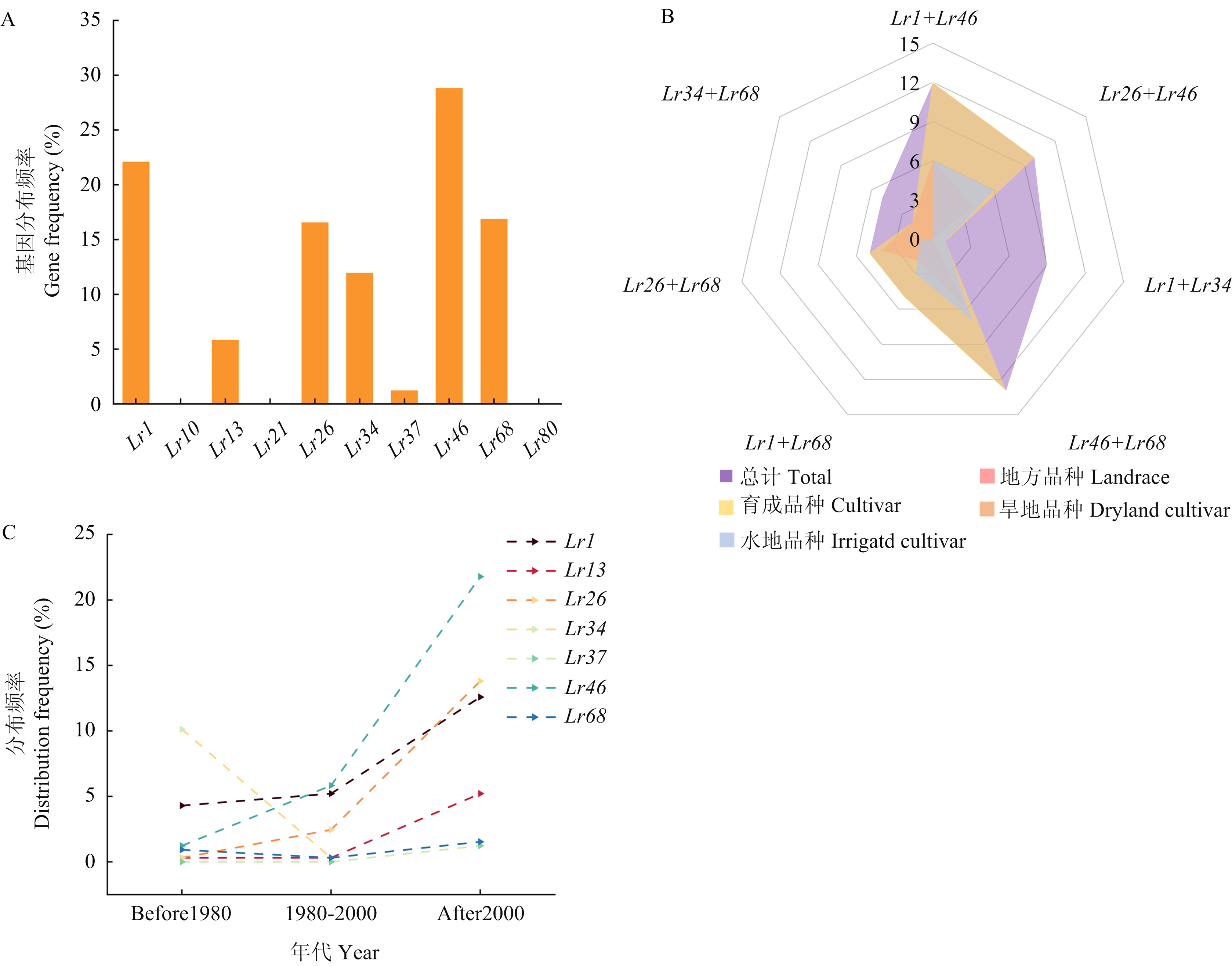
图4
山西小麦抗叶锈病基因的分布频率 A:叶锈病基因的分布;B:主要抗叶锈病基因组合的分布;C:不同育成年份品种抗叶锈病基因的分布频率"
表2
与小麦条锈病抗性显著相关的SNP"
| 生理小种 Physiological race | 标记 Marker | 染色体 Chromosome | 物理位置 Physical position (Mb) | P值 P value | 表型贡献率 R2 (%) | 参考文献 References |
|---|---|---|---|---|---|---|
| CYR32 | QYrs-2B | 2B | 394.98 | 3.16 | 5.11 | |
| QYrs-7A | 7A | 450.89 | 3.01 | 4.90 | ||
| CYR34 | QYrs-3B | 3B | 69.81 | 3.07 | 5.03 | [ |
| QYrs-3D | 3D | 344.36 | 3.09 | 5.07 | [ | |
| QYrs-5B | 5B | 40.90 | 4.03 | 5.97 | ||
| PHSH | QLrs-1B | 1B | 276.31—310.58 | 3.00—3.64 | 5.58 | |
| QLrs-1B.1 | 1B | 388.87 | 3.50 | 5.74—6.24 | ||
| QLrs-1B.2 | 1B | 546.67—615.58 | 3.21—3.38 | 4.90—6.02 | [ | |
| QLrs-2A | 2A | 709.15—712.70 | 3.15—3.71 | 4.82—5.69 | ||
| QLrs-2B | 2B | 593.63 | 3.14 | 4.79 | [ | |
| QLrs-2B.1 | 2B | 710.72 | 3.77 | 6.69 | ||
| QLrs-4A | 4A | 108.38—132.33 | 3.84 | 6.81—7.62 | ||
| QLrs-4B.1 | 4B | 295.96—329.77 | 3.63—3.82 | 5.87—5.90 | ||
| QLrs-5A | 5A | 314.16—355.87 | 3.05—3.09 | 4.66—4.72 | ||
| QLrs-5A.1 | 5A | 364.19—377.11 | 3.07—3.84 | 4.68—5.90 | ||
| QLrs-6B | 6B | 633.89—704.89 | 3.03—3.39 | 4.62—6.42 | [ | |
| QLrs-6D | 6D | 151.83—159.39 | 4.13—3.46 | 5.26—6.35 | ||
| QLrs-6D.1 | 6D | 237.98—258.61 | 3.35—3.89 | 5.13—5.97 | ||
| QLrs-7B | 7B | 477.99—533.57 | 3.15—3.33 | 4.82—5.95 |

图5
全基因组关联分析曼哈顿图和单倍型分析 A:苗期条锈/叶锈病表型全基因组关联分析曼哈顿图;B—F:染色体单倍型与条锈病表型关系;G—J:染色体单倍型与叶锈病表型关系。*和***分别表示在P<0.05和P<0.001水平差异显著,ns表示无显著差异"
| [1] |
康振生, 王晓杰, 赵杰, 汤春蕾, 黄丽丽. 小麦条锈菌致病性及其变异研究进展[J]. 中国农业科学, 2015, 48(17): 3439-3453. DOI: 10.3864/j.issn.0578-1752.2015.17.011.
|
|
|
|
| [2] |
doi: 10.1111/mpp.2008.9.issue-5 |
| [3] |
|
| [4] |
刘万才, 王保通, 赵中华, 李跃, 康振生. 我国小麦条锈病历次大流行的历史回顾与对策建议[J]. 中国植保导刊, 2022, 42(6): 21-27, 41.
|
|
|
|
| [5] |
doi: 10.1094/PDIS-02-17-0247-RE pmid: 30676921 |
| [6] |
孙海燕, 原征, 疏燕, 张兴, 张爱香, 陈怀谷. 不同杀菌剂对小麦赤霉病和叶锈病的防治效果[J]. 植物保护, 2021, 47(1): 273-276.
|
|
|
|
| [7] |
doi: 10.1371/journal.pcbi.1006067 |
| [8] |
doi: 10.1038/s41467-024-54068-6 |
| [9] |
李峰奇, 韩德俊, 魏国荣, 曾庆东, 黄丽丽, 康振生. 黄淮麦区126个小麦品种(系)抗条锈病基因的分子检测[J]. 中国农业科学, 2008, 41(10): 3060-3069. DOI: 10.3864/j.issn.0578-1752.2008.10.019.
|
|
|
|
| [10] |
郑慧敏, 温晓蕾, 郝晨阳, 张培培,
doi: 10.3724/SP.J.1006.2019.91003 |
|
doi: 10.3724/SP.J.1006.2019.91003 |
|
| [11] |
doi: 10.1038/s41477-018-0236-4 pmid: 30150615 |
| [12] |
doi: 10.1038/s41467-018-06138-9 |
| [13] |
doi: 10.1094/PHYTO.2003.93.2.153 pmid: 18943129 |
| [14] |
doi: 10.3389/fpls.2014.00641 pmid: 25505474 |
| [15] |
doi: 10.1038/s41588-025-02259-2 |
| [16] |
doi: 10.1016/j.xplc.2024.101077 |
| [17] |
贾秋珍, 曹世勤, 王晓明, 孙振宇, 张勃, 黄瑾, 骆惠生, 李青青. 2019年—2020年甘肃省小麦条锈菌生理小种变异监测[J]. 植物保护, 2022, 48(5): 327-332.
|
|
|
|
| [18] |
李明菊, 陈贤明, 万安民, 丁明亮, 程加省. 云南小麦条锈菌群体对18个抗条锈近等基因系的毒性分析[J]. 植物保护学报, 2018, 45(1): 75-82.
|
|
|
|
| [19] |
武延超, 孟庆芳, 杨文香, 温晓蕾, 刘大群. 2007年陕西、湖北和四川三省小麦叶锈菌苗期毒性分析[J]. 中国农学通报, 2009, 25(17): 195-198.
|
|
|
|
| [20] |
葛润静, 刘太国, 高利, 刘博, 陈万权. 2011—2012年度中国六省小麦叶锈菌群体毒性分析[J]. 植物病理学报, 2015, 45(2): 175-180.
doi: 10.13926/j.cnki.apps.2015.02.008 |
|
|
|
| [21] |
习玲, 王昱琦, 朱微, 王益, 陈国跃, 蒲宗君, 周永红, 康厚扬. 78份四川小麦育成品种(系)条锈病抗性鉴定与抗条锈病基因分子检测[J]. 作物学报, 2021, 47(7): 1309-1323.
doi: 10.3724/SP.J.1006.2021.01061 |
|
doi: 10.3724/SP.J.1006.2021.01061 |
|
| [22] |
郑良梅, 杨慧, 徐晓伟, 童朝阳, 蔺瑞明, 冯晶, 姚强, 王凤涛. 107个山东小麦品种抗条锈性评价及分子标记检测[J]. 麦类作物学报, 2023, 43(8): 968-976.
|
|
|
|
| [23] |
王炜星, 张梦宇, 董瑞, 张培培, 张佳瑶, 李在峰, 刘大群. 河南71个重要小麦生产品种的抗叶锈性鉴定[J]. 麦类作物学报, 2022, 42(3): 279-288.
|
|
|
|
| [24] |
徐云碧, 杨泉女, 郑洪建, 许彦芬, 桑志勤, 郭子锋, 彭海, 张丛, 蓝昊发, 王蕴波, 吴坤生, 陶家军, 张嘉楠. 靶向测序基因型检测(GBTS)技术及其应用[J]. 中国农业科学, 2020, 53(15): 2983-3004. DOI: 10.3864/j.issn.0578-1752.2020.15.001.
|
|
|
|
| [25] |
doi: 10.1007/s00122-025-04969-x pmid: 40689963 |
| [26] |
陈建雄, 严浩浩, 曹世勤, 贾秋珍, 李彦兵, 伏松平, 韩德俊, 康振生, 曾庆东, 姚强. 62份甘肃小麦品种(系)抗条锈性评价及抗病基因检测[J]. 植物病理学报, 2023, 53(5): 881-889.
doi: 10.13926/j.cnki.apps.001015 |
|
|
|
| [27] |
徐兆飞. 山西小麦[M]. 北京: 中国农业出版社, 2006.
|
|
|
|
| [28] |
庞云星, 崔宏梅, 蔺瑞明, 杨慧, 冯晶, 马东方, 徐世昌, 王凤涛. 89份河北、山西小麦品种抗条锈性评价及抗条锈病基因检测[J]. 植物保护, 2021, 47(6): 49-57, 92.
|
|
|
|
| [29] |
刘敏捷, 原宗英, 武英鹏. 2015—2018年度山西省小麦区域试验品种及育种材料抗病性评价[J]. 山西农业科学, 2020, 48(4): 489-491.
|
|
|
|
| [30] |
韩德俊, 王琪琳, 张立, 魏国荣, 曾庆东, 赵杰, 王晓杰, 黄丽丽, 康振生. “西北-华北-长江中下游”条锈病流行区系当前小麦品种(系)抗条锈病性评价[J]. 中国农业科学, 2010, 43(14): 2889-2896. DOI: 10.3864/j.issn.0578-1752.2010.14.007.
|
|
|
|
| [31] |
王佳真, 李在峰, 李星, 刘大群. 小麦品系5R618抗叶锈病基因的初步定位[J]. 植物遗传资源学报, 2014, 15(6): 1348-1351.
doi: 10.13430/j.cnki.jpgr.2014.06.025 |
|
|
|
| [32] |
|
| [33] |
|
| [34] |
doi: 10.1007/s11032-019-0940-4 |
| [35] |
doi: 10.1007/s00122-007-0551-z |
| [36] |
doi: 10.1023/A:1009619905909 |
| [37] |
doi: 10.1007/s001220100701 |
| [38] |
doi: 10.1111/pbr.2006.125.issue-3 |
| [39] |
doi: 10.1007/s00122-006-0406-z pmid: 17008991 |
| [40] |
doi: 10.1139/g07-004 pmid: 17502899 |
| [41] |
doi: 10.1007/s10681-007-9484-5 |
| [42] |
卫乃翠, 陶金博, 苑名杨, 张彧, 开梦想, 乔玲, 武棒棒, 郝宇琼, 郑兴卫, 王娟玲, 赵佳佳, 郑军. 山西小麦苗期耐低磷特性及遗传分析[J]. 中国农业科学, 2024, 57(5): 831-845. DOI: 10.3864/j.issn.0578-1752.2024.05.001.
|
|
|
|
| [43] |
doi: 10.1007/s00122-011-1675-8 pmid: 21830107 |
| [44] |
doi: 10.3389/fpls.2022.918437 |
| [45] |
doi: 10.1007/s11032-019-1004-5 |
| [46] |
doi: 10.1007/s00122-021-03776-4 pmid: 33550471 |
| [47] |
doi: 10.2135/cropsci2015.01.0031 |
| [48] |
杨迪, 李岩佳, 蔡奇昌, 黄洁, 李莹, 王保通, 龙书生, 李强. 194份小麦品种(系)抗条锈性和白粉性评价及抗病基因检测[J]. 植物病理学报, 2025, 55(2): 261-269.
doi: 10.13926/j.cnki.apps.000937 |
|
|
|
| [49] |
doi: 10.1007/s00122-022-04133-9 |
| [50] |
李俣佳, 许豪, 于士男, 唐建卫, 李巧云, 高艳, 郑继周, 董纯豪, 袁雨豪, 郑天存, 殷贵鸿. 小麦骨干亲本周8425B抗条锈病优异基因在其衍生品种中的遗传解析[J]. 作物学报, 2024, 50(1): 16-31.
doi: 10.3724/SP.J.1006.2024.31013 |
|
doi: 10.3724/SP.J.1006.2024.31013 |
|
| [51] |
doi: 10.1038/s41588-025-02207-0 |
| [52] |
doi: 10.1016/j.cj.2025.05.015 |
| [53] |
doi: 10.1038/s41588-023-01401-2 |
| [54] |
doi: 10.1186/s12870-025-06918-8 |
| [55] |
|
| [56] |
doi: 10.1038/s41588-022-01022-1 pmid: 35288708 |
| [57] |
doi: 10.1016/j.cropro.2020.105168 |
| [58] |
doi: 10.1007/s00122-010-1302-0 pmid: 20198466 |
| [59] |
doi: 10.1007/s00122-012-1998-0 pmid: 23090143 |
| [60] |
doi: 10.1007/s00122-015-2609-7 pmid: 26433828 |
| [61] |
doi: 10.1094/Phyto-85-573 |
| [62] |
doi: 10.1007/s00122-011-1545-4 pmid: 21344185 |
| [63] |
doi: 10.1007/s00122-019-03514-x |
| [64] |
doi: 10.1007/s00122-021-03818-x pmid: 33839800 |
| [65] |
doi: 10.1007/s11032-009-9381-9 |
| [66] |
doi: 10.1007/s00122-017-2957-6 |
| [67] |
杨芳萍, 刘金栋, 郭莹, 贾奥琳, 闻伟鄂, 巢凯翔, 伍玲, 岳维云, 董亚超, 夏先春. 普通小麦'Holdfast'条锈病成株抗性QTL定位[J]. 作物学报, 2019, 45(12): 1832-1840.
doi: 10.3724/SP.J.1006.2019.91026 |
|
doi: 10.3724/SP.J.1006.2019.91026 |
|
| [68] |
doi: 10.2135/cropsci2007.07.0379 |
| [69] |
doi: 10.1007/s11032-015-0234-4 |
| [70] |
doi: 10.3389/fpls.2021.666921 |
| [71] |
doi: 10.1007/s13353-010-0026-9 |
| [72] |
doi: 10.1038/s41467-025-64428-5 |
| [1] | 叶美金, 吴雷, Lohani Md Nahibuzzaman, 尹丽, 胡欣荣, 刘亚西, 蒋云峰, 陈国跃, 蒲至恩, 李阳, 李婷, 邹亚亚, 吴佳怡, 马建. 基于GWAS的中国地方小麦成熟胚大小位点的鉴定及其遗传效应解析[J]. 中国农业科学, 2026, 59(6): 1157-1171. |
| [2] | 杨丽娟, 陈丝雨, 赵薇, 朱玲, 郭磊, 马丽娜, 马瑞敏, 张娟. 全基因组重测序揭示静原鸡羽色的遗传机制[J]. 中国农业科学, 2026, 59(6): 1348-1360. |
| [3] | 焦文娟, 何万龙, 耿洪伟, 白斌, 李剑峰, 程宇坤. 155份春小麦品种(系)条锈病抗性评价与抗病基因分子检测[J]. 中国农业科学, 2026, 59(5): 937-950. |
| [4] | 王勇胜, 牛丽, 王长杰, 马立花, 廉潇潇, 孟亚雄, 马小乐, 姚立蓉, 张宏, 杨轲, 李葆春, 王化俊, 司二静, 汪军成. 冬小麦千粒重的全基因组关联分析及候选基因预测[J]. 中国农业科学, 2026, 59(3): 499-514. |
| [5] | 谭亚宁, 张保龙, 曹爱忠, 任润生. 江苏小麦品种的抗病基因分子检测[J]. 中国农业科学, 2026, 59(13): 2763-2775. |
| [6] | 陈圣琦, 刘金洋, 黄佳丽, 刘肖岑, 赵硕谦, 林云, 薛晨晨, 闫强, 陈景斌, 吴然然, 陈新, 程金平, 袁星星. 绿豆籽粒蛋白质与苏氨酸含量全基因组关联分析及KASP分子标记开发[J]. 中国农业科学, 2026, 59(13): 2789-2801. |
| [7] | 叶美金, 王同著, 陈斌, LOHANI Md Nahibuzzaman, 陈家婷, 胡欣荣, 尹丽, 王超, 张昊芃, 杨夏, 王佳琳, 姚琦馥, 丁浦洋, 王凤, 李小雨, 马建. 基于全基因组关联分析解析小麦茎节间长度的遗传基础及其效应[J]. 中国农业科学, 2026, 59(12): 2551-2562. |
| [8] | 王慧玲, 王晓玥, 闫爱玲, 刘振华, 任建成, 卢浩成, 孙磊. 葡萄果实品质性状遗传特性与基因位点解析研究进展[J]. 中国农业科学, 2026, 59(11): 2447-2467. |
| [9] | 李云丽, 刁邓超, 刘雅睿, 孙玉晨, 孟祥宇, 邬陈芳, 汪妤, 吴建辉, 李春莲, 曾庆东, 韩德俊, 郑炜君. 小麦苗期耐热性全基因组关联分析[J]. 中国农业科学, 2025, 58(9): 1663-1683. |
| [10] | 吴郁, 曲翔汝, 杨丹, 伍芩, 陈国跃, 江千涛, 魏育明, 许强. 广泛非靶向代谢组学解析小麦抗条锈病反应中叶绿体代谢产物[J]. 中国农业科学, 2025, 58(7): 1333-1343. |
| [11] | 邹晓威, 夏蕾, 朱晓敏, 孙辉, 周琦, 齐霁, 张亚封, 郑岩, 姜兆远. 基于转录组测序的玉米瘤黑粉菌UM01240过表达菌株诱导玉米抗病性分析[J]. 中国农业科学, 2025, 58(6): 1116-1130. |
| [12] | 周广飞, 马亮, 马璐, 张舒钰, 章慧敏, 宋旭东, 张振良, 陆虎华, 郝德荣, 冒宇翔, 薛林, 陈国清. 玉米苞叶性状全基因组关联分析[J]. 中国农业科学, 2025, 58(3): 431-442. |
| [13] | 许玉娟, 张捷, 王天译, 陈浩洋, 赵佳佳, 武棒棒, 郝宇琼, 李晓华, 郑兴卫, 左静静, 郑军. 山西小麦低分子量麦谷蛋白Glu-A3和Glu-B3位点多样性鉴定及其对品质的影响[J]. 中国农业科学, 2025, 58(24): 5110-5127. |
| [14] | 武书羽, 衡燕芳, 于太飞, 王世佳, 于思佳, 李园, 胡正, 张辉, 孙现军, 黎亮, 姜奇彦. 玉米自然群体苗期耐盐性鉴定及耐盐相关基因分析[J]. 中国农业科学, 2025, 58(20): 4085-4099. |
| [15] | 向爱慧, 白荣基, 郝宇琼, 赵佳佳, 武棒棒, 李晓华, 郑兴卫, 关攀锋, 郑军. 山西小麦矮秆基因的鉴定及株高遗传位点挖掘[J]. 中国农业科学, 2025, 58(17): 3372-3388. |
|
||
