






中国农业科学 ›› 2026, Vol. 59 ›› Issue (11): 2299-2313.doi: 10.3864/j.issn.0578-1752.2026.11.001
高亚峰1,2( ), 杨嘉宁1,2, 孙雪迪1, 陈佳佳1, 党志娟1,2, 汪军成1,2, 张宏1,2, 马小乐1,2, 姚立蓉1,2, 孟亚雄1,2, 司二静1,2, 李葆春2,3, 王化俊1,2()
收稿日期:2025-10-31
接受日期:2025-12-29
出版日期:2026-06-01
发布日期:2026-06-03
通信作者:
联系方式:
高亚峰,E-mail:15294486063@163.com。
基金资助:
GAO YaFeng1,2(), YANG JiaNing1,2, SUN XueDi1, CHEN JiaJia1, DANG ZhiJuan1,2, WANG JunCheng1,2, ZHANG Hong1,2, MA XiaoLe1,2, YAO LiRong1,2, MENG YaXiong1,2, SI ErJing1,2, LI BaoChun2,3, WANG HuaJun1,2()
Received:2025-10-31
Accepted:2025-12-29
Published:2026-06-01
Online:2026-06-03
摘要:
【目的】在现代农业生产中,为实现高产目标而过度依赖氮肥施用,既提升了生产成本,又导致土壤酸化和水体富营养化等严重环境问题,筛选耐低氮小麦品种是实现土壤氮素高效利用、显著降低氮肥投入的关键技术手段,为解析春小麦耐低氮特性、基因挖掘和培育耐低氮品种提供种质资源和理论依据。【方法】以285份春小麦种质资源为试验材料,在低氮(0.05 mmol·L-1)和正常氮(5 mmol·L-1)2种浓度处理下,开展苗期种子萌发袋试验,测定苗长、根长、地上部干重、地下部干重等9种性状指标,并计算其耐低氮系数,同时,采用隶属函数法对285份春小麦苗期耐低氮特性进行综合评价,对筛选出的耐低氮材料进行田间精细筛选与耐低氮特性鉴定,最终确定耐低氮与低氮敏感材料,进一步分析这些材料在低氮胁迫下氮吸收、同化和转运相关酶活性的变化,以及籽粒品质的变化。【结果】通过主成分分析和隶属函数法进行综合评价,将苗期285份春小麦种质资源划分为五类,Ⅰ类为氮极敏感利用材料(5个),D值为0.14—0.20,分别为WN-269、WN-247、WN-244、WN-149和WN-249;Ⅱ类为氮敏感利用材料(84个),D值为0.20—0.34;Ⅲ类为氮中效利用材料(162个),D值为0.34—0.51;Ⅳ类为耐低氮利用材料(29个),D值为0.51—0.61;Ⅴ类为极耐低氮利用材料(5个),D值为0.61—0.70,分别为WN-49、WN-186、WN-237、WN-294和WN-235。选取氮极敏感型材料(5份)和极耐低氮型材料(5份)进行田间鉴定,最终筛选出一份氮敏感材料WN-269和一份耐低氮型材料WN-235;通过分析2份材料硝酸还原酶、谷氨酸合成酶和谷氨酰胺合成酶活性,发现在低氮胁迫下叶片中酶活均显著下降,且耐低氮材料中酶活性显著高于氮敏感材料。【结论】筛选出一份耐低氮小麦品种和一份氮敏感小麦品种;并得到了一套评价小麦苗期和成株期耐低氮特性的综合评价体系,确定了根表面积、根体积、地下部干重可作为耐低氮核心评价指标。
高亚峰, 杨嘉宁, 孙雪迪, 陈佳佳, 党志娟, 汪军成, 张宏, 马小乐, 姚立蓉, 孟亚雄, 司二静, 李葆春, 王化俊. 春小麦耐低氮种质资源的筛选与综合评价[J]. 中国农业科学, 2026, 59(11): 2299-2313.
GAO YaFeng, YANG JiaNing, SUN XueDi, CHEN JiaJia, DANG ZhiJuan, WANG JunCheng, ZHANG Hong, MA XiaoLe, YAO LiRong, MENG YaXiong, SI ErJing, LI BaoChun, WANG HuaJun. Screening and Comprehensive Evaluation of Low Nitrogen Tolerance Germplasm Resources in Spring Wheat[J]. Scientia Agricultura Sinica, 2026, 59(11): 2299-2313.
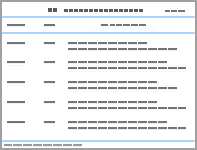
表1
小麦苗期农艺性状耐低氮系数的性状统计"
| 性状 Trait | 变化范围 Range of variation | 平均值 Average | 标准差 Standard deviation | 变异系数 Coefficient of variation (%) |
|---|---|---|---|---|
| 根长RL | 0.62-1.85 | 1.16 | 0.21 | 18 |
| 苗长SL | 0.61-1.43 | 0.96 | 0.12 | 13 |
| 地下部干重UDW | 0.50-2.42 | 1.20 | 0.30 | 25 |
| 地上部干重ADW | 0.38-2.43 | 0.95 | 0.26 | 28 |
| 根冠比RSDW | 0.39-2.13 | 1.29 | 0.19 | 15 |
| 总根长TRL | 0.48-2.57 | 1.15 | 0.31 | 27 |
| 根表面积RSA | 0.45-2.27 | 1.13 | 0.31 | 28 |
| 根系平均直径RAD | 0.64-1.92 | 1.00 | 0.15 | 15 |
| 根体积RV | 0.44-2.16 | 1.13 | 0.32 | 28 |
表2
供试春小麦材料苗期各生长指标耐低氮系数载荷矩阵、指标特征值及贡献率"
| 性状 Trait | 主成分Principal component | |||
|---|---|---|---|---|
| 1 | 2 | 3 | 4 | |
| 根长RL | 0.590 | -0.101 | 0.096 | 0.788 |
| 苗长SL | 0.831 | -0.197 | -0.054 | -0.147 |
| 地下部干重UDW | 0.894 | -0.129 | 0.241 | -0.180 |
| 地上部干重ADW | 0.877 | -0.268 | -0.239 | -0.151 |
| 根冠比RSDW | 0.016 | 0.317 | 0.939 | -0.074 |
| 总根长TRL | 0.903 | -0.22 | 0.127 | -0.051 |
| 根表面积RSA | 0.924 | 0.259 | -0.018 | -0.003 |
| 根系平均直径RAD | 0.195 | 0.901 | -0.290 | -0.001 |
| 根体积RV | 0.815 | 0.432 | -0.089 | 0.002 |
| 贡献率Contributive ration (%) | 55.317 | 15.019 | 12.426 | 7.848 |
| 权重Weight | 0.611 | 0.166 | 0.137 | 0.087 |
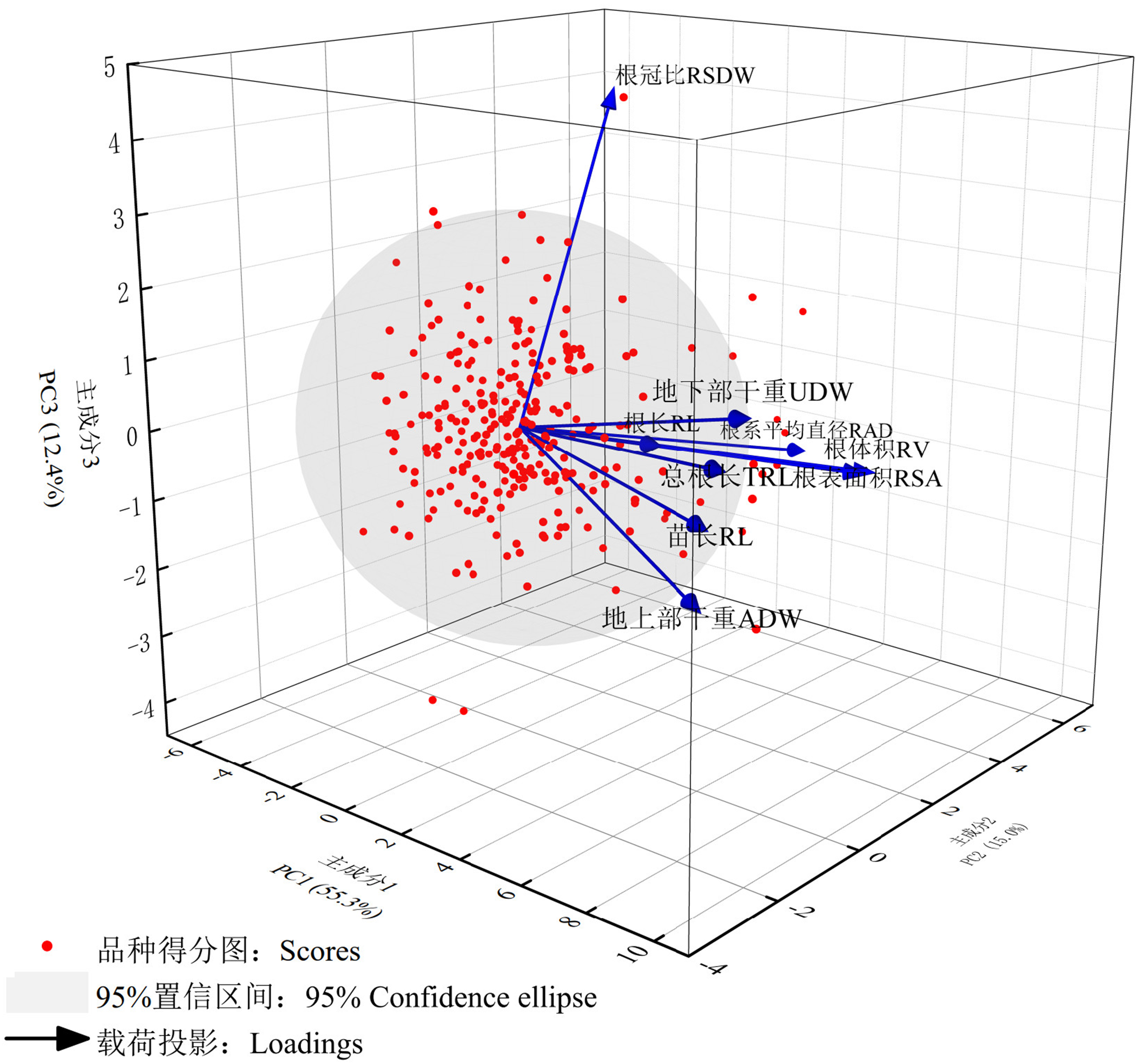
图1
苗期指标耐低氮系数主成分散点图"
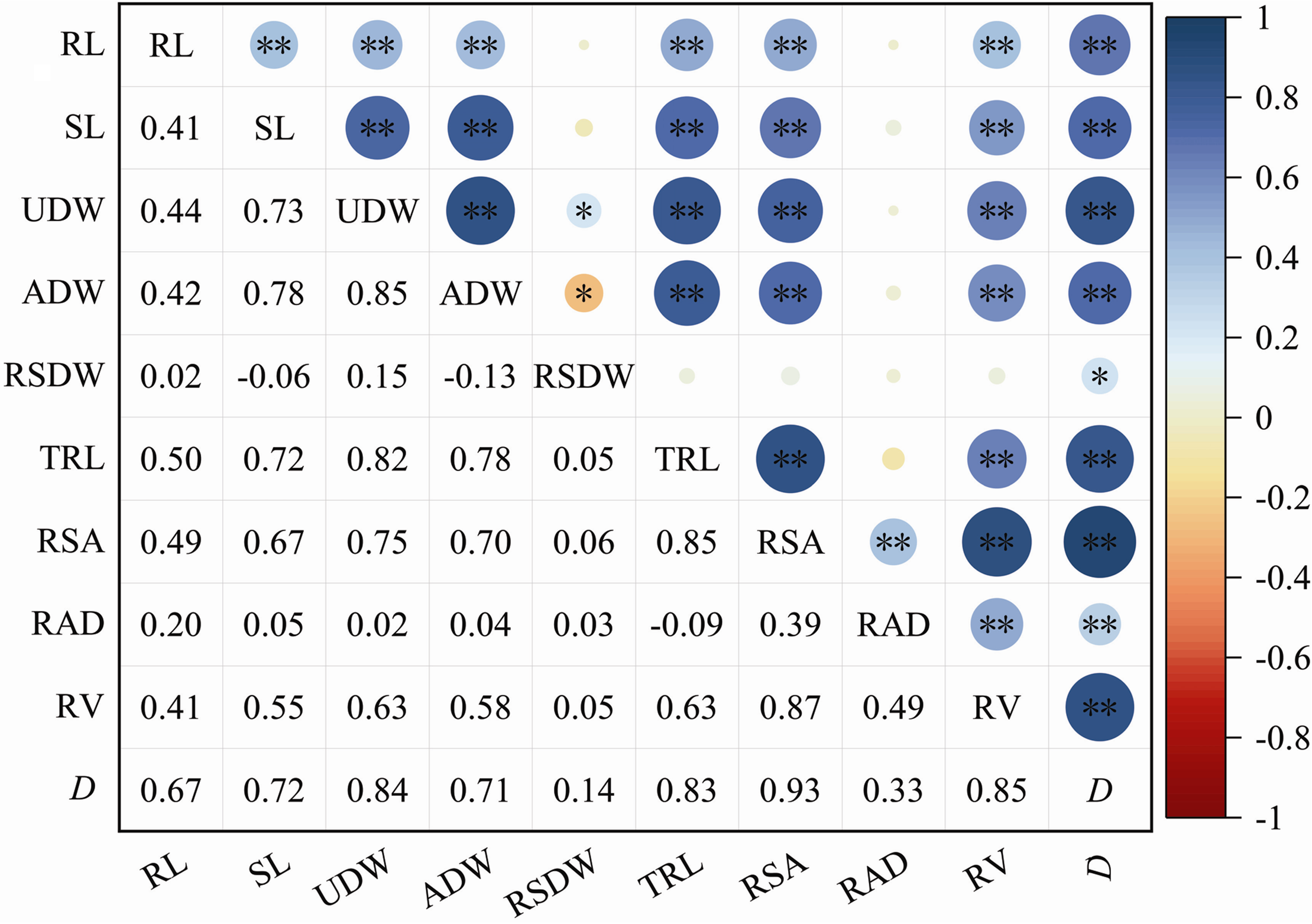
图2
小麦苗期各性状耐低氮系数与综合评价值(D)的相关系数 *:P<0.05;**:P<0.01"
表3
小麦苗期耐低氮最优模型预测"
| 多元回归方程Multiple regression equation | 决定系数R2 | F值F value | P值P value |
|---|---|---|---|
| D=0.067+0.289X1 | 0.865 | 1823.347 | <0.01 |
| D=0.023+0.213X1+0.108X2 | 0.912 | 1464.946 | <0.01 |
| D=0.015+0.156X1+0.111X2+0.062X3 | 0.922 | 1113.032 | <0.01 |
| D=-0.01+0.15X1+0.101X2+0.063X3+0.043X4 | 0.924 | 847.195 | <0.01 |

图3
低氮处理下小麦苗期氮效率综合值的系统聚类 黄色区域展示极耐低氮利用材料,紫色区域展示耐低氮利用材料,绿色区域展示氮中效利用材料,蓝色区域展示氮敏感材料,红色区域展示氮极敏感效材料"
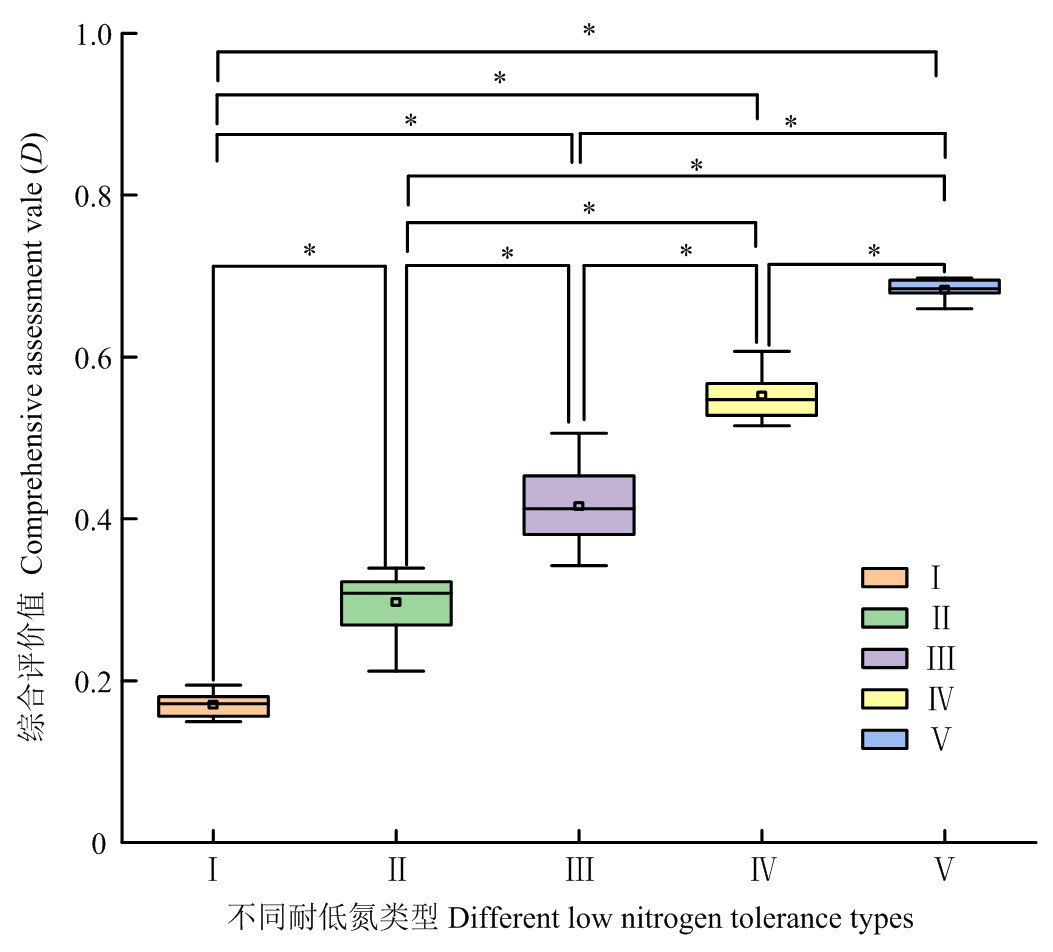
图4
不同耐低氮小麦类型的D值分析 Ⅰ:氮极敏感利用材料;Ⅱ:氮敏感利用材料;Ⅲ:氮中效利用材料;Ⅳ:耐低氮利用材料;Ⅴ:极耐低氮效利用材料。*表示在P<0.05水平差异显著"
表4
供试春小麦材料成株期各生长指标耐低氮系数载荷矩阵、指标特征值及贡献率"
| 性状 Trait | 主成分Principal component | ||
|---|---|---|---|
| 1 | 2 | 3 | |
| 株高PH | 0.602 | -0.164 | -0.725 |
| 穗长SL | 0.746 | 0.313 | 0.162 |
| 有效分蘖ET | 0.969 | -0.101 | -0.024 |
| 穗粒数GNPS | 0.653 | 0.596 | 0.235 |
| 整株干重TPDW | 0.778 | -0.544 | 0.006 |
| 千粒重TSW | 0.406 | -0.726 | 0.387 |
| 株粒数GNPP | 0.965 | 0.170 | 0.084 |
| 株粒重GWPP | 0.840 | 0.470 | -0.072 |
| 经济系数EC | -0.289 | 0.923 | -0.009 |
| 贡献率Contributive ration (%) | 53.073 | 26.860 | 8.550 |
| 权重Weight | 0.599 | 0.304 | 0.097 |
表5
10个小麦品种在低氮胁迫后的综合评价"
| 材料 Materials | 品种 Variety | 综合 值1 C1 | 综合 值2 C2 | 综合 值3 C3 | 隶属值1 ψ(C1) | 隶属值2 ψ(C2) | 隶属值3 ψ(C3) | 综合评价值 Comprehensive assessment value (D) | 排序 Order |
|---|---|---|---|---|---|---|---|---|---|
| WN-269 | 54IBWSN (1136) | -1.130 | -0.703 | 0.244 | 0.099 | 0.135 | 0.518 | 0.150 | 1 |
| WN-149 | CY-0161 | -0.629 | -0.915 | -0.129 | 0.287 | 0.068 | 0.411 | 0.232 | 2 |
| WN-247 | 54IBWSN (1101) | -1.394 | 1.263 | 0.066 | 0.000 | 0.757 | 0.467 | 0.275 | 3 |
| WN-244 | 54IBWSN (1097) | -0.860 | -0.091 | 1.003 | 0.200 | 0.329 | 0.736 | 0.291 | 4 |
| WN-294 | 54IBWSN (1172) | -0.330 | 0.520 | -0.060 | 0.398 | 0.522 | 0.430 | 0.439 | 5 |
| WN-237 | 54IBWSN (1086) | 0.431 | -0.176 | -1.560 | 0.683 | 0.302 | 0.000 | 0.501 | 6 |
| WN-249 | 54IBWSN (1103) | 0.459 | -0.298 | -1.299 | 0.694 | 0.263 | 0.075 | 0.503 | 7 |
| WN-186 | 54IBWSN (1005) | 1.033 | -1.131 | -0.277 | 0.909 | 0.000 | 0.368 | 0.580 | 8 |
| WN-49 | ZH871 | 1.276 | -0.532 | 1.924 | 1.000 | 0.190 | 1.000 | 0.754 | 9 |
| WN-235 | 54IBWSN (1083) | 0.833 | 2.033 | 0.089 | 0.834 | 1.000 | 0.473 | 0.849 | 10 |
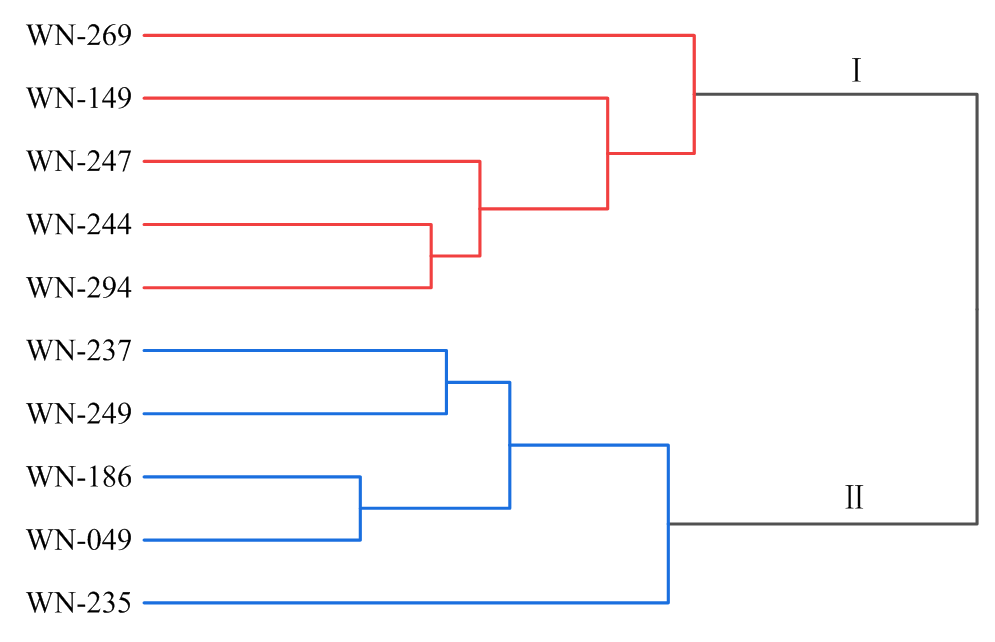
图5
小麦成株期耐低氮性聚类图 Ⅰ:氮敏感材料;Ⅱ:耐低氮材料"
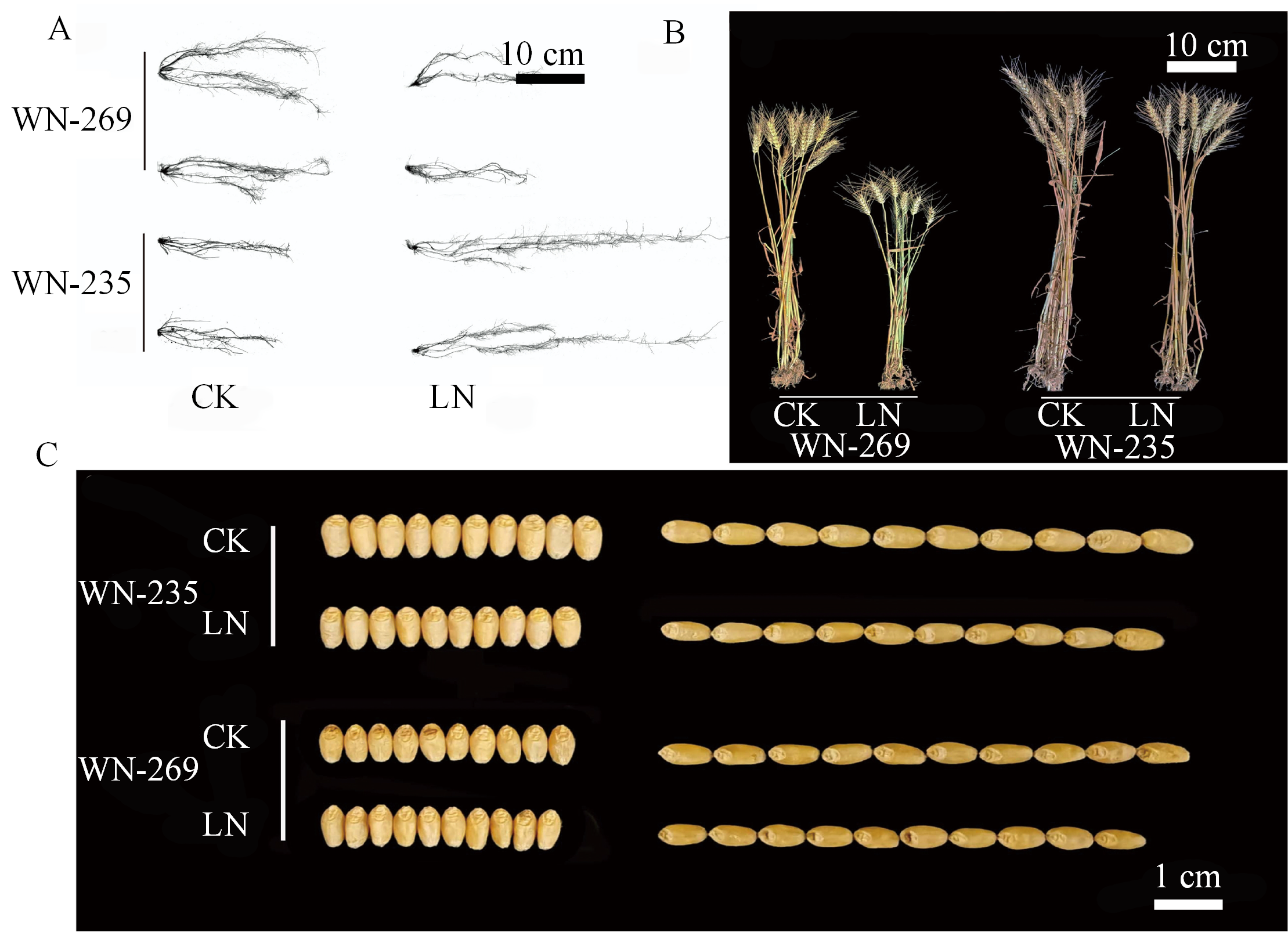
图6
不同氮处理下WN-269和WN-235苗期与成株期的生长情况及籽粒形态差异 A:苗期水培30 d根系;B:成株期植株;C:籽粒形态。CK:正常氮水平;LN:低氮胁迫。下同"
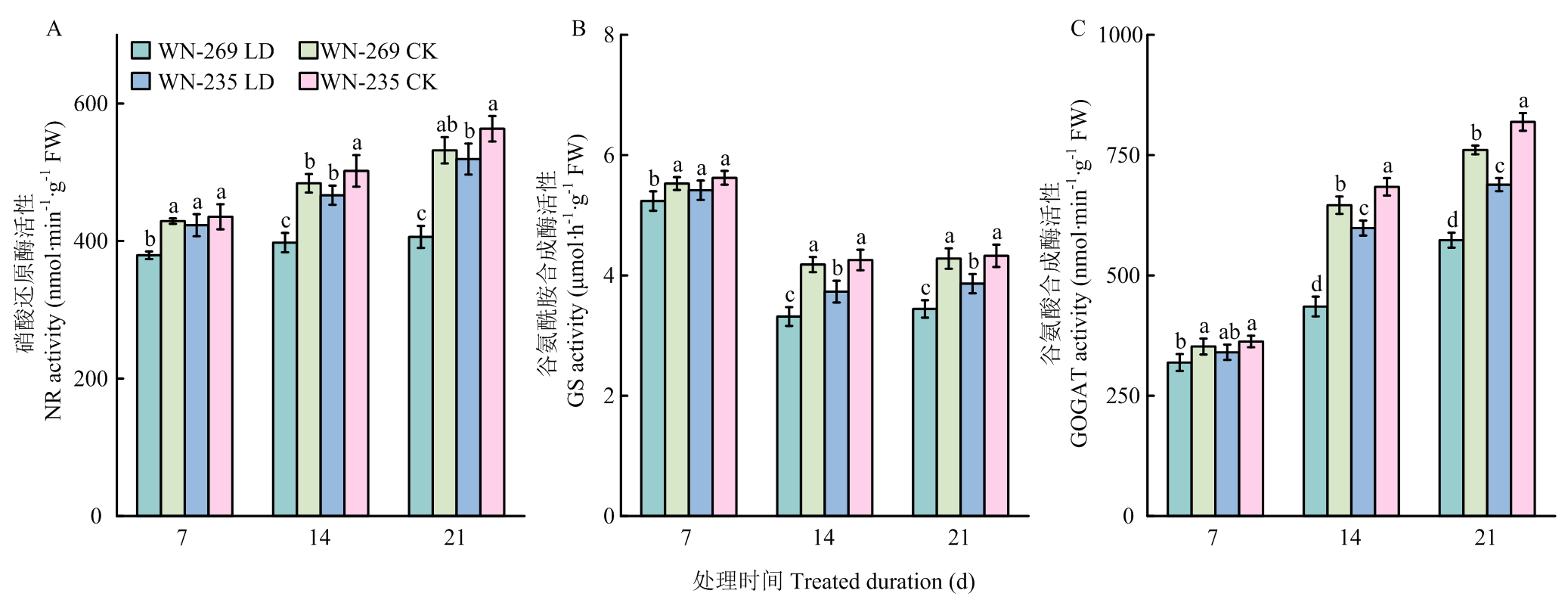
图7
不同氮处理下WN-269和WN-235叶片中硝酸还原酶、谷氨酰胺合成酶和谷氨酸合成酶活性分析 不同小写字母表示在P<0.05水平差异显著。下同"
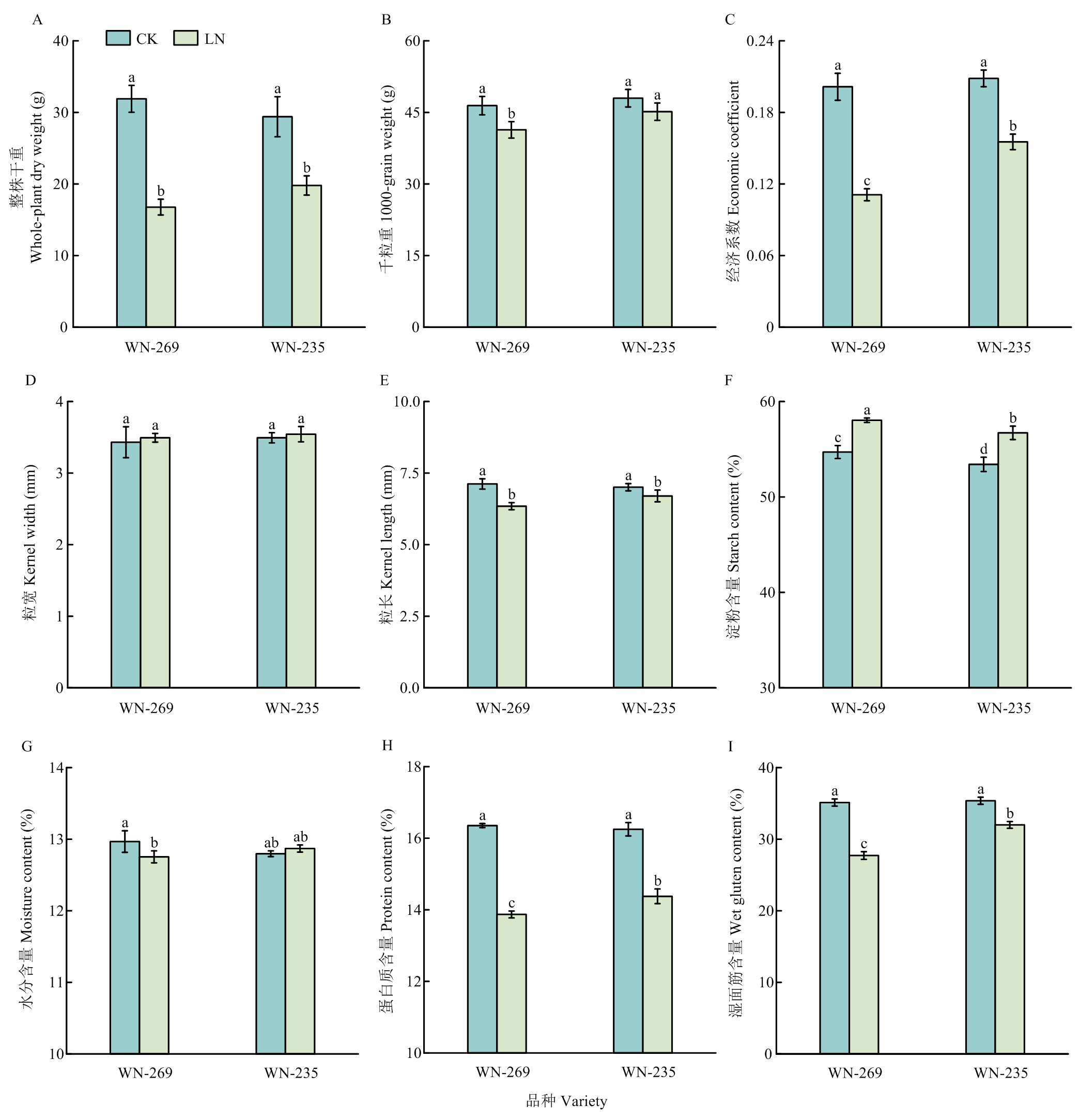
图8
不同氮处理下WN-269和WN-235的形态和品质指标变化"
| [1] |
doi: 10.1016/j.eja.2010.01.005 |
| [2] |
朱明昆, 包俊浩, 庞菁璐, 周诗绮, 方忠艳, 郑文, 张亚洲, 吴丹丹. 纤毛鹅观草-普通小麦高抗条锈病多年生属间杂种F1的创制及鉴定. 作物学报, 2024, 50(6): 1406-1419.
|
|
doi: 10.3724/SP.J.1006.2024.31056 |
|
| [3] |
doi: 10.1038/ngeo325 |
| [4] |
doi: 10.32604/phyton.2024.047628 |
| [5] |
doi: 10.1007/s42729-025-02600-y |
| [6] |
纪博翔, 王长远, 董军伟, 宋宜萱, 吕亚辉, 王禹凡, 张明明, 乔匀周. 不同施肥措施对盐碱地土下覆膜冬小麦生长及产量的影响. 西南农业学报, 2025, 38(10): 2238-2245.
|
|
|
|
| [7] |
doi: 10.1007/s11104-024-06583-0 |
| [8] |
doi: 10.1186/s40659-020-00312-4 pmid: 33066819 |
| [9] |
doi: 10.5423/PPJ.RW.01.2024.0006 |
| [10] |
查文童, 朱志畅, 郭双霜, 葛焱. 基于文献计量学的小麦氮素监测研究进展分析. 农业工程学报, 2023, 39(23): 1-13.
|
|
|
|
| [11] |
齐学礼, 马杰, 赵明忠, 董海滨, 张煜, 许国震. 低氮胁迫对不同氮效率小麦品种氮积累、代谢和产量、品质的影响. 河南农业科学, 2024, 53(4): 30-36.
|
|
|
|
| [12] |
李双双, 付驰, 孙继, 顾万荣, 芦玉双, 许为政, 李晶. 施氮量对春小麦根系生理活性及籽粒蛋白品质的影响. 麦类作物学报, 2012, 32(6): 1139-1143.
|
|
|
|
| [13] |
周晓明, 张志勇, 王小纯, 熊淑萍, 韩锦峰, 马新明. 不同氮效率小麦的氮代谢特征及GS酶活性与氮代谢指标的相关性研究. 河南农业科学, 2016, 45(9): 15-20, 32.
|
|
|
|
| [14] |
祁小平, 李广, 闫丽娟, 袁建钰, 杜梦寅, 庞烨. 耕作和施肥方式对陇中旱作春小麦氮素利用与硝态氮残留的影响. 麦类作物学报, 2023, 43(4): 477-486.
|
|
|
|
| [15] |
姜瑛, 戚秀秀, 李祥剑, 汪强, 谭金芳, 韩燕来, 李培培. 不同小麦品种的氮素利用特性研究. 麦类作物学报, 2019, 39(6): 702-708.
|
|
|
|
| [16] |
doi: 10.5958/2320-3161.2019.00014.2 |
| [17] |
doi: 10.1093/aob/mct080 pmid: 23589634 |
| [18] |
黄兴法, 孙旻昊, 刘博. 甘肃民勤地区春小麦长畦田分段灌溉与波涌灌溉技术适应性田间试验研究. 农业工程, 2021, 11(10): 73-79.
|
|
|
|
| [19] |
赵瑞, 张旭辉, 张程炀, 郭泾磊, 汪妤, 李红霞. 小麦种质资源成株期氮效率评价及筛选. 中国农业科学, 2021, 54(18): 3818-3833. doi: 10.3864/j.issn.0578-1752.2021.18.003.
|
|
|
|
| [20] |
宋晓, 张珂珂, 黄晨晨, 黄绍敏, 郭斗斗, 岳克, 张水清. 基于主成分分析的氮高效小麦品种的筛选. 河南农业科学, 2020, 49(12): 10-16.
|
|
|
|
| [21] |
徐波, 林先意, 安瞳昕, 华为, 王卫东, 朱靖环, 范敏. 小麦种质资源氮素吸收力评价与筛选. 分子植物育种, 2025, 23(10): 3329-3338.
|
|
|
|
| [22] |
连盈, 卢娟, 胡成梅, 牛胤全, 史雨刚, 杨进文, 王曙光, 张文俊, 孙黛珍. 低氮胁迫对谷子苗期性状的影响和耐低氮品种的筛选. 中国生态农业学报(中英文), 2020, 28(4): 523-534.
|
|
|
|
| [23] |
doi: 10.1071/FP03060 pmid: 32688884 |
| [24] |
郑玉冲, 张琳琦, 刘彬彬. 不同小麦品种根区微生物特征及对土壤氮素水平的响应. 中国生态农业学报(中英文), 2023, 31(11): 1708-1720.
|
|
|
|
| [25] |
李淑文, 文宏达, 周彦珍, 李雁鸣, 肖凯. 不同氮效率小麦品种氮素吸收和物质生产特性. 中国农业科学, 2006, 39(10): 1992-2000.
|
|
doi: 10.3864/j.issn.0578-1752.at-2005-6069 |
|
| [26] |
张恒, 陈艳琦, 任杰莹, 杨洪坤, 樊高琼. 西南麦区小麦苗期氮高效品种筛选及指标体系构建. 四川农业大学学报, 2022, 40(1): 10-18, 27.
|
|
|
|
| [27] |
张士昌, 史占良, 李孟军, 李亚青, 底瑞耀, 李雁鸣. 长期定位氮胁迫对小麦碳氮代谢、氮素利用及产量的影响. 河南农业科学, 2016, 45(12): 13-19.
|
|
|
|
| [28] |
张凡, 袁澍, 雷韬, 刘自礼, 杜俊波, 王建辉, 胡朝阳, 梁厚果, 林宏辉. 大量元素缺乏对小麦光合、呼吸作用和生理特性的影响. 四川大学学报(自然科学版), 2009, 46(2): 462-468.
|
|
|
|
| [29] |
王小纯, 程振云, 何建国, 熊淑萍, 马新明. 不同氮素形态对专用小麦苗期氨同化关键酶活性的影响. 麦类作物学报, 2008, 28(5): 836-840.
|
|
|
|
| [30] |
李宁, 高丽锋, 黄鑫, 史华伟, 杨进文, 史雨刚, 陈明, 贾继增, 孙黛珍. 耐低氮小麦品种的筛选及耐低氮指数的全基因组关联分析. 中国农业科学, 2025, 58(13): 2487-2503. doi: 10.3864/j.issn.0578-1752.2025.13.001.
|
|
|
|
| [31] |
向爱慧, 白荣基, 郝宇琼, 赵佳佳, 武棒棒, 李晓华, 郑兴卫, 关攀锋, 郑军. 山西小麦矮秆基因的鉴定及株高遗传位点挖掘. 中国农业科学, 2025, 58(17): 3372-3388. doi: 10.3864/j.issn.0578-1752.2025.17.002.
|
|
|
|
| [32] |
顾鹏程, 姚立蓉, 张宏, 汪军成, 王昊, 马艳, 李玉刚, 李葆春. 不同小麦品种苗期氮利用效率评价及TaSPX1基因表达分析. 麦类作物学报, 2025, 45(7): 902-912.
|
|
|
|
| [33] |
doi: 10.1002/jsfa.v33:3 |
| [34] |
陈旭, 杨习文, 李文, 周苏玫, 徐凤丹, 贺德先. 不同氮素利用效率小麦苗期的根系形态数量性状分析. 麦类作物学报, 2021, 41(2): 174-182.
|
|
|
| [1] | 王小玮, 杜佛力, 闫红财, 郎正东, 党志娟, 李葆春, 汪军成, 马小乐, 王化俊, 张宏, 姚立蓉. 396份春小麦灌浆期和成熟期抗旱性评价[J]. 中国农业科学, 2026, 59(8): 1608-1621. |
| [2] | 崔节浩, 张萌, 王沁, 于佳妍, 林琨, 李尚泽, 兰恒, 耿艳秋, 张强, 郭丽颖, 邵玺文. 粳稻资源抗倒伏性评价与生理机制[J]. 中国农业科学, 2026, 59(7): 1420-1438. |
| [3] | 焦文娟, 何万龙, 耿洪伟, 白斌, 李剑峰, 程宇坤. 155份春小麦品种(系)条锈病抗性评价与抗病基因分子检测[J]. 中国农业科学, 2026, 59(5): 937-950. |
| [4] | 郝琨, 陈洪德, 张威, 钟韵, 党美荣, 朱士江, 黄志坤, 金英. 基于柑橘产量、品质及水氮利用的涌泉根灌水氮综合评价[J]. 中国农业科学, 2026, 59(4): 862-873. |
| [5] | 谢永祥, 潘怡敏, 黄蕊, 秦慧彬, 侯森, 贺强, 凌亮, 穆志新, 王海岗. 山西谷子种质资源耐瘠性鉴定及综合评价[J]. 中国农业科学, 2026, 59(11): 2325-2339. |
| [6] | 魏文龙, 王林林, 陈晓丽, 武凌彬, 李录芳, 解云婷, 王江文. 有机替代和地膜覆盖对旱地小麦根系生长、产量和水分利用效率的影响[J]. 中国农业科学, 2026, 59(11): 2340-2357. |
| [7] | 张悦青, 张玉亭, 薛晨飞, 韩秦宇, 贺一容, 徐紫娟, 范秀梅, 王军娥, 罗丹, 冯雪, 孙胜. 364份樱桃番茄种质资源表型性状的遗传多样性分析及综合评价[J]. 中国农业科学, 2026, 59(11): 2468-2483. |
| [8] | 牟树佳, 董莉霞, 李广, 燕振刚, 逯玉兰. 基于鲸鱼算法的旱地春小麦农田土壤N2O排放模型参数优化[J]. 中国农业科学, 2025, 58(3): 537-547. |
| [9] | 仇海龙, 李盼, 张殿凯, 樊志龙, 胡发龙, 陈桂平, 范虹, 何蔚, 殷文, 赵连豪. 西北绿洲灌区麦后复种绿肥对减量施氮春小麦生长及产量的补偿效应[J]. 中国农业科学, 2025, 58(3): 443-459. |
| [10] | 陈彩锦, 马琳, 蒋庆雪, 刘金晖, 苗童, 张志鹏, 孟翔, 马晓冉, 周昕越, 张建, 刘文辉, 王学敏. 244份饲用燕麦种质资源表型性状遗传多样性分析[J]. 中国农业科学, 2025, 58(23): 4825-4836. |
| [11] | 钱芝瑾, 王西娜, 田海梅, 王月梅, 郝雯悦, 周慧, 谭军利. 引黄灌区连续减施化肥对春小麦籽粒品质稳定性的影响[J]. 中国农业科学, 2025, 58(22): 4703-4717. |
| [12] | 陈天晓, 曹榕, 宋倩楠, 胡亮亮, 王素华, 王丽侠, 程须珍, 陈红霖. 小豆种质资源苗期耐盐性综合评价及耐盐种质筛选[J]. 中国农业科学, 2025, 58(21): 4317-4332. |
| [13] | 唐桂梅, 李卫东, 周宇霞, 孔佑涵, 肖晓玲, 彭颖姝, 张力, 符红艳, 刘洋, 黄国林. 基于表型性状分析蕙兰种质资源遗传多样性[J]. 中国农业科学, 2025, 58(2): 339-354. |
| [14] | 包明芳, 秦燕, 陈彩锦, 张尚沛, 张国辉, 沙晓弟. 111份紫花苜蓿种质资源苗期表型抗旱性鉴定评价[J]. 中国农业科学, 2025, 58(19): 3825-3836. |
| [15] | 张欢欢, 张刁亮, 王晓丽, 陈寒, 邵娟, 殷文, 胡发龙, 柴强, 樊志龙. 绿肥联合麦秸还田对减量施氮春小麦光合特性和产量的影响[J]. 中国农业科学, 2025, 58(17): 3461-3472. |
|
||
