






中国农业科学 ›› 2021, Vol. 54 ›› Issue (16): 3393-3405.doi: 10.3864/j.issn.0578-1752.2021.16.003
李昕芫( ),娄金秀,刘清源,胡健(),张英俊
收稿日期:2021-02-03
接受日期:2021-05-02
出版日期:2021-08-16
发布日期:2021-08-24
联系方式:
李昕芫,E-mail: nalxy0806@163.com。
基金资助:
LI XinYuan(),LOU JinXiu,LIU QingYuan,HU Jian(),ZHANG YingJun
Received:2021-02-03
Accepted:2021-05-02
Published:2021-08-16
Online:2021-08-24
摘要:
【目的】紫花苜蓿(Medicago sativa L.)被誉为牧草之王,近年来,中国东北和华北地区种植面积不断扩大,但紫花苜蓿质量与产量仍不足以满足中国畜牧业发展的需求。本研究旨在分析中国东北和华北地区紫花苜蓿根瘤菌遗传多样性,为紫花苜蓿高效固氮根瘤菌的筛选与应用提供参考。【方法】采用表面消毒和平板划线法从根瘤中分离纯化根瘤菌单菌落;使用BOX-PCR方法对供试菌株进行基因型划分;选取代表菌株进行持家基因(atpD、glnII和rpoB)和共生基因(nifH和nodC)的系统发育分析。【结果】从中国东北和华北19个采样地共分离纯化了499株根瘤菌,BOX-PCR可将供试菌株分为37种BOX型,BOX型存在显著的地理分布现象,同时寄主品种对根瘤菌基因型具有一定的选择作用。97.60%(487/499)的根瘤菌为Sinorhizobium meliloti。其余12株分别为S. adhaerens、Mesorhizobium huakuii、Rhizobium loessense、R. mesosinicum、R. vignae、Mesorhizobium sp.和Phyllobacterium sp.,这12株根瘤菌仅在中国东北地区发现,华北地区根瘤菌均为S. meliloti。3个持家基因在紫花苜蓿根瘤菌种间系统发育分析结果一致,但其揭示优势种S. meliloti的种内多样性存在差异。共生基因系统发育结果显示,在根瘤菌属间和属内发生了共生基因的水平转移现象。nifH在S.meliloti种内显示出比nodC更丰富多样性。【结论】中国东北和华北地区紫花苜蓿根瘤菌具有较丰富的遗传多样性,且根瘤菌存在显著的地理分布特征和寄主选择现象。
李昕芫, 娄金秀, 刘清源, 胡健, 张英俊. 中国东北和华北地区紫花苜蓿根瘤菌遗传多样性研究[J]. 中国农业科学, 2021, 54(16): 3393-3405.
LI XinYuan, LOU JinXiu, LIU QingYuan, HU Jian, ZHANG YingJun. Genetic Diversity Analysis of Rhizobia Associated with Medicago sativa Cultivated in Northeast and North China[J]. Scientia Agricultura Sinica, 2021, 54(16): 3393-3405.
表1
本文供试的紫花苜蓿根瘤菌菌株信息"
| 采样地 Sampling site | 省份 Province | 区域 Region | 采样时间 Sampling date (Y.M) | 寄主品种 Host cultivar | 菌株数量 No. of strains |
|---|---|---|---|---|---|
| 五河Wuhe | 安徽Anhui | 华北North | 2016.1 | 未知Unknown | 58 |
| 沧州Cangzhou | 河北Hebei | 华北North | 2017.5 | 中苜1号、中苜3号、甘农3号 Zhongmu1, Zhongmu3, Gannong3 | 32 |
| 衡水Hengshui | 河北Hebei | 华北North | 2017.5 | 中苜1号、WL363 Zhongmu1, WL363 | 48 |
| 新乡Xinxiang | 河南Henan | 华北North | 2017.5 | M343、M354 | 58 |
| 荥阳Xingyang | 河南Henan | 华北North | 2017.5 | 三得利 Sandeli | 20 |
| 郑州Zhengzhou | 河南Henan | 华北North | 2017.5 | 劲能5010 Jinneng5010 | 32 |
| 齐齐哈尔Qiqihar | 黑龙江Heilongjiang | 东北Northeast | 2015.9 | 806 | 11 |
| 白城Baicheng | 吉林Jilin | 东北Northeast | 2017.5 | 公农5号 Gongnong5 | 59 |
| 前郭Qianguo | 吉林Jilin | 东北Northeast | 2015.9 | 敖汉 Aohan | 9 |
| 通榆Tongyu | 吉林Jilin | 东北Northeast | 2015.9 | 东苜1号 Dongmu1 | 16 |
| 延边Yanbian | 吉林Jilin | 东北Northeast | 2015.9 | 公农1号 Gongnong1 | 4 |
| 凤城Fengcheng | 辽宁Liaoling | 东北Northeast | 2016.6 | 未知 Unknown | 6 |
| 建平Jianping | 辽宁Liaoning | 东北Northeast | 2016.6 | 未知 Unknown | 12 |
| 辽阳Liaoyang | 辽宁Liaoning | 东北Northeast | 2016.6 | 龙牧、WL319 Longmu, WL319 | 34 |
| 沈阳Shenyang | 辽宁Liaoning | 东北Northeast | 2016.6 | 公农1号 Gonglong1 | 32 |
| 特尼河Turney river | 内蒙古Inner Mongolia | 东北Northeast | 2016.1 | 未知 Unknown | 7 |
| 谢尔塔拉Cher tara | 内蒙古Inner Mongolia | 东北Northeast | 2015.9 | 未知 Unknown | 9 |
| 胶州Jiaozhou | 山东Shandong | 华北North | 2017.6 | 三得利、中苜3号 Sandeli, Zhongmu3 | 24 |
| 聊城Liaocheng | 山东Shandong | 华北North | 2017.6 | 三得利、WL363 Sandeli, WL363 | 28 |
| 总计 Total | 499 |
表2
紫花苜蓿根瘤菌BOX型种类及其分布"
| BOX型 BOX type | 菌株数 No. of strains | 占比 Percentage (%) | 比对序列号 Accession No. | 菌种 Species | 采样地b Sampling site | 区域 Region |
|---|---|---|---|---|---|---|
| 1 | 38 | 7.62 | - | 草木樨中华根瘤菌 Sinorhizobium meliloti | 白城、凤城、黑龙江(5)b、建平(6)、辽阳(21)、前郭、沈阳、五河(2) Baicheng, Fengcheng, Heilongjiang (5), Jianping (6), Liaoyang (21), Qianguo, Shenyang, Wuhe (2) | NE、N |
| 2 | 2 | 0.40 | - | 草木樨中华根瘤菌 Sinorhizobium meliloti | 白城、五河 Baicheng, Wuhe | NE、N |
| 3 | 1 | 0.20 | EF549450 (91.34) a | 中慢生根瘤菌属 Mesorhizobium sp. | 白城 Baicheng | NE |
| 4 | 1 | 0.20 | - | 草木樨中华根瘤菌 Sinorhizobium meliloti | 辽阳 Liaoyang | NE |
| 5 | 6 | 1.20 | - | 草木樨中华根瘤菌 Sinorhizobium meliloti | 白城、前郭、特尼河、通榆(2)、五河 Baicheng, Qianguo, Turney river, Tongyu (2), Wuhe | NE、N |
| 6 | 1 | 0.20 | KF206625 (100) | 黄土根瘤菌 Rhizobium loessense | 白城 Baicheng | NE |
| 7 | 93 | 18.64 | - | 草木樨中华根瘤菌 Sinorhizobium meliloti | 白城(2)、沧州、衡水(28)、新乡(23)、荥阳、郑州(13)、辽阳(10)、前郭(2)、聊城(3)、沈阳(7)、五河(3) Baicheng (2), Cangzhou, Hengshui (28), Xinxiang (23), Xingyang, Zhengzhou (13), Liaoyang (10), Qianguo (2), Liaocheng (3), Shenyang (7), Wuhe (3) | NE、N |
| 8 | 2 | 0.40 | - | 草木樨中华根瘤菌 Sinorhizobium meliloti | 白城、沈阳 Baicheng, Shenyang | NE |
| 9 | 3 | 0.60 | - | 草木樨中华根瘤菌 Sinorhizobium meliloti | 白城、郑州、齐齐哈尔 Baicheng, Zhengzhou, Qiqihar | NE、N |
| 10 | 1 | 0.20 | - | 草木樨中华根瘤菌 Sinorhizobium meliloti | 白城 Baicheng | NE |
| 11 | 1 | 0.20 | KF206625 (100) | 黄土根瘤菌 Rhizobium loessense | 白城 Baicheng | NE |
| 12 | 4 | 0.80 | - | 草木樨中华根瘤菌 Sinorhizobium meliloti | 白城、聊城(3) Baicheng, Liaocheng (3) | NE、N |
| 13 | 15 | 3.00 | - | 草木樨中华根瘤菌 Sinorhizobium meliloti | 白城(5)、建平、通榆(4)、谢尔塔拉(4)、延边 Baicheng (5), Jianping, Tongyu (4), Cher tara (4), Yanbian | NE |
| 14 | 8 | 1.60 | - | 草木樨中华根瘤菌 Sinorhizobium meliloti | 白城、前郭、通榆(3)、五河(2)、延边 Baicheng, Qianguo, Tongyu (3), Wuhe (2), Yanbian | NE、N |
| 15 | 1 | 0.20 | - | 草木樨中华根瘤菌 Sinorhizobium meliloti | 白城 Baicheng | NE |
| 16 | 2 | 0.40 | KP251033 (100) | 华癸根瘤菌 Mesorhizobium huakuii | 通榆 Tongyu | NE |
| 17 | 1 | 0.20 | - | 草木樨中华根瘤菌 Sinorhizobium meliloti | 前郭 Qianguo | NE |
| 18 | 15 | 3.00 | - | 草木樨中华根瘤菌 Sinorhizobium meliloti | 齐齐哈尔(3)、沈阳、特尼河(3)、五河(6)、谢尔塔拉(2) Qiqihar (3), Shenyang, Turney river (3), Wuhe (6), Cher tara (2) | NE、N |
| 19 | 36 | 7.20 | - | 草木樨中华根瘤菌 Sinorhizobium meliloti | 沧州、衡水(5)、新乡(2)、荥阳(2)、郑州(5)、前郭、胶州(12)、通榆(2)、五河(4)、延边(2) Cangzhou, Hengshui (5), Xinxiang (2), Xingyang (2), Zhengzhou (5), Qianguo, Jiaozhou (12), Tongyu (2), Wuhe (4), Yanbian (2) | NE、N |
| 20 | 13 | 2.60 | - | 草木樨中华根瘤菌 Sinorhizobium meliloti | 齐齐哈尔、沈阳(8)、通榆 、五河(3) Qiqihar, Shenyang (8), Tongyu, Wuhe (3) | NE、N |
| 21 | 1 | 0.20 | AM418747 (99.67) | 附着剑菌 Sinorhizobium adhaerens | 沈阳 Shenyang | NE |
| OX型 BOX type | 菌株数 No. of strains | 占比 Percentage (%) | 比对序列号 Accession No. | 菌种 Species | 采样地b Sampling site | 区域 Region |
| 22 | 58 | 11.62 | - | 草木樨中华根瘤菌 Sinorhizobium meliloti | 白城(35)、凤城(2)、齐齐哈尔、建平(4)、前郭、沈阳(8)、五河(5)、谢尔塔拉(2) Baicheng (35), Fengcheng (2), Qiqihar, Jianping (4), Qianguo, Shenyang (8), Wuhe (5), Cher tara (2) | NE、N |
| 23 | 141 | 28.26 | - | 草木樨中华根瘤菌 Sinorhizobium meliloti | 凤城(3)、沧州(25)、衡水(14)、新乡(20)、荥阳(14)、郑州(12)、辽阳(2)、胶州(12)、聊城(20)、沈阳、通榆(2)、五河(15)、谢尔塔拉 Fengcheng (3), Cangzhou (25), Hengshui (14), Xinxiang (20), Xingyang (14), Zhengzhou (12), Liaoyang (2), Jiaozhou (12), Liaocheng (20), Shenyang, Tongyu (2), Wuhe (15), Cher tara | NE、N |
| 24 | 8 | 1.60 | - | 草木樨中华根瘤菌 Sinorhizobium meliloti | 五河 Wuhe | N |
| 25 | 3 | 0.60 | - | 草木樨中华根瘤菌 Sinorhizobium meliloti | 荥阳(2)、前郭 Xingyang (2), Qianguo | NE、N |
| 26 | 1 | 0.20 | - | 草木樨中华根瘤菌 Sinorhizobium meliloti | 五河 Wuhe | N |
| 27 | 4 | 0.80 | - | 草木樨中华根瘤菌 Sinorhizobium meliloti | 特尼河(3)、五河 Turney river (3), Wuhe | NE、N |
| 28 | 6 | 1.20 | - | 草木樨中华根瘤菌 Sinorhizobium meliloti | 荥阳、建平、五河(4) Xingyang, Jianping, Wuhe (4) | NE、N |
| 29 | 3 | 0.60 | - | 草木樨中华根瘤菌 Sinorhizobium meliloti | 白城(2)、谢尔塔拉 Baicheng (2), Cher tara | NE |
| 30 | 1 | 0.20 | EU120727 (98.01) | 华中根瘤菌 Rhizobium mesosinicum | 沈阳 Shenyang | NE |
| 31 | 2 | 0.40 | AM418747 (99.67) | 附着剑菌 Sinorhizobium adhaerens | 沈阳 Shenyang | NE |
| 32 | 1 | 0.20 | KF580979 (92.72) | 芸苔叶杆菌 Phyllobacterium brassicacearum | 沈阳 Shenyang | NE |
| 33 | 19 | 3.81 | - | 草木樨中华根瘤菌 Sinorhizobium meliloti | 沧州(4)、新乡(11)、郑州、聊城(2) Cangzhou (4), Xinxiang (11), Zhengzhou, Liaocheng (2) | N |
| 34 | 2 | 0.40 | - | 草木樨中华根瘤菌 Sinorhizobium meliloti | 新乡 Xinxiang | N |
| 35 | 1 | 0.20 | - | 草木樨中华根瘤菌 Sinorhizobium meliloti | 沧州 Cangzhou | N |
| 36 | 1 | 0.20 | KF206603 (99.33) | 绿豆根瘤菌 Rhizobium vignae | 白城 Baicheng | NE |
| 37 | 2 | 0.40 | - | 草木樨中华根瘤菌 Sinorhizobium meliloti | 五河 Wuhe | N |
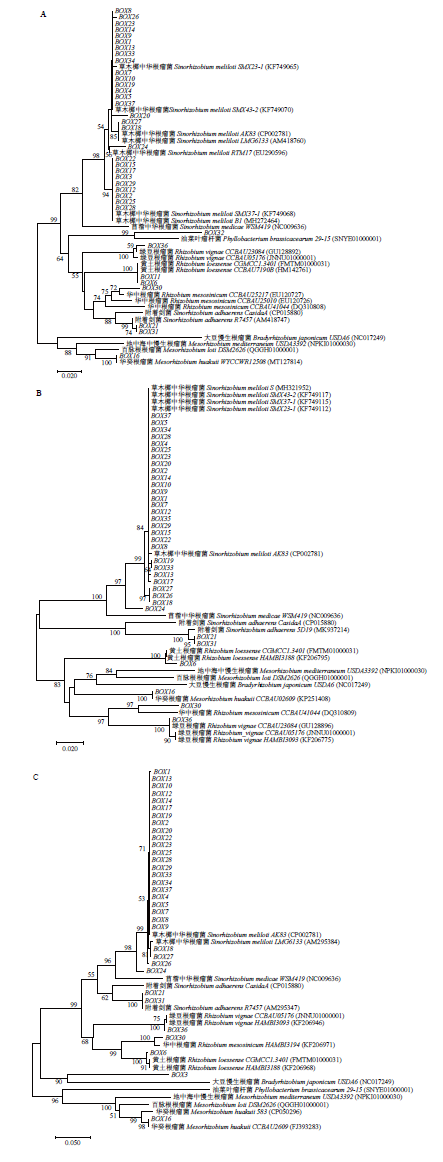
图1
持家基因atpD(A)、glnII(B)和rpoB(C)的系统发育分析"
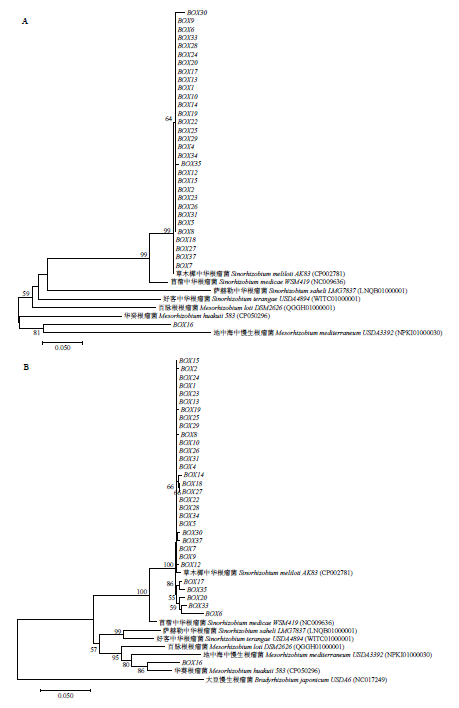
图2
共生基因nodC(A)和nifH(B)的系统发育分析"
表3
栽培品种对紫花苜蓿根瘤菌基因型的影响"
| 采样地 Sampling site | 品种a Cultivar | 菌株数 No. of strains | BOX型b BOX type |
|---|---|---|---|
| 新乡 Xinxiang | M343 | 37 | BOX7(4)b、BOX19(2)、BOX23(23)、BOX33(9)、BOX34(2) |
| M354 | 21 | BOX7(19)、BOX33(2) | |
| 沧州 Cangzhou | 中苜1号Zhongmu1 | 12 | BOX7、BOX23(9)、BOX33、BOX35 |
| 中苜3号Zhongmu3 | 16 | BOX19、BOX23(12)、BOX33(3) | |
| 甘农3号Gannong3 | 4 | BOX23(4) | |
| 胶州 Jiaozhou | 三得利Sandeli | 12 | BOX19(8)、BOX23(4) |
| 中苜3号Zhongmu3 | 12 | BOX19(4)、BOX23(8) | |
| 衡水 Hengshui | 中苜1号Zhongmu1 | 31 | BOX7(28)、BOX23(3) |
| WL363 | 17 | BOX 19(5)、BOX23(11)、BOX33 | |
| 辽阳 Liaoyang | 龙牧Nongmu | 13 | BOX1(11)、BOX7、BOX23 |
| WL319 | 21 | BOX1(10)、BOX7(9)、BOX4、BOX23 |
| [1] | 徐丽君, 徐大伟, 逄焕成, 辛晓平, 金东艳, 唐雪娟, 郭明英. 中国苜蓿属植物适宜性区划. 草业科学, 2017, 11(11):2347-2358. |
| XU L J, XU D W, PANG H C, XIN X P, JIN D Y, TANG X J, GUO M Y. Chinese alfalfa habitat suitability regionalization. Pratacultural Science, 2017, 11(11):2347-2358. (in Chinese) | |
| [2] | 郭婷, 薛彪, 白娟, 孙启忠. 刍议中国牧草产业发展现状: 以苜蓿、燕麦为例. 草业科学, 2019, 36(5):1466-1474. |
| GUO T, XUE B, BAI J, SUN Q Z. Discussion of the present situation of China’s forage grass industry development: An example using alfalfa and oats. Pratacultural Science, 2019, 36(5):1466-1474. (in Chinese) | |
| [3] | 刘鹏, 田颖哲, 钟永嘉, 廖红. 酸性土壤上花生高效根瘤菌的分离及应用. 中国农业科学, 2019, 52(19):3393-3403. |
| LIU P, TIAN Y Z, ZHONG Y J, LIAO H. Isolation and application of effective rhizobium strains in peanut on acidic soils. Scientia Agricultura Sinica, 2019, 52(19):3393-3403. (in Chinese) | |
| [4] | 苗阳阳, 师尚礼, 康文娟. 赤霉素对根瘤菌运移、定殖及苜蓿幼苗生长的影响. 中国农业科学, 2017, 50(23):4545-4557. |
| MIAO Y Y, SHI S L, KANG W J. Effects of gibberellin on migration and colonization of rhizobia and seedling growth of alfalfa. Scientia Agricultura Sinica, 2017, 50(23):4545-4557. (in Chinese) | |
| [5] | 管凤贞, 邱宏端, 陈济琛, 林新坚. 根瘤菌菌剂的研究与开发现状. 生态学杂志, 2012, 31(3):755-759. |
| GUAN F Z, QIU H D, CHEN J C, LIN X J. Rhizobium inoculants: Research progress and development status. Chinese Journal of Ecology, 2012, 31(3):755-759. (in Chinese) | |
| [6] | 张荣娟. 中国西部苜蓿根瘤菌的生物地理分布及其抗逆机理研究[D]. 北京: 中国农业大学, 2011. |
| ZHANG R J. Biogeography and stress adaptation mechanisms of Sinorhizobium associated with Medicago in Western China[D]. Beijing: China Agricultural University, 2011. (in Chinese) | |
| [7] |
KANG W J, SHI, S L, XU L. Diversity and symbiotic divergence of endophytic and non-endophytic rhizobia of Medicago sativa. Annals of Microbiology, 2018, 68:247-260.
doi: 10.1007/s13213-018-1333-3 |
| [8] | 张小甫. 甘肃不同生态区域苜蓿根瘤菌筛选菌株常规鉴定与分子鉴定[D]. 兰州: 甘肃农业大学, 2008. |
| ZHANG X F. Identification of alfalfa rhizobium strains and analysis of genetic diversity in different ecological regions in Gansu[D]. Lanzhou: Gansu Agricultural University, 2008. (in Chinese) | |
| [9] | 冯春生. 西北地区天蓝苜蓿根瘤菌系统发育研究[D]. 杨凌: 西北农林科技大学, 2008. |
| FENG C S. Phylogeny of rhizobia isolated from Medicago lupulina in Northwest of China[D]. Yangling: Northwest Agricultural and Forestry University, 2008. (in Chinese) | |
| [10] | 位秀丽, 付芸芸, 韦革宏. 西北部分重金属矿区天蓝苜蓿根瘤菌生理生化特性及16S rDNA PCR-RFLP分析. 干旱地区农业研究, 2009, 27(2):223-226. |
| WEI X L, FU Y Y, WEI G H. Physiological and biochemical characters and 16S rDNA PCR-RFLP of rhizobia isolated from Medicago lupulina in mining regions of Northwest China. Agricultural Research in the Arid Areas, 2009, 27(2):223-226. (in Chinese) | |
| [11] | 葛勇. 川西高寒地区苜蓿和无翅山黧豆根瘤菌遗传多样性及系统发育地位研究[D]. 成都: 四川农业大学, 2013. |
| GE Y. Genetic diversity and phylogeny of rhizobia isolated from Medicago and Lathyrus in the west plateau of Sichuan, China[D]. Chengdu: Sichuan Agricultural University, 2013. (in Chinese) | |
| [12] |
STEFAN A, CAUWENBERGHE J V, ROSU C M, STEDEL C. LABROU N, FLEMETAKIS E, EFROSE R C. Genetic diversity and structure of Rhizobium leguminosarum populations associated with clover plants are influenced by local environmental variables. Systematic and Applied Microbiology, 2018, 41(3):251-259.
doi: 10.1016/j.syapm.2018.01.007 |
| [13] |
WANG X L, CUI W J. FENG X Y, ZHONG Z M, LI Y, CHEN W X, CHEN W F, SHAO X M, TIAN C F. Rhizobia inhabiting nodules and rhizosphere soils of alfalfa: A strong selection of facultative microsymbionts. Soil Biology and Biochemistry, 2018, 116:340-350.
doi: 10.1016/j.soilbio.2017.10.033 |
| [14] | VERSALOVIC J, SCHNEIDER M, DE BRUIJN F J, LUPSKI J R. Genomic fingerprinting of bacteria using repetitive sequence-based polymerase chain reaction. Methods in Molecular and Cellular Biology, 1994, 5:25-40. |
| [15] |
VINUESA P, SILVA C, WERNER D, MARTINEZ-ROMERO E. Population genetics and phylogenetic inference in bacterial molecular systematics: The roles of migration and recombination in Bradyrhizobium species cohesion and delineation. Molecular Phylogenetics and Evolution, 2005, 34(1):29-54.
doi: 10.1016/j.ympev.2004.08.020 |
| [16] |
VINUESA P, ROJAS-JIMENEZ K, CONTRERAS-MOREIRA B, MAHNA S K, PRASAD B N, MOE H, SELVARAJU S B, THIERFELDER H, WERNER D. Multilocus sequence analysis for assessment of the biogeography and evolutionary genetics of four Bradyrhizobium species that nodulate soybeans on the Asiatic Continent. Applied and Environmental Microbiology, 2008, 74(22):6987-6996.
doi: 10.1128/AEM.00875-08 |
| [17] |
SARITA S, SHARMA P K, PRIEFER U B, PRELL J. Direct amplification of rhizobial nodC sequences from soil total DNA and comparison to nodC diversity of root nodule isolates. FEMS Microbiology Ecology, 2005, 54(1):1-11.
doi: 10.1016/j.femsec.2005.02.015 |
| [18] |
YAO Y, WANG R, LU J K, SUI X H, WANG E T, CHEN W X. Genetic diversity and evolution of Bradyrhizobium populations nodulating Erythrophleum fordii, an evergreen tree indigenous to the southern subtropical region of China. Applied Environmental Microbiology, 2014, 80(19):6184-6194.
doi: 10.1128/AEM.01595-14 |
| [19] |
LIU J, WANG E T, CHEN W X. Diverse rhizobia associated with woody legumes Wisteria sinensis, Cercis racemosa and Amorpha fruticosa grown in the temperate zone of China. Systematic and Applied Microbiology, 2005, 28(5):465-477.
doi: 10.1016/j.syapm.2005.02.004 |
| [20] |
ZHANG X X, GUO H J, JIAO J, ZHANG P, XIONG H Y, CHEN W X, TIAN C F. Pyrosequencing of rpoB uncovers a significant biogeographical pattern of rhizobial species in soybean rhizosphere. Journal of Biogeography, 2017, 44(7):1491-1499.
doi: 10.1111/jbi.2017.44.issue-7 |
| [21] |
XIONG H Y, ZHANG X X, GUO H J, JI Y Y, LI Y, WANG X L, ZHAO W, MO F Y, CHEN J C, YANG T, ZONG X X, CHEN W X, TIAN C F. The epidemicity of facultative microsymbionts in faba bean rhizosphere soils. Soil Biology and Biochemistry, 2017, 115:243-252.
doi: 10.1016/j.soilbio.2017.08.032 |
| [22] |
BROWN S P, GRILLO M A, PODOWSKI J C, HEATH K D. Soil origin and plant genotype structure distinct microbiome compartments in the model legume Medicago truncatula. Microbiome, 2020, 8:139.
doi: 10.1186/s40168-020-00915-9 |
| [23] |
WAGNER M R, LUNDBERG D S, DEL RIO T G, TRINGE S G, DANGL J, MITCHELL-OLDS T. Host genotype and age shape the leaf and root microbiomes of a wild perennial plant. Nature Communications, 2016, 7:12151.
doi: 10.1038/ncomms12151 |
| [24] |
PORTER S S, CHANG P L, CONOW C A, DUNHAM J P, FRIESEN M L. Association mapping reveals novel serpentine adaptation gene clusters in a population of symbiotic Mesorhizobium. The ISME Journal, 2017, 11(1):248-262.
doi: 10.1038/ismej.2016.88 |
| [25] |
TALEBI M B, BAHAR M, SAEIDI G, MENGONI A, BAZZICALUPO M. Diversity of Sinorhizobium strains nodulating Medicago sativa from different Iranian regions. FEMS Microbiology Letters, 2008, 288(1):40-46.
doi: 10.1111/fml.2008.288.issue-1 |
| [26] |
SILVA C, KAN F L, MARTÃNEZ-ROMERO E. Population genetic structure of Sinorhizobium meliloti and S. medicae isolated from nodules of Medicago spp. in Mexico. FEMS Microbiology Ecology, 2007, 60(3):477-489.
doi: 10.1111/fem.2007.60.issue-3 |
| [27] | LING J, WANG H, WU P, LI T, TANG Y, NASEER N, ZHENG H M, MASSON-BOIVIN C, ZHONG Z T, ZHU J. Plant nodulation inducers enhance horizontal gene transfer of Azorhizobium caulinodans symbiosis island. Proceedings of the National Academy of Sciences of the United States of America, 2016, 113(48):13875-13880. |
| [28] |
XIE J B, DU Z L, BAI L Q, TIAN C F, ZHANG J Z, XIE J Y, WANG T S, LIU X M, CHEN X, CHENG Q, CHEN S F, LI J L. Comparative genomic analysis of N2-fixing and non-N2-fixing Paenibacillus spp.: Organization, evolution and expression of the nitrogen fixation genes. PLoS Genetics, 2014, 10(3):e1004231.
doi: 10.1371/journal.pgen.1004231 |
| [29] | TIAN C F, ZHOU Y J, ZHANG Y M, LI Q Q, ZHANG Y Z, LI D F, WANG S, WANG J, GILBERT L B, LI R Y, CHEN W X. Comparative genomics of rhizobia nodulating soybean suggests extensive recruitment of lineage-specific genes in adaptations. Proceedings of the National Academy of Sciences of the United States of America, 2012, 109(22):8629-8634. |
| [30] | TORO N, MARTINEZ-ABARCA F, MOLINA-SANCHEZ M D, GARCIA-RODRIGUEZ F M, NISA-MARTINEZ RAFAEL. Contribution of mobile group II introns to Sinorhizobium meliloti genome evolution. Frontier in Microbiology, 2018, 9:627. |
| [31] |
ACOSTA J L, EGUIARTE L E, SANTAMARIA R I, BUSTOS P, VINUESA P, MARTINEZ-ROMERO E, DAVILA G, GONZALEZ V. Genomic lineages of Rhizobium etli revealed by the extent of nucleotide polymorphisms and low recombination. BMC Evolutionary Biology, 2011, 11:1-13
doi: 10.1186/1471-2148-11-1 |
| [32] | EPSTEIN B, ABOU-SHANAB R A I, TAYLOR M R, GUHLIN J, BURGHARDT L T, NELSON M, SADOWSKY M J, TIFFIN P. Genome-wide association analyses in the model rhizobium Ensifer meliloti. mSphere, 2018, 3(5):e00386-e00418. |
| [33] |
WANG S W, HAO B H, LI J R, GU H L, PENG J L, XIE F L, ZHAO X Y, FRECH C, CHEN N S, MA B G, LI Y G. Whole-genome sequencing of Mesorhizobium huakuii 7653R provides molecular insights into host specificity and symbiosis island dynamics. BMC Genomics, 2014, 15(1):440.
doi: 10.1186/1471-2164-15-440 |
| [34] |
REMIGI P, ZHU J, YOUNG J P W, MASSON-BOIVIN C. Symbiosis within symbiosis: evolving nitrogen-fixing legume symbionts. Trends in Microbiology, 2016, 24(1):63-75.
doi: 10.1016/j.tim.2015.10.007 |
| [35] |
REJILI M, OFF K, BRACHMANN A, MARIN M. Bradyrhizobium hipponense sp. nov., isolated from Lupinus angustifolius growing in the northern region of Tunisia. International Journal of Systematic and Evolutionary Microbiology, 2020, 70(10):5539-5550.
doi: 10.1099/ijsem.0.004445 |
| [1] | 何治霖, 孙翠霞, 岳红丽, 谈月霞, 张耀海, 王福生, 刘思涛, 江东. 基于重测序枸橼、柠檬类种质资源的遗传多样性分析和别罗勒烯的全基因组关联分析[J]. 中国农业科学, 2026, 59(2): 386-401. |
| [2] | 王文娟, 师尚礼, 康文娟, 杜媛媛, 殷辰. 干旱胁迫下陇中紫花苜蓿对外源精胺的生理响应[J]. 中国农业科学, 2025, 58(4): 676-691. |
| [3] | 许玉娟, 张捷, 王天译, 陈浩洋, 赵佳佳, 武棒棒, 郝宇琼, 李晓华, 郑兴卫, 左静静, 郑军. 山西小麦低分子量麦谷蛋白Glu-A3和Glu-B3位点多样性鉴定及其对品质的影响[J]. 中国农业科学, 2025, 58(24): 5110-5127. |
| [4] | 陈彩锦, 马琳, 蒋庆雪, 刘金晖, 苗童, 张志鹏, 孟翔, 马晓冉, 周昕越, 张建, 刘文辉, 王学敏. 244份饲用燕麦种质资源表型性状遗传多样性分析[J]. 中国农业科学, 2025, 58(23): 4825-4836. |
| [5] | 高荣, 李恒宇, 陈丽娟, 马晖玲. 5‑AzaC缓解紫花苜蓿盐碱胁迫的生理效应及其对DNA甲基化酶基因表达的影响[J]. 中国农业科学, 2025, 58(21): 4482-4496. |
| [6] | 吕缓缓, 李如月, 刘青松, 许蕾, 徐嫣然, 于浩洁, 郭长虹, 龙瑞才. 紫花苜蓿MsKTI3基因克隆及耐盐功能分析[J]. 中国农业科学, 2025, 58(21): 4497-4511. |
| [7] | 杨永念, 曾祥翠, 刘青松, 李如月, 龙瑞才, 陈林, 王雪, 何飞, 康俊梅, 李明娜. 盐碱胁迫下的紫花苜蓿幼苗蛋白组差异分析[J]. 中国农业科学, 2025, 58(21): 4512-4527. |
| [8] | 黄红梅, 王思琦, 杨青川, 郭长虹, 王雪. 磷转运蛋白MsPT5调控紫花苜蓿磷吸收利用[J]. 中国农业科学, 2025, 58(21): 4544-4556. |
| [9] | 魏益民, 周美亮, 唐宇. 荞麦的起源、进化与传播[J]. 中国农业科学, 2025, 58(21): 4305-4316. |
| [10] | 刘晓旭, 钟泽鑫, 邱佳仁, 杨春晓, 张永军, 谢文, 张友军, 潘慧鹏. 豆大蓟马不同地理种群线粒体CO1的遗传多样性[J]. 中国农业科学, 2025, 58(21): 4361-4371. |
| [11] | 张帆, 杨青川. 紫花苜蓿育种历史、现状与展望[J]. 中国农业科学, 2025, 58(21): 4471-4481. |
| [12] | 唐桂梅, 李卫东, 周宇霞, 孔佑涵, 肖晓玲, 彭颖姝, 张力, 符红艳, 刘洋, 黄国林. 基于表型性状分析蕙兰种质资源遗传多样性[J]. 中国农业科学, 2025, 58(2): 339-354. |
| [13] | 包明芳, 秦燕, 陈彩锦, 张尚沛, 张国辉, 沙晓弟. 111份紫花苜蓿种质资源苗期表型抗旱性鉴定评价[J]. 中国农业科学, 2025, 58(19): 3825-3836. |
| [14] | 郭孟泽, 张磊, 孙平平, 江彪, 闫晋强, 李正男. ToLCNDV广东冬瓜分离物的分子特征及其遗传演化规律[J]. 中国农业科学, 2025, 58(19): 3890-3904. |
| [15] | 李若鸿, 马馼, 赵士强, 毛培胜. 紫花苜蓿老化种子吸胀过程中胚根线粒体抗氧化生理及激素响应规律[J]. 中国农业科学, 2025, 58(19): 4014-4025. |
|
||
