






中国农业科学 ›› 2026, Vol. 59 ›› Issue (9): 1887-1902.doi: 10.3864/j.issn.0578-1752.2026.09.005
郭月1,2( ), 张云龙1, 刘德才1, 王俊禹1, 刘湟捷1,4, 邵晓琪1,4, 彭琦1,2, 于仕程1,4, 祁余容1,4, 高建芹1, 张洁夫1, 胡茂龙1,3,4()
收稿日期:2025-12-22
接受日期:2026-01-27
出版日期:2026-05-01
发布日期:2026-05-06
通信作者:
联系方式:
郭月,E-mail:guoguo23.25@163.com。
基金资助:
GUO Yue1,2(), ZHANG YunLong1, LIU DeCai1, WANG JunYu1, LIU HuangJie1,4, SHAO XiaoQi1,4, PENG Qi1,2, YU ShiCheng1,4, QI YuRong1,4, GAO JianQin1, ZHANG JieFu1, HU MaoLong1,3,4()
Received:2025-12-22
Accepted:2026-01-27
Published:2026-05-01
Online:2026-05-06
摘要:
【目的】高抗磺酰脲(SU)类除草剂油菜5N已广泛参与抗除草剂油菜育种利用,但其对其他4类ALS抑制剂类除草剂的交互抗性谱系及机制尚不清晰。本研究旨在系统评价5N对5大类ALS抑制剂的交互抗性水平,并阐明其抗性机制,为该种质的科学利用提供理论依据。【方法】通过苗期外源喷施5类ALS抑制剂类除草剂(磺酰脲-SU、磺酰胺羧基三唑啉酮-SCT、咪唑啉酮-IMI、嘧啶水杨酸-PB和三唑嘧啶-TP),鉴定其抗性水平和生物量的毒理学响应;通过体外酶活性抑制试验与实时荧光定量PCR(qRT-PCR)技术分析靶标酶敏感性及两个靶基因的表达模式;同时测定丙二醛含量及多种抗氧化酶活性以评估氧化应激响应。【结果】5N对SU和SCT类除草剂表现出16倍田间推荐浓度(16×RC)的高抗性,对IMI类为4×RC的中等抗性,对PB和TP类抗性较低;生物量毒理学响应结果与上述抗性谱趋势一致。机理研究表明:(1)靶标机制:5N的ALS酶对各类除草剂(20—300 µmol·L-1)的敏感性均显著低于N131,且其ALS的表达上调幅度与持续时间显著高于N131;(2)非靶标机制:SU和SCT类除草剂处理后,5N中丙二醛含量、超氧化物歧化酶、过氧化氢酶、过氧化物酶和谷胱甘肽还原酶活性以及解毒基因BnCYP86A2、BnCYP71B3、BnGST39和BnGST78的表达量均显著高于N131,而在PB、IMI和TP类除草剂处理组较为复杂。【结论】油菜5N对ALS抑制剂类除草剂存在广谱但差异性的交互抗性,该抗性主要由靶标酶的低敏感性与靶基因的突变共同介导,而增强的解毒和抗氧化能力等非靶标抗性机制对抗性表型的产生也起到了辅助作用。研究明确了SCT类除草剂可作为苗期SU类的安全替代选择,并为在抗除草剂育种中合理利用5N的交互抗性性状提供了技术支撑。
郭月, 张云龙, 刘德才, 王俊禹, 刘湟捷, 邵晓琪, 彭琦, 于仕程, 祁余容, 高建芹, 张洁夫, 胡茂龙. 油菜5N对ALS抑制剂类除草剂的交互抗性机理[J]. 中国农业科学, 2026, 59(9): 1887-1902.
GUO Yue, ZHANG YunLong, LIU DeCai, WANG JunYu, LIU HuangJie, SHAO XiaoQi, PENG Qi, YU ShiCheng, QI YuRong, GAO JianQin, ZHANG JieFu, HU MaoLong. The Cross-Resistance Mechanism of Rapeseed 5N to ALS Inhibitor Herbicides[J]. Scientia Agricultura Sinica, 2026, 59(9): 1887-1902.
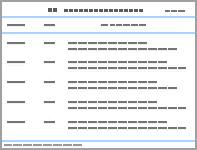
表1
除草剂类别、田间推荐使用浓度及对应国标单位浓度"
| 除草剂类别 Herbicide category | 除草剂及有效成分含量 Herbicides and active ingredient content | 田间推荐使用浓度1倍(1×RC) Recommended concentration for field use | 对应国标单位浓度 Corresponding to the national standard unit concentration (mmol·L-1) |
|---|---|---|---|
| SU | 25%噻吩磺隆Thifensulfuron-methyl | 8 g/667 m2 | 0.17 |
| 10%苄嘧磺隆Bensulfuron-methyl | 20 g/667 m2 | 0.16 | |
| TP | 25 g·L-1五氟磺草胺Penoxsulam | 80 mL/667 m2 | 0.14 |
| 50 g·L-1双氟磺草胺Florasulam | 6 mL/667 m2 | 0.028 | |
| PB | 10%双草醚Bispyribac-sodium | 20 mL/667 m2 | 0.15 |
| 5%嘧啶肟草醚Pyribenzoxim | 50 mL/667 m2 | 0.14 | |
| SCT | 70%氟唑磺隆Flucarbazone-sodium | 3.5 g/667 m2 | 0.21 |
| 99.5%噻酮磺隆Thiencarbazone-methyl | 4 g/667 m2 | 0.34 | |
| IMI | 4%甲氧咪草烟Imazamox | 80 mL/667 m2 | 0.35 |
| 5%咪唑乙烟酸Imazethapyr | 133 mL/667 m2 | 0.72 |
表2
实时荧光定量PCR引物序列"
| 名称Name | 序列Sequence (5′-3′) | 大小Size (bp) | 名称Name | 序列Sequence (5′-3′) | 大小Size (bp) | |
|---|---|---|---|---|---|---|
| BnALS1-F2 | TTCTCCTTAACCCCACAGAAAGA | 23 | CYP86A2-F | AAGGACGGAGAGAAACGACG | 20 | |
| BnALS1-R2 | GGGAGCGTAGCGGGAGAC | 18 | CYP86A2-R | AGGAGACGCCTTCACCAATG | 20 | |
| BnALS3-F2 | CTCCTTAACCCCACAGAAACC | 21 | CYP71B3-F | CTTGAGTGTTGCACAAGACCG | 21 | |
| BnALS3-R2 | GGGAGCGTAGCGGGAGAT | 18 | CYP71B3-R | CACCATATGGCGCAAAGCAA | 20 | |
| EIF4B-F | GTGAGCTGGACGACAAAGTC | 20 | BnGST39-F | GGCTAGCTACATCCAGTTACAT | 22 | |
| EIF4B-R | CTCTGATCATCGGCAGGTCT | 20 | BnGST39-R | TCACAATGTCAACTAGGCTCAT | 22 | |
| BnALS1-P | Fam+CCGTCAATGTCGCACCTCCTTCC+Tamra | 23 | BnGST78-F | CCTCAAAGAGTCTTGCTTTGTC | 22 | |
| BnALS3-P | Fam+CAACTCACCCGTCAATGTCGCACC+Tamra | 24 | BnGST78-R | ACGAAGAAGATGTTCAGGTCTT | 22 | |
| EIF4B-P | Fam+TGCCTGCACCAGACCCGGGT+Tamra | 20 |

图1
ALS抑制类除草剂处理21 d后5N和N131的温室表型"
表3
温室种植的5N和N131对ALS抑制类除草剂处理21 d后的抗性鉴定"
| 种类Category | 名称 Name | 植株 Plant | 喷施剂量Spray dose (RC) | ||||||||
|---|---|---|---|---|---|---|---|---|---|---|---|
| 0× | 1/4× | 1/2× | 1× | 2× | 4× | 8× | 16× | 20× | |||
| SU | 噻吩磺隆Thifensulfuron-methyl | 5N/N131 | R/R | R/S | R/S | R/S | R/S | R/S | R/S | R/S | M/S |
| 苄嘧磺隆Bensulfuron-methyl | 5N/N131 | R/R | R/S | R/S | R/S | R/S | R/S | R/S | R/S | M/S | |
| TP | 五氟磺草胺Penoxsulam | 5N/N131 | R/R | R/S | R/S | R/S | R/S | S/S | S/S | S/S | S/S |
| 双氟磺草胺Florasulam | 5N/N131 | R/R | R/S | R/S | R/S | R/S | M/S | S/S | S/S | S/S | |
| PB | 双草醚Bispyribac-sodium | 5N/N131 | R/R | R/S | R/S | R/S | R/S | M/S | S/S | S/S | S/S |
| 嘧啶肟草醚Pyribenzoxim | 5N/N131 | R/R | R/S | R/S | R/S | R/S | M/S | S/S | S/S | S/S | |
| SCT | 氟唑磺隆Flucarbazone-sodium | 5N/N131 | R/R | R/S | R/S | R/S | R/S | R/S | R/S | R/S | M/S |
| 噻酮磺隆Thiencarbazone-methyl | 5N/N131 | R/R | R/S | R/S | R/S | R/S | R/S | R/S | R/S | M/S | |
| IMI | 甲氧咪草烟Imazamox | 5N/N131 | R/R | R/S | R/S | R/S | R/S | R/S | S/S | S/S | S/S |
| 咪唑乙烟酸Imazethapyr | 5N/N131 | R/R | R/S | R/S | R/S | R/S | R/S | S/S | S/S | S/S | |
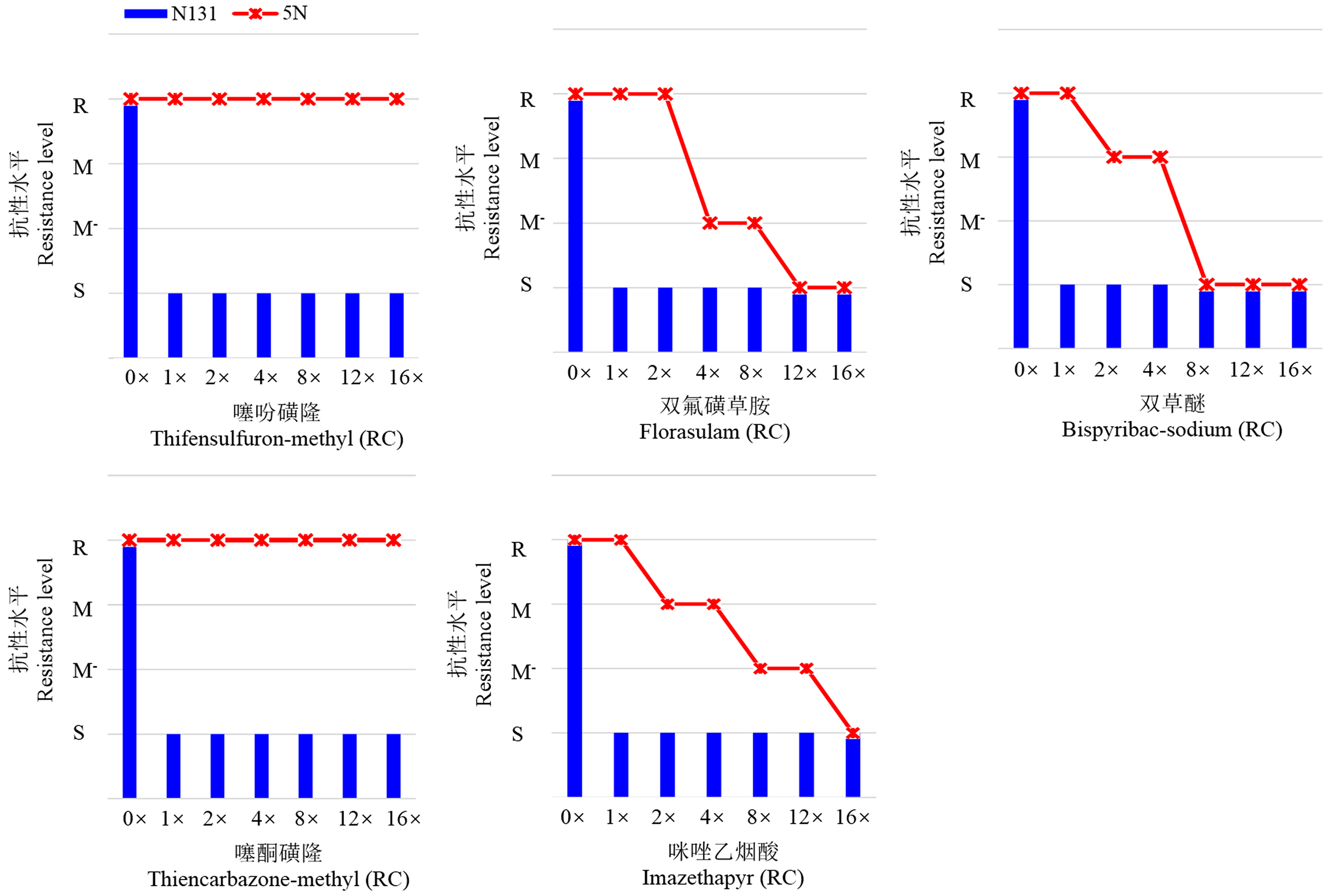
图2
ALS抑制类除草剂处理21 d后室外种植5N和N131的抗性鉴定"
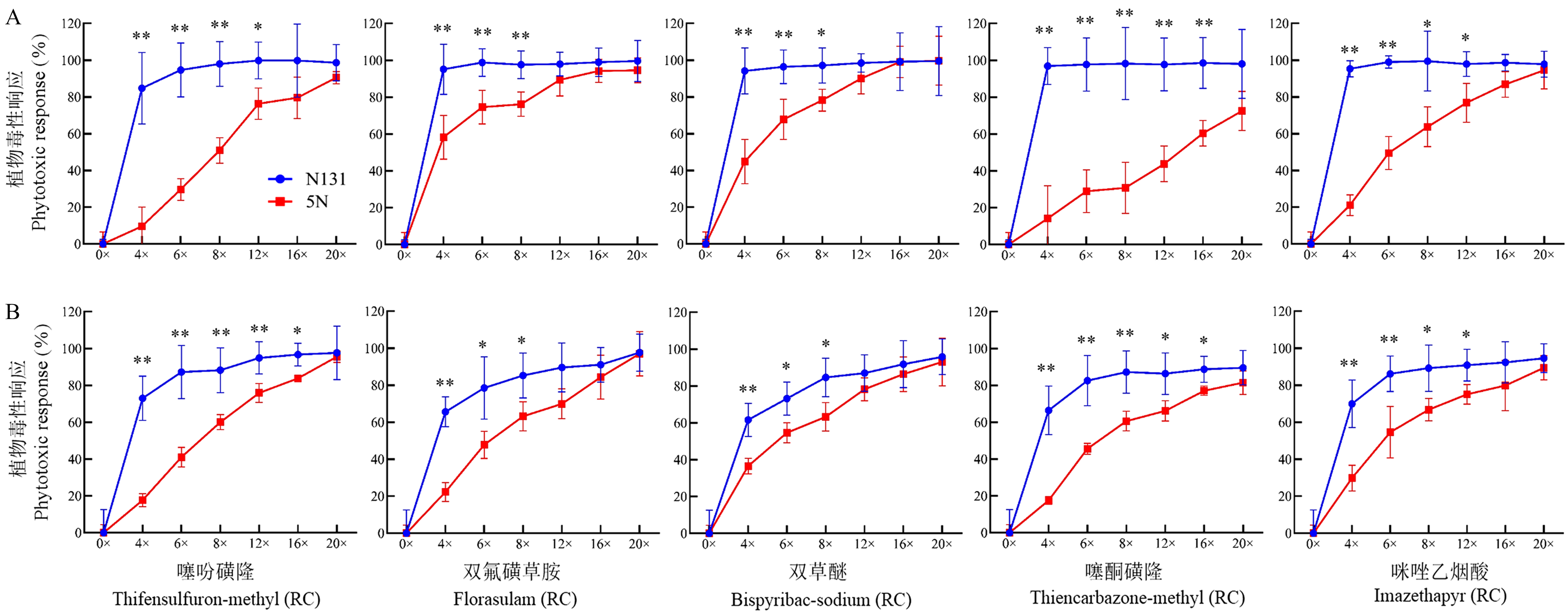
图3
室外种植的5N和N131地上(A)和地下部(B)鲜重对ALS抑制类除草剂处理的毒性响应"
表4
ALS抑制类除草剂对室外种植5N和N131的EC50"
| 油菜 Rapeseed | 噻吩磺隆 Thifensulfuron-methyl (mmol·L-1) | 双氟磺草胺 Florasulam (μmol·L-1) | 双草醚 Bispyribac-sodium (μmol·L-1) | 噻酮磺隆 Thiencarbazone-methyl (mmol·L-1) | 咪唑乙烟酸 Imazethapyr (mmol·L-1) |
|---|---|---|---|---|---|
| N131 | 0.019±0.004 | 0.154±0.033 | 7.300±2.311 | 0.039±0.007 | 0.050±0.012 |
| 5N | 2.771±0.862 | 6.116±1.046 | 295.701±39.020 | 5.462±0.637 | 3.097±0.486 |
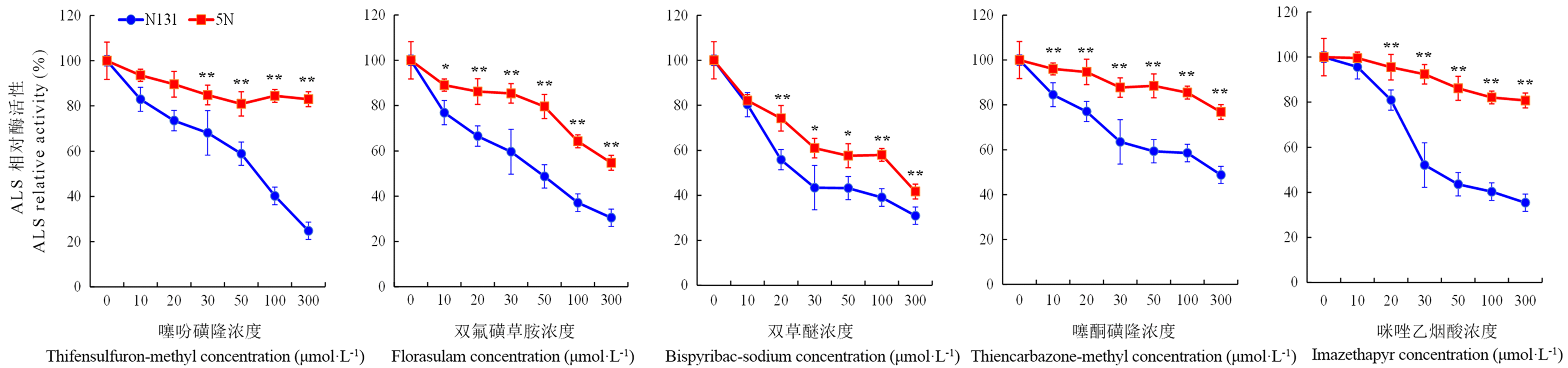
图4
5N和N131体外ALS酶活性对ALS抑制类除草剂的响应"
表5
5N和N131体外酶活响应ALS抑制类除草剂处理的IC50"
| 油菜 Rapeseed | 噻吩磺隆 Thifensulfuron-methyl | 双氟磺草胺 Florasulam | 双草醚 Bispyribac-sodium | 噻酮磺隆 Thiencarbazone-methyl | 咪唑乙烟酸 Imazethapyr |
|---|---|---|---|---|---|
| N131 | 29.510±1.654 | 25.240±2.444 | 14.180±1.756 | 19.980±4.847 | 23.850±1.482 |
| 5N | 934.700±24.640 | 76.020±9.142 | 35.130±5.421 | 608.300±47.060 | 249.700±61.860 |
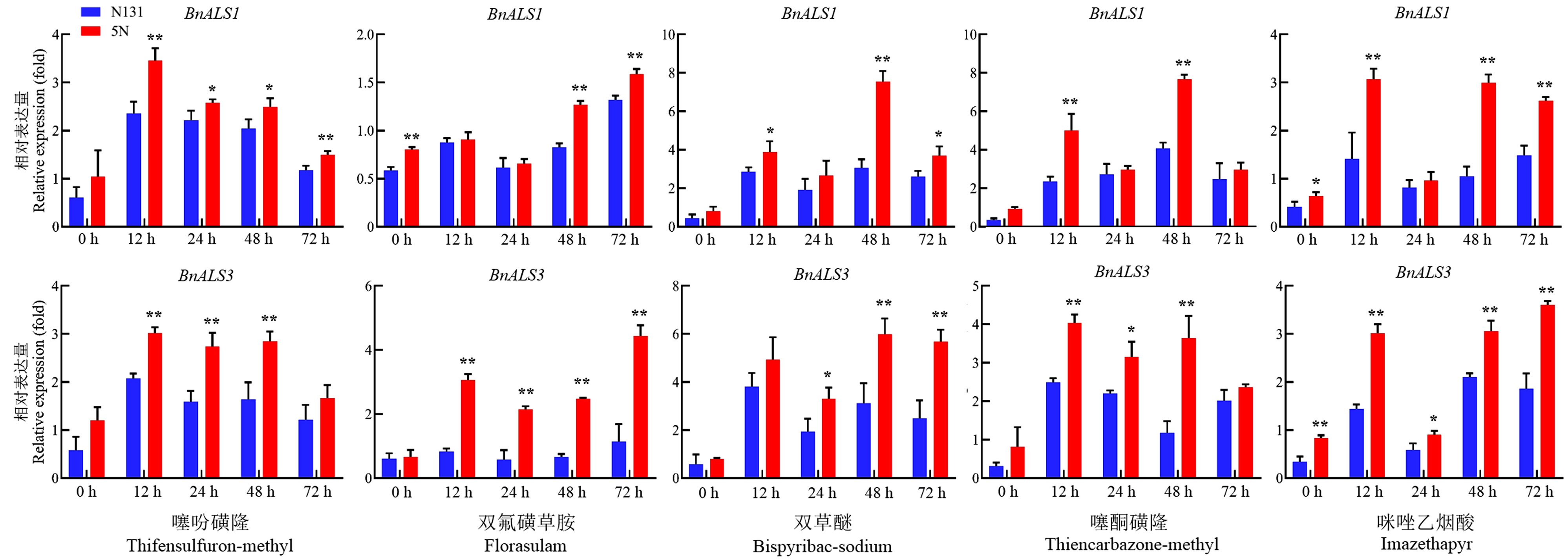
图5
5类除草剂处理后5N和N131靶基因的表达分析"

图6
20×RC除草剂处理后5N和N131非靶标抗性基因的表达分析 SU:噻吩磺隆Thifensulfuron-methyl;TP:双氟磺草胺Florasulam;PB:双草醚Bispyribac-sodium;SCT:噻酮磺隆Thiencarbazone-methyl;IMI:咪唑乙烟酸Imazethapyr"

图7
5N和N131抗氧化酶系统对ALS抑制类除草剂的响应"
| [1] |
王汉中. 中国油菜品种改良的中长期发展战略. 中国油料作物学报, 2004, 26(3): 98-101.
|
|
|
|
| [2] |
杨锐, 陈敬东, 黄郢, 张学昆, 周登文, 刘清云, 徐劲松, 谢伶俐, 许本波. 长江下游冬油菜区应对气候变化的育种和栽培策略研究. 作物学报, https://link.cnki.net/urlid/11.1809.S.20260205.1631.008.
|
|
|
|
| [3] |
官春云. 优质油菜生理生态和现代栽培技术. 北京: 中国农业出版社, 2013.
|
|
|
|
| [4] |
doi: 10.1038/s41467-022-31023-x pmid: 35690625 |
| [5] |
doi: 10.1002/ps.3710 pmid: 24338926 |
| [6] |
doi: 10.3390/ijms26178292 |
| [7] |
|
| [8] |
|
| [9] |
doi: 10.1002/ps.3696 pmid: 24302673 |
| [10] |
doi: 10.1002/ps.3318 pmid: 22614948 |
| [11] |
doi: 10.1007/s11032-015-0227-3 |
| [12] |
doi: 10.1016/j.cj.2021.05.006 |
| [13] |
郭月, 卢鑫宇, 王婷, 李伟龙, 祁余容, 吕欣蕾, 彭琦, 高建芹, 张洁夫, 胡茂龙. 油菜抗除草剂新种质PN19的交互抗性鉴定及其抗性基因的表达研究. 中国油料作物学报, 2023, 45(6): 1206-1216.
doi: 10.19802/j.issn.1007-9084.2023216 |
|
doi: 10.19802/j.issn.1007-9084.2023216 |
|
| [14] |
doi: 10.1111/pce.v46.7 |
| [15] |
doi: 10.1111/eva.12098 pmid: 24478803 |
| [16] |
doi: 10.1017/S0043174500093747 |
| [17] |
doi: 10.3390/plants11202679 |
| [18] |
doi: 10.1146/arplant.1992.43.issue-1 |
| [19] |
罗裳, 王志远, 李长威, 蒋娜, 韩永亮, 荣湘民, 杨兰. 过氧化钙缓解冬油菜苗期渍害胁迫的效应研究. 浙江大学学报(农业与生命科学版), 2023, 49(4): 516-525.
|
|
|
|
| [20] |
|
| [21] |
安晨, 韶也, 彭彦, 毛毕刚, 赵炳然. 水稻乙酰乳酸合酶Ala179Val突变赋予ALS抑制剂类除草剂广谱抗性. 植物遗传资源学报, 2024, 25(2): 259-269.
doi: 10.13430/j.cnki.jpgr.20230628004 |
|
doi: 10.13430/j.cnki.jpgr.20230628004 |
|
| [22] |
doi: 10.1007/s11356-022-18641-0 |
| [23] |
pmid: 15012235 |
| [24] |
doi: 10.1146/annurev.arplant.59.032607.092811 pmid: 18444899 |
| [25] |
|
| [26] |
doi: 10.1007/s00122-020-03633-w pmid: 32556395 |
| [27] |
doi: 10.1007/s00122-024-04678-x |
| [28] |
袁自成. 苯磺隆胁迫下的油菜GST基因筛选与非靶标抗性研究[D]. 南京: 南京农业大学, 2022.
|
|
|
|
| [29] |
doi: 10.4141/P05-193 |
| [30] |
浦惠明, 戚存扣, 张洁夫, 傅寿仲, 高建芹, 陈新军, 陈松, 赵祥祥. 转基因抗除草剂油菜对近缘作物的基因漂移. 生态学报, 2005, 25(3): 581-588.
|
|
|
|
| [31] |
doi: 10.1111/pbi.13368 pmid: 32096325 |
| [32] |
doi: 10.1111/pbi.v19.1 |
| [33] |
doi: 10.1002/ps.v78.2 |
| [34] |
doi: 10.1016/j.pestbp.2023.105576 |
| [35] |
王晓丽. 油菜ALS突变体对不同除草剂的交互抗性评价及利用分子标记辅助选择育种[D]. 杨凌: 西北农林科技大学, 2022.
|
|
|
|
| [36] |
卢鑫宇, 郭月, 祁余容, 王婷, 李伟龙, 吕欣蕾, 钟詹斐, 彭琦, 高建芹, 张洁夫, 胡茂龙. 油菜种质M196对ALS类除草剂的交互抗性评价与抗性基因BnAHAS1-3R的表达分析. 植物遗传资源学报, 2024, 25(12): 2069-2080.
|
|
|
|
| [37] |
European Food Safety Authority. Conclusion on the peer review of the pesticide risk assessment of the active substance glyphosate. EFSA Journal, 2015, 13(11): 4302.
|
| [38] |
曹莉, 李菊颖, 余佳, 豆叶枝, 张悦清, 许静, 何健, 吴文铸, 孔德洋. 环境介质中噻酮磺隆及其代谢产物的液相色谱-串联质谱测定方法研究. 分析测试学报, 2023, 42(7): 849-855.
|
|
|
|
| [39] |
doi: 10.1016/S2095-3119(17)61659-9 |
| [40] |
doi: 10.1002/ps.v77.11 |
| [41] |
|
| [42] |
doi: 10.1016/j.pestbp.2022.105057 |
| [43] |
doi: 10.1186/s12870-020-2304-y pmid: 32138670 |
| [44] |
pmid: 7925408 |
| [45] |
doi: 10.1104/pp.118.3.1049 |
| [46] |
doi: 10.1002/ps.v61:4 |
| [47] |
pmid: 12956529 |
| [48] |
doi: 10.1016/j.ecoenv.2016.01.012 pmid: 26803524 |
| [49] |
doi: 10.1021/acs.jafc.6b04129 pmid: 27992212 |
| [50] |
doi: 10.1006/pest.2001.2580 |
| [51] |
doi: 10.1016/j.pestbp.2005.03.005 |
| [52] |
doi: 10.1006/pest.1998.2365 |
| [53] |
doi: 10.1016/s0014-5793(97)00554-1 pmid: 9224692 |
| [54] |
doi: 10.1111/pbi.2005.3.issue-4 |
| [55] |
doi: 10.1093/jxb/erq282 |
| [56] |
doi: 10.1016/j.tcb.2021.02.005 pmid: 33674166 |
| [57] |
冯周德, 杨欢, 王晨轩, 弓泽涛, 李锦馨. 干旱胁迫下玫瑰生理响应研究进展. 现代农业科技, 2023(2): 109-113.
|
|
|
|
| [58] |
doi: 10.3390/ijms21155208 |
| [59] |
|
| [60] |
黄俣轩, 黄飞, 胡志文, 赵梓霖, 王鹏, 肖荣波. 大气湿沉降油菜体内铅的形态累积及氧化胁迫效应. 生态学报, 2023, 43(19): 8066-8075.
|
|
|
|
| [61] |
田学军, 卢焕仙. 热胁迫对油菜种子活力和幼苗抗氧化酶活性的影响. 江苏农业科学, 2011, 39(4): 77-78.
|
|
|
|
| [62] |
李班, 吕莹, 杨明煊, 宋婷, 于放, 刘志文. 盐碱胁迫对甘蓝型油菜生理及分子机制的影响. 华北农学报, 2022, 37(3): 86-93.
doi: 10.7668/hbnxb.20192954 |
|
|
|
| [63] |
谢伶俐, 李永铃, 许本波, 张学昆. 油菜耐渍机理解析及遗传改良研究进展. 作物学报, 2025, 51(2): 287-300.
doi: 10.3724/SP.J.1006.2025.44121 |
|
doi: 10.3724/SP.J.1006.2025.44121 |
|
| [64] |
张腾国, 李巧丽, 刁志宏, 李萍, 王娟, 郑晟. 盐及干旱胁迫对油菜抗氧化系统和RbohC、RbohF基因表达的影响. 应用生态学报, 2019, 30(3): 969-978.
doi: 10.13287/j.1001-9332.201903.017 |
|
|
|
| [65] |
doi: 10.1104/pp.56.2.337 pmid: 16659298 |
| [66] |
李胜利, 夏亚真, 刘金, 师晓丹, 孙治强. 高温胁迫下番茄幼苗对冷激的响应. 应用生态学报, 2014, 25(10): 2927-2934.
|
|
|
|
| [67] |
doi: 10.1007/s12374-011-9178-3 |
| [68] |
doi: 10.1016/j.envexpbot.2012.02.009 |
| [69] |
doi: S1369-5266(16)30103-0 pmid: 27419886 |
| [70] |
doi: 10.1111/jipb.2005.47.issue-10 |
| [71] |
doi: 10.1078/0176-1617-00327 |
| [72] |
doi: 10.1034/j.1399-3054.2001.1130414.x |
| [73] |
pmid: 11181723 |
| [1] | 祝培, 赵耀, 白岩, 张金盔, 李莓, 龙金佳, 杨龙, 罗丽娅, 许本波, 徐劲松, 张学昆. 氟唑菌酰羟胺对油菜的生理调控作用及其与咪鲜胺的复配效应[J]. 中国农业科学, 2026, 59(9): 1903-1915. |
| [2] | 朱琦, 贾振鹏, Tahir SHAH, 徐晨晟, 李芷琦, 吕会帅, 朱鹏超, 韦小敏, 黄冬琳, 孙艳妮, 曹卫东, 高亚军, 王朝辉, 张达斌. 绿肥配施增效产品降低旱地麦田温室气体排放及碳足迹[J]. 中国农业科学, 2026, 59(7): 1507-1522. |
| [3] | 苏一帆, 杨瞻旭, 王迪, 冒俊呈, 魏萌萌, 陈泽, 白欣冉, 楚天歌, 马昌宁, 乔明菲, 孙权, 胡大刚. 2, 4-表油菜素内酯对苹果果实采后贮藏性能的影响[J]. 中国农业科学, 2026, 59(7): 1536-1551. |
| [4] | 刘海卿, 金姣姣, 孙万仓, 柴鹏, 祁伟亮, 杨刚, 李婵, 骆雪梅, 苏芸芸, 秦雪雪. 甘蓝型冬油菜越冬期矮生长点形态建成及多激素调控机制[J]. 中国农业科学, 2026, 59(5): 951-966. |
| [5] | 申丽琼, 何林丽, 刘倪, 陆俊杏, 朱波, 张涛. 钾营养水平对油菜苗期抗湿害能力及内源激素平衡的影响[J]. 中国农业科学, 2026, 59(3): 528-542. |
| [6] | 杨锐, 陈敬东, 黄郢, 谢伶俐, 张学昆, 周登文, 刘清云, 徐劲松, 许本波. 长江上游油菜高产品系遗传改良与构型分析[J]. 中国农业科学, 2026, 59(2): 250-264. |
| [7] | 王彬, 吴朋浩, 鲁剑巍, 任涛, 丛日环, 陆志峰, 李小坤. 长江中游地区水稻-油菜轮作体系需水特征[J]. 中国农业科学, 2025, 58(7): 1355-1365. |
| [8] | 杜泰峰, 周媛媛, 秦桢, 李爱贤, 王庆美, 张立明, 侯夫云. 外源油菜素内酯减轻SPVD对甘薯块根萌芽的抑制作用[J]. 中国农业科学, 2025, 58(22): 4628-4637. |
| [9] | 杨龙, 张学昆, 陈爱武, 李莓, 程泰, 马伍慧, 许本波, 徐劲松. 油菜品种、越冬调控和病虫害防控对直播油菜产量的影响[J]. 中国农业科学, 2025, 58(21): 4333-4345. |
| [10] | 张天宇, 刘丽君, 杨刚, 武军艳, 蒲媛媛, 马骊, 王旺田, 路晓明, 马愿强, 孙万仓. 2006—2022年北方白菜型冬油菜农艺性状遗传增益分析[J]. 中国农业科学, 2025, 58(11): 2081-2095. |
| [11] | 何永强, 张金盔, 徐劲松, 丁晓雨, 程勇, 许本波, 张学昆. 14-羟基芸苔素甾醇生长调节剂对油菜生长和产量的影响[J]. 中国农业科学, 2024, 57(8): 1444-1454. |
| [12] | 李荣德, 何平, 罗莉霞, 史梦雅, 侯乾, 马振国, 郭瑞星, 成洪涛. “稻-稻-油”生产模式下短生育期冬油菜品种选育与推广现状分析[J]. 中国农业科学, 2024, 57(5): 846-854. |
| [13] | 关志林, 靳丰蔚, 刘婷婷, 王毅, 谭莹莹, 杨春慧, 李蕊彤, 王博, 刘克德, 董云. 甘蓝型油菜光叶性状的遗传分析及基因定位[J]. 中国农业科学, 2024, 57(4): 650-662. |
| [14] | 李飞, 熊财, 谷佳佳, 曹欣, 王珊珊, 胡伟, 周治国, 陈兵林. 迟播对油菜产量、品质、光合源演替及载荷特征的影响[J]. 中国农业科学, 2024, 57(23): 4673-4685. |
| [15] | 李亦扬, 王龙, 钱晨, 李静, 林国冰, 瞿雯婷, 王炎, 林耀威, 黄怡航, 郑经东, 尤晶晶, 左青松. 密度对油菜角果性状的影响及高产油菜增产路径分析[J]. 中国农业科学, 2024, 57(22): 4459-4472. |
|
||
