






中国农业科学 ›› 2026, Vol. 59 ›› Issue (6): 1348-1360.doi: 10.3864/j.issn.0578-1752.2026.06.015
• 畜牧·兽医 • 上一篇
杨丽娟( ), 陈丝雨, 赵薇, 朱玲, 郭磊, 马丽娜, 马瑞敏, 张娟()
收稿日期:2025-09-30
接受日期:2026-01-14
出版日期:2026-03-16
发布日期:2026-03-24
通信作者:
联系方式:
杨丽娟,E-mail:yangdfq@163.com。
基金资助:
YANG LiJuan(), CHEN SiYu, ZHAO Wei, ZHU Ling, GUO Lei, MA LiNa, MA RuiMin, ZHANG Juan()
Received:2025-09-30
Accepted:2026-01-14
Published:2026-03-16
Online:2026-03-24
摘要:
【背景】羽毛颜色是家禽品种的重要外貌特征及经济性状,其形成机制解析对地方鸡种种质资源保护和遗传改良具有重要意义。静原鸡作为我国特色地方鸡种,其丰富的羽色多样性为解析羽色形成的遗传机制提供了理想的研究材料,系统挖掘其遗传基础已成为提升种业竞争力的核心环节。【目的】利用全基因组重测序技术筛选与静原鸡黑羽、麻羽及白羽性状相关的遗传标记和候选基因,为解析其羽色形成的分子机制及分子育种提供理论依据。【方法】选取150只来自静原鸡国家保种场的126日龄不同羽色(黑羽、麻羽、白羽)的静原鸡母鸡为研究对象,通过翅下静脉采集血液样本,提取高质量基因组DNA进行全基因组重测序,采用多策略交叉验证的分析方法,分别运用基于滑动窗口的遗传分化系数(Fst)计算、核苷酸多样性比值(θπ ratio)分析、跨群体似然比检验(XP-CLR)和全基因组关联分析(GWAS)4种方法,系统筛选与黑羽、白羽和麻羽相关的候选基因,通过维恩图取交集,获得不同羽色各自的关键显著候选基因。进一步开展跨群体比较分析,通过对静原鸡不同羽色种群之间进行Fst分析,筛选与羽色相关的显著选择信号区域,利用基因注释和维恩图交集鉴定跨羽色共享的核心候选基因。最后通过GO功能注释和KEGG通路富集分析,系统解析候选基因的生物学功能及调控网络。【结果】研究系统鉴定了多个与静原鸡羽色形成相关的关键基因,鉴定了黑羽性状与 LMO3、RERGL 和 RTTN显著相关;麻羽性状关联到 CDH19 和 SLC25A1;而白羽性状则由 IKZF1主导。跨羽色比较分析进一步识别出 NLRC5、POT1、IPP、DCUN1D4、XRCC4、PALM2AKAP2、UGCG、GNG10、PRIM2、SSBP2、ZBTB34、DHFR、SLC46A2、SLF1和SHOC1 15个核心候选基因,这表明静原鸡的羽色变异受多基因调控,功能富集分析显示这些基因显著参与G蛋白偶联受体信号通路、跨膜受体信号转导等重要生物学过程,构成了复杂的羽色调控网络。【结论】通过多组学整合分析,筛选得到与静原鸡羽色形成相关的重要候选基因,并初步揭示了其参与的潜在调控通路。研究结果不仅为静原鸡羽色性状的遗传解析提供了全新的分子线索与技术支撑,填补了地方鸡种羽色调控机制研究中的部分空白,也为地方优质鸡种遗传资源的精准保护、定向选育及创新利用提供了科学依据与实践指导,同时为家禽色素形成的分子通路、遗传网络调控机制等前沿领域研究积累了关键数据,进一步丰富了畜禽功能性性状遗传研究的理论体系。
杨丽娟, 陈丝雨, 赵薇, 朱玲, 郭磊, 马丽娜, 马瑞敏, 张娟. 全基因组重测序揭示静原鸡羽色的遗传机制[J]. 中国农业科学, 2026, 59(6): 1348-1360.
YANG LiJuan, CHEN SiYu, ZHAO Wei, ZHU Ling, GUO Lei, MA LiNa, MA RuiMin, ZHANG Juan. Whole-Genome Resequencing Reveals the Genetic Mechanisms Underlying Feather Coloration in Jingyuan Chicken[J]. Scientia Agricultura Sinica, 2026, 59(6): 1348-1360.
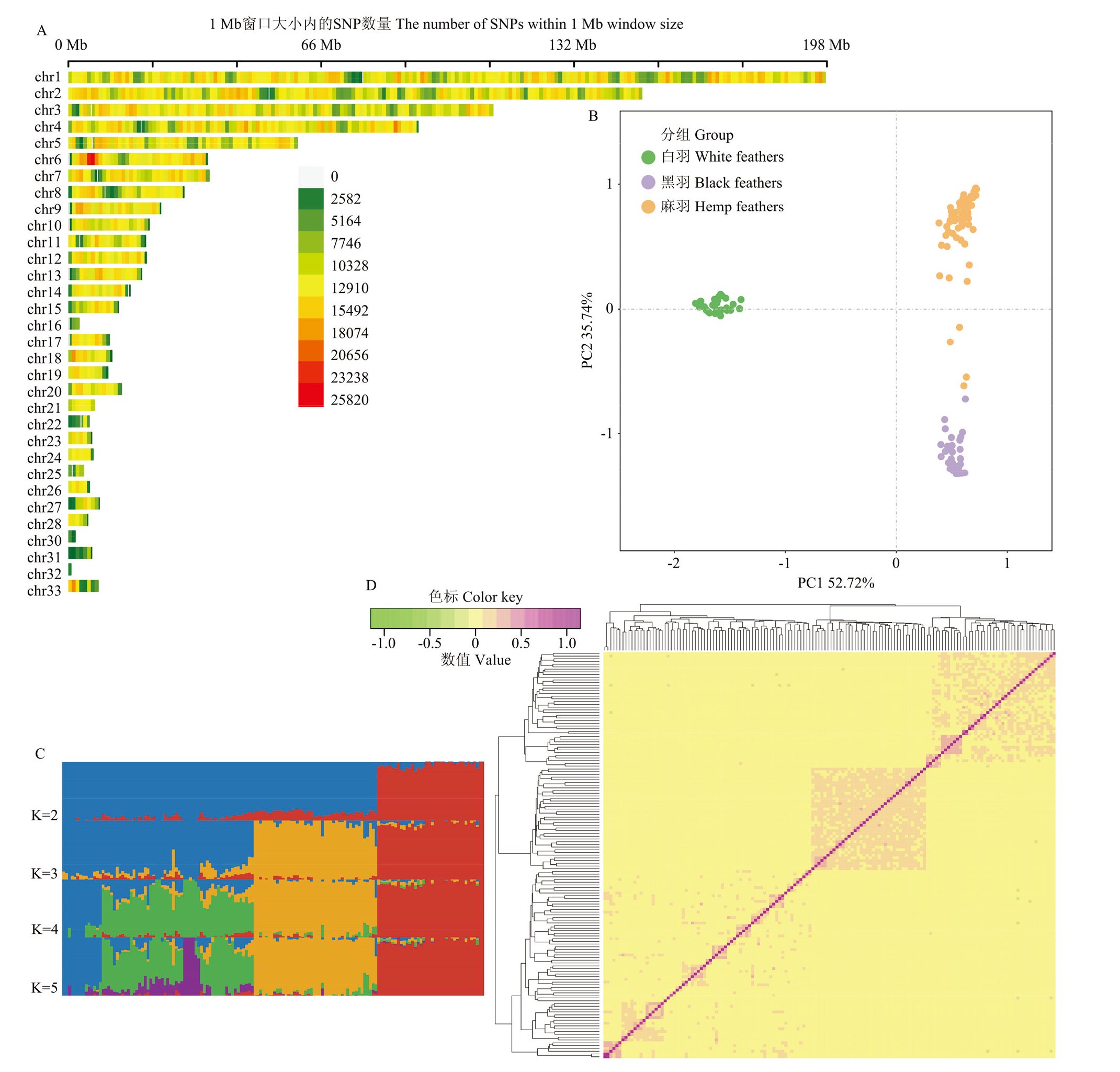
图1
静原鸡种群结构分析 A:基因分型质控后染色体密度图; B:基因分型质控后PCA图;C:种群K结构图;D:种群G矩阵图"
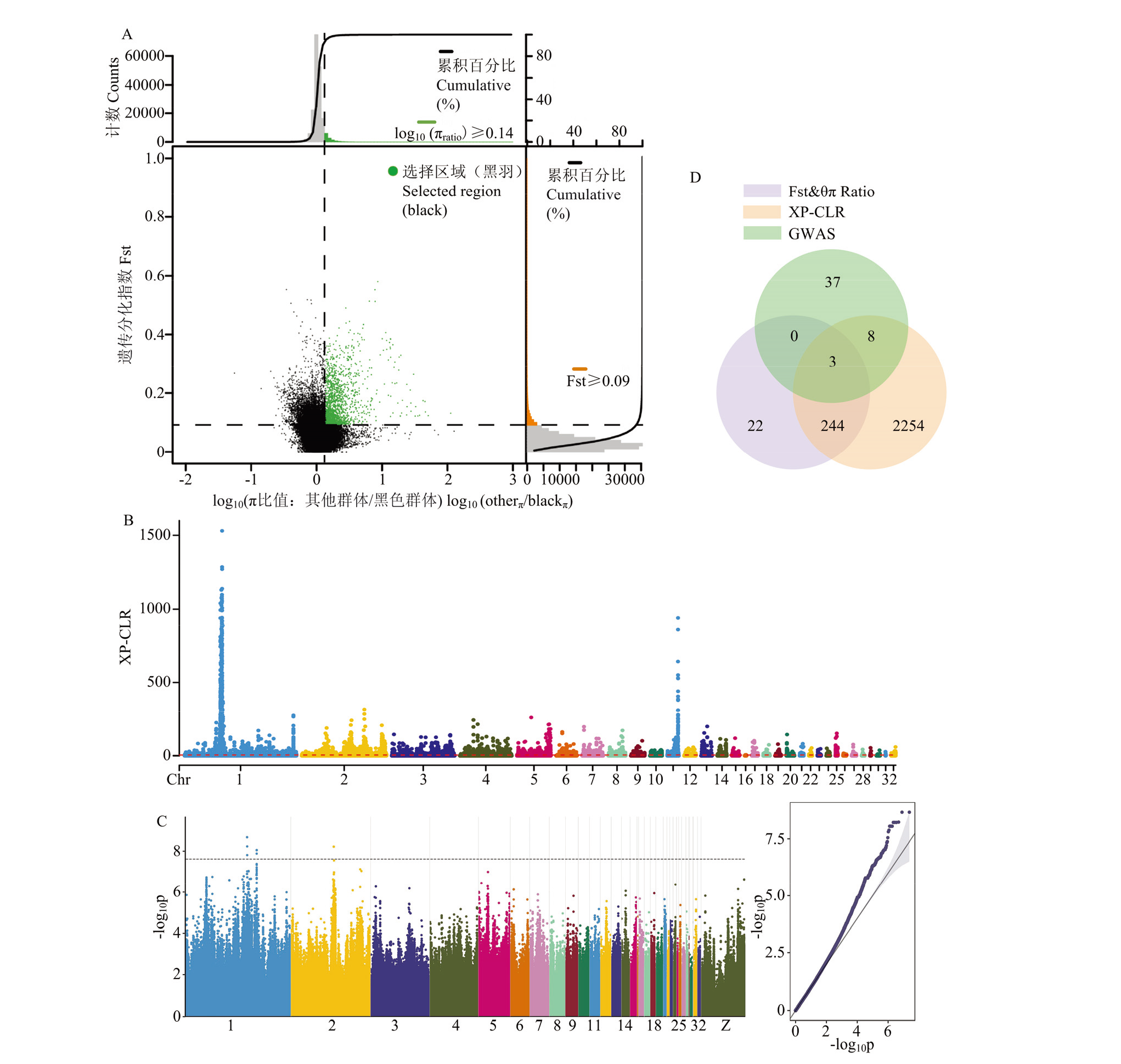
图2
静原鸡黑羽性状的全基因组选择信号与关联分析 A:黑羽的Fst和θπRatio联合分析;B:黑羽的XP-CLR曼哈顿图;C:黑羽的全基因组关联分析曼哈顿图和Q-Q图;D:黑羽Fst、θπRatio、XP-CLR和GWAS的结果维恩图。"
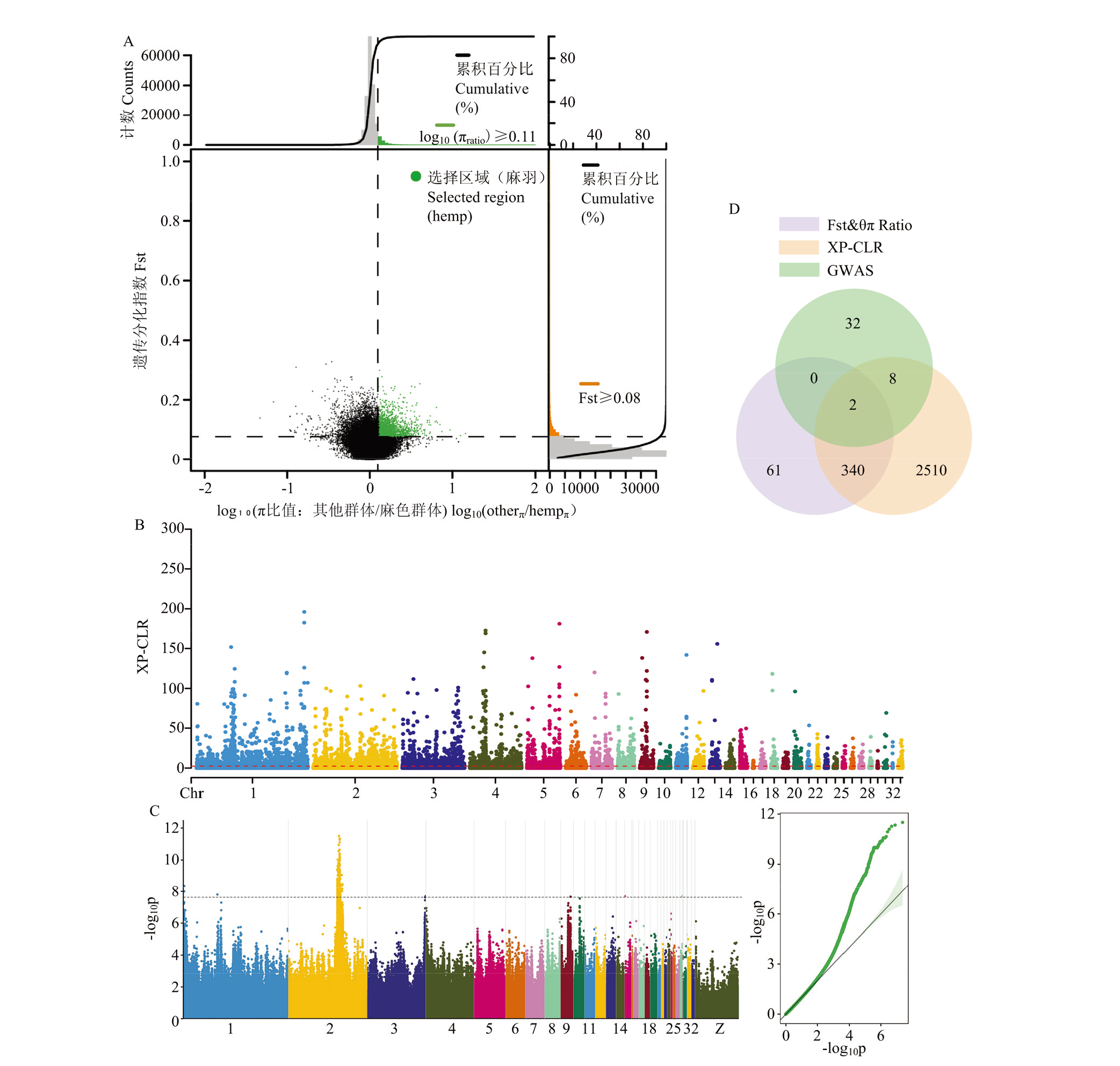
图3
静原鸡麻羽性状的全基因组选择信号与关联分析 A:麻羽的Fst和θπRatio联合分析;B:麻羽的XP-CLR曼哈顿图;C:麻羽的全基因组关联分析曼哈顿图和Q-Q图;D:麻羽Fst、θπRatio、XP-CLR和GWAS的结果维恩图"

图4
静原鸡白羽性状的全基因组选择信号与关联分析 A:白羽的Fst和θπRatio联合分析;B:白羽的XP-CLR曼哈顿图;C:白羽的全基因组关联分析曼哈顿图和Q-Q图;D:白羽Fst、θπRatio、XP-CLR和GWAS的结果维恩图"

图5
静原鸡群体间Fst分析与候选基因功能富集分析 A:黑羽vs.麻羽的Fst分析;B:黑羽vs.白羽的Fst分析;C:麻羽vs.白羽的Fst分析;D:GO通路富集分析;E:KEGG通路富集分析"
表1
基于多方法筛选的核心候选基因"
| 基因名称 Gene | 基因全称 Full name | 染色体 Chromosome | 位置 Location (bp) | 长度Length (bp) | |||
|---|---|---|---|---|---|---|---|
| NLRC5 | NLR family CARD domain containing 5 | 11 | 631 380-666 403 | 35 023 | |||
| POT1 | protection of telomeres 1 | 1 | 21 910 949-21 977 311 | 66 362 | |||
| IPP | intracisternal A particle-promoted polypeptide | 8 | 21 578 712-21 586 099 | 7 387 | |||
| DCUN1D4 | defective in cullin neddylation 1 domain containing 4 | 4 | 66 182 460-66 219 871 | 37 411 | |||
| XRCC4 | X-ray repair cross complementing 4 | Z | 62 968 695-63 173 439 | 204 744 | |||
| PALM2AKAP2 | PALM2-AKAP2 fusion | Z | 65 952 061-66 041 197 | 89 136 | |||
| UGCG | UDP-glucose ceramide glucosyltransferase | Z | 66 456 960-66 484 254 | 27 294 | |||
| GNG10 | G protein subunit gamma 10 | Z | 66 590 949-66 596 903 | 5 954 | |||
| PRIM2 | primase (DNA) subunit 2 | 3 | 86 320 097-86 404 844 | 84 747 | |||
| SSBP2 | single stranded DNA binding protein 2 | Z | 63 726 110-63 893 187 | 167 077 | |||
| ZBTB34 | zinc finger and BTB domain containing 34 | 17 | 10 852 388-10 877 691 | 25 303 | |||
| DHFR | dihydrofolate reductase | Z | 64 257 284-64 273 367 | 16 083 | |||
| SLC46A2 | Solute Carrier Family 46 Member 2 | Z | 66 053 949-66 060 686 | 6 737 | |||
| SLF1 | SDE2 C-Terminal Like Family Member 1 | Z | 58 014 361-58 053 135 | 38 774 | |||
| SHOC1 | Shortage In Chiasmata 1 | Z | 66 537 993-66 588 226 | 50 233 | |||
| [1] |
doi: 10.1016/j.psj.2024.104240 |
| [2] |
|
| [3] |
doi: S0003-9861(15)00041-7 pmid: 25637658 |
| [4] |
doi: 10.1038/nature03154 |
| [5] |
doi: 10.5713/ajas.2013.13413 pmid: 25049737 |
| [6] |
doi: S0032-5791(20)30117-6 pmid: 32475423 |
| [7] |
doi: 10.1016/j.psj.2023.102721 |
| [8] |
doi: 10.1016/j.psj.2025.105680 |
| [9] |
沈曼曼, 曲亮, 窦套存, 马猛, 郭军, 卢建, 胡玉萍, 李永峰, 王克华. 鸡脾脏重全基因组关联分析. 中国农业科学, 2018, 51(6): 1213-1222.doi:10.3864/j.issn.0578-1752.2018.06.019.
|
|
|
|
| [10] |
郭军, 曲亮, 邵丹, 马猛, 窦套存, 卢建, 胡玉萍, 王星果, 王强, 李永峰, 郭伟, 童海兵. 基于一步法全基因组关联分析解析蛋黄比率遗传结构. 中国农业科学, 2024, 57(21): 4356-4366. doi:10.3864/j.issn.0578-1752.2024.21.014.
|
|
|
|
| [11] |
高广亮, 张克山, 赵献芝, 许国洋, 谢友慧, 周莉, 张昌莲, 王启贵. 全基因组关联分析筛选鹅蛋品质相关分子标记. 中国农业科学, 2023, 56(19): 3894-3904.doi:10.3864/j.issn.0578-1752.2023.19.015.
|
|
|
|
| [12] |
骆娜, 安炳星, 魏立民, 文杰, 赵桂苹. 全基因组关联分析筛选文昌鸡体尺性状相关分子标记. 中国农业科学, 2024, 57(10): 2046-2060.doi:10.3864/j.issn.0578-1752.2024.10.015.
|
|
|
|
| [13] |
doi: 10.1093/bioinformatics/btp324 pmid: 19451168 |
| [14] |
|
| [15] |
|
| [16] |
doi: 10.1101/gr.107524.110 pmid: 20644199 |
| [17] |
doi: 10.1086/519795 |
| [18] |
doi: 10.1093/bioinformatics/btr330 pmid: 21653522 |
| [19] |
doi: 10.1101/gr.100545.109 pmid: 20086244 |
| [20] |
doi: 10.1038/ng.546 pmid: 20208535 |
| [21] |
doi: 10.1038/ng.548 pmid: 20208533 |
| [22] |
|
| [23] |
doi: 10.1093/nar/gkac194 |
| [24] |
doi: 10.1093/nar/gkaa1113 pmid: 33290552 |
| [25] |
doi: 10.1093/nar/gkab447 pmid: 34086934 |
| [26] |
doi: 10.1093/nar/28.1.27 |
| [27] |
doi: 10.1016/j.rvsc.2025.105568 |
| [28] |
doi: 10.1016/j.psj.2025.105666 |
| [29] |
doi: 10.1186/s12864-025-11927-w |
| [30] |
doi: 10.3382/ps.0440089 |
| [31] |
牛佳佳, 徐丹, 刘洋, 赵小玲. 鸡芦花羽性状遗传调控机制研究进展. 畜牧兽医学报, 2024, 55(5): 1883-1892.
doi: 10.11843/j.issn.0366-6964.2024.05.007 |
|
doi: 10.11843/j.issn.0366-6964.2024.05.007 |
|
| [32] |
doi: 10.2141/jpsa.0200060 |
| [33] |
doi: 10.3390/ijms21176129 |
| [34] |
doi: 10.1016/j.bbamem.2017.03.004 |
| [35] |
doi: 10.1038/nrc3106 |
| [36] |
doi: 10.54097/ksfqbk98 |
| [37] |
doi: 10.12688/f1000research |
| [38] |
doi: 10.18388/abp.2020_6902 pmid: 38052007 |
| [39] |
doi: 10.1101/gad.1486806 |
| [40] |
doi: 10.3390/cancers12010068 |
| [41] |
doi: 10.1172/JCI178692 |
| [42] |
doi: 10.3389/fped.2021.705497 |
| [43] |
doi: 10.1186/s12864-024-10464-2 pmid: 38886664 |
| [44] |
doi: 10.3390/ijms22083970 |
| [45] |
doi: 10.1111/exd.v30.4 |
| [46] |
doi: 10.1161/CIRCRESAHA.118.311403 pmid: 30355236 |
| [47] |
doi: S1550-4131(16)30425-9 pmid: 27641100 |
| [48] |
doi: 10.1016/j.arr.2021.101349 |
| [1] | 叶美金, 吴雷, Lohani Md Nahibuzzaman, 尹丽, 胡欣荣, 刘亚西, 蒋云峰, 陈国跃, 蒲至恩, 李阳, 李婷, 邹亚亚, 吴佳怡, 马建. 基于GWAS的中国地方小麦成熟胚大小位点的鉴定及其遗传效应解析[J]. 中国农业科学, 2026, 59(6): 1157-1171. |
| [2] | 王勇胜, 牛丽, 王长杰, 马立花, 廉潇潇, 孟亚雄, 马小乐, 姚立蓉, 张宏, 杨轲, 李葆春, 王化俊, 司二静, 汪军成. 冬小麦千粒重的全基因组关联分析及候选基因预测[J]. 中国农业科学, 2026, 59(3): 499-514. |
| [3] | 贾子成, 秦冰雨, 马彩英, 杜勇, 刘统高, 薛瑞林, 王小龙, 周世卫. 饲粮营养水平对双羔陕北白绒山羊母子一体化生产性能和瘤胃微生物的影响[J]. 中国农业科学, 2026, 59(3): 668-686. |
| [4] | 李云丽, 刁邓超, 刘雅睿, 孙玉晨, 孟祥宇, 邬陈芳, 汪妤, 吴建辉, 李春莲, 曾庆东, 韩德俊, 郑炜君. 小麦苗期耐热性全基因组关联分析[J]. 中国农业科学, 2025, 58(9): 1663-1683. |
| [5] | 罗正英, 胡鑫, 吴转娣, 钱禛锋, 田春艳, 刘新龙, 李富生. 蔗茅全基因组SSR标记特征分析与开发[J]. 中国农业科学, 2025, 58(5): 851-863. |
| [6] | 张天雨, 李白, 藏金萍, 曹宏哲, 董金皋, 邢继红, 张康. 灰葡萄孢HMG家族基因的全基因组鉴定与表达规律分析[J]. 中国农业科学, 2025, 58(4): 704-718. |
| [7] | 周广飞, 马亮, 马璐, 张舒钰, 章慧敏, 宋旭东, 张振良, 陆虎华, 郝德荣, 冒宇翔, 薛林, 陈国清. 玉米苞叶性状全基因组关联分析[J]. 中国农业科学, 2025, 58(3): 431-442. |
| [8] | 许朵朵, 杜倩倩, 赵理想, 栗燕, 黄淦, 李永华, 逯久幸. 牡丹AP2/ERF转录因子的全基因组分析[J]. 中国农业科学, 2025, 58(23): 5031-5045. |
| [9] | 张帆, 杨青川. 紫花苜蓿育种历史、现状与展望[J]. 中国农业科学, 2025, 58(21): 4471-4481. |
| [10] | 武书羽, 衡燕芳, 于太飞, 王世佳, 于思佳, 李园, 胡正, 张辉, 孙现军, 黎亮, 姜奇彦. 玉米自然群体苗期耐盐性鉴定及耐盐相关基因分析[J]. 中国农业科学, 2025, 58(20): 4085-4099. |
| [11] | 郭孟泽, 张磊, 孙平平, 江彪, 闫晋强, 李正男. ToLCNDV广东冬瓜分离物的分子特征及其遗传演化规律[J]. 中国农业科学, 2025, 58(19): 3890-3904. |
| [12] | 赵剑, 任涛, 方娅婷, 杨昕, 盛倩男, 李小坤, 朱俊, 鲁剑巍. 施氮对不同轮作模式下油菜和小麦根际土壤中有机氮矿化功能基因的影响[J]. 中国农业科学, 2025, 58(19): 3919-3931. |
| [13] | 仪泽会, 王颖, 宋慧霞, 赵婧, 毛丽萍. 芦笋过氧化物还原酶(Peroxiredoxins)基因家族全基因组鉴定及表达分析[J]. 中国农业科学, 2025, 58(18): 3728-3743. |
| [14] | 向爱慧, 白荣基, 郝宇琼, 赵佳佳, 武棒棒, 李晓华, 郑兴卫, 关攀锋, 郑军. 山西小麦矮秆基因的鉴定及株高遗传位点挖掘[J]. 中国农业科学, 2025, 58(17): 3372-3388. |
| [15] | 刘晨曦, 赵冰兵, 史智宾, 王世达, 王靖飞. 犬细小病毒CPV-2c SX-LC株感染性克隆的构建与病毒拯救[J]. 中国农业科学, 2025, 58(17): 3561-3570. |
|
||
