






中国农业科学 ›› 2026, Vol. 59 ›› Issue (5): 1070-1086.doi: 10.3864/j.issn.0578-1752.2026.05.012
岳丽昕1( ), 王清华1, 王振宝1, 尼玛琼吉2, 刘泽洲1, 孔素萍1, 张立峰1, 高莉敏1()
收稿日期:2025-10-13
接受日期:2025-12-02
出版日期:2026-03-01
发布日期:2026-03-06
通信作者:
联系方式:
岳丽昕,E-mail:yuelixin.happy@163.com。
基金资助:
YUE LiXin1(), WANG QingHua1, WANG ZhenBao1, NIMAQIONGJI2, LIU ZeZhou1, KONG SuPing1, ZHANG LiFeng1, GAO LiMin1()
Received:2025-10-13
Accepted:2025-12-02
Published:2026-03-01
Online:2026-03-06
摘要:
【目的】 探究藏葱和细香葱的农艺性状、营养品质及代谢组分的差异,揭示其特有的营养代谢特征,为挖掘藏葱特色资源价值、推动西藏特色蔬菜的高值化利用与品种改良提供科学依据。【方法】 以西藏特色蔬菜资源藏葱与我国优异分葱资源细香葱为研究对象,通过生理生化分析,比较其农艺性状与营养品质差异;采用广泛靶向代谢组学技术分析代谢谱,以“VIP>1,且FC≥2或FC≤0.5”为标准筛选差异代谢物,并进行KEGG代谢通路富集分析。【结果】 藏葱和细香葱在假茎形态、表皮颜色、株高、假茎长、叶片长和单株重等农艺性状上存在显著差异。营养品质分析发现,在藏葱中,干物质、游离氨基酸、丙酮酸和粗纤维含量高于细香葱,而可溶性固形物、可溶性糖、维生素C含量和糖酸比则显著低于细香葱。基于广泛靶向代谢组学技术,共鉴定出13类2 014种代谢物,主要以黄酮类、脂质和生物碱为主。多元统计分析共鉴定出1 012种差异代谢物,其中,583种上调表达,429种下调表达。KEGG通路富集分析表明,差异代谢物显著富集于类黄酮生物合成相关通路,主要包括黄酮与黄酮醇生物合成、花青素苷生物合成,以及山柰酚苷元Ⅰ与槲皮素苷元Ⅰ的生物合成途径。通过构建黄酮类化合物代谢合成网络和比较代谢物相对含量,藏葱与细香葱在下游黄酮类化合物代谢产物积累上具有显著的种间差异,其多样性主要源于共同前体物质二氢山柰酚的分支转化,该过程分别导向黄酮醇类(山柰酚和槲皮素)与花青素类(矢车菊素和飞燕草素)等不同次生代谢产物的合成与积累。【结论】 藏葱与细香葱在农艺性状、营养品质和代谢物积累上差异显著,藏葱干物质、氨基酸含量高,风味辛辣浓郁,质地粗,耐贮藏;细香葱则糖类、维生素C丰富,口感清甜鲜嫩。其黄酮类合成通路分化关键源于二氢山柰酚的分支转化,可生成黄酮醇与花青素等多样代谢产物。
岳丽昕, 王清华, 王振宝, 尼玛琼吉, 刘泽洲, 孔素萍, 张立峰, 高莉敏. 基于广靶代谢组学分析藏葱和细香葱营养品质及黄酮类代谢产物差异[J]. 中国农业科学, 2026, 59(5): 1070-1086.
YUE LiXin, WANG QingHua, WANG ZhenBao, NIMAQIONGJI, LIU ZeZhou, KONG SuPing, ZHANG LiFeng, GAO LiMin. Widely Targeted Metabolomics-Based Analysis of the Differences in Tibetan Bunching Onion and Chive on Nutritional Quality and Flavonoid Metabolites[J]. Scientia Agricultura Sinica, 2026, 59(5): 1070-1086.
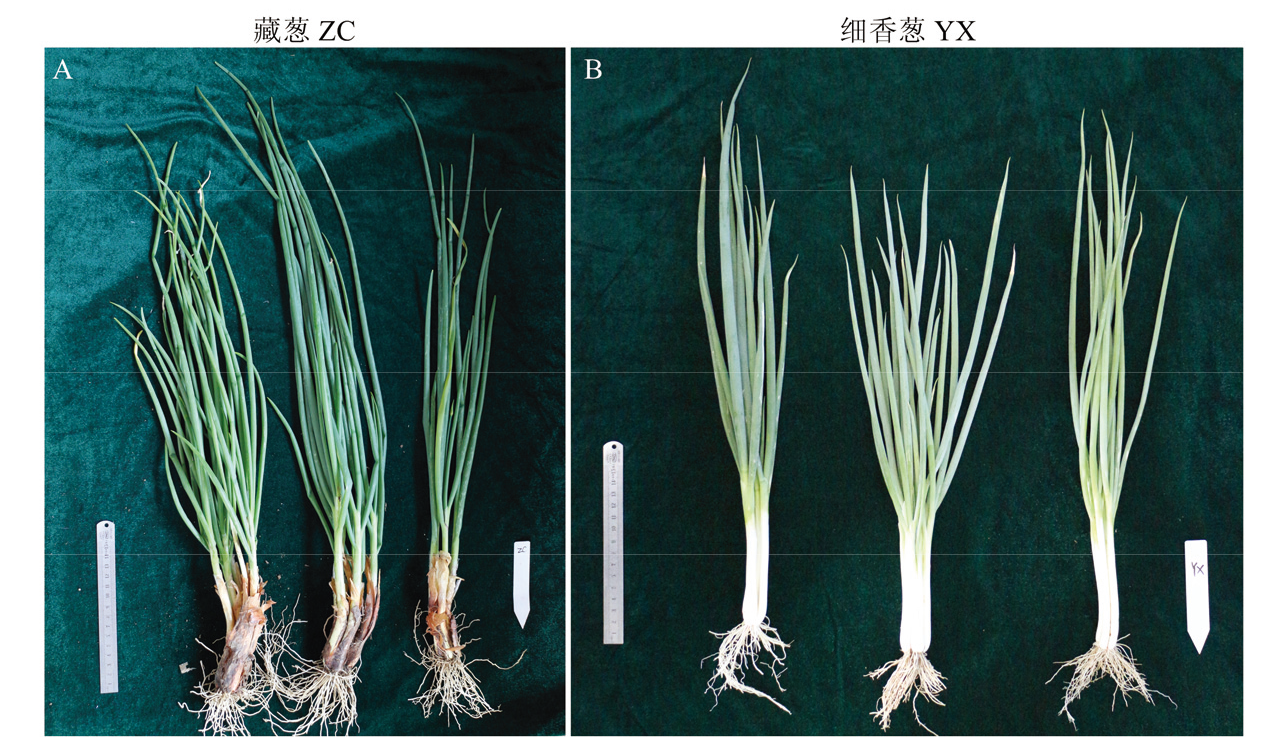
图1
藏葱和细香葱的表型 ZC:藏葱;YX:细香葱。标尺为15 cm。下同"
表1
藏葱与细香葱的农艺性状统计分析"
| 样本 Samples | 分蘖数 Tiller numbers | 单株叶数 Leaf numbers | 株高 Plant height (cm) | 假茎长 Pseudostem length (cm) | 叶片长 Leaf length (cm) | 叶扁宽 Leaf weight (mm) | 假茎粗 Pseudostem width (mm) | 单株重 Single plant weight (g) |
|---|---|---|---|---|---|---|---|---|
| 藏葱ZC | 5.33±2.05a | 4.60±0.66a | 59.90±5.05a | 17.00±0.92a | 43.65±4.14a | 8.29±1.03b | 8.58±1.15a | 16.19±3.96a |
| 细香葱YX | 5.75±1.48a | 4.20±0.60a | 46.85±5.23b | 11.45±1.29b | 35.45±4.65b | 13.27±0.66a | 8.96±1.36a | 11.60±1.23b |

图2
藏葱和细香葱的品质性状测定"
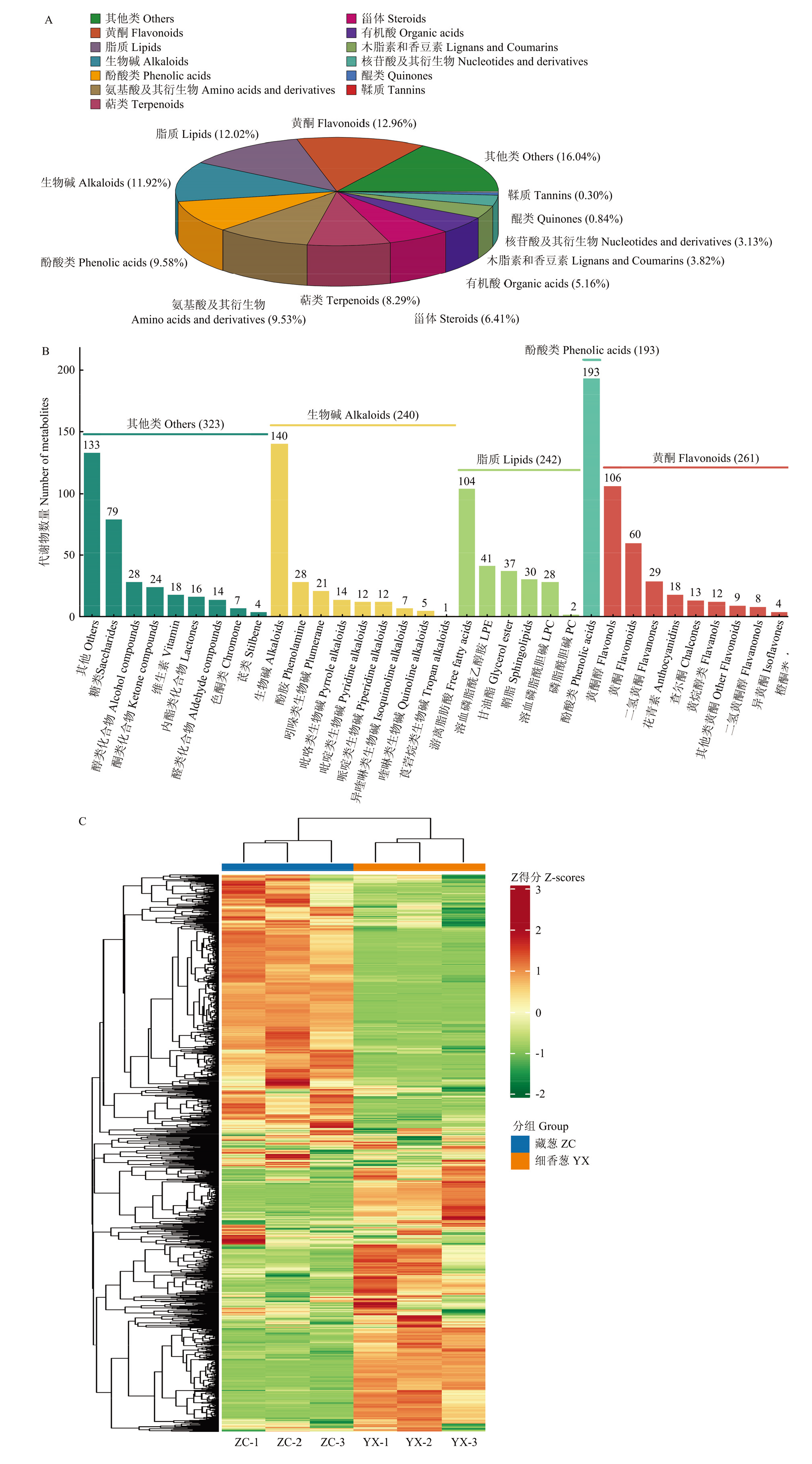
图3
藏葱和细香葱的代谢物概况分析 A:代谢物分类及占比;B:代谢物种类数量排名前五的分类;C:所有代谢物的聚类热图"

图4
代谢物多元统计分析 A:样品相关性分析;B:PCA分析;C:不同分组OPLS-DA得分图;D:OPLS-DA模型图"
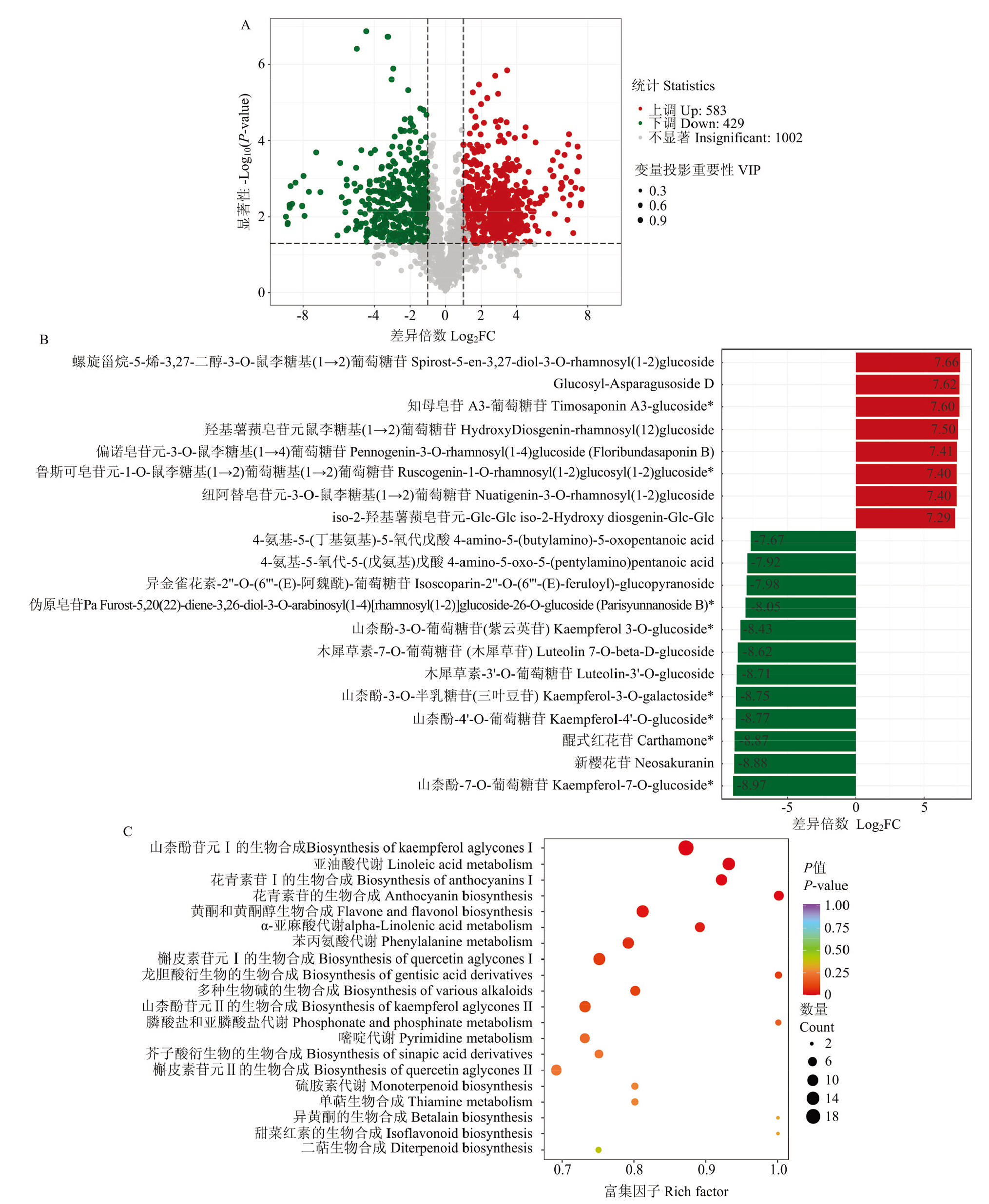
图5
差异代谢物筛选及功能富集分析 A:差异代谢物火山图;B:差异倍数排名前20的差异倍数柱状图,*:该物质存在同分异构体;C:差异代谢物KEGG富集图"
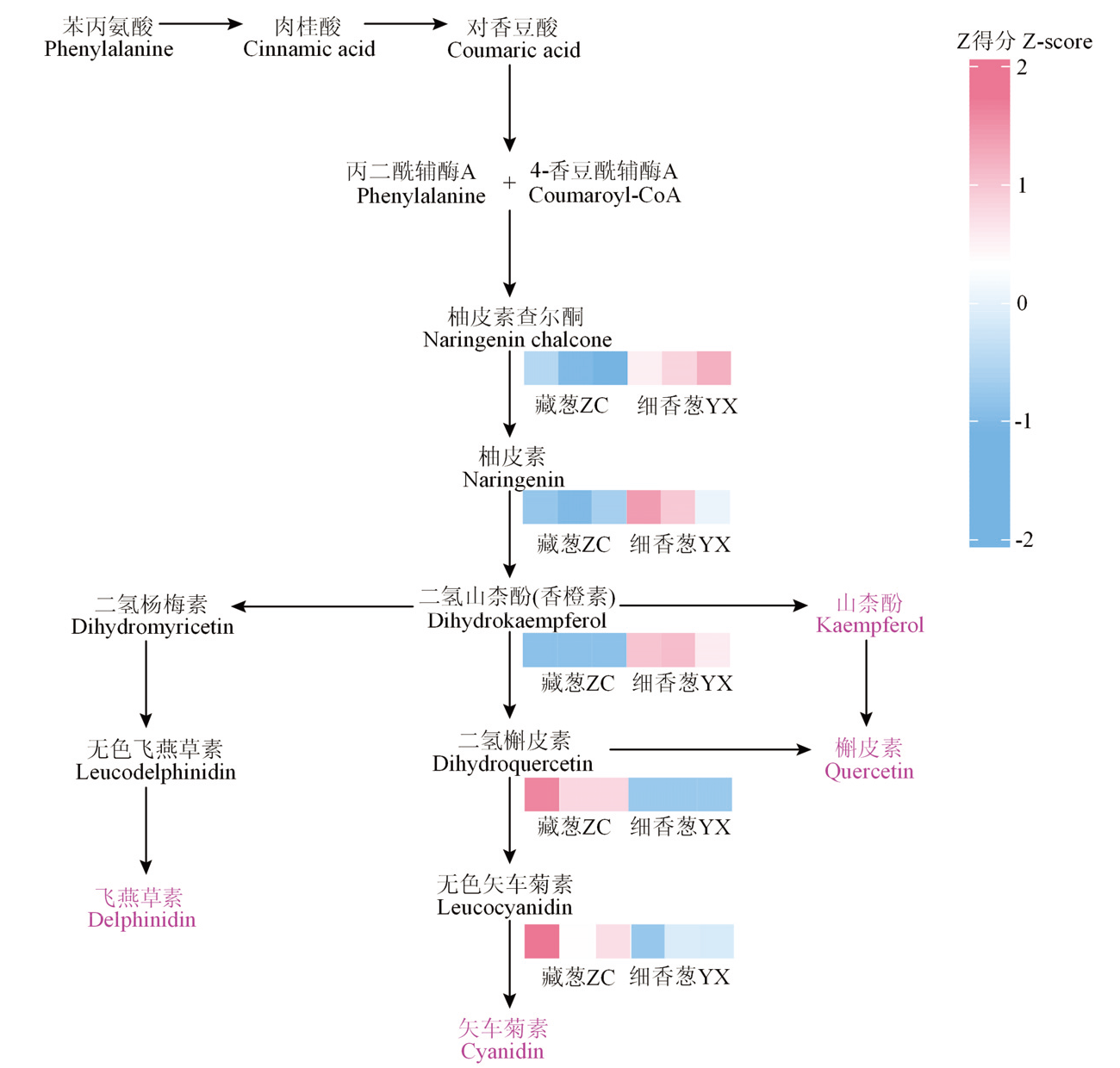
图6
黄酮类化合物生物合成途径及其代谢物相对含量比较 蓝色到红色表示代谢物相对含量从低到高。实线箭头表示直接合成。下同"

图7
飞燕草素及其下游代谢产物合成途径 虚线箭头表示间接合成。下同"
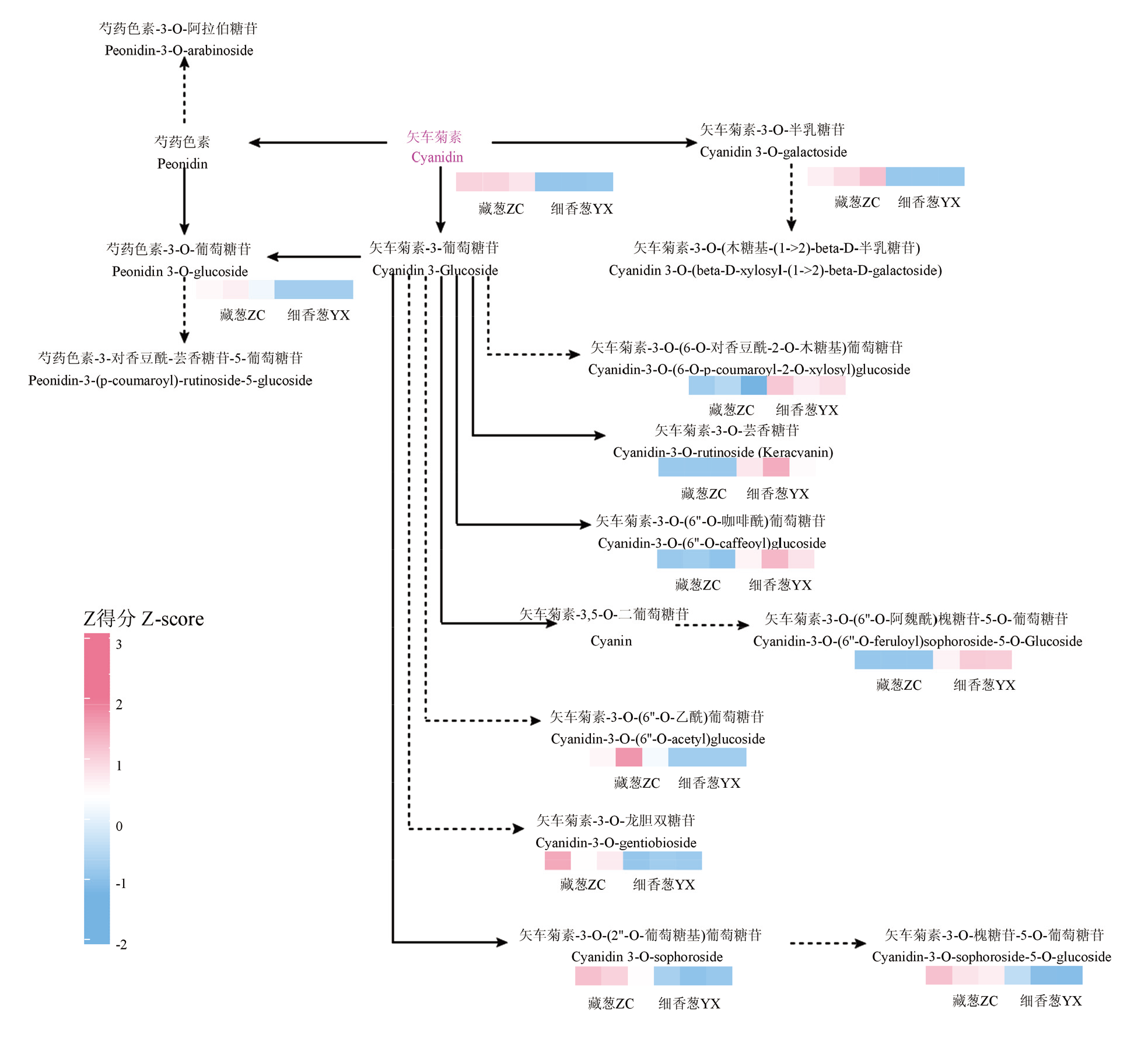
图8
矢车菊素及其下游代谢产物合成途径"
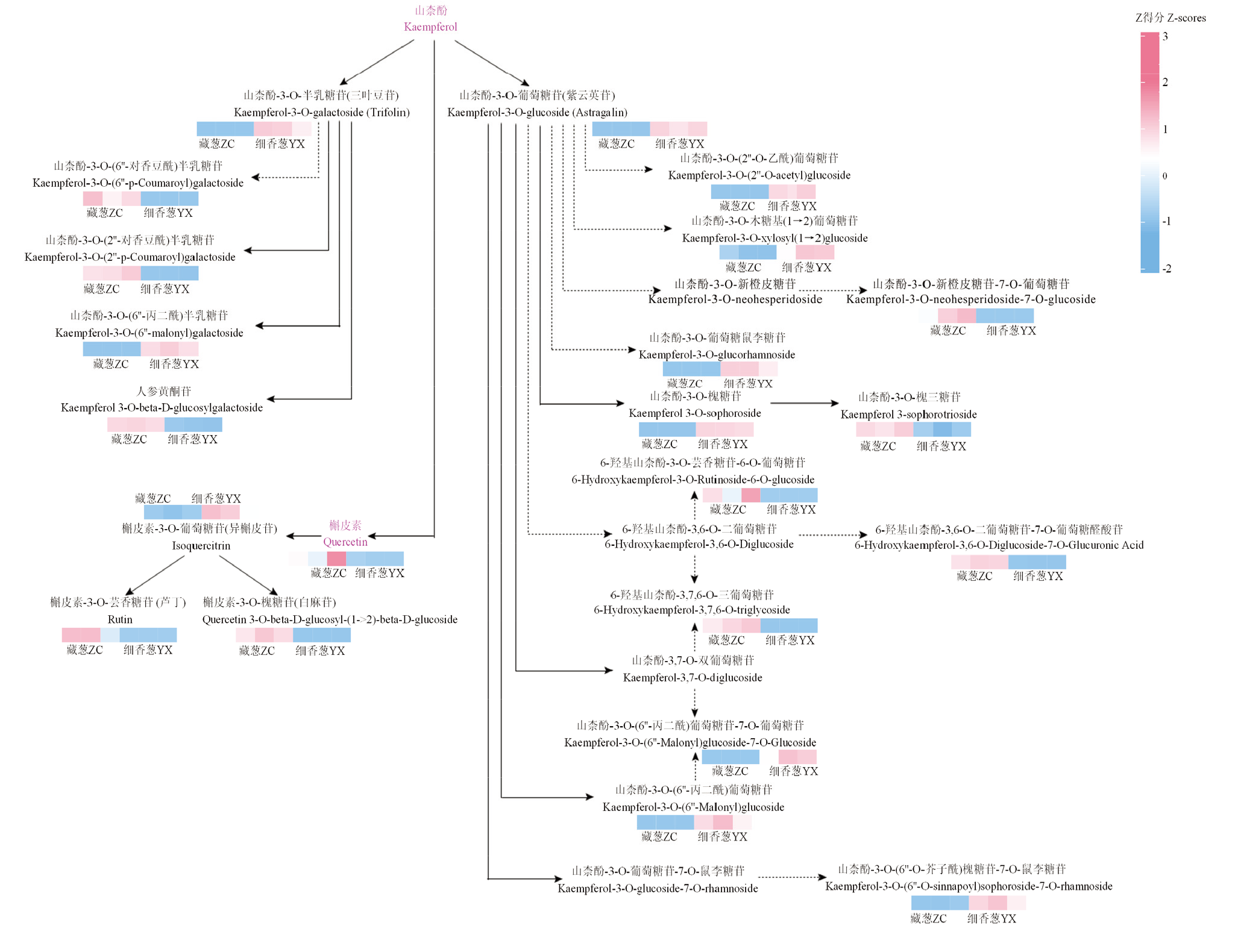
图9
山柰酚与槲皮素及其下游代谢产物合成途径"
| [1] |
doi: 10.1038/s41467-022-34491-3 |
| [2] |
|
| [3] |
王怀凤, 杨晓菊, 陈锋, 蒋兵涛, 郭好先. 藏葱扩繁技术研究. 农业科技通讯, 2017(9): 153-154.
|
|
|
|
| [4] |
王怀凤, 永毛, 胡金鑫, 王陆州, 王世彬, 李青, 程芳. 西藏部分葱属种质资源无靶向性鉴定分析. 西藏农业科技, 2020, 42(S1): 19-24.
|
|
|
|
| [5] |
王怀凤, 郭好先, 永毛, 李青, 程芳. 藏葱与栽培葱类营养品质比较. 农业科技通讯, 2020(5): 166-168.
|
|
|
|
| [6] |
贾丽娥, 张超, 袁树枝, 王丹, 赵晓燕, 马越, 王清, 王宝刚. 葱属蔬菜功能成分生物活性及贮藏温度对采后品质影响的研究进展. 农产品加工, 2024(19): 102-106, 110.
|
|
|
|
| [7] |
doi: 10.1016/j.foodchem.2017.05.043 |
| [8] |
王怀凤, 唐懿, 许琳玉, 王陆州, 永毛. 基于ISSR标记的西藏22份葱属材料的遗传多样性分析. 植物资源与环境学报, 2024, 33(5): 83-89.
|
|
|
|
| [9] |
鲁亚星. 寒葱活性成分分析及其咀嚼片制备工艺研究[D]. 延吉: 延边大学, 2018.
|
|
|
|
| [10] |
doi: 10.1080/09168451.2014.915722 |
| [11] |
doi: 10.1080/10408398.2022.2056132 |
| [12] |
|
| [13] |
张仕林. 洋葱鳞茎类黄酮类化合物含量及其转录组分析[D]. 南京: 南京农业大学, 2016.
|
|
|
|
| [14] |
|
| [15] |
|
| [16] |
尹建雄, 卢红, 谢强, 丁金玲, 李尼杭. 3, 5-二硝基水杨酸比色法快速测定烟草水溶性总糖、还原糖及淀粉的探讨. 云南农业大学学报, 2007, 22(6): 829-833, 838.
|
|
|
|
| [17] |
周春丽, 钟贤武, 范鸿冰, 吕玲琴, 苏虎, 李玉萍. 果蔬及其制品中可溶性总糖和还原糖的测定方法评价. 食品工业, 2012, 33(5): 89-92.
|
|
|
|
| [18] |
焦琳娟. 以磷酸为掩蔽剂的铁(Ⅱ)-邻二氮菲分光光度法间接测定雪莲果中维生素C含量. 韶关学院学报, 2012, 33(10): 51-53.
|
|
|
|
| [19] |
魏玲, 吕晓琴, 李学琴. 邻二氮菲分光光度法间接测定药片中维生素C的含量. 昌吉学院学报, 2008(2): 110-112.
|
|
|
|
| [20] |
顾银河, 赵文青, 史代伟, 胡伟, 王珊珊, 周治国, 王友华. 玉米抗寒性及其在低温条件下优化糖组分能力的相关性研究. 中国农业科学, 2024, 57(19): 3770-3783. doi: 10.3864/j.issn.0578-1752.2024.19.005.
|
|
|
|
| [21] |
翟江, 高原, 张晓伟, 韩鲁杰, 毕焕改, 李清明, 艾希珍. 硅钙对日光温室黄瓜光合作用及产量和品质的影响. 园艺学报, 2019, 46(4): 701-713.
doi: 10.16420/j.issn.0513-353x.2018-0687 |
|
|
|
| [22] |
曹建康, 姜微波, 赵玉梅. 果蔬采后生理生化实验指导. 北京: 中国轻工业出版社, 2007.
|
|
|
|
| [23] |
郑安然. 1-MCP和褪黑素处理对猕猴桃果实乙醇代谢及ERF转录因子表达的影响[D]. 杭州: 浙江工商大学, 2021.
|
|
|
|
| [24] |
生弘杰, 卢素文, 郑暄昂, 贾海锋, 房经贵. 基于广泛靶向代谢组学的葡萄种子代谢物鉴定与比较分析. 中国农业科学, 2023, 56(7): 1359-1376. doi: 10.3864/j.issn.0578-1752.2023.07.013.
|
|
|
|
| [25] |
doi: 10.1021/ac1003568 |
| [26] |
doi: 10.1093/mp/sst080 pmid: 23702596 |
| [27] |
doi: 10.1021/acs.jproteome.5b00354 pmid: 26088811 |
| [28] |
doi: 10.1093/nar/28.1.27 pmid: 10592173 |
| [29] |
杨帅, 高尚珠, 卢晗, 詹亚光, 曾凡锁. 植物细胞壁形成及在非生物胁迫中的作用. 植物生理学报, 2023, 59(7): 1251-1264.
|
|
|
|
| [30] |
马骊, 孙万仓, 刘自刚, 赵艳宁, 杨刚, 刘海卿, 武军艳, 方彦, 李学才, 刘林波, 等. 白菜型与甘蓝型冬油菜抗寒机理差异的研究. 华北农学报, 2016, 31(1): 147-154.
doi: 10.7668/hbnxb.2016.01.024 |
|
doi: 10.7668/hbnxb.2016.01.024 |
|
| [31] |
doi: 10.1016/j.cub.2024.01.045 |
| [32] |
马怀宇, 吕德国, 刘国成, 秦嗣军. 低温对‘寒富’苹果花芽渗透调节物质含量和膜脂过氧化的影响. 北方园艺, 2010(21): 1-4.
|
|
|
|
| [33] |
|
| [34] |
|
| [35] |
|
| [36] |
doi: 10.1021/jf000892m pmid: 11410016 |
| [37] |
doi: 10.1021/jf0712503 pmid: 17997520 |
| [38] |
doi: 10.1021/acs.jafc.5b01206 |
| [39] |
王佳蕊. 苦荞黄酮糖苷相关糖基转移酶基因的鉴定及功能验证[D]. 贵阳: 贵州师范大学, 2023.
|
|
|
|
| [40] |
doi: 10.3390/plants11162165 |
| [41] |
马瑞雪. 基于多组学技术的不同产地“宁杞1号” 枸杞黄酮类化合物生物合成差异研究[D]. 银川: 宁夏大学, 2023.
|
|
|
|
| [42] |
doi: 10.1016/S1369-703X(02)00221-8 |
| [43] |
|
| [44] |
袁利. UV-C处理对紫甘蓝花青素合成的影响以及花青素酰基转移酶的克隆[D]. 北京: 中国农业科学院, 2018.
|
|
|
|
| [45] |
doi: 10.3390/molecules17089361 |
| [46] |
doi: 10.1016/j.foodchem.2014.08.016 |
| [47] |
韩嘉琪. 百合资源遗传多样性分析及百合皂苷生物合成关键基因的挖掘[D]. 太谷: 山西农业大学, 2024.
|
|
|
|
| [48] |
doi: 10.4103/RPS.RPS_71_21 |
| [49] |
doi: 10.1007/s11101-014-9381-1 |
| [50] |
周燕燕. 百合科红葱水提物化学成分及体外活性研究[D]. 西安: 西北大学, 2020.
|
|
|
|
| [51] |
周小平, 王广树, 杨晓虹, 田丁丁. 分蘖葱头中甾体皂苷成分的分离与鉴定. 中国药物化学杂志, 2004, 14(2): 44-47.
|
|
|
|
| [52] |
doi: 10.1016/j.fitote.2014.08.022 |
| [53] |
doi: 10.1016/j.jff.2016.06.005 |
| [1] | 张利东, 郭一聪, 黄洪宇, 聂静, 王兵, 李梦雨, 李加旺, 眭晓蕾, 李愚鹤. 基于感官评价结合营养品质特征与风味物质特性关联分析黄瓜果实品质[J]. 中国农业科学, 2026, 59(5): 1087-1100. |
| [2] | 董金龙, 赵莹, 余海兵, 吕建晔, 秦佳琦, 梁晨, 明博, 李少昆. 多模型解析玉米籽粒容重的营养品质贡献度与区域异质性[J]. 中国农业科学, 2026, 59(5): 985-995. |
| [3] | 李赛亚, 徐雅萍, 郑佳兴, 郑杨, 于嘉慧, 李永强, 蒲首丞, 杨莉, 郭卫东. 34种越橘属植物叶片主要多酚组成及抗氧化能力评价[J]. 中国农业科学, 2026, 59(4): 874-886. |
| [4] | 季圣阳, 陆柏益, 李培武. 关于现代农产品品质学的若干思考[J]. 中国农业科学, 2025, 58(9): 1830-1844. |
| [5] | 罗自舒, 张怡嘉, 周瑢, 张艳欣, 周婷, 游均, 王林海. 芝麻叶片抗氧化活性的特征及优异抗氧化种质的筛选[J]. 中国农业科学, 2025, 58(19): 3814-3824. |
| [6] | 任家辉, 孙娟娟, 郝莹璐, 王凤梧, 王靖宇, 张明伟, 李宝涵, 郑成忠, 何竹青, 王照兰. 内蒙古中部地区饲用燕麦品种筛选及青贮品质评价[J]. 中国农业科学, 2025, 58(19): 4026-4038. |
| [7] | 唐佳灵, 张玉林, 杨勇, 方正锋, 韩国全, 惠腾. 日粮中添加酱油残渣压榨油脂对猪肉品质的影响[J]. 中国农业科学, 2025, 58(15): 3118-3133. |
| [8] | 王小军, 王金兰, 琚泽亮, 梁国玲, 贾志锋, 刘文辉, 马祥, 马金秀, 李文. 环青海湖地区不同饲用燕麦品种生产性能和营养品质综合评价[J]. 中国农业科学, 2024, 57(19): 3730-3742. |
| [9] | 辛朗, 宋嘉雯, 付媛媛, 唐茂淞, 敬凌琨, 王兴鹏. 咸淡水轮灌对设施番茄光合特性及叶片超微结构的影响[J]. 中国农业科学, 2024, 57(19): 3784-3798. |
| [10] | 叶雪莲, 陈靖雯, 姚祥坦, 权新华, 黄鹂. 不结球白菜叶片皱缩性状的遗传分析[J]. 中国农业科学, 2024, 57(18): 3684-3694. |
| [11] | 郑文燕, 常源升, 何平, 何晓文, 王森, 高文胜, 李林光, 王海波. ‘鲁丽’ב红1#’苹果杂交群体全基因组KASP标记开发及验证[J]. 中国农业科学, 2023, 56(5): 935-950. |
| [12] | 赵建涛, 杨开鑫, 王旭哲, 马春晖, 张前兵. 施磷对苜蓿叶片生理参数及抗氧化能力的影响[J]. 中国农业科学, 2023, 56(3): 453-465. |
| [13] | 高静, 陈吉玉, 谭先明, 吴雨珊, 杨文钰, 杨峰. 光强对苗期大豆叶片水力导度及叶脉性状的影响[J]. 中国农业科学, 2023, 56(22): 4417-4427. |
| [14] | 司雨凡, 李辉, 李子好, 姜翠霞, 郭昊南, 杨培志, 席杰军, 闫瑞瑞, 乌仁其其格, 山丹, 辛晓平. 草甸草原关键物种功能性状对长期放牧和停牧恢复的响应[J]. 中国农业科学, 2023, 56(18): 3693-3708. |
| [15] | 张文霞, 李盼, 殷文, 陈桂平, 樊志龙, 胡发龙, 范虹, 何蔚. 麦后复种绿肥及配施不同水平氮肥对小麦产量、品质及氮素利用的影响[J]. 中国农业科学, 2023, 56(17): 3317-3330. |
|
||
