






中国农业科学 ›› 2026, Vol. 59 ›› Issue (5): 1008-1019.doi: 10.3864/j.issn.0578-1752.2026.05.007
张琪( ), 陈二虎(), 孙德宏, 唐培安()
收稿日期:2025-11-19
接受日期:2025-12-29
出版日期:2026-03-01
发布日期:2026-03-06
通信作者:
联系方式:
张琪,E-mail:13468172235@163.com。
基金资助:
ZHANG Qi(), CHEN ErHu(), SUN DeHong, TANG PeiAn()
Received:2025-11-19
Accepted:2025-12-29
Published:2026-03-01
Online:2026-03-06
摘要:
【背景】 谷胱甘肽S-转移酶(GST)作为昆虫体内的重要代谢酶类,在害虫对化学药剂耐受性的形成中发挥重要作用。甲酸乙酯因具有高效、低毒和低残留等特点,被视为具有应用潜力的绿色储粮熏蒸剂。【目的】 分析锈赤扁谷盗(Cryptolestes ferrugineus)谷胱甘肽S-转移酶基因CfGSTe1和CfGSTd1与甲酸乙酯耐受性之间的关系,阐明锈赤扁谷盗对甲酸乙酯耐受性的分子机制。【方法】 以不同磷化氢抗性水平的锈赤扁谷盗为材料,测定其对甲酸乙酯的药剂敏感性。通过顺丁烯二酸二乙酯协同试验,评估其对甲酸乙酯熏蒸杀虫作用的增效效应,并分析甲酸乙酯处理对GST活性的影响。基于锈赤扁谷盗转录组数据鉴定获得两个关键谷胱甘肽S-转移酶基因(CfGSTe1和CfGSTd1),并进行氨基酸序列和系统发育分析。进一步利用实时荧光定量PCR解析两基因的时空表达特征及其在甲酸乙酯熏蒸胁迫下的转录响应变化。最后,通过RNA干扰(RNAi)技术分别沉默CfGSTe1和CfGSTd1,分析其对锈赤扁谷盗甲酸乙酯耐受性的影响。【结果】 生物测定结果表明,不同磷化氢抗性水平的锈赤扁谷盗对甲酸乙酯敏感性无显著差异,证实两种熏蒸剂间不存在交互抗性。增效剂顺丁烯二酸二乙酯可显著提高甲酸乙酯的熏蒸杀虫活性,且在药剂胁迫下锈赤扁谷盗GST活性显著升高。序列及进化树分析表明CfGSTe1和CfGSTd1分别编码216和215个氨基酸,均含有GST催化活性保守位点,属于Epsilon和Delta家族。实时荧光定量PCR结果显示,两基因均在成虫阶段显著高表达,主要在中肠、脂肪体和马氏管中表达,并可被甲酸乙酯熏蒸显著诱导。通过RNAi技术分别有效沉默CfGSTe1和CfGSTd1后,锈赤扁谷盗对甲酸乙酯耐受性显著降低,表现为熏蒸处理后成虫死亡率明显升高。【结论】 谷胱甘肽S-转移酶基因CfGSTe1和CfGSTd1可能在锈赤扁谷盗对甲酸乙酯解毒代谢过程中发挥重要作用,暗示其与昆虫甲酸乙酯耐受性间存在密切关系。
张琪, 陈二虎, 孙德宏, 唐培安. 锈赤扁谷盗谷胱甘肽S-转移酶基因CfGSTe1和CfGSTd1与甲酸乙酯耐受性关系[J]. 中国农业科学, 2026, 59(5): 1008-1019.
ZHANG Qi, CHEN ErHu, SUN DeHong, TANG PeiAn. Relationship Between Glutathione S-Transferase Genes CfGSTe1 and CfGSTd1 and Ethyl Formate Tolerance in Cryptolestes ferrugineus[J]. Scientia Agricultura Sinica, 2026, 59(5): 1008-1019.
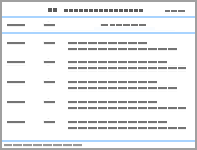
表1
不同地理种群锈赤扁谷盗磷化氢敏感性"
| 种群Population | 经纬度<BOLD>L</BOLD>ongitude and latitude | 采集时间Collection time | 抗性倍数Resistance ratio | 抗性水平Resistance level |
|---|---|---|---|---|
| SH | 31.25° N, 121.46° E | 2021-06 | 1.4 | 低抗Low resistance |
| ST | 28.72° N, 112.81° E | 2021-08 | 14.0 | 中抗Moderate resistance |
| XY | 28.62° N, 112.94° E | 2021-08 | 45.8 | 高抗High resistance |
表2
本研究RT-qPCR所用引物序列"
| 引物名称Primer name | 引物序列Primer sequence (5′ to 3′) | 决定系数Determination coefficient (R2) | 扩增效率Amplification efficiency (%) |
|---|---|---|---|
| CfGSTe1-F | TACTGAACGACTACCAACT | 1.000 | 92.38 |
| CfGSTe1-R | GCATTTCCTTAATCCATTCG | 0.998 | 101.87 |
| CfGSTd1-F | CTTGCTGATTTGGCTTTGG | 0.996 | 92.76 |
| CfGSTd1-R | CATTGGCTTCTTCGTAACC | 0.999 | 93.29 |
| RPS13-F | ATCCGTAAGCATTTGGAACG | 0.996 | 99.19 |
| RPS13-R | AGCCACTAAGGCTGAAGCTG | 0.998 | 102.74 |
| EF1α-F | CCAGGCATGGTAGTGACCTT | 0.991 | 94.26 |
| EF1α-R | TTGGAGGGTTGTTTTTGGAG | 0.993 | 97.76 |
表3
本研究所用dsRNA合成引物序列"
| 引物名称 Primer name | 引物序列 Primer sequence (5′ to 3′) |
|---|---|
| dsCfGSTe1-F | ggatcctaatacgactcactataggCATACTGTTCCCACTTT |
| dsCfGSTe1-R | ggatcctaatacgactcactataggCACCAAACTGAAATCTG |
| dsCfGSTd1-F | ggatcctaatacgactcactataggGGAGAACACCTTACACCAGAA |
| dsCfGSTd1-R | ggatcctaatacgactcactataggTTGACCTTAGCGTACCACTT |
| dsGFP-F | ggatcctaatacgactcactataggATGGTGAGCAAGGGCGAGA |
| dsGFP-R | ggatcctaatacgactcactataggTTACTTGTACAGCTCGTCCA |
表4
甲酸乙酯对不同种群锈赤扁谷盗的毒力"
| 种群<BOLD>P</BOLD>opulation | LC50(95%置信区间95% CI)(μL·L-1) | 回归方程Regression equation (y=) | 决定系数Determination coefficient (R2) |
|---|---|---|---|
| XY | 21.68 (21.05-22.32) | 15.47x-15.67 | 0.990 |
| ST | 21.58 (21.01-22.16) | 18.55x-19.74 | 0.992 |
| SH | 23.70 (22.68-24.79) | 11.24x-10.45 | 0.998 |

图1
增效剂处理对甲酸乙酯熏蒸下锈赤扁谷盗成虫死亡率的影响 柱上标有不同小写字母表示处理间差异显著。图5、图7同"
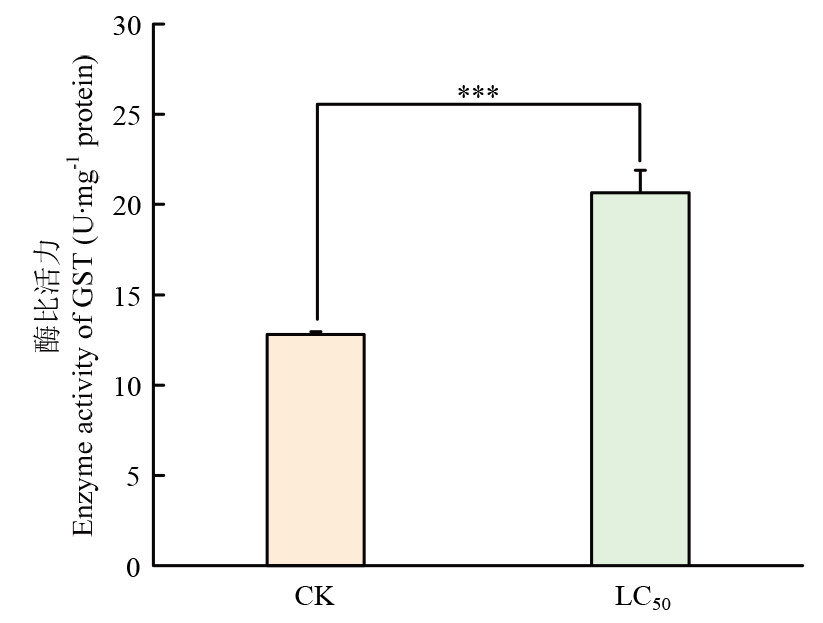
图2
甲酸乙酯处理对锈赤扁谷盗GST活性的影响 采用独立样本t检验分析差异显著性。图6同"

图3
锈赤扁谷盗与其他昆虫GST的氨基酸序列比对 红色方框和蓝色方框分别代表N端结构域和C端结构域;黄色方框标记谷胱甘肽结合位点;黑色方框标记疏水底物结合位点"

图4
锈赤扁谷盗和其他昆虫GST氨基酸序列的系统进化树 Cf:锈赤扁谷盗C. ferrugineus;Bm:家蚕B. mori;Tc:赤拟谷盗T. castaneum;Dm:黑腹果蝇D. melanogaster"
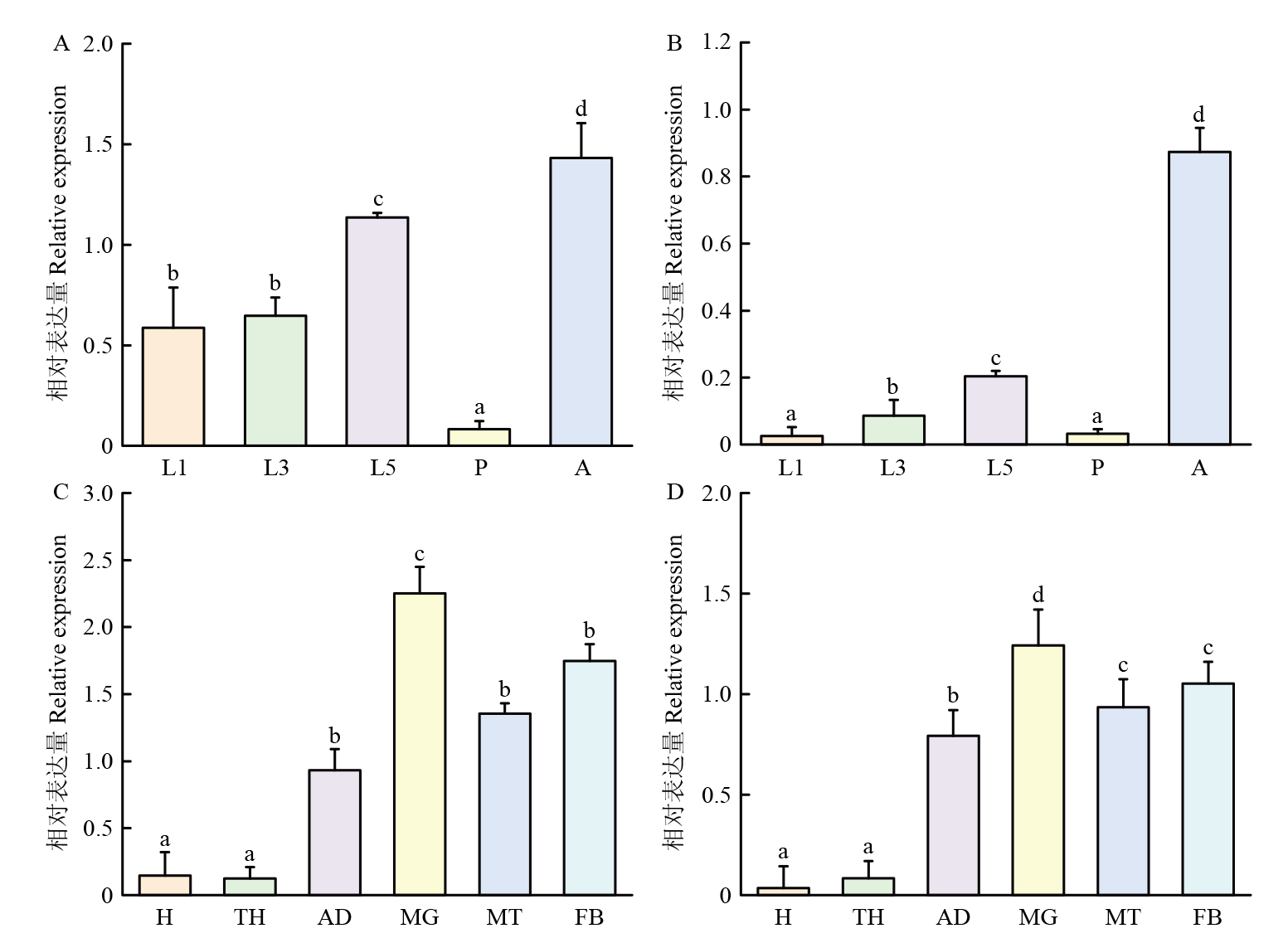
图5
CfGSTe1和CfGSTd1的时空表达模式 A、B:CfGSTe1、CfGSTd1在不同发育时期的表达量The expression levels of CfGSTe1, CfGSTd1 at different developmental stages(L1:1龄幼虫1st instar larva,L3:3龄幼虫3rd instar larva,L5:5龄幼虫5th instar larva,P:蛹Pupa,A:成虫Adult);C:CfGSTe1、CfGSTd1在不同组织中的表达量The expression levels of CfGSTe1, CfGSTd1 in different tissues(H:头Head,TH:胸Thorax,AD:腹Abdomen,MG:中肠Midgut,MT:马氏管Malpighian tubules,FB:脂肪体Fat body)"

图6
甲酸乙酯处理后CfGSTe1和CfGSTd1相对表达量变化"
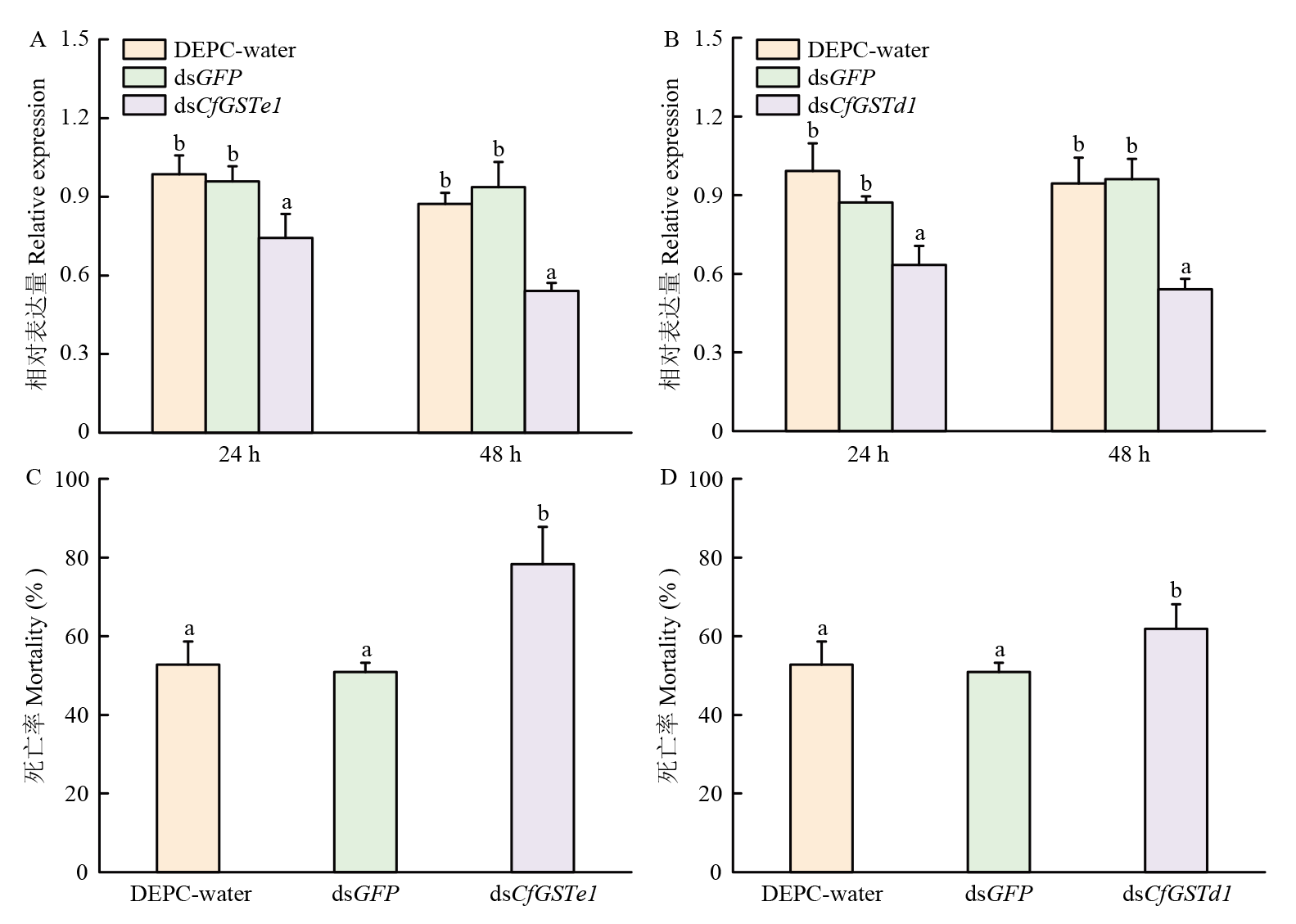
图7
CfGSTe1和CfGSTd1沉默效率及基因沉默后药剂敏感性变化"
| [1] |
胡丽华, 郭敏, 张景虎, 任娜. 储粮害虫检测新技术及应用现状. 农业工程学报, 2007, 23(11): 286-290.
|
|
|
|
| [2] |
王效国, 宋瑞成. 浅谈锈赤扁谷盗的习性与防治. 中国粮食经济, 2009(7): 40-41.
|
|
|
|
| [3] |
doi: 10.1016/j.jspr.2015.05.002 |
| [4] |
doi: 10.1016/j.jspr.2019.02.003 |
| [5] |
doi: 10.1016/j.jhazmat.2022.130141 |
| [6] |
doi: 10.1016/j.jspr.2020.101690 |
| [7] |
唐黎标. 储粮害虫防治现状与问题研讨. 粮食问题研究, 2018(4): 43-45.
|
|
|
|
| [8] |
doi: 10.1016/j.scitotenv.2022.159629 |
| [9] |
|
| [10] |
|
| [11] |
doi: 10.1002/(SICI)1096-9063(199908)55:8<>1.0.CO;2-M |
| [12] |
杨璐, 戴仁怀, 杨洪, 江兆春, 李敏, 杨燕琼. 甲酸乙酯和异硫氰酸甲酯混用对菜豆象的熏蒸活性研究. 山地农业生物学报, 2022, 41(1): 79-83.
|
|
|
|
| [13] |
王诗琦, 汪苏杭, 钟梓春, 吴洪鑫, 何柳燕, 郭玉静, 黄孙滨, 许小霞, 金丰良, 庞锐. 稻飞虱抗药性现状及抗性机制研究进展. 环境昆虫学报, 2025, 47(5): 1341-1353.
|
|
|
|
| [14] |
刘蔓文. 赤拟谷盗CYP346基因家族介导磷化氢抗性的机理研究[D]. 南京: 南京财经大学, 2019.
|
|
|
|
| [15] |
doi: 10.1016/j.aspen.2018.11.012 |
| [16] |
doi: 10.1007/s10340-019-01088-7 |
| [17] |
高新菊, 沈慧敏. 二斑叶螨对甲氰菊酯的抗性选育及解毒酶活力变化. 昆虫学报, 2011, 54(1): 64-69.
|
|
|
|
| [18] |
|
| [19] |
doi: 10.1111/j.1365-2583.2004.00529.x pmid: 15663770 |
| [20] |
doi: 10.1016/j.ibmb.2003.12.001 |
| [21] |
|
| [22] |
叶侃. 米象磷化氢抗性相关基因的表达分析[D]. 合肥: 合肥工业大学, 2019.
|
|
|
|
| [23] |
余波, 吴云龙, 王利利, 苗世远, 许安君, 鲁玉杰. 磷化氢与三种防护剂联用对三种主要储粮害虫的防治作用. 应用昆虫学报, 2025, 62(2): 319-326.
|
|
|
|
| [24] |
doi: 10.1093/molbev/msw054 pmid: 27004904 |
| [25] |
doi: 10.1006/meth.2001.1262 |
| [26] |
doi: 10.1017/S000748530005152X |
| [27] |
doi: 10.1016/j.pestbp.2019.07.008 |
| [28] |
pmid: 21882711 |
| [29] |
doi: 10.1146/annurev-ento-011019-025047 pmid: 31610132 |
| [30] |
doi: 10.1093/jee/tox284 pmid: 29182779 |
| [31] |
doi: 10.1002/ps.v62:4 |
| [32] |
|
| [33] |
doi: 10.1002/ps.1783 pmid: 19466692 |
| [34] |
doi: 10.1016/j.jspr.2008.02.003 |
| [35] |
doi: 10.3390/agriculture14020323 |
| [36] |
doi: 10.1002/ps.1895 pmid: 20014158 |
| [37] |
doi: 10.1002/ps.v78.10 |
| [38] |
pmid: 5513938 |
| [39] |
张芮铭. 甜菜夜蛾对茚虫威的抗性机制及其适合度代价研究[D]. 杨凌: 西北农林科技大学, 2025.
|
|
|
|
| [40] |
doi: 10.1186/s12864-015-1343-5 |
| [41] |
胡超. 苹果蠹蛾代谢高效氯氟氰菊酯GSTs基因的鉴定及功能分析[D]. 沈阳: 沈阳农业大学, 2021.
|
|
|
|
| [42] |
陈绪虹. 赤拟谷盗抗性相关GSTs基因筛选、功能分析及TcGSTd1差异转录组学分析[D]. 南京: 南京师范大学, 2016.
|
|
|
|
| [43] |
刘茜雅. 烟草甲谷胱甘肽-S-转移酶基因鉴定及其对高温和高效氯氟氰菊酯的响应[D]. 合肥: 安徽农业大学, 2022.
|
|
|
|
| [44] |
pmid: 19280710 |
| [45] |
doi: 10.1093/jee/toy411 |
| [46] |
刘雯雯, 徐远, 胡连清, 周万海, 席万鹏, 朱文优, 黄奇, 刘雅馨, 罗靓颖, 冯瑞章. 油樟精油对米象和赤拟谷盗的毒力及酶活性影响. 农业工程学报, 2025, 41(7): 308-317.
|
|
|
|
| [47] |
doi: 10.1016/j.jspr.2025.102714 |
| [48] |
doi: 10.1002/ps.2018.74.issue-3 |
| [49] |
doi: 10.1016/j.pestbp.2016.04.003 |
| [1] | 江峰, 吴春燕, 王亦好, 杨泽众, 龚成, 罗晨. 烟粉虱MED脂肪酸延长酶基因家族鉴定和表达分析[J]. 中国农业科学, 2026, 59(4): 793-806. |
| [2] | 鄢文英, 张元珍, 吴洪鑫, 庞锐, 陈泽鹏, 金丰良, 许小霞. 靶向小菜蛾PxGNBP3的RNAi增效绿僵菌构建及其免疫调控机制[J]. 中国农业科学, 2026, 59(3): 556-574. |
| [3] | 吴琼, 谢香庭, 王磊, 牟勇, 李进伟. 转基因大豆DBN8205转化体特异性定量PCR方法的研发和验证[J]. 中国农业科学, 2026, 59(1): 29-40. |
| [4] | 陈二虎, 唐静杰, 胡顺杰, 唐培安. 热激蛋白基因CfHsp70-1和CfHsp70-2在热驯化增强锈赤扁谷盗高温耐受性中的作用[J]. 中国农业科学, 2025, 58(5): 918-928. |
| [5] | 肖焯丹, 乔家正, 高渝岚, 尚掌印, 刘怀, 王佳. 沉默豆蚜细胞色素P450基因CYP6CY53和CYP302A1增强对氟啶虫酰胺的敏感性[J]. 中国农业科学, 2025, 58(18): 3664-3675. |
| [6] | 杨文娟, 高嘉诚, 王艳婷, 李妍, 郭铭, 汪军成, 孟亚雄, 王化俊, 司二静. 条纹病菌效应蛋白Pg00778调控对大麦致病力的作用[J]. 中国农业科学, 2025, 58(15): 3020-3035. |
| [7] | 陈二虎, 袁国庆, 陈艳, 陈梦秋, 孙晟源, 唐培安. 线粒体编码基因Nad5、Nad6和Atp6参与锈赤扁谷盗磷化氢抗性形成[J]. 中国农业科学, 2024, 57(9): 1722-1733. |
| [8] | 王程泽, 张燕, 付伟, 贾京哲, 董金皋, 申珅, 郝志敏. 玉米ACO基因家族生物信息学及表达模式分析[J]. 中国农业科学, 2024, 57(7): 1308-1318. |
| [9] | 罗丽丹, 陈嘉明, 安琪, 刘磊, 孙勤哲, 刘欢, 王森山, 宋丽雯. 极端高温对截形叶螨体内海藻糖含量及海藻糖转运蛋白基因的影响[J]. 中国农业科学, 2024, 57(6): 1091-1101. |
| [10] | 赵艺妍, 郭红芳, 刘卫敏, 赵小明, 张建珍. 飞蝗载脂蛋白对卵巢发育和脂质沉积的影响[J]. 中国农业科学, 2024, 57(4): 711-720. |
| [11] | 赵婕, 赵龙缘, 潘凝辉, 管丽蓉, 杜云龙, 李成云, 王云月, 谢勇. 水解酶基因BGIOSGA023826在稻瘟菌侵染过程中的抗病表型效应[J]. 中国农业科学, 2024, 57(23): 4607-4618. |
| [12] | 李楚欣, 宋晨虎, 周金环, 李佳欣, 王新亮, 田旭斌, 宋震. 基于VIGS的柑橘黄化脉明病毒防控技术研究[J]. 中国农业科学, 2024, 57(22): 4473-4482. |
| [13] | 袁国庆, 陈二虎, 唐培安. 线粒体编码基因ND6和ATP6介导锈赤扁谷盗低温耐受性形成的机制[J]. 中国农业科学, 2024, 57(22): 4483-4494. |
| [14] | 王妮, 施哲逸, 尤元政, 张超, 周文武, 周瀛, 祝增荣. miRNA对褐飞虱鞘脂质代谢基因表达的影响及沉默NlSPT1和NlSMase4的small RNA分析[J]. 中国农业科学, 2024, 57(20): 4022-4034. |
| [15] | 张英, 原青云, 任芳, 胡国君, 范旭东, 董雅凤. 葡萄浆果内坏死病毒RT-qPCR检测技术建立及其在葡萄砧木中的时空分布规律[J]. 中国农业科学, 2024, 57(14): 2771-2780. |
|
||
