






中国农业科学 ›› 2026, Vol. 59 ›› Issue (22): 5174-5193.doi: 10.3864/j.issn.0578-1752.2026.22.015
王阳1,2( ), 佟伟1,2(), 刘振君1,2, 李慧心1, 吴欣冉1, 邹秀琴3(), 娄钰静3
收稿日期:2026-04-10
接受日期:2026-05-27
出版日期:2026-11-16
发布日期:2026-11-19
通信作者:
联系方式:
王阳,E-mail:wangyang@caas.cn。
基金资助:
WANG Yang1,2(), TONG Wei1,2(), LIU ZhenJun1,2, LI HuiXin1, WU XinRan1, ZOU XiuQin3(), LOU YuJing3
Received:2026-04-10
Accepted:2026-05-27
Published:2026-11-16
Online:2026-11-19
摘要:
【目的】探究转色后3个时期的杨梅挥发性香气物质变化规律,明确3个时期杨梅的关键和差异挥发性香气物质,为进一步阐明杨梅香气形成机制提供数据基础,并为加工产品开发利用提供科学依据。【方法】以转色后3个时期(转红期、红熟期和成熟期)的杨梅果实为研究对象,测定其果实基本品质,通过感官评价结合顶空固相微萃取-气相色谱-质谱联用(headspace solid-phase microextraction with gas chromatography-mass spectrometry,HS-SPME-GC-MS)技术,对转色后3个时期杨梅果实的挥发性香气成分(volatile aroma components,VACs)进行定性定量分析,并采用主成分分析(principal component analysis,PCA)、气味活性值(odorant activity value,OAV)、正交偏最小二乘判别分析(orthogonal partial least squares discriminant analysis,OPLS-DA)及K-means聚类分析等方法,解析转色后3个时期杨梅果实香气物质的组成特征以及关键、差异香气物质。【结果】随着转色进程的推进,果实基本品质发生变化,但气味强度变弱。HS-SPME-GC-MS分析共鉴定出93种挥发性化合物,主要包括酯类、醇类、醛类、酮类、烯烃类、芳香烃类、烷烃类及其他类,转红期60种,红熟期66种,成熟期61种,并且转红期和红熟期均以烯烃类种类占比最高,成熟期以酯类占比最高,3个时期的杨梅果实均以烯烃类化合物含量最高。根据OAV≥1共筛选出7种关键香气物质(芳樟醇、2-己烯醛、壬醛、(E)-2-癸烯醛、1-辛烯-3-酮、6-甲基-5-庚烯-2-酮和石竹烯)。PCA表明,2个主成分累计贡献率达94.65%,根据OPLS-DA得出3组间有89种差异VACs,K-means聚类分析将差异VACs分为5类,第1类中的差异VACs含量随着成熟度的增加而增加;与之相反,第3类的差异VACs含量随着成熟度的增加而减少,并且完美反映了转红期与成熟期负相关的VACs。【结论】杨梅随着成熟度的推进而香气强度变弱,烯烃类物质含量下降,酯类物质含量上升,体现了3个时期杨梅果实香气“质”的转变与“量”的减弱的复合现象。
王阳, 佟伟, 刘振君, 李慧心, 吴欣冉, 邹秀琴, 娄钰静. 基于HS-SPME-GC-MS的杨梅转色阶段挥发性香气组分差异分析[J]. 中国农业科学, 2026, 59(22): 5174-5193.
WANG Yang, TONG Wei, LIU ZhenJun, LI HuiXin, WU XinRan, ZOU XiuQin, LOU YuJing. Differential Analysis of Volatile Aroma Components During Coloration Stage of Bayberry Fruit Based on HS-SPME-GC-MS[J]. Scientia Agricultura Sinica, 2026, 59(22): 5174-5193.
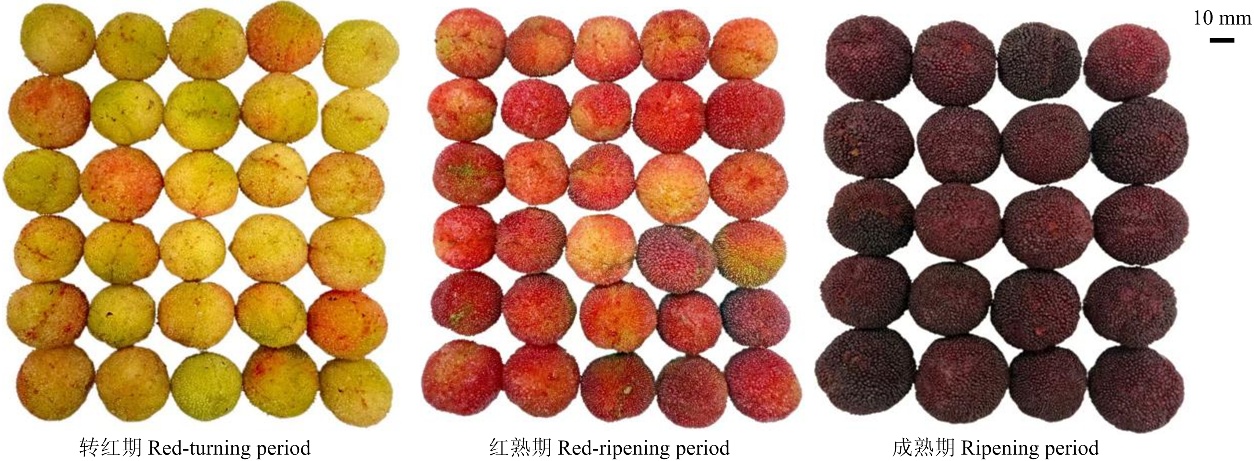
图1
杨梅不同时期样品照片"
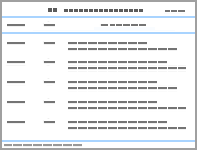
表1
杨梅香气感官评价表"
| 感官评价指标 Sensory evaluation indicators | 评价等级 Evaluation grade |
|---|---|
| 青草香 Grass fragrance | 0=无;1=极弱;2=很弱;3=较弱;4=稍弱;5=中等;6=稍强;7=较强;8=很强;9=极强 0=None; 1=Very weak; 2=Weak; 3=Moderately weak; 4=Slightly weak; 5=Medium; 6=Slightly strong; 7=Strong; 8=Very strong; 9=Extremely strong |
| 花香 Floral fragrance | |
| 果香 Fruital | |
| 木香 Wood-like fragrance | |
| 甜香 Sweet and fragrant aroma | |
| 香气强度 Intensity of aroma |
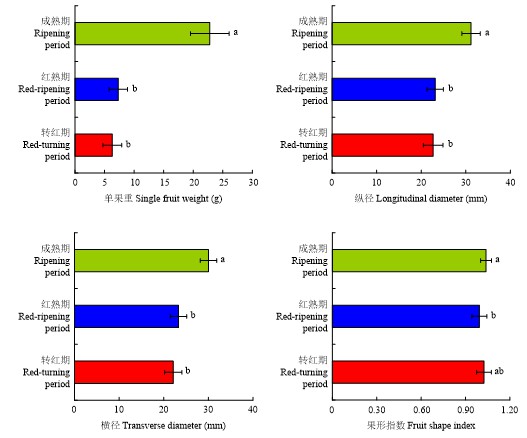
图2
转色3个时期杨梅的单果重、纵径、横径、果形指数 不同小写字母表示差异显著(P<0.05)。下同"
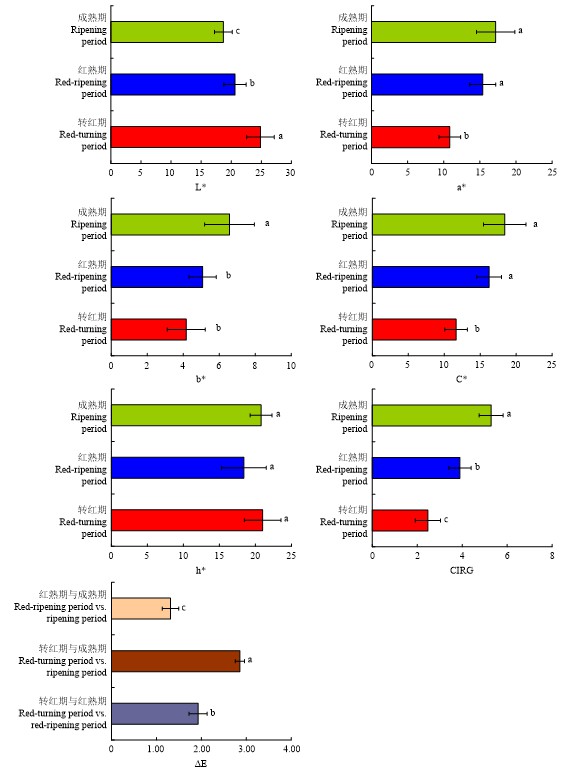
图3
转色3个时期杨梅的色差值"
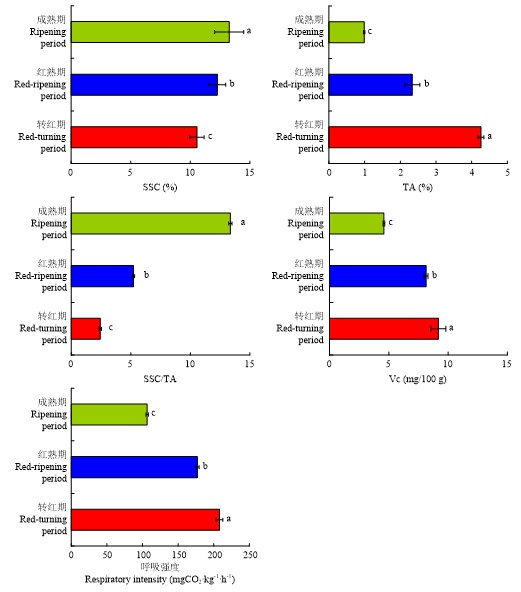
图4
转色3个时期杨梅的SSC、TA、SSC/TA、Vc及呼吸强度"
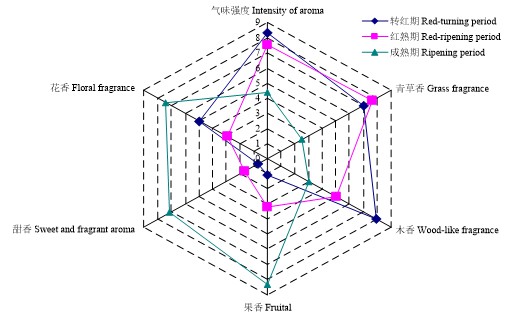
图5
转色3个时期杨梅的VACs感官评价雷达图"
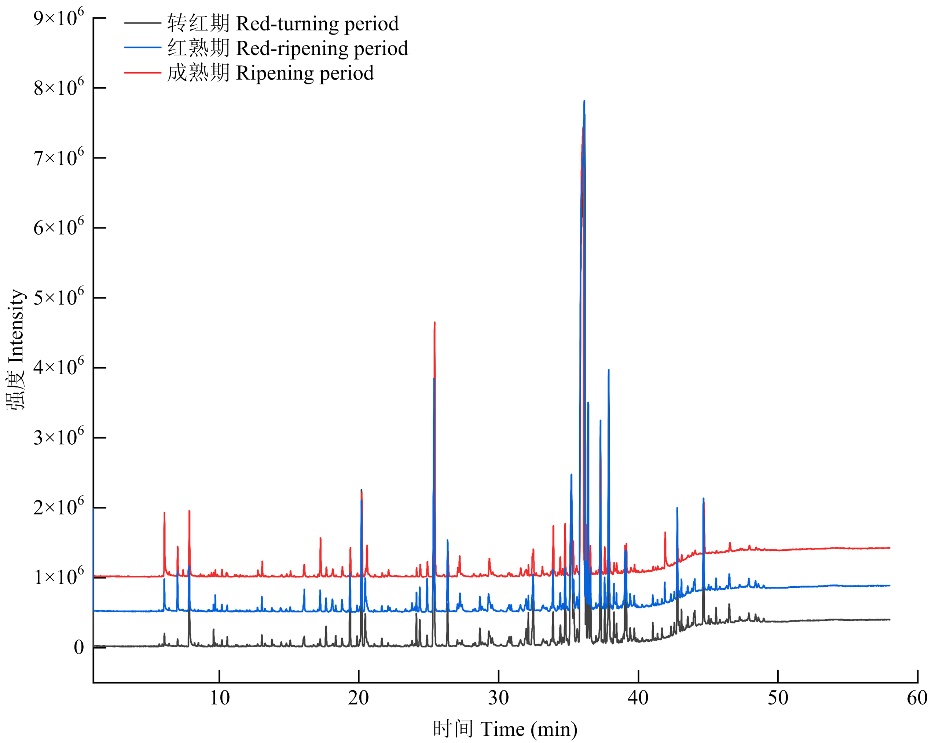
图6
转色3个时期杨梅挥发性香气成分的总离子流图"
表2
转色3个时期杨梅的VACs含量"
| 类别 Classification | 名称 Name | 含量 Content (μg·kg-1) | ||
|---|---|---|---|---|
| 转红期 Red-turning period | 红熟期 Red-ripening period | 成熟期 Ripening period | ||
| 酯类 Esters | (E)-2-戊烯酸甲酯 2-Pentenoic acid, methyl ester, (E)- | ND | ND | 0.83±0.08 |
| (Z)-3-己烯酸甲酯 3-Hexenoic acid, methyl ester, (Z)- | 4.87±0.07c | 8.97±1.75b | 25.87±5.12a | |
| 乙酸甲酯 Acetic acid, methyl ester | 7.76±0.76c | 23.13±3.17b | 44.83±4.05a | |
| 2-甲基丁酸乙酯 Butanoic acid, 2-methyl-, ethyl ester | ND | ND | 0.50±0.05 | |
| 2-甲基丁酸甲酯 Butanoic acid, 2-methyl-, methyl ester | ND | ND | 3.82±0.87 | |
| 3-羟基-3-甲基丁酸甲酯 Butanoic acid, 3-hydroxy-3-methyl-, methyl ester | ND | ND | 1.52±0.31 | |
| 3-甲基丁酸乙酯 Butanoic acid, 3-methyl-, ethyl ester | ND | ND | 0.33±0.03 | |
| 丁酸乙酯 Butanoic acid, ethyl ester | ND | ND | 0.97±0.09 | |
| 丁酸甲酯 Butanoic acid, methyl ester | 0.58±0.05b | 0.53±0.06b | 2.06±0.27a | |
| 2-羟基己酸甲酯 Hexanoic acid, 2-hydroxy-, methyl ester | ND | ND | 10.47±0.14 | |
| 己酸甲酯 Hexanoic acid, methyl ester | 5.62±0.35c | 15.55±0.95b | 24.73±1.64a | |
| 异丁酸甲酯 Methyl isobutyrate | ND | ND | 2.65±0.15 | |
| 异戊酸甲酯 Methyl isovalerate | 0.23±0.03c | 0.52±0.06b | 1.95±0.22a | |
| 丙酸甲酯 Methyl propionate | ND | 0.67±0.08b | 2.72±0.26a | |
| 戊酸甲酯 Methyl valerate | ND | 0.63±0.07b | 1.26±0.13a | |
| 2-羟基-3-甲基戊酸甲酯 Pentanoic acid, 2-hydroxy-3-methyl-, methyl ester | ND | ND | 4.52±0.24 | |
| 2-甲基丙酸乙酯 Propanoic acid, 2-methyl-, ethyl ester | ND | ND | 0.68±0.08 | |
| 丙酸-4-己烯-1-基酯 Propanoic acid, 4-hexen-1-yl ester | 1.82±0.04 | ND | ND | |
| 丙酸乙酯 Propanoic acid, ethyl ester | ND | 0.36±0.07b | 1.18±0.04a | |
| 3-甲基丁基乙酸酯 1-Butanol, 3-methyl-, acetate | ND | 2.92±0.83a | 0.48±0.09b | |
| (Z)-乙酸-3-己烯酯 3-Hexen-1-ol, acetate, (Z)- | ND | 1.92±0.25a | 0.58±0.15b | |
| 醇类 Alcohols | (3R, 6S)-2, 2, 6-三甲基-6-乙烯基四氢-2H-吡喃-3-醇 (3R, 6S)-2, 2, 6-Trimethyl-6-vinyltetrahydro-2H-pyran-3-ol | 2.80±0.20a | 2.69±0.52a | ND |
| α-松油醇 α-Terpineol | 22.64±2.23a | 17.77±0.54b | 7.06±0.15c | |
| 正丁醇 1-Butanol | 0.35±0.13b | 0.58±0.12a | 0.38±0.01b | |
| 3-甲基-1-丁醇 1-Butanol, 3-methyl- | ND | 13.67±1.84 | ND | |
| 正己醇 1-Hexanol | 8.88±0.36c | 26.77±3.05a | 11.52±1.72b | |
| 2-乙基-1-己醇 1-Hexanol, 2-ethyl- | ND | 7.16±0.91b | 8.31±1.20a | |
| 正辛醇 1-Octanol | 3.78±0.76b | 4.84±0.55a | 3.02±0.69b | |
| (E)-2-己烯-1-醇 2-Hexen-1-ol, (E)- | ND | ND | 3.19±0.31 | |
| 4-甲基-2-戊烯-1-醇 2-Penten-1-ol, 4-methyl- | ND | 0.70±0.07 | ND | |
| (E)-3-己烯-1-醇 3-Hexen-1-ol, (E)- | 36.67±1.79b | 60.98±7.45a | 21.25±0.95c | |
| (E)-3-壬烯-1-醇 3-Nonen-1-ol, (E)- | 0.72±0.10 | ND | ND | |
| 石竹烯醇 Caryophyllenyl alcohol | 90.98±3.99a | ND | 29.99±2.35b | |
| 葎草烷-1,6-二烯-3-醇 Humulane-1,6-dien-3-ol | ND | 66.05±2.48 | ND | |
| 葎草烯醇-Ⅱ Humulenol-II | 1.56±0.26 | ND | ND | |
| 芳樟醇 Linalool | 30.81±1.68b | 32.7±1.71b | 39.16±9.31a | |
| 2-甲基-2-丁醇 Amylene hydrate | 4.22±0.36a | 3.88±0.16a | ND | |
| 类别 Classification | 名称 Name | 含量 Content (μg·kg-1) | ||
| 转红期 Red-turning period | 红熟期 Red-ripening period | 成熟期 Ripening period | ||
| 醛类Aldehydes | (E)-2-庚烯醛 2-Heptenal, (E)- | 6.40±0.98b | 7.49±0.61a | 0.90±0.12c |
| 2-己烯醛 2-Hexenal | 7.86±0.54b | 11.45±1.29a | 8.31±1.76b | |
| (E)-2-辛烯醛 2-Octenal, (E)- | 3.68±0.6b | 4.66±0.49a | 0.49±0.11c | |
| 2, 4-二甲基苯甲醛 Benzaldehyde, 2, 4-dimethyl- | ND | ND | 3.03±0.41 | |
| 丁醛 Butanal | 0.66±0.07 | ND | ND | |
| 2-甲基丁醛 Butanal, 2-methyl- | ND | 0.17±0.05 | ND | |
| 己醛 Hexanal | 1.08±0.16b | 3.01±0.27a | 3.77±0.59a | |
| 壬醛 Nonanal | ND | 6.10±0.47b | 9.78±1.61a | |
| (E)-2-癸烯醛 2-Decenal, (E)- | 4.98±0.37a | 2.92±0.22b | ND | |
| 辛醛 Octanal | 2.53±0.36c | 4.09±0.21b | 5.41±1.05a | |
| 酮类 Ketones | 1-辛烯-3-酮 1-Octen-3-one | 0.86±0.08b | 1.27±0.22a | ND |
| 5-乙基-4-甲基-3-庚酮 3-Heptanone, 5-ethyl-4-methyl- | 1.52±0.15a | 0.91±0.06b | ND | |
| 6-甲基-5-庚烯-2-酮 5-Hepten-2-one, 6-methyl- | 25.01±1.43a | 19.23±1.11b | 9.42±1.49c | |
| 长叶马鞭草酮 Longiverbenone | 5.49±1.23a | 3.17±0.51b | ND | |
| 烯烃类Alkenes | (-)-β-波旁烯 (-)-.beta.-Bourbonene | 13.45±1.58a | 6.38±1.43b | ND |
| α-法尼烯α-Farnesene | 13.77±1.29a | 13.80±1.67a | 4.56±0.57b | |
| α-蒎烯α-Pinene | 5.51±0.29a | 3.87±1.37b | 2.65±0.23b | |
| β-长叶蒎烯 β-Longipinene | 3.45±1.17 | ND | ND | |
| β-月桂烯 β-Myrcene | 6.25±0.39 | ND | ND | |
| β-罗勒烯 β-Ocimene | 147.30±26.89a | 86.23±11.43b | 50.73±3.17c | |
| γ-榄香烯 γ-Muurolene | 29.36±5.07b | 33.46±4.52a | 4.54±0.48c | |
| 石竹烯 Caryophyllene | 2040.97±119.15a | 1777.58±124.92b | 78.96±6.82c | |
| 依兰烯 Ylangene | 2.32±0.55a | 1.24±0.09b | ND | |
| 顺式菖蒲烯 cis-Calamenene | ND | ND | 0.99±0.15 | |
| 顺式-榄香-4(15), 5-二烯 cis-Muurola-4(15), 5-diene | 2.86±0.30a | 2.36±0.05a | ND | |
| D-柠檬烯 D-Limonene | 16.98±1.72a | 10.7±0.66b | 7.48±1.04c | |
| α-愈创木烯α-Guaiene | 9.19±0.32a | 7.78±1.57b | 4.27±0.16c | |
| 葎草烯 Humulene | 6.50±0.34a | 4.57±0.46b | ND | |
| 表香橙烯环氧化物 Isoaromadendrene epoxide | 11.64±1.41a | 5.22±0.23b | 2.33±0.48c | |
| 西芬烯 Silphinene | 2.12±0.25 | ND | ND | |
| 苯乙烯 Styrene | 36.73±3.60a | 28.77±2.27b | ND | |
| 反式-β-罗勒烯 trans-β-Ocimene | 52.12±2.33a | 28.45±3.55b | 18.48±1.71c | |
| 反式菖蒲烯 trans-Calamenene | ND | 1.43±0.11 | ND | |
| [1aS-(1aα, 3aα, 7aβ, 7bα)]-十氢-1, 1, 3a-三甲基-7-亚甲基-1H-环丙并[a]萘 1H-Cyclopropa[a]naphthalene, decahydro-1, 1, 3a-trimethyl-7-methylene-, [1aS-(1aα, 3aα, 7aβ, 7bα)]- | ND | 32.85±1.69 a | 12.35±1.65 b | |
| 类别 Classification | 名称 Name | 含量 Content (μg·kg-1) | ||
| 转红期 Red-turning period | 红熟期 Red-ripening period | 成熟期 Ripening period | ||
| (-)-α-古巴烯 (-)-α-Panasinsen | ND | 4.97±0.35a | 3.47±0.27b | |
| 别香橙烯 Alloaromadendrene | ND | 1.86±0.22 | ND | |
| 香橙烯 Aromandendrene | 4.93±0.38a | 2.60±0.55b | ND | |
| 三环倍半萜烯-异甜橙烯异构体 (1R, 2S, 6S, 7S, 8S)-8-Isopropyl-1-methyl-3-methylenetricyclo [4.4.0.02,7] decane-rel- | ND | 1.05±0.04 | ND | |
| 烷烃类Alkanes | 癸烷 Decane | 2.46±0.10a | ND | 0.95±0.14b |
| 环丙烷并薁类饱和萜烷 1H-Cycloprop[e]azulene, 1a, 2,3,4, 4a, 5, 6, 7b-octahydro-1, 1, 4, 7-tetramethyl-, [1aR-(1aα, 4α, 4aβ, 7bα)]- | ND | 1.62±0.25a | 1.37±0.25a | |
| 芳香烃类Aromatic hydrocarbons | 间二甲苯 Benzene, 1, 3-dimethyl- | ND | ND | 4.21±0.28 |
| 间伞花烃 Benzene, 1-methyl-3-(1-methylethyl)- | 2.37±0.26a | ND | 1.28±0.21b | |
| 对伞花烃 Benzene, 1-methyl-4-(1-methylethyl)- | ND | 2.03±0.23 | ND | |
| 乙苯 Ethylbenzene | 3.43±0.22a | 1.67±0.08b | 0.95±0.06c | |
| 甲苯 Toluene | 1.06±0.2a | 0.55±0.12b | 1.21±0.09a | |
| 邻伞花烃 o-Cymene | ND | 1.46±0.25 | ND | |
| 其他类 Others | 氧化石竹烯 Caryophyllene oxide | 57.19±7.30a | 45.16±2.56b | 14.53±2.75c |
| 2-氧化别香橙烯 Alloaromadendrene oxide-(2) | 10.89±1.44a | 7.08±0.59b | 2.59±0.47c | |
| 乙酸 Acetic acid | 13.62±0.46c | 28.51±3.38a | 20.28±1.69b | |
| 桉叶素 Eucalyptol | 0.42±0.02 | ND | ND | |
| 反式-呋喃型芳樟醇氧化物 trans-Linalool oxide (furanoid) | 7.32±0.88a | 5.63±0.74b | 1.79±0.33c | |
| 2-乙基呋喃 Furan, 2-ethyl- | 1.69±0.14a | 0.66±0.07b | 0.36±0.07c | |
| 2-甲基呋喃 Furan, 2-methyl- | 0.26±0.01 | ND | ND | |
| 2-戊基呋喃 Furan, 2-pentyl- | 0.65±0.09b | 0.88±0.09a | 0.94±0.12a | |
| 异喇叭烯 Isoledene | 0.27±0.02b | 0.83±0.43a | ND | |
| (1α, 4α, 4aα, 10aα)-八氢化-11, 11-二甲基-1, 4-亚甲基环辛并[d]哒嗪 1,4-Methanocycloocta[d]pyridazine, 1, 4, 4a, 5, 6, 9, 10, 10a-octahydro-11, 11-dimethyl-, (1α, 4α,4aα, 10aα)- | 3.82±0.38 | ND | ND | |
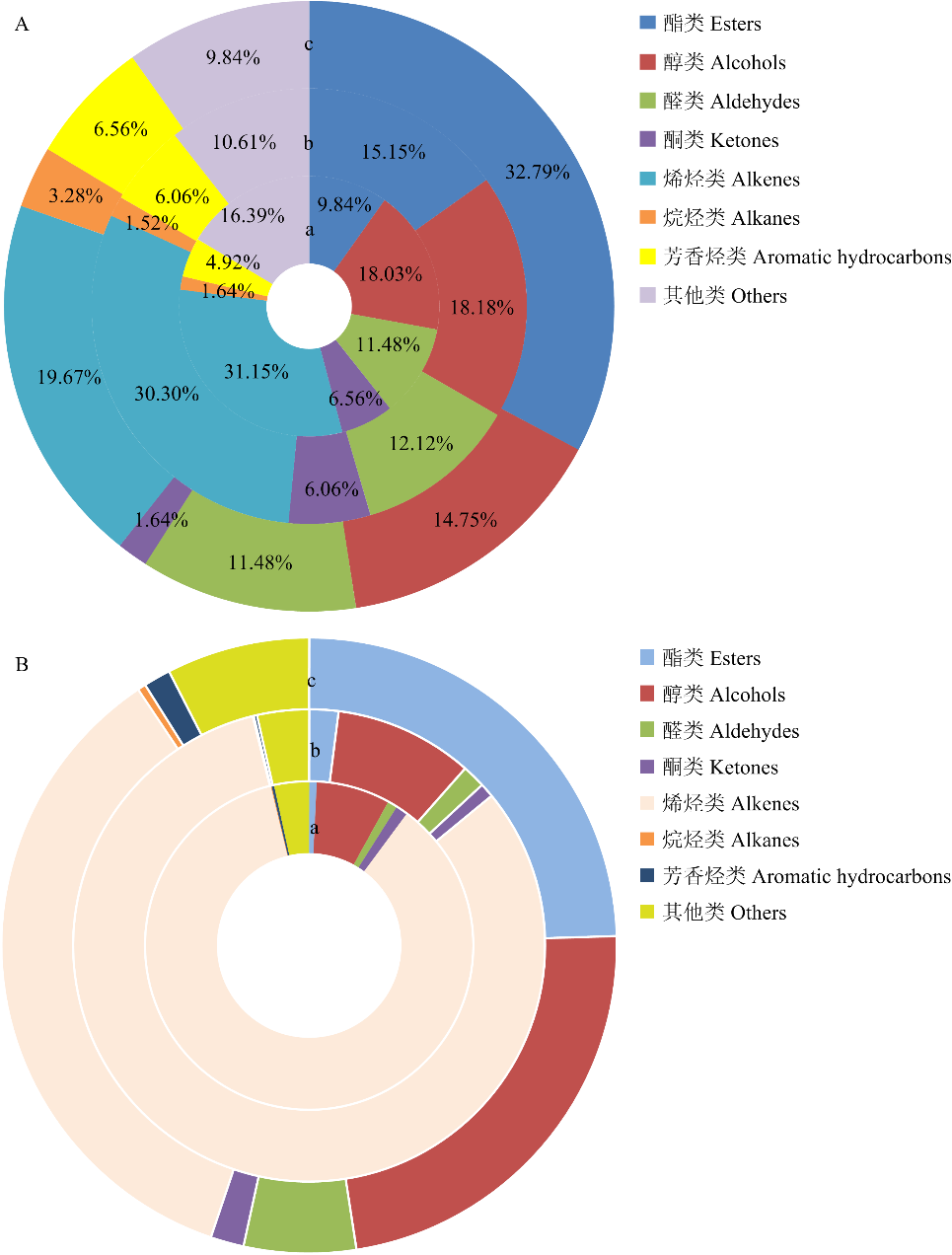
图7
转色3个时期杨梅的VACs种类占比(A)和含量占比(B) a:转红期;b:红熟期;c:成熟期"
表3
转色3个时期杨梅的关键香气物质"
| VACs | 香气特点[ Characteristics of the aroma | 香气阈值 Odor threshold (μg·kg-1)[ | OAV | ||
|---|---|---|---|---|---|
| 转红期Red-turning period | 红熟期Red-ripening period | 成熟期 Ripening period | |||
| 芳樟醇 Linalool | 具有清新的铃兰花香,还略带柑橘与木质尾调 It has a fresh fragrance of jasmine, with a hint of citrus and woody notes at the end | 20.00 | 15.41 | 16.35 | 19.58 |
| 2-己烯醛 2-Hexenal | 具有清新的绿叶香、果香,呈现新鲜果蔬的自然风味 It has a fresh green leafy aroma and fruity scent, presenting the natural flavor of fresh fruits and vegetables | 8.00 | 0.98 | 1.43 | 1.04 |
| 壬醛 Nonanal | 香甜,奶油香 Sweet with a creamy flavor | 5.00 | — | 1.22 | 1.96 |
| (E)-2-癸烯醛 2-Decenal, (E)- | 油香,坚果香The aromatic profiles of oil and nuts | 0.01 | 1.66 | 0.97 | — |
| 1-辛烯-3-酮 1-Octen-3-one | 强烈的蘑菇香、泥土香及轻微的青草香 Intense aroma of mushrooms, earth and a hint of grass | 20.00 | 286.05 | 422.08 | — |
| 6-甲基-5-庚烯-2-酮 5-Hepten-2-one, 6-methyl- | 具有清新的果香、青香,略带薄荷样气息 It has a fresh fruity and green aroma, with a hint of mint-like flavor | 0.02 | 1.25 | 0.96 | 0.47 |
| 石竹烯 Caryophyllene | 辛香、木香、柑橘香、樟脑香,温和的丁香 Spicy, woody, citrus, camphoraceous scents and gentle cloves | 0.01 | 10.20 | 8.89 | 0.39 |
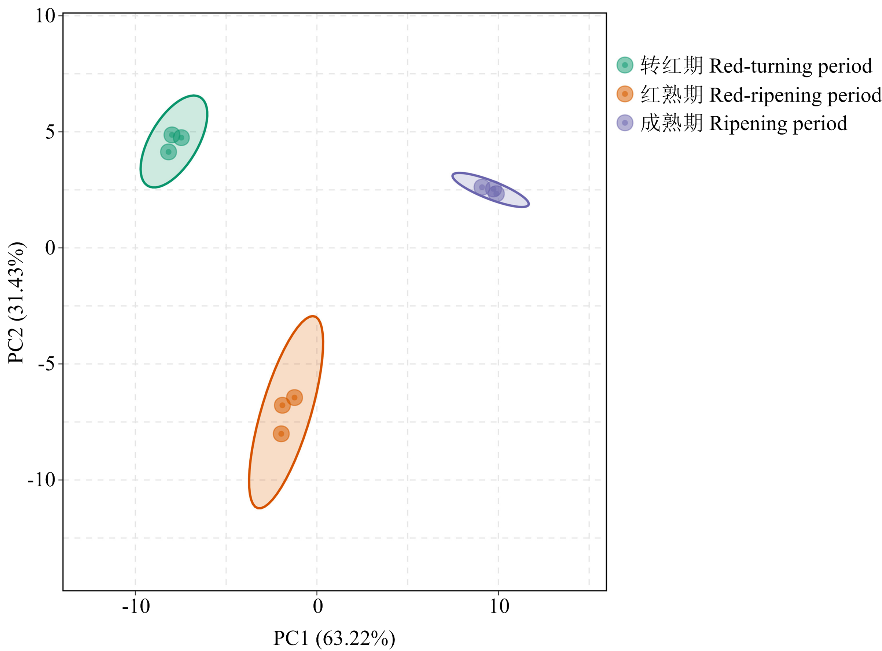
图8
转色3个时期杨梅VACs PCA散点图"
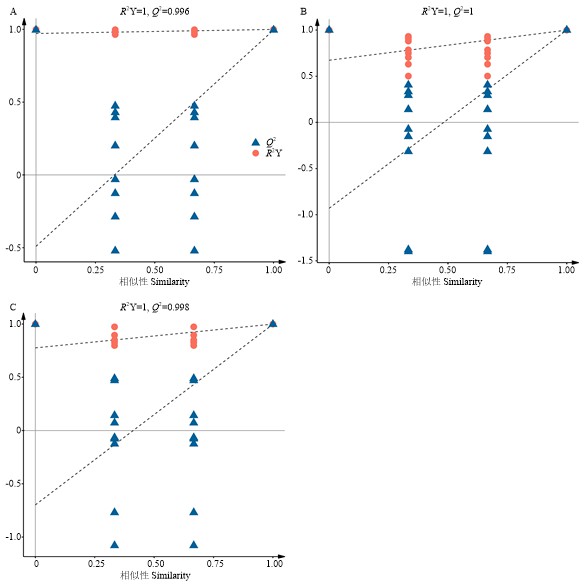
图9
OPLS-DA置换检验图 A:转红期与红熟期比较;B:转红期与成熟期比较;C:红熟期与成熟期比较"
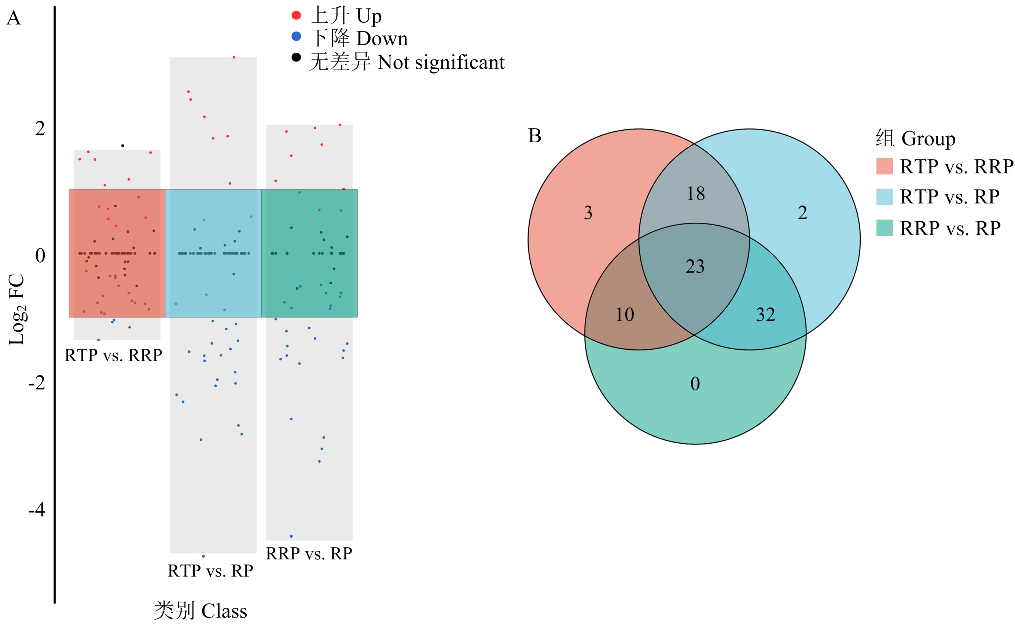
图10
杨梅转色3个时期组间VACs火山图(A)和韦恩图(B) RTP vs. RRP:转红期与红熟期比较;RTP vs. RP:转红期与成熟期比较;RRP vs. RP:红熟期与成熟期比较"
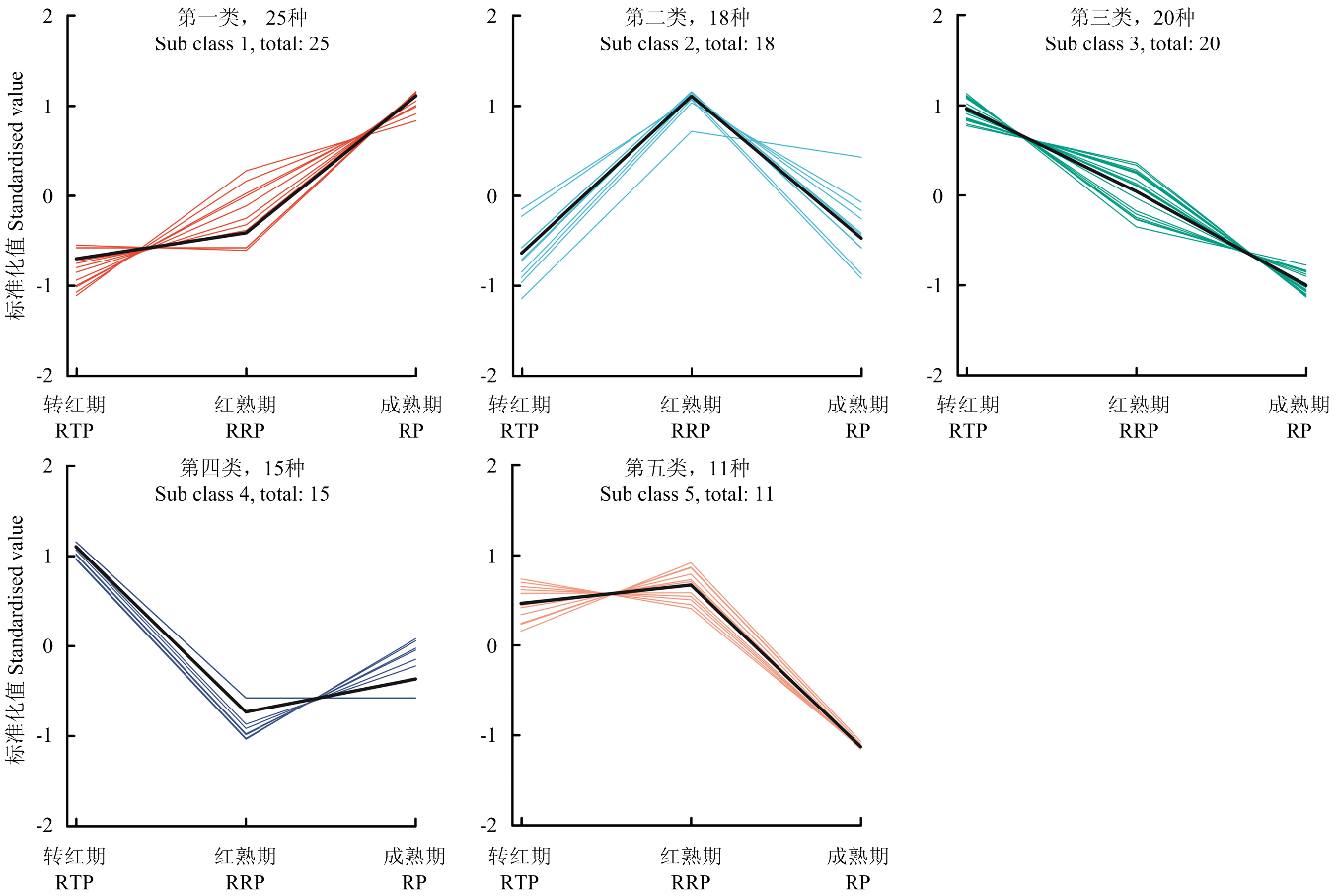
图11
杨梅转色3个时期差异香气物质K-means聚类分析图"
| [1] |
李雪, 杨丽, 王进, 陈元平, 刘世明, 樊清, 方进强, 武峥. 基于主成分分析的重庆地区杨梅果实品质综合评价[J]. 果树学报, 2026, 43(5): 1186-1199.
|
|
|
|
| [2] |
陈春霞, 张祯, 孔祥锦, 赵勇, 梁玉浩, 张煜, 李霁昕, 蒋玉梅. 转色期BTH诱抗改变霞多丽葡萄果实理化品质和香气构成[J]. 农业工程学报, 2023, 39(3): 237-247.
|
|
|
|
| [3] |
|
| [4] |
王慧玲, 张莹莹, 闫爱玲, 王晓玥, 刘振华, 任建成, 徐海英, 孙磊. 多组学联合解析红色玫瑰香型葡萄品种转色过程中单萜和花色苷积累规律[J]. 中国农业科学, 2025, 58(13): 2645-2662. DOI: 10.3864/j.issn.0578-1752.2025.13.012.
|
|
|
|
| [5] |
乔晨, 赵慧宇, 林佳琦, 刘成, 刘有春, 齐沛沛, 孙晓丽, 王新全. 蓝莓果实不同发育时期挥发性风味物质变化及差异性分析[J]. 现代食品科技, 2026, 42(4): 276-286.
|
|
|
|
| [6] |
谢雅婷, 严文怡, 杨艳, 李洁瑜, 杨小洪, 余爱农. 不同成熟度纽荷尔脐橙果肉中香气成分变化规律研究[J]. 食品科学技术学报, 2025, 43(3): 125-134.
|
|
|
|
| [7] |
吴斌, 苏金生, 邢文婷, 宋顺, 马伏宁, 黄东梅. 不同品种百香果果实转色期糖酸品质性状评价[J]. 果树学报, 2024, 41(12): 2532-2542.
|
|
|
|
| [8] |
|
| [9] |
刘金莹, 孔令喜, 王威浩, 秦国政, 王豫颖. 草莓果实香气物质生物合成研究进展[J]. 园艺学报, 2023, 50(9): 1959-1970.
|
|
|
|
| [10] |
杨鹏飞, 吴薇, 孙海峰, 刘龑章, 尚紫博, 薛晶晶, 许志杰, 宋梦坤. 基于GC-MS结合多元统计的2种工艺提取脐橙挥发性成分差异分析[J]. 轻工学报, 2025, 40(4): 1-9.
|
|
|
|
| [11] |
万鹏, 梁国平, 马丽娟, 陈佰鸿, 毛娟. 19个苹果品种果实香气成分的GC-MS分析[J]. 食品工业科技, 2019, 40(14): 227-232.
|
|
|
|
| [12] |
魏珊珊, 李娟, 刘贵珊. 香水梨香气成分的萃取条件优化及GC-MS分析[J]. 食品研究与开发, 2023, 44(11): 194-200.
|
|
|
|
| [13] |
尹燕雷, 苑兆和, 冯立娟, 招雪晴, 王金政, 王超. 不同杏品种果实发育期间香气成分的GC-MS分析[J]. 果树学报, 2010, 27(3): 337-343.
|
|
|
|
| [14] |
郝帅棋, 郭青云, 李霖灏, 袁华宁. 青海地区6个甜樱桃品种果实发育过程中香气物质的动态变化[J]. 果树学报, 2025, 42(4): 815-827.
|
|
|
|
| [15] |
林旗华, 张泽煌, 钟秋珍. 3个福建主栽地方杨梅品种果实香气成分分析[J]. 热带作物学报, 2015, 36(1): 115-119.
|
|
|
|
| [16] |
张泽煌, 林旗华, 钟秋珍. 10个品种杨梅果实香气成分的GC-MS检测及聚类分析[J]. 福建农林大学学报(自然科学版), 2014, 43(3): 269-272.
|
|
|
|
| [17] |
|
| [18] |
|
| [19] |
|
| [20] |
|
| [21] |
|
| [22] |
王梦琪, 朱荫, 张悦, 施江, 林智, 吕海鹏. “清香”绿茶的挥发性成分及其关键香气成分分析[J]. 食品科学, 2019, 40(22): 219-228.
|
|
|
|
| [23] |
宫连瑾, 薄佳慧, 张天天, 孙红玉, 陈义琴, 裴若云, 肖力争. 黄金茶红茶加工过程中香气成分及其相关酶活性的动态变化[J]. 食品与发酵工业, 2022, 48(6): 204-209.
|
|
|
|
| [24] |
|
| [25] |
李霞, 高阳, 尹洁, 许利平, 牛云蔚, 朱建才, 王辉, 杨君. 天然产物香气成分相互作用及香气物质强度预测研究[J]. 中国食品添加剂, 2022, 33(9): 1-9.
|
|
|
|
| [26] |
范文来, 徐岩. 白酒79个风味化合物嗅觉阈值测定[J]. 酿酒, 2011, 38(4): 80-84.
|
|
|
|
| [27] |
|
| [28] |
|
| [29] |
|
| [30] |
|
| [31] |
|
| [32] |
|
| [33] |
张泽煌, 林旗华, 钟秋珍. 10个杨梅品种果实的香气成分研究[J]. 福建农业学报, 2013, 28(6): 552-556.
|
|
|
|
| [34] |
张洁, 郭金星, 张汝忠, 王星星, 张晓玲, 刘琳, 侯平, 张汝民. 东魁杨梅果实储藏期挥发性有机化合物成分的变化[J]. 浙江农林大学学报, 2012, 29(1): 143-150.
|
|
|
|
| [35] |
|
| [36] |
|
| [37] |
|
| [38] |
周建昌, 褚剑峰, 胡桂仙, 王君虹, 白丽萍, 李雪, 张玉. 上虞二都杨梅主栽品种的品质特征分析[J]. 农产品质量与安全, 2025(4): 58-63.
|
|
|
| [1] | 王晶, 李岗, 蔡晓雅, 庞璐瑶, 黄青滢, 林宝义, 孔海民, 郝跃, 任海英. 杨梅凋萎病生防芽孢杆菌的筛选及其防病机制[J]. 中国农业科学, 2026, 59(7): 1467-1479. |
| [2] | 张志淳, 何筱毅, 何成军, 辜冬琳, 钟恋, 苟琰, 高必兴, 耿昭, 李小红, 陈斯恺. 基于GC-MS技术比较分析盐源与汉源花椒籽挥发油化学成分[J]. 中国农业科学, 2025, 58(23): 5057-5070. |
| [3] | 徐梦雨, 王佳洋, 王江波, 唐雯, 陈一恒, 上官凌飞, 房经贵, 卢素文. 不同葡萄种质果皮中香气物质含量及基因表达的差异分析[J]. 中国农业科学, 2024, 57(13): 2635-2650. |
| [4] | 王炫栋, 宋振, 兰赫婷, 江樱姿, 齐文杰, 刘晓阳, 蒋冬花. 杨梅园土壤优势放线菌的分离及其防病促生功能[J]. 中国农业科学, 2023, 56(2): 275-286. |
| [5] | 任海英,周慧敏,戚行江,郑锡良,俞浙萍,张淑文,王震铄. 多效唑对杨梅土壤微生物及内生群落结构的影响[J]. 中国农业科学, 2021, 54(17): 3752-3765. |
| [6] | 陈学渊,唐华俊,吴永常,周清波,崔健. 耕地格局时空动态变化过程和差异分析——以浙江安吉为例[J]. 中国农业科学, 2015, 48(21): 4302-4313. |
| [7] | 戴建军,常缨,张美萍,李彩凤,马凤鸣. 甜菜幼苗低温和长日照诱导表达基因的克隆和序列分析[J]. 中国农业科学, 2005, 38(09): 1856-1862 . |
| [8] | 茅林春,方雪花,庞华卿. 1-MCP对杨梅果实采后生理和品质的影响[J]. 中国农业科学, 2004, 37(10): 1532-1536 . |
|
||
