






中国农业科学 ›› 2025, Vol. 58 ›› Issue (23): 5057-5070.doi: 10.3864/j.issn.0578-1752.2025.23.019
张志淳1,2( ), 何筱毅2, 何成军2, 辜冬琳2, 钟恋2, 苟琰2, 高必兴2, 耿昭2,*(), 李小红1,*(), 陈斯恺3
收稿日期:2025-07-18
接受日期:2025-10-29
出版日期:2025-12-01
发布日期:2025-12-09
通信作者:
联系方式:
张志淳,E-mail:lucky1022zy@163.com。
基金资助:
ZHANG ZhiChun1,2(), HE XiaoYi2, HE ChengJun2, GU DongLin2, ZHONG Lian2, GOU Yan2, GAO BiXing2, GENG Zhao2,*(), LI XiaoHong1,*(), CHEN SiKai3
Received:2025-07-18
Accepted:2025-10-29
Published:2025-12-01
Online:2025-12-09
摘要:
【背景】花椒籽作为花椒加工副产物,含油量丰富,具有较高开发潜力,但常用作肥料或以废料形式丢弃,造成资源浪费。【目的】 为提升其利用价值,实现资源高效利用,本研究聚焦于不同产地花椒籽挥发油的关键特征,探究盐源与汉源两大代表性产地花椒籽挥发油中化学成分组成,分析其挥发油化学成分异同性及变化规律。【方法】采集四川省盐源县与汉源县花椒籽样品,采用水蒸气蒸馏法提取挥发油,运用气相色谱-质谱联用技术(GC-MS)进行成分鉴定。通过比对对照品、NIST数据库及文献数据综合分析鉴定挥发油成分,采用峰面积归一化法计算各成分相对含量。运用正交偏最小二乘判别分析(OPLS-DA),筛选具有产地判别能力的差异标志物。【结果】从13批样品中共鉴定出124种挥发性成分,其中醇类化合物28种,萜烯类化合物23种,醛类化合物20种,酮类化合物19种,酯类化合物13种,脂肪酸类5种,烯烃类3种,烷烃类2种,以及其他类别化合物(包括酚类、环醚类、噻唑类等)共计10种,未知化合物1种。以VIP>1、P<0.05为标准对盐源与汉源花椒籽挥发油成分进行筛选,共筛选出22个差异挥发性成分,盐源产地花椒籽挥发油中,萜烯类(如D-柠檬烯)和酯类(如乙酸芳樟酯)化合物的相对含量普遍较高;而汉源产地花椒籽挥发油中,醛类(如壬醛、癸醛)和酮类(如香芹酮)化合物的相对含量则较高。此外,正庚醇为汉源特有成分。【结论】盐源与汉源花椒籽挥发油化学成分存在一定相似性,但在具体成分及其相对含量上存在一定的差异,这种差异可能由地理位置、生长环境及种植培育方式等多方面因素共同作用导致。这些特征性差异可为花椒籽的产地鉴别、品质评价及地理标志产品开发提供关键科学依据。
张志淳, 何筱毅, 何成军, 辜冬琳, 钟恋, 苟琰, 高必兴, 耿昭, 李小红, 陈斯恺. 基于GC-MS技术比较分析盐源与汉源花椒籽挥发油化学成分[J]. 中国农业科学, 2025, 58(23): 5057-5070.
ZHANG ZhiChun, HE XiaoYi, HE ChengJun, GU DongLin, ZHONG Lian, GOU Yan, GAO BiXing, GENG Zhao, LI XiaoHong, CHEN SiKai. Comparative Analysis of Volatile Oil Chemical Constituents from Zanthoxylum bungeanum Seeds in Yanyuan and Hanyuan Based on GC-MS Technology[J]. Scientia Agricultura Sinica, 2025, 58(23): 5057-5070.
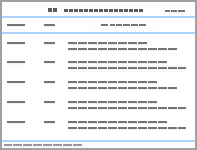
表1
花椒籽样品信息表"
| 花椒籽编号 Zanthoxylum bungeanum seeds number | 采集来源 Source of collection |
|---|---|
| 盐源1 Yanyuan 1 | 盐源县树河镇大水田村 Dashuitian Village, Shuhe Town, Yanyuan County |
| 盐源2 Yanyuan 2 | 盐源县树河镇石门坎村 Shimenkan Village, Shuhe Town, Yanyuan County |
| 盐源3 Yanyuan 3 | 盐源县树河镇贡椒经销点 Gongjiao sales outlet, Shuhe Town,Yanyuan County |
| 盐源4 Yanyuan 4 | 盐源县平川镇青天铺村花椒专业合作社 Qingtianpu Village, Zanthoxylum bungeanum Maxim. Cooperative Pingchuan Town, Yanyuan County |
| 盐源5 Yanyuan 5 | 盐源县平川镇青天铺村一组 Group 1, Qingtiangpu Village, Pingchuan Town, Yanyuan County |
| 盐源6 Yanyuan 6 | 盐源县平川镇兴隆村 Xinglong Village, Pingchuan Town, Yanyuan County |
| 汉源1 Hanyuan 1 | 汉源县宜东镇关华村八组 Group 8, Guanhua Village, Yidong Town, Hanyuan County |
| 汉源2 Hanyuan 2 | 汉源县宜东镇川椒汇种植专业合作社 Chuanjiaohui planting specialised cooperative, Yidong Town, Hanyuan County |
| 汉源3 Hanyuan 3 | 汉源县宜东镇大志花椒种植合作社湖南食品商会花椒直供部 Hunan Food Chamber of Commerce Sichuan Zanthoxylum bungeanum Maxim. Direct Supply Department, Dazhi Sichuan Zanthoxylum bungeanum Maxim. Cultivation Cooperative, Yidong Town, Hanyuan County |
| 汉源4 Hanyuan 4 | 汉源县宜东镇新市村宜椒种植合作社 Yijiao Zanthoxylum bungeanum Maxim. Cultivation Cooperative, Xinshi Village, Yidong Town, Hanyuan County |
| 汉源5 Hanyuan 5 | 汉源县清溪镇贡椒经销点同心村贡椒园 Gongjiao Sales Outlet, Tongxin Village, Gongjiao Orchard, Qingxi Town, Hanyuan County |
| 汉源6 Hanyuan 6 | 汉源县清溪镇永安村 Yong'an Village, Qingxi Town, Hanyuan County |
| 汉源7 Hanyuan 7 | 汉源县刚花椒种植合作社 Ganghuajiao Zanthoxylum bungeanum Maxim. Planting Cooperative, Hanyuan County |
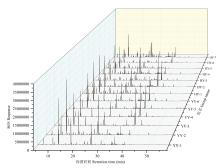
图1
盐源(YY)、汉源(HY)花椒籽发挥油总离子流图"
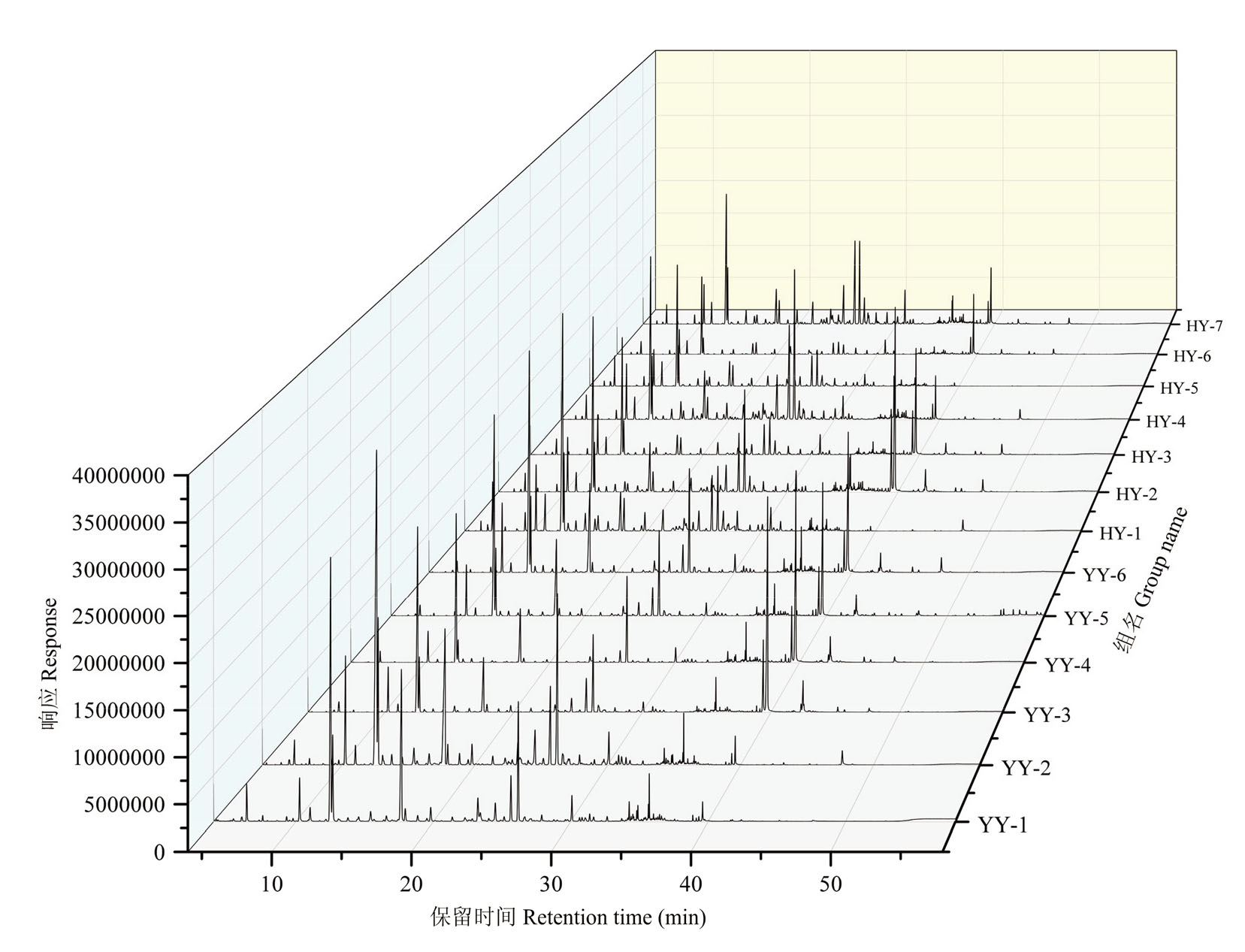
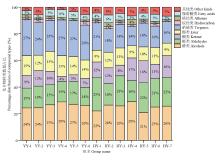
图2
盐源(YY)、汉源(HY)花椒籽挥发油化合物种类数量占比图(只显示占比大于1%的成分)"
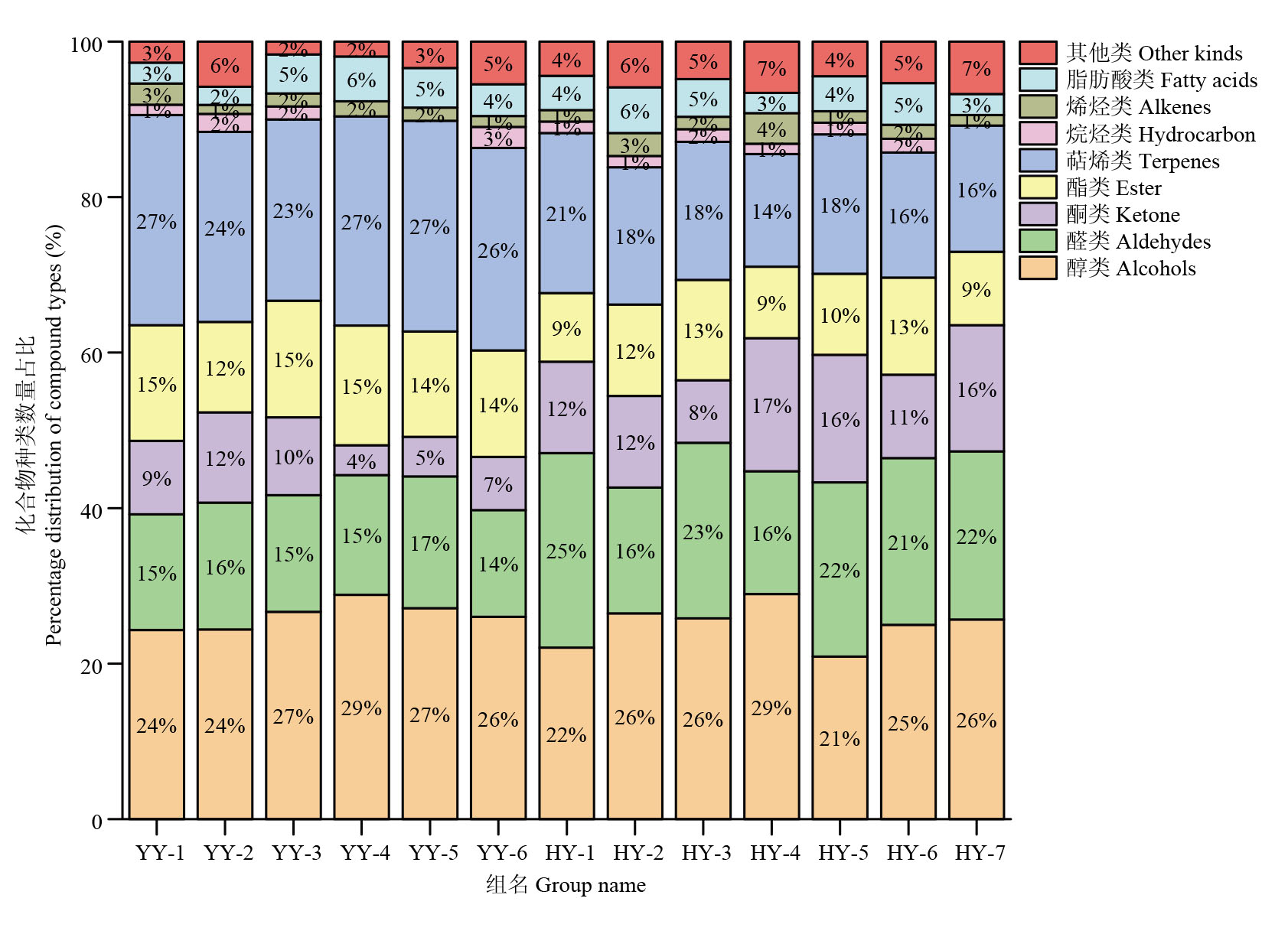
图3
盐源(YY)、汉源(HY)花椒籽挥发油各类化合物总相对含量占比图(只显示占比大于1%的成分)"

图4
盐源(YY)、汉源(HY)花椒籽挥发油高占比成分相对含量趋势图"
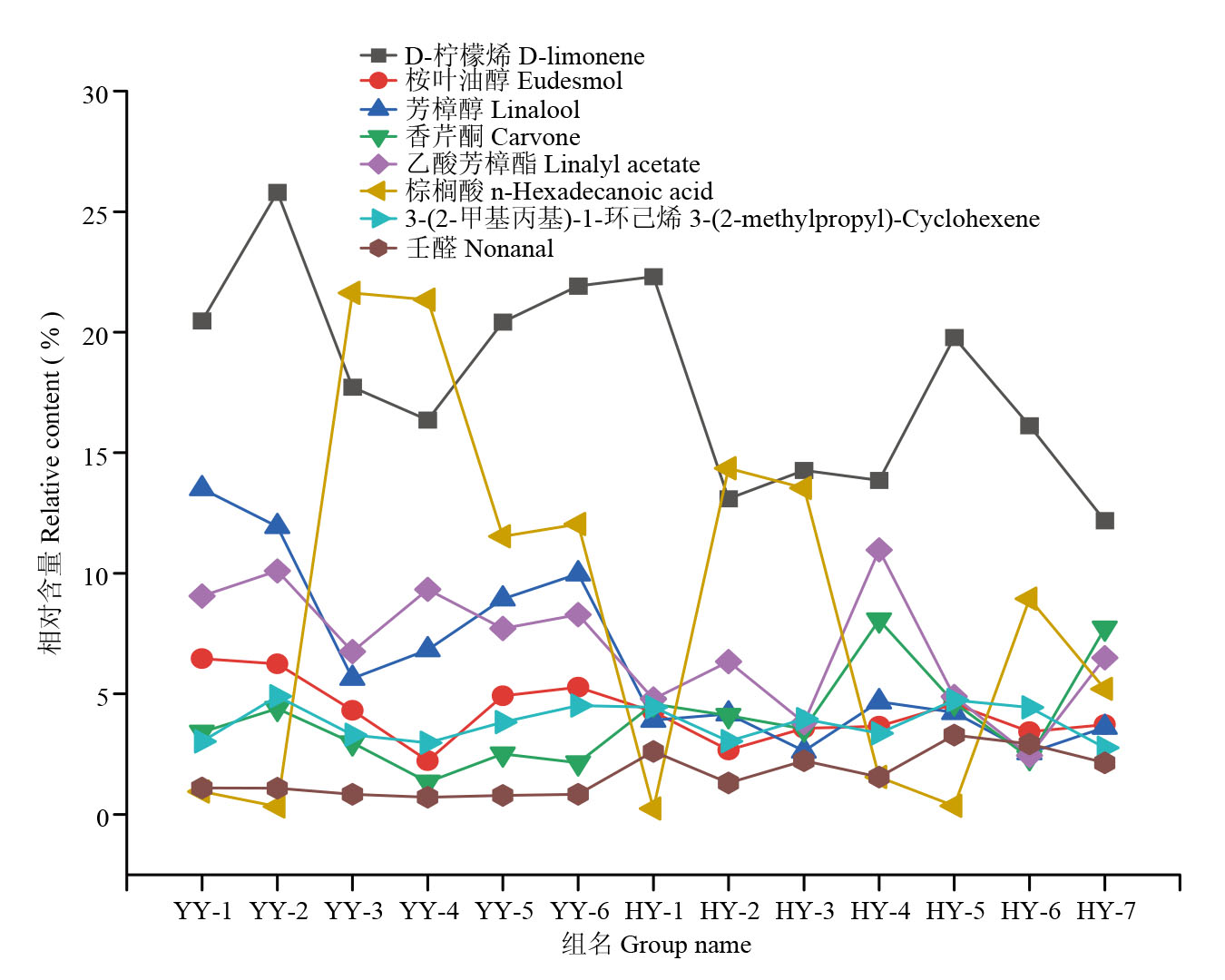
图5
盐源(YY)、汉源(HY)花椒籽的PCA聚类图"
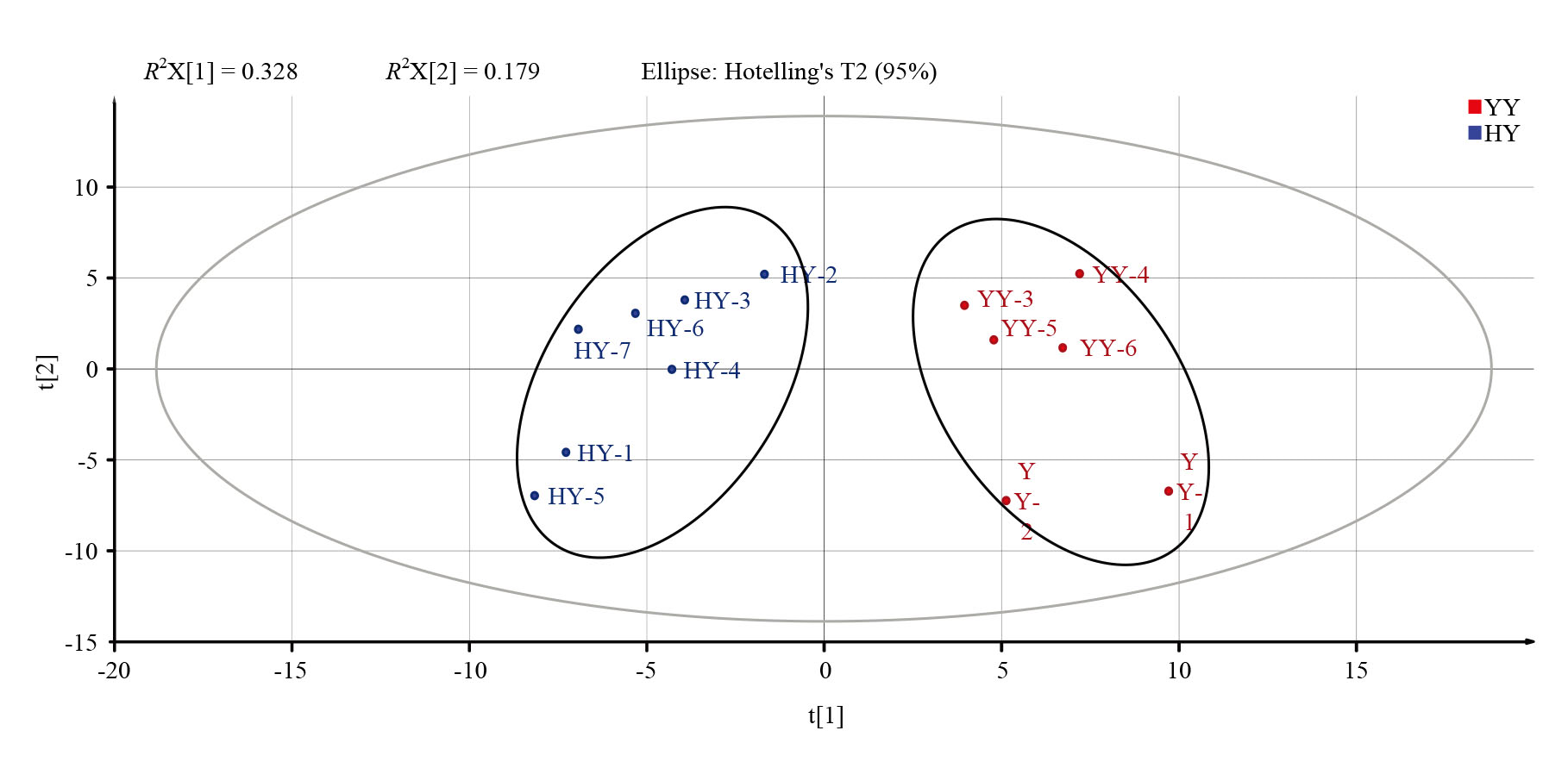
图6
盐源(YY)、汉源(HY)花椒籽的OPLS-DA聚类图"
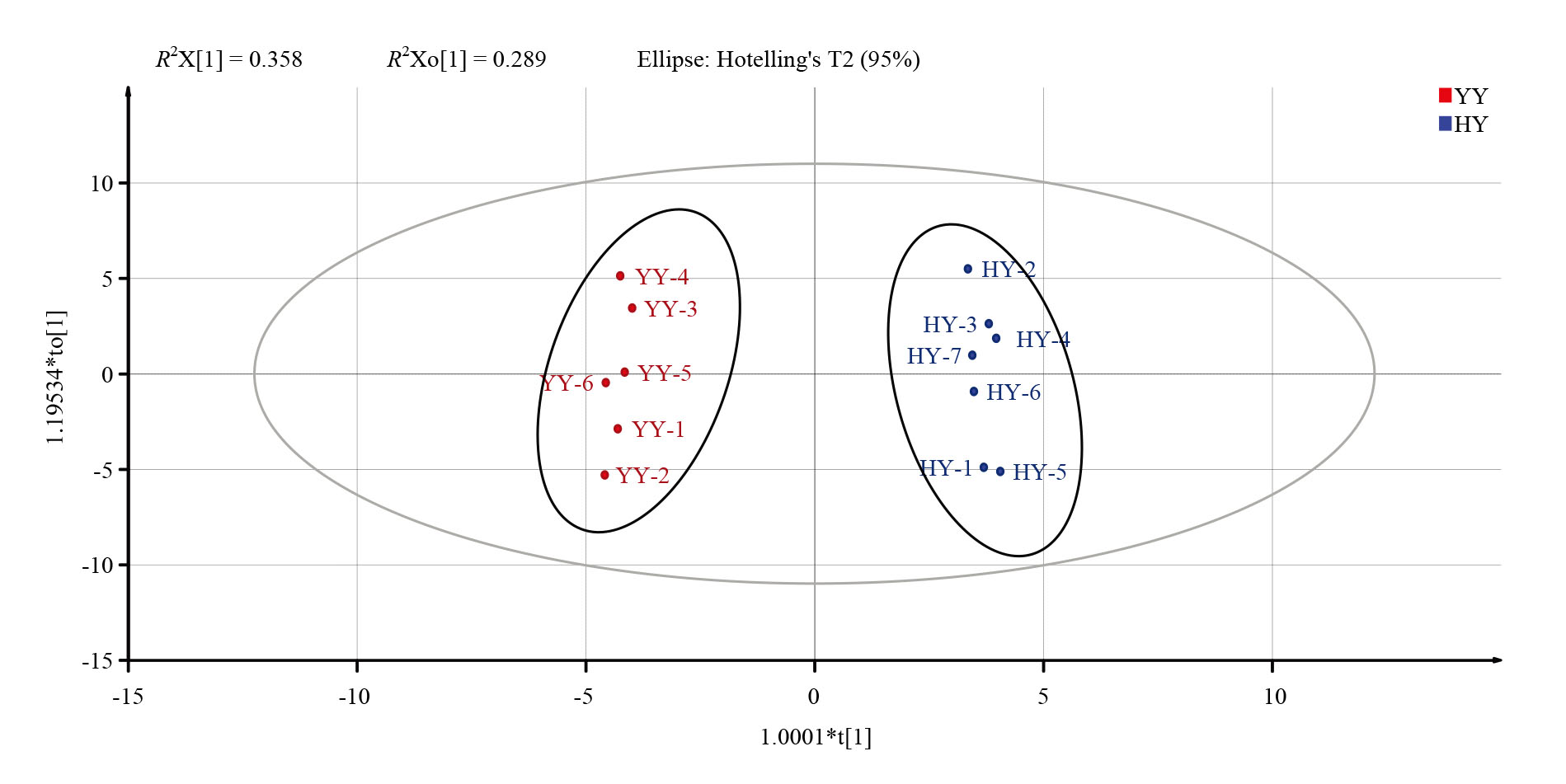

图7
盐源(YY)、汉源(HY)花椒籽OPLS-DA模型置换检验结果"
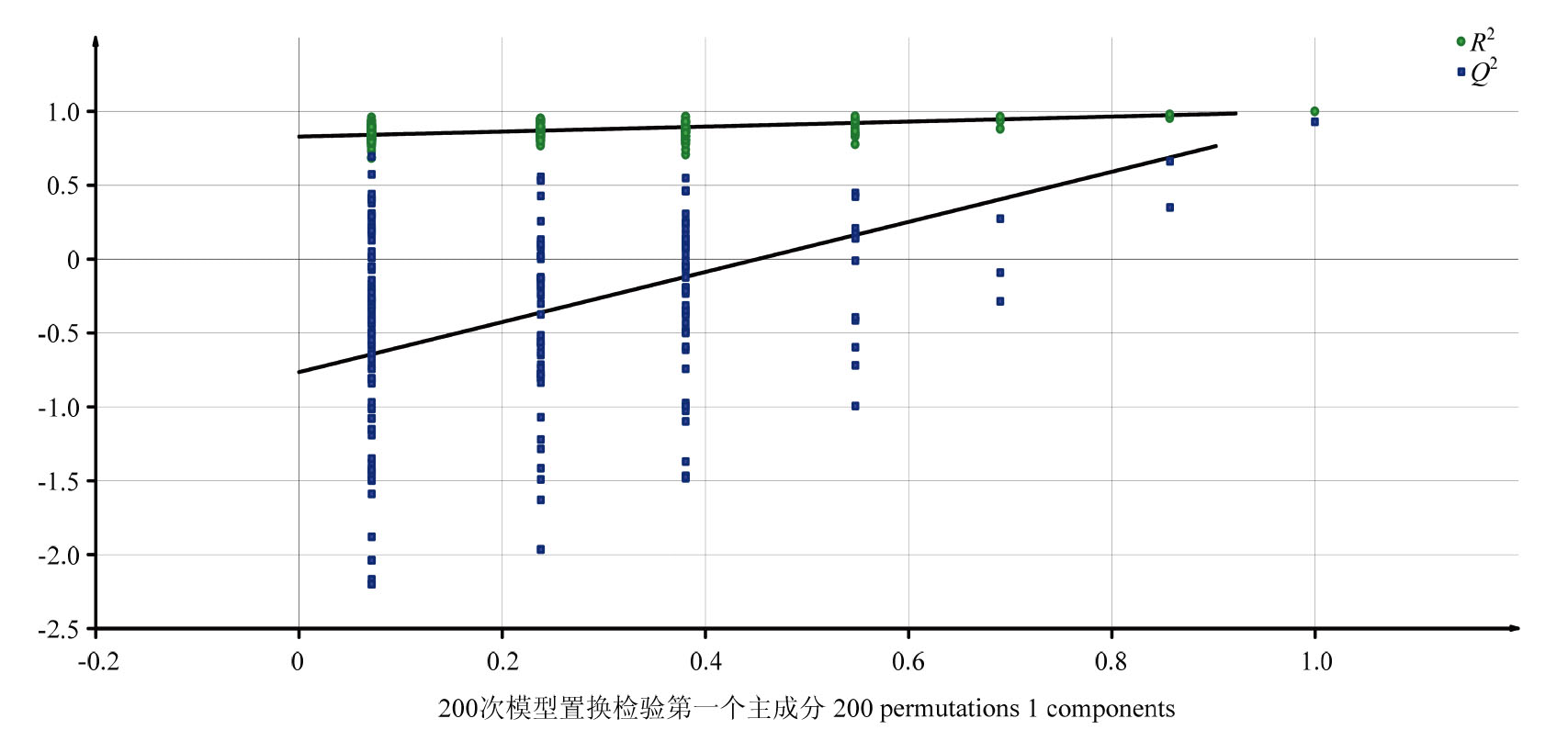
图8
盐源(YY)、汉源(HY)花椒籽VIP值预测图"

图9
盐源(YY)、汉源(HY)花椒籽S-plot聚类图"
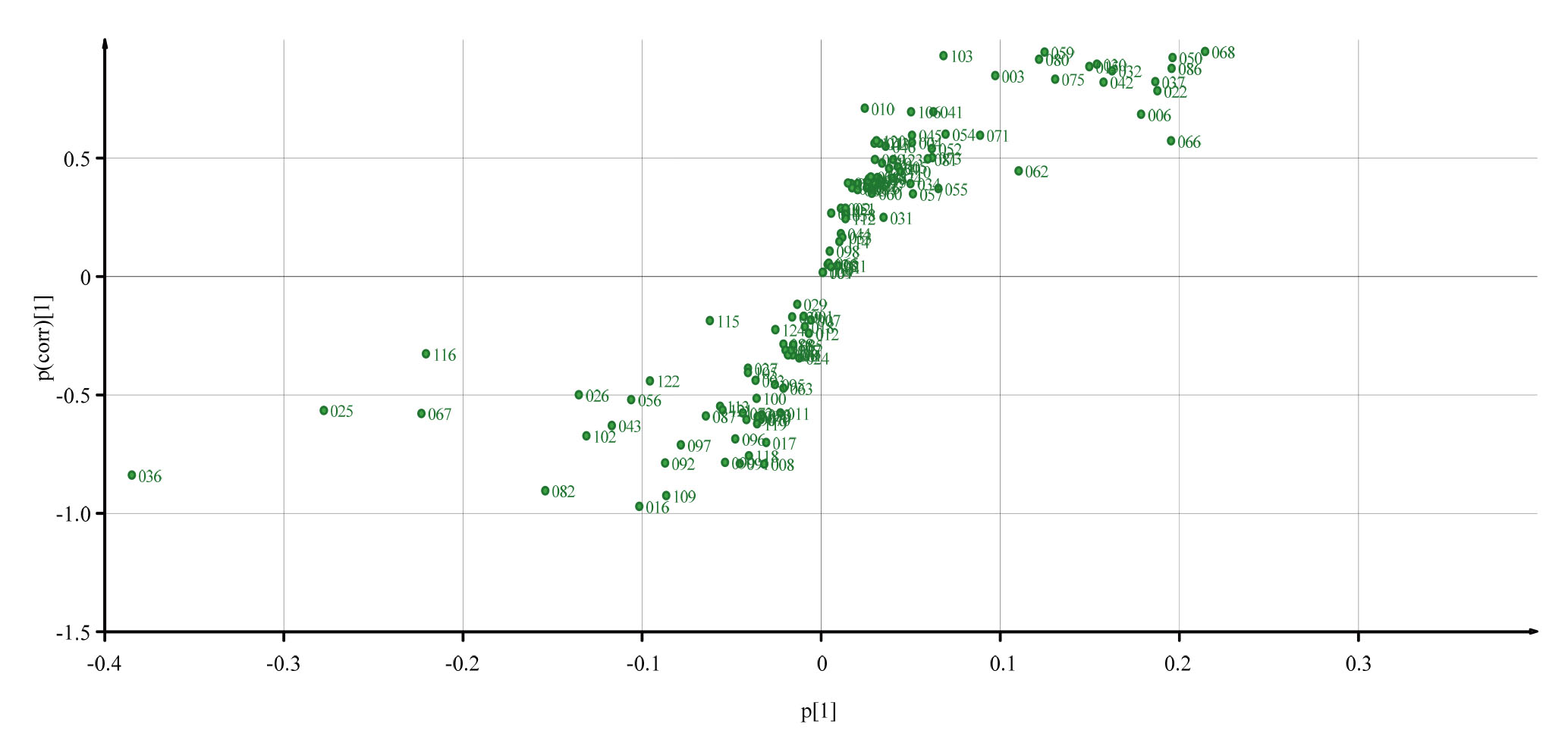
表2
盐源花椒籽挥发油与汉源花椒籽挥发油差异性成分及趋势"
| 序号NO. | 类别 Classification | 化合物 Compound | VIP值 VIP value | P值 P-value | 趋势 Trend |
|---|---|---|---|---|---|
| 1 | 酯类 Esters | 乙酸芳樟酯 Linalyl acetate | 2.70 | 3.68×10⁻²* | ↓ |
| 2 | 酯类 Esters | 乙酸松油酯 Terpinyl acetate | 1.75 | 2.12×10⁻⁵*** | ↓ |
| 3 | 酯类 Esters | 己酸戊酯 Hexanoic acid, pentyl ester | 1.46 | 4.00×10⁻⁴*** | ↑ |
| 4 | 未知 Unknown | 未知化合物1 Unknown Compound 1 | 1.11 | 5.78×10⁻⁸*** | ↓ |
| 5 | 酮类 Ketones | 香芹酮 Carvone | 2.19 | 4.19×10⁻²* | ↑ |
| 6 | 萜烯类 Terpenes | D-柠檬烯 D-Limonene | 3.20 | 4.40×10⁻²* | ↓ |
| 7 | 萜烯类 Terpenes | 反式-柠檬烯环氧化物 trans-Limonene oxide | 1.83 | 5.00×10⁻⁴*** | ↑ |
| 8 | 醛类 Aldehydes | 反式-2-癸烯醛 trans-2-Decenal | 2.42 | 5.05×10⁻⁷*** | ↑ |
| 9 | 醛类 Aldehydes | 反式-2-十一烯醛 trans-2-Undecenal | 2.32 | 4.73×10⁻⁵*** | ↑ |
| 10 | 醛类 Aldehydes | 反式-2-壬醛 trans-2-Nonenal | 2.26 | 5.47×10⁻⁶*** | ↑ |
| 11 | 醛类 Aldehydes | 壬醛 Nonanal | 2.13 | 7.00×10⁻⁴*** | ↑ |
| 12 | 醛类 Aldehydes | 正辛醛 Octanal | 2.09 | 1.80×10⁻³** | ↑ |
| 13 | 醛类 Aldehydes | 庚醛 Heptanal | 2.05 | 1.16×10⁻²* | ↑ |
| 14 | 醛类 Aldehydes | 反式-2-辛烯醛 trans-2-Octenal | 1.74 | 4.02×10⁻⁵*** | ↑ |
| 15 | 醛类 Aldehydes | (2E,4Z)-2,4-癸二烯醛 (2E,4Z)-2,4-Decanedienal | 1.42 | 8.74×10⁻⁶*** | ↑ |
| 16 | 醛类 Aldehydes | 癸醛 Decanal | 1.41 | 1.25×10⁻⁶*** | ↑ |
| 17 | 醇类 Alcohols | 芳樟醇 Linalool | 4.49 | 4.00×10⁻⁴*** | ↓ |
| 18 | 醇类 Alcohols | 辛醇 Octanol | 1.82 | 2.00×10⁻⁴*** | ↑ |
| 19 | 醇类 Alcohols | 正庚醇 1-Heptanol | 1.66 | 8.02×10⁻⁵*** | ↑ |
| 20 | 醇类 Alcohols | 石竹素 Caryophyllene oxide | 1.47 | 1.27×10⁻²* | ↓ |
| 21 | 醇类 Alcohols | 1-异丙烯基-4-甲基-1,2-环己二醇 (1S-(1Alpha,2alpha,4beta)-1-isopropenyl-4-methyl- 1,2-cyclohexanediol | 1.40 | 1.84×10⁻²* | ↓ |
| 22 | 醇类 Alcohols | 正己醇 1-Hexanol | 1.06 | 3.00×10⁻⁴*** | ↑ |
| [1] |
吴娟娟, 张加余, 史石磊, 连运河, 程远欣, 武亚明, 蔡兴福, 吴迪. 不同产地红花椒椒目的全组分分析. 天然产物研究与开发, 2023, 35(5): 837-851.
|
|
|
|
| [2] |
吴素玲, 张卫明, 孙晓明, 金敬红, 陈文华, 张锋伦. 花椒籽油的提取和组分分析. 中国野生植物资源, 2015, 34(6): 5-8.
|
|
|
|
| [3] |
李越峰, 张淑娟, 边甜甜, 牛江涛, 司昕蕾, 曹瑞, 张育贵, 严兴科. 花椒不同炮制品中挥发性成分GC-MS分析. 天然产物研究与开发, 2020, 32(9): 1470-1476.
|
|
|
|
| [4] |
doi: 10.1016/j.fitote.2022.105380 |
| [5] |
doi: 10.1021/acs.jafc.0c02026 |
| [6] |
郑敏燕, 汪俊豪, 汤欣璐, 张娜, 李锦康, 李涓. 花椒挥发油脂肪油化学组成GC/MS分析比较. 咸阳师范学院学报, 2024, 39(6): 24-29.
|
|
|
|
| [7] |
|
| [8] |
罗德怡, 杨爱梅, 杨军丽. 花椒籽油提取方法、化学成分分析及其不饱和脂肪酸的神经保护作用研究进展. 分析测试技术与仪器, 2025, 31(2): 88-100.
|
|
|
|
| [9] |
慕钰文, 黄玉龙, 张辉元. 花椒籽不同溶剂提取物的活性成分及抗氧化性比较. 包装与食品机械, 2021, 39(3): 21-26.
|
|
|
|
| [10] |
叶萌. 四川花椒产业发展现状及展望. 中国农村科技, 2020(9): 70-73.
|
|
|
|
| [11] |
李后强. 四川是花椒原产地. 当代县域经济, 2018(5): 12-19.
|
|
|
|
| [12] |
龚志伟. 川味之王汉源花椒. 农村农业农民, 2015(1): 49.
|
|
|
|
| [13] |
冯雨莎, 岳家斌. 汉源花椒地理标志的渊源探析与时代传承. 农村经济与科技, 2024(23): 113-116.
|
|
|
|
| [14] |
金银春, 王芹, 陈善波, 王丽华, 杨怀茹, 毛国慧, 王莎. 盐源县花椒栽培发展现状与对策研究. 园艺与种苗, 2020, 40(9): 8-11.
|
|
|
|
| [15] |
金银春, 陈伟, 毛国慧, 陈善波, 罗慧, 王丽华. 盐源县花椒气候适应性评价与种植区划. 四川林业科技, 2021, 42(4): 94-98.
|
|
|
|
| [16] |
央青. 盐源: 站在新“椒”点上描绘乡村振兴新蓝图. 凉山日报(汉), 2021-07-29.
|
|
|
|
| [17] |
花椒市场行情分析. 农村百事通, 2020(10): 30.
|
|
Analysis of Zanthoxylum bungeanum market. Nongcun Baishitong, 2020(10): 30. (in Chinese)
|
|
| [18] |
王晓娜, 孙宏亮, 马琴, 田路, 石辰, 魏安智. 不同发育时期红花椒‘凤椒’果皮的非靶向代谢组学分析. 西北林学院学报, 2025, 40(3): 11-18, 28.
|
|
|
|
| [19] |
doi: 10.1016/j.fochx.2024.102017 |
| [20] |
课净璇, 瞿瑗, 黎杉珊, 申光辉, 罗擎英, 吴贺君, 陈安均, 蒲彪, 叶萌, 张志清. 基于GC-MS建立花椒挥发油指纹图谱及在汉源红花椒鉴定中的应用. 中国粮油学报, 2018, 33(11): 116-126.
|
|
|
|
| [21] |
李亚南, 崔传坚, 陈江琳, 运晶, 金龙, 侯如燕. 基于挥发性风味物质的花椒产地溯源技术研究. 食品工业科技, 2022, 43(2): 293-303.
|
|
|
|
| [22] |
程小雪, 袁永俊, 胡丽丽, 邱鹏, 陈海风, 豆剑伟, 董思杨. 贮藏条件对花椒调味油中柠檬烯和芳樟醇含量的影响. 食品科学, 2014, 35(18): 258-261.
doi: 10.7506/spkx1002-6630-201418049 |
|
doi: 10.1111/jfds.1970.35.issue-3 |
|
| [23] |
王慧玲, 张莹莹, 闫爱玲, 王晓玥, 刘振华, 任建成, 徐海英, 孙磊. 多组学联合解析红色玫瑰香型葡萄品种转色过程中单萜和花色苷积累规律. 中国农业科学, 2025, 58(13): 2645-2662. doi: 10.3864/j.issn.0578-1752.2025.13.012.
|
|
|
|
| [24] |
罗朝丹, 冯春梅, 李建强, 黎新荣, 韦勇, 杨李益, 刘筱瑾, 谭和, 任二芳, 罗小杰. 基于GC-MS非靶向代谢组学分析不同成熟度‘台农一号’芒果香气物质. 中国农业科学, 2025, 58(3): 564-584. doi: 10.3864/j.issn.0578-1752.2025.03.012.
|
|
|
|
| [25] |
李玉姗, 邱勋荣, 齐娅汝, 万琴, 高欢, 王学成, 杨明, 李远辉. 中药材干燥过程中的活性成分变化机制研究现状. 中国中药杂志, 2024, 49(2): 315-324.
|
|
|
|
| [26] |
王安娜, 王赟, 彭小伟, 吴玉芳, 阚欢, 刘云, 全伟, 陆斌. 不同干燥方式对竹叶花椒叶品质的影响. 中国农业科学, 2023, 56(18): 3655-3669. doi: 10.3864/j.issn.0578-1752.2023.18.013.
|
|
|
|
| [27] |
张庆. 不同干燥方式下花椒品质及油胞变化规律研究[D]. 雅安: 四川农业大学, 2024.
|
|
|
|
| [28] |
杨明翰, 骆骄阳, 乔美玲, 杨美华, 盛萍. 多伞阿魏挥发油化学成分GC-MS分析及D-柠檬烯抗胃癌活性研究. 中国现代应用药学, 2020, 37(7): 806-813.
|
|
|
|
| [29] |
蒋莹, 刘欣. 柠檬烯的开发利用研究进展. 食品安全导刊, 2018(9): 133.
|
|
|
|
| [30] |
|
| [31] |
doi: 10.2174/1570159X19666210920094504 |
| [32] |
doi: 10.1016/j.colsurfb.2018.08.001 |
| [33] |
doi: 10.1016/j.fitote.2013.05.014 pmid: 23707744 |
| [34] |
doi: 10.3390/ijms18102172 |
| [35] |
陈劼. 复合香型青脆李果酒增香工艺及陈酿期品质稳定性研究[D]. 雅安: 四川农业大学, 2023.
|
|
|
|
| [36] |
黄明翠, 舒树敏, 张岩, 赵晨伟, 郑梦林, 金俊, 金青哲, 王兴国. 家庭用油条件下食用植物油的氧化酸败研究. 中国油脂, 2025, 50(4): 46-51.
|
|
|
|
| [37] |
席海源, 梁锁兴, 张芳. 不同品种榛子果仁中脂肪酸的成分及含量分析. 果树资源学报, 2024, 5(5): 17-21.
|
|
|
|
| [38] |
陈立发. 汉源花椒精深加工产业现状分析与发展对策研究[D]. 雅安: 四川农业大学, 2020.
|
|
|
|
| [39] |
doi: 10.1016/j.abb.2025.110404 |
| [40] |
张莹莹, 张鑫鑫, 李新畅, 任杰, 葛红丽, 盖凡丁, 赵建伟. 冀北水稻挥发性物质及其香气成分研究. 北方水稻, 2025, 55(3): 12-16.
|
|
|
|
| [41] |
芦昶彤, 刘亚龙, 刘远上, 张弛, 陈芝飞, 宁一博, 曹雪颖, 曲利利, 许春平. 甜橙油存放过程中的挥发特性及特征香气的变化规律. 化学研究与应用, 2025, 37(4): 904-914.
|
|
|
|
| [42] |
张宇. 汉源花椒籽油提取及其调节血脂功能的研究[D]. 雅安: 四川农业大学, 2020.
|
|
|
|
| [43] |
黎英, 赵镭, 钟葵, 张迪, 汪厚银, 周先礼, 邹小波, 何晓宁, 项雅科, 张丽涵, 黄帅, 史波林. 西南地区青花椒精油香气差异的物质基础分析. 食品研究与开发, 2025, 46(11): 133-141.
|
|
|
|
| [44] |
doi: 10.1016/j.foodres.2024.114964 |
| [45] |
doi: 10.5650/jos.ess14225 |
| [46] |
李云宁, 吴新新, 黎晓蕾, 郝鸣昭, 张芳, 张悦, 李皓月, 赵静. 芳香中药精油外用防治呼吸道传染病的作用机制与应用研究概况. 中医杂志, 2025, 66(6): 638-644.
|
|
|
|
| [47] |
刘倩影, 张佳琪, 刘琛, 耿珠峰, 尤春雪, 刘鼎阔, 张文娟. 桉叶油醇和α-松油醇复配对赤拟谷盗的抗虫作用机制研究. 中国粮油学报, 2025, 40(2): 1-8.
|
|
|
|
| [48] |
doi: 10.1111/jfds.v88.4 |
| [49] |
张露, 张晴. 油脂结晶改良剂对底物油脂结晶行为的调控及其作用机制的研究进展. 中国油脂, 2023, 48(8): 23-29, 33.
|
|
|
|
| [50] |
皇甫秋灵, 柴秀航, 韩宛君, 刘元法, 杨巍. 冻融循环中不同脂肪酸组成的油脂对植脂搅打奶油稳定性的影响. 食品科学, 2025, 46(9): 69-79.
|
|
|
| [1] | 陈学渊,唐华俊,吴永常,周清波,崔健. 耕地格局时空动态变化过程和差异分析——以浙江安吉为例[J]. 中国农业科学, 2015, 48(21): 4302-4313. |
| [2] | 戴建军,常缨,张美萍,李彩凤,马凤鸣. 甜菜幼苗低温和长日照诱导表达基因的克隆和序列分析[J]. 中国农业科学, 2005, 38(09): 1856-1862 . |
|
||
