






中国农业科学 ›› 2026, Vol. 59 ›› Issue (21): 4710-4728.doi: 10.3864/j.issn.0578-1752.2026.21.002
尹晓康1( ), 冯佳宜1(), 李栩慷1, 张朝旭1, 马驰1, 王若禹1, 白佳乾1, 蓝罗冰1, 张良凤1, 刘易科2, 朱展望2, 丁富功2, 刘大同3, 王书平1(), 方正武1(), 张迎新1()
收稿日期:2026-04-12
接受日期:2026-06-26
出版日期:2026-11-01
发布日期:2026-11-06
通信作者:
联系方式:
尹晓康,E-mail:yin_xiaokang2004@126.com。冯佳宜,E-mail:fengjiayi420@163.com。尹晓康和冯佳宜为同等贡献作者。
基金资助:
YIN XiaoKang1(), FENG JiaYi1(), LI XuKang1, ZHANG ZhaoXu1, MA Chi1, WANG RuoYu1, BAI JiaQian1, LAN LuoBing1, ZHANG LiangFeng1, LIU YiKe2, ZHU ZhanWang2, DING FuGong2, LIU DaTong3, WANG ShuPing1(), FANG ZhengWu1(), ZHANG YingXin1()
Received:2026-04-12
Accepted:2026-06-26
Published:2026-11-01
Online:2026-11-06
摘要:
【目的】针对小麦灌浆期高温胁迫造成的小麦减产问题,明确不同基因型小麦品种灌浆期高温胁迫对植株表型、农艺性状、产量及其构成因素的影响,构建一套适合长江中下游冬麦区的小麦耐高温综合评价体系,筛选耐高温小麦品种,为小麦耐高温育种提供鉴定方法和优异的种质资源。【方法】以30个冬小麦品种为供试材料,在花后第7天分别设置高温处理组(日温38 ℃/夜温20 ℃处理7 d)和对照组(日温25 ℃/夜温20 ℃处理7 d),测定旗叶叶绿素相对含量(旗叶SPAD值)、丙二醛(MDA)、过氧化氢(H2O2)和超氧阴离子自由基(O2-·)含量,以及抗坏血酸过氧化物酶(APX)、过氧化物酶(POD)、超氧化物歧化酶(SOD)和过氧化氢酶(CAT)活性,收获后,测定粒长、粒宽、穗粒重、千粒重和单株产量。利用方差分析剔除无显著差异的指标,随后,利用耐高温系数(HTC)对原始数据进行标准化,采用主成分分析和隶属函数法计算综合评价值D,以评价小麦耐高温能力。最后,利用冗余分析(RDA)和逐步回归建立预测模型。【结果】灌浆期,高温胁迫对不同基因型小麦品种均造成了不同程度的叶片枯黄和籽粒皱缩。高温处理下各指标的变幅为-66.82%—210.07%,O2-·含量升幅最大(210.07%),APX活性降幅最大(-66.82%)。不同品种各指标的耐高温系数存在显著差异,变异系数为9.522%—115.003%,APX活性的变异系数最大(115.003%),粒宽的变异系数最小(9.522%)。对满足MSA值>0.5、KMO值≥0.6的7个指标进行主成分分析,生成4个新的相互独立的综合指标,包含82.814%的原始信息。进一步将隶属函数分析获得的综合评价值D进行聚类分析,将30个品种划分为3个类型,即耐高温型(5个)、中等耐高温型(12个)和高温敏感型(13个)。采用冗余分析和逐步回归建立小麦耐高温评价最优回归模型:D=-0.111+0.259X8+0.136X12+0.186X2+0.111X1+0.137X11+0.12X10,各品种的回归值(RV)与D值高度相关(r=0.996),确定了旗叶叶绿素相对含量(X8)、单株产量(X12)、POD活性(X2)、APX活性(X1)、千粒重(X11)和穗粒重(X10)可用于小麦耐高温性的重要评价指标。【结论】灌浆期高温胁迫显著影响了小麦的生长发育。采用主成分分析和聚类分析,筛选出5个耐高温型小麦品种。构建了适合于长江中下游麦区的小麦耐高温综合评价模型,可用于评价不同小麦品种灌浆期的耐高温特性。
尹晓康, 冯佳宜, 李栩慷, 张朝旭, 马驰, 王若禹, 白佳乾, 蓝罗冰, 张良凤, 刘易科, 朱展望, 丁富功, 刘大同, 王书平, 方正武, 张迎新. 小麦耐高温优异资源鉴定及其与农艺性状的关联分析[J]. 中国农业科学, 2026, 59(21): 4710-4728.
YIN XiaoKang, FENG JiaYi, LI XuKang, ZHANG ZhaoXu, MA Chi, WANG RuoYu, BAI JiaQian, LAN LuoBing, ZHANG LiangFeng, LIU YiKe, ZHU ZhanWang, DING FuGong, LIU DaTong, WANG ShuPing, FANG ZhengWu, ZHANG YingXin. Identification of Excellent High Temperature Tolerant Resources in Wheat and Their Association Analysis with Agronomic Traits[J]. Scientia Agricultura Sinica, 2026, 59(21): 4710-4728.
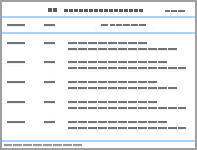
表1
灌浆期高温处理对30个小麦品种各指标的影响"
| 性状 Trait | 对照Control | 高温处理High temperature treatment | 变幅 Range (%) |
|---|---|---|---|
| 均值±标准差Mean±SD | 均值±标准差Mean±SD | ||
| 超氧化物歧化酶活性SOD activity (U·g-1·h-1) | 761.88±65.36b | 896.18±108.88a | 17.63 |
| 过氧化物酶活性POD activity (U·g-1·min-1) | 361.79±76.06a | 217.17±87.66b | -39.97 |
| 过氧化氢酶活性CAT activity (U·g-1·min-1) | 593.87±62.71a | 539.44±49.96b | -9.17 |
| 抗坏血酸过氧化物酶活性APX activity (U·g-1) | 2.20±1.19a | 0.73±0.96b | -66.82 |
| 丙二醛含量MDA content (μmol·g-1) | 29.73±5.89b | 42.16±23.80a | 41.81 |
| 过氧化氢含量H2O2 content (μmol·g-1) | 5.53±2.06a | 3.80±1.95b | -31.28 |
| 超氧阴离子自由基含量O2-· content (μg·g-1) | 22.74±7.96b | 70.51±43.12a | 210.07 |
| 旗叶叶绿素相对含量Flag leaf SPAD | 56.33±4.16a | 46.40±12.51b | -17.63 |
| 穗粒重Grain weight per spike (g) | 1.14±0.30a | 0.66±0.17b | -42.11 |
| 粒长Grain length (mm) | 5.97±0.45a | 6.04±0.39a | 1.27 |
| 粒宽Grain width (mm) | 2.73±0.26a | 2.53±0.22b | -7.22 |
| 千粒重Thousand-grain weight (g) | 37.27±7.15a | 26.57±7.02b | -28.71 |
| 单株产量Yield per plant (g) | 4.46±1.23a | 2.29±0.73b | -48.65 |

图1
小麦灌浆期经高温胁迫7 d的植株表型及其成熟籽粒的变化 CK:对照;HT:高温处理。下同。株高比例尺为25 cm,籽粒比例尺为5 mm"
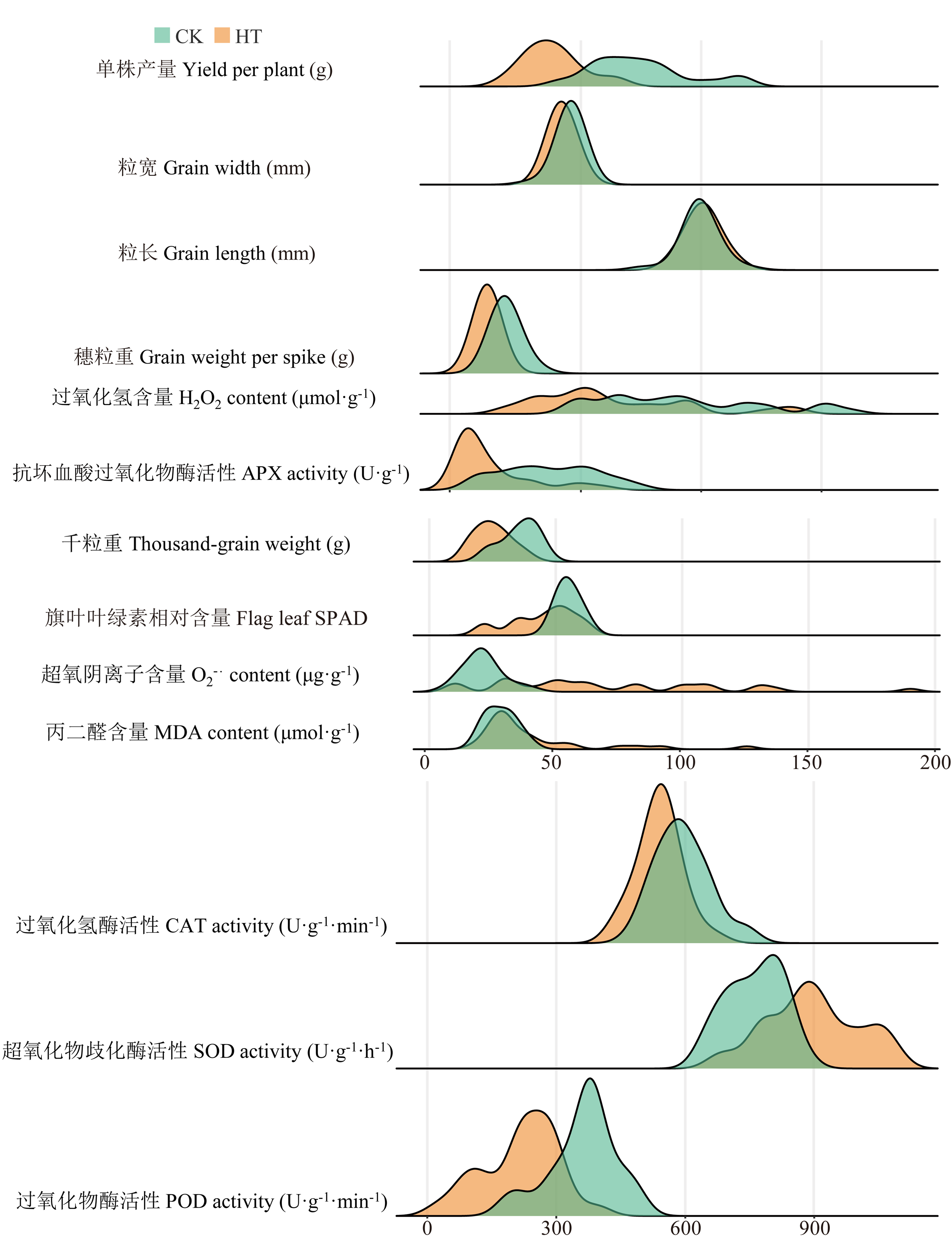
图2
小麦灌浆期高温处理组和对照组各项指标的离散程度分析"
表2
不同小麦品种各单项指标的耐高温系数"
| 品种Variety | X1 | X2 | X3 | X4 | X5 | X6 | X7 | X8 | X9 | X10 | X11 | X12 |
|---|---|---|---|---|---|---|---|---|---|---|---|---|
| 楚襄40 Chuxiang 40 | 0.051 | 0.374 | 1.084 | 0.992 | 0.790 | 1.100 | 1.774 | 0.410 | 1.267 | 0.495 | 0.674 | 0.424 |
| 楚襄1588 Chuxiang1588 | 0.404 | 0.076 | 0.967 | 1.172 | 1.358 | 0.876 | 1.159 | 0.432 | 0.861 | 0.431 | 0.590 | 0.503 |
| 襄麦2305 Xiangmai 2305 | 0.510 | 0.182 | 0.936 | 0.910 | 0.557 | 0.837 | 0.506 | 0.687 | 0.841 | 0.499 | 0.449 | 0.367 |
| 华麦216 Huamai 216 | 0.210 | 0.632 | 1.416 | 0.769 | 0.506 | 0.759 | 2.726 | 0.652 | 0.832 | 0.500 | 0.606 | 0.467 |
| 垦麦58 Kenmai 58 | 0.269 | 0.673 | 1.299 | 0.950 | 0.644 | 0.617 | 1.787 | 0.683 | 0.858 | 0.373 | 0.545 | 0.303 |
| 鄂麦017 Emai 017 | 0.187 | 0.696 | 0.994 | 0.908 | 0.346 | 0.931 | 3.104 | 0.751 | 0.761 | 0.470 | 0.487 | 0.321 |
| 鄂麦180 Emai180 | 0.231 | 0.768 | 1.274 | 0.825 | 0.413 | 0.832 | 1.493 | 0.922 | 0.989 | 0.711 | 0.962 | 0.875 |
| 长麦2号 Changmai 2 | 0.088 | 0.796 | 1.230 | 1.107 | 0.245 | 1.274 | 3.690 | 0.986 | 0.929 | 0.670 | 0.664 | 0.515 |
| 鄂麦229 Emai 229 | 0.658 | 0.612 | 1.051 | 0.976 | 0.671 | 1.109 | 1.709 | 0.937 | 0.903 | 0.432 | 0.685 | 0.378 |
| 长辐麦10号 Changfumai 10 | 0.050 | 0.670 | 1.306 | 0.873 | 1.162 | 2.251 | 3.396 | 0.655 | 0.944 | 0.612 | 0.754 | 0.510 |
| H51995 | 0.055 | 0.681 | 1.714 | 0.826 | 1.066 | 1.638 | 4.077 | 0.887 | 0.932 | 0.478 | 0.664 | 0.435 |
| 鄂麦026 Emai 026 | 0.072 | 0.432 | 1.074 | 0.674 | 0.851 | 1.147 | 3.544 | 0.861 | 0.968 | 0.584 | 0.744 | 0.292 |
| 泰麦1号 Taimai 1 | 0.977 | 0.683 | 1.187 | 1.030 | 1.036 | 0.976 | 4.176 | 1.070 | 1.077 | 0.820 | 0.957 | 0.615 |
| 楚科316 Chuke 316 | 0.165 | 0.713 | 1.077 | 0.924 | 0.456 | 0.974 | 3.338 | 1.011 | 0.933 | 0.479 | 0.750 | 0.555 |
| 长麦007 Changmai 007 | 0.254 | 1.561 | 1.260 | 1.009 | 0.655 | 1.137 | 2.422 | 0.924 | 0.933 | 0.813 | 0.761 | 1.012 |
| 轮选112 Lunxuan112 | 0.102 | 0.217 | 0.935 | 0.827 | 0.685 | 1.078 | 1.604 | 0.962 | 0.973 | 0.865 | 0.823 | 0.906 |
| 创红麦2号 Chuanghongmai 2 | 0.038 | 0.766 | 1.199 | 0.834 | 0.538 | 1.731 | 5.338 | 0.834 | 0.853 | 0.708 | 0.583 | 0.826 |
| 华麦1913 Huamai 1913 | 1.159 | 0.776 | 1.274 | 0.977 | 0.553 | 1.112 | 1.697 | 0.994 | 0.935 | 0.460 | 0.691 | 0.460 |
| 华麦230 Huamai 230 | 0.093 | 1.974 | 1.279 | 0.843 | 0.780 | 1.009 | 6.323 | 0.910 | 0.950 | 0.470 | 0.764 | 0.352 |
| 鄂麦008 Emai 008 | 0.946 | 0.948 | 1.121 | 1.008 | 0.793 | 1.022 | 3.665 | 0.942 | 0.980 | 0.768 | 0.821 | 0.566 |
| 华麦243 Huamai 243 | 0.053 | 0.362 | 1.110 | 0.830 | 0.546 | 1.120 | 6.354 | 1.039 | 0.973 | 0.629 | 0.827 | 0.399 |
| 长辐麦8号 Changfumai 8 | 0.144 | 0.627 | 1.309 | 0.950 | 1.134 | 1.042 | 2.741 | 0.931 | 0.918 | 0.933 | 0.708 | 0.622 |
| 鄂810619 E810619 | 0.227 | 0.787 | 1.485 | 0.814 | 0.837 | 0.999 | 1.616 | 0.989 | 0.970 | 0.375 | 0.890 | 0.456 |
| 鄂麦235 Emai 235 | 1.118 | 0.498 | 0.958 | 1.024 | 1.046 | 1.315 | 3.467 | 0.757 | 0.886 | 0.698 | 0.865 | 0.698 |
| 襄麦2355 Xiangmai 2355 | 0.022 | 0.787 | 1.490 | 0.872 | 0.635 | 3.145 | 4.131 | 0.744 | 0.932 | 0.575 | 0.742 | 0.602 |
| 华麦2260 Huamai 2260 | 1.321 | 0.743 | 1.131 | 0.719 | 0.630 | 0.810 | 0.701 | 0.948 | 0.904 | 0.963 | 0.701 | 0.811 |
| 金广天麦2号Jinguangtianmai 2 | 0.065 | 0.561 | 1.186 | 1.110 | 0.690 | 2.393 | 3.079 | 0.843 | 0.848 | 0.241 | 0.423 | 0.212 |
| 长麦5号Changmai 5 | 0.036 | 0.379 | 1.101 | 1.139 | 0.555 | 4.139 | 2.742 | 0.873 | 0.974 | 0.610 | 0.761 | 0.560 |
| 鄂麦30 Emai 30 | 0.026 | 0.250 | 1.203 | 0.744 | 0.357 | 5.380 | 7.869 | 0.486 | 0.879 | 0.689 | 0.719 | 0.435 |
| 华麦1912 Huamai 1912 | 0.804 | 0.190 | 0.912 | 0.892 | 0.388 | 2.886 | 3.792 | 0.416 | 0.992 | 0.774 | 0.881 | 0.774 |
| 平均值Average | 0.344 | 0.647 | 1.185 | 0.918 | 0.697 | 1.521 | 3.134 | 0.818 | 0.933 | 0.604 | 0.716 | 0.542 |
| 标准差STDEV | 0.396 | 0.381 | 0.186 | 0.125 | 0.270 | 1.084 | 1.712 | 0.190 | 0.089 | 0.178 | 0.136 | 0.200 |
| 变异系数CV(%) | 115.003 | 58.890 | 15.653 | 13.640 | 38.775 | 71.260 | 54.630 | 23.268 | 9.522 | 29.394 | 18.988 | 36.945 |
表3
各指标耐高温系数的KMO和Bartlett球形度检验"
| 变量筛选阶段 Screening stage | Measure of Sampling Adequacy度量值 Measure of Sampling Adequacy measurement value | Kaiser-Meyer-Olkin度量值 Kaiser-Meyer-Olkin measurement value | Bartlett球形度检验 Bartlett’s sphericity test | |||||||||||
|---|---|---|---|---|---|---|---|---|---|---|---|---|---|---|
| X1 | X2 | X3 | X4 | X5 | X6 | X7 | X8 | X9 | X10 | X11 | X12 | |||
| Bef. | 0.452 | 0.411 | 0.380 | 0.209 | 0.199 | 0.379 | 0.337 | 0.350 | 0.290 | 0.449 | 0.434 | 0.384 | 0.37 | <0.001 |
| Aft. | 0.702 | 0.558 | 0.583 | - | - | - | - | 0.633 | - | 0.643 | 0.819 | 0.628 | 0.65 | <0.001 |
表4
各性状主成分的特征向量及贡献率"
| 主成分Principle factor | CI 1 | CI 2 | CI 3 | CI 4 | |
|---|---|---|---|---|---|
| 特征值Eigen value | 2.499 | 1.772 | 0.929 | 0.597 | |
| 贡献率Contribution ratio (%) | 35.705 | 25.316 | 13.269 | 8.523 | |
| 累计贡献率Cumulative contribution ratio (%) | 35.705 | 61.022 | 74.291 | 82.814 | |
| 特征向量Eigen vector | X1 | 0.302 | -0.246 | 0.726 | 0.245 |
| X2 | 0.150 | 0.587 | 0.173 | 0.552 | |
| X3 | -0.062 | 0.604 | -0.274 | 0.042 | |
| X8 | 0.280 | 0.438 | 0.415 | -0.462 | |
| X10 | 0.541 | -0.158 | -0.244 | 0.128 | |
| X11 | 0.481 | 0.069 | -0.132 | -0.549 | |
| X12 | 0.530 | -0.088 | -0.345 | 0.320 | |
表5
各参试品种综合指标值、权重、u(Xj)、D值、RV及综合评价"
| 品种 Variety | CI 1 | CI 2 | CI 3 | CI 4 | u1 | u2 | u3 | u4 | D值 D value | RV | 综合评价 Comprehensive evaluation |
|---|---|---|---|---|---|---|---|---|---|---|---|
| 楚襄40 Chuxiang 40 | -1.069 | -1.037 | -1.049 | 0.385 | 0.258 | 0.269 | 0.121 | 0.591 | 0.274 | 0.280 | 高温敏感型High temperature-sensitive type |
| 楚襄1588 Chuxiang1588 | -1.105 | -1.811 | -0.256 | 0.543 | 0.248 | 0.095 | 0.332 | 0.626 | 0.254 | 0.261 | 高温敏感型High temperature-sensitive type |
| 襄麦2305 Xiangmai 2305 | -1.197 | -1.425 | 0.910 | 0.535 | 0.224 | 0.182 | 0.643 | 0.624 | 0.319 | 0.329 | 高温敏感型High temperature-sensitive type |
| 华麦216 Huamai 216 | -0.844 | 0.374 | -0.601 | 0.777 | 0.317 | 0.586 | 0.241 | 0.676 | 0.424 | 0.405 | 高温敏感型High temperature-sensitive type |
| 垦麦58 Kenmai 58 | -1.408 | 0.276 | 0.316 | 0.629 | 0.168 | 0.564 | 0.485 | 0.644 | 0.389 | 0.381 | 高温敏感型High temperature-sensitive type |
| 鄂麦017 Emai 017 | -1.226 | -0.380 | 0.682 | 0.739 | 0.216 | 0.417 | 0.582 | 0.668 | 0.383 | 0.401 | 高温敏感型High temperature-sensitive type |
| 鄂麦180 Emai180 | 1.367 | 0.501 | -1.052 | -0.659 | 0.903 | 0.615 | 0.120 | 0.364 | 0.634 | 0.632 | 中等耐高温型 Moderately high temperature-tolerant type |
| 长麦2号Changmai 2 | 0.027 | 0.636 | -0.099 | -0.165 | 0.548 | 0.645 | 0.374 | 0.472 | 0.542 | 0.544 | 中等耐高温型 Moderately high temperature-tolerant type |
| 鄂麦229 Emai 229 | -0.393 | -0.152 | 1.624 | -0.564 | 0.437 | 0.468 | 0.833 | 0.385 | 0.504 | 0.516 | 中等耐高温型 Moderately high temperature-tolerant type |
| 长辐麦10号Changfumai 10 | -0.265 | 0.196 | -1.097 | 0.102 | 0.470 | 0.546 | 0.108 | 0.530 | 0.442 | 0.435 | 高温敏感型High temperature-sensitive type |
| H51995 | -0.718 | 1.684 | -0.762 | -0.296 | 0.350 | 0.881 | 0.198 | 0.443 | 0.498 | 0.459 | 中等耐高温型 Moderately high temperature-tolerant type |
| 鄂麦026 Emai 026 | -0.516 | -0.214 | 0.097 | -1.467 | 0.404 | 0.454 | 0.426 | 0.189 | 0.401 | 0.412 | 高温敏感型High temperature-sensitive type |
| 泰麦1号Taimai 1 | 1.624 | 0.111 | 1.109 | -1.124 | 0.971 | 0.527 | 0.696 | 0.263 | 0.718 | 0.715 | 耐高温型High temperature-tolerant type |
| 楚科316 Chuke 316 | -0.014 | 0.321 | 0.413 | -0.922 | 0.537 | 0.574 | 0.511 | 0.307 | 0.521 | 0.537 | 中等耐高温型 Moderately high temperature-tolerant type |
| 长麦007 Changmai 007 | 1.556 | 1.189 | -0.799 | 2.265 | 0.953 | 0.770 | 0.188 | 1.000 | 0.779 | 0.786 | 耐高温型High temperature-tolerant type |
| 轮选112 Lunxuan112 | 1.314 | -1.002 | -1.082 | -1.084 | 0.889 | 0.277 | 0.113 | 0.272 | 0.514 | 0.530 | 中等耐高温型 Moderately high temperature-tolerant type |
| 创红麦2号 Chuanghongmai 2 | 0.274 | 0.125 | -1.033 | 1.313 | 0.613 | 0.530 | 0.126 | 0.793 | 0.528 | 0.529 | 中等耐高温型 Moderately high temperature-tolerant type |
| 华麦1913 Huamai 1913 | 0.100 | 0.405 | 2.251 | 0.190 | 0.567 | 0.593 | 1.000 | 0.549 | 0.643 | 0.632 | 中等耐高温型 Moderately high temperature-tolerant type |
| 华麦230 Huamai 230 | -0.194 | 2.214 | 0.692 | 1.259 | 0.489 | 1.000 | 0.585 | 0.781 | 0.691 | 0.711 | 耐高温型High temperature-tolerant type |
| 鄂麦008 Emai 008 | 1.083 | 0.046 | 1.284 | 0.292 | 0.828 | 0.513 | 0.742 | 0.571 | 0.691 | 0.696 | 耐高温型High temperature-tolerant type |
| 华麦243 Huamai 243 | 0.065 | 0.077 | 0.037 | -2.335 | 0.558 | 0.519 | 0.410 | 0.000 | 0.465 | 0.474 | 高温敏感型High temperature-sensitive type |
| 长辐麦8号 Changfumai 8 | 0.725 | 0.318 | -0.925 | -0.002 | 0.733 | 0.574 | 0.154 | 0.507 | 0.568 | 0.556 | 中等耐高温型 Moderately high temperature-tolerant type |
| 鄂810619 E810619 | -0.123 | 1.494 | 0.079 | -1.581 | 0.508 | 0.838 | 0.422 | 0.164 | 0.560 | 0.546 | 中等耐高温型 Moderately high temperature-tolerant type |
| 鄂麦235 Emai 235 | 1.101 | -1.252 | 1.050 | 0.094 | 0.833 | 0.221 | 0.680 | 0.528 | 0.590 | 0.599 | 中等耐高温型 Moderately high temperature-tolerant type |
| 襄麦2355 Xiangmai 2355 | -0.150 | 0.940 | -1.273 | 0.287 | 0.501 | 0.714 | 0.062 | 0.570 | 0.503 | 0.483 | 中等耐高温型 Moderately high temperature-tolerant type |
| 华麦2260 Huamai 2260 | 1.734 | -0.589 | 1.304 | 1.509 | 1.000 | 0.370 | 0.748 | 0.836 | 0.750 | 0.741 | 耐高温型High temperature-tolerant type |
| 金广天麦2号Jinguangtianmai 2 | -2.041 | 0.317 | 0.884 | 0.047 | 0.000 | 0.573 | 0.636 | 0.518 | 0.331 | 0.335 | 高温敏感型High temperature-sensitive type |
| 长麦5号Changmai 5 | -0.005 | -0.269 | -0.545 | -1.136 | 0.539 | 0.442 | 0.256 | 0.261 | 0.435 | 0.443 | 高温敏感型High temperature-sensitive type |
| 鄂麦30 Emai 30 | -0.575 | -0.863 | -1.505 | -0.105 | 0.388 | 0.308 | 0.000 | 0.485 | 0.312 | 0.304 | 高温敏感型High temperature-sensitive type |
| 华麦1912 Huamai 1912 | 0.874 | -2.233 | -0.655 | 0.474 | 0.772 | 0.000 | 0.226 | 0.611 | 0.432 | 0.440 | 高温敏感型High temperature-sensitive type |
| 权重ω | 0.431 | 0.306 | 0.160 | 0.103 |
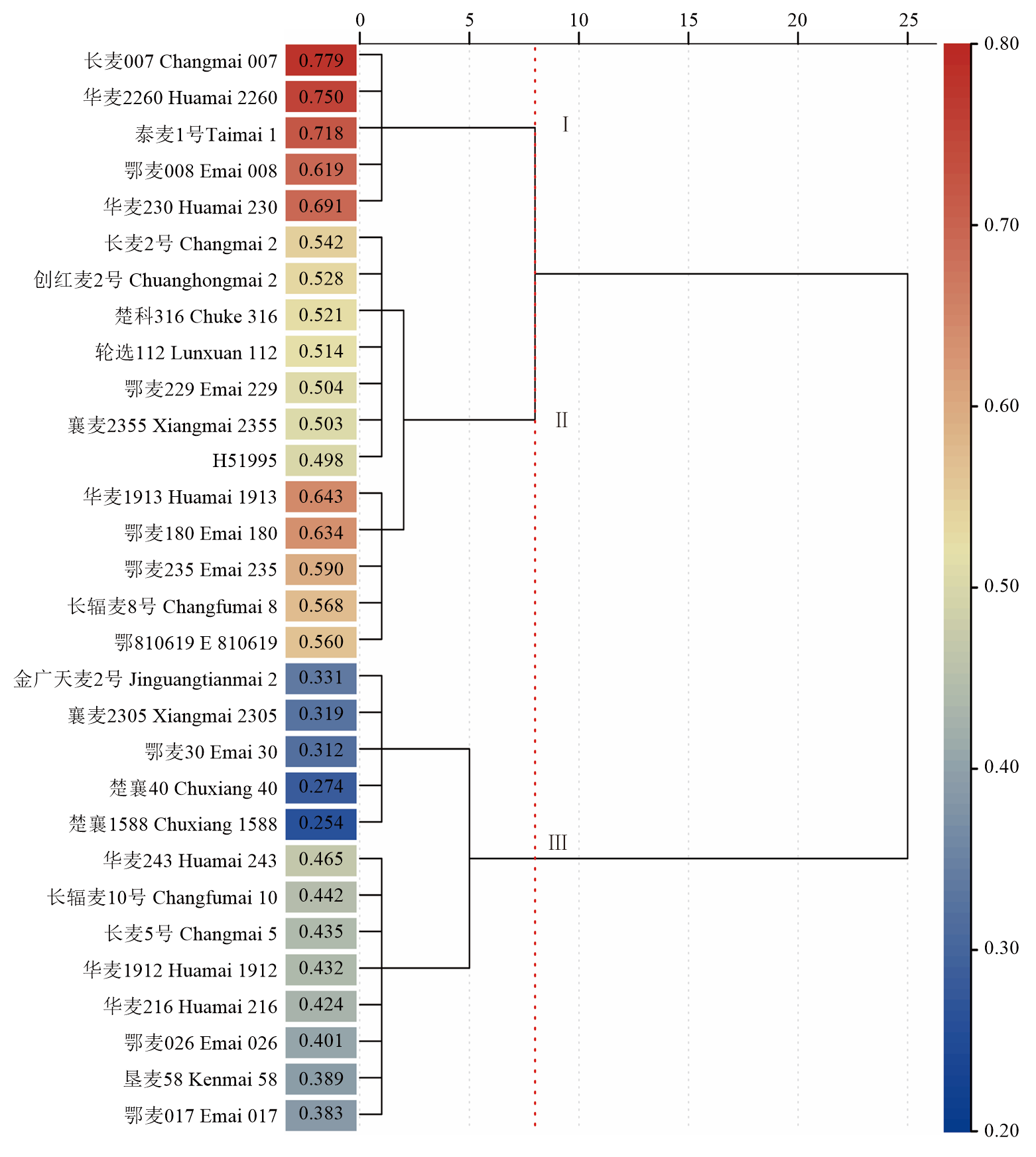
图3
30个小麦品种的系统聚类热图"
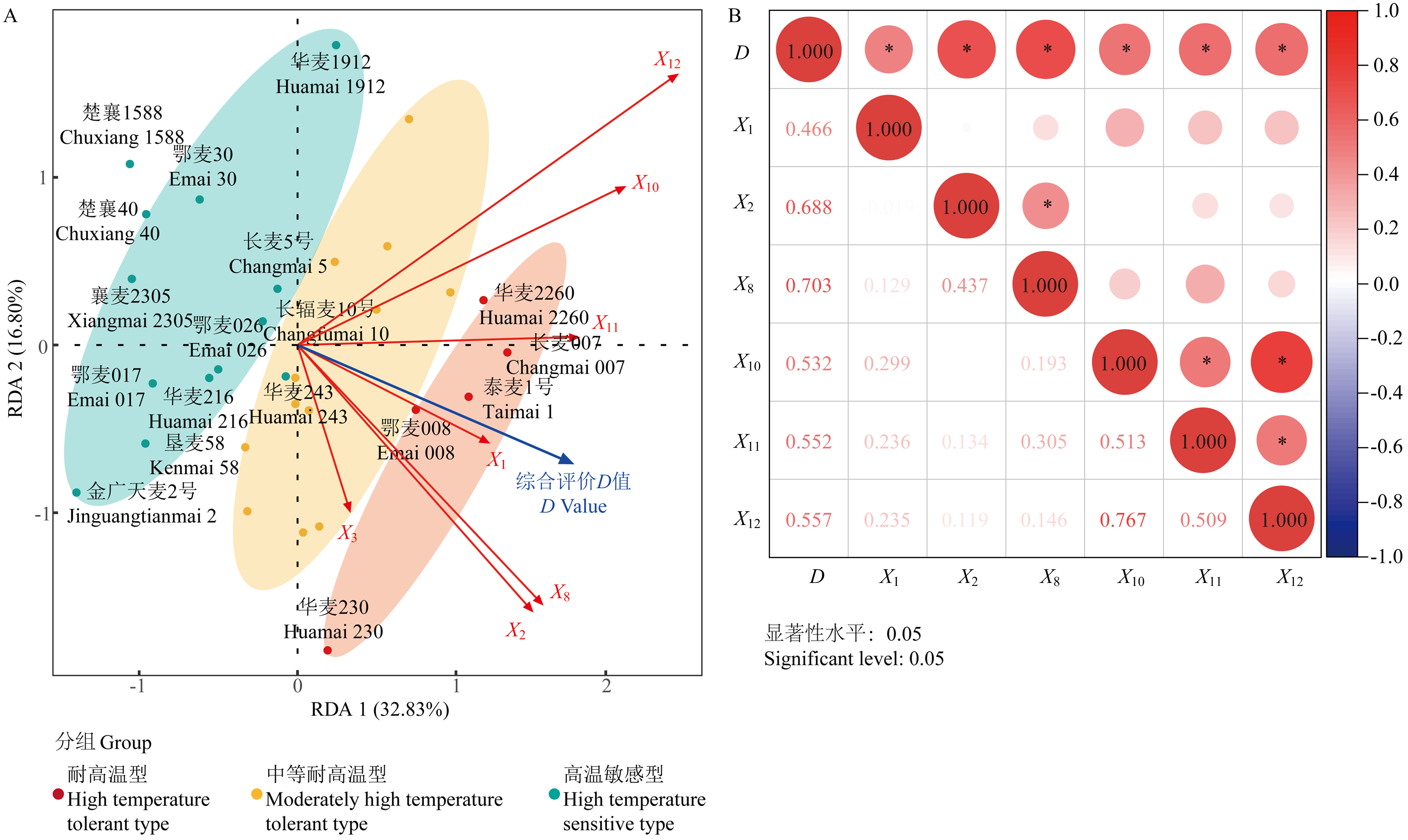
图4
30个小麦品种的冗余分析及综合评价值D与所选指标的相关性热图 A:高温胁迫下小麦各农艺性状和生理指标的RDA排序分析,2个解释变量间的夹角表示其相关性,夹角为锐角表示成正相关,钝角则表示负相关;箭头长短表示影响D值的主次要关系,箭头越长,表示解释力越大,反之越小;B:6个指标耐高温系数的相关性分析,红色表示正相关,蓝色表示负相关,圆形直径越大说明相关系数越大,*表示在P<0.05水平差异显著"
表6
逐步回归模型的系数估计与显著性检验结果"
| 变量Variable | B | β | t | P | VIF |
|---|---|---|---|---|---|
| -0.111 | 0.000 | -6.572 | <0.001 | - | |
| X8 | 0.259 | 0.348 | 15.300 | <0.001 | 1.380 |
| X12 | 0.136 | 0.193 | 6.122 | <0.001 | 2.641 |
| X2 | 0.186 | 0.499 | 22.634 | <0.001 | 1.298 |
| X1 | 0.111 | 0.309 | 15.111 | <0.001 | 1.118 |
| X11 | 0.137 | 0.131 | 5.491 | <0.001 | 1.526 |
| X10 | 0.120 | 0.150 | 4.692 | <0.001 | 2.726 |
| [1] |
doi: 10.1016/j.molp.2025.01.005 |
| [2] |
doi: 10.1088/1748-9326/ab154b |
| [3] |
胡阳阳, 卢红芳, 刘卫星, 康娟, 马耕, 李莎莎, 褚莹莹, 王晨阳. 灌浆期高温与干旱胁迫对小麦籽粒淀粉合成关键酶活性及淀粉积累的影响[J]. 作物学报, 2018, 44(4): 591-600.
|
|
doi: 10.3724/SP.J.1006.2018.00591 |
|
| [4] |
潘石凤, 尹志聪, 段明铿, 韩婷婷, 范怡, 黄艳艳, 王会军. 长江中下游极端高温日数的季节预测[J]. 中国科学: 地球科学, 2024, 54(7): 2167-2177.
|
|
|
|
| [5] |
高德荣, 张晓, 康建鹏, 别同德, 张伯桥, 张晓祥, 程顺和. 长江中下游麦区小麦迟播的不利影响及育种对策[J]. 麦类作物学报, 2014, 34(2): 279-283.
|
|
|
|
| [6] |
陶源, 赵凯敏, 代存虎, 刘明敏, 朱敏, 丁锦峰, 李春燕, 朱新开, 郭文善. 花后短暂高低温胁迫对小麦产量形成的影响及减灾调控[J]. 麦类作物学报, 2022, 42(12): 1557-1566.
|
|
|
|
| [7] |
doi: 10.1088/1748-9326/ac3870 |
| [8] |
|
| [9] |
doi: 10.1038/s41598-023-33913-6 pmid: 37095206 |
| [10] |
卢奕霏, 顾迎港, 陈威, 王娜, 康珍, 侯泽豪, 张迎新, 方正武, 马东方, 刘易科, 朱展望, 张改生, 王书平. 高温胁迫对小麦花药活性氧代谢的影响[J]. 麦类作物学报, 2020, 40(4): 488-493.
|
|
|
|
| [11] |
郑甲成, 尤依锦, 刘婷, 徐祥, 李杰勤, 王歆, 程昕昕, 许峰, 詹秋文. 花期高温胁迫下TaERECTA基因对小麦生理特性和光合作用的影响[J]. 麦类作物学报, 2019, 39(1): 35-41.
|
|
|
|
| [12] |
|
| [13] |
doi: 10.1021/acs.jafc.5c00721 pmid: 40042217 |
| [14] |
谌怡锦. 利用全基因组关联分析鉴定小麦穗部相关性状位点及其耐热性分析[D]. 杨凌: 西北农林科技大学, 2023.
|
|
|
|
| [15] |
王小波, 关攀锋, 辛明明, 汪永法, 陈希勇, 赵爱菊, 刘曼双, 李红霞, 张明义, 逯腊虎, 魏亦勤, 刘旺清, 张金波, 倪中福, 姚颖垠, 胡兆荣, 彭惠茹, 孙其信. 小麦种质资源耐热性评价[J]. 中国农业科学, 2019, 52(23): 4191-4200. DOI: 10.3864/j.issn.0578-1752.2019.23.001.
|
|
|
|
| [16] |
马晨晨, 梁小菡, 张前进, 叶飞宇, 庞芸芸, 张新, 鲁晓民, 曹丽茹. 玉米杂交种及其亲本自交系耐高温性综合分析[J]. 江苏农业科学, 2025, 53(13): 80-89.
|
|
|
|
| [17] |
王洋. 小麦对灌浆期高温胁迫的生理响应和转录组分析[D]. 杨凌: 西北农林科技大学, 2025.
|
|
|
|
| [18] |
李贵全, 张海燕, 季兰, 赵二开, 刘建兵, 李玲, 张家蓉. 不同大豆品种抗旱性综合评价[J]. 应用生态学报, 2006, 17(12): 2408-2412.
|
|
|
|
| [19] |
王伟伟, 王伟, 邹景伟, 于亮, 王志, 王奉芝, 陆莉, 钮力亚. 小麦耐盐性综合评价方法的研究进展[J]. 现代农业研究, 2022, 28(7): 111-113.
|
|
|
|
| [20] |
方保停, 李向东, 邵运辉, 王汉芳, 岳俊芹, 张德奇, 杨程, 秦峰. 黄淮麦区冬小麦品种耐热性比较研究[J]. 河南农业科学, 2019, 48(7): 19-23.
|
|
|
|
| [21] |
王洋, 郭绪雨, 孙志伟, 史张鹏, 赵越, 周昊, 邵磊磊, 王海容, 牛娜, 马翎健. 不同小麦材料灌浆期耐热性分析及综合评价[J]. 西北农业学报, 2025, 34(12): 2190-2201.
|
|
|
|
| [22] |
赵鹏, 王晓明, 刘曼双, 许盛宝. 小麦种质资源耐热性评估研究进展[J]. 麦类作物学报, 2021, 41(5): 569-576.
|
|
|
|
| [23] |
李敏, 苏慧, 李阳阳, 李金鹏, 李金才, 朱玉磊, 宋有洪. 黄淮海麦区小麦耐热性分析及其鉴定指标的筛选[J]. 中国农业科学, 2021, 54(16): 3381-3393. DOI: 10.3864/j.issn.0578-1752.2021.16.002.
|
|
|
|
| [24] |
王红盼, 熊肖, 蔡海亚, 刘刚, 张硕, 何永刚, 焦春海, 徐乐, 徐延浩. 灌浆期高温对小麦籽粒粒型的影响及耐高温性评价[J]. 江苏农业科学, 2023, 51(12): 78-85.
|
|
|
|
| [25] |
刘秀坤, 韩冉, 李晓明, 解树斌, 李法计, 陈亚鹏, 翟胜男, 李豪圣, 刘建军, 赵振东, 张玉梅, 曹新有. 灌浆期小麦旗叶在高温胁迫下的转录组分析[J]. 山东农业科学, 2022, 54(10): 1-10, 16.
|
|
|
|
| [26] |
邵从本, 罗广华, 王爱国, 郭俊彦. 几种检测超氧物歧化酶活性反应的比较[J]. 植物生理学通讯, 1983, 19(5): 46-49.
|
|
|
|
| [27] |
王爱国, 罗广华. 植物的超氧物自由基与羟胺反应的定量关系[J]. 植物生理学通讯, 1990, 26(6): 55-57.
|
|
|
|
| [28] |
赵猛, 毕焕改, 孟令浩, 姜婷婷, 张晓伟, 艾希珍. 低温循环诱导的胁迫记忆调控黄瓜耐冷性机制[J]. 中国农业科学, 2024, 57(24): 4933-4944. DOI: 10.3864/j.issn.0578-1752.2024.24.009.
|
|
|
|
| [29] |
doi: 10.1016/0003-2697(84)90039-3 pmid: 6476384 |
| [30] |
doi: 10.1038/s41598-024-76875-z |
| [31] |
|
| [32] |
doi: 10.1016/j.celrep.2025.115271 |
| [33] |
汪明华. 耐高温大豆种质资源筛选及响应高温胁迫的蛋白组学分析[D]. 合肥: 安徽农业大学, 2019.
|
|
|
|
| [34] |
doi: 10.1016/j.plaphy.2025.110204 |
| [35] |
唐宇, 雷毕欣, 王传伟, 严轩韬, 王浩, 郑杰, 张文静, 马尚宇, 黄正来, 樊永惠. 彩色小麦花青素积累对花后高温胁迫的响应机理[J]. 中国农业科学, 2025, 58(6): 1083-1101. DOI: 10.3864/j.issn.0578-1752.2025.06.004.
|
|
|
|
| [36] |
鲁海琴, 陈丽, 陈磊, 张盈川, 文静, 易斌, 涂金星, 傅廷栋, 沈金雄. Bna-novel-miR311-HSC70-1模块调控甘蓝型油菜响应热胁迫的机制[J]. 作物学报, 2020, 46(10): 1474-1484.
doi: 10.3724/SP.J.1006.2020.04014 |
|
doi: 10.3724/SP.J.1006.2020.04014 |
|
| [37] |
doi: 10.1111/pbi.v23.10 |
| [38] |
齐学礼, 赵明忠, 尹文生, 李莹, 郭瑞, 焦竹青, 张煜. 小麦耐高温特性的生理机制与基因挖掘研究进展[J]. 南方农业学报, 2022, 53(10): 2885-2893.
|
|
|
|
| [39] |
付丽军, 李聪晓, 苏胜宇, 李玉华, 周禹. 黄瓜苗期耐热种质筛选与耐热性评价体系构建[J]. 植物生理学报, 2020, 56(7): 1593-1604.
|
|
|
|
| [40] |
张英华, 杨佑明, 曹莲, 郝杨凡, 黄菁, 李金鹏, 姚得秀, 王志敏. 灌浆期高温对小麦旗叶与非叶器官光合和抗氧化酶活性的影响[J]. 作物学报, 2015, 41(1): 136-144.
|
|
doi: 10.3724/SP.J.1006.2015.00136 |
|
| [41] |
黄松, 黄岩, 杨战峰, 张天海, 孙君艳. 灌浆期高温胁迫对豫南稻茬麦区小麦灌浆速率及籽粒品质的影响[J]. 江苏农业科学, 2023, 51(18): 88-93.
|
|
|
|
| [42] |
doi: 10.3390/agronomy13010154 |
| [43] |
刘振山. 小麦苗期干旱、高温和旱热共胁迫转录表达谱及ABD部分同源基因表达分化分析[D]. 北京: 中国农业大学, 2015.
|
|
|
|
| [44] |
晁漫宁. 干旱、 高温及其互作对灌浆期小麦籽粒发育的影响解析[D]. 杨凌: 西北农林科技大学, 2020.
|
|
|
|
| [45] |
doi: 10.3390/plants11010059 |
| [46] |
王维领. 外源水杨酸对小麦高温胁迫的缓解效应及其生理机制[D]. 南京: 南京农业大学, 2015.
|
|
|
|
| [47] |
杨毅, 李昱, 康建宏, 刘萍. 花后高温胁迫对春小麦籽粒淀粉合成的影响[J]. 麦类作物学报, 2015, 35(11): 1535-1541.
|
|
|
|
| [48] |
李敏, 赖晨骏, 李金鹏, 李金才, 朱玉磊, 宋有洪. 灌浆期高温对冬小麦叶源与粒库生理特征的影响[J]. 麦类作物学报, 2022, 42(12): 1567-1574.
|
|
|
|
| [49] |
封超年, 郭文善, 施劲松, 彭永欣, 朱新开. 小麦花后高温对籽粒胚乳细胞发育及粒重的影响[J]. 作物学报, 2000, 26(4): 399-405.
|
|
|
|
| [50] |
刘希伟, 王德梅, 王艳杰, 杨玉双, 赵广才, 常旭虹. 小麦生育中后期干旱高温对籽粒产量形成过程的影响机制及缓解措施[J]. 作物杂志, 2023(6): 17-25.
|
|
|
|
| [51] |
王松峰, 王永霞, 郭瑞. 小麦耐热性研究进展[J]. 大麦与谷类科学, 2024, 41(5): 1-7.
|
|
|
|
| [52] |
|
| [53] |
doi: 10.1016/j.agrformet.2024.110354 |
| [54] |
doi: 10.3390/agronomy13102590 |
| [55] |
doi: 10.3390/plants14020148 |
| [56] |
李宇星, 马亮亮, 张月, 秦博雅, 张文静, 马尚宇, 黄正来, 樊永惠. 外源海藻糖对灌浆期高温胁迫下小麦旗叶生理特性和产量的影响[J]. 作物学报, 2023, 49(8): 2210-2224.
doi: 10.3724/SP.J.1006.2023.21057 |
|
doi: 10.3724/SP.J.1006.2023.21057 |
|
| [57] |
|
| [58] |
戎亚思, 李丰, 张鹏钰, 王东勇, 苏小雨, 田媛, 高桐梅. 基于主成分-聚类分析芝麻盛花期耐高温评价及品种筛选[J]. 中国农业科学, 2024, 57(20): 3957-3973. DOI: 10.3864/j.issn.0578-1752.2024.20.002.
|
|
|
|
| [59] |
靳路真, 王洋, 张伟, 邱红梅, 陈健, 候云龙, 马晓萍, 王跃强, 谢甫绨. 大豆品种(系)耐热性鉴定及分级评鉴[J]. 中国油料作物学报, 2016, 38(1): 77-87.
|
|
|
|
| [60] |
牛丽, 刘源, 于康珂, 刘荣花, 李潮海, 刘天学. 玉米杂交种苗期耐热性评价[J]. 玉米科学, 2015, 23(1): 107-114.
|
|
|
|
| [61] |
任茂, 张文英. 棉花品种耐热性分析及鉴定指标筛选[J]. 核农学报, 2018, 32(4): 788-794.
doi: 10.11869/j.issn.100-8551.2018.04.0788 |
|
doi: 10.11869/j.issn.100-8551.2018.04.0788 |
|
| [62] |
谈静如, 胡齐赞, 岳智臣, 陶鹏, 雷娟利, 李必元, 赵彦婷, 臧运祥. 基于叶绿素荧光参数的苗用型大白菜耐热性综合评价体系[J]. 浙江农业学报, 2025, 37(2): 288-299.
doi: 10.3969/j.issn.1004-1524.20240151 |
|
|
| [1] | 王小玮, 杜佛力, 闫红财, 郎正东, 党志娟, 李葆春, 汪军成, 马小乐, 王化俊, 张宏, 姚立蓉. 396份春小麦灌浆期和成熟期抗旱性评价[J]. 中国农业科学, 2026, 59(8): 1608-1621. |
| [2] | 王彩玉, 刘小丽, 李文广, 杨文平, 杨珍平, 高志强. 有机肥不同替代比例对土壤多功能性的影响及微生物驱动机制[J]. 中国农业科学, 2026, 59(8): 1712-1726. |
| [3] | 崔节浩, 张萌, 王沁, 于佳妍, 林琨, 李尚泽, 兰恒, 耿艳秋, 张强, 郭丽颖, 邵玺文. 粳稻资源抗倒伏性评价与生理机制[J]. 中国农业科学, 2026, 59(7): 1420-1438. |
| [4] | 朱琦, 贾振鹏, Tahir SHAH, 徐晨晟, 李芷琦, 吕会帅, 朱鹏超, 韦小敏, 黄冬琳, 孙艳妮, 曹卫东, 高亚军, 王朝辉, 张达斌. 绿肥配施增效产品降低旱地麦田温室气体排放及碳足迹[J]. 中国农业科学, 2026, 59(7): 1507-1522. |
| [5] | 叶美金, 吴雷, Lohani Md Nahibuzzaman, 尹丽, 胡欣荣, 刘亚西, 蒋云峰, 陈国跃, 蒲至恩, 李阳, 李婷, 邹亚亚, 吴佳怡, 马建. 基于GWAS的中国地方小麦成熟胚大小位点的鉴定及其遗传效应解析[J]. 中国农业科学, 2026, 59(6): 1157-1171. |
| [6] | 李文虎, 礼海风, 杜宇鹏, 丁玉兰, 罗一诺, 李宇珂, 佘文婷, 张丰, 滕宇, 张思琦, 黄翠, 李小涵, 刘金山, 王朝辉. 小麦锌吸收转移对土施锌肥响应的区域差异[J]. 中国农业科学, 2026, 59(5): 1034-1047. |
| [7] | 焦文娟, 何万龙, 耿洪伟, 白斌, 李剑峰, 程宇坤. 155份春小麦品种(系)条锈病抗性评价与抗病基因分子检测[J]. 中国农业科学, 2026, 59(5): 937-950. |
| [8] | 郝琨, 陈洪德, 张威, 钟韵, 党美荣, 朱士江, 黄志坤, 金英. 基于柑橘产量、品质及水氮利用的涌泉根灌水氮综合评价[J]. 中国农业科学, 2026, 59(4): 862-873. |
| [9] | 崔士友, 陈澎军, 缪源卿, 韩继军, 沈俊明. EMS诱变抗草甘膦小麦新种质的创制与大田评价[J]. 中国农业科学, 2026, 59(4): 723-733. |
| [10] | 钱瑾, 李映雪, 吴芳, 邹晓晨. 集成光谱降维的冬小麦叶片磷含量估算[J]. 中国农业科学, 2026, 59(4): 781-792. |
| [11] | 孔媛, 崔沙沙, 李美, 李健, 杨思雨, 房锋, 刘帅帅, 刘明平, 曾艳, 高兴祥, 柏连阳. 黄淮海冬小麦田多花黑麦草等5种禾本科杂草时空分布变化规律[J]. 中国农业科学, 2026, 59(4): 807-823. |
| [12] | 王勇胜, 牛丽, 王长杰, 马立花, 廉潇潇, 孟亚雄, 马小乐, 姚立蓉, 张宏, 杨轲, 李葆春, 王化俊, 司二静, 汪军成. 冬小麦千粒重的全基因组关联分析及候选基因预测[J]. 中国农业科学, 2026, 59(3): 499-514. |
| [13] | 李心怡, 李嘉宁, 杨文平, 夏清, 霍滢睿, 郝世航, 黄婷苗, 任永康, 陈杰, 高志强, 杨珍平. 彩粒小麦锌营养对花后叶面喷锌的响应[J]. 中国农业科学, 2026, 59(3): 515-527. |
| [14] | 咸青林, 肖鉴珂, 高阿庆, 郜利闯, 刘杨. 种植方式结合测墒补灌下冬小麦产量及水分利用效率[J]. 中国农业科学, 2026, 59(3): 589-601. |
| [15] | 翁颖, 王豪, 刘泽昊, 郭一婷, 唐雅婷, 刘柳, 郑宝强, 李金才, 陈翔. 药隔期倒春寒对小麦强、弱势籽粒形态与代谢组学的影响[J]. 中国农业科学, 2026, 59(21): 4746-4764. |
|
||
