






中国农业科学 ›› 2026, Vol. 59 ›› Issue (17): 3712-3729.doi: 10.3864/j.issn.0578-1752.2026.17.002
王浩栋1,2( ), 王鹏3, 吴宇轩2, 张钦2, 王巧芸2, 郭利建1, 杨德龙1,2(), 陈涛2()
收稿日期:2026-02-03
接受日期:2026-04-01
出版日期:2026-09-03
发布日期:2026-09-03
通信作者:
联系方式:
王浩栋,E-mail:17789375583@163.com。
基金资助:
WANG HaoDong1,2(), WANG Peng3, WU YuXuan2, ZHANG Qin2, WANG QiaoYun2, GUO LiJian1, YANG DeLong1,2(), CHEN Tao2()
Received:2026-02-03
Accepted:2026-04-01
Published:2026-09-03
Online:2026-09-03
摘要:
【目的】小麦是全球最重要的粮食作物之一,提高产量对保障粮食安全具有重要意义。穗粒数是影响小麦产量的核心因素之一,深入解析小麦穗粒数遗传基础并挖掘关键候选基因,为小麦穗粒数遗传改良和分子标记辅助育种提供依据。【方法】以123份小麦品种(系)为材料,在不同干旱环境条件下进行穗粒数表型鉴定,结合35K SNP芯片基因分型信息,采用混合线性模型开展全基因组关联分析。针对与穗粒数显著相关的标记-性状关联位点(MTA),进一步开展单倍型分析,开发KASP分子标记并进行多环境表型验证。利用公共RNA-seq数据筛选穗部组织特异性高表达基因,结合qRT-PCR验证其表达模式。通过同源比对和已有功能研究信息,对候选基因进行功能注释。【结果】穗粒数在不同环境条件下的变异系数为17.18%—22.48%,表明该性状受环境影响较大。GWAS共检测到47个与穗粒数显著关联的MTA,其中,5A染色体上分布最多,达9个MTA。标记AX-94445381位于5A染色体,在2个环境中被重复检测到,表现出稳定的遗传关联。单倍型分析将该标记划分为HapⅠ和HapⅡ 2种单倍型,进一步开发的KASP标记验证结果表明,在3个环境中,携带HapⅡ单倍型的小麦品种的穗粒数均显著高于携带HapⅠ单倍型的小麦品种。利用公开的重测序数据分析优异单倍型AX-94445381-HapⅡ的分布情况,发现其在育成品种中的分布频率(30.1%)低于地方品种(40.0%),表明该单倍型在小麦育种进程中尚未得到充分利用。对AX-94445381上下游1 Mb区间进行基因检索,整合RNA-seq数据筛选出穗部组织特异性高表达基因,经qRT-PCR验证并结合水稻同源基因信息,发现3个已被报道直接参与穗部发育的候选基因,分别编码UDP-糖基转移酶、MADS-box转录因子和WD重复序列蛋白。【结论】鉴定到与小麦穗粒数稳定关联的重要位点AX-94445381,明确了优异单倍型AX-94445381-HapⅡ具有显著提高穗粒数的功能,具有进一步挖掘和应用的潜力。
王浩栋, 王鹏, 吴宇轩, 张钦, 王巧芸, 郭利建, 杨德龙, 陈涛. 旱地小麦穗粒数全基因组关联分析与候选基因发掘[J]. 中国农业科学, 2026, 59(17): 3712-3729.
WANG HaoDong, WANG Peng, WU YuXuan, ZHANG Qin, WANG QiaoYun, GUO LiJian, YANG DeLong, CHEN Tao. Genome-Wide Association Study and Candidate Gene Identification for Grain Number per Spike in Dryland Wheat (Triticum aestivum L.)[J]. Scientia Agricultura Sinica, 2026, 59(17): 3712-3729.
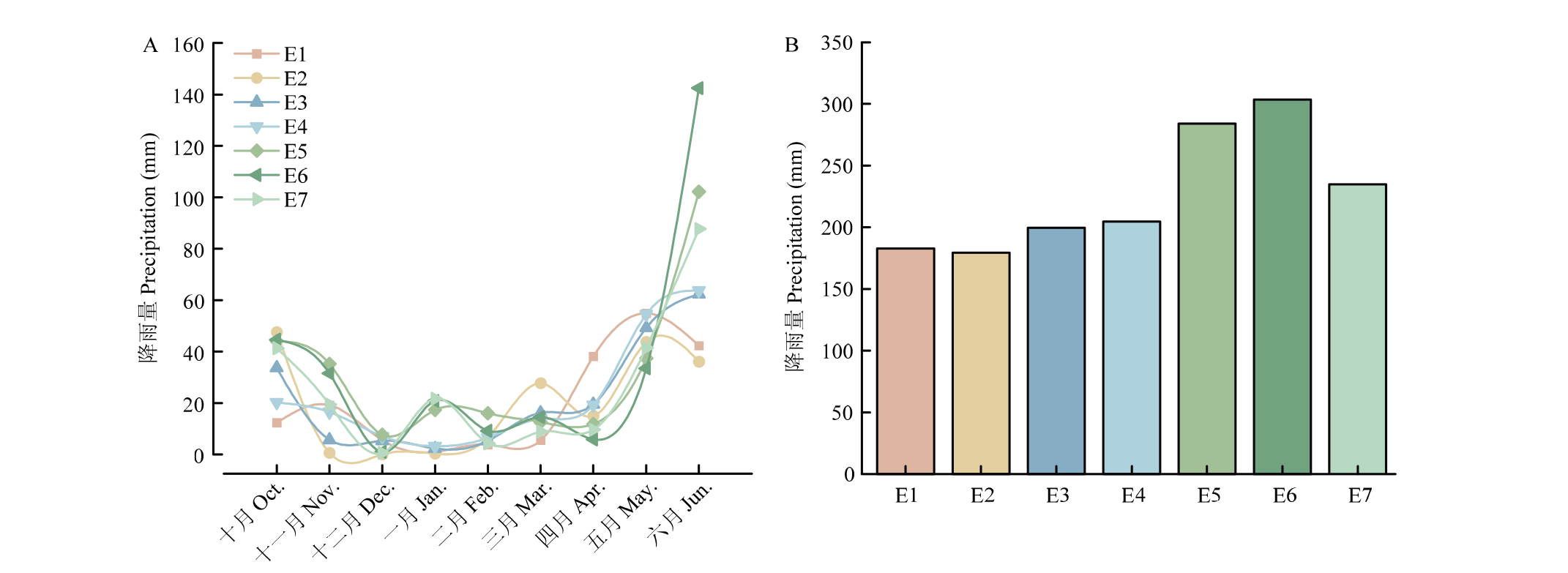
图1
NP1和NP2群体生育期内不同环境的降雨量统计 A:不同环境中不同月份的降雨量;B:不同环境总降雨量。E1—E4分别为2015—2016年、2016—2017年、2017—2018年和2018—2019年的通渭县吴家川小麦试验基地;E5:庄浪县南湖小麦试验基地;E6:宁县和盛小麦试验基地;E7:灵台县什字小麦试验基地。下同"
表1
KASP分子标记引物"
| 引物Primer | 序列Sequence (5′-3′) |
|---|---|
| AX-94445381-KASP-F1 | GAAGGTGACCAAGTTCATGCTTTGGAAGGATTCGGCACGCA |
| AX-94445381-KASP-F2 | GAAGGTCGGAGTCAACGGATTTTGGAAGGATTCGGCACGCC |
| AX-94445381-KASP-R | CAGCCAGCCCTTGCCTCCGTGC |
表2
实时荧光定量PCR引物"
| 基因ID Gene ID | 正向引物 Forward primer (5′-3′) | 反向引物 Reverse primer (5′-3′) |
|---|---|---|
| TraesCS5A02G391800 | GATGCTGCCGTGCCGACTACC | GACCCTCAAGCTGTTCAAGCTCG |
| TraesCS5A02G392400 | AGAACCTCACGCAGGCCGCCG | CCGCCAGCACCGGAGTCAAAC |
| TraesCS5A02G392600 | CGTCGCCTCTCTCAGTAACCTCC | GAATAGCCATGCCCGGAGAGC |
| TraesCS5A02G393000 | GAGGGAGAGATTCCGGAGAGTGTC | CGACACTGCCCTAGCTCCCTAG |
| TraesCS5A02G393500 | GAAGGCGAAGGGGTCACTGGAC | GATTTGGGCACCACGCGCGTC |
| TraesCS5A02G393700 | CCGGGCTTGCCAGTACAGTTATCC | CCGGTGCTAGAGGCTGAAGTGG |
| TraesCS5A02G394200 | GTCCAACCGAAGGGCAGCAGCTG | CGGAGCTCCTGGTCGGCAAAC |
| TaGAPDH | AAATCTGGCATCACACTTTCTAC | GTCTCAAACATAATCTGGGTCATC |
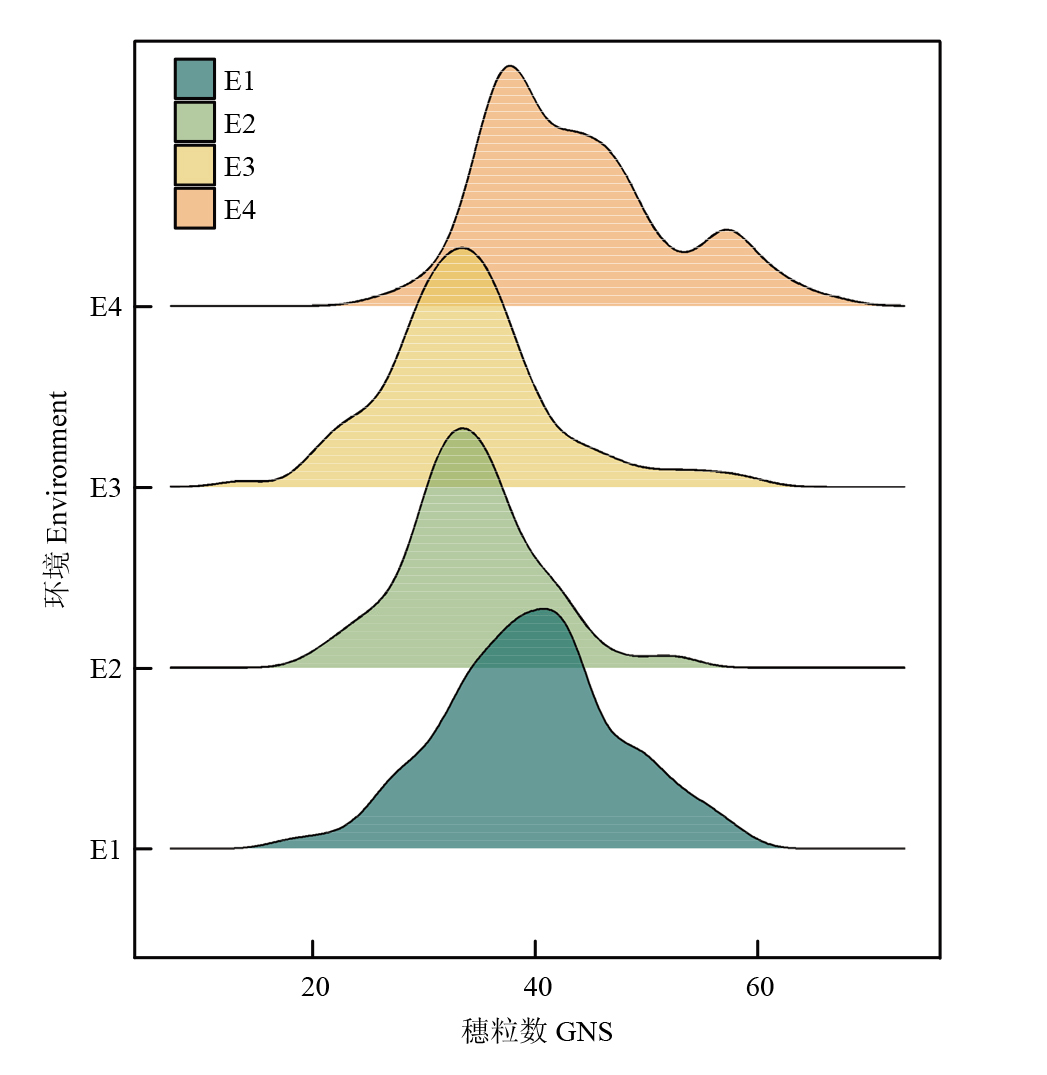
图2
不同环境下NP1群体穗粒数的表型频率分布 GNS:穗粒数。下同"
表3
NP1群体穗粒数表型分析"
| 性状 Trait | 环境 Environment | 范围 Range | 平均值±标准差 Mean±SD | 变异系数 CV (%) | 偏度 Skewness | 峰度 Kurtosis |
|---|---|---|---|---|---|---|
| 穗粒数 GNS | E1 | 18.00-58.00 | 39.59±7.85 | 19.83 | -0.013 | -0.039 |
| E2 | 20.33-53.00 | 34.32±5.89 | 17.18 | 0.404 | 0.940 | |
| E3 | 13.67-59.33 | 33.94±7.63 | 22.48 | 0.409 | -0.442 | |
| E4 | 26.00-66.67 | 43.61±8.29 | 19.01 | 0.650 | -0.123 |
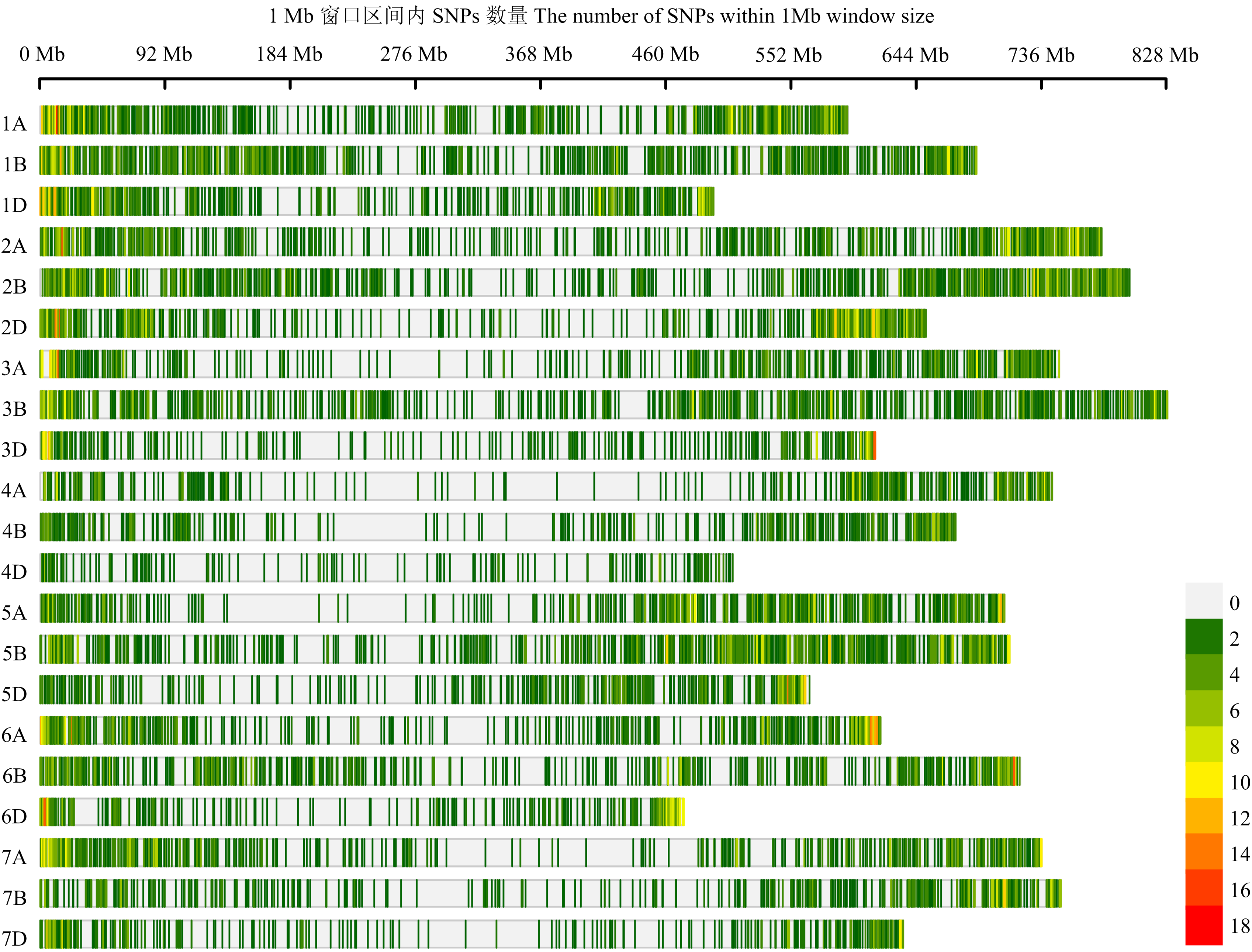
图3
高质量SNP在小麦21条染色体上的分布"
表4
SNP标记信息"
| 染色体 Chr. | 标记数目 No. of markers | 物理长度 Physical length (Mb) | 标记密度 Marker density (Mb) | 最小等位基因频率MAF | 多态性信息含量PIC | ||
|---|---|---|---|---|---|---|---|
| 均值Average | 范围Range | 均值Average | 范围Range | ||||
| 1A | 812 | 592.86 | 0.73 | 0.75 | 0.50-0.95 | 0.27 | 0.09-0.38 |
| 1B | 924 | 688.60 | 0.75 | 0.74 | 0.50-0.95 | 0.29 | 0.09-0.38 |
| 1D | 616 | 495.13 | 0.80 | 0.76 | 0.50-0.95 | 0.27 | 0.09-0.38 |
| 2A | 854 | 780.32 | 0.91 | 0.76 | 0.50-0.95 | 0.26 | 0.09-0.38 |
| 2B | 980 | 799.42 | 0.82 | 0.75 | 0.50-0.95 | 0.27 | 0.09-0.38 |
| 2D | 709 | 651.40 | 0.92 | 0.74 | 0.50-0.95 | 0.28 | 0.09-0.38 |
| 3A | 621 | 749.26 | 1.21 | 0.74 | 0.50-0.95 | 0.28 | 0.09-0.38 |
| 3B | 875 | 829.07 | 0.95 | 0.74 | 0.50-0.95 | 0.28 | 0.09-0.38 |
| 3D | 391 | 613.59 | 1.57 | 0.74 | 0.50-0.95 | 0.28 | 0.09-0.38 |
| 4A | 453 | 742.10 | 1.64 | 0.77 | 0.50-0.95 | 0.26 | 0.09-0.38 |
| 4B | 444 | 672.67 | 1.52 | 0.78 | 0.50-0.95 | 0.25 | 0.09-0.38 |
| 4D | 181 | 508.05 | 2.81 | 0.74 | 0.50-0.95 | 0.28 | 0.09-0.38 |
| 5A | 685 | 708.54 | 1.03 | 0.73 | 0.50-0.95 | 0.29 | 0.09-0.38 |
| 5B | 912 | 712.88 | 0.78 | 0.74 | 0.50-0.95 | 0.28 | 0.09-0.38 |
| 5D | 478 | 565.85 | 1.18 | 0.73 | 0.50-0.95 | 0.28 | 0.09-0.38 |
| 6A | 635 | 617.28 | 0.97 | 0.73 | 0.50-0.95 | 0.28 | 0.09-0.38 |
| 6B | 717 | 720.60 | 1.01 | 0.74 | 0.50-0.95 | 0.28 | 0.09-0.37 |
| 6D | 383 | 473.37 | 1.24 | 0.76 | 0.50-0.95 | 0.27 | 0.09-0.38 |
| 7A | 694 | 736.45 | 1.06 | 0.77 | 0.50-0.95 | 0.26 | 0.09-0.38 |
| 7B | 550 | 750.49 | 1.36 | 0.77 | 0.50-0.95 | 0.26 | 0.09-0.38 |
| 7D | 388 | 634.71 | 1.64 | 0.77 | 0.50-0.95 | 0.26 | 0.09-0.38 |
| A基因组Genome A | 4754 | 4926.81 | 1.04 | 0.75 | 0.50-0.95 | 0.27 | 0.09-0.38 |
| B基因组Genome B | 5402 | 5173.73 | 0.96 | 0.75 | 0.50-0.95 | 0.27 | 0.09-0.38 |
| D基因组Genome D | 3146 | 3942.10 | 1.25 | 0.75 | 0.50-0.95 | 0.27 | 0.09-0.38 |
| 总计Total | 13302 | 14042.64 | 1.06 | 0.75 | 0.50-0.95 | 0.27 | 0.09-0.38 |
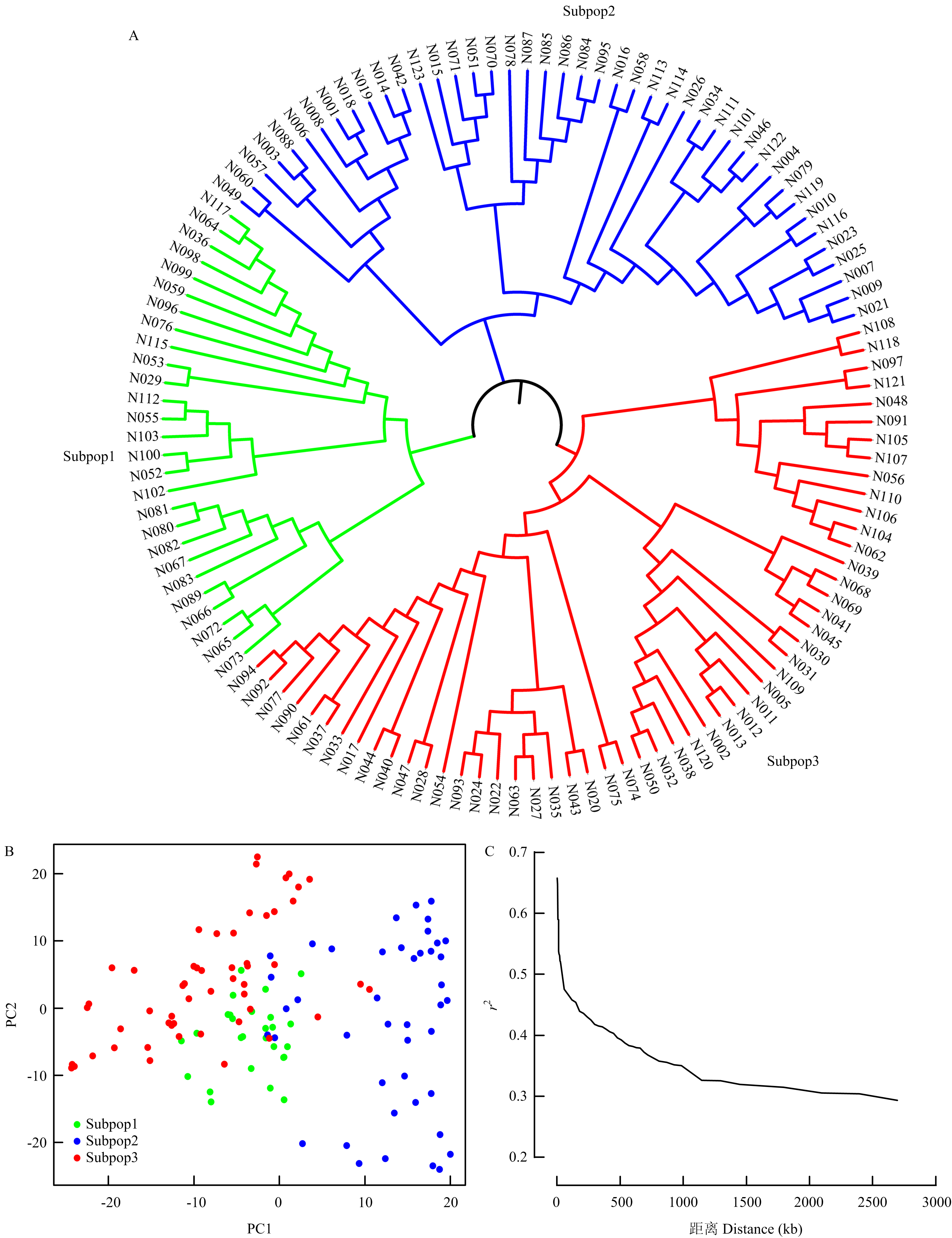
图4
NP1群体的群体结构分析 A:邻接法聚类图;B:主成分分析;C:连锁不平衡衰减距离"

图5
不同环境下穗粒数全基因组关联分析的曼哈顿图 曼哈顿图中水平虚线表示显著性阈值,不同环境的GWAS结果使用不同颜色表示"
表5
GWAS分析检测到与穗粒数相关的MTA"
| 标记Marker | 等位变异Allelic variation | 染色体Chr. | 物理位置Position (bp) | 环境Environment | P值P value | R2 (%) |
|---|---|---|---|---|---|---|
| AX-94940774 | G/T | 1A | 412035140 | E3 | 3.71E-04 | 12.69 |
| AX-94595074 | A/G | 1B | 1434729 | E2 | 4.28E-04 | 14.29 |
| AX-94460586 | C/T | 2A | 568411263 | E2 | 2.52E-04 | 14.39 |
| AX-94918833 | G/T | 2A | 740873736 | E3 | 3.10E-04 | 13.95 |
| AX-94773990 | C/T | 2A | 31089755 | E3 | 7.14E-04 | 14.08 |
| AX-94905029 | A/G | 2A | 52586827 | E4 | 7.04E-04 | 13.14 |
| AX-95126447 | A/G | 2A | 24060452 | E4 | 7.20E-04 | 13.55 |
| AX-94970086 | C/G | 2B | 680522418 | E1 | 1.30E-04 | 16.48 |
| AX-94450454 | A/G | 2B | 738686815 | E2 | 8.58E-05 | 16.72 |
| AX-94408488 | C/T | 2B | 580887157 | E2 | 3.16E-04 | 13.91 |
| AX-94431990 | A/C | 2B | 657793077 | E2 | 5.19E-04 | 13.06 |
| AX-95256964 | A/G | 2B | 737490832 | E2 | 6.45E-04 | 12.66 |
| AX-94450445 | A/G | 3B | 783870123 | E3 | 3.30E-04 | 16.08 |
| AX-94783697 | A/C | 4B | 581072860 | E2 | 4.15E-04 | 13.27 |
| AX-95127411 | A/T | 4B | 573290876 | E4 | 8.46E-04 | 10.46 |
| AX-94472979 | A/G | 5A | 551483456 | E1 | 4.72E-04 | 15.27 |
| AX-94479272 | C/G | 5A | 552515382 | E1 | 7.24E-04 | 13.06 |
| AX-95243984 | A/G | 5A | 549800941 | E1 | 7.90E-04 | 13.23 |
| AX-94522762 | C/T | 5A | 485598127 | E2 | 4.07E-04 | 14.71 |
| AX-94445381 | A/C | 5A | 588738568 | E3 | 3.38E-04 | 13.83 |
| E4 | 3.99E-04 | 14.02 | ||||
| AX-94404219 | A/C | 5A | 588854488 | E3 | 6.30E-04 | 13.74 |
| AX-95085015 | A/C | 5A | 480284549 | E4 | 2.44E-04 | 14.79 |
| AX-95629907 | A/G | 5A | 480176958 | E4 | 4.33E-04 | 13.72 |
| AX-94615284 | A/T | 5A | 479848189 | E4 | 6.85E-04 | 14.04 |
| AX-94712641 | C/G | 5B | 691797180 | E2 | 3.81E-04 | 13.48 |
| AX-94820753 | C/T | 5B | 689950369 | E2 | 3.97E-04 | 13.53 |
| AX-94878420 | G/T | 5B | 449201643 | E2 | 5.32E-04 | 12.82 |
| AX-94977236 | A/C | 5D | 408304024 | E2 | 3.97E-04 | 13.60 |
| AX-94431816 | G/T | 5D | 545932823 | E2 | 4.07E-04 | 13.26 |
| AX-95114243 | C/G | 5D | 375310485 | E2 | 4.19E-04 | 13.23 |
| AX-94395064 | A/G | 6A | 73994641 | E2 | 4.38E-04 | 13.51 |
| AX-94750824 | A/G | 6A | 25692809 | E2 | 8.20E-04 | 12.07 |
| AX-94660514 | A/G | 6A | 65066575 | E3 | 7.25E-04 | 15.86 |
| AX-94982674 | G/T | 6A | 559432410 | E3 | 7.78E-04 | 12.85 |
| AX-94624630 | G/T | 6A | 108070104 | E4 | 9.10E-04 | 13.33 |
| AX-94511580 | A/T | 6B | 191529940 | E2 | 2.67E-04 | 14.64 |
| AX-94758158 | C/T | 6B | 492492877 | E2 | 7.01E-04 | 12.29 |
| AX-94708023 | C/T | 6B | 21138180 | E3 | 2.16E-04 | 16.89 |
| AX-94898852 | C/T | 6B | 462157403 | E3 | 8.90E-04 | 12.28 |
| AX-95252437 | G/T | 6D | 55925493 | E1 | 9.43E-04 | 12.53 |
| AX-95222417 | C/T | 6D | 9972857 | E2 | 2.14E-04 | 16.19 |
| AX-94759612 | C/T | 6D | 200873028 | E2 | 3.73E-04 | 13.44 |
| AX-94572243 | A/G | 6D | 80064488 | E3 | 6.84E-04 | 14.55 |
| AX-94675786 | C/T | 7A | 21446154 | E2 | 5.21E-04 | 12.81 |
| AX-94389135 | A/C | 7A | 713743759 | E2 | 9.81E-04 | 11.80 |
| AX-94456211 | A/G | 7A | 30816891 | E3 | 5.81E-04 | 14.12 |
| AX-94467530 | G/T | 7B | 537458194 | E1 | 9.01E-04 | 10.29 |
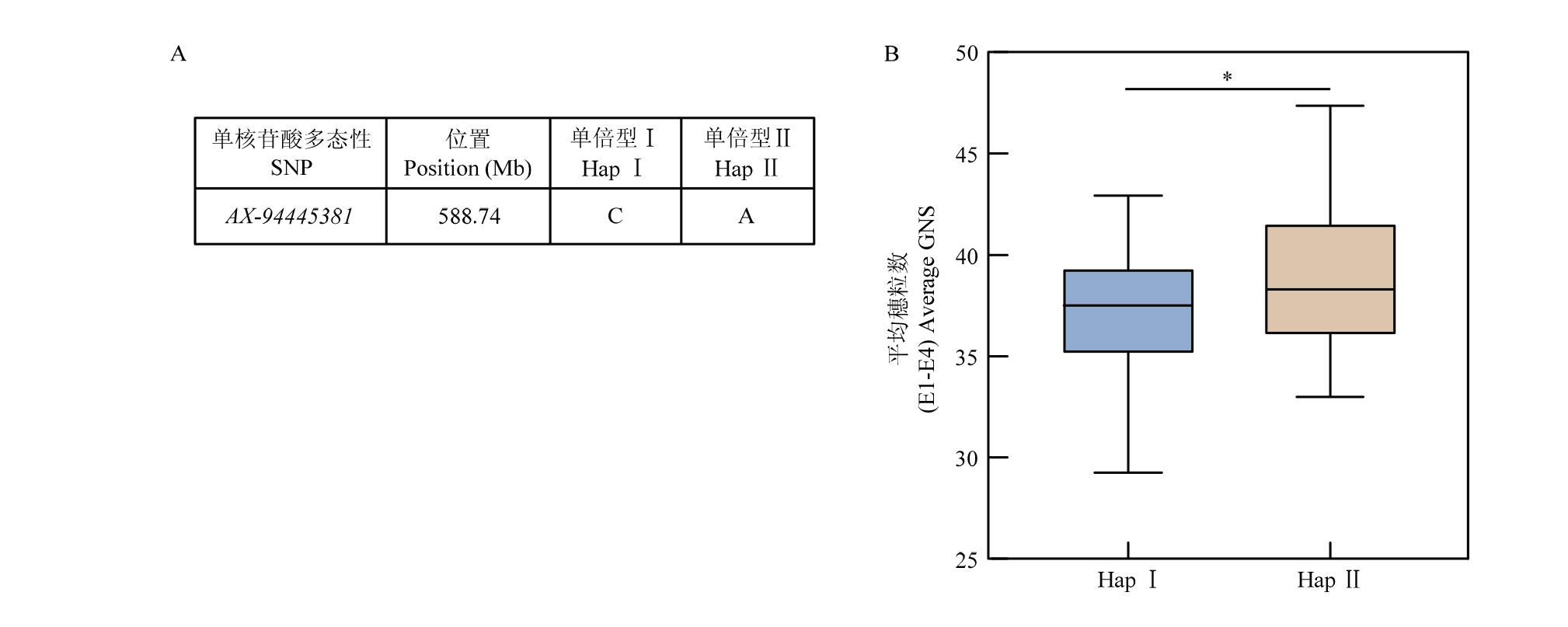
图6
AX-94445381标记的单倍型分析 A:标记位置及等位基因;B:E1—E4环境下2种单倍型小麦品种的平均穗粒数。*:在P<0.05水平差异显著。下同"
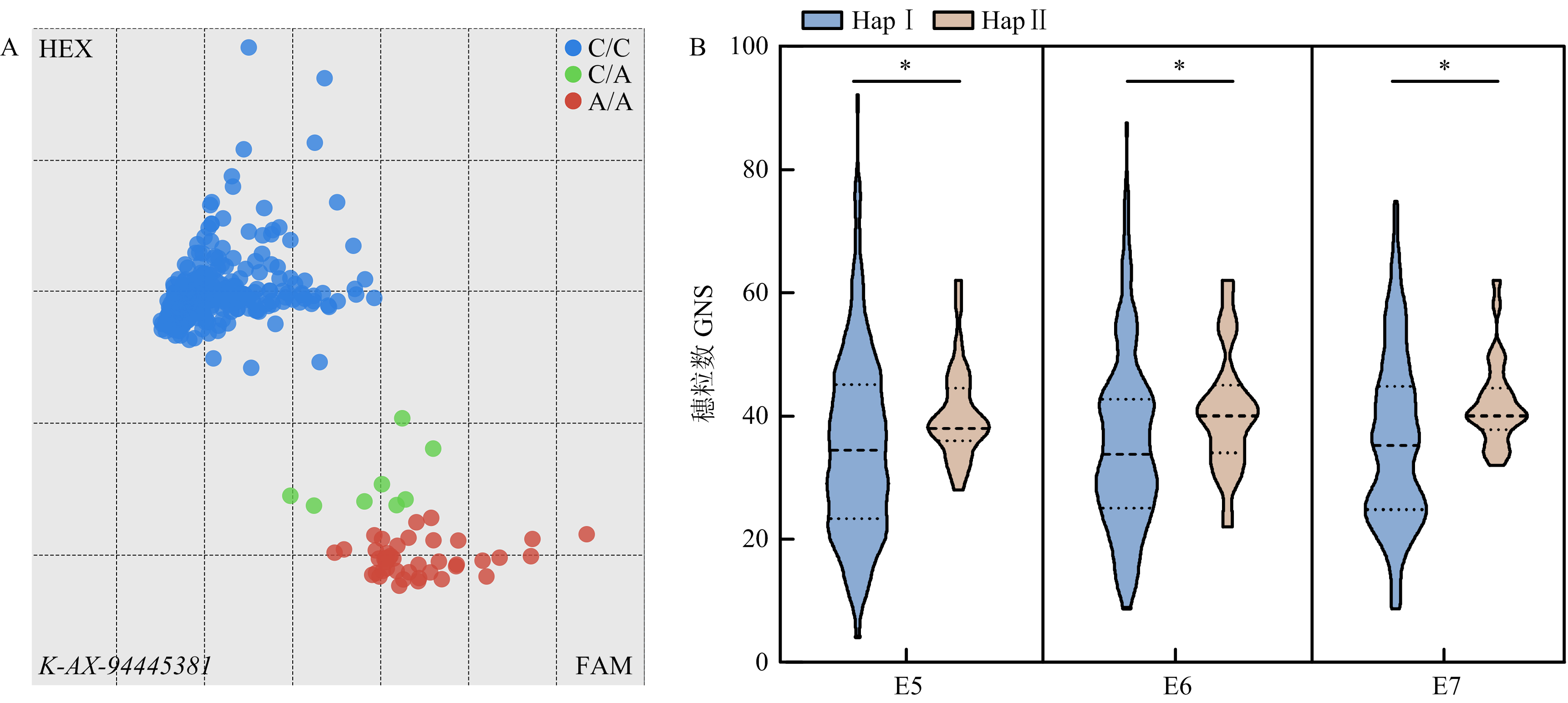
图7
AX-94445381的基因分型及穗粒数性状表型显著性检验 A:KASP标记基因分型散点聚类,C/C表示HapⅠ纯合子,A/A表示HapⅡ纯合子,C/A表示杂合子;B:穗粒数性状表型显著性分析"
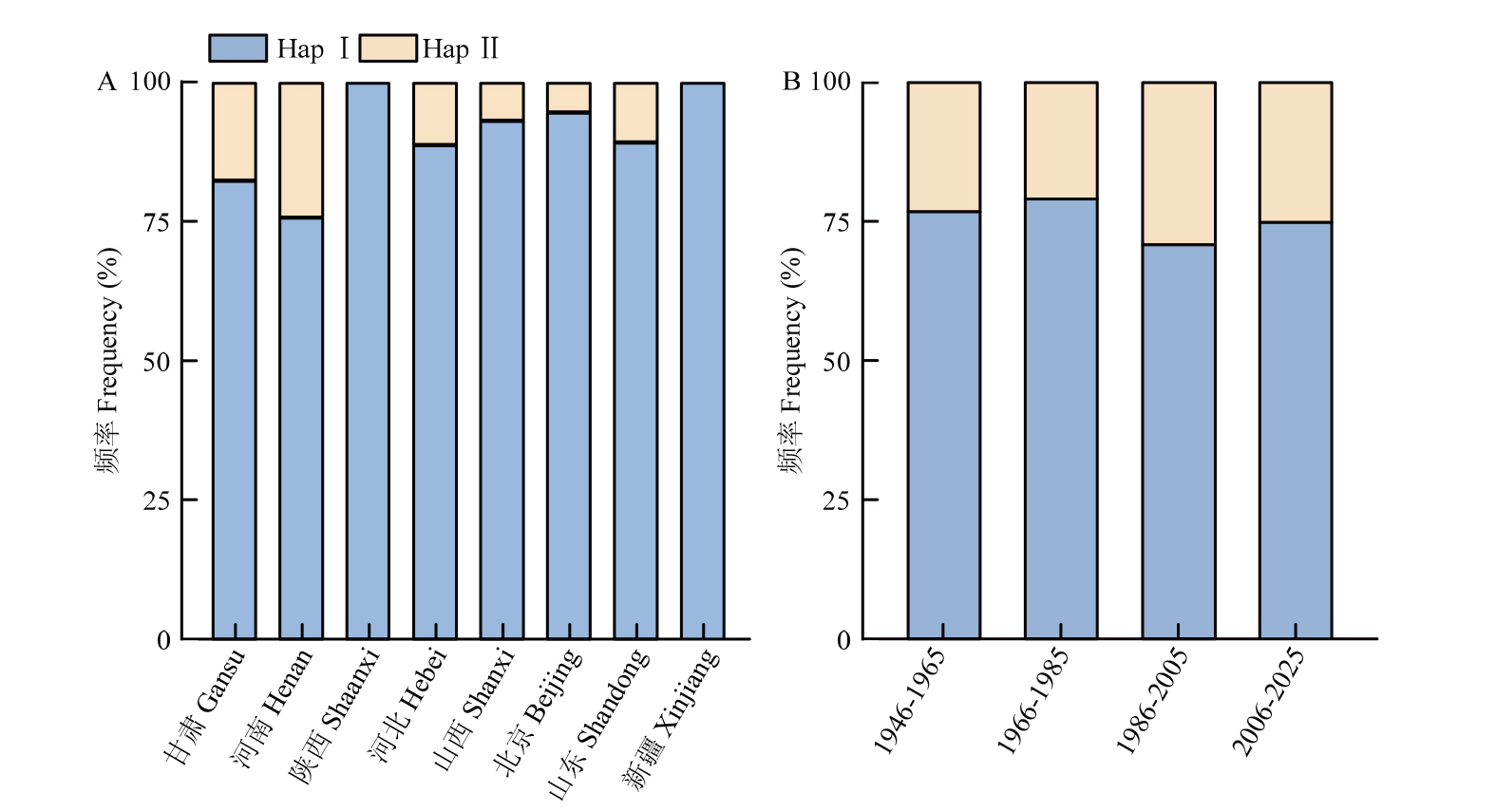
图8
AX-94445381标记2种单倍型在我国主要麦区育成品种中的时空分布及不同育成年代品种中的分布频率 A:AX-94445381-HapⅡ在我国8个小麦主产省份育成品种中的分布频率;B:AX-94445381 2种单倍型在不同育成年代(1946—2025年)品种中的频率变化趋势"
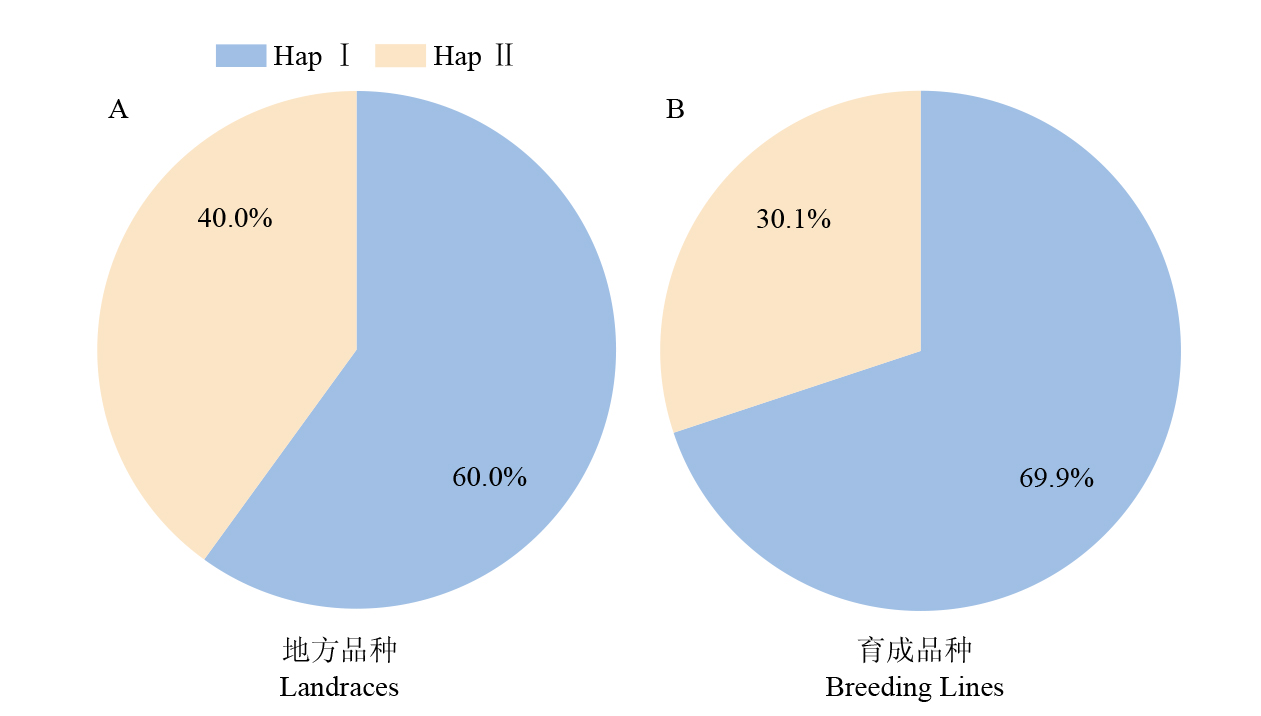
图9
AX-94445381-HapⅡ的频率分布 A:AX-94445381-HapⅡ在地方品种中的频率分布;B:AX-94445381-HapⅡ在育成品种中的频率分布"

图10
AX-94445381标记上下游各1 Mb区间内候选基因表达模式分析 Z为Zadoks生长尺度的缩写,其后的数字代表具体的发育时期代码"
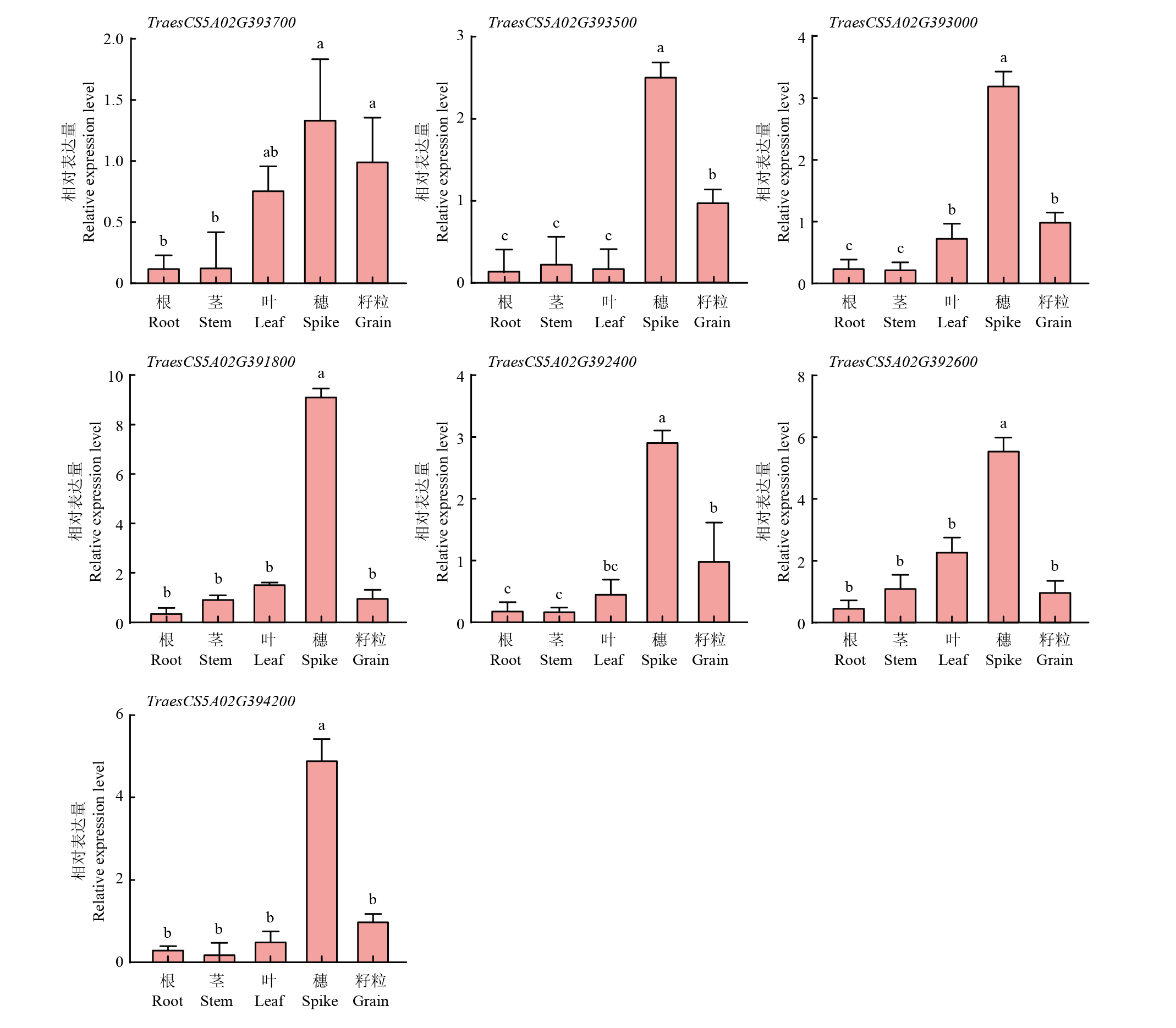
图11
候选基因的qRT-PCR表达量分析 不同小写字母表示在P<0.05水平差异显著"
表6
最终确定的候选基因"
| 候选基因 Candidate gene | 基因区间 Gene interval (bp) | 基因注释 Gene annotation | 水稻基因号 Rice gene number | 同源性 Homology (%) | E值 E value |
|---|---|---|---|---|---|
| TraesCS5A02G391800 | 588017833-588024080 | MADS-box转录因子 MADS-box transcription factor | LOC_Os03g54170 | 97 | 1.24E-118 |
| LOC_Os06g06750 | 96 | 2.54E-71 | |||
| TraesCS5A02G392400 | 588553923-588558813 | WD重复序列蛋白 WD repeat-containing protein | LOC_Os03g51550 | 73 | 6.64E-29 |
| TraesCS5A02G394200 | 589370600-589373630 | UDP-糖基转移酶 UDP-glycosyltransferase | LOC_Os03g55040 | 93 | 8.82E-116 |
| TraesCS5A02G392600 | 588740101-588746176 | ABC转运蛋白B家族蛋白 ABC transporter B family protein | LOC_Os03g54790 | 100 | 0.0 |
| TraesCS5A02G393000 | 588871831-588876487 | 受体蛋白激酶Receptor protein kinase | LOC_Os07g41140 | 96 | 0.0 |
| TraesCS5A02G393500 | 589240694-589244001 | 有丝分裂纺锤体组织蛋白1B Mitotic-spindle organizing protein 1B | LOC_Os03g32150 | 91 | 2.96e-13 |
| TraesCS5A02G393700 | 589287682-589295519 | 牙本质唾液磷蛋白 Dentin sialophosphoprotein-like protein | LOC_Os03g54970 | 61 | 2.03e-136 |
| [1] |
|
| [2] |
doi: 10.1016/j.agrformet.2019.02.025 pmid: 31217650 |
| [3] |
李明, 程宇坤, 白斌, 雷斌, 耿洪伟. 冬小麦穗部性状GWAS分析及优异单倍型筛选[J]. 中国农业科学, 2025, 58(18): 3583-3597. DOI: 10.3864/j.issn.0578-1752.2025.18.002.
|
|
|
|
| [4] |
魏艳丽, 王彬龙, 李瑞国, 蒋会利, 张安静. 大穗小麦穗部性状的遗传分析[J]. 麦类作物学报, 2015, 35(10): 1366-1371.
|
|
|
|
| [5] |
doi: 10.3389/fpls.2018.01584 pmid: 30429867 |
| [6] |
doi: 10.1186/s13007-023-01096-w pmid: 37891590 |
| [7] |
doi: 10.1139/g05-055 pmid: 16391693 |
| [8] |
doi: 10.1007/s00122-014-2277-z pmid: 24522724 |
| [9] |
|
| [10] |
doi: 10.1007/s00122-014-2435-3 pmid: 25490985 |
| [11] |
左煜昕, 马靖福, 刘媛, 张沛沛, 栗孟飞, 程宏波, 陈思瑾, 幸华, 杨德龙. 小麦穗粒数QTL整合与元分析[J]. 麦类作物学报, 2020, 40(7): 771-779.
|
|
|
|
| [12] |
|
| [13] |
|
| [14] |
|
| [15] |
|
| [16] |
doi: 10.1111/nph.14342 pmid: 27918076 |
| [17] |
|
| [18] |
doi: 10.1038/s41588-019-0496-6 pmid: 31548720 |
| [19] |
|
| [20] |
|
| [21] |
doi: 10.1111/pbi.70032 pmid: 40100647 |
| [22] |
|
| [23] |
|
| [24] |
doi: 10.1093/nar/8.19.4321 pmid: 7433111 |
| [25] |
doi: 10.1086/519795 pmid: 17701901 |
| [26] |
|
| [27] |
doi: 10.1093/bioinformatics/bti282 pmid: 15705655 |
| [28] |
|
| [29] |
|
| [30] |
doi: 10.1002/csc2.20692 pmid: 35915786 |
| [31] |
doi: 10.1186/s12870-021-03180-6 pmid: 34517837 |
| [32] |
doi: 10.1016/j.molp.2020.09.001 pmid: 32896642 |
| [33] |
doi: 10.1093/plcell/koad229 pmid: 37647532 |
| [34] |
doi: 10.1038/s41467-020-18738-5 pmid: 33033250 |
| [35] |
doi: 10.1038/s41588-020-00722-w pmid: 33106631 |
| [36] |
doi: 10.1093/plphys/kiac029 pmid: 35088857 |
| [37] |
|
| [38] |
|
| [39] |
doi: 10.1006/meth.2001.1262 pmid: 11846609 |
| [40] |
doi: 10.1016/j.tplants.2006.12.001 pmid: 17224302 |
| [41] |
刘易科, 朱展望, 陈泠, 邹娟, 佟汉文, 朱光, 何伟杰, 张宇庆, 高春保. 基于SNP标记揭示我国小麦品种(系)的遗传多样性[J]. 作物学报, 2020, 46(2): 307-314.
|
|
|
|
| [42] |
|
| [43] |
李云丽, 刁邓超, 刘雅睿, 孙玉晨, 孟祥宇, 邬陈芳, 汪妤, 吴建辉, 李春莲, 曾庆东, 韩德俊, 郑炜君. 小麦苗期耐热性全基因组关联分析[J]. 中国农业科学, 2025, 58(9): 1663-1683. DOI: 10.3864/j.issn.0578-1752.2025.09.001.
|
|
|
|
| [44] |
雍瑞, 胡文静, 吴迪, 汪尊杰, 李东升, 赵蝶, 尤俊超, 肖永贵, 王春平. 小麦穗粒数QTL分析及其对千粒重多效性评价[J]. 作物学报, 2025, 51(2): 312-323.
doi: 10.3724/SP.J.1006.2025.41045 |
|
|
|
| [45] |
doi: 10.1038/s42003-021-02782-y pmid: 34737387 |
| [46] |
|
| [47] |
doi: 10.1104/pp.17.01749 pmid: 29440594 |
| [48] |
doi: 10.1093/pcp/pcp166 pmid: 19933267 |
| [49] |
|
| [50] |
|
| [51] |
|
| [52] |
|
| [1] | 王小玮, 杜佛力, 闫红财, 郎正东, 党志娟, 李葆春, 汪军成, 马小乐, 王化俊, 张宏, 姚立蓉. 396份春小麦灌浆期和成熟期抗旱性评价[J]. 中国农业科学, 2026, 59(8): 1608-1621. |
| [2] | 王彩玉, 刘小丽, 李文广, 杨文平, 杨珍平, 高志强. 有机肥不同替代比例对土壤多功能性的影响及微生物驱动机制[J]. 中国农业科学, 2026, 59(8): 1712-1726. |
| [3] | 朱琦, 贾振鹏, Tahir SHAH, 徐晨晟, 李芷琦, 吕会帅, 朱鹏超, 韦小敏, 黄冬琳, 孙艳妮, 曹卫东, 高亚军, 王朝辉, 张达斌. 绿肥配施增效产品降低旱地麦田温室气体排放及碳足迹[J]. 中国农业科学, 2026, 59(7): 1507-1522. |
| [4] | 叶美金, 吴雷, Lohani Md Nahibuzzaman, 尹丽, 胡欣荣, 刘亚西, 蒋云峰, 陈国跃, 蒲至恩, 李阳, 李婷, 邹亚亚, 吴佳怡, 马建. 基于GWAS的中国地方小麦成熟胚大小位点的鉴定及其遗传效应解析[J]. 中国农业科学, 2026, 59(6): 1157-1171. |
| [5] | 杨丽娟, 陈丝雨, 赵薇, 朱玲, 郭磊, 马丽娜, 马瑞敏, 张娟. 全基因组重测序揭示静原鸡羽色的遗传机制[J]. 中国农业科学, 2026, 59(6): 1348-1360. |
| [6] | 李文虎, 礼海风, 杜宇鹏, 丁玉兰, 罗一诺, 李宇珂, 佘文婷, 张丰, 滕宇, 张思琦, 黄翠, 李小涵, 刘金山, 王朝辉. 小麦锌吸收转移对土施锌肥响应的区域差异[J]. 中国农业科学, 2026, 59(5): 1034-1047. |
| [7] | 焦文娟, 何万龙, 耿洪伟, 白斌, 李剑峰, 程宇坤. 155份春小麦品种(系)条锈病抗性评价与抗病基因分子检测[J]. 中国农业科学, 2026, 59(5): 937-950. |
| [8] | 崔士友, 陈澎军, 缪源卿, 韩继军, 沈俊明. EMS诱变抗草甘膦小麦新种质的创制与大田评价[J]. 中国农业科学, 2026, 59(4): 723-733. |
| [9] | 钱瑾, 李映雪, 吴芳, 邹晓晨. 集成光谱降维的冬小麦叶片磷含量估算[J]. 中国农业科学, 2026, 59(4): 781-792. |
| [10] | 孔媛, 崔沙沙, 李美, 李健, 杨思雨, 房锋, 刘帅帅, 刘明平, 曾艳, 高兴祥, 柏连阳. 黄淮海冬小麦田多花黑麦草等5种禾本科杂草时空分布变化规律[J]. 中国农业科学, 2026, 59(4): 807-823. |
| [11] | 王勇胜, 牛丽, 王长杰, 马立花, 廉潇潇, 孟亚雄, 马小乐, 姚立蓉, 张宏, 杨轲, 李葆春, 王化俊, 司二静, 汪军成. 冬小麦千粒重的全基因组关联分析及候选基因预测[J]. 中国农业科学, 2026, 59(3): 499-514. |
| [12] | 李心怡, 李嘉宁, 杨文平, 夏清, 霍滢睿, 郝世航, 黄婷苗, 任永康, 陈杰, 高志强, 杨珍平. 彩粒小麦锌营养对花后叶面喷锌的响应[J]. 中国农业科学, 2026, 59(3): 515-527. |
| [13] | 咸青林, 肖鉴珂, 高阿庆, 郜利闯, 刘杨. 种植方式结合测墒补灌下冬小麦产量及水分利用效率[J]. 中国农业科学, 2026, 59(3): 589-601. |
| [14] | 张志勇, 谭世超, 熊淑萍, 马新明, 韦一昊, 王小纯. 水氮周年优化对豫北灌区小麦玉米轮作系统产量和氮迁移的影响[J]. 中国农业科学, 2026, 59(2): 336-353. |
| [15] | 郭金旺, 赵卫松, 李社增, 默韶京, 杨威, 鹿秀云, 郭庆港, 马平. 小麦茎基腐病发生对根际土壤微生物群落结构与代谢物组成的影响[J]. 中国农业科学, 2026, 59(17): 3778-3794. |
|
||
