






中国农业科学 ›› 2026, Vol. 59 ›› Issue (17): 3778-3794.doi: 10.3864/j.issn.0578-1752.2026.17.006
郭金旺1( ), 赵卫松2(), 李社增2, 默韶京2, 杨威2, 鹿秀云2, 郭庆港2, 马平2
收稿日期:2026-04-14
接受日期:2026-06-16
出版日期:2026-09-03
发布日期:2026-09-03
通信作者:
联系方式:
郭金旺,E-mail:1979690105@qq.com。
基金资助:
GUO JinWang1(), ZHAO WeiSong2(), LI SheZeng2, MO ShaoJing2, YANG Wei2, LU XiuYun2, GUO QingGang2, MA Ping2
Received:2026-04-14
Accepted:2026-06-16
Published:2026-09-03
Online:2026-09-03
摘要:
【目的】通过研究小麦健株与茎基腐病病株之间的根际土壤微生物群落结构及土壤代谢物质的差异,明确小麦根际土壤微生物群落结构、关键代谢物质与茎基腐病发生之间的关系,从微生物生态角度解释小麦茎基腐病发生的原因,并为该病害防治提供新的思路和理论依据。【方法】以小麦健株与茎基腐病病株的根际土壤作为研究对象,通过宏基因组和代谢组技术探究小麦病株与健株之间微生物群落结构的变化及差异代谢物质,结合冗余分析(RDA)明确土壤微生物群落与土壤养分的相关性,并挖掘病株与健株土壤微生物群落结构与关键差异代谢物质之间的相关关系。【结果】小麦茎基腐病发生导致植株的鲜重和株高显著降低,并且小麦根际土壤中速效磷、速效钾、硝态氮含量均有所降低,但差异不显著。高通量测序分析表明,小麦茎基腐病病株根际土壤细菌和真菌丰富度和多样性减少。属水平物种差异分析表明,在细菌方面,病株根际土壤中诺卡氏菌属(Nocardioides)、节杆菌属(Arthrobacter)、鞘氨醇微杆菌属(Sphingomicrobium)、溶杆菌属(Lysobacter)的相对丰度显著上升,分别增加73.51%、21.53%、23.48%、60.69%;而链霉菌属(Streptomyces)和慢生根瘤菌属(Bradyrhizobium)的相对丰度显著降低,分别降低23.50%和16.66%。在真菌方面,病株根际土壤中木霉菌属(Trichoderma)的相对丰度显著提高130%;而胶膜菌属(Tulasnella)和齿盾囊霉属(Dentiscutata)的相对丰度显著降低,分别降低45.79%和81.36%。微生物群落组成与土壤养分的冗余分析(RDA)表明,土壤微生物群落与土壤养分显著相关。诺卡氏菌属、节杆菌属、慢生根瘤菌属等有益菌与速效钾、有机质、硝态氮呈正相关关系;曲霉属(Aspergillus)、青霉菌属(Penicillium)等病原菌分别与有机质和铵态氮呈正相关关系。此外,健株与小麦茎基腐病病株根际土壤共检测到160种差异代谢物。土壤微生物群落与土壤代谢物联合分析表明,链霉菌属、慢生根瘤菌属与9-氧代十八碳二烯酸、月桂酸、13-羟基十八碳二烯酸3种参与植物防御免疫反应的有机酸呈显著正相关关系,而溶杆菌属、诺卡氏菌属、鞘氨醇微杆菌属、木霉属与上述物质呈显著负相关关系。【结论】病株根际土壤微生物群落多样性降低、群落结构改变可能是引起小麦茎基腐病发生的重要原因,且微生物群落结构与土壤养分存在显著相关性。此外,病株土壤代谢物变化显著,且与土壤微生物群落结构显著相关。
郭金旺, 赵卫松, 李社增, 默韶京, 杨威, 鹿秀云, 郭庆港, 马平. 小麦茎基腐病发生对根际土壤微生物群落结构与代谢物组成的影响[J]. 中国农业科学, 2026, 59(17): 3778-3794.
GUO JinWang, ZHAO WeiSong, LI SheZeng, MO ShaoJing, YANG Wei, LU XiuYun, GUO QingGang, MA Ping. Effects of Wheat Crown Rot Occurrence on Rhizosphere Soil Microbial Community Structure and Metabolite Composition[J]. Scientia Agricultura Sinica, 2026, 59(17): 3778-3794.
表1
小麦茎基腐病对植株生长量的影响"
| 处理 Treatment | 发病率 Incidence rate (%) | 病情指数 Disease index | 单株鲜重 Fresh weight per plant (g) | 单株干重 Dry weight per plant (g) | 平均株高 Average plant height (cm) |
|---|---|---|---|---|---|
| 健株Healthy plant | 0b | 0b | 0.33±0.003a | 0.034±0.001a | 22.63±0.27a |
| 病株Disease plant | 48.44±3.93a | 28.71±0.74a | 0.29±0.009b | 0.028±0.002a | 20.89±0.46b |
表2
小麦茎基腐病对土壤养分的影响"
| 处理Treatment | 健株Healthy plant | 病株Disease plant |
|---|---|---|
| 速效磷AP (μmol·g-1) | 3.280±0.166a | 3.170±0.150a |
| 速效钾AK (mg·kg-1) | 165.594±7.212a | 158.079±7.054a |
| 有机质OM (%) | 5.207±0.081a | 5.347±0.065a |
| 铵态氮NH4+-N (μg·g-1) | 12.273±1.389a | 14.242±1.747a |
| 硝态氮NO3--N (μg·g-1) | 21.231±1.157a | 19.374±0.957a |
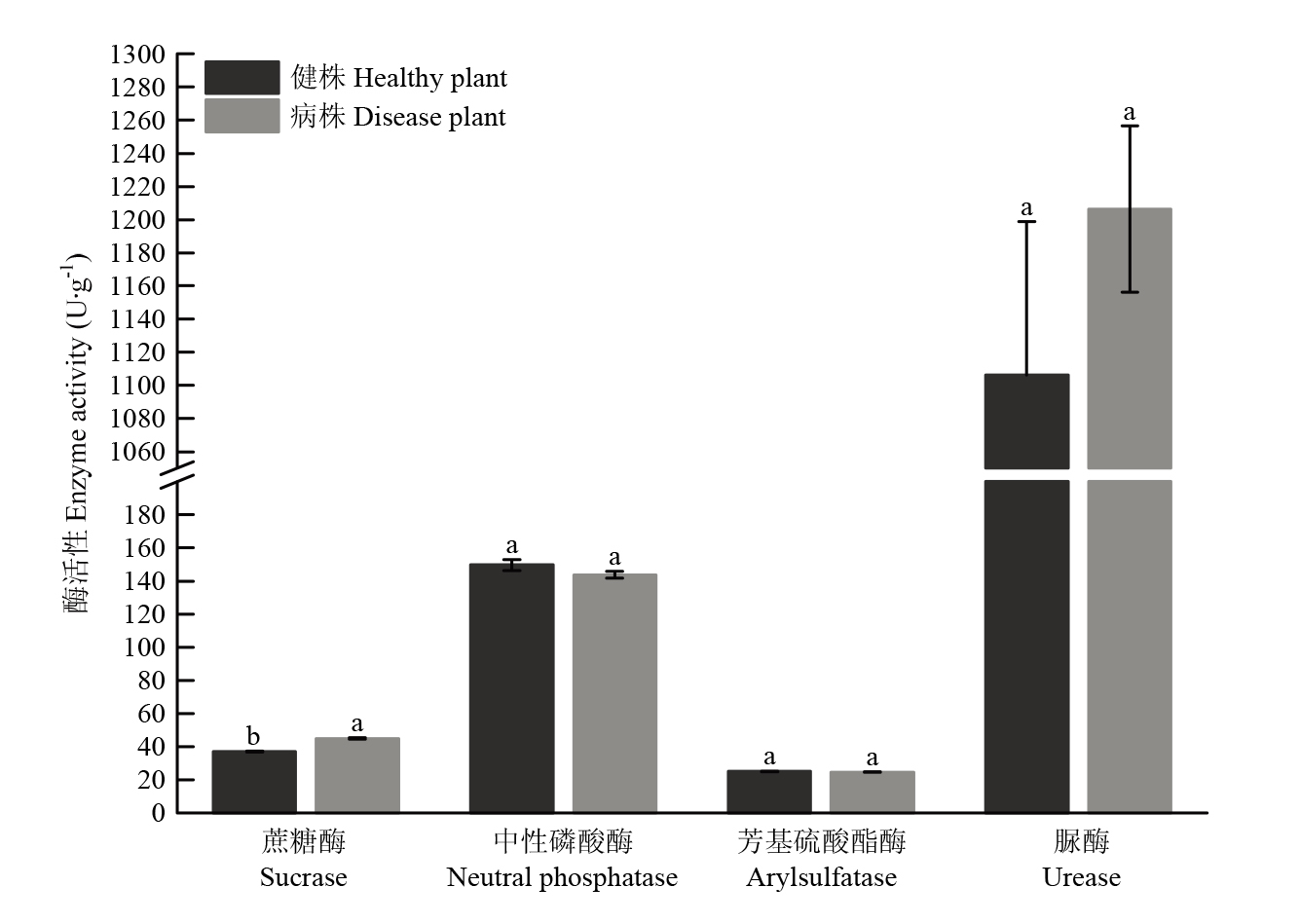
图1
健株和病株根际土壤酶活性变化"
表3
小麦茎基腐病对丙二醛和脯氨酸含量的影响"
| 处理 Treatment | 丙二醛MDA (μg·g-1) | 脯氨酸Pro (nmol·g-1) | ||
|---|---|---|---|---|
| 根Root | 茎Stem | 根Root | 茎Stem | |
| 健株Healthy plant | 20.968±0.538a | 34.404±1.119a | 13.427±0.385a | 31.878±0.801a |
| 病株Disease plant | 15.591±0.821b | 31.900±0.988a | 11.427±1.019a | 20.096±0.385b |
表4
微生物群落的α多样性指数"
| 微生物群落 Microbial community | 处理 Treatment | ACE指数 ACE index | Chao1指数 Chao1 index | Simpson指数 Simpson index | Shannon指数 Shannon index |
|---|---|---|---|---|---|
| 细菌Bacteria | 健株Healthy plant | 3094.33±11.98a | 3094.33±11.98a | 4.69±0.01a | 0.036±0.001a |
| 病株Disease plant | 3079.33±15.24a | 3079.33±15.24a | 4.61±0.02a | 0.033±0.001a | |
| 真菌Fungi | 健株Healthy plant | 54.33±0.88a | 54.33±0.88a | 3.59±0.03a | 0.036±0.001b |
| 病株Disease plant | 50.33±4.84a | 50.33±4.84a | 3.34±0.09a | 0.065±0.007a |
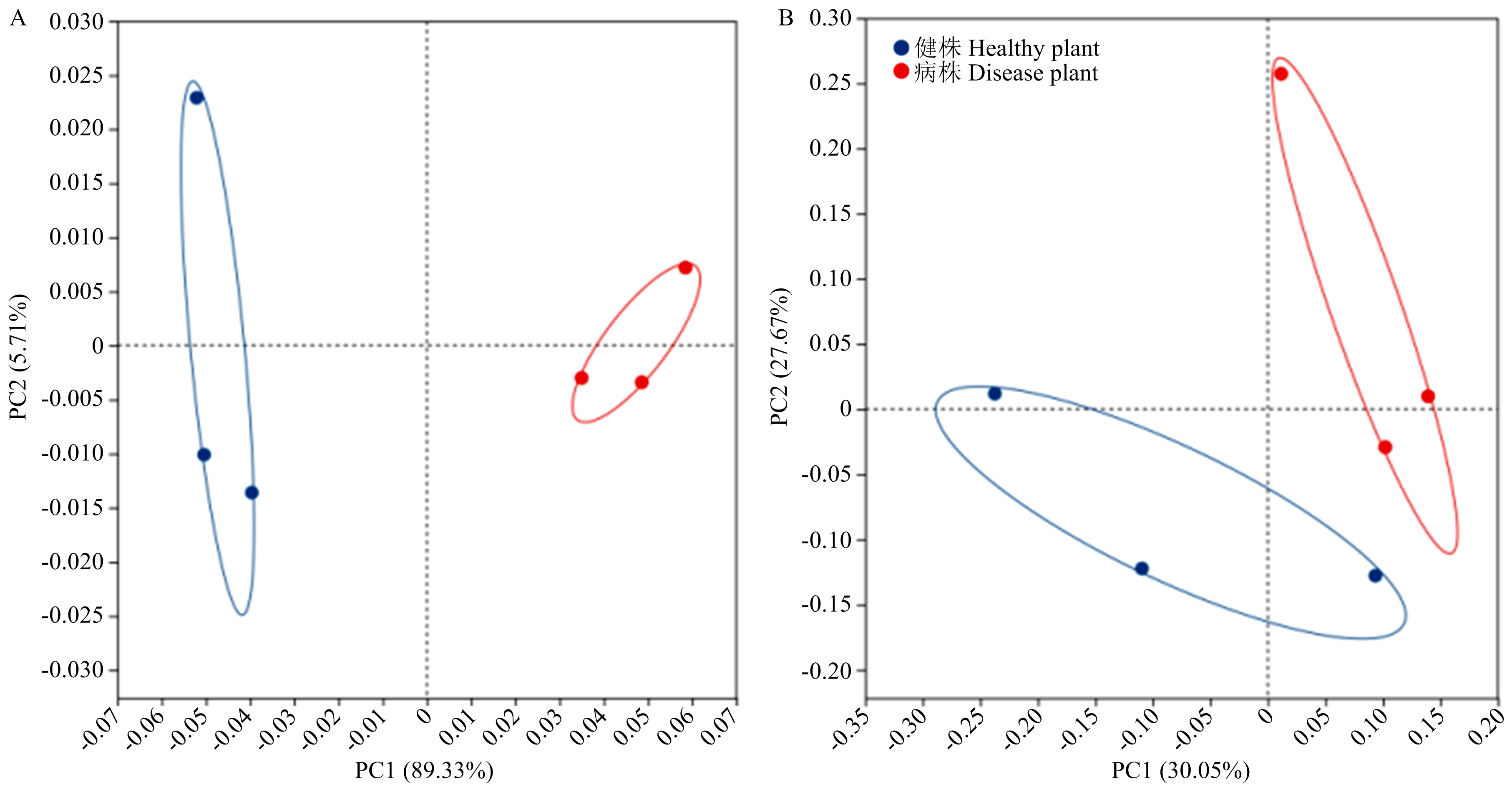
图2
小麦茎基腐病对土壤细菌(A)和真菌(B)群落β多样性的影响"
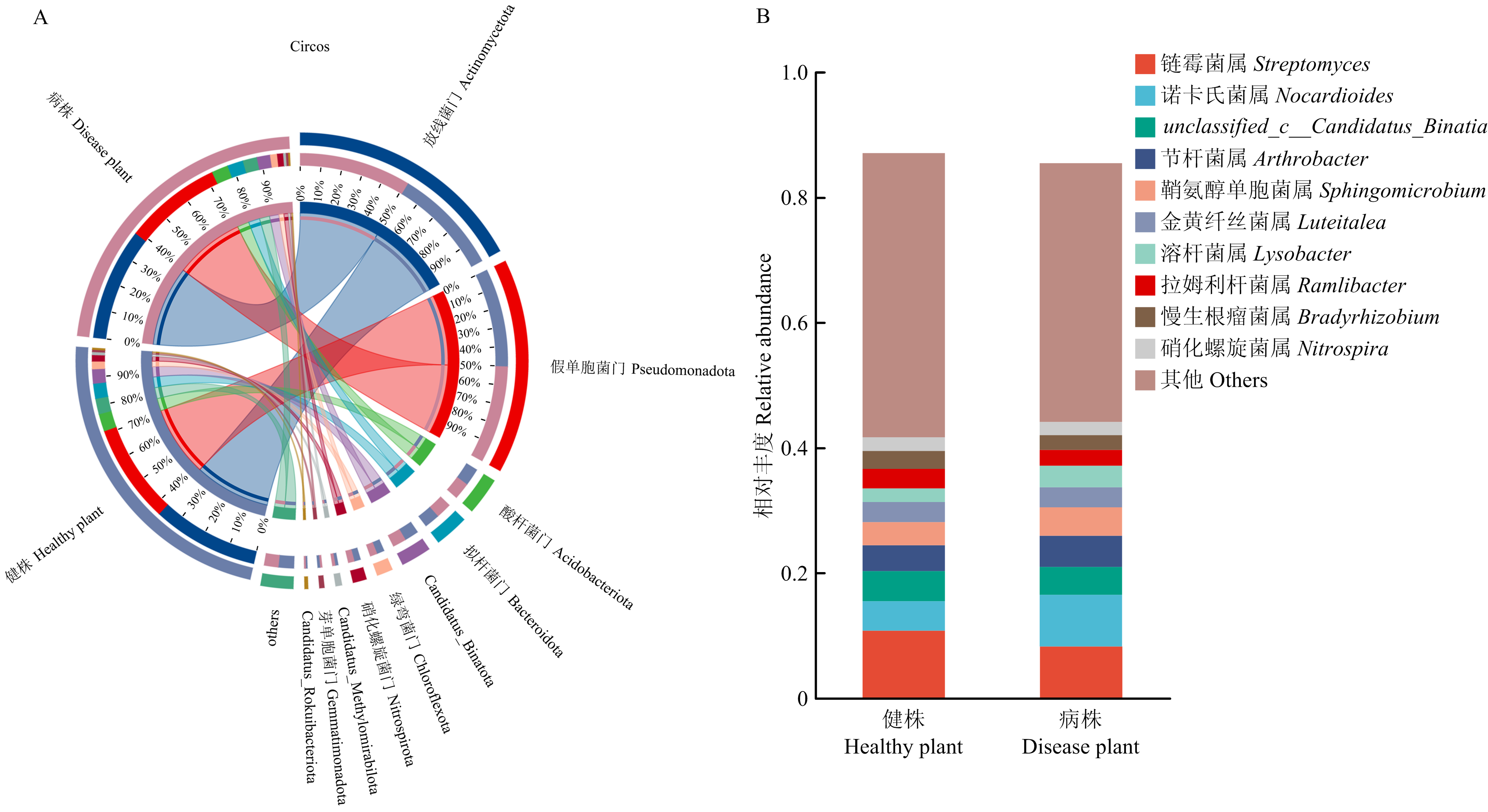
图3
小麦茎基腐病对土壤门水平和属水平细菌群落的影响"
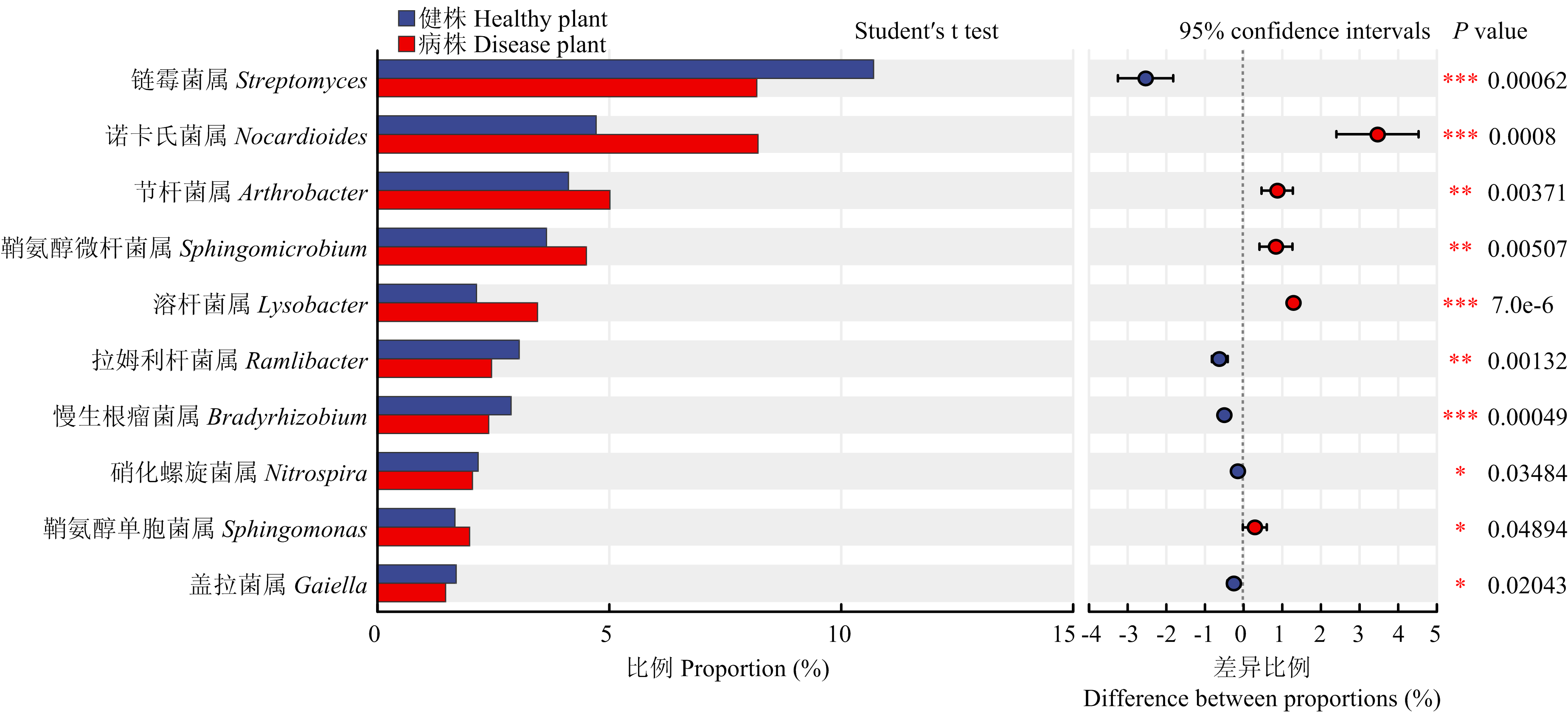
图4
健株和病株根际土壤细菌属水平菌群差异分析"
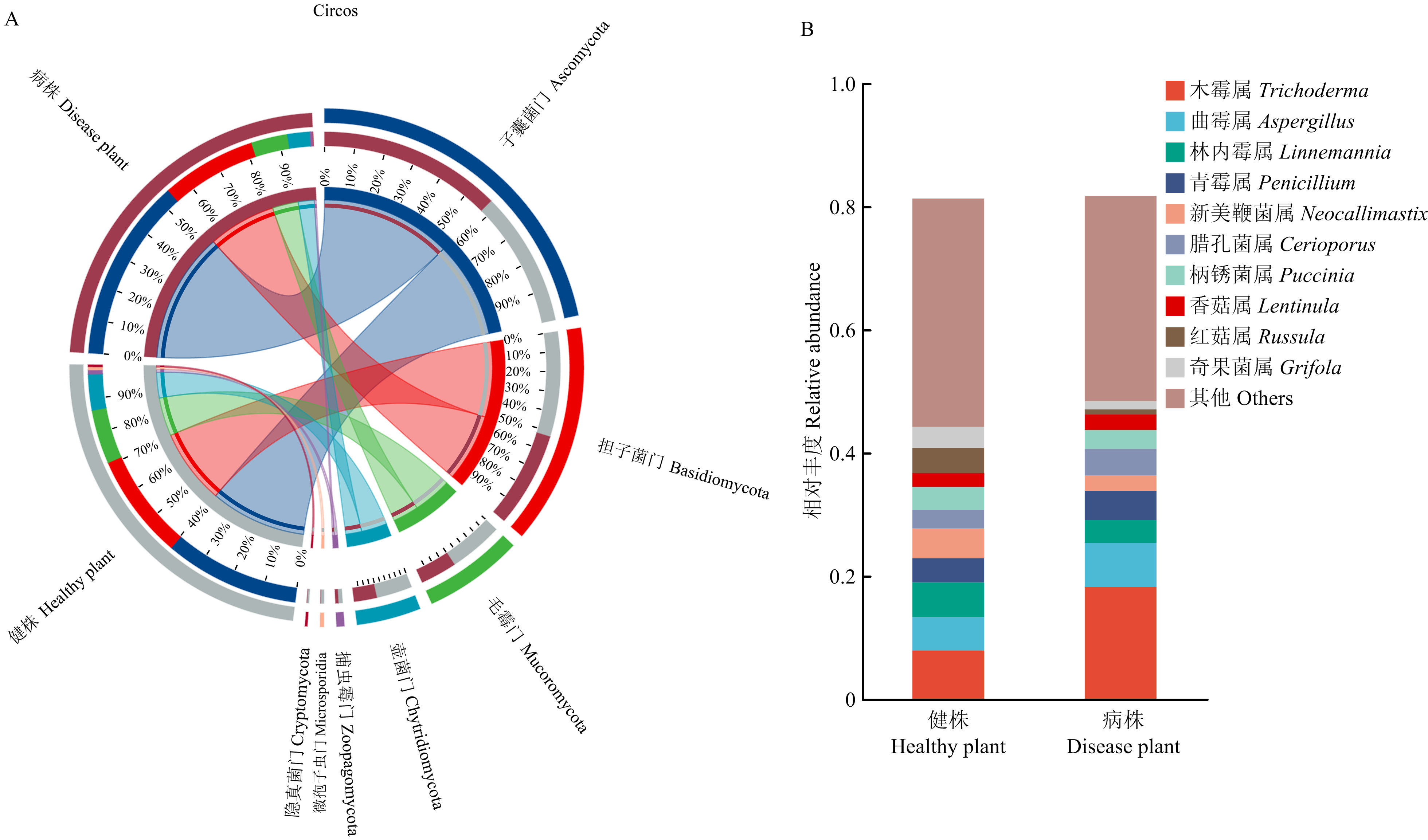
图5
小麦茎基腐病对土壤门水平和属水平真菌群落的影响"
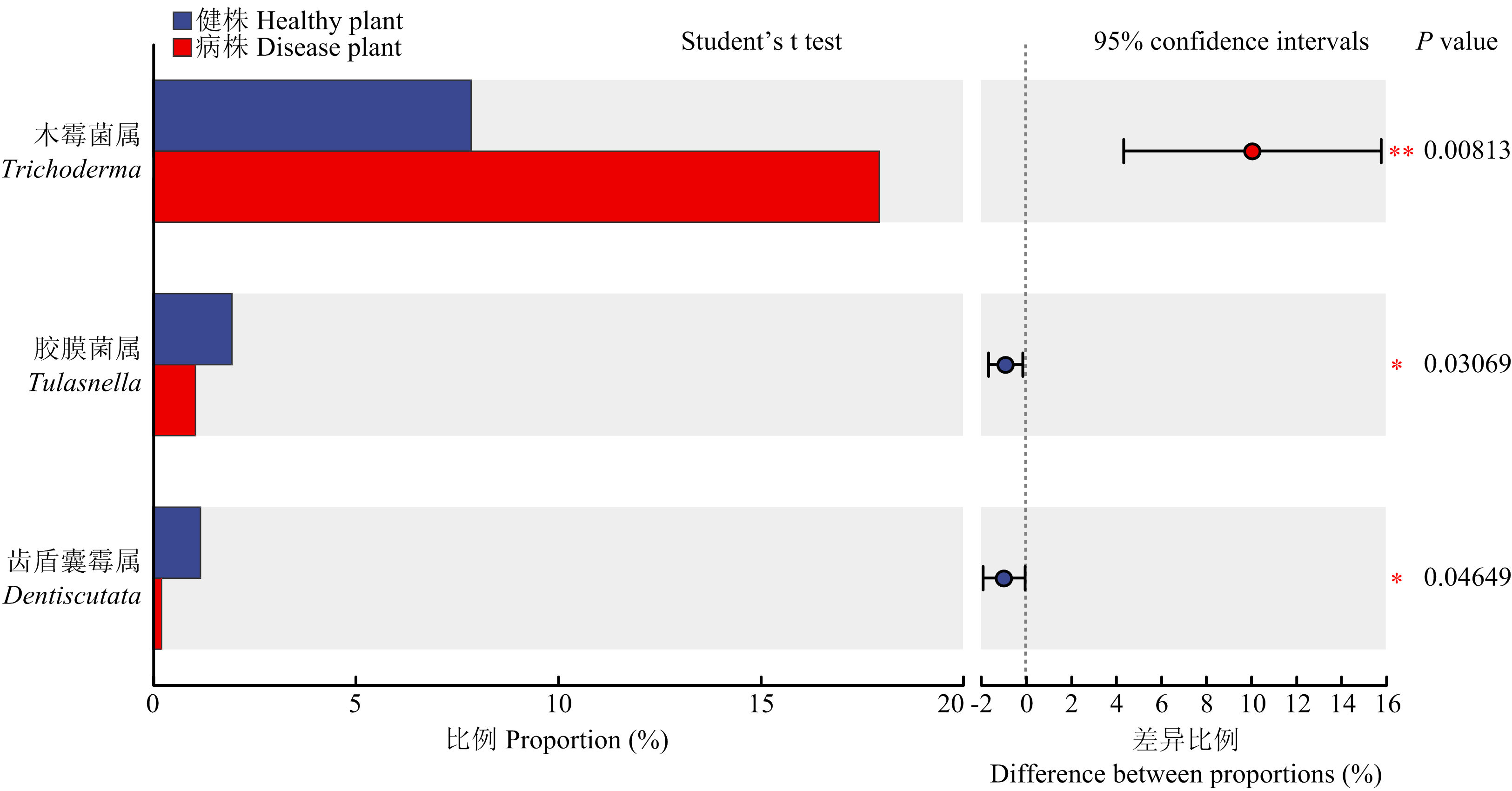
图6
健株和病株根际土壤真菌属水平菌群差异分析"
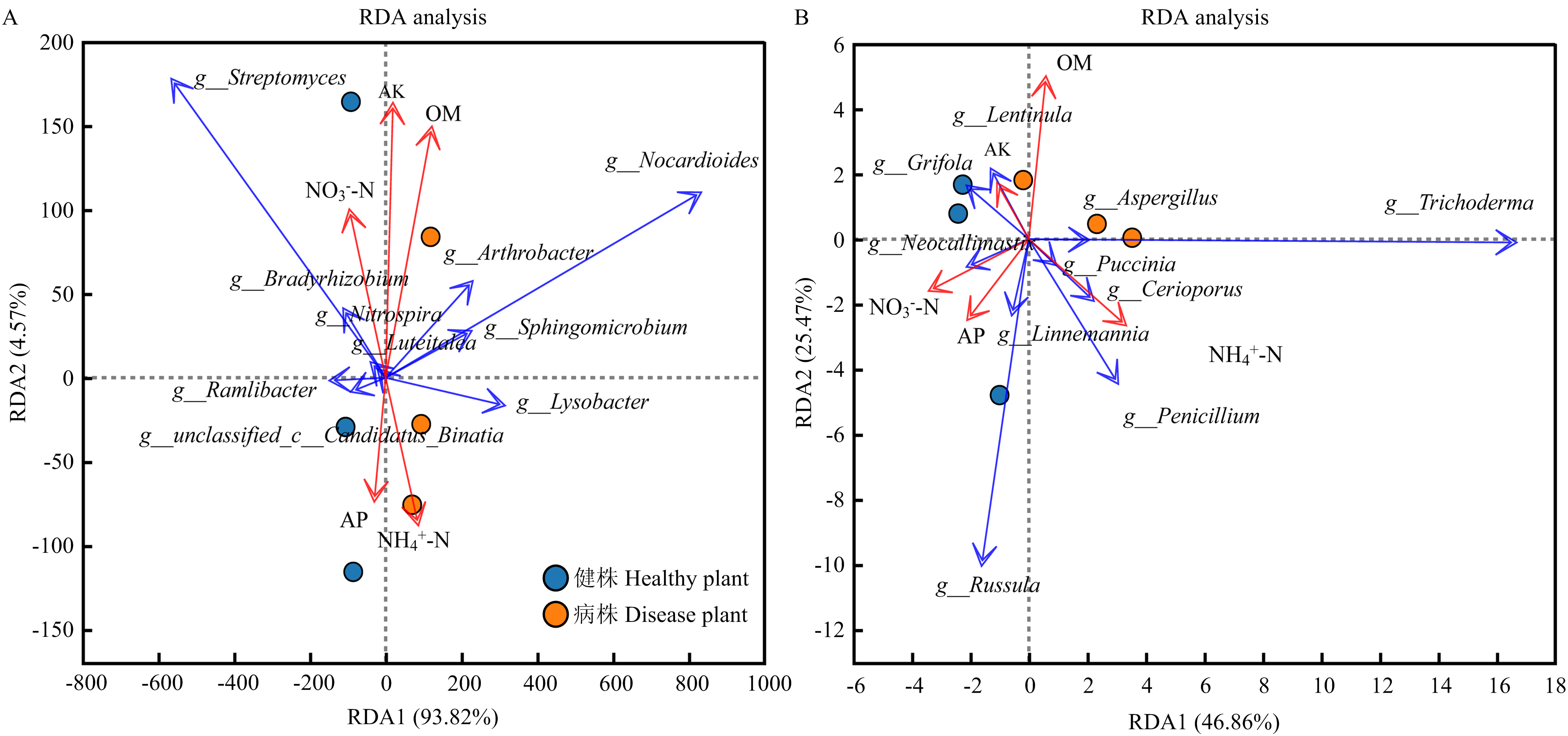
图7
土壤养分与细菌(A)和真菌(B)属水平群落结构的冗余分析 Streptomyces:链霉菌属;Nocardioides:诺卡氏菌属;Arthrobacter:节杆菌属;Sphingomicrobium:鞘氨醇微杆菌属;Luteitalea:金黄纤丝菌属;Lysobacter:溶杆菌属;Ramlibacter:拉姆利杆菌属;Bradyrhizobium:慢生根瘤菌属;Nitrospira:硝化螺旋菌属;Trichoderma:木霉属;Aspergillus:曲霉属;Linnemannia:林内霉属;Penicillium:青霉属;Neocallimastix:新美鞭菌属;Cerioporus:腊孔菌属;Puccinia:柄锈菌属;Lentinula:香菇属;Russula:红菇属;Grifola:奇果菌属。图9同The same as Fig. 9"
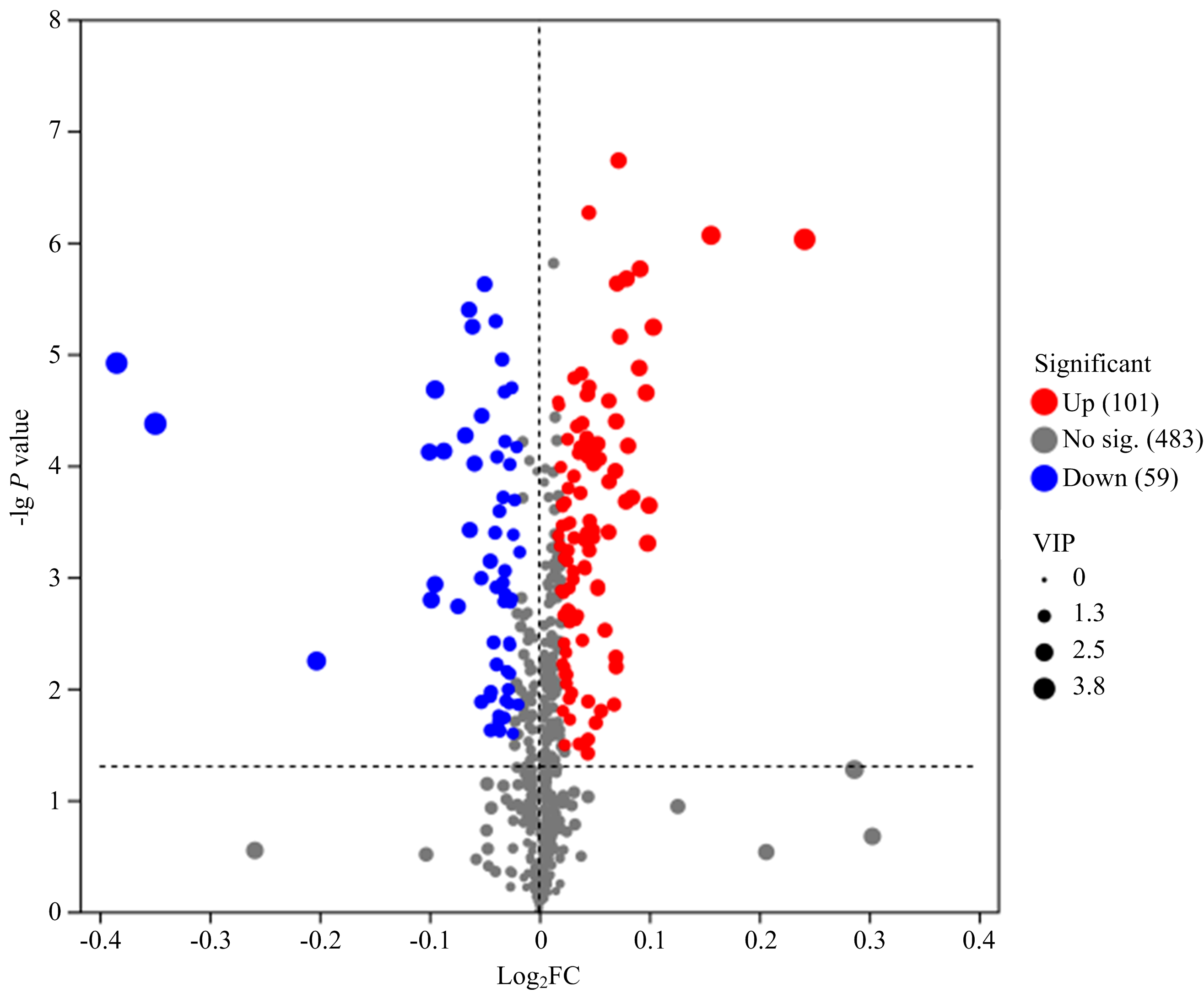
图8
健株和病株根际土壤差异代谢物火山图"
表5
健株和病株根际土壤显著差异的糖类和有机酸类代谢物"
| 分类Classification | 代谢物名称Metabolite name | 表达差异倍数FC | VIP值VIP value | |||||
|---|---|---|---|---|---|---|---|---|
| 糖类 Carbohydrate | N-乙酰-D-氨基葡萄糖N-acetyl-D-glucosamine | 1.0321 | 1.4902 | |||||
| 核心寡糖Core oligosaccharide | 1.0255 | 1.2696 | ||||||
| D-木酮糖D-xylulose | 1.0242 | 1.3875 | ||||||
| 5-甲硫基核糖5-Methylthioribose | 1.0746 | 2.2322 | ||||||
| 有机酸 Organic acid | 月桂酸Dodecanoic acid | 0.9817 | 1.2050 | |||||
| 3-羟基二十烷酸3-Hydroxyicosanoic acid | 1.0177 | 1.1214 | ||||||
| 9-氧代十八碳二烯酸9-Oxooctadecadienoic acid | 0.9847 | 1.1091 | ||||||
| 2-正丙基-4-氧代戊酸2-N-propyl-4-oxopentanoic acid | 1.0196 | 1.1617 | ||||||
| 13-羟基十八碳二烯酸13-Hydroxyoctadecadienoic acid | 0.9859 | 1.0614 | ||||||
| 二十二碳二酸Docosanedioic acid | 1.0148 | 1.0250 | ||||||
| 对甲苯磺酸P-toluenesulfonic acid | 1.0497 | 1.6872 | ||||||
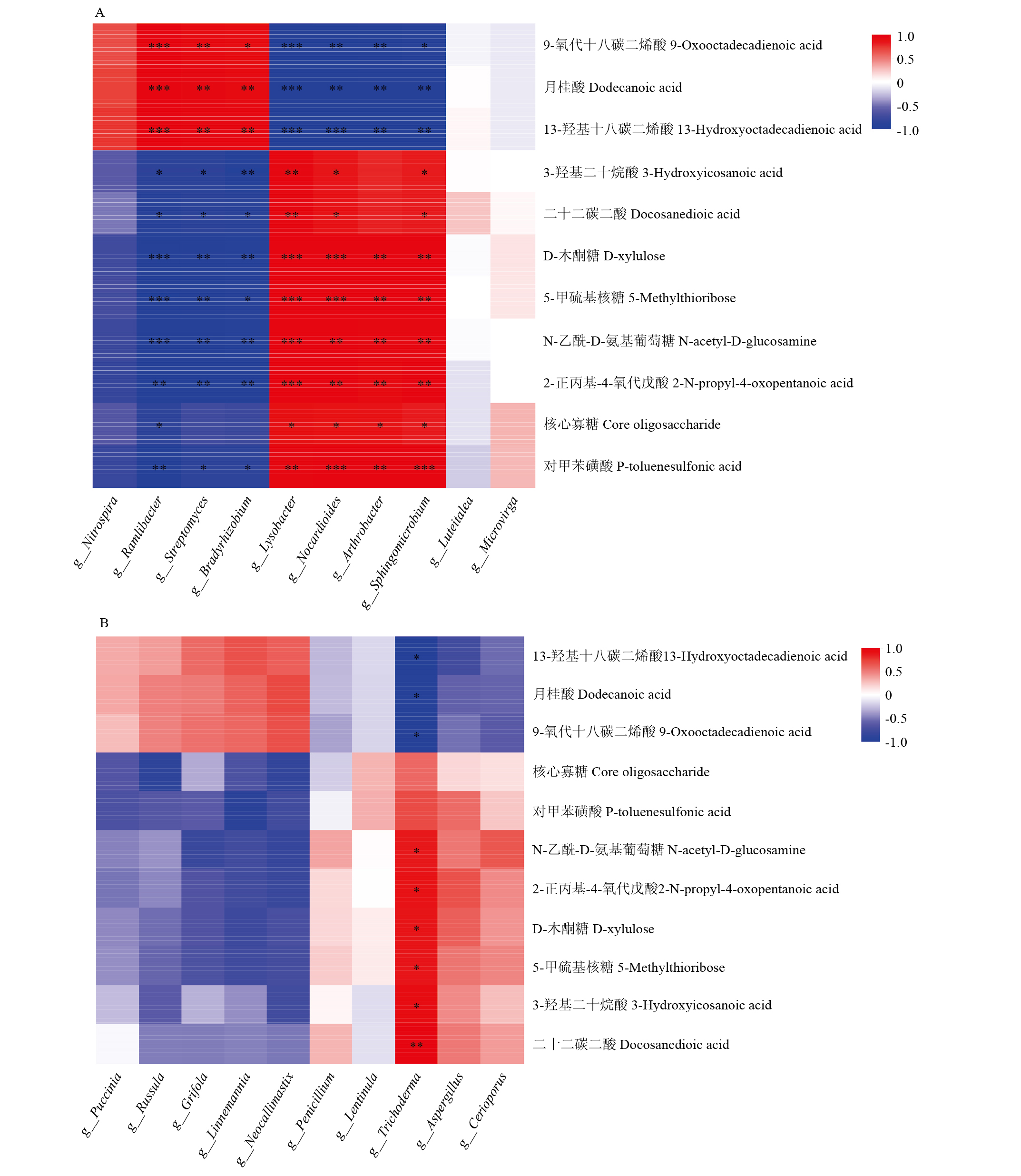
图9
土壤微生物群落与差异代谢物关联分析 红色表示正相关,蓝色表示负相关。星号表示相关性达到显著水平(*P<0.05,**P<0.01,***P<0.001)"
| [1] |
doi: 10.1111/mpp.12618 pmid: 29045052 |
| [2] |
doi: 10.1111/mpp.12639 pmid: 29105256 |
| [3] |
赵利民, 吕国强, 何洋, 冯贺奎, 彭红. 河南省小麦茎基腐病发生现状及综合防控措施[J]. 中国植保导刊, 2022, 42(5): 49-51.
|
|
|
|
| [4] |
竺筱洁. 茎基腐病对小麦根际微生物群落影响及其生防微生物筛选与应用研究[D]. 贵阳: 贵州民族大学, 2025.
|
|
|
|
| [5] |
王楚涵. 根际微生物调控小麦茎基腐病发生的机制[D]. 赣州: 江西理工大学, 2025.
|
|
|
|
| [6] |
冯志珍, 陈太春, 颜宏, 陈志杰, 李英梅, 徐进, 郭欢, 秦涛, 付博. 小麦茎基腐病发病与健康土壤理化性质和微生物群落结构比较分析[J]. 中国农学通报, 2026, 42(12): 109-118.
doi: 10.11924/j.issn.1000-6850.casb2026-0015 |
|
|
|
| [7] |
谢田朋, 张佳宁, 杨林桦, 丁琦, 杜晓雪, 刘雪枫, 朱田田, 杨涛. 茄腐镰刀菌胁迫下甘肃渭源当归根际土壤微生物及代谢物变化[J]. 南方农业学报, 2025, 56(9): 2697-2712.
|
|
|
|
| [8] |
|
| [9] |
|
| [10] |
|
| [11] |
隋丽娜. 木霉防治小麦茎基腐病及对小麦土壤微生物群落的影响[D]. 济南: 齐鲁工业大学, 2021.
|
|
|
|
| [12] |
高梦瑶. 秸秆还田与化肥配施对土壤养分和土壤酶活性的影响[D]. 合肥: 安徽农业大学, 2020.
|
|
|
|
| [13] |
赵卫松, 郭庆港, 李社增, 鹿秀云, 勾建军, 马平. 土壤添加西兰花残体对棉花根际土壤酶活性的影响及其与碳代谢特征的关系[J]. 中国农业科学, 2023, 56(11): 2092-2105. DOI: 10.3864/j.issn.0578-1752.2023.11.005.
|
|
|
|
| [14] |
张彦, 郝松泽, 窦明, 李平, 米庆彬, 梁志杰, 杜臻杰, 周雨泽. 可降解微塑料对小麦根际土壤酶活性及其代谢组学的影响[J]. 环境科学, 2026, 47(6): 4164-4175.
|
|
|
|
| [15] |
李彦林, 贺怀鹏, 刘菁, 邓小娟. 不同根系分泌有机酸组分分析及其对土壤养分、酶活性的影响[J]. 北方园艺, 2024(12): 73-79.
|
|
|
|
| [16] |
罗林毅. MB35-5微生物菌剂对土壤养分及棉花产量品质的影响[D]. 石河子: 石河子大学, 2023.
|
|
|
|
| [17] |
李平, 聂浩, 郎漫, 施明杨, 杨彬妍, 罗小三. 几种土壤结构改良剂对重金属污染土壤养分有效性与酶活性的影响[J]. 环境科学研究, 2025, 38(3): 599-609.
|
|
|
|
| [18] |
李琪, 张鹏飞, 沈逸凡, 李宇航, 金博, 魏人杰, 罗璟, 张卫彪, 张晓超, 雷泞菲, 裴向军. 高寒草甸工程扰损区生态重构土壤养分与微生物群落演变特征[J/OL]. 地球科学, https://link.cnki.net/urlid/42.1874.p.20260105.1241.004.
|
|
|
|
| [19] |
刘军民, 潘倍莎. 土壤水分胁迫对不同茬次紫花苜蓿丙二醛及抗氧化酶含量的影响[J]. 工业微生物, 2023, 53(5): 172-178.
|
|
|
|
| [20] |
梁智诚, 汪妮, 许灿越, 谭婉莹, 冯靖启, 朱勇勇, 陈晓远. PRD和氮素形态对水稻游离氨基酸和脯氨酸含量的影响[J]. 陕西农业科学, 2026, 72(1): 17-23, 31.
|
|
|
|
| [21] |
徐肖, 潘雨涵, 沈会权, 吕超, 郭宝健, 许如根. 大麦黄花叶病抗性差异对大麦主要农艺性状的影响程度分析[J]. 麦类作物学报, 2018, 38(9): 1094-1099.
|
|
|
|
| [22] |
|
| [23] |
闫欢, 高芬, 王梦亮, 秦雪梅. 黄芪根腐病病株和健株根围微生物菌群变化分析[J]. 植物保护, 2020, 46(4): 48-54.
|
|
|
|
| [24] |
史腾飞. 小麦茎基腐病菌对根际土壤微生物影响研究[D]. 合肥: 安徽农业大学, 2024.
|
|
|
|
| [25] |
赵卫松, 郭庆港, 苏振贺, 王培培, 董丽红, 胡卿, 鹿秀云, 张晓云, 李社增, 马平. 马铃薯健株与黄萎病株根际土壤真菌群落结构及其对碳源利用特征[J]. 中国农业科学, 2021, 54(2): 296-309. DOI: 10.3864/j.issn.0578-1752.2021.02.006.
|
|
|
|
| [26] |
唐涛, 袁斌, 王帆帆, 郭杰, 郭晓亮, 段媛媛, 游景茂. 黄连根腐病发生与根际土壤、根茎内生、叶内生细菌群落结构变化关系[J]. 植物保护, 2022, 48(1): 73-81, 103.
|
|
|
|
| [27] |
黄海霞, 黄昆鹏, 杨再军, 曹可心, 潘恒德, 韦学平, 陆福勇, 李俊霖, 罗勤站. 烟-薯套作对根际微生物多样性的影响[J]. 浙江农业科学, 2025, 66(12): 2901-2909.
doi: 10.16178/j.issn.0528-9017.20240100 |
|
doi: 10.16178/j.issn.0528-9017.20240100 |
|
| [28] |
谭雪莲, 郭天文, 胡新元, 张平良, 曾骏, 刘晓伟. 黄土高原旱作区马铃薯连作根际土壤微生物群落变化特征[J]. 作物学报, 2022, 48(3): 682-694.
|
|
|
|
| [29] |
李华伟, 罗文彬, 许国春, 刘中华, 林志坚, 许泳清, 纪荣昌, 邱思鑫, 汤浩. 基于高通量测序的福建北部马铃薯晚疫病株根际土壤细菌群落分析[J]. 微生物学通报, 2022, 49(3): 1017-1029.
|
|
|
|
| [30] |
谭海霞, 彭红丽, 王连龙, 魏建梅. 马铃薯健康株与疮痂病株根区土壤微生物群落多样性差异分析[J]. 浙江农业学报, 2025, 37(8): 1743-1754.
doi: 10.3969/j.issn.1004-1524.20240756 |
|
doi: 10.3969/j.issn.1004-1524.20240756 |
|
| [31] |
张廷富, 文国琴, 王守长, 宋波. 柑橘采后青霉病原中寄生病毒的筛选与鉴定[J]. 西南农业学报, 2023, 36(2): 348-355.
|
|
|
|
| [32] |
|
| [33] |
|
| [34] |
|
| [35] |
林亚, 蔡瑜, 胡凡, 王佳瑜, 江虹霖, 周双双, 张庆伟. 大黄根腐病与土壤营养及微生物群落组成的相关性研究[J]. 西南大学学报(自然科学版), 2024, 46(3): 70-83.
|
|
|
|
| [36] |
|
| [37] |
|
| [38] |
|
| [39] |
doi: 10.1186/s40168-024-01906-w pmid: 39342390 |
| [40] |
|
| [41] |
张智浩, 邓毅书, 聂强, 解国玲, 吴流通, 邸雪嫣, 石浩, 付克剑, 张继来, 林春, 张乃明, 苏友波. 白菜健康株与根肿病患病株的土壤微生物群落和功能差异[J]. 中国生态农业学报, 2023, 31(4): 530-542.
|
|
|
|
| [42] |
|
| [43] |
|
| [44] |
李树泓, 杜薇, 张松杰, 李先锋, 杜鸿波, 任天宝, 张松涛, 耿宗泽, 杜娇. 感染黑胫病烟株根际土壤微生物群落结构和代谢物特征分析[J]. 烟草科技, 2026, 59(2): 22-30.
|
|
|
|
| [45] |
doi: 10.1021/pr400425f pmid: 23971515 |
| [46] |
|
| [47] |
|
| [48] |
doi: 10.1007/s00253-016-8067-6 pmid: 28040844 |
| [49] |
|
| [50] |
doi: 10.1584/jpestics.D18-022 pmid: 30363135 |
| [51] |
|
| [1] | 李永娟, 张悦彤, 王艺博, 赵长江, 宋洁, 陈雪丽, 姚钦. 生物炭施用对大豆轮连作系统土壤固氮微生物nifH基因丰度及群落组成的影响[J]. 中国农业科学, 2026, 59(6): 1272-1285. |
| [2] | 贾会丽, 朱熠辰, 陈思学, 刘妙, 董宽虎, 赵祥, 石永红. 氮添加对晋北赖草草地土壤微生物的影响[J]. 中国农业科学, 2026, 59(13): 2878-2893. |
| [3] | 曾清苹, 刘涵, 聂堂杰, 蒋宣斌, 李红艳, 唐佳佳, 申玲, 陈丽洁, 罗小刚, 谢成伟, 童龙. 金佛山方竹鲜笋品质海拔分异及驱动因素分析[J]. 中国农业科学, 2026, 59(13): 2946-2961. |
| [4] | 林娇, 牟廷森, 陈俊, 李想, 袁思雨, 刘乐, 张振华, 夏银行. 湖南省典型红壤区不同土地利用方式农田土壤碳氮磷化学计量比特征[J]. 中国农业科学, 2026, 59(11): 2434-2446. |
| [5] | 罗一诺, 李艳霏, 李文虎, 张思琦, 牟文燕, 黄宁, 孙蕊卿, 丁玉兰, 佘文婷, 宋文斌, 李小涵, 石美, 王朝辉. 我国新育成小麦品种(系)籽粒不同部位铁含量及影响因素[J]. 中国农业科学, 2025, 58(3): 416-430. |
| [6] | 张丰, 徐隽峰, 高志源, 党海燕, 郭戎博, 佘文婷, 李文虎, 刘金山, 王朝辉. 基于长期定位试验的氮磷表观平衡优化小麦氮磷肥用量[J]. 中国农业科学, 2025, 58(22): 4688-4702. |
| [7] | 张斯佳, 杨杰, 赵帅, 李莉威, 王贵彦. 华北平原多样化作物与小麦-玉米轮作对土壤质量的影响[J]. 中国农业科学, 2025, 58(2): 238-251. |
| [8] | 袁慧琳, 李雅莹, 顾文杰, 徐培智, 卢钰升, 孙丽丽, 周昌敏, 黎婉玲, 仇荣亮. 长期施用新鲜与腐熟畜禽粪肥土壤溶解性有机质与微生物群落的特征及其关联性[J]. 中国农业科学, 2025, 58(2): 307-325. |
| [9] | 吴勇, 文雪, 王天舒, 黄炎炎, 孟熠黎, 姜红宇, 毕利东, 吴会军, 尧水红. 黑土区坡耕地地形因子和垄作方式对土壤养分和肥力指数的影响[J]. 中国农业科学, 2025, 58(18): 3676-3689. |
| [10] | 郭磊, 张斌斌, 沈志军, 严娟, 许建兰, 蔡志翔, 俞明亮, 王发林, 宋宏峰. 桃园绿肥连续还田后中微量元素释放特征及对土壤有效养分的影响[J]. 中国农业科学, 2025, 58(12): 2411-2426. |
| [11] | 董在芳, 丁腾腾, 单艺轩, 李洪连, 陈琳琳, 邢小萍. 自噬相关基因FpAtg3参与假禾谷镰孢的生长和致病[J]. 中国农业科学, 2024, 57(6): 1080-1090. |
| [12] | 王清慧, 李乃荟, 张一平, 狄成乾, 吴凤芝. 小麦和豌豆填闲对白菜幼苗生长和土壤微生物群落结构的影响[J]. 中国农业科学, 2024, 57(3): 555-569. |
| [13] | 罗玉红, 黄予姝, 珠娜, 李乐, 程延彬, 刘嘉慧, 张敬敏, 包雨凡, 徐诺, 闫玉春. 锡林郭勒盟典型草原区草地开垦及退耕造林对土壤粒径分布和养分的影响[J]. 中国农业科学, 2024, 57(24): 4919-4932. |
| [14] | 栗海鹏, 杜武焰, 吴涵茜, 张杰, 孟会生, 洪坚平, 徐明岗, 郝鲜俊, 高文俊. 不同有机肥对煤矿复垦区土壤养分及细菌群落结构的影响[J]. 中国农业科学, 2024, 57(16): 3207-3219. |
| [15] | 苏海兰, 朱雁鸣, 陈宏, 牛雨晴, 郑梅霞, 朱育菁. 不同间作方式对凉粉草品质及根际土壤特性的影响[J]. 中国农业科学, 2024, 57(14): 2755-2770. |
|
||
