






中国农业科学 ›› 2026, Vol. 59 ›› Issue (12): 2551-2562.doi: 10.3864/j.issn.0578-1752.2026.12.002
叶美金1,7( ), 王同著2, 陈斌2, LOHANI Md Nahibuzzaman2, 陈家婷2, 胡欣荣2, 尹丽2, 王超2, 张昊芃2, 杨夏2, 王佳琳3, 姚琦馥4, 丁浦洋5, 王凤1, 李小雨6(), 马建2()
收稿日期:2025-12-09
接受日期:2026-01-20
出版日期:2026-06-16
发布日期:2026-06-16
通信作者:
联系方式:
叶美金,E-mail:091048@cdnu.edu.cn。
基金资助:
YE MeiJin1,7(), WANG TongZhu2, CHEN Bin2, LOHANI Md Nahibuzzaman2, CHEN JiaTing2, HU XinRong2, YIN Li2, WANG Chao2, ZHANG HaoPeng2, YANG Xia2, WANG JiaLin3, YAO QiFu4, DING PuYang5, WANG Feng1, LI XiaoYu6(), MA Jian2()
Received:2025-12-09
Accepted:2026-01-20
Published:2026-06-16
Online:2026-06-16
摘要:
【目的】株高是影响小麦产量潜力和抗倒伏性的关键农艺性状,主要由茎秆节间的伸长决定。系统评估224份四川小麦品种的节间长度,解析其遗传基础,挖掘调控节间长度的稳定表达新位点,明确其遗传效应,并筛选相关候选基因,为高产小麦品种的定向选育提供重要基因资源和理论依据。【方法】在2个环境下分别测定小麦第一节间(IL1)、第二节间(IL2)和第三节间(IL3)的长度。利用小麦120K SNP芯片对供试群体进行基因型分析,通过全基因组关联分析(GWAS)鉴定调控节间长度的遗传位点,结合表型相关性分析解析主效位点的遗传效应,并基于公共数据库预测候选基因。【结果】表型分析显示,所有节间性状均呈连续变异,广义遗传力较高,估计值为75%—89%。相关性分析表明,3个节间长度均与最终株高呈正相关,其中,IL1的相关性最强。此外,IL2与IL3之间高度相关,提示下部茎节具有协调的遗传调控。GWAS检测到位于5A和4D染色体上的4个稳定位点,分别为调控第一节间的QIL1.sau.5A、调控第二节间的2个紧密连锁但独立的QTL QIL2.sau.5A.1和QIL2.sau.5A.2,以及调控第三节间的QIL3.sau.4D。多效性分析显示,QIL2.sau.5A.1显著增加株高和穗长,而QIL3.sau.4D主要促进节间伸长及整体株高。基于功能注释和时空表达数据,共鉴定出5个潜在候选基因,可能参与转录调控、激素信号传导和细胞生长过程。【结论】揭示了四川小麦节间伸长的遗传结构,鉴定出2个新QTL及多个具有多效性的遗传位点。
叶美金, 王同著, 陈斌, LOHANI Md Nahibuzzaman, 陈家婷, 胡欣荣, 尹丽, 王超, 张昊芃, 杨夏, 王佳琳, 姚琦馥, 丁浦洋, 王凤, 李小雨, 马建. 基于全基因组关联分析解析小麦茎节间长度的遗传基础及其效应[J]. 中国农业科学, 2026, 59(12): 2551-2562.
YE MeiJin, WANG TongZhu, CHEN Bin, LOHANI Md Nahibuzzaman, CHEN JiaTing, HU XinRong, YIN Li, WANG Chao, ZHANG HaoPeng, YANG Xia, WANG JiaLin, YAO QiFu, DING PuYang, WANG Feng, LI XiaoYu, MA Jian. Genetic Dissection of Stem Internode Length and Its Effects in Wheat Based on a Genome-Wide Association Study[J]. Scientia Agricultura Sinica, 2026, 59(12): 2551-2562.
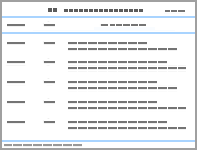
表1
自然群体的表型评价"
| 性状 Trait | 环境 Environment | 最大值 Max | 最小值 Min | 平均值 Mean | 标准差 Standard deviation | 变异系数 CV (%) | 广义遗传力 H2 (%) |
|---|---|---|---|---|---|---|---|
| 第一节间长度 IL1 (cm) | WJ2025 | 49.16 | 23.14 | 31.20 | 3.36 | 10.78 | 89 |
| CZ2025 | 42.84 | 22.16 | 29.61 | 3.30 | 11.14 | ||
| BLUP | 41.94 | 25.33 | 30.41 | 2.20 | 7.22 | ||
| 第二节间长度 IL2 (cm) | WJ2025 | 25.34 | 12.02 | 18.89 | 2.11 | 11.19 | 85 |
| CZ2025 | 20.28 | 10.32 | 14.52 | 1.85 | 12.77 | ||
| BLUP | 20.89 | 13.34 | 16.71 | 1.19 | 7.14 | ||
| 第三节间长度 IL3 (cm) | WJ2025 | 22.34 | 8.53 | 13.35 | 1.89 | 14.18 | 75 |
| CZ2025 | 15.14 | 5.88 | 10.03 | 1.60 | 15.97 | ||
| BLUP | 15.22 | 9.79 | 11.69 | 0.78 | 6.67 |

图1
2种不同环境和BLUP条件下第一节间长度(A)、第二节间长度(B)及第三节间长度(C)的相关系数 *、**和***分别表示在0.05、0.01和0.001水平上的显著性。下同"
表2
各节间长度与农艺性状间的皮尔逊两两相关系数"
| 性状 Trait | 第一节间长度 IL1 | 第二节间长度 IL2 | 第三节间长度 IL3 | 株高 PH | 有效分蘖数 ETN | 穗长 SL | 每穗小穗数 SNS |
|---|---|---|---|---|---|---|---|
| 第二节间长度IL2 | 0.416** | ||||||
| 第三节间长度IL3 | 0.311** | 0.748** | |||||
| 株高PH | 0.615** | 0.556** | 0.613** | ||||
| 有效分蘖数ETN | 0.033 | -0.009 | -0.026 | -0.098 | |||
| 穗长SL | 0.095 | -0.04 | -0.117 | 0.283** | -0.021 | ||
| 每穗小穗数SNS | -0.024 | -0.122 | -0.042 | 0.109 | -0.188** | 0.380** | |
| 千粒重TKW | 0.04 | 0.016 | -0.031 | 0.11 | 0.105 | 0.198** | -0.245** |

图2
基于全基因组关联分析的曼哈顿图与分位数-分位数(Q-Q)图 A:IL1;B:IL2;C:IL3。红色虚线代表-log10(P)=4.00的显著性阈值"
表3
基于GWAS的小麦茎节间长度稳定表达位点鉴定"
| 性状 Trait | 位点 QTL | 单核苷酸多态性 SNP | 等位位点 Allele | 染色体 Chromosome | 物理位置 Position (bp) | 显著性阈值 -log10(P) | 贡献率 R2(%) | 环境 Environments |
|---|---|---|---|---|---|---|---|---|
| 第一节间长度 IL1 | QIL1.sau.5A | 5A_501635166 | T/C | 5A | 501635166 | 4.21-5.42 | 1.62-2.19 | CZ2025, WJ2025, BLUP |
| 第二节间长度 IL2 | QIL2.sau.5A.1 | 5A_510913304 | G/A | 5A | 510913304 | 4.23-5.58 | 5.90-8.18 | CZ2025, WJ2025, BLUP |
| 5A_510913376 | C/T | 5A | 510913376 | 4.21-5.68 | 5.82-8.30 | CZ2025, WJ2025, BLUP | ||
| 5A_510913381 | T/C | 5A | 510913381 | 4.21-5.68 | 5.82-8.30 | CZ2025, WJ2025, BLUP | ||
| 5A_511296202 | T/C | 5A | 511296202 | 4.02-5.54 | 5.88-8.59 | CZ2025, WJ2025, BLUP | ||
| 5A_511296204 | C/G | 5A | 511296204 | 4.02-5.54 | 5.88-8.59 | CZ2025, WJ2025, BLUP | ||
| 5A_511991250 | G/T | 5A | 511991250 | 4.01-5.76 | 5.98-9.16 | CZ2025, WJ2025, BLUP | ||
| 5A_513013678 | A/G | 5A | 513013678 | 4.02-5.69 | 5.88-8.88 | CZ2025, WJ2025, BLUP | ||
| 5A_513255742 | T/C | 5A | 513255742 | 4.04-6.08 | 5.95-9.65 | CZ2025, WJ2025, BLUP | ||
| 5A_514724687 | C/T | 5A | 514724687 | 4.14-5.41 | 8.06-11.04 | CZ2025, WJ2025, BLUP | ||
| 5A_514884600 | A/G | 5A | 514884600 | 4.04-6.08 | 5.95-9.65 | CZ2025, WJ2025, BLUP | ||
| QIL2.sau.5A.2 | 5A_517883089 | G/A | 5A | 517883089 | 4.10-6.28 | 6.10-10.07 | CZ2025, WJ2025, BLUP | |
| 5A_518500826 | T/C | 5A | 518500826 | 4.09-6.17 | 6.08-9.87 | CZ2025, WJ2025, BLUP | ||
| 5A_518579568 | A/G | 5A | 518579568 | 4.04-6.08 | 5.95-9.65 | CZ2025, WJ2025, BLUP | ||
| 5A_519456501 | C/T | 5A | 519456501 | 4.04-6.08 | 5.95-9.65 | CZ2025, WJ2025, BLUP | ||
| 5A_519549809 | G/A | 5A | 519549809 | 4.08-5.57 | 5.69-8.23 | CZ2025, WJ2025, BLUP | ||
| 5A_519551494 | C/T | 5A | 519551494 | 4.20-5.63 | 5.90-8.32 | CZ2025, WJ2025, BLUP | ||
| 5A_519604654 | T/C | 5A | 519604654 | 4.32-6.08 | 6.09-9.10 | CZ2025, WJ2025, BLUP | ||
| 5A_521267698 | G/A | 5A | 521267698 | 4.02-5.50 | 4.55-6.58 | CZ2025, WJ2025, BLUP | ||
| 第三节间长度 IL3 | QIL3.sau.4D | 4D_20705614 | G/A | 4D | 20705614 | 4.04-5.03 | 7.76-10.07 | CZ2025, WJ2025, BLUP |
| 4D_21001512 | G/T | 4D | 21001512 | 4.22-5.28 | 8.15-10.61 | CZ2025, WJ2025, BLUP |
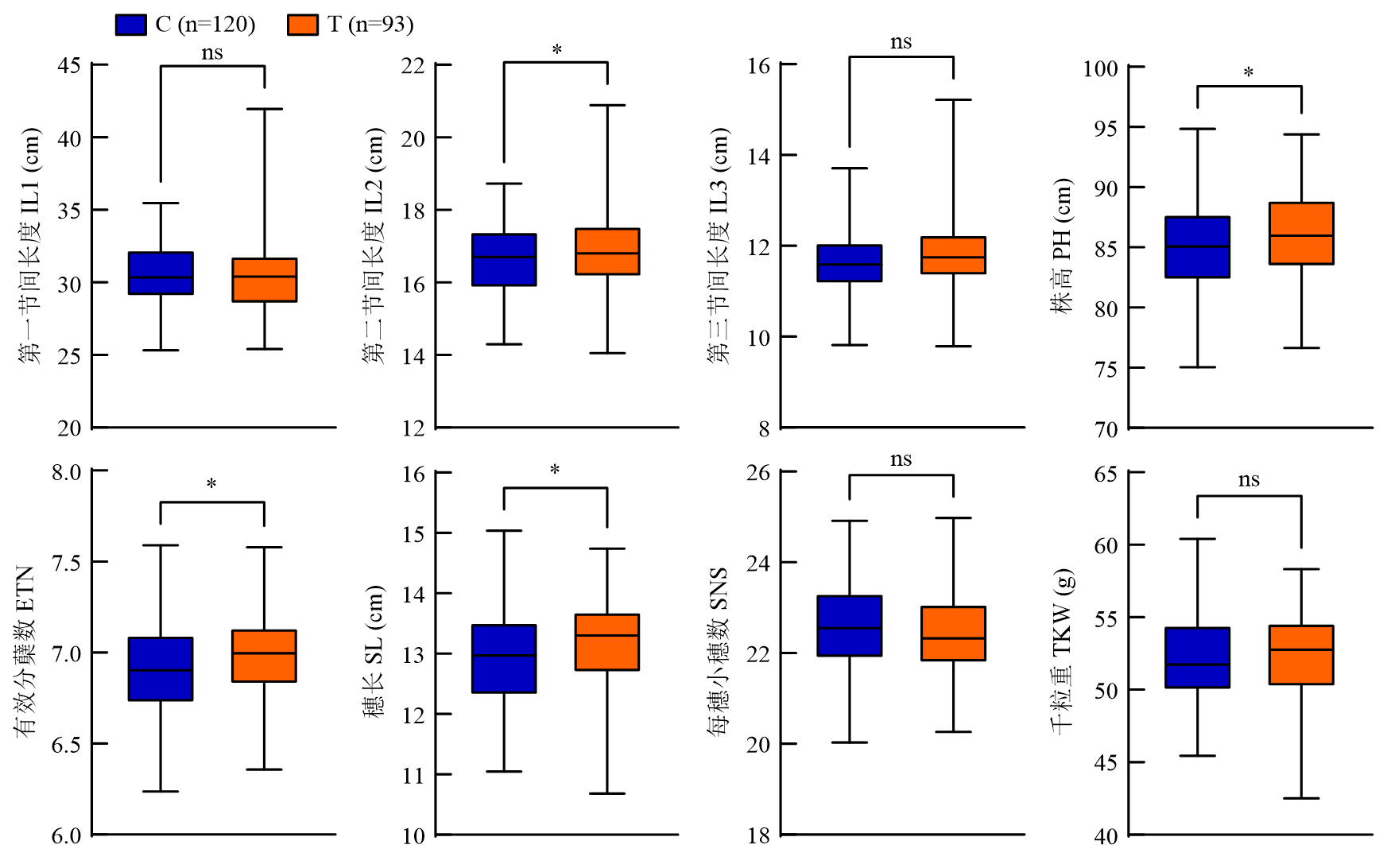
图3
QIL2.sau.5A.1(5A_514724687)对农艺性状的效应分析"
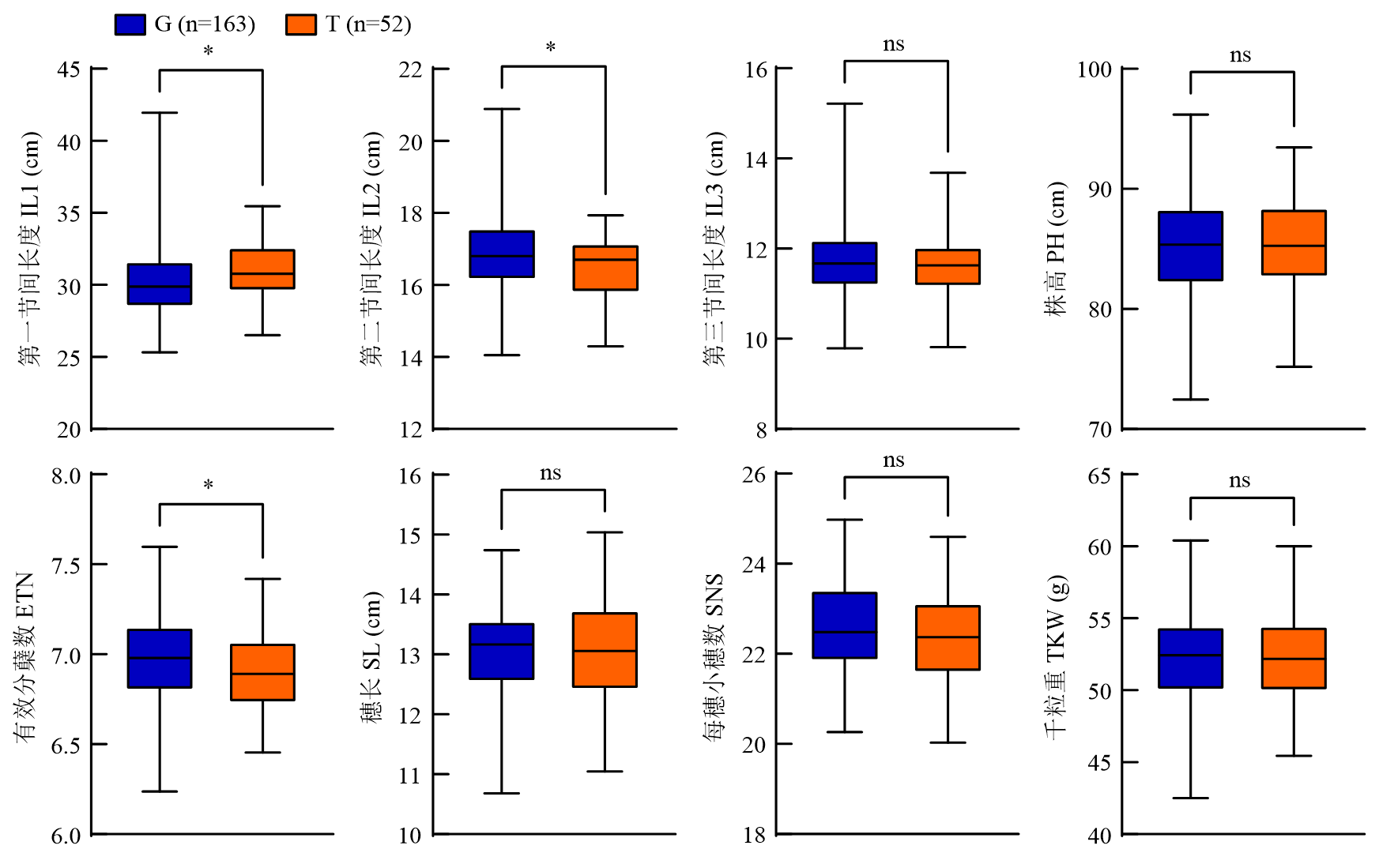
图4
QIL2.sau.5A.2(5A_517883089)对农艺性状的效应分析"
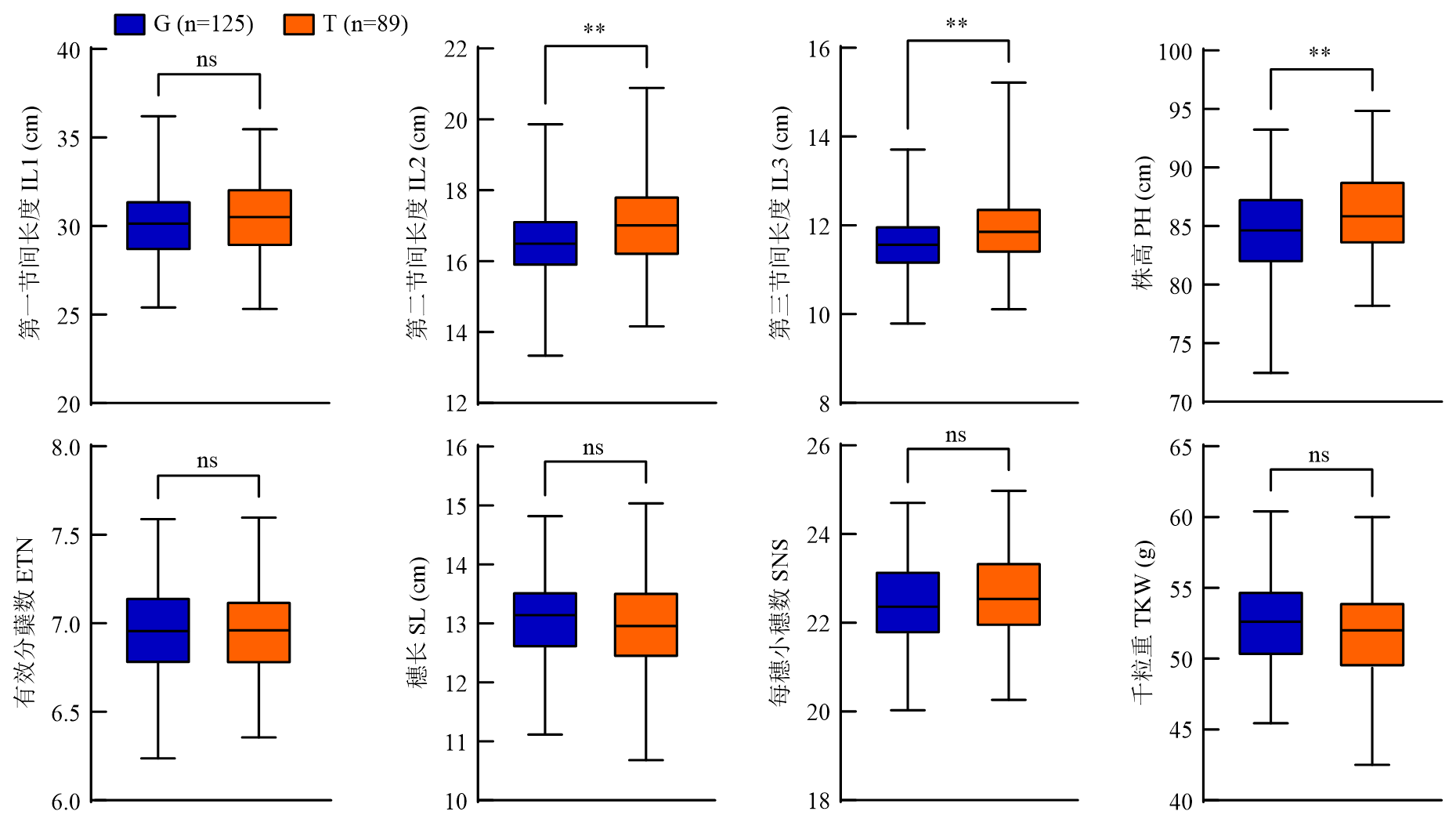
图5
QIL3.sau.4D(4D_21001512)对农艺性状的效应分析"
表4
小麦节间长度候选基因的预测与注释"
| 位点 QTL | 候选基因 Candidate genes | 起始位置 Start position (Mb) | 基因注释或编码蛋白 Gene annotation or coding proteins | 同源基因 Homologs gene |
|---|---|---|---|---|
| QIL3.sau.4D | TraesCS4D02G041400 | 19.813161 | ATP依赖性RNA解旋酶 ATP-dependent RNA helicase | OsRH21, OsRH52B, OsRH52C |
| TraesCS4D02G042100 | 20.090627 | 碱性蓝蛋白 Basic blue protein | OsUCL8, OsUCL9, OsUCL12, ARPN, ENODL22 | |
| QIL1.sau.5A | TraesCS5A02G286200 | 494.413105 | pfkB样碳水化合物激酶家族蛋白 pfkB-like carbohydrate kinase family protein | OsFKI, OsFKII |
| QIL2.sau.5A.2 | TraesCS5A02G299500 | 509.602215 | 组蛋白H4 Histone H4 | 无Null |
| TraesCS5A02G299800 | 509.669584 | RNA聚合酶Ⅱ转录辅激活因子 RNA polymerase Ⅱ transcriptional coactivator | SI1, KIWI, KELP |
| [1] |
doi: 10.1186/s13059-023-02932-x pmid: 37173729 |
| [2] |
doi: 10.1093/jxb/erq300 |
| [3] |
doi: 10.1186/s12870-025-07076-7 |
| [4] |
doi: 10.1007/s00122-017-2884-6 |
| [5] |
doi: 10.1007/s00122-018-3130-6 pmid: 29959472 |
| [6] |
doi: 10.1111/pbi.12690 pmid: 28055148 |
| [7] |
姚琦馥, 陈黄鑫, 周界光, 马瑞莹, 邓亮, 谭陈芯雨, 宋靖涵, 吕季娟, 马建. 基于16K SNP芯片的小麦株高QTL鉴定及其遗传分析. 中国农业科学, 2023, 56(12): 2237-2248. doi: 10.3864/j.issn.0578-1752.2023.12.001.
|
|
|
|
| [8] |
doi: 10.1038/s41598-020-69138-0 pmid: 32703989 |
| [9] |
doi: 10.1007/s00122-023-04502-y pmid: 37989964 |
| [10] |
|
| [11] |
doi: 10.1093/jxb/eraa443 |
| [12] |
doi: 10.1016/j.molp.2022.01.013 |
| [13] |
doi: 10.1104/pp.18.00023 |
| [14] |
doi: 10.1111/nph.v233.2 |
| [15] |
doi: 10.1016/j.molp.2022.01.014 |
| [16] |
doi: 10.1007/s001220051094 |
| [17] |
doi: 10.1007/s00122-015-2624-8 pmid: 26520114 |
| [18] |
doi: 10.1007/s00122-015-2476-2 pmid: 25687129 |
| [19] |
doi: 10.3389/fpls.2015.01099 pmid: 26734019 |
| [20] |
doi: 10.3389/fpls.2021.727077 |
| [21] |
doi: 10.3389/fgene.2021.649988 |
| [22] |
doi: 10.3389/fpls.2021.628478 |
| [23] |
doi: 10.1007/s00122-026-05253-2 |
| [24] |
doi: 10.1007/s00122-019-03458-2 pmid: 31628527 |
| [25] |
姚琦馥, 周界光, 王健, 陈黄鑫, 杨瑶瑶, 刘倩, 闫磊, 王瑛, 周景忠, 崔凤娟, 等. 小麦穗长QTL鉴定及其遗传分析. 中国农业科学, 2023, 56(24): 4814-4825. doi: 10.3864/j.issn.0578-1752.2023.24.002.
|
|
|
|
| [26] |
|
| [27] |
张智源, 周界光, 刘家君, 王素容, 王同著, 赵聪豪, 尤佳宁, 丁浦洋, 唐华苹, 刘燕林, 等. 基于遗传解析新模式的小麦寡分蘖QTL的鉴定和验证. 作物学报, 2024, 50(6): 1373-1383.
|
|
doi: 10.3724/SP.J.1006.2024.31051 |
|
| [28] |
doi: 10.2135/cropsci1998.0011183X003800050003x |
| [29] |
doi: 10.1111/j.1467-985X.2010.00676_9.x |
| [30] |
doi: 10.1007/s00122-025-05059-8 pmid: 41081823 |
| [31] |
doi: 10.1093/genetics/155.2.945 pmid: 10835412 |
| [32] |
doi: 10.1186/s12870-019-1764-4 |
| [33] |
doi: 10.1111/men.2018.18.issue-1 |
| [34] |
|
| [35] |
doi: 10.1038/ng1702 pmid: 16380716 |
| [36] |
doi: 10.1016/j.molp.2021.10.006 pmid: 34715393 |
| [37] |
doi: 10.1038/s41588-025-02137-x |
| [38] |
doi: 10.1186/s12864-026-12693-z |
| [39] |
doi: 10.1016/j.cj.2023.05.007 |
| [40] |
doi: 10.1038/22307 |
| [41] |
doi: 10.1046/j.1365-3040.2001.00688.x |
| [42] |
doi: 10.3390/genes13060979 |
| [43] |
pmid: 8876647 |
| [44] |
doi: 10.1186/1471-2229-12-102 |
| [45] |
doi: 10.1016/j.cell.2011.11.061 pmid: 22304917 |
| [1] | 王小玮, 杜佛力, 闫红财, 郎正东, 党志娟, 李葆春, 汪军成, 马小乐, 王化俊, 张宏, 姚立蓉. 396份春小麦灌浆期和成熟期抗旱性评价[J]. 中国农业科学, 2026, 59(8): 1608-1621. |
| [2] | 王彩玉, 刘小丽, 李文广, 杨文平, 杨珍平, 高志强. 有机肥不同替代比例对土壤多功能性的影响及微生物驱动机制[J]. 中国农业科学, 2026, 59(8): 1712-1726. |
| [3] | 朱琦, 贾振鹏, Tahir SHAH, 徐晨晟, 李芷琦, 吕会帅, 朱鹏超, 韦小敏, 黄冬琳, 孙艳妮, 曹卫东, 高亚军, 王朝辉, 张达斌. 绿肥配施增效产品降低旱地麦田温室气体排放及碳足迹[J]. 中国农业科学, 2026, 59(7): 1507-1522. |
| [4] | 叶美金, 吴雷, Lohani Md Nahibuzzaman, 尹丽, 胡欣荣, 刘亚西, 蒋云峰, 陈国跃, 蒲至恩, 李阳, 李婷, 邹亚亚, 吴佳怡, 马建. 基于GWAS的中国地方小麦成熟胚大小位点的鉴定及其遗传效应解析[J]. 中国农业科学, 2026, 59(6): 1157-1171. |
| [5] | 杨丽娟, 陈丝雨, 赵薇, 朱玲, 郭磊, 马丽娜, 马瑞敏, 张娟. 全基因组重测序揭示静原鸡羽色的遗传机制[J]. 中国农业科学, 2026, 59(6): 1348-1360. |
| [6] | 李文虎, 礼海风, 杜宇鹏, 丁玉兰, 罗一诺, 李宇珂, 佘文婷, 张丰, 滕宇, 张思琦, 黄翠, 李小涵, 刘金山, 王朝辉. 小麦锌吸收转移对土施锌肥响应的区域差异[J]. 中国农业科学, 2026, 59(5): 1034-1047. |
| [7] | 焦文娟, 何万龙, 耿洪伟, 白斌, 李剑峰, 程宇坤. 155份春小麦品种(系)条锈病抗性评价与抗病基因分子检测[J]. 中国农业科学, 2026, 59(5): 937-950. |
| [8] | 崔士友, 陈澎军, 缪源卿, 韩继军, 沈俊明. EMS诱变抗草甘膦小麦新种质的创制与大田评价[J]. 中国农业科学, 2026, 59(4): 723-733. |
| [9] | 钱瑾, 李映雪, 吴芳, 邹晓晨. 集成光谱降维的冬小麦叶片磷含量估算[J]. 中国农业科学, 2026, 59(4): 781-792. |
| [10] | 孔媛, 崔沙沙, 李美, 李健, 杨思雨, 房锋, 刘帅帅, 刘明平, 曾艳, 高兴祥, 柏连阳. 黄淮海冬小麦田多花黑麦草等5种禾本科杂草时空分布变化规律[J]. 中国农业科学, 2026, 59(4): 807-823. |
| [11] | 王勇胜, 牛丽, 王长杰, 马立花, 廉潇潇, 孟亚雄, 马小乐, 姚立蓉, 张宏, 杨轲, 李葆春, 王化俊, 司二静, 汪军成. 冬小麦千粒重的全基因组关联分析及候选基因预测[J]. 中国农业科学, 2026, 59(3): 499-514. |
| [12] | 李心怡, 李嘉宁, 杨文平, 夏清, 霍滢睿, 郝世航, 黄婷苗, 任永康, 陈杰, 高志强, 杨珍平. 彩粒小麦锌营养对花后叶面喷锌的响应[J]. 中国农业科学, 2026, 59(3): 515-527. |
| [13] | 咸青林, 肖鉴珂, 高阿庆, 郜利闯, 刘杨. 种植方式结合测墒补灌下冬小麦产量及水分利用效率[J]. 中国农业科学, 2026, 59(3): 589-601. |
| [14] | 张志勇, 谭世超, 熊淑萍, 马新明, 韦一昊, 王小纯. 水氮周年优化对豫北灌区小麦玉米轮作系统产量和氮迁移的影响[J]. 中国农业科学, 2026, 59(2): 336-353. |
| [15] | 张烨, 王文宁, 朱靓萍, 陈语涵, 韩燕, 张润泽, 胡昌录, 杨学云, 张树兰. 土壤管理措施对小麦产量影响的全球Meta分析[J]. 中国农业科学, 2026, 59(12): 2656-2670. |
|
||
