






中国农业科学 ›› 2025, Vol. 58 ›› Issue (24): 5216-5233.doi: 10.3864/j.issn.0578-1752.2025.24.009
郭松1,2( ), 韩磊1, 汪源3, 王子君1, 钱紫慧3, 路佳明3, 赵灿3, 王维领3, 许轲3, 张洪程3, 杨凤萍1,*(), 霍中洋3,*()
收稿日期:2025-01-06
接受日期:2025-04-27
出版日期:2025-12-22
发布日期:2025-12-22
通信作者:
联系方式:
郭松,E-mail:1004751420@qq.com。
基金资助:
GUO Song1,2(), HAN Lei1, WANG Yuan3, WANG ZiJun1, QIAN ZiHui3, LU JiaMing3, ZHAO Can3, WANG WeiLing3, XU Ke3, ZHANG HongCheng3, YANG FengPing1,*(), HUO ZhongYang3,*()
Received:2025-01-06
Accepted:2025-04-27
Published:2025-12-22
Online:2025-12-22
摘要:
【目的】建立高产、氮高效协同低碳减排的缓控释氮肥一次性侧深施用技术,为长江中下游地区水稻绿色轻简化生态栽培提供新途径。【方法】以生育期相近的高产优质迟熟中粳稻南粳9108和泰香粳1402为材料,选用静水控释周期为100 d的43%树脂包膜尿素和46%速效尿素为氮肥,并分别设置100%∶0(S1)、80%∶20%(S2)、60%∶40%(S3)、50%∶50%(S4)与40%∶60%(S5)5个不同控释与速效氮肥用量配比处理一次性侧深施,同时设置常规施氮肥(CK)与不施氮肥(0N)为对照,研究不同处理对水稻产量、氮肥吸收利用效率和温室气体排放的影响。【结果】(1)与CK处理的产量相比,S1处理均显著降低,S2处理均无显著差异,S3、S4处理均显著提高,且S4处理显著高于S3处理,年度间和品种间均表现出一致规律。其中,南粳9108的S3、S4处理分别提高了2.2%—3.2%、3.6%—5.4%,泰香粳1402则分别提高了0.9%—3.4%、3.1%—5.0%。(2)与CK处理相比,S1—S5处理的吸氮量在分蘖盛期和拔节期均显著降低(S4除外),而在抽穗期和成熟期均有显著提高(除S1处理显著降低外),且均以S4处理增幅最大;S1—S5处理的氮素积累量在播种—分蘖盛期时均显著降低,而在分蘖盛期—拔节期、拔节期—抽穗期则均有显著提高,且均以S4处理增幅最大;最终S2—S5处理的氮素农学利用率、氮素吸收利用率以及氮素偏生产力均显著提高,其中南粳9108分别提高了3.0%—14.7%、11.6%—23.2%、0.4%—3.7%,泰香粳1402则分别提高了2.3%—14.8%、11.3%—24.6%、0.8%—5.0%,且均以S4处理提升幅度最大,其次为S3。(3)与CK处理相比,S1—S5处理在分蘖盛期—拔节期、抽穗期—成熟期和全生育期的CH4累积排放量均显著降低,其中南粳9108分别降低了48.0%—64.1%、55.1%—68.7%、26.8%—35.6%,泰香粳1402则分别降低了42.4%—49.2%、46.4%—61.9%、24.9%—37.5%,且均以S3降幅最大,S4次之;S1—S5处理在移栽—分蘖盛期、分蘖盛期—拔节期和全生育期的N2O累积排放量均显著降低,其中南粳9108分别降低了42.9%—60.8%、40.8%—73.0%、33.9%—58.9%,泰香粳1402分别降低了24.5%—53.3%、39.5%—57.6%、29.9%—30.7%,且均以S5处理降幅最大;最终S1—S5处理的GWP(温室气体增温潜势)和GHGI(温室气体排放强度)均显著降低,其中南粳9108分别降低了26.7%—35.3%、25.3%—37.9%,泰香粳分别降低了26.6%—37.9%、28.1%—40.4%,并均以S3处理降幅最大,S4次之。【结论】缓控释与速效氮肥适宜配比为50%∶50%或60%∶40%时一次性侧深施用具有较好的高产、氮高效协同低碳减排效果,可作为长江中下游地区水稻丰产高效、绿色低碳的轻简化施氮技术。
郭松, 韩磊, 汪源, 王子君, 钱紫慧, 路佳明, 赵灿, 王维领, 许轲, 张洪程, 杨凤萍, 霍中洋. 控释与速效氮肥不同配比一次性侧深施对水稻产量、氮肥利用率和碳减排的影响[J]. 中国农业科学, 2025, 58(24): 5216-5233.
GUO Song, HAN Lei, WANG Yuan, WANG ZiJun, QIAN ZiHui, LU JiaMing, ZHAO Can, WANG WeiLing, XU Ke, ZHANG HongCheng, YANG FengPing, HUO ZhongYang. Effect of One-Time Side Deep Application Ratios of Controlled-Release Nitrogen Fertilizer and Common Urea to Rice Yield, Nitrogen Fertilizer Efficiency and Carbon Emission Reduction[J]. Scientia Agricultura Sinica, 2025, 58(24): 5216-5233.

表1
供试土壤类型及养分含量"
| 年份 Year | 土壤类型 Soil type | pH | 有机质 Organic matter (g·kg-1) | 全氮 Total nitrogen (g·kg-1) | 碱解氮 Alkaline nitrogen decomposition (mg·kg-1) | 速效磷 Quick-acting phosphorus (mg·kg-1) | 速效钾 Quick-acting potassium (mg·kg-1) |
|---|---|---|---|---|---|---|---|
| 2022 | 底黑勤泥土 Bottom black soil | 7.11 | 25.3 | 1.79 | 113.8 | 8.23 | 110.5 |
| 2023 | 底黑勤泥土 Bottom black soil | 7.16 | 23.6 | 1.54 | 104.9 | 7.57 | 113.8 |
表2
基肥不同控释氮肥与普通尿素配比处理的肥料种类和施肥量"
| 处理 Treatment | 控释氮肥与普通尿素配比 Ratio of controlled-release N to urea | 施肥方式 Fertilizer application | 施氮量 Fertilizer application rate (kg·hm-2) | |
|---|---|---|---|---|
| 基肥中控释氮肥 Controlled-release N | 基肥中普通氮肥 Urea | |||
| 0N | / | / | / | / |
| CK | 0:35% | 撒施Sprinkle | 0 | 94.5 |
| S1 | 100%:0 | 侧深施Side deep application | 270 | 0 |
| S2 | 80%:20% | 侧深施Side deep application | 216 | 54 |
| S3 | 60%:40% | 侧深施Side deep application | 162 | 108 |
| S4 | 50%:50% | 侧深施Side deep application | 135 | 135 |
| S5 | 40%:60% | 侧深施Side deep application | 108 | 162 |
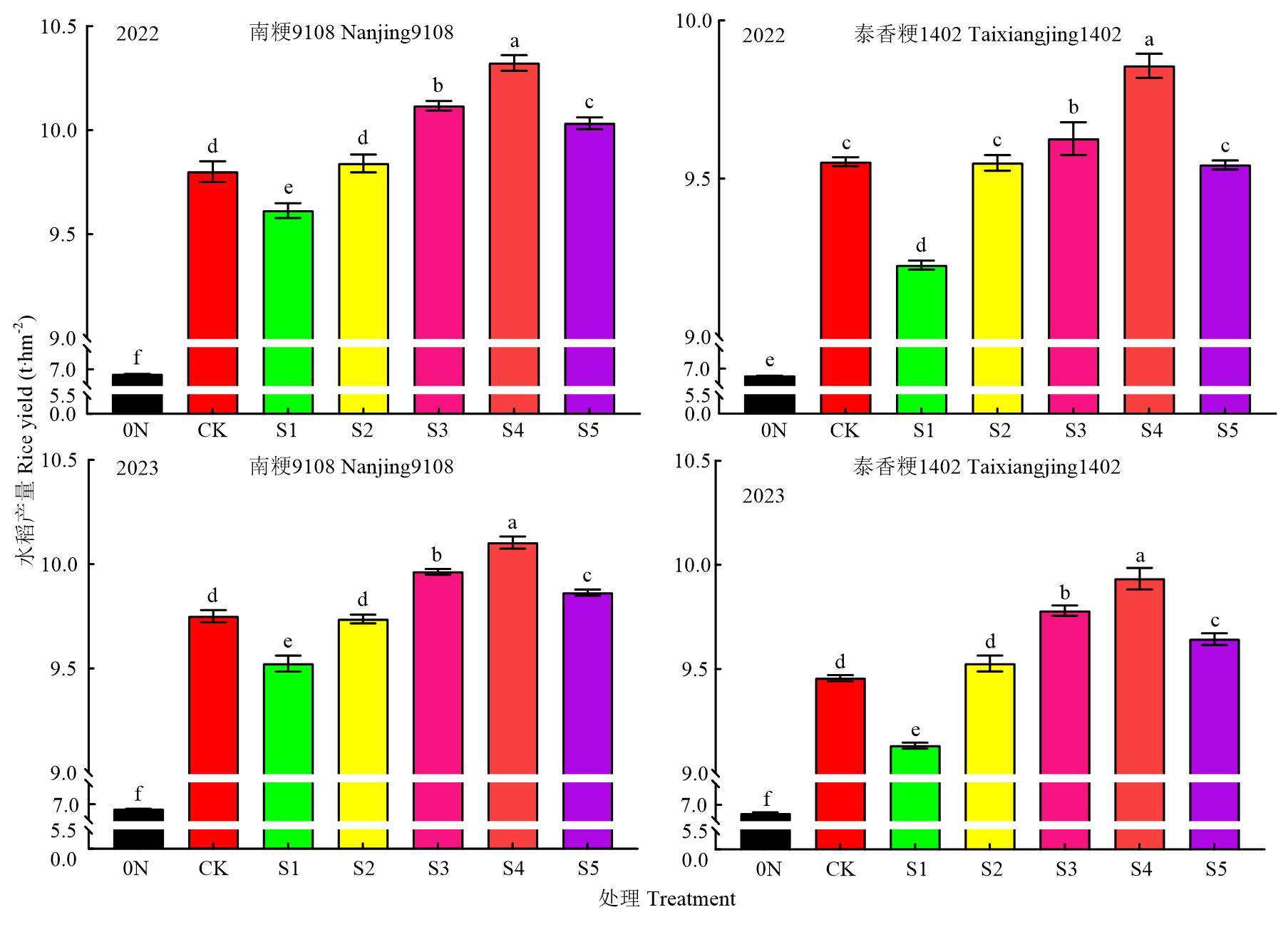
图1
2022和2023年不同处理水稻的实际产量 处理同表2。误差线均表示标准偏差。同一年度同一品种标注不同小写字母表示处理间差异达0.05显著水平"
表3
2022年不同处理水稻主要生育时期的吸氮量"
| 品种 Cultivar | 处理 Treatment | 分蘖盛期 Tillering stage | 拔节期 Jointing stage | 抽穗期 Heading stage | 成熟期 Mature stage |
|---|---|---|---|---|---|
| 南粳9108 Nanjing9108 | 0N | 9.31±0.02g | 19.99±0.92f | 62.76±1.05g | 107.01±1.77f |
| CK | 63.27±0.42a | 103.18±0.98a | 151.98±1.13e | 192.82±0.14d | |
| S1 | 27.30±0.12f | 91.59±0.59e | 146.40±0.50f | 190.71±0.87e | |
| S2 | 40.67±0.18e | 94.36±1.18d | 157.39±0.11d | 202.81±0.46c | |
| S3 | 49.67±0.54c | 100.70±0.46b | 167.69±0.18b | 209.82±0.75b | |
| S4 | 52.60±0.04b | 102.42±0.24a | 171.80±0.03a | 212.70±0.39a | |
| S5 | 47.72±0.24d | 96.03±0.21c | 163.75±0.19c | 203.52±0.43c | |
| 泰香粳1402 Taixiangjing1402 | 0N | 14.73±0.23g | 25.40±0.04f | 63.83±0.53g | 109.59±0.30g |
| CK | 78.94±0.41a | 112.51±0.25a | 148.62±0.89e | 185.21±0.61e | |
| S1 | 35.81±0.32f | 97.05±0.02e | 146.20±0.46f | 182.95±0.32f | |
| S2 | 43.31±0.15e | 100.75±0.17d | 157.70±0.52d | 193.76±0.12c | |
| S3 | 49.29±0.17d | 106.58±0.16c | 164.09±0.58c | 198.47±0.11b | |
| S4 | 56.00±0.39b | 112.21±0.55a | 174.04±0.61a | 203.86±0.45a | |
| S5 | 53.26±0.08c | 108.57±1.18b | 170.11±0.40b | 191.22±0.18d |
表4
2022年水稻主要生育阶段不同处理的氮素积累量"
| 品种 Cultivar | 处理 Treatment | 播种期—分蘖盛期 Seeding-tillering stage | 分蘖盛期—拔节期 Tillering-jointing stage | 拔节期—抽穗期 Jointing-heading stage | 抽穗期—成熟期 Heading-mature stage |
|---|---|---|---|---|---|
| 南粳9108 Nanjing9108 | 0N | 9.31±0.02g | 10.68±0.90f | 42.77±0.13e | 44.25±0.17a |
| CK | 63.27±0.42a | 39.91±1.40e | 48.80±2.11d | 40.84±1.14bc | |
| S1 | 27.30±0.12f | 64.29±0.71a | 54.82±0.09c | 44.31±0.87a | |
| S2 | 40.67±0.18e | 53.69±1.00b | 63.03±1.29b | 45.42±0.86a | |
| S3 | 49.67±0.54c | 51.03±0.07bc | 66.99±1.28a | 42.13±1.15b | |
| S4 | 52.60±0.04b | 49.82±0.28cd | 69.37±3.21a | 40.94±0.39bc | |
| S5 | 47.72±0.24d | 48.32±0.45d | 67.72±1.40a | 39.77±0.43c | |
| 泰香粳1402 Taixiangjing1402 | 0N | 14.73±0.23f | 10.68±0.27e | 38.43±1.49d | 45.76±0.30a |
| CK | 78.94±0.41a | 33.57±0.66d | 36.12±0.65d | 36.59±0.01b | |
| S1 | 35.81±0.32e | 61.24±0.34a | 49.15±0.44c | 36.75±0.72b | |
| S2 | 43.31±0.15d | 57.45±0.32b | 56.95±0.69b | 36.06±0.12b | |
| S3 | 49.29±0.17c | 57.29±1.32b | 57.52±0.74b | 34.37±0.11c | |
| S4 | 56.00±0.39b | 56.21±0.16b | 61.83±1.16a | 29.82±0.45d | |
| S5 | 53.26±3.08b | 55.31±0.10c | 61.53±1.18a | 21.11±0.18e |
表5
2022年不同处理水稻的氮肥利用率"
| 处理 Treatment | 南粳9108 Nanjing9108 | 泰香粳1402 Taixiangjing1402 | ||||
|---|---|---|---|---|---|---|
| 氮素农学利用率 NAUE (kg·kg-1) | 氮素吸收利用率 NUE (%) | 氮素偏生产力 NPP (kg·kg-1) | 氮素农学利用率 NAUE (kg·kg-1) | 氮素吸收利用率 NUE (%) | 氮素偏生产力 NPP (kg·kg-1) | |
| 0N | / | / | / | / | / | / |
| CK | 11.52±0.03e | 31.78±0.60d | 36.12±0.10d | 12.01±0.04d | 28.01±0.11e | 35.03±0.02d |
| S1 | 11.05±0.04f | 31.74±0.98d | 35.24±0.01e | 10.81±0.05e | 27.17±0.10f | 33.82±0.01e |
| S2 | 11.87±0.02d | 35.48±0.49c | 36.28±0.09d | 12.28±0.02c | 31.17±0.16c | 35.32±0.02c |
| S3 | 12.68±0.02b | 38.08±0.38b | 36.89±0.00b | 12.48±0.06b | 32.92±0.15b | 35.48±0.02b |
| S4 | 13.21±0.01a | 39.14±0.80a | 37.45±0.01a | 13.79±0.07a | 34.91±0.06a | 36.77±0.07a |
| S5 | 12.31±0.01c | 35.74±0.82c | 36.54±0.01c | 12.32±0.03c | 30.23±0.04d | 35.35±0.01c |

图2
2022年不同处理的CH4和N2O排放通量变化特征 误差线均表示标准偏差"
表6
2022年水稻主要生育阶段不同处理的CH4和N2O排放累积量"
| 气体 类型 Gas | 品种 Cultivar | 处理 Treatment | 移栽—分蘖盛期 Transplanting- tillering stage | 分蘖盛期—拔节期 Tillering-jointing stage | 拔节期—抽穗期 Jointing-heading stage | 抽穗期至成熟期 Heading-mature stage | 全生育期 Whole growth period |
|---|---|---|---|---|---|---|---|
| CH4 (kg·hm-2) | 南粳9108 Nanjing9108 | 0N | 15.18±0.09d | 45.31±0.44f | 37.76±0.89e | 25.58±0.46b | 123.82±0.78f |
| CK | 153.43±0.09c | 249.02±0.12a | 60.98±0.36b | 49.25±0.68a | 512.68±0.53a | ||
| S1 | 172.39±1.08b | 129.39±0.96b | 57.85±1.24c | 15.70±2.01c | 375.34±0.65b | ||
| S2 | 170.23±3.23b | 104.23±1.14c | 65.84±0.23a | 16.24±0.62c | 356.53±2.94d | ||
| S3 | 173.29±1.00b | 89.44±0.46e | 45.37±0.14d | 22.14±1.74b | 330.23±1.33e | ||
| S4 | 181.39±1.49a | 98.27±0.40d | 57.04±0.65c | 16.89±1.45c | 353.60±1.90d | ||
| S5 | 182.88±0.05a | 104.81±0.67c | 65.12±0.23a | 15.42±0.98c | 368.24±0.49c | ||
| 泰香粳1402 Taixiangjing1402 | 0N | 26.48±0.03f | 65.05±0.38f | 14.15±0.51f | 10.36±0.02d | 116.03±0.93g | |
| CK | 207.95±0.86b | 180.74±1.19a | 102.00±0.96a | 29.25±0.08a | 519.94±2.92a | ||
| S1 | 195.88±0.53c | 90.39±0.36e | 53.40±1.00c | 15.05±0.20b | 354.72±1.69d | ||
| S2 | 206.44±2.18b | 95.63±1.13d | 47.28±1.30d | 15.68±0.31b | 365.03±4.91c | ||
| S3 | 175.76±0.27e | 91.81±0.97e | 45.80±0.42e | 11.65±0.68c | 325.01±0.14f | ||
| S4 | 184.53±0.99d | 104.14±0.39b | 45.30±0.84e | 11.16±0.07c | 345.13±0.32e | ||
| S5 | 216.01±0.20a | 99.16±0.48c | 60.29±0.38b | 15.06±0.24b | 390.53±0.54b | ||
| N2O (g·hm-2) | 南粳9108 Nanjing9108 | 0N | 31.50±0.21f | 277.09±0.60g | 184.61±0.61g | 356.39±1.03g | 849.59±2.46g |
| CK | 709.91±0.65a | 1815.20±3.19a | 659.17±0.71b | 294.83±0.14d | 3479.11±3.27a | ||
| S1 | 405.07±3.22b | 1073.82±1.33b | 694.06±8.69a | 438.49±1.64a | 2611.43±12.23b | ||
| S2 | 369.31±1.57c | 714.76±4.05c | 618.23±11.60c | 415.24±0.75b | 2117.54±14.83c | ||
| S3 | 333.61±1.54d | 647.75±2.25d | 533.56±7.94d | 326.95±6.52c | 1841.86±2.37d | ||
| S4 | 278.48±0.63e | 518.96±0.72e | 424.92±2.25e | 248.27±4.08e | 1470.64±3.18e | ||
| S5 | 281.01±7.03e | 495.59±2.76f | 378.36±4.60f | 274.89±0.79f | 1429.85±4.39f | ||
| 泰香粳1402 Taixiangjing1402 | 0N | 48.24±0.59g | 255.24±0.71g | 129.22±0.48g | 301.78±1.00e | 734.48±1.37g | |
| CK | 807.25±0.38a | 2178.88±3.27a | 1023.36±1.18a | 739.53±5.13a | 4749.03±6.84a | ||
| S1 | 609.20±0.95b | 1318.63±2.60b | 804.79±4.17b | 597.31±16.25bc | 3329.93±22.06b | ||
| S2 | 407.48±0.63e | 937.60±0.36f | 651.38±9.48f | 566.26±1.99c | 2562.72±8.49e | ||
| S3 | 499.65±0.63d | 923.07±5.13d | 668.38±12.10e | 606.17±4.35b | 2697.26±10.69d | ||
| S4 | 553.25±1.39c | 970.08±5.79c | 801.88±1.12c | 573.66±11.76c | 2898.87±6.24c | ||
| S5 | 376.69±2.02f | 942.52±2.43e | 695.08±1.37d | 512.24±3.72d | 2526.53±0.63f |
表7
2022年不同处理的GWP与GHGI"
| 处理 Treatment | 南粳9108 Nanjing9108 | 泰香粳1402 Taixiangjing1402 | ||
|---|---|---|---|---|
| 温室气体增温潜势 GWP (kg CO2-eq·hm-2) | 温室气体排放强度 GHGI (kg·kg-1) | 温室气体增温潜势 GWP (kg CO2-eq·hm-2) | 温室气体排放强度 GHGI (kg·kg-1) | |
| 0N | 4473. 41±27.30f | 0.69±0.00g | 4172.64±32.09f | 0.68±0.01g |
| CK | 18509.80±17.06a | 1.90±0.00a | 19150.21±101.47a | 2.03±0.01a |
| S1 | 13571.01±25.83b | 1.42±0.00b | 13092.81±50.64c | 1.43±0.01c |
| S2 | 12778.59±95.26d | 1.31±0.01d | 13205.57±169.63c | 1.39±0.00d |
| S3 | 11798.83±44.59e | 1.18±0.00f | 11886.57±8.17e | 1.21±0.00f |
| S4 | 12478.14±65.58d | 1.24±0.01e | 12632.92±8.85d | 1.27±0.01e |
| S5 | 12963.39±15.29c | 1.31±0.00c | 14061.20±18.52b | 1.46±0.00b |
表8
缓控释氮肥不同施用方式GWP和GHGI的降低效果"
| 序号 No. | 肥料类型 Fertilizer types | 施氮方式 N application method | 氮肥运筹 N fertilizer operation | GWP降幅 GWP reduction (%) | GHGI降幅 GHGI reduction (%) | 文献来源 Literature sources |
|---|---|---|---|---|---|---|
| 1 | 单一缓控释氮肥 Single slow/controlled release N fertilizer | |||||
| 硫包衣控释尿素 CRS | 撒施SK | 一次性施入One-time | 20.7 | 22.7 | 王飞飞等 WANG F F, et al[ | |
| 聚氨酯包衣尿素 CRT | 撒施SK | 一次性施入One-time | 36.0 | 38.6 | 王飞飞等 WANG F F, et al [ | |
| 脲甲醛缓释氮 CRUF | 撒施SK | 一次性施入One-time | 34.5 | 34.1 | 王飞飞等 WANG F F, et al [ | |
| 树脂包膜尿素 CRP | 撒施SK | 一次性施入One-time | 29.6 | 27.3 | 王飞飞等 WANG F F, et al [ | |
| 树脂包衣控释氮肥 CRN | 撒施SK | 早/晚稻,一次性施入 Early/late rice, one-time | 21.1 | 32.9 | 郭晨 GUO C[ | |
| 控释掺混肥① CRBF | 撒施SK | 一次性施入One-time | 20.37 | 22.9 | 孟轶 MENG Y[ | |
| 缓释氮专用肥② SRN | 撒施SK | 一次性施入One-time | P>0.05 | 8.9 | 康治东等 KANG Z D, et al[ | |
| 控失尿素 LCU | 撒施SK | 一次性施入One-time | 4.5 | / | 张阳阳 ZHANG Y Y[ | |
| FeⅢ-单宁酸纳米改性 水基包膜尿素 NWU | 撒施SK | 一次性施入One-time | 12.5 | / | 张阳阳 ZHANG Y Y[ | |
| 控释尿素 CRU | 土层混施SM | 早/晚稻,基肥:分蘖肥=90:60 Early/late rice, base:tillering = 90:60 | 10.19 | 19.6 | 田昌等 TIAN C, et al [ | |
| 2 | 单一缓控释氮肥减量 Single slow/controlled release N fertilizer reduction | |||||
| -10%控释尿素 -10% CRU | 土层混施SM | 早/晚稻,基肥:分蘖肥=81:54 Early/late rice, base:tillering = 81:54 | 21.7 | 33.0 | 田昌等 TIAN C, et al [ | |
| -20%控释尿素 -20% CRU | 土层混施SM | 早/晚稻, 基肥:分蘖肥=72:48 Early/late rice, base:tillering = 72:48 | 22.9 | 29.5 | 田昌等 TIAN C, et al [ | |
| -30%控释尿素 -30% CRU | 土层混施SM | 早/晚稻, 基肥:分蘖肥=63:42 Early/late rice, base:tillering = 63:42 | 32.5 | 36.4 | 田昌等 TIAN C, et al [ | |
| -20%缓释氮专用肥② -20% SRN | 撒施SK | 一次性施入One-time | 11.7 | 17.7 | 康治东等 KANG Z D, et al[ | |
| -40%缓释氮专用肥② -40% SRN | 撒施SK | 一次性施入One-time | 16.1 | 12.4 | 康治东等 KANG Z D, et al[ | |
| 3 | 缓控释氮肥结合灌溉 Slow/controlled release N fertilizer with irrigation | |||||
| 包膜控释尿素+间歇灌溉 CRU+IIG | 撒施SK | 早/稻,基肥:分蘖肥=120:60 Early/late rice, base:tillering = 120 : 60 | P>0.05 | P>0.05 | 宋春燕 SONG C Y[ | |
| -20%包膜控释尿素减量+间歇灌溉 -20%CRU+S+IIG | 撒施SK | 早/晚稻,基肥:分蘖肥=96:48 Early/late rice, base:tillering = 96:48 | P>0.05 | P>0.05 | 宋春燕 SONG C Y [ | |
| -20%包膜控释尿素减量+节水灌溉 -20%CRU+WSIG | 撒施SK | 早/晚稻, 基肥:分蘖肥=96:48 Early/late rice, base:tillering = 96:48 | 25.3 | 14.2 | 宋春燕 SONG C Y [ | |
| 树脂包衣控释氮肥+薄浅湿晒节水灌溉 CRU+SI | 撒施SK | 早/晚稻, 基肥:分蘖肥=120:45/120:60 Early/late rice, base:tillering = 96:48/120:60 | 49.24 | 55.33 | 李健陵 LI J L,et al[ | |
| 4 | 缓控释氮肥结合有机肥 Slow/controlled release N fertilizer with organic fertilizer | |||||
| 有机肥替代20%氮素+树脂包膜控释尿素 OF+SDCRU | 侧深施肥SD | 一次性施入One-time | 28.69 | 35.93 | 余庆等 YU Q, et al [ | |
| 减氮10%+有机肥替代20%氮素+树脂包膜控释尿素 -10%+OF+SDCRU | 侧深施肥SD | 一次性施入One-time | 31.25 | 38.38 | 余庆等 YU Q, et al [ | |
| 减氮20%+有机肥替代20%氮素+树脂包膜控释尿素 -20%+OF+SDCRU | 侧深施肥SD | 一次性施入One-time | 34.41 | 35.94 | 余庆等 YU Q, et al [ | |
| [1] |
doi: 10.1038/NCLIMATE2826 |
| [2] |
邵美红, 孙加焱, 阮关海. 稻田温室气体排放与减排研究综述. 浙江农业学报, 2011, 23(1): 181-187.
|
|
|
|
| [3] |
|
| [4] |
|
| [5] |
doi: 10.1016/j.jenvman.2020.111211 |
| [6] |
doi: 10.1111/gcb.13185 pmid: 26661415 |
| [7] |
IPCC. Climate Change 2013-The Physical Science Basis Working Group I Contribution to the Fifth Assessment Report of the Intergovernmental Panel on Climate Change. Cambridge: Cambridge University Press, 2014.
|
| [8] |
张广斌, 马静, 徐华, 蔡祖聪. 中国稻田CH4排放量估算研究综述. 土壤学报, 2009, 46(5): 907-916.
|
|
|
|
| [9] |
doi: 10.1016/j.atmosenv.2007.06.049 |
| [10] |
doi: 10.1051/agro/2010002 |
| [11] |
蒋鹏, 徐富贤, 熊洪, 张林, 朱永川, 郭晓艺, 陈琳, 明静. 两种产量水平下减量施氮对杂交中稻产量和氮肥利用率的影响. 核农学报, 2020, 34(1): 147-156.
doi: 10.11869/j.issn.100-8551.2020.01.0147 |
|
doi: 10.11869/j.issn.100-8551.2020.01.0147 |
|
| [12] |
杨秉臻, 金涛, 陆建飞. 长江中下游地区近20年水稻生产与优势的变化. 江苏农业科学, 2018, 46(19): 62-67.
|
|
|
|
| [13] |
段然. 施肥方式对稻田氮素转化的影响及其微生物学机制[D]. 北京: 中国农业科学院, 2018.
|
|
|
|
| [14] |
陈颖. 栽培措施对水稻产置和氮肥利用率的影响及其生理机制[D]. 扬州: 扬州大学, 2018.
|
|
|
|
| [15] |
魏海燕, 李宏亮, 程金秋, 张洪程, 戴其根, 霍中洋, 许轲, 郭保卫, 胡雅杰, 崔培媛. 缓释肥类型与运筹对不同穗型水稻产量的影响. 作物学报, 2017, 43(5): 730-740.
|
|
doi: 10.3724/SP.J.1006.2017.00730 |
|
| [16] |
程爽, 李绍平, 田晋钰, 邢志鹏, 胡雅杰, 郭保卫, 魏海燕, 高辉, 张洪程. 氮肥一次性基施对不同机直播水稻产量和品质的影响. 农业工程学报, 2020, 36(24): 1-10.
|
|
|
|
| [17] |
宋文杰. 控释肥一次性侧深施对水稻生长、氮素利用和产量的影响[D]. 武汉: 长江大学, 2023.
|
|
|
|
| [18] |
陆喜瞻, 朱海滨, 张凯激, 许方甫, 朱盈, 李光彦, 刘国栋, 魏海燕, 胡群, 张洪程. 控释氮肥一次性减量基施和密植对机插粳稻产量、品质及经济效益的影响. 江苏农业学报, 2024, 40(8): 1400-1411.
|
|
|
|
| [19] |
蒋伟勤, 胡群, 俞航, 马会珍, 任高磊, 马中涛, 朱盈, 魏海燕, 张洪程, 刘国栋, 胡雅杰, 郭保卫. 优质食味粳稻控混肥一次性基施效应. 中国农业科学, 2021, 54(7): 1382-1396. doi: 10.3864/j.issn.0578-1752.2021.07.006.
|
|
|
|
| [20] |
朱从桦, 张玉屏, 向镜, 张义凯, 武辉, 王亚梁, 朱德峰, 陈惠哲. 侧深施氮对机插水稻产量形成及氮素利用的影响. 中国农业科学, 2019, 52(23): 4228-4239. doi: 10.3864/j.issn.0578-1752.2019.23.004.
|
|
|
|
| [21] |
张晨晖, 章岩, 李国辉, 杨子君, 查莹莹, 周驰燕, 许轲, 霍中洋, 戴其根, 郭保卫. 侧深施肥下水稻高产形成的根系形态及其生理变化特征. 作物学报, 2023, 49(4): 1039-1051.
doi: 10.3724/SP.J.1006.2023.22023 |
|
|
|
| [22] |
郭松, 郭慧婷, 张裕梁, 钱紫慧, 王子君, 路佳明, 汪源, 赵灿, 王维领, 张洪程, 杨凤萍, 霍中洋. 侧深施控释氮肥运筹方式对水稻产量、NH3挥发和温室气体排放的影响. 作物学报, 2024, 50(6): 1525-1539.
|
|
|
|
| [23] |
王书伟, 林静慧, 吴正贵, 陈吉, 潘云俊, 盛雪雯. 氮肥深施对太湖地区稻田氨挥发的影响. 中国生态农业学报(中英文), 2021, 29(12): 2002-2012.
|
|
|
|
| [24] |
李玥, 李应洪, 赵建红, 孙永健, 徐徽, 严奉君, 谢华英, 马均. 缓控释氮肥对机插稻氮素利用特征及产量的影响. 浙江大学学报(农业与生命科学版), 2015, 41(6): 673-684.
|
|
|
|
| [25] |
余婷, 翟壮, 高镜清, 蔡文倩. 种植模式协同秸秆管理对稻田温室气体排放的影响. 环境工程技术学报, 2024, 14(5): 1504-1512.
|
|
|
|
| [26] |
田昌, 周旋, 黄思怡, 袁浩凌, 谢桂先, 刘强, 彭建伟. 控释尿素减施对稻田CH4和N2O排放及经济效益的影响. 生态环境学报, 2019, 28(11): 2223-2230.
doi: 10.16258/j.cnki.1674-5906.2019.11.011 |
|
|
|
| [27] |
易琼, 逄玉万, 杨少海, 卢钰升, 付弘婷, 李苹, 蒋瑞萍, 唐拴虎. 施肥对稻田甲烷与氧化亚氮排放的影响. 生态环境学报, 2013, 22(8): 1432-1437.
|
|
|
|
| [28] |
张洪程, 吴桂成, 戴其根, 霍中洋, 许轲, 高辉, 魏海燕, 端木银熙, 孙菊英, 赵品恒, 等. 粳型杂交水稻超高产形成规律与栽培途径的探讨. 杂交水稻, 2010, 25(S1): 346-353.
|
|
|
|
| [29] |
王云翔. 不同缓释期氮肥与尿素一次配施对中、晚粳稻群体特征形成的影响[D]. 扬州: 扬州大学, 2023.
|
|
|
|
| [30] |
邢晓鸣, 李小春, 丁艳锋, 王绍华, 刘正辉, 唐设, 丁承强, 李刚华, 魏广彬. 缓控释肥组配对机插常规粳稻群体物质生产和产量的影响. 中国农业科学, 2015, 48(24): 4892-4902. doi: 10.3864/j.issn.0578-1752.2015.24.004.
|
|
|
|
| [31] |
李玥. 缓控释氮肥及配施对机插稻氮素利用特征、产量及土壤理化性质的影响[D]. 雅安: 四川农业大学, 2016.
|
|
|
|
| [32] |
李杰, 张洪程, 常勇, 龚金龙, 郭振华, 戴其根, 霍中洋, 许轲, 魏海燕, 高辉. 不同种植方式水稻高产栽培条件下的光合物质生产特征研究. 作物学报, 2011, 37(7): 1235-1248.
|
|
doi: 10.3724/SP.J.1006.2011.01235 |
|
| [33] |
doi: 10.1016/j.fcr.2016.08.004 |
| [34] |
付月君, 王昌全, 李冰, 尹斌, 张敬昇. 控释氮肥与尿素配施对单季稻产量及氮肥利用率的影响. 土壤, 2016, 48(4): 648-652.
|
|
|
|
| [35] |
黄巧义, 张木, 黄旭, 唐拴虎, 张发宝, 逄玉万, 易琼, 李苹, 付弘婷. 聚脲甲醛缓释氮肥一次性基施在双季稻上的应用效果. 中国农业科学, 2018, 51(20): 3996-4006. doi: 10.3864/j.issn.0578-1752.2018.20.017.
|
|
|
|
| [36] |
黄见良, 邹应斌, 彭少兵,
|
|
|
|
| [37] |
吕腾飞, 谌洁, 马鹏, 代邹, 杨志远, 徐徽, 郑传刚, 马均. 氮肥缓速配施对机插杂交稻氮素利用特征的影响. 中国农业科学, 2021, 54(7): 1410-1423. doi: 10.3864/j.issn.0578-1752.2021.07.008.
|
|
|
|
| [38] |
李敏, 郭熙盛, 叶舒娅, 刘枫, 袁嫚嫚, 黄义德. 硫膜和树脂膜控释尿素对水稻产量、光合特性及氮肥利用率的影响. 植物营养与肥料学报, 2013, 19(4): 808-815.
|
|
|
|
| [39] |
彭碧琳, 李妹娟, 胡香玉, 钟旭华, 唐湘如, 刘彦卓, 梁开明, 潘俊峰, 黄农荣, 傅友强, 胡锐. 轻简氮肥管理对华南双季稻产量和氮肥利用率的影响. 中国农业科学, 2021, 54(7): 1424-1438. doi: 10.3864/j.issn.0578-1752.2021.07.009.
|
|
|
|
| [40] |
马丽, 张雪儿, 张如梦, 衡继璇, 熊启中, 郝杏中, 陈骏, 喻海峰, 王孝忠, 柴如山, 景建元, 罗来超, 张卫峰. 不同施肥方式与新型肥料匹配对巢湖流域水稻品质、经济效益及氮肥利用率的影响. 安徽农业大学学报, 2024, 51(4): 669-676.
|
|
|
|
| [41] |
张惠, 杨正礼, 罗良国, 张晴雯, 易军, 杨世琦, 陈媛媛, 王明. 黄河上游灌区稻田N2O排放特征. 生态学报, 2011, 31(21): 6606-6615.
|
|
|
|
| [42] |
吴家梅, 纪雄辉, 彭华, 谢运河, 官迪, 田发祥, 朱坚, 霍莲杰. 不同有机肥对稻田温室气体排放及产量的影响. 农业工程学报, 2018, 34(4): 162-169.
|
|
|
|
| [43] |
李熠凡, 李烙布, 李伏生. 不同灌溉施氮模式对稻田甲烷和氧化亚氮排放的影响. 灌溉排水学报, 2021, 40(12): 44-53.
|
|
|
|
| [44] |
彭世彰, 李道西, 徐俊增, 丁加丽, 何岩, 郁进元. 节水灌溉模式对稻田CH4排放规律的影响. 环境科学, 2007, 28(1): 9-13.
|
|
|
|
| [45] |
李晶, 王明星, 陈德章. 水稻田甲烷的减排方法研究及评价. 大气科学, 1998, 22(3): 354-362.
|
|
|
|
| [46] |
郭晨. 缓/控释尿素施用对作物产量、氮肥利用率及温室气体排放的影响[D]. 武汉: 华中农业大学, 2018.
|
|
|
|
| [47] |
张怡, 吕世华, 马静, 徐华, 袁江, 董瑜皎. 控释肥料对覆膜栽培稻田N2O排放的影响. 应用生态学报, 2014, 25(3): 769-775.
|
|
|
|
| [48] |
纪洋, 张晓艳, 马静, 李小平, 徐华, 蔡祖聪. 控释肥及其与尿素配合施用对水稻生长期N2O排放的影响. 应用生态学报, 2011, 22(8): 2031-2037.
|
|
|
|
| [49] |
王飞飞, 陈春, 李凡, 郭新亚, 史玉良, 陈卫军. 不同控释氮肥对稻田温室气体排放和水稻产量的影响. 核农学报, 2025, 39(4): 839-845.
doi: 10.11869/j.issn.1000-8551.2025.04.0839 |
|
doi: 10.11869/j.issn.1000-8551.2025.04.0839 |
|
| [50] |
孟轶. 一次性基施控释掺混肥对水稻产量、稻米品质和温室气体排放的影响[D]. 扬州: 扬州大学, 2024.
|
|
|
|
| [51] |
康治东, 徐飞, 卢恒, 钟自勉, 章力干, 李硕. 缓释氮肥减量替代对水稻产量和稻田温室气体排放的影响. 中国生态农业学报(中英文), 2025, 33(7): 1383-1393.
|
|
|
|
| [52] |
张阳阳. 缓控释肥与秸秆配施对土壤酶活性、NH3挥发和温室气体排放的影响[D]. 郑州: 河南农业大学, 2022.
|
|
|
|
| [53] |
宋春燕. 节水减氮及秸秆还田对双季稻温室气体排放和产量的综合影响[D]. 北京: 中国农业科学院, 2023.
|
|
|
|
| [54] |
李健陵, 李玉娥, 周守华, 苏荣瑞, 万运帆, 王斌, 蔡威威, 郭晨, 秦晓波, 高清竹, 刘硕. 节水灌溉、树脂包膜尿素和脲酶/硝化抑制剂对双季稻温室气体减排的协同作用. 中国农业科学, 2016, 49(20): 3958-3967. doi: 10.3864/j.issn.0578-1752.2016.20.010.
|
|
|
|
| [55] |
余庆, 冯涛, 丁紫娟, 柯娜, 段洪波, 聂江文, 朱波, 蒋梦蝶, 刘章勇. 有机肥与控释尿素减氮配施对再生稻田温室气体排放的影响. 农业环境科学学报, 2025, 44(6): 1675-1686.
|
|
|
| [1] | 彭廷燊, 陆久焱, 吴美林, 严雨欣, 刘宏周, 南文斌, 秦小健, 李明, 龚俊义, 梁永书. 多年生水稻黄糯2号和长白7号产量相关性状的QTL分析[J]. 中国农业科学, 2026, 59(7): 1361-1379. |
| [2] | 陈敏, 焦紫岚, 乔承彬, 许昊, 张碧, 马东花, 孔维儒, 王敬文, 宋佳伟, 罗成科, 李培富, 田蕾. 不同亚种水稻种质资源对盐胁迫的形态生理响应及适应策略[J]. 中国农业科学, 2026, 59(4): 705-722. |
| [3] | 郭富城, 唐海江, 郝馨怡, 马国林, 杨九菊, 黄霖锋, 田蕾, 王彬, 罗成科. 不同灌溉方式对宁夏盐渍化土壤水盐运移、水稻产量及水分利用效率的影响[J]. 中国农业科学, 2026, 59(4): 750-764. |
| [4] | 张卫建, 严圣吉, 尚子吟, 唐志伟, 吴柳格, 李佳锐, 陈浩天, 邓艾兴, 张俊, 张鑫, 郑成岩, 宋振伟. 稻田甲烷不完全源于水稻种植的人为贡献[J]. 中国农业科学, 2026, 59(4): 824-833. |
| [5] | 朱姝, 国志鹏, 孙颖. 水稻雷帕霉素靶蛋白OsTOR调控根伸长的功能研究[J]. 中国农业科学, 2026, 59(3): 475-485. |
| [6] | 吕文彦, 程海涛, 马兆惠, 田淑华. 育种新时代水稻杂交育种技术与策略探讨[J]. 中国农业科学, 2026, 59(2): 233-238. |
| [7] | 廖婷璐, 石亚飞, 肖东浩, 舍杨梦斐, 郭富城, 杨九菊, 唐海江, 罗成科. 外源硝普钠对碱胁迫下水稻幼苗糖代谢的影响[J]. 中国农业科学, 2026, 59(2): 265-277. |
| [8] | 刘天生, 刘耕源, 赵安琪, 杨旭, 蔡明雪, 杨艾文, 娄铭轩, 李沐恺, 王晗, 张亚玲. 黑龙江省水稻恶苗病致病群体[J]. 中国农业科学, 2026, 59(2): 305-321. |
| [9] | 王忠妮, 雷月, 李佳丽, 宫彦龙, 朱速松. ABC转运蛋白OsARG1调控水稻抽穗期的功能[J]. 中国农业科学, 2026, 59(1): 1-16. |
| [10] | 费耀莹, 王迪, 唐伟杰, 郭彩丽, 张小虎, 邱小雷, 程涛, 姚霞, 江冲亚, 朱艳, 曹卫星, 郑恒彪. 基于无人机多源影像融合的水稻籽粒蛋白质含量估测[J]. 中国农业科学, 2026, 59(1): 41-56. |
| [11] | 董桂春, 王子涵, 王树深, 李杰, 霍晓晴, 杨瑞, 周娟, 舒小伟, 李妍, 曹靓婧, 王子瑞, 姚友礼, 黄建晔. 硫包衣缓释肥提升水稻产量及氮肥利用率的技术途径[J]. 中国农业科学, 2026, 59(1): 57-77. |
| [12] | 王爱冬, 李瑞杰, 冯向前, 洪卫源, 李子秋, 张晓果, 王丹英, 陈松. 基于多角度成像与机器学习的水稻叶面积精确估算[J]. 中国农业科学, 2025, 58(9): 1719-1734. |
| [13] | 韦萍, 潘炬忠, 朱德平, 邵胜雪, 陈珊珊, 韦雅倩, 高维维. OsDREB1J调控水稻籽粒大小的功能研究[J]. 中国农业科学, 2025, 58(8): 1463-1478. |
| [14] | 刘劲松, 伍龙梅, 包晓哲, 刘志霞, 张彬, 杨陶陶. 短期减施氮肥对华南地区早晚兼用型水稻产量和稻米品质的影响[J]. 中国农业科学, 2025, 58(8): 1508-1520. |
| [15] | 王彬, 吴朋浩, 鲁剑巍, 任涛, 丛日环, 陆志峰, 李小坤. 长江中游地区水稻-油菜轮作体系需水特征[J]. 中国农业科学, 2025, 58(7): 1355-1365. |
|
||
