






中国农业科学 ›› 2026, Vol. 59 ›› Issue (18): 4033-4047.doi: 10.3864/j.issn.0578-1752.2026.18.007
• 专题:面向农业害虫精准防控的机制解析、技术优化与决策支撑 • 上一篇 下一篇
李仁1,2( ), 程沈航2,3, 梁平卓2, 张雷2(), 王山宁1()
收稿日期:2026-04-01
接受日期:2026-05-02
出版日期:2026-09-16
发布日期:2026-09-20
通信作者:
联系方式:
李仁,E-mail:liren@baafs.net.cn。
基金资助:
LI Ren1,2(), CHENG ShenHang2,3, LIANG PingZhuo2, ZHANG Lei2(), WANG ShanNing1()
Received:2026-04-01
Accepted:2026-05-02
Published:2026-09-16
Online:2026-09-20
摘要:
【目的】明确我国主要棉区棉蚜(Aphis gossypii)种群对氧乐果的抗性水平,以及这些种群中氧乐果的作用靶标乙酰胆碱酯酶1(acetylcholinesterase,AChE1)存在的主要突变类型,并进一步解析这些主要的突变类型对AChE1结构的影响及与氧乐果抗性的关系。【方法】2019—2023年从我国主要棉区采集棉蚜种群,采用浸叶法测定棉蚜对氧乐果的抗性水平;采用单头蚜虫PCR扩增测序法,检测AChE1存在的突变,并分析其携带的突变类型;通过单头雌蚜饲养的方法构建携带不同AChE1突变的棉蚜单克隆品系,通过毒力测定与增效剂试验明确这些突变对氧乐果抗性的贡献;利用同源建模、分子对接及分子动力学模拟,揭示这些突变介导棉蚜对氧乐果抗性的机制。【结果】2019—2023年间,我国38个棉蚜种群对氧乐果产生中等至高水平抗性(17.1—207.8倍),且年际间保持相对稳定。这些种群的AChE1普遍存在G221A、A302S、A332V和S431F突变,其中S431F突变频率达100%,且以纯合突变为主,而G221A、A302S、A332V的平均频率分别为37.26%、51.26%和74.64%。单头棉蚜突变类型检测显示,携带A332V+S431F组合突变的个体频率最高(35.24%),其次是G221A+A302S+A332V+S431F(26.80%)和A302S+A332V+S431F(12.12%),S431F单突变的平均频率为9.56%。这些主要突变类型的加权频率与氧乐果的抗性具有一定的线性相关性(R2=0.46,P<0.001)。通过构建单克隆突变品系证实,携带A332V+S431F、G221A+A302S+S431F、A302S+A332V+S431F和G221A+A302S+A332V+S431F组合突变的棉蚜品系对氧乐果产生了46.1—77.8倍的中等水平抗性,显著高于S431F单突变品系(12.5倍),且这些突变品系中PBO、TPP和DEM对氧乐果的毒力无明显增效作用。通过分子对接和动力学模拟证实,S431F单突变和A332V+S431F、G221A+A302S+S431F、A302S+A332V+S431F、G221A+A302S+A332V+S431F组合突变均导致AChE1催化三联体与氧乐果的几何中心距离较野生型显著增加0.074—0.185 nm,同时改变了AChE1活性中心的疏水面积与回旋半径,影响了棉蚜AChE1的活性中心及与氧乐果的结合构象。【结论】我国主要棉区棉蚜种群对氧乐果产生了中等至高水平抗性,这些棉蚜种群的AChE1存在4个位点突变,这些点突变以不同组合的形式改变AChE1的活性中心及与氧乐果的结合能力,介导了田间棉蚜种群对氧乐果的抗性。在田间防治时应减少靶向AChE药剂的使用,防止产生靶标交互抗性,导致抗性进一步增强。
李仁, 程沈航, 梁平卓, 张雷, 王山宁. 我国棉蚜田间种群对氧乐果的抗性监测及靶标抗性机制解析[J]. 中国农业科学, 2026, 59(18): 4033-4047.
LI Ren, CHENG ShenHang, LIANG PingZhuo, ZHANG Lei, WANG ShanNing. Monitoring of Resistance to Omethoate in Field Populations of Aphis gossypii in China and Elucidation of Target Resistance Mechanisms[J]. Scientia Agricultura Sinica, 2026, 59(18): 4033-4047.
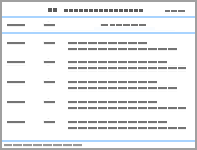
表1
2019—2023年棉蚜田间种群采样点"
| 年份 Year | 种群 Population | 位置 Location | 经纬度 Longitude, latitude (E, N) | 年份 Year | 种群 Population | 位置 Location | 经纬度 Longitude, latitude (E, N) | |
|---|---|---|---|---|---|---|---|---|
| 2019 | HeBCZ | 河北沧州Cangzhou, Hebei | 116.87°, 38.31° | 2021 | HNNY | 河南南阳Nanyang, Henan | 112.54°, 33.00° | |
| HeBHS | 河北衡水Hengshui, Hebei | 115.58°, 37.55° | SDBZ | 山东滨州Binzhou, Shandong | 118.02°, 37.43° | |||
| SDDY | 山东东营Dongying, Shandong | 118.58°, 37.45° | SXYC | 山西运城Yuncheng, Shanxi | 111.00°, 35.02° | |||
| SDHZ | 山东菏泽Heze, Shandong | 115.57°, 35.07° | XJCJ | 新疆昌吉Changji, Xinjiang | 87.31°, 44.01° | |||
| SDJN | 山东济宁Jining, Shandong | 116.60°, 35.41° | XJKC | 新疆库车Kuche, Xinjiang | 86.17°, 42.03° | |||
| XJKEL | 新疆库尔勒Kuerle, Xinjiang | 86.17°, 41.73° | XJKT | 新疆奎屯Kuitun, Xinjiang | 84.90°, 44.43° | |||
| XJSHZ | 新疆石河子Shihezi, Xinjiang | 86.08°, 44.31° | XJTMSK | 新疆图木舒克Tumushuke, Xinjiang | 79.21°, 40.00° | |||
| XJNWS | 新疆农五师Nongwushi, Xinjiang | 82.41°, 44.21° | XJTLF | 新疆吐鲁番Tulufan, Xinjiang | 89.19°, 42.94° | |||
| 2020 | SDDY | 山东东营Dongying, Shandong | 118.58°, 37.45° | XJYL | 新疆伊犁Yili, Xinjiang | 81.32°, 43.92° | ||
| HeBHS | 河北衡水Hengshui, Hebei | 115.58°, 37.55° | 2022 | HuBJZ | 湖北荆州Jingzhou, Hubei | 112.02°, 30.05° | ||
| SDXJ | 山东夏津Xiajin, Shandong | 116.00°, 36.95° | SDDY | 山东东营Dongying, Shandong | 118.41°, 37.05° | |||
| SXYC | 山西运城Yuncheng, Shanxi | 111.00°, 35.02° | XJWJQ | 新疆五家渠Wujiaqu, Xinjiang | 87.54°, 44.17° | |||
| XJBL | 新疆博乐Bole, Xinjiang | 82.05°, 44.85° | XJSW | 新疆沙湾Shawan, Xinjiang | 85.62°, 44.33° | |||
| XJKEL | 新疆库尔勒Kuerle, Xinjiang | 86.17°, 41.73° | 2023 | SDTZ | 山东滕州Tengzhou, Shandong | 116.00°, 36.95° | ||
| XJSHZ | 新疆石河子Shihezi, Xinjiang | 86.08°, 44.31° | SDDY | 山东东营Dongying, Shandong | 118.41°, 37.05° | |||
| XJWS | 新疆乌苏Wusu, Xinjiang | 84.68°, 44.44° | HuBJZ | 湖北荆州Jingzhou, Hubei | 112.19°, 30.35° | |||
| XJYL | 新疆伊犁Yili, Xinjiang | 81.32°, 43.92° | XJHYH | 新疆胡杨河Huyanghe, Xinjiang | 84.83°, 44.69° | |||
| 2021 | HeBHS | 河北衡水Hengshui, Hebei | 115.58°, 37.55° | XJKS | 新疆喀什Kashi, Xinjiang | 75.99°, 39.47° | ||
| HNKF | 河南开封Kaifeng, Henan | 114.35°, 34.79° | XJHT | 新疆和田Hetian, Xinjiang | 79.92°, 37.11° |
表2
2019—2023年棉蚜田间种群对氧乐果的抗性"
| 年份 Year | 种群 Population | 试虫数 Number of test insects | 斜率±标准误Slope±SE | 致死中浓度(95%置信限) LC50 (95% CL) (mg·L-1) | 抗性倍数Resistance ratio | 卡方值(自由度) χ2 (df) |
|---|---|---|---|---|---|---|
| 2019 | HeBCZ | 434 | 2.39±0.23 | 247.79 (204.60-300.85) | 41.2 | 12.47 (12) |
| HeBHS | 403 | 1.38±0.20 | 1022.21 (758.50-1567.85) | 169.8 | 12.17 (13) | |
| SDDY | 464 | 1.25±0.14 | 282.29 (210.85-359.73) | 46.9 | 8.61 (14) | |
| SDHZ | 457 | 1.47±0.14 | 400.68 (328.38-495.35) | 66.6 | 11.25 (13) | |
| SDJN | 463 | 1.41±0.15 | 372.81 (289.67-463.10) | 61.9 | 12.48 (15) | |
| XJKEL | 449 | 1.64±0.15 | 468.96 (380.87-570.35) | 77.9 | 9.38 (14) | |
| XJNWS | 525 | 1.49±0.17 | 102.90 (69.97-139.53) | 17.1 | 8.29 (16) | |
| XJSHZ | 445 | 2.08±0.20 | 383.24 (310.00-460.45) | 63.7 | 10.71 (13) | |
| 2020 | HeBHS | 522 | 1.13±0.13 | 590.32 (453.63-807.69) | 98.1 | 4.43 (11) |
| SDDY | 451 | 3.52±0.49 | 729.43 (573.32-864.53) | 121.2 | 14.60 (12) | |
| SDXJ | 484 | 2.29±0.48 | 508.70 (331.93-666.55) | 84.5 | 14.61 (13) | |
| SXYC | 544 | 1.63±0.18 | 1217.41 (944.02-1648.82) | 202.2 | 16.35 (13) | |
| XJBL | 536 | 1.19±0.14 | 636.75 (482.49-917.19) | 105.8 | 4.77 (13) | |
| XJKEL | 469 | 1.79±0.17 | 387.28 (308.77-475.30) | 64.3 | 11.73 (13) | |
| XJSHZ | 444 | 1.46±0.19 | 624.73 (444.95-980.10) | 103.8 | 13.35 (10) | |
| XJWS | 507 | 2.48±0.22 | 1251.02 (1015.26-1517.09) | 207.8 | 18.63 (13) | |
| XJYL | 505 | 2.30±0.18 | 389.62 (327.96-467.65) | 64.7 | 13.58 (13) | |
| 2021 | SDBZ | 626 | 1.71±0.16 | 592.34 (476.68-720.05) | 98.4 | 14.48 (16) |
| XJCJ | 597 | 1.75±0.17 | 343.13 (233.55-462.08) | 57.0 | 18.72 (14) | |
| HeBHS | 568 | 1.31±0.11 | 746.39 (577.30-980.07) | 124.0 | 17.24 (16) | |
| HNKF | 616 | 2.17±0.21 | 165.80 (117.15-217.33) | 27.5 | 17.05 (14) | |
| XJKC | 677 | 2.33±0.22 | 438.88 (349.80-527.30) | 72.9 | 16.54 (16) | |
| XJKT | 632 | 2.11±0.24 | 365.47 (263.43-465.18) | 60.7 | 16.06 (15) | |
| HNNY | 577 | 2.17±0.21 | 196.79 (127.87-274.43) | 32.7 | 15.97 (10) | |
| XJTLF | 610 | 1.70±0.14 | 674.63 (552.27-819.63) | 112.1 | 12.80 (13) | |
| XJTMSK | 597 | 1.92±0.18 | 1200.53 (1016.26-1434.19) | 199.4 | 9.71 (14) | |
| XJYL | 579 | 2.11±0.28 | 735.29 (512.96-955.97) | 122.1 | 16.62 (13) | |
| SXYC | 622 | 1.60±0.15 | 380.01 (274.01-504.93) | 63.1 | 15.54 (13) | |
| 2022 | SDDY | 675 | 1.81±0.21 | 541.21 (409.16-669.77) | 89.9 | 12.47 (16) |
| HuBJZ | 670 | 1.78±0.26 | 308.75 (147.39-465.93) | 51.3 | 20.78 (12) | |
| XJSW | 670 | 1.93±0.22 | 824.45 (605.06-1066.98) | 137.0 | 19.38 (14) | |
| XJWJQ | 582 | 1.82±0.23 | 1234.02 (940.00-1656.41) | 205.0 | 19.01 (14) | |
| 2023 | SDDY | 492 | 2.39±0.34 | 372.95 (262.56-478.86) | 62.0 | 12.67(12) |
| XJHYH | 470 | 2.41±0.43 | 645.37 (458.83-848.08) | 107.2 | 18.56 (13) | |
| SDTZ | 458 | 1.22±0.24 | 404.84 (238.08-602.15) | 67.2 | 5.01 (13) | |
| HuBJZ | 407 | 1.60±0.22 | 141.41 (72.98-218.58) | 23.5 | 18.48 (13) | |
| XJKS | 534 | 4.22±0.84 | 805.12 (630.18-942.79) | 133.7 | 14.73 (10) | |
| XJHT | 525 | 1.25±0.33 | 738.51 (452.45-1133.60) | 122.7 | 8.40 (12) |

图1
棉蚜田间种群AChE1 G221A(A)、A302S(B)、A332V(C)和S431F(D)突变测序峰图 SS、RS和RR分别为敏感纯合、抗性杂合和抗性纯合突变。图2同"
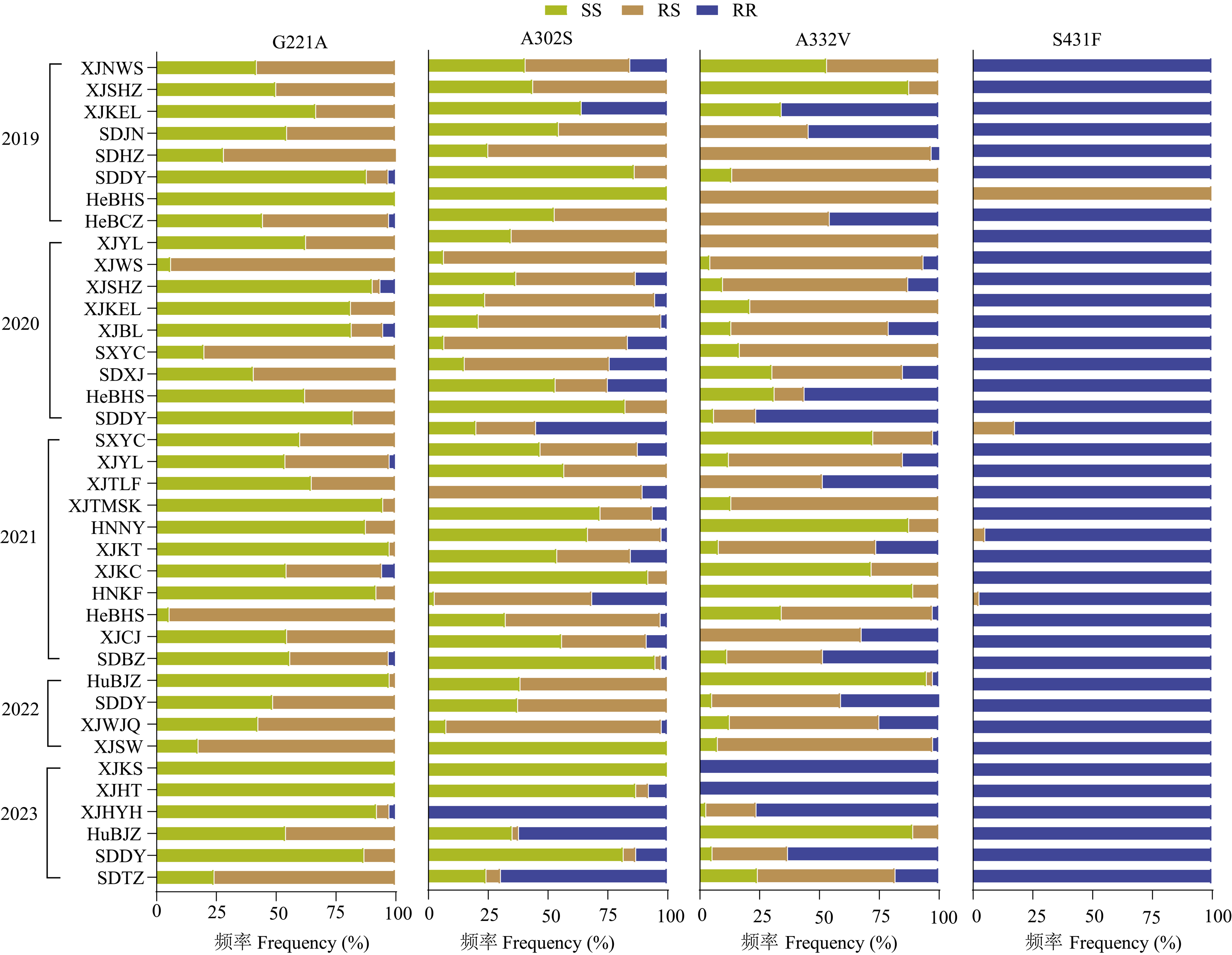
图2
棉蚜田间种群AChE1 G221A、A302S、A332V和S431F突变频率"
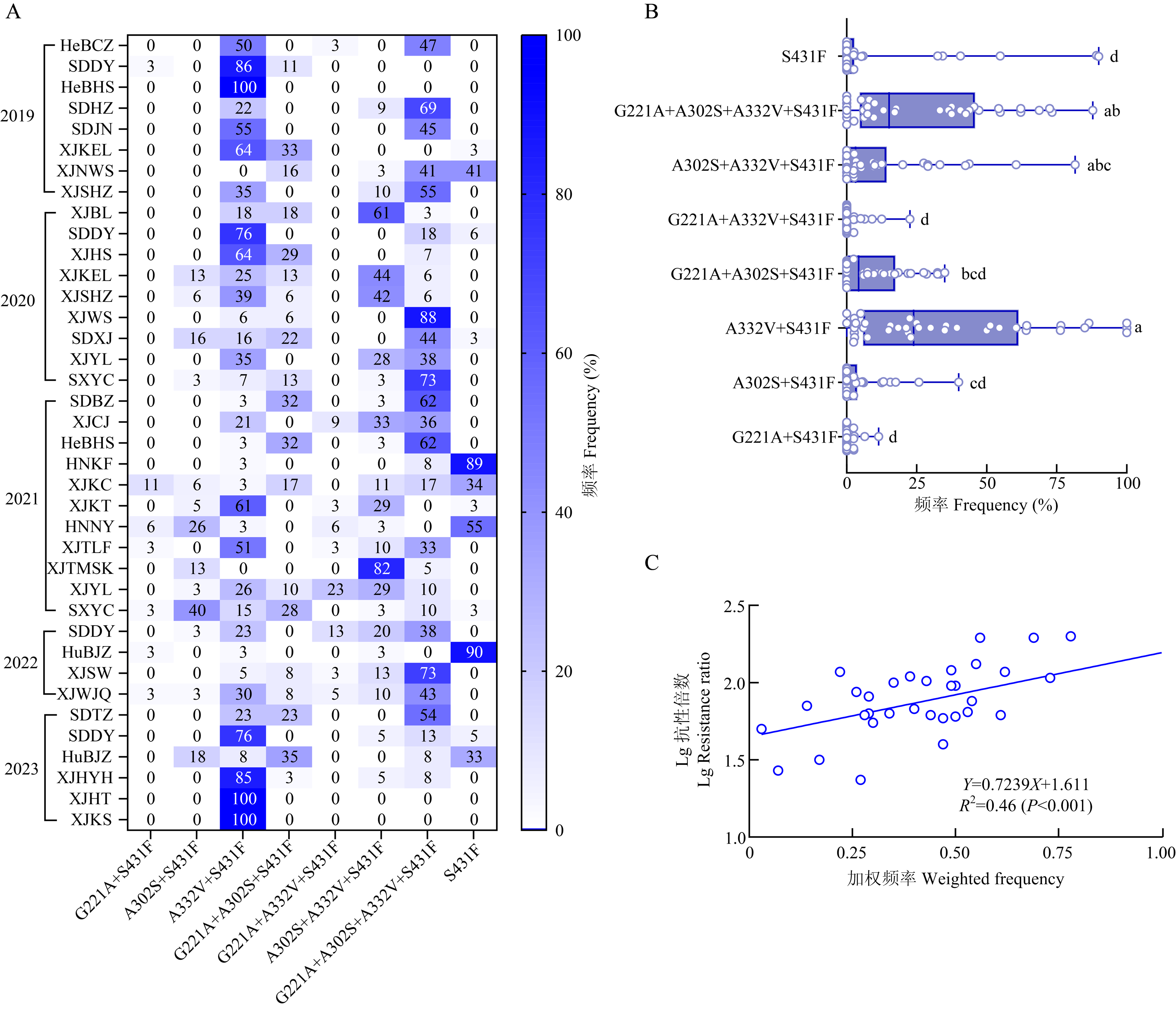
图3
单头棉蚜AChE1携带的突变类型及与氧乐果抗性相关性分析 A:2019—2023年棉蚜田间种群中单头蚜虫携带不同突变类型的频率Frequencies of different mutation types carried by an individual aphid in field populations of A. gossypii in 2019-2023;B:不同突变类型频率比较,不同小写字母表示差异显著(Kruskal-Wallis检验,Dunn多重比较,P<0.05)Frequencies comparison of different mutation types, different lowercase letters indicate the significant differences (Kruskal-Wallis test, Dunn multiple comparisons, P<0.05);C:不同突变类型加权频率与氧乐果抗性倍数的回归分析Regression analysis of weighted frequency of different mutation types versus omethoate resistance ratio"
表3
棉蚜突变品系中PBO、TPP和DEM对氧乐果毒力的增效作用"
| 品系 Strain | 药剂+增效剂 Insecticide+ synergist | 试虫数 Number of test insects | 斜率±标准误 Slope±SE | 致死中浓度(95%置信限) LC50 (95% CL) (mg·L-1) | P值 P value | 抗性倍数 Resistance ratio | 增效倍数 Synergism ratio | |||||||
|---|---|---|---|---|---|---|---|---|---|---|---|---|---|---|
| S431F (RR) | OME | 534 | 3.70±0.38 | 75.0 (64.3-87.3) | 0.889 | 12.5 | — | |||||||
| OME+TPP | 539 | 2.18±0.19 | 81.0 (64.7-98.8) | 0.897 | 13.5 | 0.93 | ||||||||
| OME+DEM | 533 | 2.23±0.21 | 86.5 (67.3-107.0) | 0.909 | 14.4 | 0.87 | ||||||||
| OME+PBO | 523 | 2.05±0.19 | 78.5 (60.5-98.1) | 0.843 | 13.0 | 0.96 | ||||||||
| A332V (RR)+S431F (RR) | OME | 500 | 2.24±0.33 | 277.3 (195.3-352.8) | 0.871 | 46.1 | — | |||||||
| OME+TPP | 524 | 3.34±0.56 | 346.0 (234.4-427.2) | 0.141 | 57.5 | 0.80 | ||||||||
| OME+DEM | 505 | 5.35±0.76 | 408.3 (338.8-471.1) | 0.175 | 67.8 | 0.68 | ||||||||
| OME+PBO | 509 | 4.55±0.76 | 363.0 (297.2-414.7) | 0.843 | 60.3 | 0.76 | ||||||||
| G221A (RS)+A302S (RR) +S431F (RR) | OME | 500 | 4.59±0.72 | 410.8 (281.9-510.0) | 0.124 | 68.2 | — | |||||||
| OME+TPP | 561 | 2.93±0.39 | 379.3 (289.4-459.2) | 0.230 | 63.0 | 1.08 | ||||||||
| OME+DEM | 515 | 2.71±0.35 | 468.4 (387.2-549.3) | 0.529 | 77.8 | 0.88 | ||||||||
| OME+PBO | 520 | 2.58±0.57 | 405.6 (263.2-501.7) | 0.773 | 67.4 | 1.01 | ||||||||
| A302S (RS)+A332V (RS) +S431F (RR) | OME | 525 | 2.25±0.35 | 410.8 (311.8-499.8) | 0.605 | 68.2 | — | |||||||
| OME+TPP | 521 | 1.72±0.25 | 301.0 (208.5-391.3) | 0.674 | 50.0 | 1.36 | ||||||||
| OME+DEM | 507 | 1.79±0.26 | 293.8 (192.2-390.1) | 0.285 | 48.8 | 1.40 | ||||||||
| OME+PBO | 517 | 1.59±0.18 | 280.6 (192.3-381.9) | 0.164 | 46.6 | 1.46 | ||||||||
| G221A (RS)+A302S (RS) +A332V (RS)+S431F (RR) | OME | 536 | 2.39±0.55 | 468.6 (196.1-641.6) | 0.074 | 77.8 | — | |||||||
| OME+TPP | 525 | 2.16±0.23 | 264.4 (190.5-341.4) | 0.195 | 43.9 | 1.77 | ||||||||
| OME+DEM | 522 | 2.63±0.33 | 393.3 (319.8-463.2) | 0.915 | 65.3 | 1.19 | ||||||||
| OME+PBO | 528 | 2.08±0.33 | 287.6 (183.5-375.5) | 0.388 | 47.8 | 1.63 | ||||||||
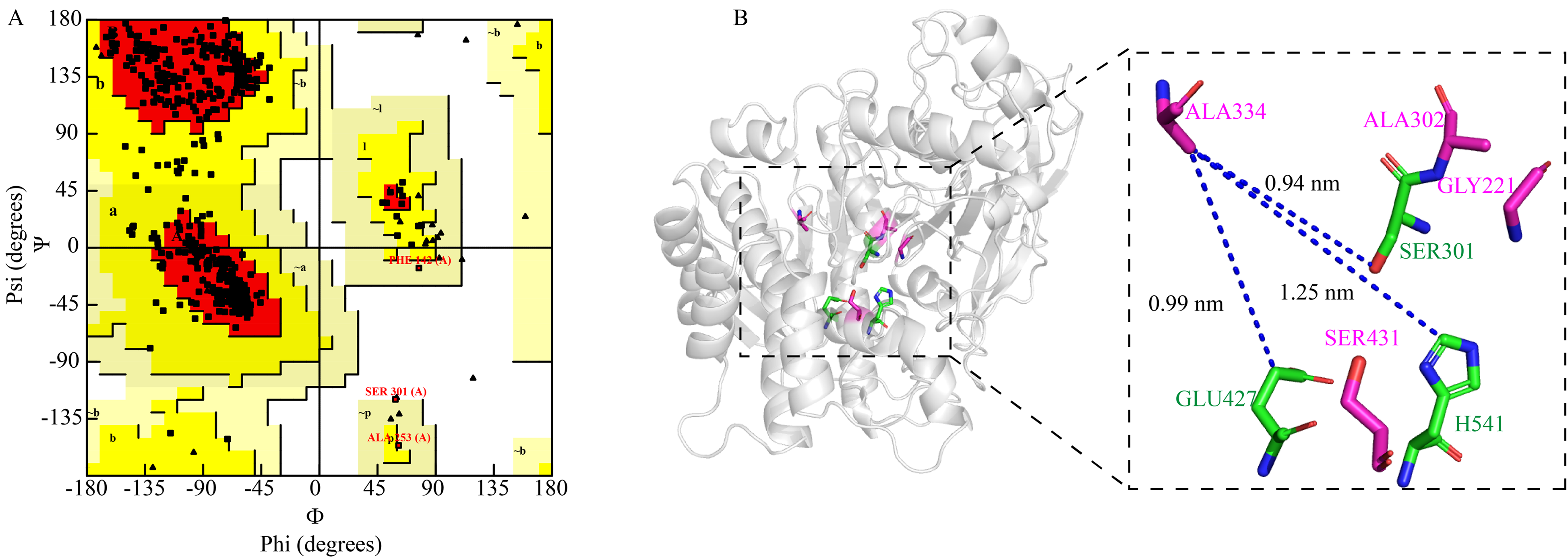
图4
棉蚜AChE1结构 A:棉蚜AChE1结构氨基酸残基骨架的二面角,白色区域为立体化学结构不允许的区域,其他颜色区域为立体化学结构允许区域Dihedral angles of the amino acid residue backbone in the structure of A. gossypii AChE1. The white area represents the region where stereochemical structures are not allowed, while the other colored areas represent regions where stereochemical structures are permitted;B:棉蚜AChE1催化三联体(绿色)与突变氨基酸(粉色)的位置,蓝色虚线为A332V突变与催化三联体3个氨基酸的距离The positions of catalytic triad (green) and mutant amino acids (pink) in A. gossypii AChE1, and the blue dashed line indicates the distance between the A332V mutation and the three amino acids of the catalytic triad"
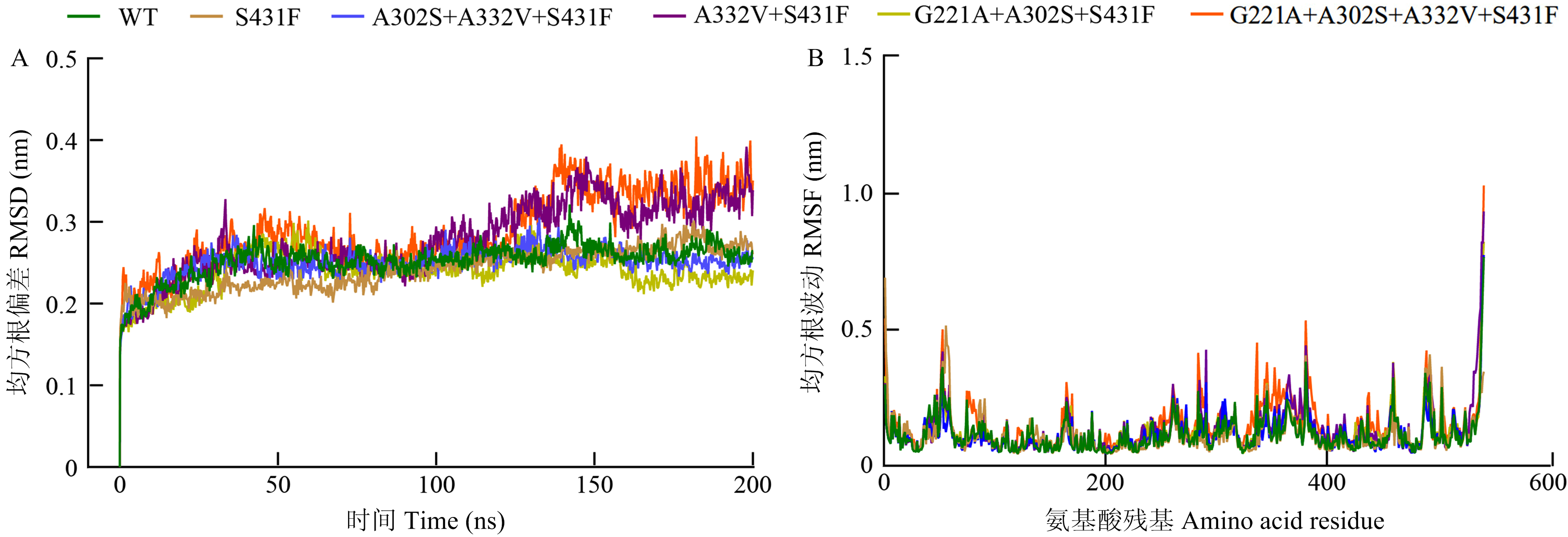
图5
棉蚜AChE1野生型和突变体结构与氧乐果复合物分子动力学模拟的稳定性分析 A:200 ns模拟过程中AChE1-氧乐果复合物均方根偏差Root mean square deviation (RMSD) of the AChE1-omethoate complexes during the 200 ns simulation;B:各氨基酸残基的均方根波动Root mean square fluctuation (RMSF) of each amino acid residue"

图6
棉蚜AChE1突变对氧乐果结合口袋的影响 A:分子动力学模拟过程中野生型和突变体AChEl的催化三联体与氧乐果的几何中心距离变化Changes in the geometric center distance between the catalytic triad of wild-type (WT) and mutant AChE1 and omethoate during molecular dynamics simulations;B、C:分别为分子动力学模拟过程中AChE1 WT与突变体结构活性中心的疏水面积与回旋半径The hydrophobic area and radius of gyration of the active center in the structures of AChE1 WT and mutants during molecular dynamics simulations;D—F:采集模拟平衡后180—200 ns结构的催化三联体与氧乐果几何中心距离、活性中心疏水面积与回旋半径The catalytic triad distance from the geometric center of omethoate, the hydrophobic area and the radius of gyration of the active center were measured for structures collected after 180-200 ns of simulated equilibration。*:P<0.05,**:P<0.01,***:P<0.001,ns:差异不显著No significance (Brown-Forsythe和Welch方差分析,Dunnett T3多重比较Brown-Forsythe and Welch ANOVA, Dunnett T3 multiple comparisons)"

图7
棉蚜AChE1野生型和突变体结构与氧乐果的相互作用"
表4
棉蚜AChE1野生型和突变体结构与氧乐果间的结合能"
| 突变类型 Mutation type | 吉布斯自由能 Gibbs free energy | 范德华能 Van der Waals energy | 静电能 Electrostatic energy | 溶剂化能极性部分 Polar solvation energy | 溶剂化能非极性部分 Non-polar solvation energy | 熵 Entropy |
|---|---|---|---|---|---|---|
| WT | -21.8±15.5 | -126.4±10.8 | -57.1±14.1 | 151.0±12.8 | -15.9±0.5 | -26.6 |
| S431F | -15.9±16.3 | -140.5±11.9 | -74.0±11.9 | 183.7±17.3 | -16.0±0.3 | -30.8 |
| A302S+A332V+S431F | -6.8±15.1 | -137.7±10.6 | -54.5±11.6 | 167.9±15.7 | -16.2±0.4 | -33.9 |
| A332V+S431F | -7.5±18.3 | -131.7±9.1 | -47.6±8.8 | 166.0±18.5 | -16.2±0.3 | -22.1 |
| G221A+A302S+S431F | -23.6±17.2 | -129.7±11.3 | -49.8±14.3 | 146.2±22.6 | -16.2±0.5 | -25.9 |
| G221A+A302S+A332V+S431F | -20.8±15.0 | -137.3±11.0 | -61.1±19.3 | 146.2±15.7 | -16.3±0.6 | -47.6 |
| [1] |
doi: 10.1002/ps.v82.1 |
| [2] |
唐睿, 孙宪银, 卓富彦, 朱景全, 郭荣. 近5年中国棉花主要病虫害发生演替及防控分析[J]. 新疆农业科学, 2021, 58(12): 2208-2219.
doi: 10.6048/j.issn.1001-4330.2021.12.007 |
|
|
|
| [3] |
doi: 10.1111/jen.v147.6 |
| [4] |
元洁琼. 我国棉蚜杀虫药剂的敏感度及CarE和AChE活性变异[D]. 北京: 中国农业大学, 2013.
|
|
|
|
| [5] |
安静杰, 高占林, 党志红, 赵玉敬, 窦亚楠, 闫秀, 华佳楠, 潘文亮, 郭江龙, 李耀发. 河北省不同地区棉蚜种群对6种杀虫剂的抗性动态[J]. 农药学学报, 2021, 23(6): 1123-1131.
|
|
|
|
| [6] |
doi: 10.1016/j.pestbp.2021.105033 |
| [7] |
doi: 10.1111/imb.12331 pmid: 28799241 |
| [8] |
doi: 10.3390/insects12040335 |
| [9] |
doi: 10.1016/j.ibmb.2023.103937 |
| [10] |
doi: 10.3390/agriculture16010021 |
| [11] |
doi: 10.1016/j.ibmb.2004.02.001 |
| [12] |
doi: 10.1016/j.ibmb.2012.11.004 pmid: 23168079 |
| [13] |
doi: 10.1111/jen.2017.141.issue-8 |
| [14] |
doi: 10.1002/arch.v114.3 |
| [15] |
doi: 10.1016/j.pestbp.2012.01.004 |
| [16] |
doi: 10.1186/s12859-017-1741-6 pmid: 28693417 |
| [17] |
pmid: 15373812 |
| [18] |
pmid: 26797869 |
| [19] |
doi: 10.1002/ps.v78.4 |
| [20] |
doi: 10.1006/pest.1996.0064 |
| [21] |
doi: 10.1016/j.pestbp.2019.03.021 |
| [22] |
doi: 10.3390/insects15030144 |
| [23] |
doi: 10.1007/s11030-021-10312-5 |
| [24] |
doi: 10.1021/acs.jcim.6c00014 |
| [25] |
吴孔明, 刘芹轩. 棉蚜对杀虫剂抗性的稳定性[J]. 昆虫学报, 1995, 38(2): 253-255.
|
|
|
|
| [26] |
慕立义, 王开运, 姜翠玲, 沈慧敏, 姜家良, 陈巧云, 邓启荣, 林国芳. 棉蚜 (Aphis gossypii Glover) 对氰戊菊酯、氧乐果及其混剂抗药性的研究[J]. 中国农业科学, 1988, 21(6): 18-26.
|
|
|
|
| [27] |
doi: 10.1146/annurev-ento-020117-043042 pmid: 29324040 |
| [28] |
肖佳玲. 棉蚜乙酰胆碱酯酶点突变检测及RNAi验证[D]. 北京: 中国农业大学, 2015.
|
|
|
|
| [29] |
帕提玛·乌木尔汗. 新疆棉蚜抗药性及杀虫剂和棉蚜胁迫对棉叶生理生化效应[D]. 乌鲁木齐: 新疆农业大学, 2019.
|
|
Patima W M E H. Resistance of Aphis gossypii (Glover) in Xinjiang and physiological and biochemical effects on cotton leaves caused by insecticide and Aphis gossypii stress[D]. Urumqi: Xinjiang Agricultural University, 2019. (in Chinese)
|
|
| [30] |
王帅宇, 张子腾, 谢爱婷, 董杰, 杨建国, 张爱环. 我国草地贪夜蛾种群杀虫剂靶标基因突变分析[J]. 中国农业科学, 2022, 55(20): 3948-3959. DOI: 10.3864/j.issn.0578-1752.2022.20.007.
|
|
|
|
| [31] |
doi: 10.1093/jee/toae268 |
| [32] |
doi: 10.1016/j.ecoenv.2025.118189 |
| [33] |
doi: 10.1016/j.pestbp.2014.04.009 |
| [34] |
doi: 10.1002/tox.v29.5 |
| [35] |
doi: 10.1016/j.compbiolchem.2018.09.004 |
| [36] |
doi: 10.1016/j.pestbp.2024.105957 |
| [37] |
doi: 10.1038/s41598-017-03088-y pmid: 28607438 |
| [1] | 崔士友, 陈澎军, 缪源卿, 韩继军, 沈俊明. EMS诱变抗草甘膦小麦新种质的创制与大田评价[J]. 中国农业科学, 2026, 59(4): 723-733. |
| [2] | 王覃丽, 谭顺阳, 夏根, 刘文庆, 杨玉婷, 田丽霞. 韭菜迟眼蕈蚊气味结合蛋白OBP11的配体结合能力及关键氨基酸分析[J]. 中国农业科学, 2026, 59(18): 4007-4020. |
| [3] | 罗星媛, 朱品, 王艺, 周妍, 刘头明, 王延周, 高松. EMS诱变大蒜突变体库构建及主要农艺性状评价[J]. 中国农业科学, 2026, 59(17): 3842-3852. |
| [4] | 王胜楠, 高茂盛, 韩婉瑞, 冯浩伟, 林祥, 王东. 气候变暖对农业气候分界线时空变化的影响[J]. 中国农业科学, 2026, 59(10): 2138-2153. |
| [5] | 庄丽华, 罗磊, 赵春芳, 王纪忠, 张亚东, 赫磊. 水稻粒型突变体sgd13的鉴定及其基因定位[J]. 中国农业科学, 2025, 58(24): 5097-5109. |
| [6] | 王梦云, 邓力元, 余洋, 杨宇衡, 方安菲, 田斌年, 王静, 毕朝位. 稻瘟病菌琥珀酸脱氢酶不同位点氨基酸替换对苯并烯氟菌唑敏感性的影响[J]. 中国农业科学, 2025, 58(24): 5175-5189. |
| [7] | 万云飞, 杨玉莹, 张乃心, 许萌萌, 于钦浩, 乔传玲, 陈化兰. 欧亚类禽H1N1猪流感病毒适应性突变氨基酸的鉴定及其功能分析[J]. 中国农业科学, 2025, 58(10): 2035-2044. |
| [8] | 雷建峰, 尤扬子, 张锦恩, 代培红, 于莉, 杜正阳, 李月, 刘晓东. 靶向敲除棉花GhAGL16高效sgRNA的筛选[J]. 中国农业科学, 2024, 57(6): 1023-1033. |
| [9] | 张健, 赵彬森, 冯浩, 黄丽丽. Vm-milRN7调控苹果树腐烂病菌致病的功能及机理[J]. 中国农业科学, 2024, 57(10): 1930-1942. |
| [10] | 徐重新, 金嘉凤, 孙晓明, 沈成, 张霄, 陈澄宇, 刘贤金, 刘媛. 基于Bt毒素的杀虫蛋白理性设计与创新应用策略[J]. 中国农业科学, 2024, 57(1): 96-125. |
| [11] | 葛天成, 尹飞, 胡琼波, 彭争科, 李振宇. MBF2转录调控小菜蛾谷胱甘肽S-转移酶代谢氯虫苯甲酰胺的功能[J]. 中国农业科学, 2023, 56(4): 665-673. |
| [12] | 王晓阳, 彭振, 邢爱双, 赵盈睿, 马欣丽, 刘方, 杜雄明, 何守朴. 亚洲棉短纤维发育相关长链非编码RNA的鉴定及表达[J]. 中国农业科学, 2023, 56(23): 4565-4584. |
| [13] | 张丽雅, 李奇, 史珊珊, 马雨梦, 刘亚琪, 赵超伟, 王鹤如, 操海群, 廖敏, 赵宁. 稻田稗草对五氟磺草胺的抗性机制及其防治药剂筛选[J]. 中国农业科学, 2023, 56(14): 2713-2723. |
| [14] | 李桂香,李秀环,郝新昌,李智文,刘峰,刘西莉. 山东省多主棒孢对三种常用杀菌剂的敏感性监测及对氟吡菌酰胺的抗性[J]. 中国农业科学, 2022, 55(7): 1359-1370. |
| [15] | 蒋琪琪,许建建,苏越,张琦,曹鹏,宋晨虎,李中安,宋震. 柑橘黄化花叶病毒侵染性克隆构建及应用[J]. 中国农业科学, 2022, 55(24): 4840-4850. |
|
||
