






中国农业科学 ›› 2026, Vol. 59 ›› Issue (18): 4021-4032.doi: 10.3864/j.issn.0578-1752.2026.18.006
• 专题:面向农业害虫精准防控的机制解析、技术优化与决策支撑 • 上一篇 下一篇
孙佳宁( ), 刘晨曦, 刘小侠, 李贞()
收稿日期:2026-01-04
接受日期:2026-03-15
出版日期:2026-09-16
发布日期:2026-09-20
通信作者:
联系方式:
孙佳宁,E-mail:sy20243193573@cau.edu.cn。
基金资助:
SUN JiaNing(), LIU ChenXi, LIU XiaoXia, LI Zhen()
Received:2026-01-04
Accepted:2026-03-15
Published:2026-09-16
Online:2026-09-20
摘要:
【背景】卵寄生蜂的高效人工扩繁需要高质量的替代寄主卵,因此保持寄主卵的新鲜和营养状态是影响寄生蜂扩繁效率的关键因素之一。【目的】以目前农业生产上广泛应用的卵寄生蜂松毛虫赤眼蜂(Trichogramma dendrolimi)及其优势替代寄主米蛾(Corcyra cephalonica)卵为供试材料,探究冷藏和杀胚处理对寄主卵质量的影响,从而为科学保藏寄主卵、优化卵寄生蜂人工扩繁技术、提升扩繁效率、降低防治成本提供数据支撑。【方法】通过对1日龄米蛾卵设置仅经过紫外杀胚处理(K)以及杀胚与4 ℃冷藏不同时序组合的4个处理:冷藏3 d后杀胚(3 d+K)、杀胚后冷藏3 d(K+3 d)、冷藏7 d后杀胚(7 d+K)和杀胚后冷藏7 d(K+7 d),比较不同处理后米蛾卵对松毛虫赤眼蜂寄生率、子代羽化率、雌蜂比和发育历期的影响,同时结合对各处理米蛾卵内甘油三酯、总蛋白及海藻糖含量的测定,以及米蛾卵和子代松毛虫赤眼蜂体内Wolbachia菌群水平的检测,评价不同处理米蛾卵对松毛虫赤眼扩繁效率的影响并分析相关生理机制。【结果】与K相比,7 d+K处理可显著增加松毛虫赤眼蜂的寄生率约20%,显著提升子代雌蜂数约72%,而对羽化率和发育历期无显著影响;K+7 d处理也可以显著提升赤眼蜂的寄生率约19%,但子代蜂羽化率显著下降。营养物质含量测定结果表明,冷藏处理(无论杀胚前后)均能显著提高米蛾卵内甘油三酯含量,先冷藏3 d再杀胚的处理(3 d+K)可显著提高米蛾卵内蛋白质含量,冷藏和杀胚处理顺序对海藻糖含量均无显著影响。相关性分析显示,米蛾卵内甘油三酯含量与松毛虫赤眼蜂的寄生率、子代雌蜂比及Wolbachia菌群水平均呈显著正相关关系。【结论】在紫外杀胚前对1日龄米蛾卵进行7 d的4 ℃冷藏预处理可有效延长其保鲜期,并可提高其卵内甘油三酯等营养物质含量,以及松毛虫赤眼蜂的寄生效率与子代雌蜂比例。研究结果可为米蛾卵作为替代寄主进行高效、低成本人工扩繁赤眼蜂提供优化的保鲜与预处理技术方案。
孙佳宁, 刘晨曦, 刘小侠, 李贞. 冷藏和杀胚处理对米蛾卵扩繁松毛虫赤眼蜂效率的影响[J]. 中国农业科学, 2026, 59(18): 4021-4032.
SUN JiaNing, LIU ChenXi, LIU XiaoXia, LI Zhen. Effects of Refrigeration and Embryo-Killing Treatment of Corcyra cephalonica Eggs on Propagation Efficiency of Egg Parasitoid Trichogramma dendrolimi[J]. Scientia Agricultura Sinica, 2026, 59(18): 4021-4032.

表1
冷藏时长及杀胚顺序对米蛾卵繁育松毛虫赤眼蜂的影响"
| 处理 Treatment | 寄生率 Parasitism rate (%) | 羽化率 Eclosion rate (%) | 雌蜂比 Female ratio (%) | 发育历期 Developmental duration (d) |
|---|---|---|---|---|
| K | 36.33±2.48c | 87.62±3.63a | 77.98±3.98a | 10.85±0.08a |
| 3 d+K | 43.64±4.95abc | 76.88±7.22ab | 81.24±8.69a | 10.36±0.15b |
| K+3 d | 40.33±4.54bc | 78.77±5.79ab | 79.33±5.52a | 10.30±0.15b |
| 7 d+K | 55.95±2.69a | 83.53±2.97ab | 90.50±1.13a | 10.83±0.08a |
| K+7 d | 54.58±2.99ab | 71.30±3.55b | 82.00±2.56a | 10.39±0.09b |
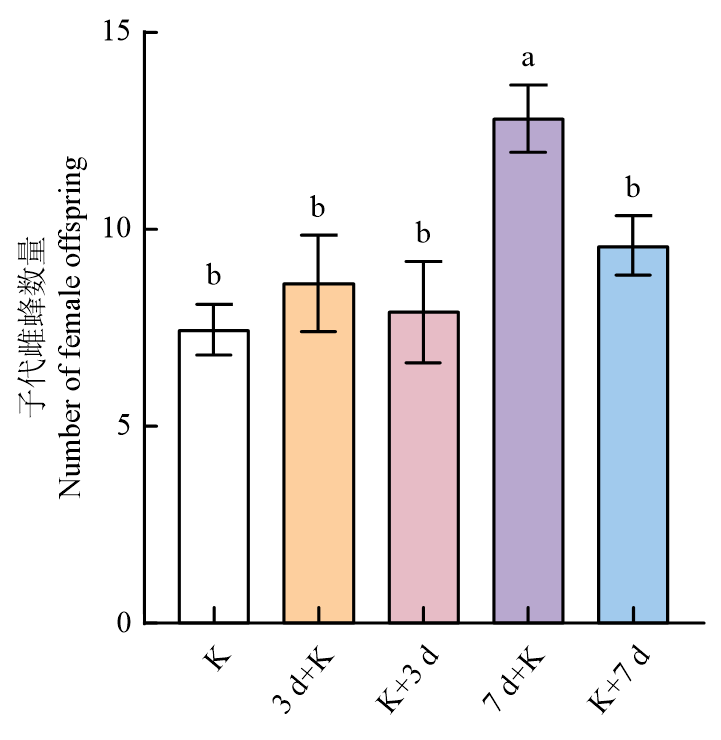
图1
冷藏时长及其与杀胚处理的先后顺序对每张米蛾卵卡平均繁育的松毛虫赤眼蜂雌蜂数量的影响 柱上不同小写字母表示经单因素方差分析Tukey检验差异显著(P<0.05)。下同"
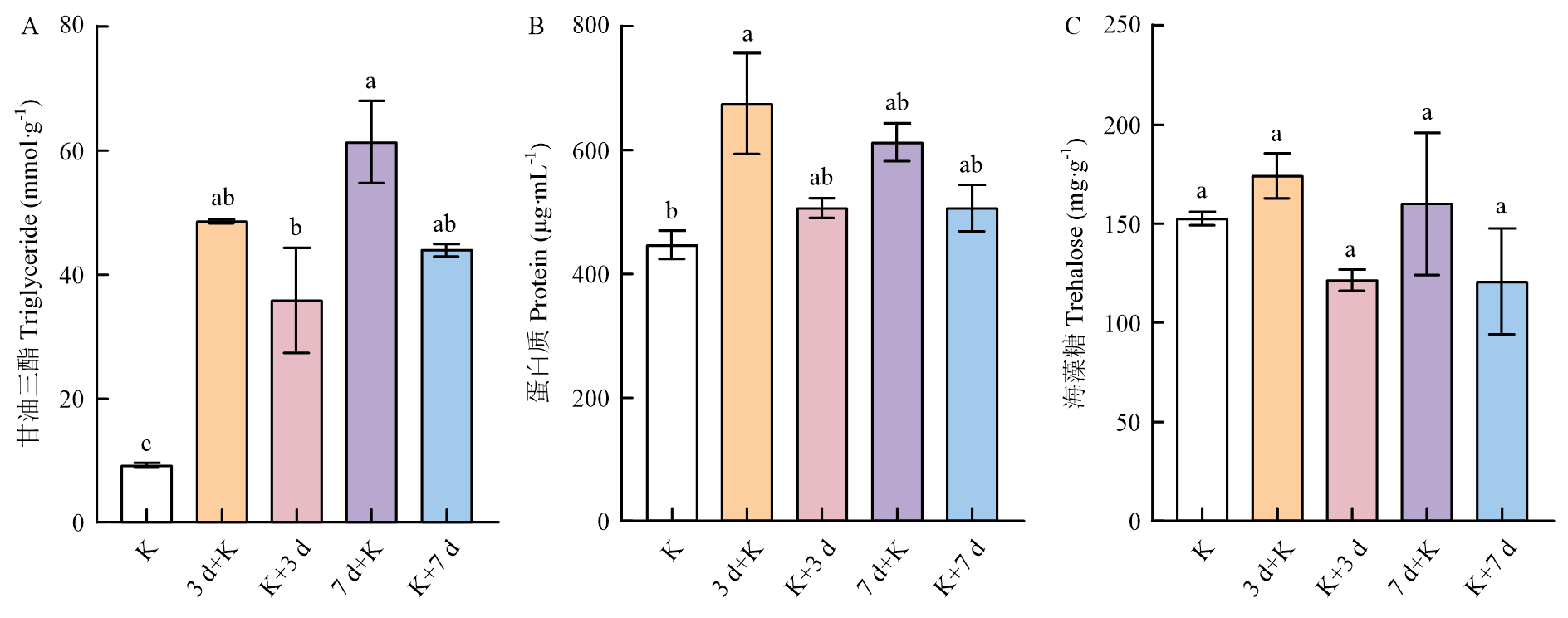
图2
冷藏时长及其与杀胚处理的先后顺序对米蛾卵内营养物质含量的影响"
表2
米蛾卵营养物质含量与松毛虫赤眼蜂寄生和发育指标的相关性分析"
| 生物学指标 Biological indicator | 相关性 Correlation | 甘油三酯 Triglyceride | 蛋白质 Protein | 海藻糖 Trehalose |
|---|---|---|---|---|
| 寄生率 Parasitism rate | 相关系数ρ Correlation coefficient ρ | 0.900* | 0.700 | 0.100 |
| P值P value | 0.037* | 0.188 | 0.873 | |
| 子代蜂羽化率 Offspring eclosion rate | 相关系数ρ Correlation coefficient ρ | 0.300 | 0.500 | 0.300 |
| P值P value | 0.624 | 0.391 | 0.624 | |
| 子代蜂雌蜂比 Offspring female ratio | 相关系数ρ Correlation coefficient ρ | 0.900* | 0.700 | 0.100 |
| P值P value | 0.037* | 0.188 | 0.873 | |
| 子代蜂发育历期 Offspring developmental duration | 相关系数ρ Correlation coefficient ρ | 0.100 | 0.300 | 0.100 |
| P值P value | 0.873 | 0.624 | 0.873 | |
| 子代雌蜂数 Offspring female number | 相关系数ρ Correlation coefficient ρ | 0.900* | 0.700 | 0.100 |
| P值P value | 0.037* | 0.188 | 0.873 |
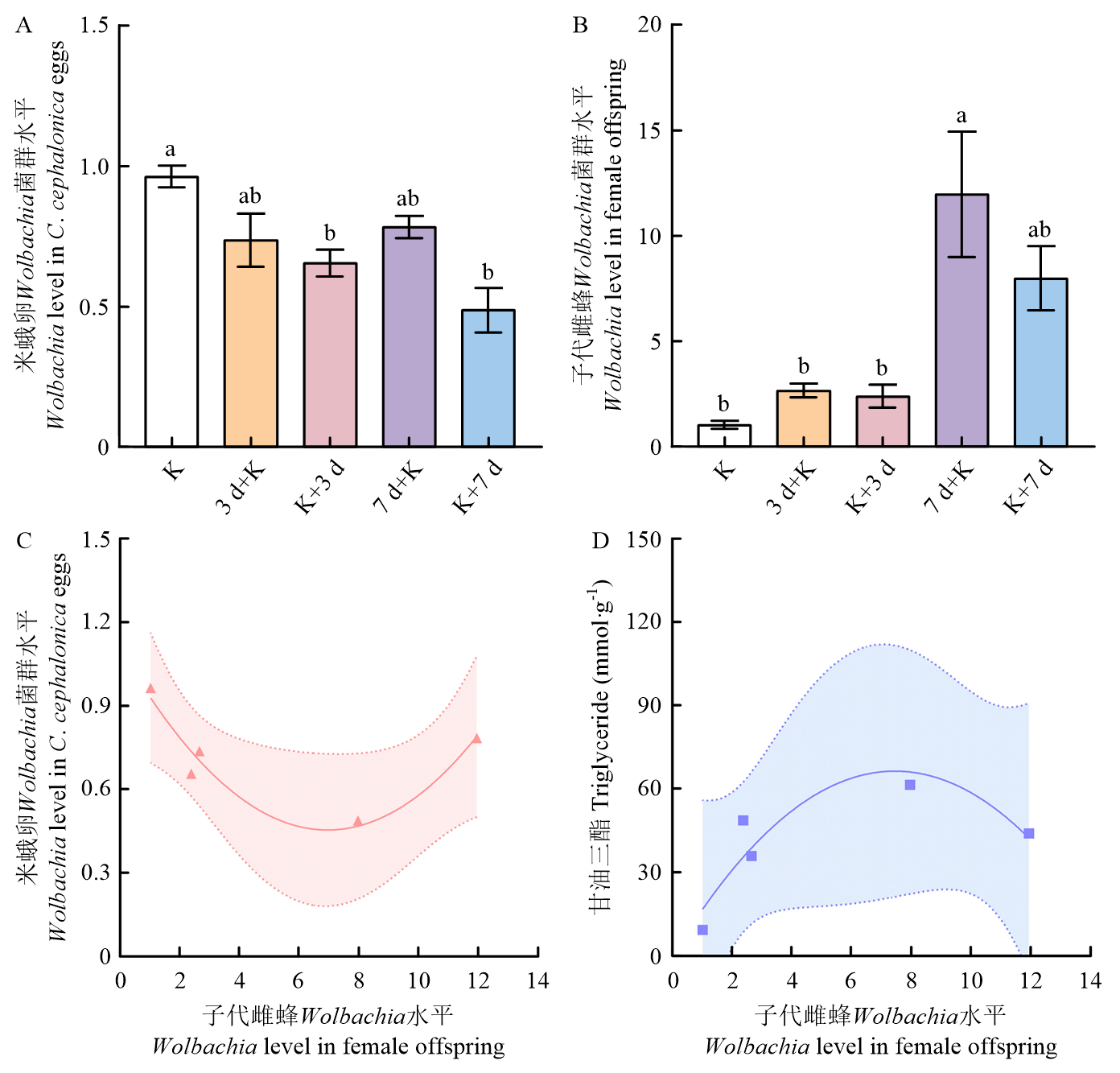
图3
不同处理米蛾卵及其繁育松毛虫赤眼蜂的菌群水平分析 A:不同处理米蛾卵的Wolbachia菌群水平Wolbachia level in C. cephalonica eggs of different treatments;B:不同处理米蛾卵繁育的子代松毛虫赤眼蜂雌蜂的Wolbachia菌群水平Wolbachia level in offspring female T. dendrolimi emerged from different C. cephalonica egg treatments;C:米蛾卵与其繁育的子代雌蜂Wolbachia菌群水平的相关性Correlation of Wolbachia levels between the C. cephalonica eggs and offspring female T. dendrolimi emerged from the eggs;D:米蛾卵内营养物质含量与繁育出的子代雌蜂Wolbachia菌群水平的相关性Correlation between nutrient content in C. cephalonica eggs and Wolbachia levels in offspring female T. dendrolimi emerged from the eggs"
| [1] |
刘树生, 施祖华. 赤眼蜂研究和应用进展[J]. 中国生物防治, 1996, 12(2): 78-84.
|
|
|
|
| [2] |
王庆雨, 宋灿灿, 单常峰, 杨承磊, 别晓婷, 兰玉彬. 基于赤眼蜂的生物防治技术研究现状与展望[J]. 中国农机化学报, 2023, 44(5): 71-80.
|
|
|
|
| [3] |
罗晨, 王素琴, 吴钜文, 张芝利, 张君明. 不同地理种群赤眼蜂对亚洲玉米螟的控制潜能[J]. 植物保护学报, 2001, 28(4): 377-378.
|
|
|
|
| [4] |
doi: 10.1146/ento.2021.66.issue-1 |
| [5] |
doi: 10.1002/ps.6311 pmid: 33522100 |
| [6] |
王勇, 李天昊, 王汐亚, 臧连生. 中国赤眼蜂寄生生态学与工厂化繁殖应用新进展[J]. 植物保护, 2023, 49(5): 399-409.
|
|
|
|
| [7] |
张旭, 霍莹, 宣慧. 利用赤眼蜂防治农林害虫技术综述[J]. 农业开发与装备, 2019(7): 200, 211.
|
|
|
|
| [8] |
doi: 10.1002/ps.v78.8 |
| [9] |
陈锦宏, 秦睿嫔, 王潇雨, 刘小侠, 张松斗, 李贞. 米蛾卵和柞蚕卵对松毛虫赤眼蜂人工扩繁效率影响的比较[J]. 植物保护学报, 2024, 51(4): 952-959.
|
|
|
|
| [10] |
张俊杰, 杜文梅, 阮长春, 臧连生, 彭海娇, 孙光芝. 不同饲料配方对米蛾生长发育及繁殖的影响[J]. 吉林农业大学学报, 2012, 34(6): 603-606, 611.
|
|
|
|
| [11] |
胡振尉, 徐企尧. 米蛾卵冷冻保存技术研究[J]. 浙江林业科技, 1985(3): 23-26.
|
|
|
|
| [12] |
邸宁, 魏瑜岭, 王甦, 郭晓军, 张帆. 米蛾人工饲养技术优化[J]. 中国生物防治学报, 2018, 34(6): 831-837.
doi: 10.16409/j.cnki.2095-039x.2018.06.005 |
|
|
|
| [13] |
林思诚, 王祥, 冼子耀, 卜蜜源. 冷藏对米蛾卵繁育广赤眼蜂的影响[J]. 湖南林业科技, 2022, 49(5): 97-100.
|
|
|
|
| [14] |
黄文功, 张树权, 刘岩, 陈思, 姚玉波, 任传英, 原晓华. 米蛾人工饲料配方筛选[J]. 黑龙江农业科学, 2017(4): 41-43.
|
|
|
|
| [15] |
马德英, 张军, 陈伟利, 郭玉层. 米蛾在新疆的繁殖与利用研究[J]. 新疆农业大学学报, 2001, 24(4): 25-28.
|
|
|
|
| [16] |
潘雪红, 黄诚华, 魏吉利, 商显坤. 赤眼蜂及其寄主卵低温贮存时间对赤眼蜂繁殖的影响[J]. 湖北农业科学, 2011, 50(20): 4194-4196.
|
|
|
|
| [17] |
周淑香, 鲁新, 李丽娟, 张国红, 毛刚, 孙康娜, 丁岩, 常雪, 李光雪. 冷藏米蛾卵对稻螟赤眼蜂和玉米螟赤眼蜂子代质量的影响[J]. 应用昆虫学报, 2019, 56(2): 202-207.
|
|
|
|
| [18] |
doi: 10.1111/imb.v31.5 |
| [19] |
doi: 10.1007/s10340-023-01727-0 |
| [20] |
丛斌, 张明珠, 胡志凤, 段立佳, 王晓静, 张统书, 董辉. 米蛾β-actin基因cDNA片段的克隆及表达量检测[J]. 沈阳农业大学学报, 2016, 47(1): 24-28.
|
|
|
|
| [21] |
doi: 10.1016/j.aspen.2022.101883 |
| [22] |
doi: 10.1006/meth.2001.1262 pmid: 11846609 |
| [23] |
张琛, 周金成, 杨帅, 张龙喜, 张柱亭, 宁素芳, 董前进, 董辉. 短期冷藏米蛾卵对草地贪夜蛾天敌短管赤眼蜂繁育质量的影响[J]. 植物保护, 2019, 45(5): 37-41.
|
|
|
|
| [24] |
doi: 10.1016/j.biocontrol.2018.05.011 |
| [25] |
毛刚, 鲁新, 周淑香, 李丽娟, 张国红, 孙康娜, 李光雪, 常雪, 丁岩. 低温冷藏对米蛾卵繁育稻螟赤眼蜂和玉米螟赤眼蜂质量的影响[J]. 环境昆虫学报, 2019, 41(5): 1118-1124.
|
|
|
|
| [26] |
薛汇. 广双瘤蚜茧蜂脂质合成能力及对寄主棉蚜脂代谢的调控研究[D]. 武汉: 华中农业大学, 2022.
|
|
|
|
| [27] |
周金成, 何玥, 赵倩, 董辉. 松毛虫赤眼蜂两性生殖品系和孤雌产雌品系在不同品种柞蚕卵中的寄生和生长发育表现[J]. 昆虫学报, 2021, 64(1): 80-89.
|
|
|
|
| [28] |
doi: 10.1073/pnas.1001744107 pmid: 20421492 |
| [29] |
|
| [30] |
王伟. 两种卵育型寄生蜂的寄主取食对其寿命和繁殖力的影响以及营养生理机制的研究[D]. 海口: 海南大学, 2012.
|
|
Wang W. Effect and nutritional physiology mechanism of host feeding on the longevity and fecundity of two synovigenic parasitoids[D]. Haikou: Hainan University, 2012. (in Chinese)
|
|
| [31] |
|
| [32] |
pmid: 964455 |
| [33] |
|
| [34] |
doi: 10.1017/S000748531600033X |
| [35] |
doi: 10.1653/0015-4040(2007)90[502:POADEO]2.0.CO;2 |
| [36] |
|
| [37] |
于彩虹, 卢丹, 林荣华, 王晓军, 姜辉, 赵飞. 海藻糖——昆虫的血糖[J]. 昆虫知识, 2008, 45(5): 832-837.
|
|
|
|
| [38] |
doi: 10.1111/eea.2014.152.issue-1 |
| [39] |
郑希. 人工卵接蜂时间和蜂卵比对松毛虫赤眼蜂寄生的影响及人工卵配方的改进[D]. 南京: 南京农业大学, 2021.
|
|
|
|
| [40] |
doi: 10.1016/j.jinsphys.2021.104232 |
| [41] |
|
| [42] |
|
| [43] |
doi: 10.1111/ibi.1947.89.issue-2 |
| [44] |
doi: 10.1093/ee/14.4.383 |
| [45] |
doi: 10.1002/ps.v76.8 |
| [46] |
doi: 10.1093/genetics/126.4.933 pmid: 2076821 |
| [47] |
pmid: 10547686 |
| [48] |
龚鹏, 沈佐锐, 李志红. Wolbachia属共生细菌及其对节肢动物生殖活动的调控作用[J]. 昆虫学报, 2002, 45(2): 241-252.
|
|
|
|
| [49] |
doi: 10.1111/eea.1993.67.issue-2 |
| [50] |
|
| [51] |
潘雪红, 何余容, 陈科伟, 潘飞, 盘梅. Wolbachia感染对拟澳洲赤眼蜂寿命、生殖力和嗅觉反应的影响[J]. 昆虫学报, 2007, 50(3): 207-214.
|
|
|
|
| [52] |
霍梁霄, 李媛媛, 张丹, 于茜, 宁素芳, 赵旭, 周金成, 董辉. 孤雌产雌生殖品系松毛虫赤眼蜂产卵强度对Wolbachia诱导的其生殖表型的影响[J]. 昆虫学报, 2021, 64(5): 597-604.
|
|
|
|
| [53] |
pmid: 10209097 |
| [54] |
doi: 10.1098/rspb.2003.2640 pmid: 15129961 |
| [55] |
张海燕, 王丽艳, 丛斌, 金永玲, 林志伟, 孙强, 吴金花, 赵长江, 赵莹, 胡雪微. 感染Wolbachia赤眼蜂的嗅觉反应和寄生力比较[J]. 黑龙江八一农垦大学学报, 2013, 25(3): 11-14, 19.
|
|
|
|
| [56] |
霍梁霄, 周金成, 张琛, 赵倩, 董辉. 四环素对孤雌产雌松毛虫赤眼蜂生殖表型及适合度的影响[J]. 环境昆虫学报, 2020, 42(4): 966-972.
|
|
|
|
| [57] |
|
| [58] |
|
| [1] | 吕馨宁,王玥,贾润普,王胜男,姚玉新. 不同温度下褪黑素处理对‘阳光玫瑰'葡萄采后品质的影响[J]. 中国农业科学, 2022, 55(7): 1411-1422. |
| [2] | 强宇, 姜薇, 刘成江, 黄峰, 韩东, 张春晖. 风冷与冷藏过程中酱卤牛肉风味逸散行为研究[J]. 中国农业科学, 2022, 55(16): 3224-3241. |
| [3] | 古明辉,刘永峰,申倩,乔春艳. 猕猴桃多酚在山羊肉冷藏中延缓氧化和改善品质的作用[J]. 中国农业科学, 2020, 53(8): 1643-1654. |
| [4] | 程玉豆,张亚光,关军锋,冯云霄,何近刚. 1-MCP和延迟冷藏对‘早红考密斯’梨货架期间品质 和软化相关基因表达的影响[J]. 中国农业科学, 2020, 53(22): 4658-4666. |
| [5] | 杜文梅,臧连生,张俊杰,祁颖慧,阮长春. 两种不同地理种群松毛虫赤眼蜂对米蛾卵的寄生功能及数值反应[J]. 中国农业科学, 2016, 49(23): 4669-4676. |
| [6] | 孙志娟,陈丹,范秀娟,刘莉,程云吉,张长华,任广伟,刘向东. 烟蚜茧蜂触角的超微结构与冷藏对触角的影响[J]. 中国农业科学, 2014, 47(23): 4637-4647. |
| [7] | 党国瑞, 张莹, 陈红印, 张礼生, 王孟卿, 刘晨曦. 人工饲料对大草蛉生长发育和繁殖力的影响[J]. 中国农业科学, 2012, 45(23): 4818-4825. |
| [8] | 王红芳, 刘红云, 杨维仁, 刘建新, 杨在宾. 外源反-10,顺-12共轭亚油酸对体外培养牛乳腺上皮细胞SREBP-1基因表达和蛋白质合成的影响[J]. 中国农业科学, 2011, 44(23): 4892-4901. |
| [9] | 谷 会;弓德强;朱世江;谢江辉;张鲁斌 . 冷激处理对辣椒冷害及抗氧化防御体系的影响[J]. 中国农业科学, 2011, 44(12): 2523-2530 . |
| [10] | 张海燕,张 莹,丛 斌,钱海涛,董 辉,付海滨. 外界生态因子对感染Wolbachia的松毛虫赤眼蜂生殖稳定性影响[J]. 中国农业科学, 2009, 42(7): 2366-2372 . |
| [11] | 万方浩,仝赞华,陶淑霞,赵奎军. 引诱赤眼蜂产卵的他感化合物活性物质的提取及分析[J]. 中国农业科学, 2001, 34(3): 277-282 . |
| [12] | 陶淑霞,万方浩,仝赞华,赵奎军. 引诱赤眼蜂产卵的他感化合物物质源研究及生物活性测定[J]. 中国农业科学, 2000, 33(6): 59-66 . |
| [13] | 寇晓虹,王文生,吴彩娥,郭平毅. 鲜枣冷藏过程中生理生化变化的研究[J]. 中国农业科学, 2000, 33(6): 44-49 . |
|
||
