






中国农业科学 ›› 2026, Vol. 59 ›› Issue (17): 3871-3889.doi: 10.3864/j.issn.0578-1752.2026.17.012
鲍若彤( ), 马高兴(), 胡秋辉, 赵歆怡, 张冉, 李曹宇, 李玟琪, 郭文洛
收稿日期:2026-01-24
接受日期:2026-04-13
出版日期:2026-09-03
发布日期:2026-09-03
通信作者:
联系方式:
鲍若彤,E-mail:brtplayup0618@163.com。
基金资助:
BAO RuoTong(), MA GaoXing(), HU QiuHui, ZHAO XinYi, ZHANG Ran, LI CaoYu, LI WenQi, GUO WenLuo
Received:2026-01-24
Accepted:2026-04-13
Published:2026-09-03
Online:2026-09-03
摘要:
【目的】为解决由于产地差异导致的香菇精深加工产品附加值低、加工适宜性差等产业问题,选取我国香菇主产区浙江庆元、湖北随州主栽香菇品种‘申香1513’为研究对象,结合香菇多酚在香菇中独特存在方式及健康效应,系统比较不同制备工艺所得不同香菇多酚提取物的组成与功能特性差异,明确不同香菇多酚提取物(Lentinula edodes Polyphenol Extracts,LEPs)的潜在加工及应用方向,为精准开发香菇高附加值产品提供理论依据。【方法】由水浴法(H)、微波辅助提取(M)、超声辅助提取(U)3种技术制备LEPs,并采用扫描电子显微镜(SEM)和液相色谱-质谱联用技术(LC-MS)对其进行微观结构观察和组成成分分析,结合LEPs的基础理化性质进行分析;最后通过自由基清除试验及还原力试验评价其体外抗氧化能力,通过测定对主要消化酶的抑制能力、酶的内源荧光淬灭及糖脂吸附能力评估其降糖降脂潜力,从而对LEPs进行多维品质评价。【结果】LEPs的总多酚含量在2.82—5.51 mg GAE·g-1,总黄酮含量在5.69—6.81 mg RE·g-1。通过LC-MS检测分析,浙江庆元香菇多酚提取物中的芦丁、苯甲酸、3, 4-二羟基苯甲酸和4-羟基苯甲酸的含量较高,而湖北随州香菇多酚提取物则以3, 4-二羟基苯甲酸、香草酸和苯甲酸为主。基础理化性质结果表明LEPs具备良好的溶解性和持油性;体外抗氧化的结果显示,庆元-H对ABTS+自由基和羟基自由基的清除能力最强,其IC50值分别为0.18和3.25 mg·mL-1。庆元-M则对DPPH自由基和还原力表现出更高的生物活性,对DPPH自由基的半抑制浓度为1.49 mg·mL-1;当浓度为6 mg·mL-1时,其还原力达到5.20 mg AAE·g-1 DW。通过体外降血糖试验,证实浙江庆元香菇多酚提取物相比湖北随州香菇多酚提取物有更好的降糖效果,庆元-M对α-葡萄糖苷酶的半抑制浓度为1.63 mg·mL-1,荧光猝灭机制为单一猝灭。对葡萄糖的吸附能力为211.64 µmol·g-1;湖北随州香菇多酚提取物对胰脂肪酶抑制率高于浙江庆元香菇多酚提取物,随州-M对酶的抑制能力可达66.63%,对甘氨胆酸钠和牛磺胆酸钠的结合率分别为28.93%和48.74%。【结论】基于香菇功能差异可选择不同加工方向,浙江庆元产地香菇适宜靶向开发天然抗氧化产品。微波辅助提取的浙江庆元香菇多酚提取物在降糖方面表现突出,适宜作为相关功能产品的原料;而微波辅助提取的湖北随州香菇多酚则更适用于开发降脂产品。
鲍若彤, 马高兴, 胡秋辉, 赵歆怡, 张冉, 李曹宇, 李玟琪, 郭文洛. 基于香菇多酚提取物组成与功能特性差异的加工应用方向探索[J]. 中国农业科学, 2026, 59(17): 3871-3889.
BAO RuoTong, MA GaoXing, HU QiuHui, ZHAO XinYi, ZHANG Ran, LI CaoYu, LI WenQi, GUO WenLuo. Exploration of Processing Applications Based on Differences in the Composition and Functional Properties of Lentinula edodes Polyphenol Extracts[J]. Scientia Agricultura Sinica, 2026, 59(17): 3871-3889.

表1
香菇样品信息"
| 试验材料Material | 庆元香菇 L. edodes, Qingyuan | 随州香菇 L. edodes, Suizhou |
|---|---|---|
| 供货商Supplier | 浙江香满亭生物科技有限公司 Zhejiang xiangmanting Biotechnology Co., Ltd | 湖北长久菌业有限公司 Hubei Changjiu Fungi Industry Co., Ltd |
| 采摘地点Collection site | 浙江省庆元县香菇生产基地 L. edodes Production Base, Qingyuan County, Zhejiang Province | 湖北省随州市香菇生产基地 L. edodes Production Base, Suizhou City, Hubei Province |
| 品种Variety | 申香1513 Shenxiang1513 | |
| 采摘时间Harvest date | 2023年冬季;同一潮次Winter 2023, Same flush | |
| 购买时间Purchase date | 2024年3月 March 2024 | |
| 干制条件Drying conditions | 50—65 ℃烘干24 h Dried at 50-65 ℃ for 24 h | |

图1
LEPs的扫描电镜图 H:水浴法提取;M:微波辅助提取;U:超声辅助提取。下同"
表2
LEPs中总酚及黄酮含量的比较分析"
| 样品 Sample | 总多酚含量 Total phenolic content (mg GAE·g-1) | 总黄酮含量 Total flavonoid content (mg RE·g-1) |
|---|---|---|
| 庆元-H Qingyuan-H | 5.19±0.03b | 6.78±0.04a |
| 庆元-M Qingyuan-M | 5.51±0.09a | 6.81±0.08a |
| 庆元-U Qingyuan-U | 4.28±0.02c | 6.25±0.08b |
| 随州-H Suizhou-H | 2.82±0.08f | 5.69±0.02e |
| 随州-M Suizhou-M | 3.30±0.06d | 5.98±0.08c |
| 随州-U Suizhou-U | 2.94±0.07e | 5.83±0.04d |
表3
LEPs主要成分定量分析"
| 酚类化合物 Phenolic compound | 样品 Sample | |||||
|---|---|---|---|---|---|---|
| 庆元-H Qingyuan-H | 庆元-M Qingyuan-M | 庆元-U Qingyuan-U | 随州-H Suizhou-H | 随州-M Suizhou-M | 随州-U Suizhou-U | |
| 原儿茶酸 3,4-Dihydroxybenzoic | 2.7612±0.0357b | 3.3492±0.0760a | 2.7500±0.1000b | — | — | — |
| 4-羟基苯甲酸 4-Hydroxybenzoic acid | 3.4462±0.0783b | 3.3937±0.0427b | 3.5674±0.1156b | 8.2075±0.2961a | 8.0888±0.3377a | 7.9664±0.2693a |
| 香草酸 Vanillic acid | — | — | — | 1.9755±0.1153a | 1.8067±0.04451b | 1.6457±0.0760c |
| 咖啡酸 Caffeic acid | 0.2747±0.0058a | 0.2563±0.0023b | 0.2529±0.0108b | 0.1820±0.0055c | 0.1623±0.0058d | 0.1537±0.0100d |
| 丁香酸 Syringic acid | 0.1454±0.0039d | 0.1416±0.0025d | 0.1143±0.0022d | 0.8325±0.0426a | 0.7087±0.0200b | 0.6374±0.0379c |
| 香草醛 Vanillin | 0.0509±0.0013c | 0.0493±0.0009c | 0.0408±0.0023d | 0.2053±0.0061a | 0.1473±0.0037b | 0.1539±0.0095b |
| 丁香醛 Syringaldehyde | — | — | — | 0.0929±0.0051a | 0.0627±0.0033c | 0.0762±0.0030b |
| 芦丁 Rutin | 7.3605±0.1846a | 7.4744±0.0510a | 6.8880±0.0509b | 0.2932±0.0062c | 0.3025±0.0198c | 0.2917±0.0108c |
| 牡荆素 Vitexin | 0.1013±0.0019d | 0.1069±0.0012d | 0.0505±0.0013e | 0.2998±0.0170a | 0.1808±0.0092b | 0.1293±0.0048c |
| 反式阿魏酸 Trans-Ferulic acid | 0.0745±0.0004c | 0.0832±0.0017b | 0.1674±0.0023a | 0.0361±0.0010e | 0.0604±0.0023d | 0.0615±0.0034d |
| 槲皮素-3-O-葡萄糖苷 Quercetin 3-β-D-glucoside | 0.7544±0.0196a | 0.7444±0.0261a | 0.6699±0.0437b | 0.0668±0.0016c | 0.0579±0.0017c | 0.0390±0.0023c |
| 二氢槲皮素 (+)-Dihydroquercetin | 0.1812±0.0043a | 0.1740±0.0035b | 0.1846±0.0036a | — | — | — |
| 苯甲酸 Benzoic acid | 3.2042±0.2478b | 3.9258±0.1279a | 2.9956±0.1834b | 1.6012±0.0876c | 1.3856±0.0513c | 1.4241±0.0931c |
| 山奈酚-3-O-葡萄糖苷 Kaempferol-3-O-glucoside | 0.1345±0.0015b | 0.1380±0.001a | 0.1185±0.0016c | 0.0367±0.0015d | 0.0319±0.0019e | 0.0294±0.0031e |
| 二氢山奈酚 (+)-Dihydrokaempferol | 0.0340±0.0007a | 0.0288±0.0004c | 0.0322±0.0017b | — | — | — |
| 白藜芦醇 Resveratrol | 0.0024±0.0003a | 0.0012±0.0003b | — | — | — | — |
| 槲皮素 Quercetin | 0.1393±0.0032b | 0.1355±0.0014c | 0.1493±0.0040a | 0.0153±0.0012d | 0.0119±0.0004d | 0.0135±0.0011d |
| 氢化肉桂酸 Hydrocinnamic acid | 0.4226±0.0079b | 0.4558±0.0138a | 0.4307±0.0119ab | 0.2342±0.0214c | 0.2185±0.0106c | 0.2181±0.0226c |
| 反式肉桂酸 Trans-Cinnamic acid | 1.0034±0.0051a | 0.9861±0.0032a | 0.9551±0.0231b | 0.2228±0.0094d | 0.2479±0.0100c | 0.2212±0.0140d |
| 柚皮素 Naringenin | 0.0044±0.0003a | 0.0044±0.0003a | 0.0026±0.0003b | — | — | — |
| 山奈酚 Kaempferol | 0.011±0.0004a | 0.0081±0.0003c | 0.0092±0.0002b | — | — | — |
表4
LEPs的溶解性、持水力和持油力"
| 样品 Sample | 溶解性 Water solubility (%) | 持水力 Water-holding capacity (g·g-1) | 持油力 Oil-holding capacity (g·g-1) |
|---|---|---|---|
| 庆元-H Qingyuan-H | 85.99±4.66a | 0.07±0.03d | 2.02±0.03b |
| 庆元-M Qingyuan-M | 87.90±5.29a | 0.26±0.01c | 2.19±0.03ab |
| 庆元-U Qingyuan-U | 89.35±2.10a | 0.06±0.02d | 2.13±0.02ab |
| 随州-H Suizhou-H | 89.61±4.72a | 0.56±0.08b | 1.98±0.14b |
| 随州-M Suizhou-M | 86.41±5.45a | 0.76±0.15a | 2.34±0.24a |
| 随州-U Suizhou-U | 86.33±3.47a | 0.34±0.16c | 1.93±0.21b |

图2
LEPs的体外抗氧化能力 不同小写字母表示不同样品在同一浓度下存在显著性差异(P<0.05)。下同"
表5
LEPs抗氧化能力分析"
| 样品 Sample | 半抑制浓度IC50 (mg·mL-1) | 抗坏血酸当量 AAE (mg AAE·g-1 DW) | ||
|---|---|---|---|---|
| DPPH· | ABTS+· | ·OH | 还原力 Reducing power | |
| 庆元-H Qingyuan-H | 1.73±0.22d | 0.18±0.01d | 3.25±0.12c | 5.00±0.07d |
| 庆元-M Qingyuan-M | 1.49±0.08e | 0.21±0.01c | 3.45±0.06c | 5.20±0.08e |
| 庆元-U Qingyuan-U | 1.61±0.05de | 0.21±0.00c | 3.38±0.16c | 4.99±0.04d |
| 随州-H Suizhou-H | 3.27±0.07b | 0.31±0.01b | 6.48±0.31b | 2.94±0.03a |
| 随州-M Suizhou-M | 2.59±0.11c | 0.35±0.01a | 7.79±0.51a | 3.10±0.05c |
| 随州-U Suizhou-U | 3.64±0.11a | 0.35±0.01a | 8.07±0.54a | 3.01±0.03b |
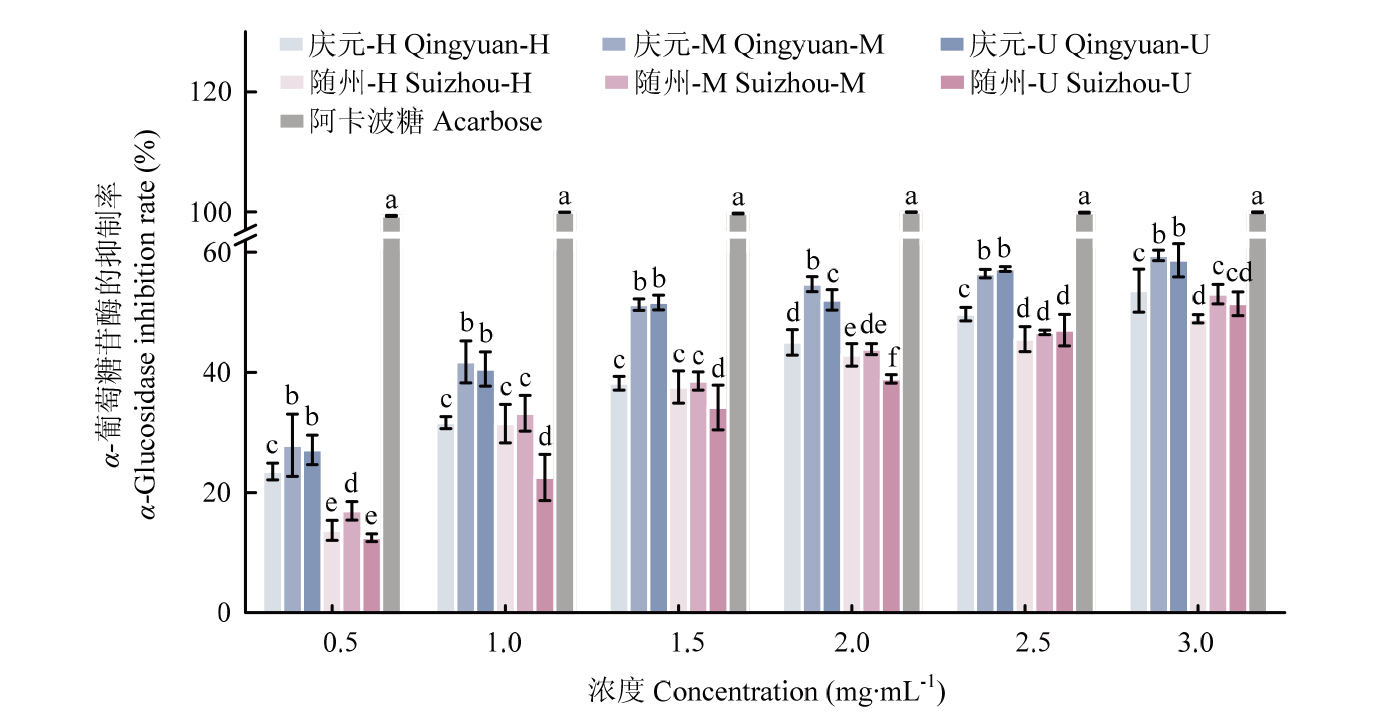
图3
LEPs对α-葡萄糖苷酶活性的抑制能力"
表6
LEPs对α-葡萄糖苷酶的半抑制浓度"
| 庆元-H Qingyuan-H | 庆元-M Qingyuan-M | 庆元-U Qingyuan-U | 随州-H Suizhou-H | 随州-M Suizhou-M | 随州-U Suizhou-U | |
|---|---|---|---|---|---|---|
| 半抑制浓度IC50 (mg·mL-1) | 2.62±0.19b | 1.63±0.09a | 1.70±0.03a | 2.87±0.20c | 2.65±0.04b | 2.85±0.11c |
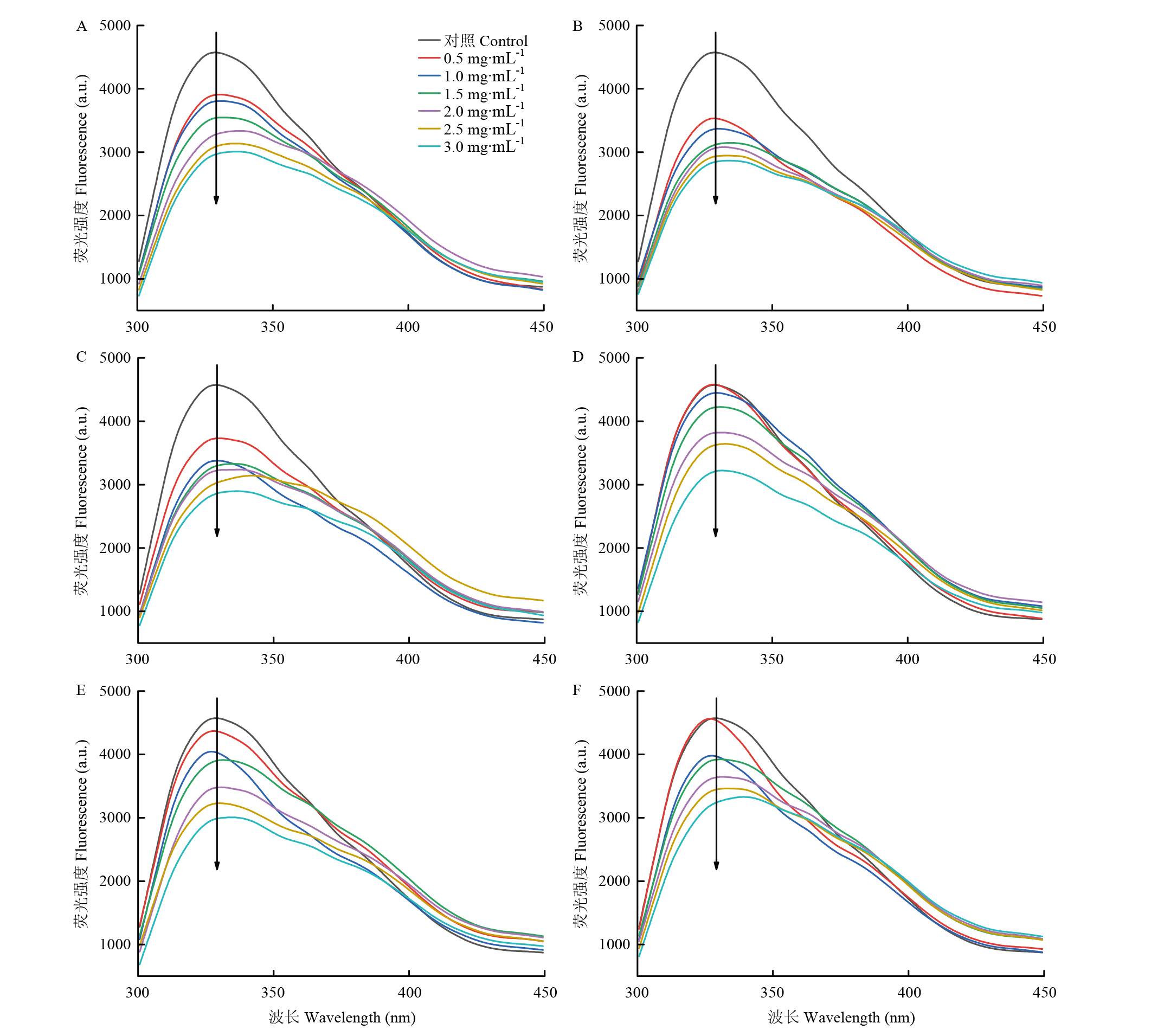
图4
LEPs对α-葡萄糖苷酶荧光光谱的影响 A:庆元-H;B:庆元-M;C:庆元-U;D:随州-H;E:随州-M;F:随州-U"
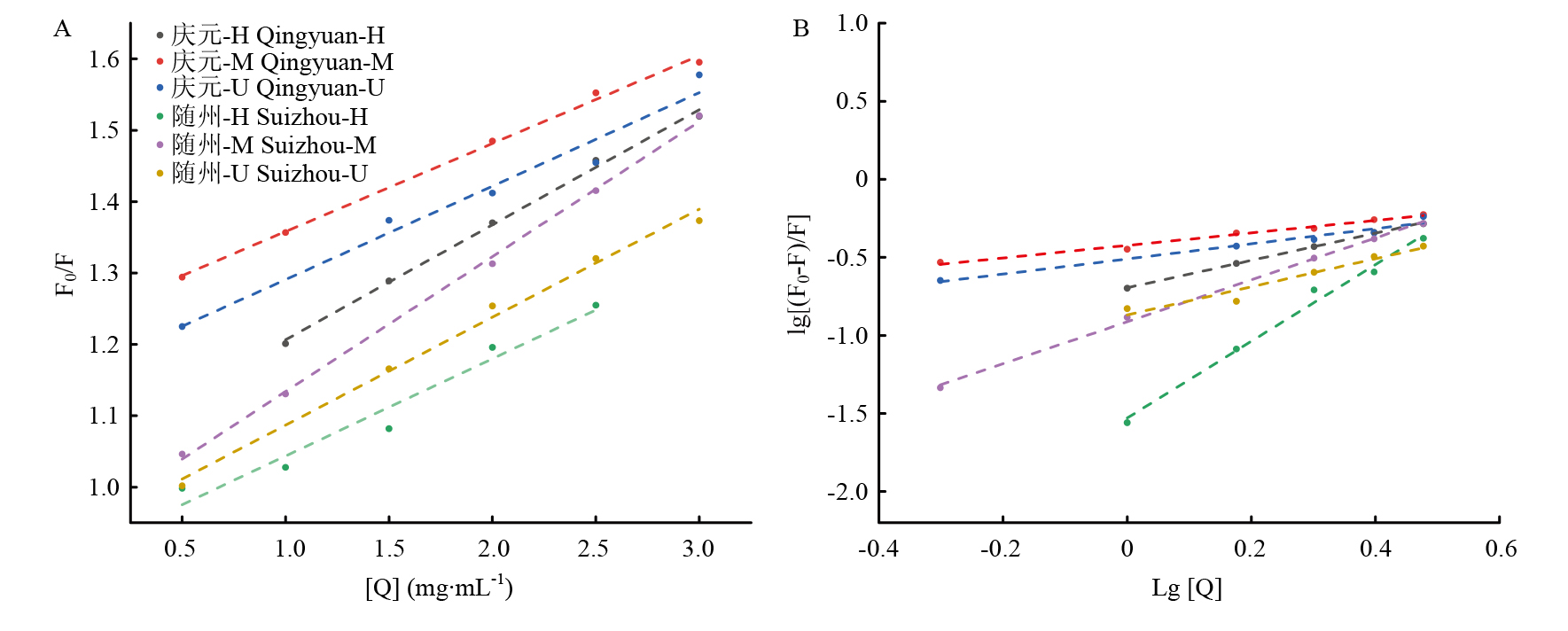
图5
LEPs对α-葡萄糖苷酶的Stern-Volmer曲线(A)和对数图(B)"
表7
LEPs与α-葡萄糖苷酶相互作用参数"
| Stern-Volmer方程R2 | Ka (mL·mg-1) | n | |
|---|---|---|---|
| 庆元-H Qingyuan-H | 0.9966 | 0.2021 | 0.87 |
| 庆元-M Qingyuan-M | 0.9970 | 0.3768 | 0.40 |
| 庆元-U Qingyuan-U | 0.9682 | 0.3089 | 0.48 |
| 随州-H Suizhou-H | 0.9593 | 0.0296 | 2.46 |
| 随州-M Suizhou-M | 0.9985 | 0.1222 | 1.34 |
| 随州-U Suizhou-U | 0.9924 | 0.1357 | 0.90 |
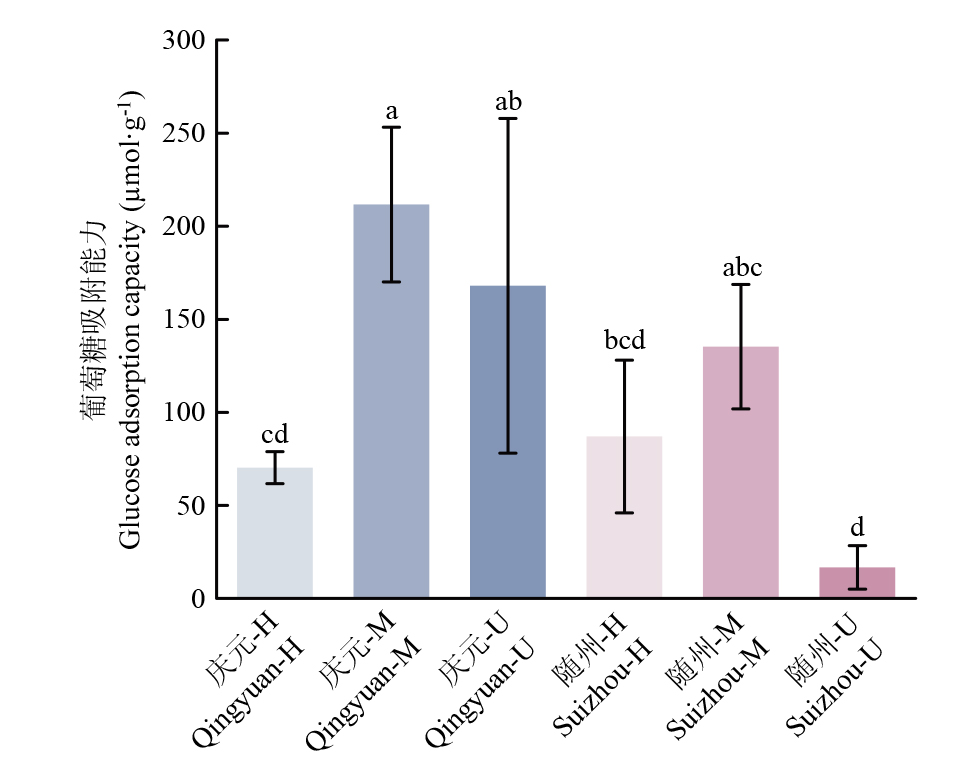
图6
LEPs对葡萄糖的吸附能力"
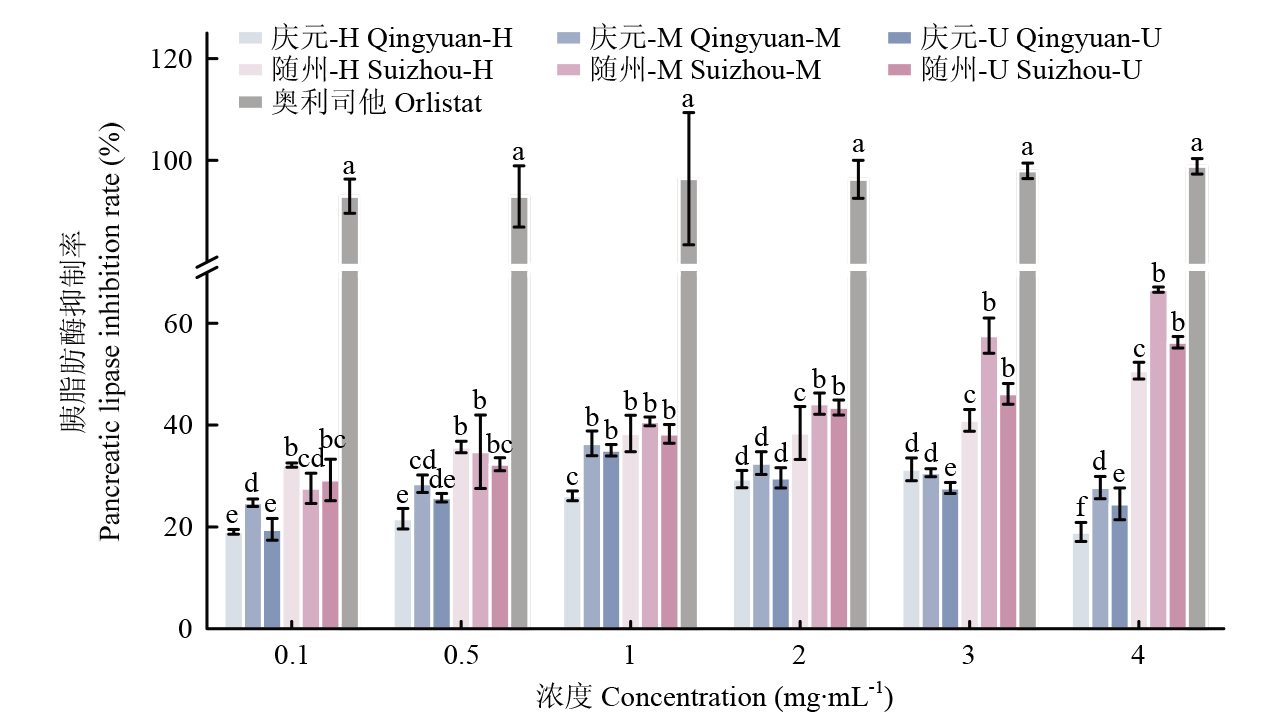
图7
LEPs对胰脂肪酶活性的抑制能力"
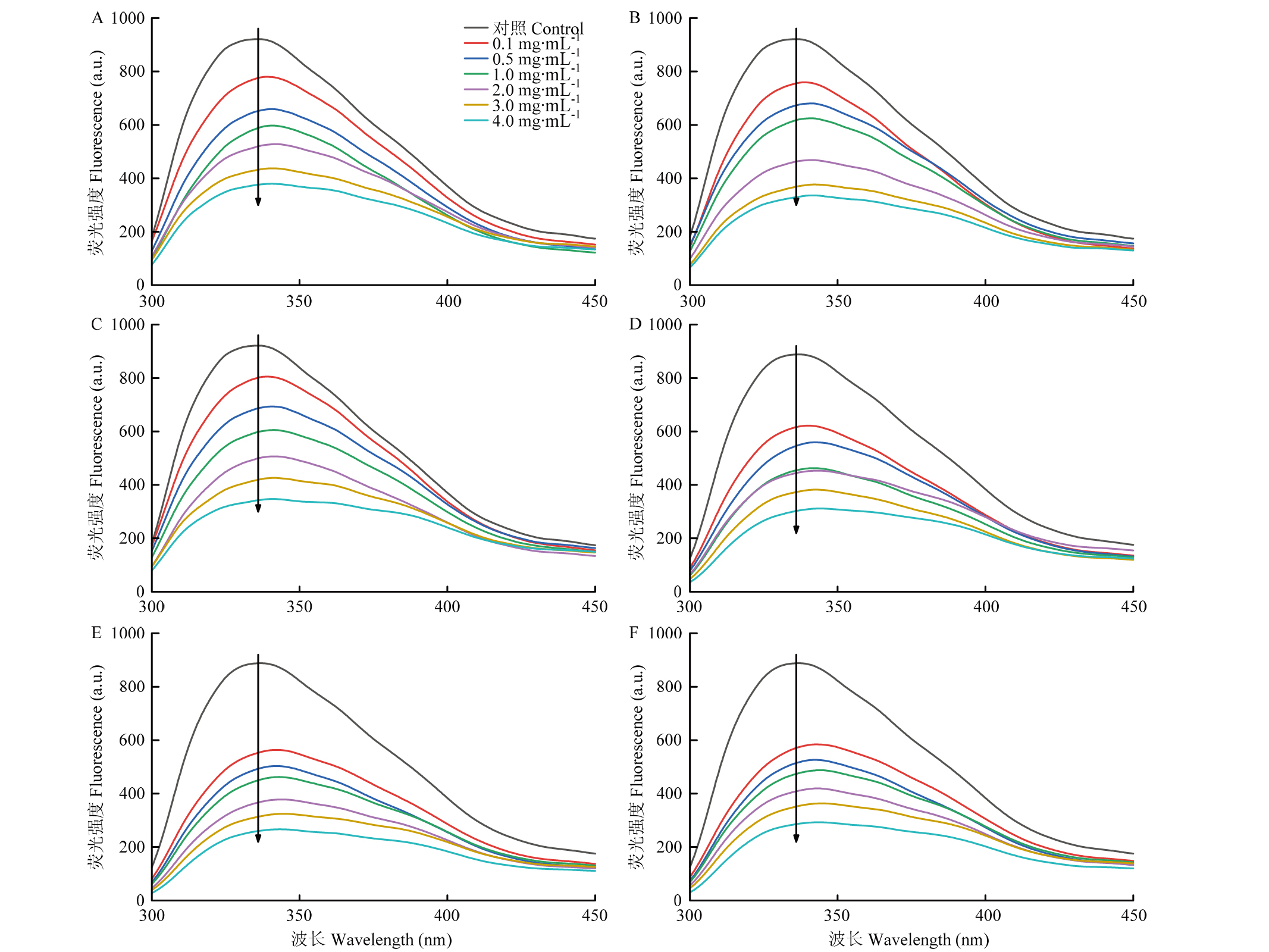
图8
LEPs对胰脂肪酶荧光光谱的影响 A:庆元-H;B:庆元-M;C:庆元-U;D:随州-H;E:随州-M;F:随州-U"
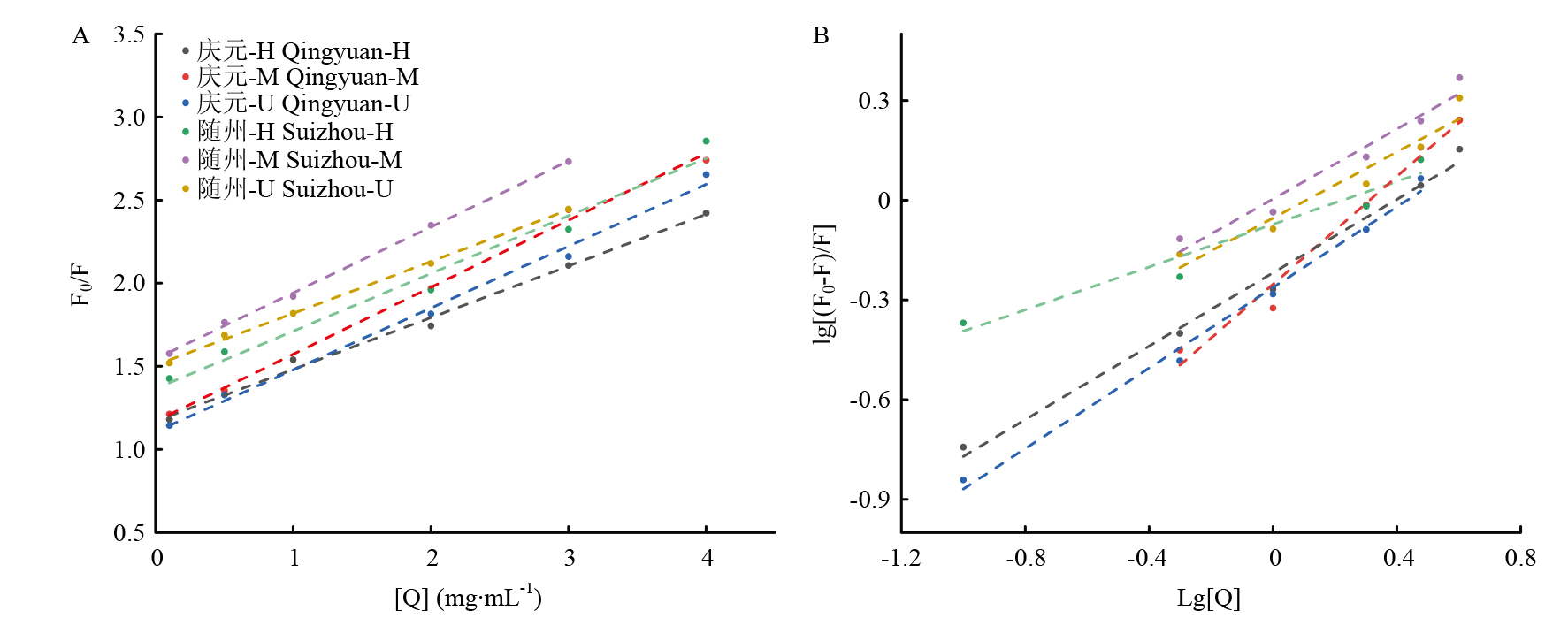
图9
LEPs对胰脂肪酶的stern-Volmer曲线(A)和对数图(B)"
表8
LEPs与胰脂肪酶相互作用参数"
| Stern-Volmer方程R2 | Ka (mL·mg-1) | n | |
|---|---|---|---|
| 庆元-H Qingyuan-H | 0.9933 | 0.6051 | 0.5525 |
| 庆元-M Qingyuan-M | 0.9965 | 0.5585 | 0.8104 |
| 庆元-U Qingyuan-U | 0.9963 | 0.5470 | 0.6062 |
| 随州-H Suizhou-H | 0.9773 | 0.8473 | 0.3218 |
| 随州-M Suizhou-M | 0.9988 | 1.0083 | 0.5266 |
| 随州-U Suizhou-U | 0.9980 | 0.8838 | 0.4966 |
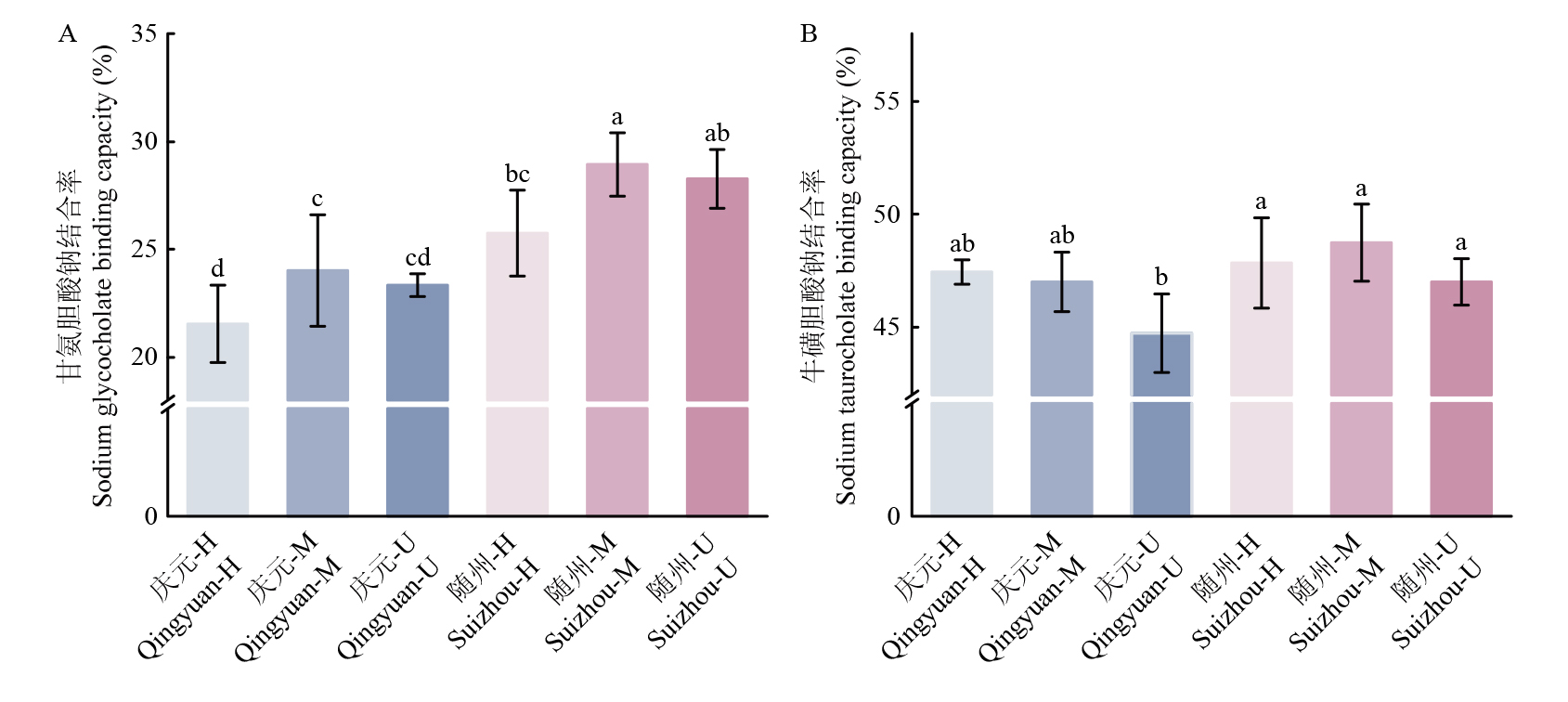
图10
LEPs对甘氨胆酸钠的结合能力(A)和LEPs对牛磺胆酸钠的结合能力(B)"
| [1] |
曹斌. 新时代背景下中国香菇消费市场发展特征与趋势[J]. 食用菌学报, 2023, 30(3): 90-102.
|
|
|
|
| [2] |
周璐, 马宁, 胡秋辉, 俞云燕, 段亚宁, 苏安祥, 马高兴. 基于氨基酸及理化性质差异分析香菇水提物的加工适宜性[J]. 食品工业科技, 2026, 47(8): 314-323.
|
|
|
|
| [3] |
|
| [4] |
崔国梅, 许方方, 李顺峰, 魏书信, 刘丽娜, 王安建. 香菇精深加工及生物活性研究进展[J]. 中国农学通报, 2021, 37(7): 132-137.
doi: 10.11924/j.issn.1000-6850.casb2020-0049 |
|
|
|
| [5] |
唐玉姝, 吴立峰. 科技助力上海市种源农业高质量发展[J]. 上海农业科技, 2023(5): 3-5, 73.
|
|
|
|
| [6] |
|
| [7] |
|
| [8] |
|
| [9] |
|
| [10] |
彭汝月, 梁淑惠, 龚玉石, 胡勇, 李冬梅, 李彦力, 严文静, 郭娟. 超声耦合亚临界水提取香菇多酚及对α-葡萄糖苷酶的抑制[J]. 现代食品科技, 2026, 42(1): 69-74.
|
|
|
|
| [11] |
郑洪梨, 路洪艳, 艾有伟, 易阳, 王宏勋, 闵婷. 不同产地香菇营养物质和功能活性成分的差异研究及品质评价[J]. 武汉轻工大学学报, 2025, 44(5): 33-41.
|
|
|
|
| [12] |
|
| [13] |
姜宁, 董浩然, 李巧珍, 李玉, 周峰, 李正鹏. 不同光质培养下香菇挥发性风味物质的比较分析[J]. 上海农业学报, 2023, 39(6): 32-40.
|
|
|
|
| [14] |
李泉岑, 蔡雯雯, 李娜, 肖嵋方, 李鑫, 刘斌, 曾峰. 响应面法优化香菇多酚提取工艺及稳定性研究[J]. 食品科技, 2022, 47(5): 230-237.
|
|
|
|
| [15] |
doi: 10.1146/annurev-food-052720-010354 pmid: 35041793 |
| [16] |
doi: 10.1111/1541-4337.12572 pmid: 33337093 |
| [17] |
|
| [18] |
|
| [19] |
张美彦, 于海龙, 尚晓冬, 谭琦, 李玉, 周峰, 杨慧, 章炉军, 宋春艳. 香菇新品种‘申香1513’[J]. 园艺学报, 2018, 45(S2): 2777-2778.
|
|
|
|
| [20] |
doi: 10.1021/jf0115589 pmid: 11982434 |
| [21] |
郭亚健, 范莉, 王晓强, 张兰珍. 关于NaNO2-Al(NO3)3-NaOH比色法测定总黄酮方法的探讨[J]. 药物分析杂志, 2002, 22(2): 97-99.
|
|
|
|
| [22] |
|
| [23] |
|
| [24] |
|
| [25] |
|
| [26] |
|
| [27] |
薛雯, 房玉林, 戴璐, 唐丽丽, 姚瑞祺. 葡萄不同组织多酚含量及抗氧化性的周年期变化[J]. 农产品加工(下半月), 2021(9): 56-62.
|
|
|
|
| [28] |
doi: S0141-8130(19)33559-7 pmid: 31356939 |
| [29] |
徐倩, 王晗, 马赛, 胡秋辉, 马宁, 苏安祥, 李辰, 马高兴. 杏鲍菇多糖及其消化产物对淀粉消化酶的抑制及相互作用[J]. 中国农业科学, 2023, 56(2): 357-367. DOI: 10.3864/j.issn.0578-1752.2023.02.012.
|
|
|
|
| [30] |
|
| [31] |
闫宇轩. 金针菇菇根膳食纤维的水溶性改性及其理化和功能性质评价[D]. 无锡: 江南大学, 2024.
|
|
|
|
| [32] |
李向鹏, 王晓琴, 孟勐, 吴皓, 曹阳. 阿尔山地区8种食用菌营养品质的综合评价[J]. 中国瓜菜, 2026, 39(1): 126-133.
|
|
|
|
| [33] |
|
| [34] |
|
| [35] |
|
| [36] |
|
| [37] |
|
| [38] |
|
| [39] |
|
| [40] |
刘文强, 董壮壮, 孙庆, 梁颖, 赵晓茹, 韩立华, 原红霞. 桑叶茶中多酚、黄酮含量与抗氧化作用的相关性研究[J]. 食品科技, 2023, 48(2): 239-245.
|
|
|
|
| [41] |
|
| [42] |
陈越洋. 全细胞生物催化合成对羟基苯甲酸、苯甲酸和熊果苷[D]. 厦门: 厦门大学, 2022.
|
|
|
|
| [43] |
孔保华, 李菁, 刘骞. 美拉德反应产物抗氧化机理及影响因素的研究进展[J]. 东北农业大学学报, 2011, 42(11): 9-13.
|
|
|
|
| [44] |
袁博, 曹健, 秦朗, 田华, 郑竟成, 何东平. 四种酚类化合物体外抗氧化活性的比较研究[J]. 食品工业, 2018, 39(9): 200-204.
|
|
|
|
| [45] |
姜帅章. 冬虫夏草菌丝体培养及其抗氧化物提取研究[D]. 沈阳: 沈阳大学, 2014.
|
|
|
|
| [46] |
|
| [47] |
|
| [48] |
|
| [49] |
|
| [50] |
|
| [51] |
|
| [52] |
|
| [53] |
|
| [54] |
|
| [1] | 许杨浩峻, 陈丽明, 杨世奇, 唐奕凡, 谭雪明, 曾勇军, 潘晓华, 曾研华. 长期秸秆还田对双季稻田不同土层有机碳、养分和团聚体的影响[J]. 中国农业科学, 2026, 59(7): 1492-1506. |
| [2] | 冯振康, 于爱忠, 尹波, 张冬玲, 蔡宏玮, 侯世和, 黄亚丽, 于彦子, 霍建喆, 庞小能. 麦田土壤团聚体及其有机碳、全氮分布特征对绿肥还田结合氮肥减施的响应[J]. 中国农业科学, 2026, 59(14): 3094-3104. |
| [3] | 王少骅, 沈年桥, 储天然, 吴永汉, 李康宁, 石延霞, 谢学文, 李磊, 范腾飞, 李宝聚, 柴阿丽. 浙江苍南番茄-水稻轮作对连作土壤理化性质和微生物群落的影响[J]. 中国农业科学, 2025, 58(4): 692-703. |
| [4] | 韩哲群, 苏莹, 高奇奇, 刘美英, 贾昂元, 张海睿, 南珊珊, 徐勤政, 王强, 王利军, 武雪萍. 智能滴灌水肥耦合模式实现土壤节水控盐与向日葵产量品质协同提升[J]. 中国农业科学, 2025, 58(20): 4158-4177. |
| [5] | 张海睿, 贾昂元, 高奇奇, 韩哲群, 南珊珊, 段碧华, 武雪萍. 生物炭配施黄腐酸对滨海盐碱地土壤理化性质、酶活性和多功能性的影响[J]. 中国农业科学, 2025, 58(20): 4178-4188. |
| [6] | 王庆峰, 褚长彬, 赵峥, 吴淑杭, 周德平. 草莓连作对土壤微生物及碳氮磷功能基因丰度的影响[J]. 中国农业科学, 2025, 58(17): 3488-3502. |
| [7] | 唐佳灵, 张玉林, 杨勇, 方正锋, 韩国全, 惠腾. 日粮中添加酱油残渣压榨油脂对猪肉品质的影响[J]. 中国农业科学, 2025, 58(15): 3118-3133. |
| [8] | 余静, 朱大伟, 郑欣, 徐清宇, 董会颖, 陈铭学, 邵雅芳. 糙米淀粉消化特征及降糖活性[J]. 中国农业科学, 2025, 58(12): 2439-2452. |
| [9] | 陈会鲜, 何文, 阮丽霞, 黄小娟, 兰秀, 蔡兆琴, 李恒锐, 黄珍玲, 韦婉羚, 梁振华, 李天元, 曹升, 李喜弟, 韦均参. 间作大豆对木薯生长及连作土壤特性的影响[J]. 中国农业科学, 2025, 58(11): 2176-2189. |
| [10] | 李伟晶, 王洪媛, 徐洋, 李浩, 翟丽梅, 刘宏斌. 稻蟹共生系统稻田水-土界面微生物群落结构特征[J]. 中国农业科学, 2024, 57(18): 3551-3567. |
| [11] | 周雷, 曲潇琳, 周涛, 马常宝, 李建兵, 龙怀玉, 徐爱国, 张认连, 李格. 宁夏土壤颗粒组成特点及其影响因素分析[J]. 中国农业科学, 2023, 56(21): 4272-4287. |
| [12] | 陈硕桐, 夏鑫, 丁元君, 冯潇, 刘晓雨, Marios Drosos, 李恋卿, 潘根兴. 不同形态秸秆还田下乌栅土耕层土壤有机质含量与组成变化[J]. 中国农业科学, 2023, 56(13): 2518-2529. |
| [13] | 符慧珍, 邓梅, 张名位, 贾栩超, 董丽红, 黄菲, 马勤, 赵东, 张瑞芬. 黑曲霉改性葛渣膳食纤维的工艺优化及其理化功能特性[J]. 中国农业科学, 2023, 56(12): 2380-2394. |
| [14] | 郭鑫虎, 马静, 李仲峰, 初金鹏, 徐海成, 贾殿勇, 代兴龙, 贺明荣. 长期定位条件下栽培模式对麦田土壤理化性质和氮素平衡的影响[J]. 中国农业科学, 2023, 56(12): 2262-2273. |
| [15] | 龚小雅,石记博,方凌,方亚鹏,吴凤芝. 淹水对辣椒连作土壤化学性质与微生物群落结构的影响[J]. 中国农业科学, 2022, 55(12): 2472-2484. |
|
||
