






中国农业科学 ›› 2026, Vol. 59 ›› Issue (16): 3556-3576.doi: 10.3864/j.issn.0578-1752.2026.16.007
吴建辉1,3( ), 曾庆东2,3, 刘胜杰2,3, 王晓杰2,3, 韩德俊1,3, 康振生2,3
收稿日期:2026-03-22
接受日期:2026-06-06
出版日期:2026-08-16
发布日期:2026-08-17
通信作者:
基金资助:
WU JianHui1,3(), ZENG QingDong2,3, LIU ShengJie2,3, WANG XiaoJie2,3, HAN DeJun1,3, KANG ZhenSheng2,3
Received:2026-03-22
Accepted:2026-06-06
Published:2026-08-16
Online:2026-08-17
摘要:
小麦(Triticum aestivum)对全球粮食安全至关重要,但其生产持续受到各类病原菌的侵害。发掘利用抗病资源是应对病害威胁、实现绿色防控的首选途径。本文在系统梳理小麦抗病分子机制研究进展的基础上,通过比较活体营养与死体营养型病原菌侵染特征,阐明了小麦与病原菌协同进化下的攻防演替策略;重点分析了抗病小体组装与等位基因特异性演变、激酶融合蛋白介导的模块化协作、非经典基因驱动的寄主生理稳态重构等免疫调控机制,并阐释了效应子通过劫持寄主免疫通路或利用超敏反应诱导感病的分子基础。基于上述免疫机制认识,总结了当前抗病资源发掘与精准改良的重要策略,包括构建抗病基因全景导航图、深度发掘野生近缘种资源以及通过关键遗传位点编辑实现免疫受体定向优化等。面对未来病原菌持续演化与多病害复合发生趋势,提出以防御激活与细胞死亡解耦、进化导向的通用免疫受体设计及多界免疫生态屏障构建为代表的新型抗性改良方向,为实现小麦广谱、持久抗性的理性设计提供理论依据与技术参考。
吴建辉, 曾庆东, 刘胜杰, 王晓杰, 韩德俊, 康振生. 小麦抗病机制研究进展与抗性创新利用策略[J]. 中国农业科学, 2026, 59(16): 3556-3576.
WU JianHui, ZENG QingDong, LIU ShengJie, WANG XiaoJie, HAN DeJun, KANG ZhenSheng. Advances in Mechanisms and Innovative Improvement Strategies for Wheat Disease Resistance[J]. Scientia Agricultura Sinica, 2026, 59(16): 3556-3576.

图1
小麦主要病害发病特征 条锈病、叶锈病、秆锈病、白粉病为活体营养型病害,主要发生在叶部和茎部;其他为死体营养型病害,其中赤霉病和麦瘟病发生在穗部,叶枯病发生在叶部,纹枯病和茎基腐病发生在茎部。麦瘟病和叶枯病图片参考Singh等[15-16]"
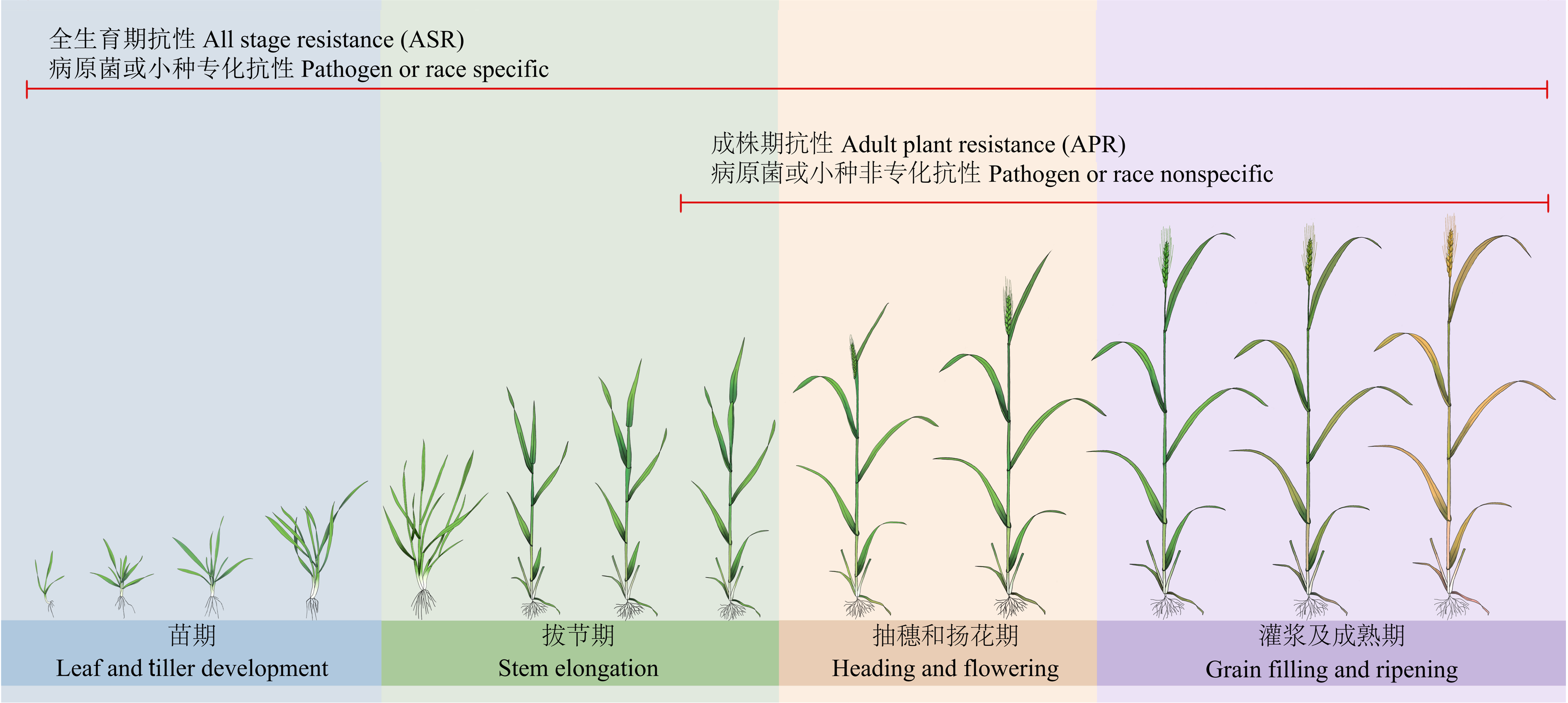
图2
小麦抗病性类型"
表1
已克隆的小麦抗病基因"
| 基因Gene | 蛋白Protein | 位点Loci | 供体Donor | 病害Disease |
|---|---|---|---|---|
| Yr5a/b/x | BED-NLR | 2BL | 斯贝尔脱小麦T. spelta; 普通小麦T. aestivum | 条锈病Stripe rust (Pst) |
| Yr61 | CNL pair | 7BL | 普通小麦T. aestivum | 条锈病Stripe rust (Pst) |
| Yr7 | BED-NLR | 2BL | 普通小麦T. aestivum | 条锈病Stripe rust (Pst) |
| Yr9 | CNL | 1RS | 黑麦S. cereale | 条锈病Stripe rust (Pst) |
| YrNAM (Yr10) | NAM-ZnF-BED | 1BS | 普通小麦T. aestivum | 条锈病Stripe rust (Pst) |
| Yr15 (WTK1) | KD-PKD | 1BS | 野生二粒小麦T. dicoccoides | 条锈病Stripe rust (Pst) |
| Yr26 | DTMP | 1BL | 硬粒小麦T. durum | 条锈病Stripe rust (Pst) |
| Yr272 | CNL | 2BS | 普通小麦T. aestivum | 条锈病Stripe rust (Pst) |
| Yr28/AS2388R; YrAet672 | CNL | 4DS | 山羊草Ae. tauschii | 条锈病Stripe rust (Pst) |
| Yr36 (WKS1) | KD-START | 6BS | 野生二粒小麦T. dicoccoides | 条锈病Stripe rust (Pst) |
| Yr84/TD121 | CNL and NL pair | 1BS | 野生二粒小麦T. dicoccoides | 条锈病Stripe rust (Pst) |
| YrKB | PH-START-EDR2 | 7BL | 普通小麦T. aestivum | 条锈病Stripe rust (Pst) |
| YrU1 | ANK-NLR-WRKY | 5AL | 乌拉尔图小麦T. urartu | 条锈病Stripe rust (Pst) |
| Lr1 | CNL | 5DL | 普通小麦T. aestivum | 叶锈病Leaf rust (Pt) |
| Lr10-Rga2 | CNL and CNL pair | 1AS | 普通小麦T. aestivum | 叶锈病Leaf rust (Pt) |
| Lr13 (Ne2)2 | CNL | 2BS | 普通小麦T. aestivum | 叶锈病Leaf rust (Pt) |
| Lr14a | Ankyrin TM protein | 7BL | 普通小麦T. aestivum | 叶锈病Leaf rust (Pt) |
| Lr21 | CNL | 1DS | 山羊草Ae. tauschii | 叶锈病Leaf rust (Pt) |
| Lr22a | CNL | 2DS | 山羊草Ae. tauschii | 叶锈病Leaf rust (Pt) |
| Lr30 | CNL | 4AS | 硬粒小麦T. durum | 叶锈病Leaf rust (Pt) |
| Lr39 | KD-KD-MSP-WD40 | 2DS | 山羊草Ae. tauschii | 叶锈病Leaf rust (Pt) |
| Lr42 | CNL | 1DS | 山羊草Ae. tauschii | 叶锈病Leaf rust (Pt) |
| Lr47 | CNL | 7S#1S | 斯贝尔脱山羊草Ae. speltoides | 叶锈病Leaf rust (Pt) |
| Lr9/Lr58 (WTK6)3 | KD-PKD-vWA | 6BL | 小伞山羊草Ae. umbellulata | 叶锈病Leaf rust (Pt) |
| Rga2 | NLR-ID | 1DS | 普通小麦T. aestivum | 叶锈病Leaf rust (Pt) |
| AcRLK2P-1 | LRR-RK | 2PL | 冰草Ag. cristatum | 叶锈病Leaf rust (Pt) |
| Sr6 | BED-NLR | 2DS | 普通小麦T. aestivum | 秆锈病Stem rust (Pgt) |
| Sr9 | CNL | 2BL | 硬粒小麦T. durum | 秆锈病Stem rust (Pgt) |
| Sr13 | CNL | 6AL | 硬粒小麦T. durum | 秆锈病Stem rust (Pgt) |
| Sr21 | CNL | 2AmL | 一粒小麦T. monococcum | 秆锈病Stem rust (Pgt) |
| Sr22a/b4 | CNL | 7AbL; 7AmL | 野生一粒小麦T. boeoticum; 一粒小麦T. monococcum | 秆锈病Stem rust (Pgt) |
| Sr26 | CNL | 6Ae#1L | 十倍体长穗偃麦草Th. ponticum | 秆锈病Stem rust (Pgt) |
| Sr27 | CNL | 3RS | 黑麦S. cereale | 秆锈病Stem rust (Pgt) |
| Sr33 | CNL | 1DS | 山羊草Ae. tauschii | 秆锈病Stem rust (Pgt) |
| Sr35 | CNL | 3AmL | 一粒小麦T. monococcum | 秆锈病Stem rust (Pgt) |
| Sr43 | KD-DUFs | 7EL | 二倍体长穗偃麦草Th. elongatum | 秆锈病Stem rust (Pgt) |
| Sr45 | CNL | 1DS | 山羊草Ae. tauschii | 秆锈病Stem rust (Pgt) |
| Sr46 | CNL | 2DS | 山羊草Ae. tauschii | 秆锈病Stem rust (Pgt) |
| Sr50 | CNL | 1RS | 黑麦S. cereale | 秆锈病Stem rust (Pgt) |
| Sr60 (WTK2) | KD-KD | 5AmS | 一粒小麦T. monococcum | 秆锈病Stem rust (Pgt) |
| Sr61 | CNL | 6Ae#3L | 十倍体长穗偃麦草Th. ponticum | 秆锈病Stem rust (Pgt) |
| Sr62 (WTK5) | KD-PKD | 1SshS | 沙融山羊草Ae. sharonensis | 秆锈病Stem rust (Pgt) |
| Sr66 (TA1662) | CNL | 1DS | 山羊草Ae. tauschii | 秆锈病Stem rust (Pgt) |
| Sr8155B1 | CNL | 6AS | 硬粒小麦T. durum | 秆锈病Stem rust (Pgt) |
| Pm1a | CNL | 7AL | 普通小麦T. aestivum | 白粉病Powdery mildew (Bgt) |
| Pm2 | CNL | 5DS | 山羊草Ae. tauschii | 白粉病Powdery mildew (Bgt) |
| Pm3a/b/d | CNL | 1AS | 普通小麦T. aestivum | 白粉病Powdery mildew (Bgt) |
| Pm4b5 | KD-MCTP | 2AL | 波斯小麦T. carthlicum | 白粉病Powdery mildew (Bgt) |
| Pm5e1 | CNL pair | 7BL | 普通小麦T. aestivum | 白粉病Powdery mildew (Bgt) |
| Pm6/52 | CNL | 2GL | 提莫菲维小麦T. timopheevii | 白粉病Powdery mildew (Bgt) |
| Pm8, Pm17 | CNL | 1RS | 黑麦S. cereale | 白粉病Powdery mildew (Bgt) |
| Pm12 | CNL | 6SS | 斯贝尔脱山羊草Ae. speltoides | 白粉病Powdery mildew (Bgt) |
| Pm13 | HeLo-KD | 3SlS | 高大山羊草Ae. longissima | 白粉病Powdery mildew (Bgt) |
| Pm21 | CNL | 6VS | 簇毛麦D. villosum | 白粉病Powdery mildew (Bgt) |
| Pm24 (WTK3)6 | KD-PKD | 1DS | 普通小麦T. aestivum | 白粉病Powdery mildew (Bgt) |
| Pm26 | CNL pair | 3BL | 野生二粒小麦T. dicoccoides | 白粉病Powdery mildew (Bgt) |
| Pm36 (WTK7) | KD-KD-TM | 5BL | 野生二粒小麦T. dicoccoides | 白粉病Powdery mildew (Bgt) |
| Pm374 | CNL | 7AL | 普通小麦T. aestivum | 白粉病Powdery mildew (Bgt) |
| Pm41 | CNL | 3BL | 野生二粒小麦T. dicoccoides | 白粉病Powdery mildew (Bgt) |
| SuPm55-Pm55a/b | CNL | 5VS | 簇毛麦D. villosum | 白粉病Powdery mildew (Bgt) |
| Pm57 (WTK6b)3 | KD-PKD-vWA | 2SL | 西尔斯山羊草Ae. searsii | 白粉病Powdery mildew (Bgt) |
| Pm60a/b; MlIW18/172 | CNL | 7AL | 乌拉尔图小麦T. urartu; 野生二粒小麦T. dicoccoides | 白粉病Powdery mildew (Bgt) |
| Pm68/WR183/MlIW39 | CNL pair | 6BL | 野生二粒小麦T. dicoccoides | 白粉病Powdery mildew (Bgt) |
| Pm69 | CNL | 6BL | 野生二粒小麦T. dicoccoides | 白粉病Powdery mildew (Bgt) |
| Pm6Sl | BED-NLR | 6SlL | 高大山羊草Ae. longissima | 白粉病Powdery mildew (Bgt) |
| PmAeu1 | CNL | 2UL | 小伞山羊草Ae. umbellulata | 白粉病Powdery mildew (Bgt) |
| PmTR1, PmTR3 | CNL | 6RS | 黑麦S. cereale | 白粉病Powdery mildew (Bgt) |
| WTK4 | KD-PKD | 7DS | 山羊草Ae. tauschii | 白粉病Powdery mildew (Bgt) |
| Yr18/Lr34/Sr57/Pm38 | ABC transporter | 7DS | 普通小麦T. aestivum | 兼抗Multiple diseases resistance (Pt/Pst/Pgt/Bgt) |
| Yr46/Lr67/Sr55/Pm46 | Hexose-proton symporter | 4DL | 普通小麦T. aestivum | 兼抗Multiple diseases resistance (Pt/Pst/Pgt/Bgt) |
| Lr85/Yr87 | CNL | 6SshS/6SlS | 沙融山羊草Ae. sharonensis; 高大山羊草Ae. longissima | 兼抗Multiple diseases resistance (Pt/Pst) |
| Fhb1 | His | 3BS | 普通小麦T. aestivum | 赤霉病Fusarium head blight (Fg) |
| Fhb7 | GST | 7EL | 二倍体长穗偃麦草Th. elongatum | 赤霉病Fusarium head blight (Fg) |
| Stb15 | LecRK | 6AS | 普通小麦T. aestivum | 叶枯病Septoria tritici blotch (Zt) |
| Stb16q | CRK | 3DS | 山羊草Ae. tauschii | 叶枯病Septoria tritici blotch (Zt) |
| Stb6 | WAK | 3AS | 普通小麦T. aestivum | 叶枯病Septoria tritici blotch (Zt) |
| Snn1 | WAK | 1BS | 普通小麦T. aestivum | 颖枯病Septoria nodorum blotch (Pn) |
| Snn3 | KD-MSP | 5DS | 山羊草Ae. tauschii | 颖枯病Septoria nodorum blotch (Pn) |
| Tsn1 | KD-NBS-LRR | 5BL | 普通小麦T. aestivum | 褐斑病Tan spot (Bs) |
| Rmg75 | KD-MCTP | 2AL | 栽培二粒小麦T. dicoccum | 麦瘟病Wheat blast (Po) |
| Rmg8 | KD-MCTP | 2BL | 普通小麦T. aestivum | 麦瘟病Wheat blast (Po) |
| Rwt3 | CNL | 1DS | 普通小麦T. aestivum | 麦瘟病Wheat blast (Po) |
| RWT46 | KD-PKD | 1DS | 山羊草Ae. tauschii | 麦瘟病Wheat blast (Po) |

图3
小麦抗病基因的结构多样性及其介导的免疫防御机制"

图4
未来小麦抗病育种策略"
| [1] |
Food and Agriculture Organization of the United Nations (FAO). FAOSTAT. Crops and livestock products[DB/OL]. (2025-12-31) [2026-03-05]. https://www.fao.org/faostat/en/#data/QCL.
|
| [2] |
Food and Agriculture Organization of the United Nations (FAO). In brief to the state of the world’s land and water resources for food and agriculture 2025. The potential to produce more and better[DB/OL]. [2026-03-05]. https://doi.org/10.4060/cd7598en.
|
| [3] |
|
| [4] |
doi: 10.1146/annurev-phyto-080614-120207 pmid: 26047565 |
| [5] |
doi: 10.1007/s12571-020-01016-z |
| [6] |
doi: 10.1038/s41437-019-0288-x pmid: 31863032 |
| [7] |
doi: 10.1002/fes3.v11.1 |
| [8] |
doi: 10.1038/s41467-022-31975-0 pmid: 35882860 |
| [9] |
doi: 10.1038/s41467-023-36674-y pmid: 36828814 |
| [10] |
康振生, 王晓杰, 赵杰, 汤春蕾, 黄丽丽. 小麦条锈菌致病性及其变异研究进展[J]. 中国农业科学, 2015, 48(17): 3439-3453. DOI: 10.3864/j.issn.0578-1752.2015.17.011.
|
|
|
|
| [11] |
doi: 10.1146/phyto.2025.63.issue-1 |
| [12] |
doi: 10.1038/s41558-023-01902-2 |
| [13] |
韩德俊, 康振生. 中国小麦品种抗条锈病现状及存在问题与对策[J]. 植物保护, 2018, 44(5): 1-12.
|
|
|
|
| [14] |
doi: 10.1146/phyto.2025.63.issue-1 |
| [15] |
doi: 10.3389/fpls.2021.710707 |
| [16] |
doi: 10.1038/s41588-018-0051-x pmid: 29434355 |
| [17] |
doi: 10.1073/pnas.1105802108 pmid: 21576481 |
| [18] |
pmid: 16078883 |
| [19] |
doi: 10.1146/annurev-phyto-081211-172955 pmid: 22726121 |
| [20] |
doi: 10.1146/phyto.2025.63.issue-1 |
| [21] |
doi: 10.1146/annurev-phyto-082718-100318 pmid: 30893009 |
| [22] |
doi: 10.1017/S0021859600000137 |
| [23] |
doi: 10.1146/phyto.1971.9.issue-1 |
| [24] |
doi: 10.1038/nature05286 |
| [25] |
doi: 10.1146/annurev-phyto-080614-115928 pmid: 26047563 |
| [26] |
doi: 10.1146/annurev-phyto-080615-100037 pmid: 27296142 |
| [27] |
|
| [28] |
doi: 10.1007/s00122-023-04253-w pmid: 36952017 |
| [29] |
doi: 10.1038/s41467-020-20685-0 pmid: 33469010 |
| [30] |
doi: 10.1038/s41477-025-01920-2 pmid: 40087541 |
| [31] |
doi: 10.1126/science.1166289 pmid: 19228999 |
| [32] |
doi: 10.1038/s41467-018-06138-9 |
| [33] |
doi: 10.1038/s41467-020-14294-0 pmid: 32015344 |
| [34] |
doi: 10.1038/s41588-023-01401-2 |
| [35] |
doi: 10.1126/science.1166453 pmid: 19229000 |
| [36] |
doi: 10.1038/ng.3439 pmid: 26551671 |
| [37] |
doi: 10.1016/j.cell.2024.03.045 pmid: 38670067 |
| [38] |
doi: 10.1016/j.pbi.2021.102030 |
| [39] |
doi: 10.1038/s41586-022-05231-w |
| [40] |
doi: 10.1016/j.cell.2026.02.024 |
| [41] |
doi: 10.1073/pnas.1004090107 pmid: 20624958 |
| [42] |
doi: 10.1111/tpj.2014.79.issue-6 |
| [43] |
doi: 10.1007/s11103-018-0780-3 |
| [44] |
doi: 10.1016/j.molp.2021.05.009 |
| [45] |
doi: 10.1016/j.molp.2021.05.010 |
| [46] |
doi: 10.1038/s41588-022-01022-1 pmid: 35288708 |
| [47] |
doi: 10.1111/nph.v228.3 |
| [48] |
doi: 10.1016/j.xplc.2025.101541 |
| [49] |
doi: 10.1016/j.xplc.2025.101542 |
| [50] |
doi: 10.1038/nbt.3543 pmid: 27111722 |
| [51] |
doi: 10.1038/s41467-026-69717-1 |
| [52] |
doi: 10.1038/s41467-024-54068-6 |
| [53] |
doi: 10.1016/j.cj.2025.10.003 |
| [54] |
doi: 10.1038/s41467-025-64049-y |
| [55] |
doi: 10.1038/s41467-025-64052-3 |
| [56] |
doi: 10.1038/s41467-025-64048-z |
| [57] |
doi: 10.1038/s41588-025-02203-4 |
| [58] |
doi: 10.1038/s41588-025-02207-0 |
| [59] |
doi: 10.1038/s41588-025-02208-z |
| [60] |
doi: 10.1111/pbi.v23.4 |
| [61] |
doi: 10.1038/s41477-018-0236-4 pmid: 30150615 |
| [62] |
doi: 10.1038/s41588-025-02259-2 |
| [63] |
doi: 10.1038/s41467-020-15139-6 pmid: 32170056 |
| [64] |
doi: 10.1038/s41588-018-0052-9 pmid: 29434356 |
| [65] |
doi: 10.1126/sciadv.1600822 |
| [66] |
doi: 10.1016/j.cj.2022.02.005 |
| [67] |
doi: 10.1038/s41588-026-02515-z |
| [68] |
doi: 10.1038/s41588-024-02032-x pmid: 39779952 |
| [69] |
doi: 10.1038/s41588-025-02162-w |
| [70] |
doi: 10.1126/science.adp5469 pmid: 40146830 |
| [71] |
doi: 10.1126/science.adp5034 pmid: 40146821 |
| [72] |
doi: 10.1111/pbi.14106 pmid: 37494504 |
| [73] |
doi: 10.1038/s41467-024-50909-6 |
| [74] |
doi: 10.1038/s41467-024-46814-7 |
| [75] |
doi: 10.1038/s41477-021-00869-2 pmid: 33707738 |
| [76] |
doi: 10.1038/s41477-025-02180-w |
| [77] |
doi: 10.1105/tpc.114.134296 |
| [78] |
doi: 10.1016/j.molp.2019.10.005 |
| [79] |
doi: 10.1038/s41477-023-01357-5 pmid: 36797350 |
| [80] |
doi: 10.1038/s41477-024-01718-8 |
| [81] |
doi: 10.1038/s41477-024-01711-1 |
| [82] |
doi: 10.1038/s41467-024-49257-2 pmid: 38839783 |
| [83] |
doi: 10.1074/jbc.RA118.002532 pmid: 30327425 |
| [84] |
doi: 10.1111/nph.15815 pmid: 30913300 |
| [85] |
doi: 10.1093/plphys/kiad104 pmid: 36806945 |
| [86] |
doi: 10.1093/jxb/erae164 |
| [87] |
doi: 10.1038/s41467-020-20777-x pmid: 33574268 |
| [88] |
doi: 10.1016/j.cub.2025.10.033 |
| [89] |
|
| [90] |
|
| [91] |
doi: 10.1105/tpc.17.00579 pmid: 29382771 |
| [92] |
doi: 10.1105/tpc.140910 |
| [93] |
doi: 10.1016/s0092-8674(00)81912-1 pmid: 9054509 |
| [94] |
doi: 10.1038/416447a |
| [95] |
doi: 10.1104/pp.010954 pmid: 12114562 |
| [96] |
doi: 10.1038/nbt.2969 pmid: 25038773 |
| [97] |
doi: 10.1038/s41586-022-04395-9 |
| [98] |
doi: 10.1016/j.cell.2022.06.027 |
| [99] |
doi: 10.1093/jxb/eraf141 |
| [100] |
刘成, 韩冉, 汪晓璐, 宫文萍, 程敦公, 曹新有, 刘爱峰, 李豪圣, 刘建军. 小麦远缘杂交现状、抗病基因转移及利用研究进展[J]. 中国农业科学, 2020, 53(7): 1287-1308. DOI: 10.3864/j.issn.0578-1752.2020.07.001.
|
|
|
|
| [101] |
doi: 10.1038/s41587-018-0007-9 pmid: 30718880 |
| [102] |
doi: 10.1038/s41586-024-07808-z |
| [103] |
doi: 10.1038/s41477-025-02110-w |
| [104] |
doi: 10.1038/s41467-025-64428-5 |
| [105] |
|
| [106] |
doi: 10.1111/pbi.13903 pmid: 35904481 |
| [107] |
doi: 10.1094/MPMI-07-22-0154-R pmid: 36867580 |
| [108] |
doi: 10.1016/j.xplc.2024.101138 |
| [109] |
doi: 10.1007/s00122-023-04538-0 |
| [110] |
doi: 10.1007/s11032-023-01359-3 |
| [111] |
doi: 10.1007/s44154-025-00232-x |
| [112] |
孟祥宇, 刁邓超, 刘雅睿, 李云丽, 孙玉晨, 吴玮, 赵雯, 汪妤, 吴建辉, 李春莲, 曾庆东, 韩德俊, 郑炜君. 小麦新品种西农877高产稳产的遗传特性解析[J]. 作物学报, 2025, 51(5): 1261-1276.
doi: 10.3724/SP.J.1006.2025.41064 |
|
doi: 10.3724/SP.J.1006.2025.41064 |
|
| [113] |
李笑笑, 相明杰, 刘胜杰, 王晓婷, 李杰, 郑炜君, 吴建辉, 曾庆东, 康振生, 张传量, 王长发, 韩德俊. 结合0.1K前景和16K背景芯片快速解析小麦新品系的基因组结构和重要性状遗传基础[J]. 麦类作物学报, 2025, 45(1): 52-62.
|
|
|
|
| [114] |
doi: 10.1016/j.xplc.2023.100549 |
| [1] | 王小玮, 杜佛力, 闫红财, 郎正东, 党志娟, 李葆春, 汪军成, 马小乐, 王化俊, 张宏, 姚立蓉. 396份春小麦灌浆期和成熟期抗旱性评价[J]. 中国农业科学, 2026, 59(8): 1608-1621. |
| [2] | 王彩玉, 刘小丽, 李文广, 杨文平, 杨珍平, 高志强. 有机肥不同替代比例对土壤多功能性的影响及微生物驱动机制[J]. 中国农业科学, 2026, 59(8): 1712-1726. |
| [3] | 朱琦, 贾振鹏, Tahir SHAH, 徐晨晟, 李芷琦, 吕会帅, 朱鹏超, 韦小敏, 黄冬琳, 孙艳妮, 曹卫东, 高亚军, 王朝辉, 张达斌. 绿肥配施增效产品降低旱地麦田温室气体排放及碳足迹[J]. 中国农业科学, 2026, 59(7): 1507-1522. |
| [4] | 叶美金, 吴雷, Lohani Md Nahibuzzaman, 尹丽, 胡欣荣, 刘亚西, 蒋云峰, 陈国跃, 蒲至恩, 李阳, 李婷, 邹亚亚, 吴佳怡, 马建. 基于GWAS的中国地方小麦成熟胚大小位点的鉴定及其遗传效应解析[J]. 中国农业科学, 2026, 59(6): 1157-1171. |
| [5] | 李文虎, 礼海风, 杜宇鹏, 丁玉兰, 罗一诺, 李宇珂, 佘文婷, 张丰, 滕宇, 张思琦, 黄翠, 李小涵, 刘金山, 王朝辉. 小麦锌吸收转移对土施锌肥响应的区域差异[J]. 中国农业科学, 2026, 59(5): 1034-1047. |
| [6] | 焦文娟, 何万龙, 耿洪伟, 白斌, 李剑峰, 程宇坤. 155份春小麦品种(系)条锈病抗性评价与抗病基因分子检测[J]. 中国农业科学, 2026, 59(5): 937-950. |
| [7] | 崔士友, 陈澎军, 缪源卿, 韩继军, 沈俊明. EMS诱变抗草甘膦小麦新种质的创制与大田评价[J]. 中国农业科学, 2026, 59(4): 723-733. |
| [8] | 钱瑾, 李映雪, 吴芳, 邹晓晨. 集成光谱降维的冬小麦叶片磷含量估算[J]. 中国农业科学, 2026, 59(4): 781-792. |
| [9] | 孔媛, 崔沙沙, 李美, 李健, 杨思雨, 房锋, 刘帅帅, 刘明平, 曾艳, 高兴祥, 柏连阳. 黄淮海冬小麦田多花黑麦草等5种禾本科杂草时空分布变化规律[J]. 中国农业科学, 2026, 59(4): 807-823. |
| [10] | 王勇胜, 牛丽, 王长杰, 马立花, 廉潇潇, 孟亚雄, 马小乐, 姚立蓉, 张宏, 杨轲, 李葆春, 王化俊, 司二静, 汪军成. 冬小麦千粒重的全基因组关联分析及候选基因预测[J]. 中国农业科学, 2026, 59(3): 499-514. |
| [11] | 李心怡, 李嘉宁, 杨文平, 夏清, 霍滢睿, 郝世航, 黄婷苗, 任永康, 陈杰, 高志强, 杨珍平. 彩粒小麦锌营养对花后叶面喷锌的响应[J]. 中国农业科学, 2026, 59(3): 515-527. |
| [12] | 咸青林, 肖鉴珂, 高阿庆, 郜利闯, 刘杨. 种植方式结合测墒补灌下冬小麦产量及水分利用效率[J]. 中国农业科学, 2026, 59(3): 589-601. |
| [13] | 张志勇, 谭世超, 熊淑萍, 马新明, 韦一昊, 王小纯. 水氮周年优化对豫北灌区小麦玉米轮作系统产量和氮迁移的影响[J]. 中国农业科学, 2026, 59(2): 336-353. |
| [14] | 张艳菲, 吴子月, 薛志伟, 马冬云, 康国章, 冯伟, 谢迎新, 景蕊莲, 王万章, 毛新国, 王晨阳. 小麦转录因子基因TaWRKY65-3A功能解析和分子标记开发[J]. 中国农业科学, 2026, 59(15): 3237-3251. |
| [15] | 王琦, 郭双奇, 梅蓝欣, 吴承东, 郑长宏, 周琴, 蔡剑, 王笑, 黄梅, 仲迎鑫, 姜东. 基于茎秆结构优化的小麦抗倒伏调控及烯效唑与调环酸钙的协同作用[J]. 中国农业科学, 2026, 59(15): 3283-3301. |
|
||
