






中国农业科学 ›› 2026, Vol. 59 ›› Issue (10): 2154-2164.doi: 10.3864/j.issn.0578-1752.2026.10.007
孙华1( ), 安晓玲1,2, 郑晓娟1, 张硕1, 郭宁1, 石洁1(), 刘树森1, 张海剑1, 马红霞1
收稿日期:2026-01-20
接受日期:2026-02-08
出版日期:2026-05-16
发布日期:2026-05-20
通信作者:
联系方式:
孙华,E-mail:1550416593@qq.com。
基金资助:
SUN Hua1(), AN XiaoLing1,2, ZHENG XiaoJuan1, ZHANG Shuo1, GUO Ning1, SHI Jie1(), LIU ShuSen1, ZHANG HaiJian1, MA HongXia1
Received:2026-01-20
Accepted:2026-02-08
Published:2026-05-16
Online:2026-05-20
摘要:
【目的】玉米穗腐病严重影响玉米产量和质量,培育和种植抗病品种是最经济有效的防治措施。目前,穗腐病抗性品种的选育主要针对病害发生程度,病害发生后籽粒内的毒素积累则容易被忽视。本研究旨在建立一种基于伏马毒素含量的拟轮枝镰孢(Fusarium verticillioides)穗腐病抗性评价体系,为选育具有产毒抗性的玉米新品种提供依据。【方法】通过针刺接种法将含有绿色荧光蛋白(GFP)标记的拟轮枝镰孢接种到郑单958果穗上,调查病原菌在果穗上的侵染及产毒情况。将拟轮枝镰孢接种到36份玉米主栽品种上,采用现行标准对其进行抗性评价,并采用酶联免疫吸附法(ELISA)测定各品种籽粒中伏马毒素含量,分析毒素含量与平均病级的相关性,并基于伏马毒素含量比值构建玉米品种对拟轮枝镰孢穗腐病的抗性评价体系,用该评价体系和现行行业标准同时评价142份自交系对拟轮枝镰孢穗腐病的抗性。【结果】玉米果穗被拟轮枝镰孢侵染后除了肉眼可见的霉烂籽粒,还存在无症状感染籽粒,这些籽粒不仅影响对穗腐病发生程度的判断,还会提高籽粒中伏马毒素含量。籽粒中伏马毒素含量与平均病级间呈中度相关关系(r=0.39),表明依据平均病级无法筛选出抗伏马毒素产生的品种。因此,基于籽粒中伏马毒素含量比值构建了玉米品种对拟轮枝镰孢穗腐病的抗性评价体系:伏马毒素含量比值<0.45,高抗(HR);0.45≤伏马毒素含量比值<0.65,抗病(R);0.65≤伏马毒素含量比值<0.85,中抗(MR);0.85≤伏马毒素含量比值<1.25,感病(S);伏马毒素含量比值≥1.25,高感(HS)。在142份自交系中,两种评价方法的符合率仅为14.79%,但有37.32%的自交系在两种评价方法中均表现中抗及以上水平。【结论】基于籽粒中伏马毒素含量比值构建了一种用于评价玉米品种对拟轮枝镰孢穗腐病抗性的新体系,该体系与现行标准的符合率仅为14.79%,两种方法结合可为筛选和培育兼具抗病与抗产毒“双重抗性”的玉米种质/品种提供新方法。
孙华, 安晓玲, 郑晓娟, 张硕, 郭宁, 石洁, 刘树森, 张海剑, 马红霞. 基于伏马毒素含量的拟轮枝镰孢穗腐病抗性评价体系探索[J]. 中国农业科学, 2026, 59(10): 2154-2164.
SUN Hua, AN XiaoLing, ZHENG XiaoJuan, ZHANG Shuo, GUO Ning, SHI Jie, LIU ShuSen, ZHANG HaiJian, MA HongXia. Exploration of Resistance Evaluation System to Fusarium Ear Rot Based on Fumonisin Content[J]. Scientia Agricultura Sinica, 2026, 59(10): 2154-2164.
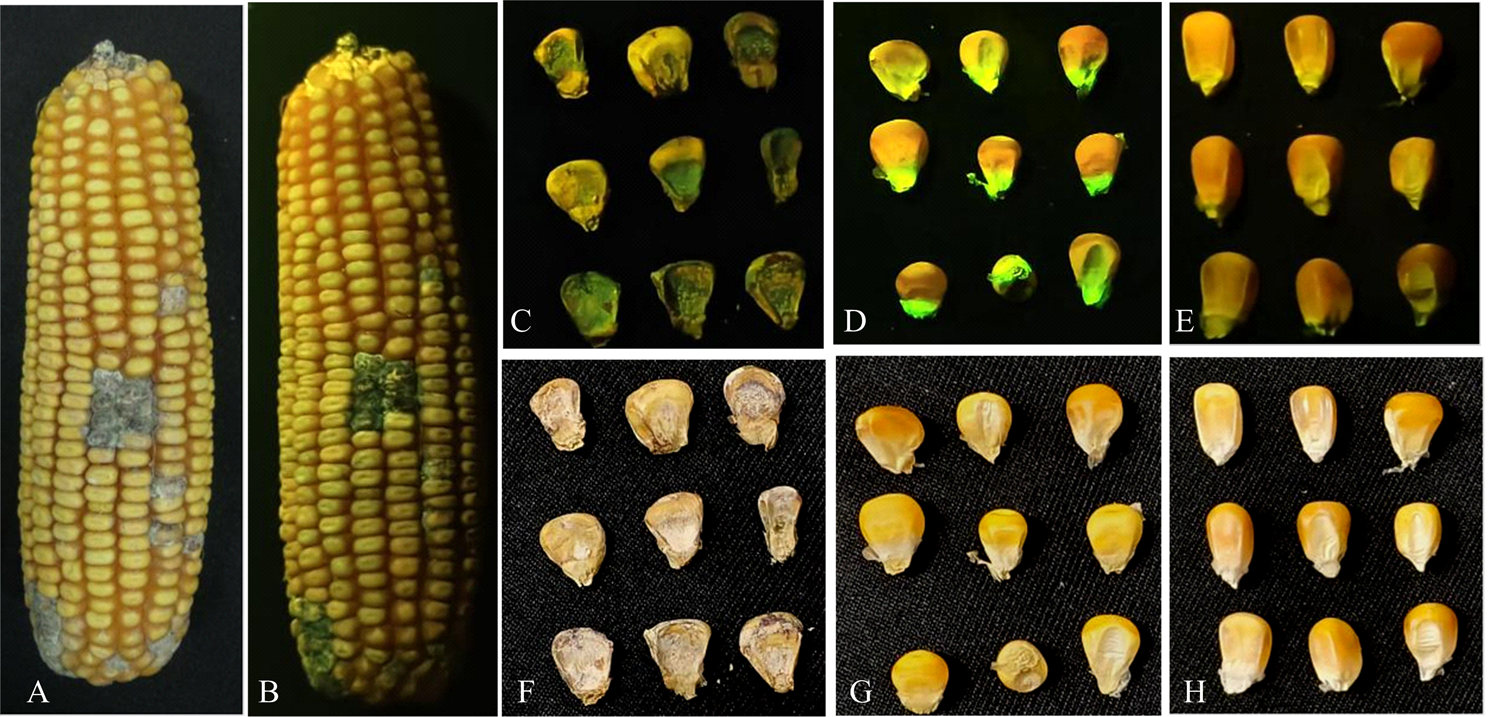
图1
拟轮枝镰孢在果穗上的侵染情况 A、B:分别为明场和荧光场下的果穗Ears under bright field and fluorescence field, respectively;C、F:分别为荧光场和明场下的发病籽粒Diseased kernels under fluorescence field and bright field, respectively;D、G:分别为荧光场和明场下的无症状感染籽粒Asymptomatically infected kernels under fluorescence field and bright field, respectively;E、H:分别为荧光场和明场下的健康籽粒Healthy kernels under fluorescence field and bright field, respectively"
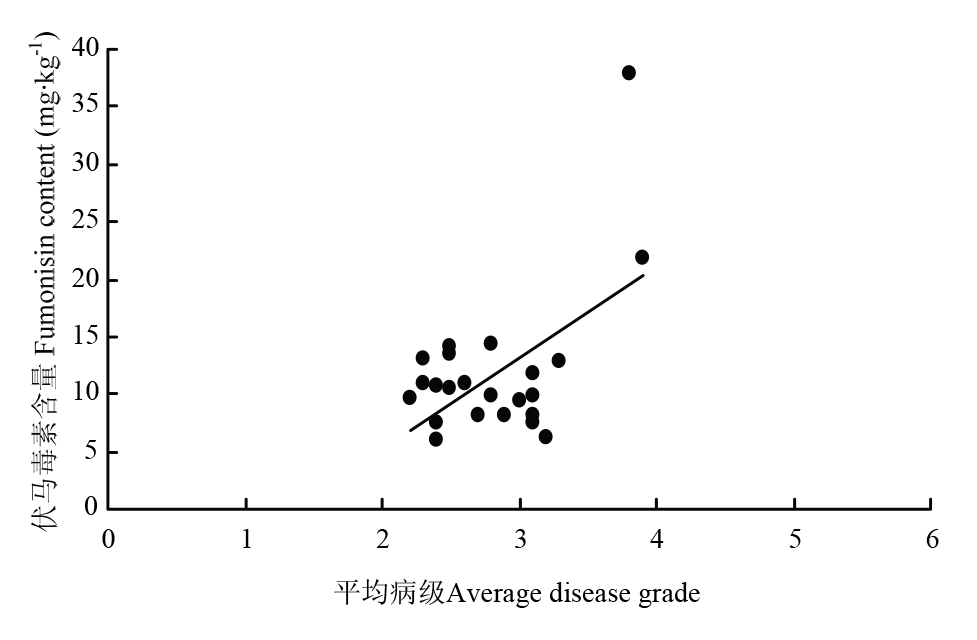
图2
毒素含量与平均病级相关性散点图"
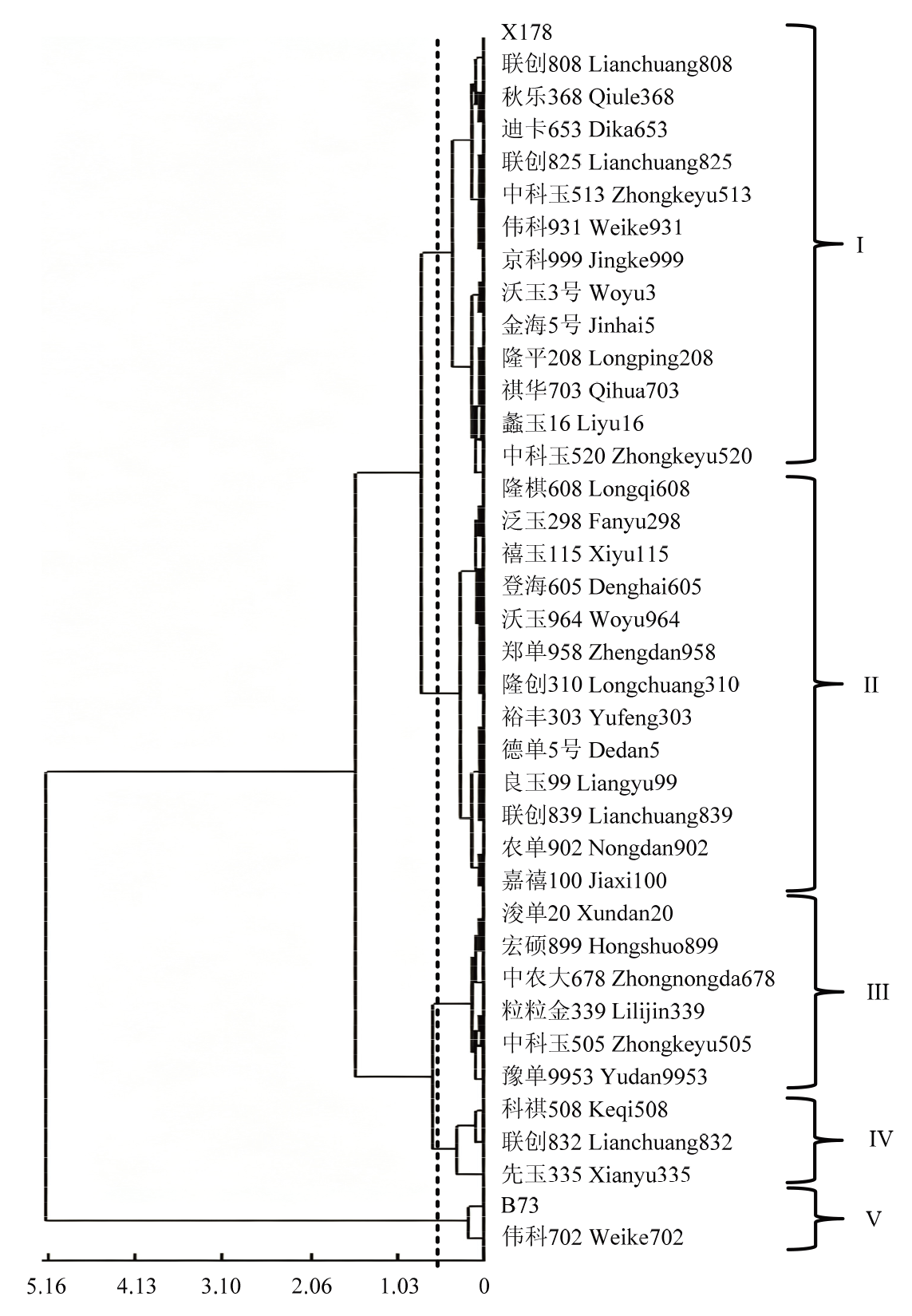
图3
基于伏马毒素含量比值的不同玉米品种聚类图"

表1
两种评价方法下142份自交系对拟轮枝镰孢穗腐病的抗性水平"
| 品种 Variety | 标准NY/T1248.8—2016 Standard NY/T1248.8—2016 | 本研究抗性评价体系 Resistance evaluation system in this study | 品种 Variety | 标准NY/T1248.8—2016 Standard NY/T1248.8—2016 | 本研究抗性评价体系 Resistance evaluation system in this study | ||||||||||||
|---|---|---|---|---|---|---|---|---|---|---|---|---|---|---|---|---|---|
| 平均病级 Average disease grade | 抗性 Resistance | 伏马毒素含量比值 Fumonisin content ratio | 抗性 Resistance | 平均病级 Average disease grade | 抗性 Resistance | 伏马毒素含量比值 Fumonisin content ratio | 抗性 Resistance | ||||||||||
| X178 | 3.5 | R | 0.53 | R | F351 | 1.3 | HR | 0.62 | R | ||||||||
| B73 | 7.0 | S | 1.47 | HS | 17INI20 | 6.0 | S | 4.46 | HS | ||||||||
| PH0DH | 4.0 | MR | 0.72 | MR | 09DSS1 | 3.2 | R | 0.91 | S | ||||||||
| PH0HR | 4.4 | MR | 1.20 | S | PHKV0 | 2.8 | R | 1.70 | HS | ||||||||
| PH02T | 4.7 | MR | 1.15 | S | PH0AA | 3.0 | R | 0.06 | HR | ||||||||
| PH04G | 4.6 | MR | 0.10 | HR | LH293 | 2.4 | R | 0.45 | R | ||||||||
| PH05F | 2.8 | R | 2.62 | HS | 79314N1 | 3.1 | R | 1.09 | S | ||||||||
| PH05W | 4.9 | MR | 1.13 | S | LH261 | 7.8 | HS | 5.57 | HS | ||||||||
| PH06N | 5.4 | MR | 1.16 | S | PH1B8 | 3.0 | R | 0.27 | HR | ||||||||
| PH07D | 2.4 | R | 1.61 | HS | PH2KN | 2.1 | R | 0.02 | HR | ||||||||
| PH08A | 4.1 | MR | 1.01 | S | PH1W0 | 4.4 | MR | 1.12 | S | ||||||||
| PH08B | 6.4 | S | 5.31 | HS | LH287 | 3.9 | MR | 0.50 | R | ||||||||
| PH09E | 2.2 | R | 5.31 | HS | LH245 | 3.7 | MR | 0.72 | MR | ||||||||
| PH12J | 7.3 | S | 1.70 | HS | PH0CD | 4.4 | MR | 4.02 | HS | ||||||||
| PH17C | 2.2 | R | 0.73 | MR | PH1CN | 1.7 | R | 0.15 | HR | ||||||||
| PH22G | 4.9 | MR | 0.09 | HR | PH1GC | 4.5 | MR | 2.28 | HS | ||||||||
| PH24M | 2.8 | R | 0.03 | HR | PH24D | 5.8 | S | 2.71 | HS | ||||||||
| PH32C | 2.7 | R | 1.92 | HS | PH0GP | 4.0 | MR | 1.96 | HS | ||||||||
| PH21T | 3.7 | MR | 2.72 | HS | PH19V | 2.6 | R | 0.48 | R | ||||||||
| PH1B5 | 4.4 | MR | 1.71 | HS | PH189 | 4.6 | MR | 4.13 | HS | ||||||||
| PH0JG | 4.5 | MR | 1.15 | S | NP2015 | 5.6 | S | 0.72 | MR | ||||||||
| PH1TB | 4.9 | MR | 0.62 | R | PH0B3 | 3.1 | R | 0.67 | MR | ||||||||
| PH45A | 4.7 | MR | 2.61 | HS | PH0WE | 2.3 | R | 0.92 | S | ||||||||
| PH0V0 | 4.7 | MR | 4.62 | HS | PH1NF | 1.1 | HR | 0.08 | HR | ||||||||
| PH12C | 3.8 | MR | 1.17 | S | SVAP7 | 7.1 | S | 0.36 | HR | ||||||||
| PH80B | 6.0 | S | 2.47 | HS | SVBE4 | 4.3 | MR | 1.80 | HS | ||||||||
| PH42B | 3.3 | R | 0.72 | MR | SVCI17 | 4.8 | MR | 1.17 | S | ||||||||
| 01IZB2 | 4.3 | MR | 0.72 | MR | MR724 | 2.3 | R | 2.38 | HS | ||||||||
| SNBM | 2.8 | R | 0.04 | HR | NR113 | 6.9 | S | 1.66 | HS | ||||||||
| ZS01228 | 4.3 | MR | 1.14 | S | 83INI14 | 6.9 | S | 1.08 | S | ||||||||
| 3DHA9 | 5.3 | MR | 2.47 | HS | PH3KP | 5.4 | MR | 1.89 | HS | ||||||||
| 01CSI6 | 2.0 | R | 0.04 | HR | PH2VE | 3.2 | R | 0.21 | HR | ||||||||
| 90DJD28 | 2.0 | R | 0.13 | HR | PH1CP | 6.1 | S | 1.26 | HS | ||||||||
| LH300 | 4.7 | MR | 1.63 | HS | PH2V7 | 2.7 | R | 0.94 | S | ||||||||
| LH238 | 1.7 | R | 0.73 | MR | PH1EM | 3.9 | MR | 0.23 | HR | ||||||||
| LH264 | 1.9 | R | 1.06 | S | PH1M8 | 2.2 | R | 0.46 | R | ||||||||
| LH273 | 3.1 | R | 0.14 | HR | PH1MD | 3.8 | MR | 0.02 | HR | ||||||||
| LH286 | 6.0 | S | 1.95 | HS | PH3EV | 4.8 | MR | 0.45 | R | ||||||||
| ND288 | 5.9 | S | 1.35 | HS | PH4TF | 3.1 | R | 0.16 | HR | ||||||||
| 09DSQ1 | 3.3 | R | 1.60 | HS | PH9H3 | 3.0 | R | 1.05 | S | ||||||||
| 17DHD7 | 1.9 | R | 0.15 | HR | PH3GR | 2.6 | R | 0.31 | HR | ||||||||
| 70LDL5 | 5.2 | MR | 0.83 | MR | PH3GK | 5.7 | S | 1.20 | S | ||||||||
| NP2029 | 4.1 | MR | 5.84 | HS | PH2VK | 3.3 | R | 0.51 | R | ||||||||
| NP2151 | 2.1 | R | 0.86 | S | PH2VJ | 5.0 | MR | 1.02 | S | ||||||||
| NP2031 | 3.1 | R | 1.71 | HS | PH0WD | 3.3 | R | 0.29 | HR | ||||||||
| NP2115 | 4.5 | MR | 3.42 | HS | PH224 | 3.6 | MR | 1.04 | S | ||||||||
| PH185 | 7.8 | HS | 3.54 | HS | PH1MR | 5.1 | MR | 0.93 | S | ||||||||
| PH54H | 7.3 | S | 1.60 | HS | PH1K2 | 5.6 | S | 0.26 | HR | ||||||||
| PH79A | 2.6 | R | 0.73 | MR | LH253 | 5.0 | MR | 0.84 | MR | ||||||||
| WDHQ11 | 2.7 | R | 1.99 | HS | LH267 | 5.8 | S | 1.13 | S | ||||||||
| 86ISI26 | 3.5 | R | 0.88 | S | PH2N0 | 6.5 | S | 10.47 | HS | ||||||||
| 86ISI27 | 3.4 | R | 1.40 | HS | PH3P0 | 8.4 | HS | 3.55 | HS | ||||||||
| 22DHQ3 | 2.3 | R | 0.95 | S | PH8V0 | 6.7 | S | 4.48 | HS | ||||||||
| 87ATD2 | 3.7 | MR | 0.95 | S | LH266 | 5.7 | S | 0.33 | HR | ||||||||
| PH0B4 | 4.5 | MR | 1.52 | HS | LH303 | 2.1 | R | 0.22 | HR | ||||||||
| NP2066 | 2.8 | R | 0.34 | HR | LH277 | 6.4 | S | 1.13 | S | ||||||||
| PH77C | 3.6 | MR | 0.79 | MR | LH229 | 2.9 | R | 0.43 | HR | ||||||||
| 17DHD16 | 4.4 | MR | 0.58 | R | PH0KT | 2.7 | R | 0.73 | MR | ||||||||
| 01HGI4 | 4.5 | MR | 2.36 | HS | PH5D6 | 2.7 | R | 0.39 | HR | ||||||||
| 17INI30 | 5.7 | S | 0.97 | S | PH3HH | 4.5 | MR | 0.04 | HR | ||||||||
| 17QFB1 | 7.2 | S | 5.21 | HS | PH1BC | 3.4 | R | 0.36 | HR | ||||||||
| 94INK1A | 8.8 | HS | 2.61 | HS | PH2EJ | 4.3 | MR | 0.39 | HR | ||||||||
| 91ISI5 | 4.3 | MR | 1.87 | HS | PH3PG | 3.7 | MR | 0.94 | S | ||||||||
| PH0AV | 6.6 | S | 1.57 | HS | PH4TW | 2.9 | R | 1.99 | HS | ||||||||
| PH1GG | 4.9 | MR | 3.92 | HS | PH4TV | 4.2 | MR | 1.27 | HS | ||||||||
| PH2CB | 2.9 | R | 1.23 | S | GF6150 | 5.0 | MR | 0.69 | MR | ||||||||
| PH38D | 3.6 | MR | 0.28 | HR | PH48V | 3.8 | MR | 0.41 | HR | ||||||||
| 86AQV2 | 3.2 | R | 1.14 | S | PH51H | 7.3 | S | 1.36 | HS | ||||||||
| 86ISI5 | 6.4 | S | 0.64 | R | PH4PV | 4.5 | MR | 0.37 | HR | ||||||||
| WDHQ2 | 2.7 | R | 0.32 | HR | PH1GD | 3.2 | R | 0.33 | HR | ||||||||
| 83INI8 | 4.3 | MR | 1.59 | HS | PH50P | 6.0 | S | 1.51 | HS | ||||||||
| 01HGI2 | 4.0 | MR | 0.92 | S | PH5CT | 5.2 | MR | 1.55 | HS | ||||||||
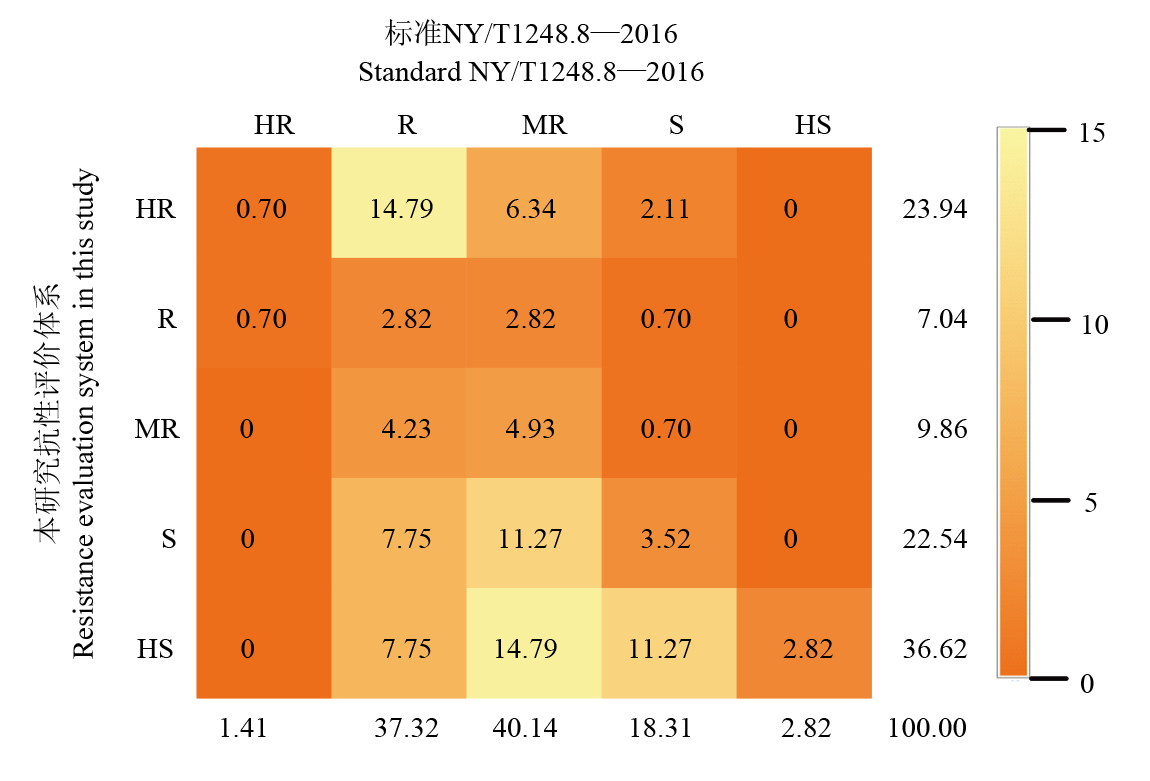
图4
两种评价方法下142份自交系的抗性等级分布"
| [1] |
段灿星, 王晓鸣, 宋凤景, 孙素丽, 周丹妮, 朱振东. 玉米抗穗腐病研究进展. 中国农业科学, 2015, 48(11): 2152-2164. doi: 10.3864/j.issn.0578-1752.2015.11.007.
|
|
|
|
| [2] |
孙华, 丁梦军, 张家齐, 石洁, 郭宁, 李坡. 河北省玉米穗腐病病原菌鉴定及潜在产伏马毒素镰孢菌系统发育分析. 植物病理学报, 2019, 49(2): 151-159.
doi: 10.13926/j.cnki.apps.000284 |
|
doi: 10.13926/j.cnki.apps.000284 |
|
| [3] |
丁梦军, 杨扬, 孙华, 马红霞, 刘树森, 石洁. 山东省玉米穗腐病病原菌的分离鉴定及优势种的系统发育分析. 华北农学报, 2019, 34(5): 216-223.
doi: 10.7668/hbnxb.201751508 |
|
|
|
| [4] |
doi: 10.1016/j.micpath.2024.107237 |
| [5] |
doi: 10.1016/j.ijbiomac.2023.125046 |
| [6] |
doi: 10.1016/j.envpol.2023.121065 |
| [7] |
doi: 10.1590/S0100-736X2011000500007 |
| [8] |
doi: 10.1093/carcin/12.7.1247 |
| [9] |
doi: 10.3892/etm.2013.1364 |
| [10] |
doi: 10.1007/s00244-014-0004-z pmid: 24549592 |
| [11] |
李巍. 伏马毒素对雏鸡毒性作用的初步探究[D]. 长沙: 湖南农业大学, 2015.
|
|
|
|
| [12] |
坚乃丹, 常晓娇, 孙晶, 王春玲, 孙长坡. 伏马毒素的危害及防控技术研究进展. 食品工业科技, 2018, 39(7): 335-339, 347.
|
|
|
|
| [13] |
李人杰. 不同耕作方式及杀虫剂处理对玉米穗腐病发生及玉米籽粒中伏马毒素污染水平的影响[D]. 保定: 河北农业大学, 2015.
|
|
|
|
| [14] |
doi: 10.1016/j.foodcont.2017.03.055 |
| [15] |
谭莉, 孟繁磊, 范宏,
|
|
|
|
| [16] |
夏玉生, 郭成, 温胜慧, 孙素丽, 朱振东, 段灿星. 玉米种质抗拟轮枝镰孢与禾谷镰孢穗腐病鉴定及抗性多样性分析. 植物遗传资源学报, 2022, 23(1): 61-71.
doi: 10.13430/j.cnki.jpgr.20210727001 |
|
|
|
| [17] |
段灿星, 崔丽娜, 夏玉生, 董怀玉, 杨知还, 胡清玉, 孙素丽, 李晓, 朱振东, 王晓鸣. 玉米种质资源对拟轮枝镰孢与禾谷镰孢穗腐病的抗性精准鉴定与分析. 作物学报, 2022, 48(9): 2155-2167.
doi: 10.3724/SP.J.1006.2022.13055 |
|
doi: 10.3724/SP.J.1006.2022.13055 |
|
| [18] |
齐欣, 张默, 贾钰莹, 孙成韬, 马骏, 姜敏, 王延波, 曹志艳, 刘宁, 刘欣芳. 抗两种穗腐病玉米种质资源的鉴选. 玉米科学, 2025, 33(8): 111-117.
|
|
|
|
| [19] |
doi: 10.1094/PDIS-08-11-0695 |
| [20] |
doi: 10.1002/csc2.v65.5 |
| [21] |
陈婧. 长江中下游麦区小麦种质资源抗病性鉴定与分析[D]. 荆州: 长江大学, 2025.
|
|
|
|
| [22] |
杨校文, 常立国, 杨琴. 玉米穗腐病真菌毒素污染抗性遗传研究进展. 玉米科学, 2023, 31(1): 161-169.
|
|
|
|
| [23] |
王晓鸣, 孙世贤, 石洁, 李晓, 晋齐鸣. 第8部分: 镰孢穗腐病(NY/T 1248.8—2016)//玉米抗病虫性鉴定技术规范. 北京: 中国农业出版社, 2017.
|
|
|
|
| [24] |
陈强, 张金龙, 雷帅, 李强, 陈国华, 张晓明. 不同玉米新品种田间抗蚜性比较. 玉米科学, 2020, 28(5): 162-168.
|
|
|
|
| [25] |
李改婵, 祖瑞锋, 巩智利. 陕西地区玉米生霉粒、小麦病斑粒与真菌毒素关系的探讨分析. 粮食储藏, 2018, 47(6): 33-39.
|
|
|
|
| [26] |
doi: 10.1094/PDIS.2003.87.2.147 |
| [27] |
doi: 10.1094/PHYTO.2004.94.3.251 |
| [28] |
姜友军, 陈晋莹, 徐广超, 余苗. 玉米生霉粒和霉变粒与真菌毒素含量关系的研究分析. 中国粮油学报, 2020, 35(2): 129-133.
|
|
|
|
| [29] |
刘璐. 花生疮痂病菌毒素生物活性及产生条件研究[D]. 沈阳: 沈阳农业大学, 2018.
|
|
|
|
| [30] |
唐璎, 刘晓静. 基于高分辨质谱法的甘肃青贮紫花苜蓿真菌毒素污染特征. 草业学报, 2025, 34(11): 81-97.
doi: 10.11686/cyxb2024479 |
|
doi: 10.11686/cyxb2024479 |
|
| [31] |
张娜娜, 陈利容, 张守梅, 郭玉秋, 刘开昌, 龚魁杰. 鲜食玉米籽粒发育期间污染真菌分离鉴定及真菌毒素含量分析. 食品科学, 2021, 42(16): 273-280.
|
|
doi: 10.7506/spkx1002-6630-20200313-206 |
|
| [32] |
doi: 10.1016/j.envres.2023.116907 |
| [33] |
郭宁, 孙华, 马红霞, 刘树森, 张海剑, 石洁, 郑晓娟, 董跃广. 玉米腐霉茎腐病生防木霉菌株的筛选、鉴定及防治效果分析. 中国农业科学, 2023, 56(22): 4453-4466. doi: 10.3864/j.issn.0578-1752.2023.22.008.
|
|
|
|
| [34] |
刘树森, 孙华, 石洁, 郭宁, 马红霞, 张海剑. 基于地上部症状的玉米根腐病分级及严重度与农艺性状的关系. 中国农业科学, 2022, 55(20): 3939-3947. doi: 10.3864/j.issn.0578-1752.2022.20.006.
|
|
|
|
| [35] |
周金鑫, 吴佳文, 吴达粉, 葛玉林. 小麦叶部锈病与白粉病防治药剂的筛选. 大麦与谷类科学, 2021, 38(6): 39-43.
|
|
|
|
| [36] |
徐晓伟, 冯晶, 王凤涛, 赵小倩, 秦艳艳, 童朝阳, 蔺瑞明. 一粒系小麦遗传多样性分析及抗条锈菌CYR34鉴定. 植物遗传资源学报, 2024, 25(10): 1726-1736.
|
|
|
|
| [37] |
李佳阳, 刘国强, 黄诗涵, 崔金月, 肖淑芹, 薛春生. 辽宁省玉米穗腐病致病层出镰孢菌生物学特性、致病力与产伏马毒素B1比较. 玉米科学, 2022, 30(5): 163-170.
|
|
|
|
| [38] |
孙华, 李坡, 郭宁, 石洁, 张家齐, 张海剑. 玉米穗腐病样本中温和镰孢菌的鉴定及其生物学特性. 玉米科学, 2020, 28(1): 177-183, 190.
|
|
|
| [1] | 郭月, 张云龙, 刘德才, 王俊禹, 刘湟捷, 邵晓琪, 彭琦, 于仕程, 祁余容, 高建芹, 张洁夫, 胡茂龙. 油菜5N对ALS抑制剂类除草剂的交互抗性机理[J]. 中国农业科学, 2026, 59(9): 1887-1902. |
| [2] | 赵思捷, 任家欣, 南江磊, 王兴云, 成卫宁. 玉米叶片次生物质含量及相关基因表达与其对草地贪夜蛾抗性的关系[J]. 中国农业科学, 2026, 59(8): 1686-1696. |
| [3] | 崔士友, 陈澎军, 缪源卿, 韩继军, 沈俊明. EMS诱变抗草甘膦小麦新种质的创制与大田评价[J]. 中国农业科学, 2026, 59(4): 723-733. |
| [4] | 岳润清, 李文兰, 丁照华, 孟昭东. 转基因复合抗虫耐除草剂玉米LD05的分子特征及抗性评价[J]. 中国农业科学, 2025, 58(7): 1269-1283. |
| [5] | 覃璐, 谌丹丹, 江晓丽, 谢合平, 敖义俊, 杨阳, 朱峰, 许让伟, 廖文月, 程运江. 水分状态对连阴雨天气采收柑橘果实贮藏性能的影响[J]. 中国农业科学, 2025, 58(24): 5259-5273. |
| [6] | 陈娟妮, 陈品璐, 李珏, 谢蒙潇, 李欣蓓, 丁伟. 纳米氧化镁诱导烟草抗青枯病的作用机理[J]. 中国农业科学, 2025, 58(16): 3327-3344. |
| [7] | 颉晖晖, 杨秋华, 李文丽, 朱锦程, 李惠霞, 张峰. 抗南方根结线虫马铃薯野生种渐渗种质的鉴定[J]. 中国农业科学, 2025, 58(14): 2924-2932. |
| [8] | 崔梦杰, 孙子淇, 齐飞艳, 刘华, 徐静, 杜培, 黄冰艳, 董文召, 韩锁义, 张新友. 322份花生种质资源黄曲霉侵染抗性的评价[J]. 中国农业科学, 2025, 58(12): 2303-2315. |
| [9] | 陈二虎, 袁国庆, 陈艳, 陈梦秋, 孙晟源, 唐培安. 线粒体编码基因Nad5、Nad6和Atp6参与锈赤扁谷盗磷化氢抗性形成[J]. 中国农业科学, 2024, 57(9): 1722-1733. |
| [10] | 黄立强, 江如, 朱波汁, 彭焕, 许翀, 宋家雄, 陈敏, 李永青, 黄文坤, 彭德良. 马铃薯主栽品种抗马铃薯金线虫鉴定及抗性分子标记检测[J]. 中国农业科学, 2024, 57(8): 1506-1516. |
| [11] | 肖刘华, 康乃慧, 李树成, 郑致远, 罗绕绕, 陈金印, 陈明, 向妙莲. 茉莉酸甲酯对猕猴桃果实抗葡萄座腔菌过程中能量代谢和膜脂代谢的影响[J]. 中国农业科学, 2024, 57(7): 1377-1393. |
| [12] | 胡衡亮, 顾天宇, 陈思颖, 王垚, 彭佳师. 莲中介导矿质元素胁迫耐受性基因的筛选与功能验证[J]. 中国农业科学, 2024, 57(5): 980-988. |
| [13] | 熊尚烨, 张翔, 梁宝慧, 叶仰东, 李浴阳, 朱晓, 朱志鸿, 官华忠, 张帅, 吴建国, 胡杰. 水稻抗褐飞虱基因QBPH1和QBPH4的精细定位与聚合效应分析[J]. 中国农业科学, 2024, 57(23): 4619-4631. |
| [14] | 柴海燕, 潘艺元, 白雪, 孟玲敏, 张伟, 吴宏斌, 王义生, 高月波, 贾娇, 苏前富. 蚜虫危害与玉米果穗镰孢菌组成及毒素污染关系分析[J]. 中国农业科学, 2024, 57(16): 3171-3181. |
| [15] | 曹鹏, 周金环, 王新亮, 李楚欣, 李佳欣, 姜培, 刘金香, 宋震. 发根农杆菌介导的柑橘黄龙病抗性快速评价体系优化及应用[J]. 中国农业科学, 2024, 57(16): 3182-3191. |
|
||
