






中国农业科学 ›› 2026, Vol. 59 ›› Issue (4): 887-899.doi: 10.3864/j.issn.0578-1752.2026.04.014
杨帆1,2( ), 胡小倩1,2, 王宇2, 岳彩霞2, 张锐2, 田雯1,2, 汪婷婷2, 李阳2, 季美泉2, 张莉会3, 安可婧4
收稿日期:2025-06-19
出版日期:2026-02-10
发布日期:2026-02-10
通信作者:
联系方式:
杨帆,E-mail:fyang@nufe.edu.cn
基金资助:
YANG Fan1,2(), HU XiaoQian1,2, WANG Yu2, YUE CaiXia2, ZHANG Rui2, TIAN Wen1,2, WANG TingTing2, LI Yang2, JI MeiQuan2, ZHANG LiHui3, AN KeJing4
Received:2025-06-19
Published:2026-02-10
Online:2026-02-10
摘要:
【目的】芽孢杆菌的热抗性及潜在安全风险可能威胁蜂蜜产品品质,因此需要优化蜂蜜中芽孢杆菌检测前处理工艺,揭示芽孢杆菌污染特征,并评估加工环节风险,为建立科学有效的质量安全管控体系提供理论依据。【方法】为提升蜂蜜中芽孢杆菌检测结果的准确性,本研究选取60—80 ℃温度区间开展热处理条件优化试验,系统探究可同步实现高效灭活杂菌与保留芽孢杆菌芽孢浓度的最优工艺条件。对150份市售蜂蜜样本与150份原料蜜样本中的芽孢杆菌进行芽孢计数,并进一步对菌株分离纯化,同时结合基质辅助激光解吸电离飞行时间质谱(Matrix-Assisted Laser Desorption/ Ionization Time of Flight Mass Spectometry,MALDI-TOF MS)和基于二代测序对细菌基因组测序的方法鉴定蜂蜜中芽孢杆菌类型,并统计各蜂蜜样品中芽孢杆菌的种类及检出率,同时开展食品安全风险评估。模拟蜂蜜的加工环节,探究40—60 ℃热处理对蜂蜜中蜡样芽孢杆菌芽孢生长的影响,并明确其变化趋势。【结果】80 ℃/10 min热处理可完全灭活蜂蜜中的干扰菌(大肠杆菌和酿酒酵母),并且维持芽孢存活率在同一数量级;对150份市售蜂蜜样本与150份原料蜜样本的芽孢杆菌计数结果及鉴定结果进行统计分析,结果显示:市售蜂蜜芽孢杆菌总检出率为38.7%,以蜡样芽孢杆菌(20.7%)、枯草芽孢杆菌(12.7%)及短小芽孢杆菌(11.3%)为主;原料蜜中芽孢杆菌总体检出率为23.3%,以蜡样芽孢杆菌(16.7%)、短小芽孢杆菌(8.0%)和地衣芽孢杆菌(3.3%)为主,对比市售蜂蜜和原料蜜中检出芽孢杆菌浓度最高的样品,结果显示均为蜡样芽孢杆菌的单一污染。此外,模拟蜂蜜加工热处理条件(40—60 ℃),结果显示蜡样芽孢杆菌芽孢数量与温度-时间呈正相关,随处理温度升高与处理时间延长,其芽孢数量呈现上升趋势。芽孢杆菌种类相关性分析显示,市售蜂蜜中的芽孢杆菌污染主要源自原料蜜携带,环境菌的检出间接表明蜂蜜在蜜蜂采集、原料蜜采收及后续加工等环节中存在被微生物污染的可能性。【结论】80 ℃热处理10 min为蜂蜜中芽孢杆菌检测的最优热处理条件;蜡样芽孢杆菌为蜂蜜中的主要风险菌株,建议蜂蜜生产企业可将芽孢杆菌列为原料蜜质量管控的核心监测指标之一。
杨帆, 胡小倩, 王宇, 岳彩霞, 张锐, 田雯, 汪婷婷, 李阳, 季美泉, 张莉会, 安可婧. 蜂蜜中需氧芽孢杆菌检测条件优化及污染特征分析[J]. 中国农业科学, 2026, 59(4): 887-899.
YANG Fan, HU XiaoQian, WANG Yu, YUE CaiXia, ZHANG Rui, TIAN Wen, WANG TingTing, LI Yang, JI MeiQuan, ZHANG LiHui, AN KeJing. Optimization of Detection Conditions for Aerobic Spore-Forming Bacillus in Honey and Analysis of Its Contamination Characteristics[J]. Scientia Agricultura Sinica, 2026, 59(4): 887-899.
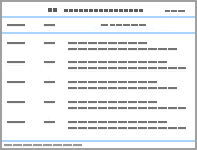
表1
市售蜂蜜类型及数量"
| 市售蜂蜜类型 Types of commercial honey | 检测数量 Detection quantity |
|---|---|
| 洋槐蜂蜜Robinia pseudoacacia honey | 38 |
| 百花蜂蜜Mixed nectar honey | 35 |
| 荆条蜂蜜Vitex negundo honey | 20 |
| 枣花蜂蜜Ziziphus jujuba honey | 15 |
| 椴树蜂蜜 Tilia spp. honey | 11 |
| 油菜蜂蜜 Brassica napus honey | 11 |
| 紫云英蜂蜂蜜Astragalus sinicus honey | 9 |
| 麦卢卡蜂蜜Leptospermum scoparium honey | 3 |
| 紫花苕蜂蜜Vicia villosa honey | 1 |
| 益母草蜂蜜Leonurus japonicus honey | 1 |
| 枇杷蜂蜜 Eriobotrya japonica honey | 1 |
| 葵花蜂蜜Helianthus annuus honey | 1 |
| 党参蜂蜜Codonopsis pilosula honey | 1 |
| 黄芪蜂蜜Astragalus membranaceus honey | 1 |
| 桂花蜂蜜Osmanthus fragrans honey | 1 |
| 枸杞蜂蜜Lycium barbarum honey | 1 |
表2
原料蜜类型、数量及采集信息"
| 原料蜜类型 Types of raw honey | 检测数量 Detection quantity | 采集地址 Collection address | 采集时间(年.月) Collection time (Y.M) |
|---|---|---|---|
| 椴树蜂蜜 Tilia spp. honey | 12 | 吉林延边安图县 Antu County, Yanbian, Jilin | 2023.07 |
| 8 | 伊春嘉荫保兴马连 Malian, Baoxing, Jiayin, Yichun | 2023.07 | |
| 4 | 伊春嘉荫东升 Dongsheng, Jiayin, Yichun | 2023.07 | |
| 3 | 伊春嘉荫保兴永丰 Yongfeng, Baoxing, Jiayin, Yichun | 2023.07 | |
| 洋槐蜂蜜Robinia pseudoacacia honey | 11 | 山西灵石 Lingshi, Shanxi | 2023.05 |
| 10 | 山西永和Yonghe, Shanxi | 2023.05 | |
| 7 | 山西大宁县 Daning County, Shanxi | 2023.05 | |
| 6 | 甘肃省泾川县 Jingchuan County, Gansu | 2023.05 | |
| 5 | 甘肃省天水市Tianshui, Gansu | 2023.05 | |
| 5 | 河北省石家庄市 Shijiazhuang, Hebei | 2023.05 | |
| 5 | 山西石楼Shilou, Shaanxi | 2023.05 | |
| 5 | 山西石楼 Shilou, Shaanxi | 2023.05 | |
| 4 | 甘肃省庆阳市 Qingyang, Gansu | 2023.05 | |
| 4 | 山西省临汾市 Linfen, Shanxi | 2023.05 | |
| 4 | 山西隰县 Xixian, Shanxi | 2023.05 | |
| 4 | 山西隰县 Xixian, Shanxi | 2023.05 | |
| 4 | 陕西麟游县 Linyou, Shaanxi | 2023.05 | |
| 3 | 河南省洛阳市 Luoyang, Henan | 2023.05 | |
| 3 | 山东省潍坊市 Weifang, Shandong | 2023.05 | |
| 2 | 山西柳林 Liulin, Shanxi | 2023.05 | |
| 油菜蜂蜜 Brassica napus honey | 2 | 四川中江县 Zhongjiang, Sichuan | 2024.03 |
| 1 | 江苏宝应 Baoying, Jiangsu | 2024.04 | |
| 1 | 江苏涟水 Lianshui, Jiangsu | 2024.04 | |
| 1 | 江苏南京 Nanjing, Jiangsu | 2024.04 | |
| 1 | 江苏泰州 Taizhou, Jiangsu | 2024.04 | |
| 1 | 江苏兴化 Xinghua, Jiangsu | 2024.04 | |
| 1 | 江苏盐城 Yancheng, Jiangsu | 2024.04 | |
| 枇杷蜂蜜 Eriobotrya japonica honey | 16 | 江苏扬州 Yangzhou, Jiangsu | 2024.05 |
| 枣花蜂蜜 Ziziphus jujuba honey | 12 | 陕西省榆林市 Yulin, Shaanxi | 2024.06 |
| 枸杞蜂蜜 Lycium barbarum honey | 3 | 青海西海 Xihai, Qinghai | 2023.07 |
| 山花蜂蜜 Mountain multi-floralr honey | 2 | 青海东海 Donghai, Qinghai | 2023.07 |
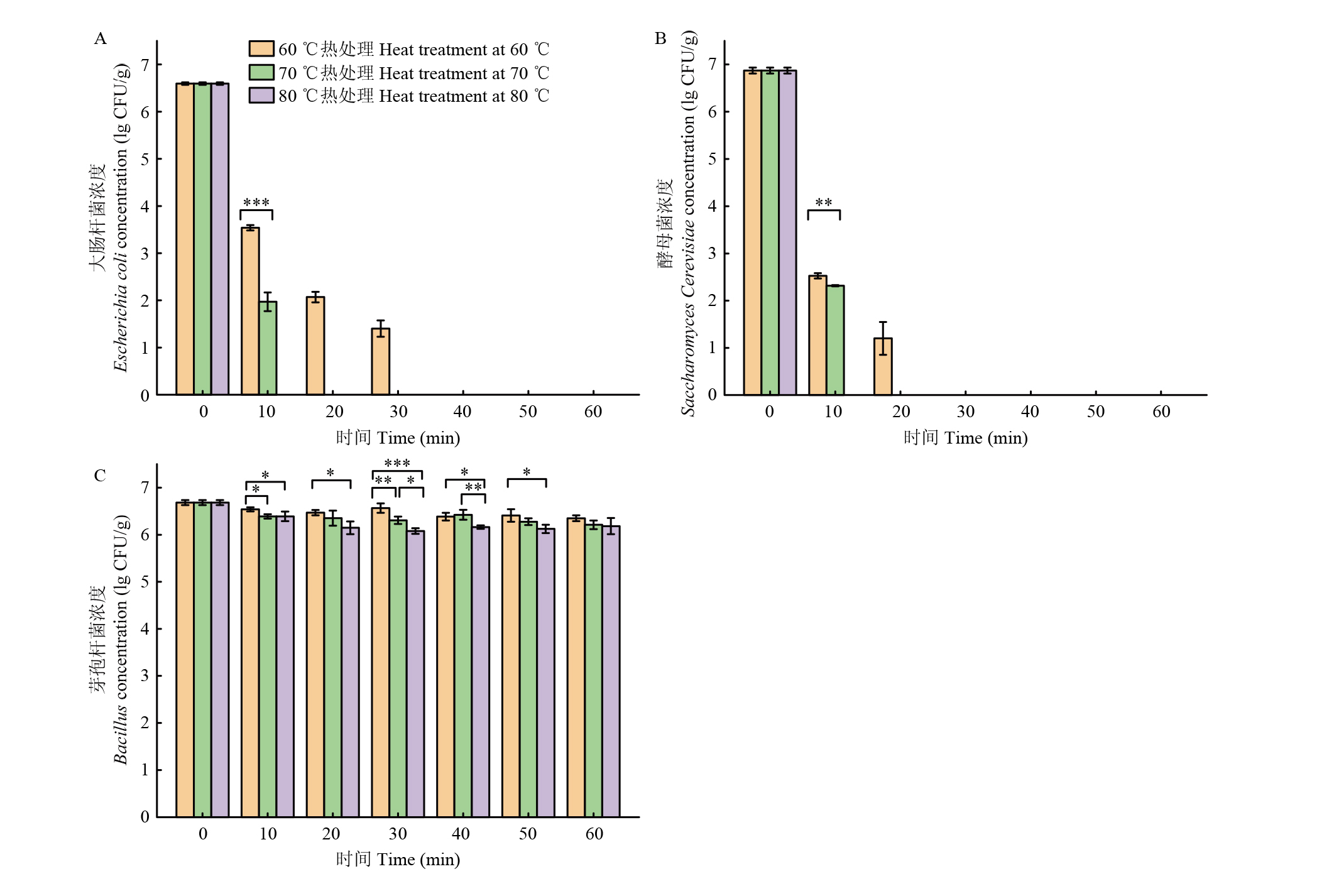
图1
不同热处理温度和时间对蜂蜜中大肠杆菌、酿酒酵母和芽孢杆菌浓度的影响 *:P<0.05;**:P<0.01;***:P<0.001。下同 The same as below"
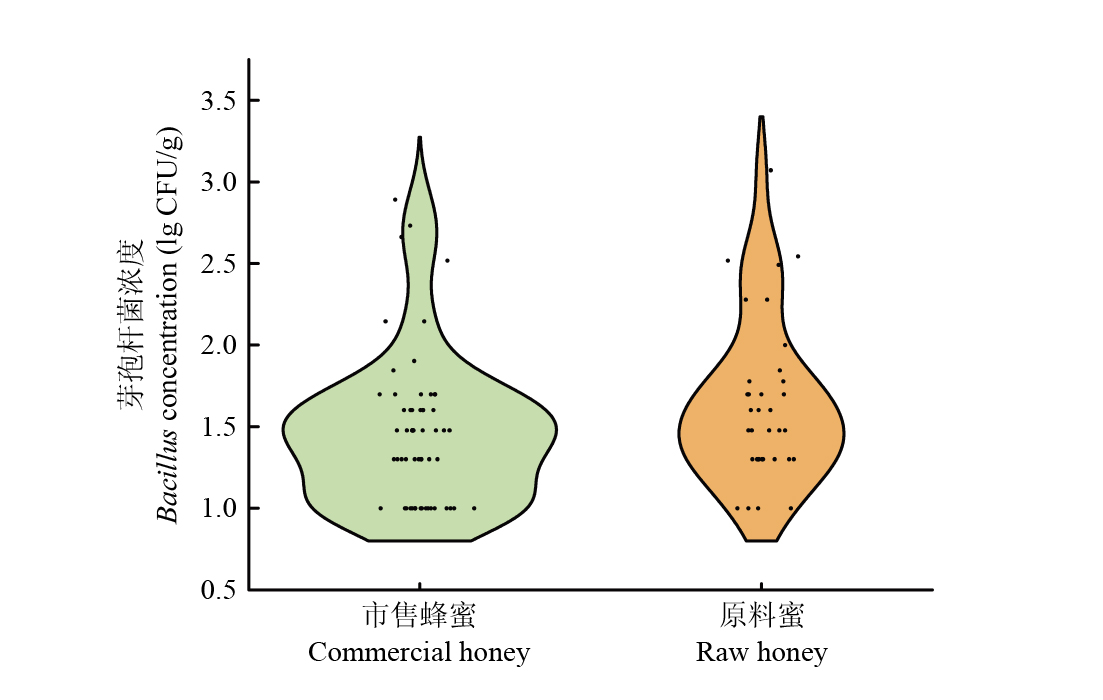
图2
150份市售蜂蜜和150份原料蜜中芽孢杆菌浓度(≥1 lg CFU/g)"

图3
市售蜂蜜(A)和原料蜜(B)中不同芽孢杆菌的检出率"

图4
4个市售蜂蜜来源菌株二代测序ANI相似度热图 1158、2987、1913和2739为4株芽孢杆菌的试验编号,GCA+数字为NCBI基因组集合组装序列 1158、2987、1913 and 2739 are the laboratory codes for four strains of Bacillus, while GCA+numbers refer to the NCBI genome collection assembly"
表3
4个市售蜂蜜来源菌株的菌种鉴定结果"
| 编号 No. | 菌种类型 Strains Species | 相似度 Similarity (%) | 基因组集合组装序列 Genome Collection Assembly |
|---|---|---|---|
| 1158 | 高地芽孢杆菌Bacillus altitudinis | 98.52 | GCA 028550655.1 |
| 2987 | 高地芽孢杆菌Bacillus altitudinis | 98.45 | GCA 028550655.1 |
| 1913 | 沙福芽孢杆菌Bacillus safensis | 98.72 | GCA 000828395.1 |
| 2739 | 沙福芽孢杆菌Bacillus safensis | 99.12 | GCA 015854505.1 |
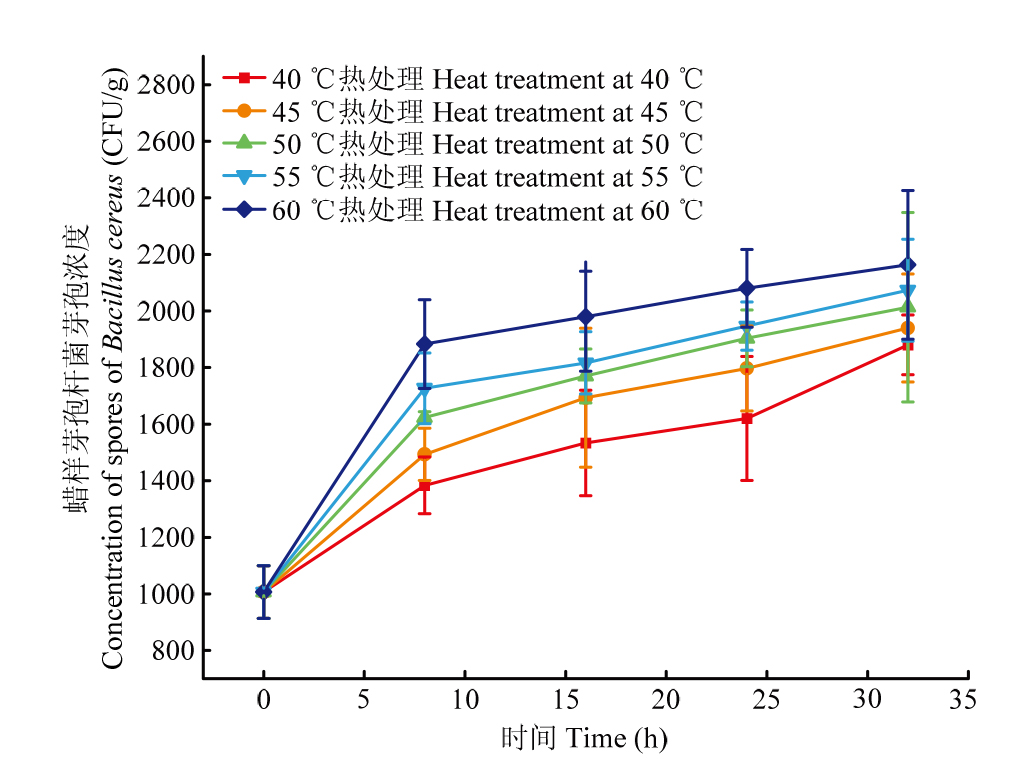
图5
温度和时间对蜂蜜中蜡样芽孢杆菌芽孢浓度的影响"
| [1] |
中华人民共和国卫生部. GB 14963-2011 食品安全国家标准蜂蜜. 北京: 中国标准出版社, 2011.
|
|
Ministry of Health of the People's Republic of China. GB 14963-2011 national food safety standard:Honey. Beijing: Standards Press of China, 2011. (in Chinese)
|
|
| [2] |
|
| [3] |
doi: 10.1007/s00217-022-04146-0 |
| [4] |
doi: 10.53365/nrfhh/174739 |
| [5] |
|
| [6] |
徐国钧, 郭智勇, 温佳豪, 刘青松. 中国蜂蜜在国际市场的定价话语权: 基于国际市场势力的实证分析. 世界农业, 2019(3): 77-83, 103, 116.
|
|
|
|
| [7] |
孟丽峰, 齐季, 罗照明, 游森刚. 2024年全球蜂蜜出口贸易概况. 中国蜂业, 2025, 76(10): 36-40.
|
|
|
|
| [8] |
doi: 10.4315/0362-028X.JFP-11-292 |
| [9] |
doi: 10.3390/molecules26082361 |
| [10] |
doi: 10.36948/ijfmr |
| [11] |
doi: 10.3390/microorganisms12040711 |
| [12] |
doi: 10.1016/j.ijfoodmicro.2021.109200 |
| [13] |
曾德新, 厉蓉蓉, 张娜, 封振, 许蔚, 张锐, 周俊, 蒋鲁岩. 市售蜂蜜中残留细菌的分离与鉴定. 美食研究, 2021(3): 75-81.
|
|
|
|
| [14] |
doi: 10.5897/AJB |
| [15] |
doi: 10.3389/fmicb.2022.930648 |
| [16] |
doi: 10.1038/s41598-025-17272-y |
| [17] |
郑飞. 蜂蜜浓缩加工工艺. 农村新技术, 2017(1): 54.
|
|
|
|
| [18] |
宁准梅. 蜂蜜过滤工艺的优化及其对产品品质影响的研究. 工业微生物, 2022, 52(3): 35-40.
|
|
|
|
| [19] |
刘秀芬. 中国非成熟蜂蜜的成因及加工工艺探析. 食品安全导刊, 2021(25): 184-187.
|
|
|
|
| [20] |
李传东. 成熟蜂蜜采收加工生产工艺初探. 蜜蜂杂志, 2022, 42(3): 29-30.
|
|
|
|
| [21] |
doi: 10.1016/j.foodres.2023.113904 |
| [22] |
国家卫生和计划生育委员会. GB 4789.15—2016 食品安全国家标准食品微生物学检验霉菌和酵母计数. 北京: 中国标准出版社, 2017.
|
|
National Health and Family Planning Commission of the People's Republic of China. GB 4789.15- 2016 national food safety standard:Microbiological examination of foods-Enumeration of Moulds and Yeasts. Beijing: Standards Press of China, 2017. (in Chinese)
|
|
| [23] |
国家卫生和计划生育委员会. GB 4789.14—2014 食品安全国家标准食品微生物学检验蜡样芽胞杆菌检验. 北京: 中国标准出版社, 2015.
|
|
National Health and Family Planning Commission of the People's Republic of China. GB 4789.14- 2014 national food safety standard:Microbiological examination of foods-Examination of Bacillus cereus. Beijing: Standards Press of China, 2015. (in Chinese)
|
|
| [24] |
中华人民共和国卫生部. GB 4789.38—2012 食品安全国家标准食品微生物学检验大肠杆菌计数. 北京: 中国标准出版社, 2012.
|
|
Ministry of Health of the People's Republic of China. GB 4789.38- 2012 national food safety standard:Microbiological examination of foods-enumeration of Escherichia coli. Beijing: Standards Press of China, 2012. (in Chinese)
|
|
| [25] |
国家卫生健康委员会, 国家市场监督管理总局. GB 4789.2—2022 食品安全国家标准食品微生物学检验菌落总数测定. 北京: 中国标准出版社, 2022.
|
|
National Health Commission of the People's Republic of China, State Administration for Market Regulation. GB 4789.2-2022 national food safety standard:Microbiological examination of foods-Determination of total viable counts. Beijing: Standards Press of China, 2022. (in Chinese)
|
|
| [26] |
doi: 10.1016/j.ijfoodmicro.2019.108245 |
| [27] |
张东春, 张雅娟, 孙颖, 司海山, 康亚朋, 马梦戈, 王志新, 宁亚维. 细菌芽孢的形成、萌发及控制手段研究进展. 食品工业科技, 2023, 44(15): 463-473.
|
|
|
|
| [28] |
doi: 10.3389/fcimb.2021.632679 |
| [29] |
RYCHERT J. Benefits and limitations of MALDI-TOF mass spectrometry for the identification of microorganisms. Journal of Infectiology, 2019, 2(4): 1-5.
|
| [30] |
沈应博, 史晓敏, 沈建忠, 汪洋, 王少林. 全基因组测序与生物信息学分析在细菌耐药性研究中的应用. 生物工程学报, 2019, 35(4): 541-557.
|
|
|
|
| [31] |
doi: 10.3390/ijerph15092002 |
| [32] |
蒋波, 李琼琼, 张芝华, 戴佳丽, 秦峰, 杨美成. 市售蜂蜜中污染微生物的调查分析. 上海预防医学, 2022, 34(1): 77-80.
|
|
|
|
| [33] |
中华人民共和国农业部. 饲料添加剂品种目录(2013). 北京: 农业农村部, 2024.
|
|
Ministry of Agriculture of the People's Republic of China. Catalogue of feed additive varieties (2013). Beijing: Ministry of Agriculture and Rural Affairs, 2024. (in Chinese)
|
|
| [34] |
宗凯, 周莉质, 李云飞, 陈雪娇, 孙娟娟, 郑海松, 余晓峰. 基于MALDI-TOF-MS质谱技术对蜂蜜中芽孢杆菌的鉴定与分型. 安徽农业科学, 2016, 44(8): 107-109.
|
|
|
|
| [35] |
doi: 10.1016/S0168-1605(01)00692-4 |
| [36] |
罗信旭, 谢珊. 食品中呕吐毒素Cereulide特性及检测方法研究进展. 食品安全导刊, 2021(27): 142-143.
|
|
|
|
| [37] |
中华人民共和国卫生部. WS/T 82—1996 蜡样芽胞杆菌食物中毒诊断标准及处理原则. 北京: 中国标准出版社, 1997.
|
|
Ministry of Health of the People's Republic of China. WS/T 82-1996 diagnostic criteria and management principles for Bacillus cereus food poisoning. Beijing: Standards Press of China, 1997. (in Chinese)
|
|
| [38] |
doi: 10.1016/j.bioflm.2022.100070 |
| [39] |
罗欢, 王炜捷, 李玮玮, 郭银莉, 刘伟佳, 卢嵘, 薛云新, 王岱, 赵西林. 细菌生物膜抵抗消毒剂的研究进展. 中国抗生素杂志, 2023, 48(2): 133-143.
|
|
|
|
| [40] |
|
| [41] |
吴凡华. 热加工对蜂蜜抗氧化活性、酚类化合物和挥发性成分的影响研究[D]. 西安: 西北大学, 2022.
|
|
|
|
| [42] |
张国志, 张言政, 李珊珊, 胡福良. 蜂蜜中的酶及其在蜂蜜质量控制中的应用. 食品安全质量检测学报, 2021, 12(21): 8313-8320.
|
|
|
|
| [43] |
李静媛, 张莹, 姜楠楠, 赵方圆. 加热处理对蜂蜜中4种酶活性的影响. 安徽农学通报, 2017, 23(7): 20-22.
|
|
|
|
| [44] |
|
| [45] |
陈伟盛, 简敏骞, 刘瑜, 郑小玲. 关于蜡样芽孢杆菌片活菌数测定和杂菌检查方法的研究. 中国药学杂志, 2024, 59(9): 840-844.
doi: 10.11669/cpj.2024.09.010 |
|
|
|
| [46] |
doi: 10.1139/m78-214 |
| [1] | 覃璐, 谌丹丹, 江晓丽, 谢合平, 敖义俊, 杨阳, 朱峰, 许让伟, 廖文月, 程运江. 水分状态对连阴雨天气采收柑橘果实贮藏性能的影响[J]. 中国农业科学, 2025, 58(24): 5259-5273. |
| [2] | 谢海鹏, 林俊旭, 刘勇, 麦贤俊, 罗丰, 王学武, 谢文, 李少卡, 孔祥义, 吴小燕. 施用不同有机肥对贝莱斯芽孢杆菌SD13防控豇豆枯萎病的影响[J]. 中国农业科学, 2025, 58(21): 4405-4420. |
| [3] | 乔英翠, 王薄毓, 王倩, 赵丹, 郭巍, 宁文烁, 常梦颖, 王海, 陆秀君. 暗黑鳃金龟HpvATPase B克隆、表达及与Bt Cry8Ea3毒素结合特性[J]. 中国农业科学, 2025, 58(10): 1947-1957. |
| [4] | 张爱红, 杨菲, 赵元业, 赵怡涵, 邸垫平, 苗洪芹. 大麦黄条点花叶病毒致病性及流行风险[J]. 中国农业科学, 2024, 57(23): 4686-4697. |
| [5] | 赵思健, 聂谦, 张峭, 陈爱莲, 李越. 基于多源数据的全国三大主粮生产风险评估研究[J]. 中国农业科学, 2024, 57(21): 4276-4289. |
| [6] | 彭治鑫, 张希芬, 韩小斌, 司国栋, 徐康文, 张成省. 脂肪酸类天然产物2E,4E-癸二烯酸对烟草根际微生物群落的影响[J]. 中国农业科学, 2024, 57(18): 3601-3611. |
| [7] | 陈文杰, 陈渊, 韦清源, 汤复跃, 郭小红, 陈淑芳, 覃夏燕, 韦荣昌, 梁江. 利用高世代转录组测序挖掘控制南方大豆皱叶症候选基因[J]. 中国农业科学, 2024, 57(15): 2914-2930. |
| [8] | 徐重新, 金嘉凤, 孙晓明, 沈成, 张霄, 陈澄宇, 刘贤金, 刘媛. 基于Bt毒素的杀虫蛋白理性设计与创新应用策略[J]. 中国农业科学, 2024, 57(1): 96-125. |
| [9] | 吴世豪, 黄天然, 黄明. HS-SPME-GC-MS技术结合电子鼻分析热处理对南京盐水鸭高温蒸煮味的影响[J]. 中国农业科学, 2023, 56(17): 3435-3451. |
| [10] | 张峭, 王克. 农业生产风险评估及农业保险费率厘定的不确定性:研究进展和破解之道[J]. 中国农业科学, 2021, 54(22): 4778-4786. |
| [11] | 邵美琪,赵卫松,苏振贺,董丽红,郭庆港,马平. 盐胁迫下枯草芽孢杆菌NCD-2对番茄促生作用及对土壤微生物群落结构的影响[J]. 中国农业科学, 2021, 54(21): 4573-4584. |
| [12] | 赵卫松,郭庆港,董丽红,王培培,苏振贺,张晓云,鹿秀云,李社增,马平. 枯草芽孢杆菌NCD-2对棉花根系分泌物L-脯氨酸响应的转录-蛋白质组学联合分析[J]. 中国农业科学, 2021, 54(21): 4585-4600. |
| [13] | 周京龙,冯自力,魏锋,赵丽红,张亚林,周燚,冯鸿杰,朱荷琴. 棉花内生细菌YUPP-10及其分泌蛋白CGTase对棉花枯萎病的防治作用及机理[J]. 中国农业科学, 2021, 54(17): 3691-3701. |
| [14] | 魏艳侠,李卓然,张斌,苑瑜瑾,于玮玮,常若葵,王远宏. 贝莱斯芽孢杆菌LJ02中植物免疫蛋白的筛选及其功能[J]. 中国农业科学, 2021, 54(16): 3451-3460. |
| [15] | 李扬凡,邵美琪,刘畅,郭庆港,王培培,陈秀叶,苏振贺,马平. 解淀粉芽孢杆菌HMB33604的抑菌物质及对马铃薯黑痣病的防治效果[J]. 中国农业科学, 2021, 54(12): 2559-2569. |
|
||
