






中国农业科学 ›› 2026, Vol. 59 ›› Issue (1): 190-204.doi: 10.3864/j.issn.0578-1752.2026.01.014
李雪( ), 徐妍, 毛雪飞*()
收稿日期:2025-04-29
接受日期:2025-10-17
出版日期:2026-01-01
发布日期:2026-01-07
通信作者:
联系方式:
李雪,E-mail:lixue06@caas.cn。
基金资助:
LI Xue(), XU Yan, MAO XueFei*()
Received:2025-04-29
Accepted:2025-10-17
Published:2026-01-01
Online:2026-01-07
摘要:
元素作为物质的基本组成,广泛存在于植物、动物、食用菌、种子、化肥、农药、饲料以及农业生态环境中,深刻影响农业生产和环境质量。本综述就农业生产和可持续发展过程对元素合理利用与科学调控的需求,提出农业元素组学的概念,该领域聚焦农业生物和媒介中元素的存在、浓度、分布、形态和形式等信息,揭示元素在农业生产中的作用及其与其他因子(如基因组、代谢组等)的相互作用机制。因此,农业元素组学的研究不仅限于单一元素,而是聚焦于多元素之间的相互关系及其对作物生长、食品安全、环境污染等方面的综合影响。为了揭示农业元素组学的内在和相互作用机制,不可或缺地需要元素感知技术手段。因此,本文重点以农业元素组学的分析技术为切入点,对基于光谱、质谱、能谱、色谱以及同步辐射原理的元素超灵敏和高通量分析、元素形态分析、空间和微量分析等技术进行综述,详细讨论这些技术在农业样品中的应用优势和挑战,并对未来发展前景予以展望。未来对于农业元素组学的发展,技术上应重点发展具有更高抗干扰能力、更广元素种类覆盖的技术体系,突破高分辨率同位素分析、固体进样和无损分析的关键瓶颈,深化对元素化学种类和形态、相关分子簇和大分子配合物的解析;同时推动分析技术向微/纳米颗粒或微/细结构甚至单细胞或亚细胞尺度迈进,并深度融合人工智能算法以优化数据处理和解析效率。在农业应用上,应推动元素组学分析技术与基因组、转录组、蛋白组、代谢组、脂质组等多组学相关技术的系统性整合,通过构建跨组学关联网络,结合多组学的技术优势,共同回答农业领域元素驱动的生命科学问题,最终服务于作物遗传改良、营养调控、污染溯源、农产品质量安全等多方面的应用,为农业可持续发展的战略需求提供核心的科学支撑。
李雪, 徐妍, 毛雪飞. 农业元素组学概念及其分析技术研究进展[J]. 中国农业科学, 2026, 59(1): 190-204.
LI Xue, XU Yan, MAO XueFei. Agroelementomics: Concept, Progress and Perspective in Analytical Techniques[J]. Scientia Agricultura Sinica, 2026, 59(1): 190-204.
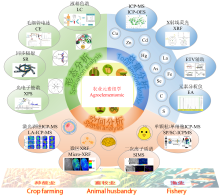
图1
农业元素组学的研究对象及分析技术分类示意图"

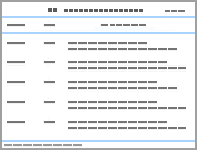
表1
农业元素组学分析技术的应用范围及优势和局限性"
| 分类 Classification | 方法 Method | 元素范围 Elemental range | 检测限 Detection limit | 应用场景 Application scenarios | 优势 Advantage | 局限性 Limitation |
|---|---|---|---|---|---|---|
| 高灵敏和多元素分析技术High-sensitivity and multi- element analysis technology | ICP-MS | 多元素(包括金属、非金属、同位素,范围覆盖Li—U多达80余个元素) Multiple elements (including metals, non-metals, and isotopes, and covering more than 80 elements ranging from Li to U) | ng·L-1-pg·g-1 | 农产品多元素定量、产地溯源、土壤重金属监测等多场景 Multi-element quantification of agricultural products, origin traceability, soil heavy metal monitoring and other scenarios | 高灵敏度、广泛的元素覆盖、多元素同时检测能力 High sensitivity, broad element coverage, and simultaneous multi- element detection capability | 基质干扰需要处理,前处理较为复杂,对轻元素(H、He、C、N、O等)检测能力较弱 Matrix interference requires treatment, and pretreatment is relatively complex. Detection capabilities for light elements (H, He, C, N, O, etc.) are relatively weak |
| TIMS | 重金属和稳定同位素(如Sr、Pb、Nd、U、Th、Os、Re、Hf、W、Mo、Ca、K、Mg、Fe、Ni、Cu、Zn、Cd、Sn、Ba、La、Ce、Pr、Sm、Eu、Gd、Dy、Er、Yb、Lu等稀土元素和放射性元素) Heavy metals and stable isotopes (such as Sr, Pb, Nd, U, Th, Os, Re, Hf, W, Mo, Ca, K, Mg, Fe, Ni, Cu, Zn, Cd, Sn, Ba, La, Ce, Pr, Sm, Eu, Gd, Dy, Er, Yb, Lu, and other rare earth elements and radioactive elements) | ppm级精度 ppm-level accuracy | 食品地理来源鉴别、元素生物利用度等研究 Research on food geographic origin identification and elemental bioavailability | 极高同位素测量精度 Extremely high isotope measurement accuracy | 前处理复杂,成本高。对轻元素(如C、N、O、H)和挥发性元素检测能力较弱、不适合多元素总量分析 Complex pretreatment and high costs. Limited detection capability for light elements (e.g., C, N, O, H) and volatile elements; unsuitable for multi-element total analysis | |
| ICP-OES / MP-AES | 金属及非金属(如P、S、Si、Fe、Mn、Na、K、Ca、Mg等常量元素) Metals and non-metals (such as macroelements including P, S, Si, Fe, Mn, Na, K, Ca, Mg, etc.) | ppb-%级 ppb-% level | 复杂样品常量分析、现场土壤养分检测、肥料元素测定等多场景 Constant analysis of complex samples, on-site soil nutrient testing, fertilizer element determination, and other scenarios | 快速、成本较低、可现场分析、抗分子离子干扰 Rapid, cost-effective, on-site analysis, resistant to molecular ion interference | 灵敏度低于ICP-MS,难测痕量,易受光谱干扰且需要背景校正 Compared to ICP-MS, it exhibits lower sensitivity, faces challenges in detecting trace amounts, is susceptible to spectral interference, and requires background correction | |
| LTP(DBD等) | 蒸发温度相对较低的元素(如Hg、Cd、Pb、As、Se、Sb等) Elements with relatively low evaporation temperatures (such as Hg, Cd, Pb, As, Se, Sb, etc.) | ng·g-1级 ng·g-1 level | 便携式固体样品检测、动植物中重金属监测、现场元素分析等多场景 Portable solid sample analyzing, heavy metal monitoring in plants and animals, on-site elemental analysis, and other scenarios | 便携、简单、无需复杂前处理、常压操作 Portable, simple, requires no complex pretreatment, operates at atmospheric pressure | 元素范围有限,易受环境干扰,需优化仪器各系统结构,灵敏度中等 The element range is limited and susceptible to environmental interference, requiring optimization of the instrument's system architecture. Sensitivity is moderate | |
| XRF(EDXRF, TXRF) | 中重元素(如Cd、Pb、As、Mn、Zn、Fe、Cu、K、Ca等,从Na—U) Medium-to-heavy elements (such as Cd, Pb, As, Mn, Zn, Fe, Cu, K, Ca, etc., from Na to U) | ppm-%级 ppm-% level (TXRF: 10-7-10-12 g) | 非破坏性土壤/植物分析、污染现场监测、产地溯源等多场景 Non-destructive soil/plant analysis, contaminated site monitoring, origin tracing, and other scenarios | 非破坏性、便捷、可现场监测、多元素定量 Non-destructive, convenient, field- monitorable, multi- element quantitative analysis | 对轻元素(如C、N、O)灵敏度差,痕量元素检测有局限性 Poor sensitivity to light elements (such as C, N, O), with limitations in detecting trace elements | |
| 固体直接进样辅助分析技术(GD-MS/ ETV) | 多元素(与检测器有关,可测金属、非金属和稀土元素等60余种元素) Multi-element (detector-dependent, capable of measuring over 60 elements including metals, non-metals, and rare earth elements) | ng·g-1级 ng·g-1 level | 固体直接进样(如植物、土壤、粮油、水产等复杂介质中元素的快速检测),液体样品也适用 Solid direct sampling (e.g., rapid detection of elements in complex media such as plants, soil, grains, oils, and aquatic products) is also suitable for liquid samples. | 直接分析固体,减少前处理、快速高灵敏 Direct analysis of solid samples with minimal pretreatment enables rapid and highly sensitive detection. | 基质效应大,定量难度高。 对于GD-MS限于导电性样品 Significant matrix effects make quantitative analysis challenging. GD-MS is limited to conductive samples | |
| EA/EA- IRMS | 生源元素(如C、H、N、S、P)及同位素(如δ13C、δ15N、δ34S) Source elements (e.g., C, H, N, S, P) and isotopes (e.g., δ13C, δ15N, δ34S) | %级(同位素可达‰级) Percentage level (isotopes can reach parts per thousand level) | 土壤碳氮循环、产地溯源、植物δ13C追踪等多场景 Soil carbon and nitrogen cycles, origin tracing, plant δ13C tracking, and other scenarios | 高精度同位素分析、总量检测简便 High-precision isotope analysis, simple total quantity detection | 仅限轻元素,样品需预处理,挥发性样品易损失 Only light elements are applicable. Samples need to be pre-treated. Volatile samples are prone to loss | |
| INAA | 多元素(如植物中稀土、Au、Ag、Co、Cr、Fe、Hf、Ir、Sb、Sc、Se、Th、U、Zn等) Multiple elements (such as rare earth elements, Au, Ag, Co, Cr, Fe, Hf, Ir, Sb, Sc, Se, Th, U, Zn, etc. in plants) | 10-¹³ g·g-1级 10-¹³ g·g-1 level | 无损食品/土壤多元素同步测定、动植物元素定量等多场景 Non-destructive simultaneous multi-element analysis of food/soil, quantitative elemental analysis of plants and animals, and other scenarios | 无损、高通量、灵敏度高 Non-destructive, high-throughput, high sensitivity | 设备昂贵,操作复杂、核素衰变时间长 The equipment is expensive, the operation is complex, and the nuclide decay time is long | |
| EC(SWASV等) | 金属元素(如Zn、Cd、Ni、Pb、Cu、Hg等) Metal elements (such as Zn, Cd, Ni, Pb, Cu, Hg, etc.) | ng·g-1—pg·g-1级 ng·g-1-pg·g-1 level | 水/土壤浸提液痕量检测、重金属污染评估等多场景 Trace detection in water/soil extracts, heavy metal pollution assessment, and other scenarios | 便携、高选择性、电极修饰可增强抗干扰能力 Portable, highly selective, and electrode modification can enhance anti- interference capability | 仅限电活性元素,干扰较多、前处理要求高 It is limited to electroactive elements, with many interferences and high requirements for pretreatment | |
| 元素形态和价态分析技术Element speciation and valence analysis techniques | 色谱联用(HPLC-ICP-MS等 | 元素形态(如As(III)/ As(V)、Hg有机/无机、Se、Cr、I等) Elemental forms (e.g., As (III)/As(V), organic/inorganic Hg, Se, Cr, I, etc.) | ng·g-1级 ng·g-1 level | 农产品形态分析(如海产品中As或者Hg形态的分析、安全性评价等场景) Analysis of agricultural product speciation (e.g., analysis of arsenic or mercury forms in seafood, safety assessment scenarios, etc.) | 高分辨率形态分析、多元素形态同步检测 High-resolution morphological analysis, simultaneous multi-element morphological detection | 前处理易导致形态转化,设备复杂,成本高 Pre-treatment is prone to causing morphological transformation, involves complex equipment, and incurs high costs |
| SR(SRXRF, SRXAS) | 多元素及形态(从Na—U的中重元素,轻元素如C、N、O等需要软X射线) Multiple elements and speciation (medium-heavy elements from Na to U; light elements such as C, N, O, etc., require soft X-rays) | 1—10 ppm或更低(与X射线能量范围有关,成像可达μm尺度的分辨率) 1-10 ppm or lower (depending on X-ray energy range, with imaging resolution down to the micrometer scale) | 植物、动物组织中元素的原位分布 In situ distribution of elements in plant and animal tissues | 高空间分辨率、无损分析、原位价态解析 High spatial resolution, non-destructive analysis, in situ valence state analysis | 需要同步辐射设施,成本高,数据处理复杂 Synchrotron radiation facilities are required, which are costly and involve complex data processing | |
| XPS / XRD | 表面元素价态和晶体成分(如Cr、F、P、Fe、Mn等) Surface element valence states and crystal composition (e.g., Cr, F, P, Fe, Mn, etc.) | ppm级(XPS的表面深度约10 nm左右) ppm level (XPS surface depth approximately 10 nm) | 材料表征、吸附机制研究等多场景 Material characterization, adsorption mechanism studies, and other scenarios | 表面化学状态分析、晶体结构表征 Surface chemical state analysis, crystal structure characterization | 仅限表面,深度分析受限,对非晶体样品受限、痕量灵敏度低 It is only limited to the surface, in - depth analysis is restricted, it is restricted for non-crystalline samples, and the trace sensitivity is low | |
| 微区空间成像与原位分析技术Micro-area space imaging and in-situ analysis technology | LA-ICP- MS | 多元素及同位素(元素范围随检测器而定) Multiple elements and isotopes (element range determined by the detector) | ng·g-1级(成像分析光斑分辨率可达μm尺度) ng·g-1 level (imaging analysis spot resolution down to the micrometer scale) | 动物、植物组织的元素成像 Elemental imaging of animal and plant tissues | 高空间分辨率、同时定量多元素、固体原位分析 High spatial resolution, simultaneous quantitative multi- element analysis, in situ solid-state analysis | 基质效应、分馏问题影响定量精度、需能校正的标准物质 Matrix effects and fractionation issues affect quantitative accuracy; calibration of reference materials is required |
| LIBS | 多元素(从H—U,几乎所有元素) Multiple elements (from H to U, encompassing nearly all elements) | ppm级 ppm level | 现场土壤/叶片快速筛查、产地识别、重金属监测等多场景 On-site rapid screening of soil/leaf samples, origin identification, heavy metal monitoring, and other scenarios | 快速响应、无需消解、便携性强 Rapid response, no digestion required, highly portable | 灵敏度有限,重复性较差 Limited sensitivity, poor repeatability | |
| micro-XRF | 多元素(从Na—U的中重元素) Multiple elements (medium- to-heavy elements from Na to U) | ppm-%级(成像μm分辨) ppm-% level (imaging with μm resolution) | 动物或植物样本的微区分布 Micro-regional distribution of animal or plant samples | 高空间分辨率、非破坏性、成像能力 High spatial resolution, non-destructive, imaging capability | 轻元素检测能力有限 Limited detection capability for light elements | |
| SIMS(NanoSIMS, TOF- SIMS) | 元素及有机(如15N、Zn、Cd、Fe、脂质等) Elements and organic compounds (such as 15N, Zn, Cd, Fe, lipids, etc.) | fg·g-1级(成像nm尺度分辨) FG/G-class (imaging at the nanometer scale) | 单细胞分析、根际固氮15N吸收、植物细胞定位等多场景 Single-cell analysis, rhizosphere nitrogen fixation 15N uptake, plant cell localization, and other scenarios | 超高空间分辨率、痕量检测 Ultra-high spatial resolution, trace detection | 样品制备复杂,成本极高、深度有限 Complex sample preparation, costly, depth limited sample preparation | |
| LIMS | 多元素(从Na—U,60+种元素) Multi-element (from Na to U, 60+ elements) | ng·g-1级(成像μm尺度分辨) ng·g-1 level (imaging at the micrometer scale) | 固体土壤/植物快速分析 Rapid Analysis of Solid Soil/Plant Samples | 直接固体分析、高分辨率、高通量 Direct solid analysis, high resolution, high throughput | 基质干扰大,定量精度低,易受离子干扰 Significant matrix interference, low quantitative accuracy, and susceptibility to ionic interference | |
| SP/SC-ICP-MS | 单颗粒/单细胞的元素(检测范围与检测器有关) Single-particle/single-cell elements (detection range depends on the detector) | fg级 fg level | 细胞样品或纳米颗粒暴露(如微塑料、纳米材料之类,单细胞生物学研究) Exposure of cell samples or nanoparticles (e.g., microplastics, nanomaterials, etc., for single- cell biology research) | 单颗粒/细胞级分辨率 Single-particle/single-cell resolution | 多元素能力有限,颗粒尺寸下限受限、需专用仪器,数据处理复杂 Limited multi-element capabilities, constrained lower limit of particle size, specialized instruments required, and complex data processing |
| [1] |
doi: 10.1016/j.agsy.2016.09.021 pmid: 28701818 |
| [2] |
doi: 10.1016/j.eng.2024.11.034 |
| [3] |
|
| [4] |
doi: 10.1016/S0010-8545(00)00398-2 |
| [5] |
doi: 10.1039/b308213j |
| [6] |
熊依杰, 欧阳荔, 刘雅琼, 解青, 王京宇. 肺癌和癌旁组织中17种微量元素的ICP-MS测定及相关研究. 质谱学报, 2005, 26(S1): 19-20, 58.
|
|
|
|
| [7] |
doi: 10.1146/annurev.arplant.59.032607.092942 pmid: 18251712 |
| [8] |
doi: 10.1351/pac200880122577 |
| [9] |
doi: 10.1021/acs.jafc.1c00275 |
| [10] |
doi: 10.1039/c2mt00002d pmid: 22511294 |
| [11] |
doi: 10.1021/acs.jchemed.8b00026 |
| [12] |
doi: 10.1016/j.foodchem.2019.125172 |
| [13] |
doi: 10.1016/j.foodcont.2020.107735 |
| [14] |
doi: 10.1038/s43586-023-00235-w |
| [15] |
doi: 10.1016/j.foodcont.2014.04.027 |
| [16] |
doi: 10.1016/j.talanta.2020.121636 |
| [17] |
doi: 10.1016/j.jhazmat.2019.121528 |
| [18] |
|
| [19] |
doi: 10.1007/s12161-016-0550-2 |
| [20] |
doi: 10.1179/146141010X12640787648694 |
| [21] |
doi: 10.1007/BF02796684 pmid: 24254607 |
| [22] |
doi: 10.1039/C5AY02816G |
| [23] |
|
| [24] |
|
| [25] |
doi: 10.22161/ijeab |
| [26] |
doi: 10.1007/s12161-017-0908-0 |
| [27] |
doi: 10.1039/D0JA00222D |
| [28] |
doi: 10.1088/1361-6595/ab708b |
| [29] |
doi: 10.1039/C6JA00341A |
| [30] |
doi: 10.1021/acs.analchem.7b00126 pmid: 28205438 |
| [31] |
doi: 10.1039/C7JA00228A |
| [32] |
doi: 10.1016/j.talanta.2019.120468 |
| [33] |
doi: 10.1021/ac400296v |
| [34] |
doi: 10.1021/acs.analchem.6b00506 pmid: 26976077 |
| [35] |
doi: 10.1016/j.aca.2020.04.057 |
| [36] |
doi: 10.1016/j.talanta.2020.121348 |
| [37] |
doi: 10.1016/j.trac.2008.11.011 |
| [38] |
doi: 10.1016/j.ecolind.2019.01.069 |
| [39] |
doi: 10.1016/j.envres.2020.110444 |
| [40] |
doi: 10.46770/AS |
| [41] |
doi: 10.1080/00032719.2018.1485025 |
| [42] |
毛雪飞, 刘霁欣, 钱永忠. 土壤重金属快速检测技术研究进展. 中国农业科学, 2019, 52(24): 4555-4566. doi: 10.3864/j.issn.0578-1752.2019.24.010.
|
|
|
|
| [43] |
doi: 10.1016/j.trac.2021.116437 |
| [44] |
doi: 10.1134/S1061934808110142 |
| [45] |
doi: 10.1016/j.foodchem.2022.133896 |
| [46] |
doi: 10.1007/s00216-023-04595-w |
| [47] |
doi: 10.1016/j.orggeochem.2023.104652 |
| [48] |
李玉锋, 高愈希, 陈春英, 李柏, 赵宇亮, 柴之芳. 金属组学: 高通量分析技术进展与展望. 中国科学(B辑: 化学), 2009, 39(7): 580-589.
|
|
|
|
| [49] |
doi: 10.1007/s10967-005-0799-1 |
| [50] |
doi: 10.1016/j.jtusci.2017.01.007 |
| [51] |
doi: 10.1007/s10967-019-06874-2 |
| [52] |
doi: 10.1016/j.foodcont.2023.109743 |
| [53] |
doi: 10.1016/j.foodchem.2024.138500 |
| [54] |
doi: 10.1016/j.microc.2025.112919 |
| [55] |
doi: 10.1038/s41565-023-01367-6 pmid: 37081082 |
| [56] |
doi: 10.1016/j.aca.2010.04.036 |
| [57] |
doi: 10.1039/C5JA00155B |
| [58] |
doi: 10.1016/j.aca.2012.07.035 |
| [59] |
doi: 10.1016/j.trac.2020.115963 |
| [60] |
doi: 10.1016/j.ijms.2011.01.026 |
| [61] |
doi: 10.1016/j.talanta.2020.120803 |
| [62] |
SEDIGH RAHIMABADI P,
doi: 10.1002/xrs.v49.3 |
| [63] |
|
| [64] |
doi: 10.1016/j.jclepro.2020.123967 |
| [65] |
doi: 10.1016/j.jclepro.2020.124052 |
| [66] |
doi: 10.1021/acs.jafc.4c00980 pmid: 38747516 |
| [67] |
doi: 10.1016/j.scitotenv.2020.141902 |
| [68] |
doi: S0141-8130(20)34129-5 pmid: 32784021 |
| [69] |
doi: 10.1039/B202122F |
| [70] |
doi: 10.1016/j.ecoenv.2019.109623 |
| [71] |
doi: S0045-6535(18)30182-6 pmid: 29421757 |
| [72] |
doi: 10.1039/c2an15792f |
| [73] |
doi: 10.1021/acs.jafc.8b05479 pmid: 30592410 |
| [74] |
doi: 10.1016/j.aca.2023.341524 |
| [75] |
doi: 10.1016/j.trac.2019.05.052 |
| [76] |
doi: 10.1016/j.surfrep.2012.09.001 |
| [77] |
doi: 10.1016/j.foodres.2025.115925 |
| [78] |
doi: 10.1186/s40538-024-00641-6 |
| [79] |
doi: 10.1038/s41598-018-37556-w |
| [80] |
doi: 10.1007/s00216-023-04721-8 pmid: 37162524 |
| [81] |
doi: S0969-8043(19)30169-1 pmid: 31077976 |
| [82] |
doi: 10.1016/j.radphyschem.2018.05.006 |
| [83] |
doi: 10.3390/met12111798 |
| [84] |
doi: 10.1002/mas.21490 pmid: 26757103 |
| [85] |
doi: 10.1007/s00374-020-01497-2 |
| [86] |
doi: 10.1038/s41598-018-25130-3 |
| [87] |
doi: 10.1002/jms.v55.3 |
| [88] |
doi: 10.1016/j.ijms.2021.116662 |
| [89] |
doi: 10.3390/app11062562 |
| [90] |
|
| [91] |
doi: 10.1016/j.aca.2020.07.041 pmid: 33153603 |
| [92] |
doi: 10.1007/s00216-016-0075-y pmid: 27909780 |
| [93] |
doi: 10.1021/acs.analchem.0c01775 |
| [94] |
doi: 10.1021/es506179e |
| [95] |
doi: 10.1016/j.teac.2016.02.001 |
| [1] | 杨国昌, 郑月, 包向男, 代迎春, 王金刚, 白雪峰, 孙伟, 李喜和, 张淑君. 中红外光谱分析技术在奶牛甲烷排放预测中的应用研究进展[J]. 中国农业科学, 2025, 58(9): 1856-1866. |
| [2] | 栗方亮, 孔庆波, 张青. 基于光谱指数的琯溪蜜柚叶片钙素含量估测模型研究[J]. 中国农业科学, 2025, 58(7): 1321-1332. |
| [3] | 张志淳, 何筱毅, 何成军, 辜冬琳, 钟恋, 苟琰, 高必兴, 耿昭, 李小红, 陈斯恺. 基于GC-MS技术比较分析盐源与汉源花椒籽挥发油化学成分[J]. 中国农业科学, 2025, 58(23): 5057-5070. |
| [4] | 罗钦, 陈谢勇, 徐玉英, 韦航, 黄彪, 姚清华, 叶乃兴, 郑德勇, 颜明娟. 基于非挥发性代谢物特征的福安大白茶产地溯源[J]. 中国农业科学, 2025, 58(22): 4757-4770. |
| [5] | 李明丽, 温彩运, 马东豪, 李存军, 王宇文, 康璐, 陆苗. 基于土壤高光谱特征波段优选的盐分预测模型构建[J]. 中国农业科学, 2025, 58(20): 4054-4069. |
| [6] | 刘静, 汪泓, 张磊, 肖玖军, 吴建高, 龚明冲. 基于高光谱的辣椒叶片氮素含量反演[J]. 中国农业科学, 2025, 58(2): 252-265. |
| [7] | 韩林蒲, 马纪龙, 齐勇杰, 高嘉琪, 谢铁娜, 贾彪. 无人机多光谱参数与Shapley分析融合的青贮玉米生物量估算[J]. 中国农业科学, 2025, 58(18): 3632-3647. |
| [8] | 燕雯, 金秀良, 李龙, 徐子涵, 苏悦, 张跃强, 景蕊莲, 毛新国, 孙黛珍. 基于无人机多源影像数据的灌浆期人工合成小麦抗旱性评价[J]. 中国农业科学, 2024, 57(9): 1674-1686. |
| [9] | 周智辉, 谷晓博, 程智楷, 常甜, 赵彤彤, 王玉明, 杜娅丹. 基于影像分割的覆膜玉米叶绿素含量反演[J]. 中国农业科学, 2024, 57(6): 1066-1079. |
| [10] | 梅广源, 李荣, 梅新, 陈日强, 樊意广, 程金鹏, 冯子恒, 陶婷, 赵倩, 赵培钦, 杨小冬. 基于VSURF-CA的小麦条锈病高光谱病情指数估测模型[J]. 中国农业科学, 2024, 57(3): 484-499. |
| [11] | 运彬媛, 谢铁娜, 李虹, 岳翔, 吕明玥, 王佳琦, 贾彪. 融合无人机光谱与纹理信息的玉米氮素营养估测[J]. 中国农业科学, 2024, 57(16): 3154-3170. |
| [12] | 郝磊晓, 褚楚, 温佩佩, 彭松悦, 杨卓, 邹慧颖, 樊懿楷, 王海童, 刘文举, 王东薇, 刘维华, 杨俊华, 赵娟, 李委奇, 温万, 周佳敏, 张淑君. 基于中红外光谱的中国荷斯坦牛牛奶中钠钾镁含量预测模型的建立[J]. 中国农业科学, 2024, 57(14): 2862-2873. |
| [13] | 梁丽娟, 程李香, 袁剑龙, 撒刚, 张峰. 茉莉酸调控马铃薯离体块茎发育的主要代谢物变化[J]. 中国农业科学, 2024, 57(13): 2525-2538. |
| [14] | 石浩磊, 曹红霞, 张伟杰, 朱珊, 何子建, 张泽. 基于无人机多光谱的棉花多生育期叶面积指数反演[J]. 中国农业科学, 2024, 57(1): 80-95. |
| [15] | 魏永康, 杨天聪, 臧少龙, 贺利, 段剑钊, 谢迎新, 王晨阳, 冯伟. 基于无人机多光谱影像特征融合的小麦倒伏监测[J]. 中国农业科学, 2023, 56(9): 1670-1685. |
|
||
