






中国农业科学 ›› 2025, Vol. 58 ›› Issue (23): 5046-5056.doi: 10.3864/j.issn.0578-1752.2025.23.018
魏晨曦( ), 董山榕, 王小满, 罗建让*()
收稿日期:2025-08-04
接受日期:2025-09-15
出版日期:2025-12-01
发布日期:2025-12-09
通信作者:
联系方式:
魏晨曦,E-mail:Weichenxilearn@163.com。
基金资助:
WEI ChenXi(), DONG ShanRong, WANG XiaoMan, LUO JianRang*()
Received:2025-08-04
Accepted:2025-09-15
Published:2025-12-01
Online:2025-12-09
摘要:
【目的】 牡丹不仅具有良好的观花价值,其新生叶片常常呈现紫红色,是园林中的春色叶植物之一。解析牡丹红色叶性状形成的生理机制和关键基因,可为牡丹观叶品种的选育提供理论依据。【方法】 采集长红叶期的卵叶牡丹(Paeonia qiui)和短红叶期的‘洛阳红’(P. Luoyang Hong)叶片6个发育时期样品,通过色差仪测定叶色参数,使用酶标法测定花青苷和叶绿素含量,并采用高效液相色谱(HPLC)分析花青苷组分,最后通过qPCR检测花青苷合成相关基因的表达。【结果】 表型观察与色差分析表明,卵叶牡丹叶片红度较高,红叶持续期长,可维持到开花前;而‘洛阳红’虽早期新叶呈现红色,但展叶后很快转绿。HPLC分析表明,2种牡丹的叶片均以芍药素-3,5-二葡萄糖苷(Pn3G5G)为主要花青苷成分,卵叶牡丹的总花青苷含量显著高于‘洛阳红’,尤其在S4时期差异明显。qPCR结果显示,卵叶牡丹叶片中花青苷合成相关结构基因CHS、DFR和ANS的表达水平与花青苷含量变化趋势一致,相关性分析表明,DFR表达水平与花青苷含量呈极显著正相关,ANS表达水平与花青苷含量呈显著正相关;二者作为关键结构基因影响花青苷的合成。‘洛阳红’叶片中CHS、F3H、DFR和ANS的表达水平与花青苷含量趋势基本一致,相关性分析显示,DFR与ANS表达水平均与花青苷含量呈显著正相关。【结论】 卵叶牡丹和‘洛阳红’叶片呈现红色的主要色素均为芍药素-3,5-二葡萄糖苷,DFR和ANS是牡丹叶片花青苷生物合成途径中的关键结构基因,其表达水平与花青苷积累密切相关,进而影响牡丹红色叶片的形成。
魏晨曦, 董山榕, 王小满, 罗建让. 基于叶色表型和花青苷积累特征的牡丹红色叶性状解析[J]. 中国农业科学, 2025, 58(23): 5046-5056.
WEI ChenXi, DONG ShanRong, WANG XiaoMan, LUO JianRang. Analysis of Red Color Leaf Traits in Tree Peony Based on Leaf Color Phenotypes and Anthocyanin Accumulation Characteristics[J]. Scientia Agricultura Sinica, 2025, 58(23): 5046-5056.
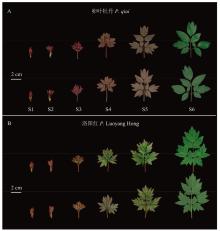
图1
卵叶牡丹和‘洛阳红’不同时期叶片表型 A:卵叶牡丹不同时期的叶片表型;B:‘洛阳红’不同时期的叶片表型"
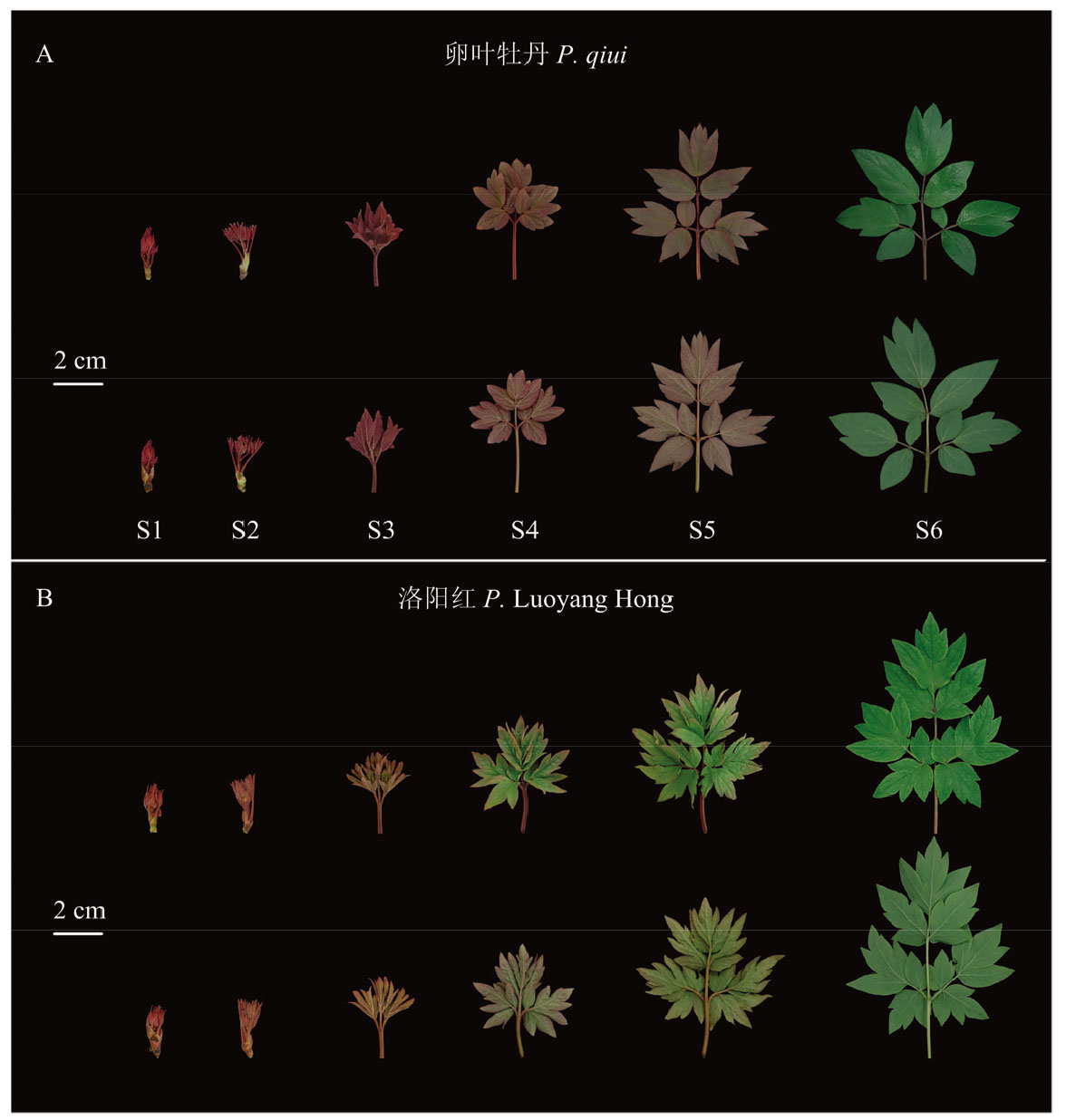

表1
实时荧光定量PCR引物"
| 基因 Gene name | 正向引物 Forward primer (5′-3′) | 反向引物 Reverse primer (5′-3′) |
|---|---|---|
| PqCHS, PsCHS | TAGTCCCGGATAGCGATGGT | TGCCTGGTCGCTTGTAGTTT |
| PqCHI, PsCHI | GTCAGCGGAGTCAAGATTGAA | AATATCCCGGAAGAAGTCGTC |
| PqF3H, PsF3H | ACGAAATCCCAATCATCTCCC | CTATTTCACGCCAATCTCGCA |
| PqF3’H, PsF3’H | CAAGGCCGACAAATTCAAGGA | ACCCTCGCTATCAACATCATC |
| PqDFR, PsDFR | TGGTGGATGGAAGCTTTGATG | TAAACTCCATGTCACTCCAGC |
| PqANS, PsANS | CAGCATCACCAACATCTTCGA | CAGCAATCTTCCCAGTCTCTT |
| PqUFGT, PsUFGT | ACCATCATCCGCTACCTTTC | CACTAAACAGCTCACCTTCC |
表2
卵叶牡丹和‘洛阳红’叶色RHSCC比色数据"
| 种类 Species | 时期 Period | 英国皇家园艺学会比色卡 RHSCC |
|---|---|---|
| 卵叶牡丹 P. qiui | S1 | 红色组47B Red group 47B |
| S2 | 红色组47A Red group 47A | |
| S3 | 灰红组181B Greyed-red group 181B | |
| S4 | 灰红组182B Greyed-red group 182B | |
| S5 | 灰红组177C Greyed-red group 177C | |
| S6 | 绿色组135C Green group 135C | |
| 洛阳红 P. Luoyang Hong | S1 | 红色组45C Red group 45C |
| S2 | 灰红组180C Greyed-red group 180C | |
| S3 | 灰红组176D Greyed-red group 176D | |
| S4 | 绿色组143C Green group 143C | |
| S5 | 绿色组141C Green group 141C | |
| S6 | 绿色组139B Green group 139B |
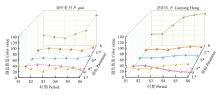
图2
卵叶牡丹和‘洛阳红’叶片颜色指数"
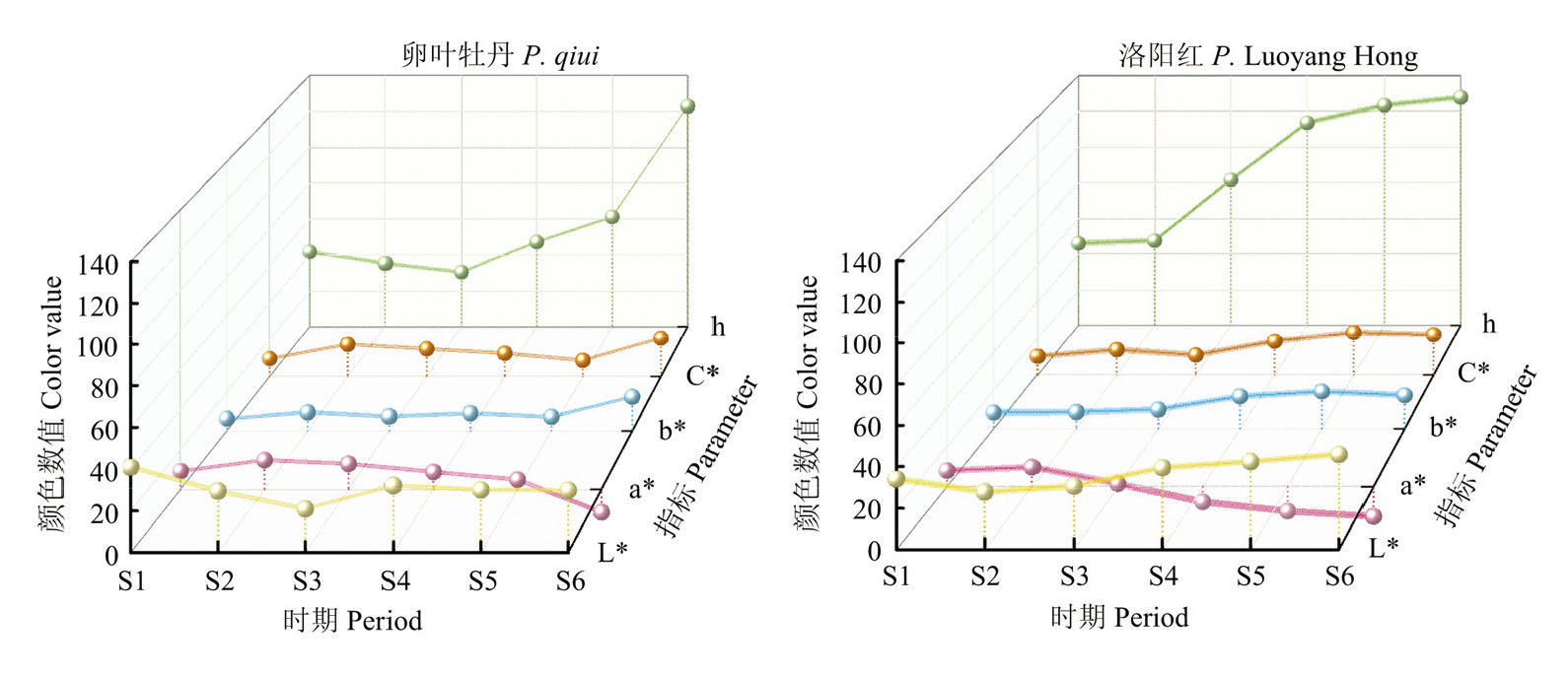
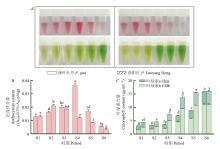
图3
卵叶牡丹和‘洛阳红’不同时期叶片色素含量 A:花青苷萃取液及叶绿素萃取液;B:叶片花青苷含量;C:叶片叶绿素含量。不同小写字母表示在P<0.05水平上差异显著。下同"
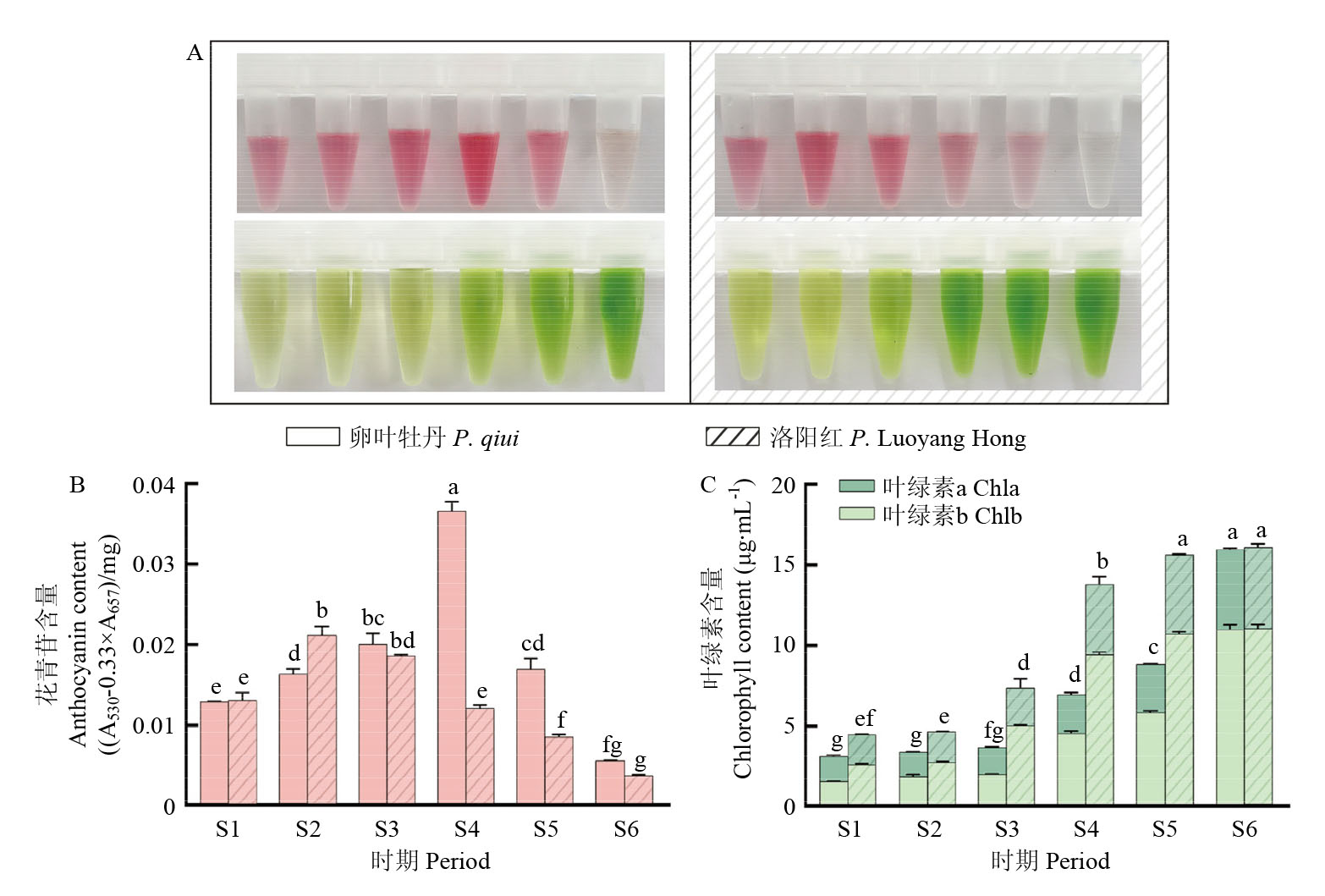
图4
卵叶牡丹和‘洛阳红’不同时期花青苷成分及含量"
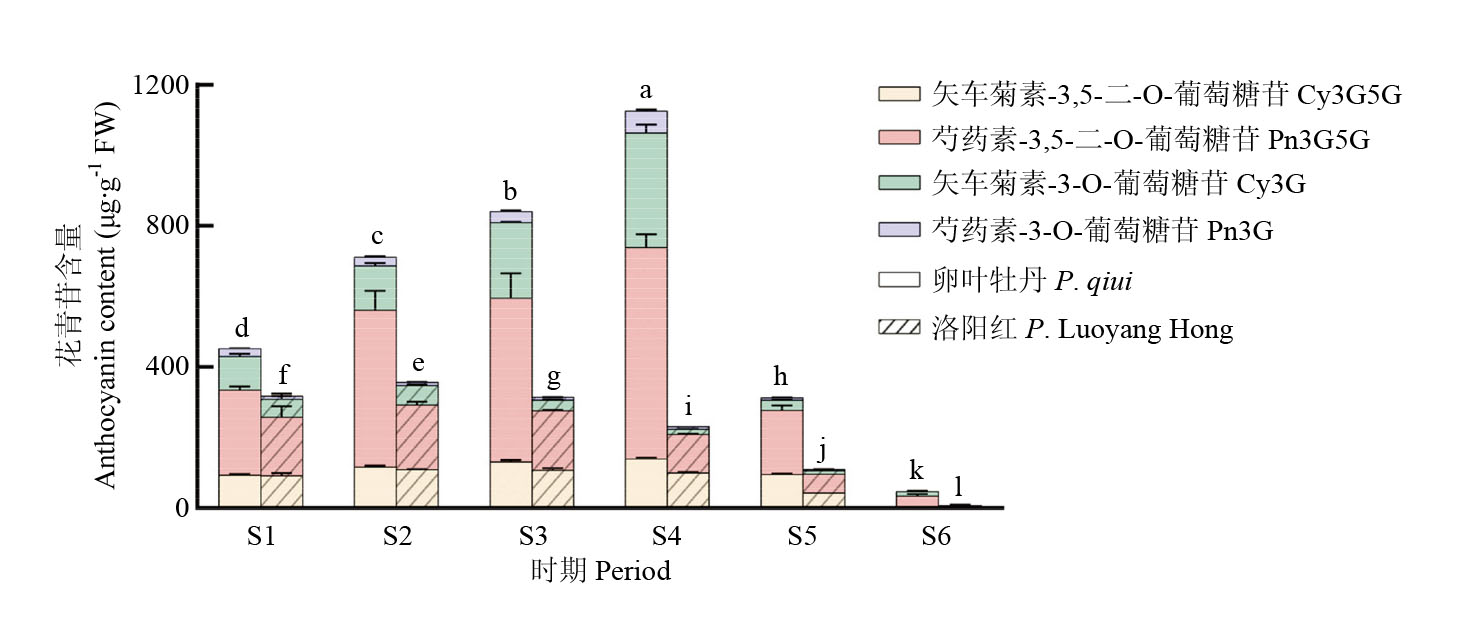
图5
卵叶牡丹和‘洛阳红’叶片不同时期花青苷合成相关基因的表达分析"
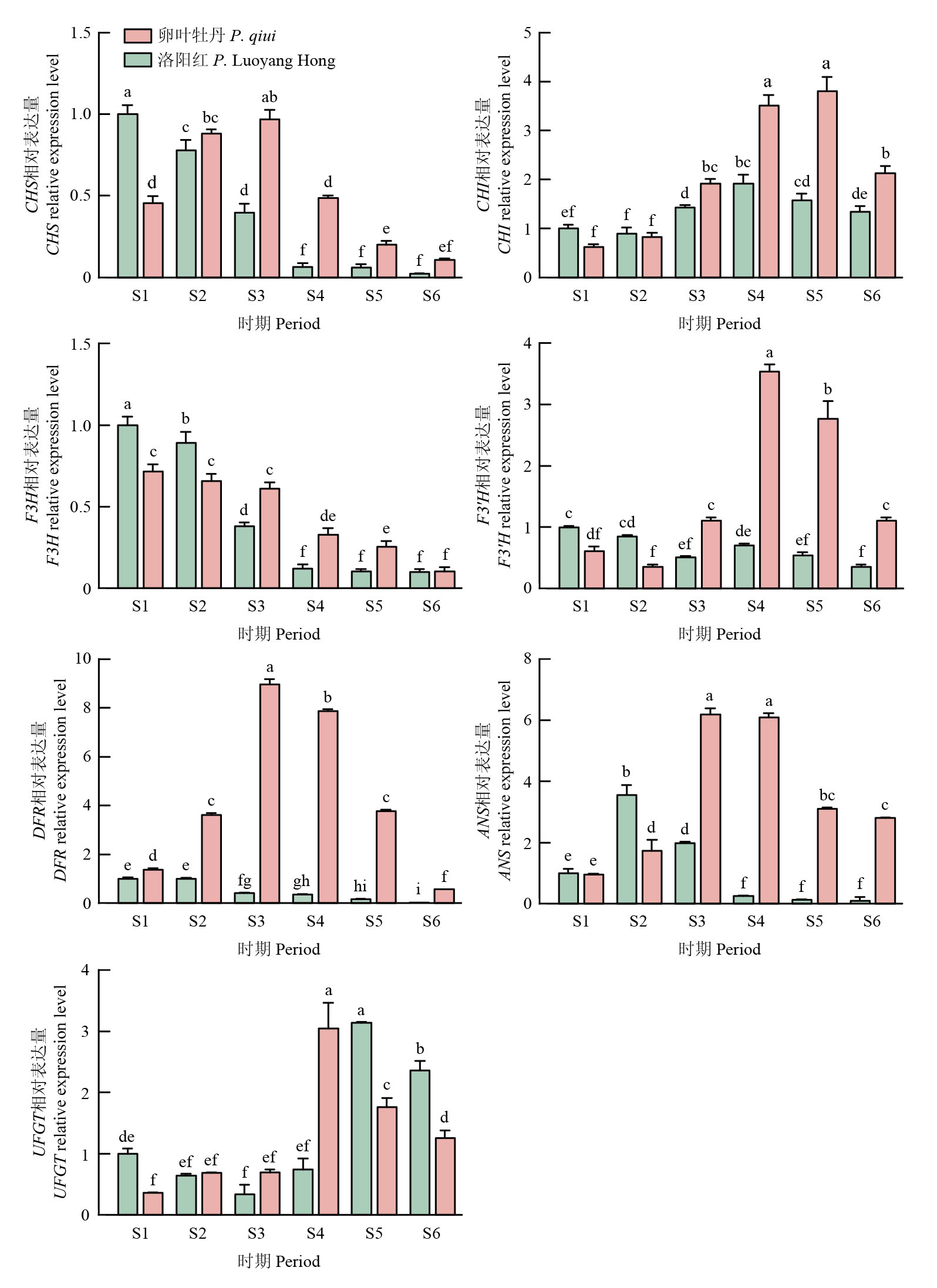
图6
卵叶牡丹和‘洛阳红’叶片花青苷含量与结构基因表达量的相关性分析 A:卵叶牡丹;B:‘洛阳红’。*P<0.05,**P<0.01,***P<0.001 A: P. qiui; B: P. Luoyang Hong. *P<0.05, **P<0.01, ***P<0.001"
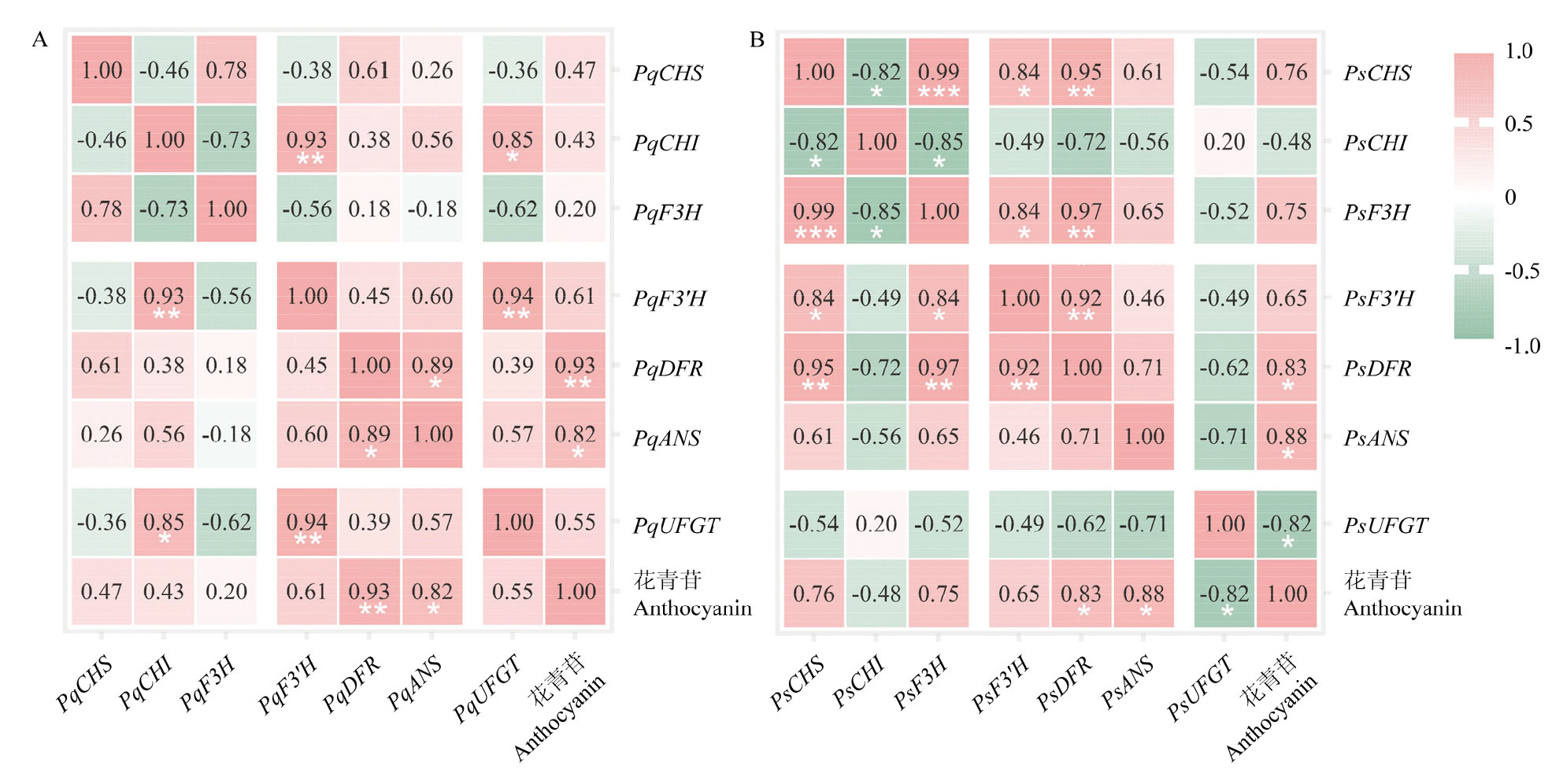
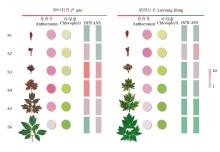
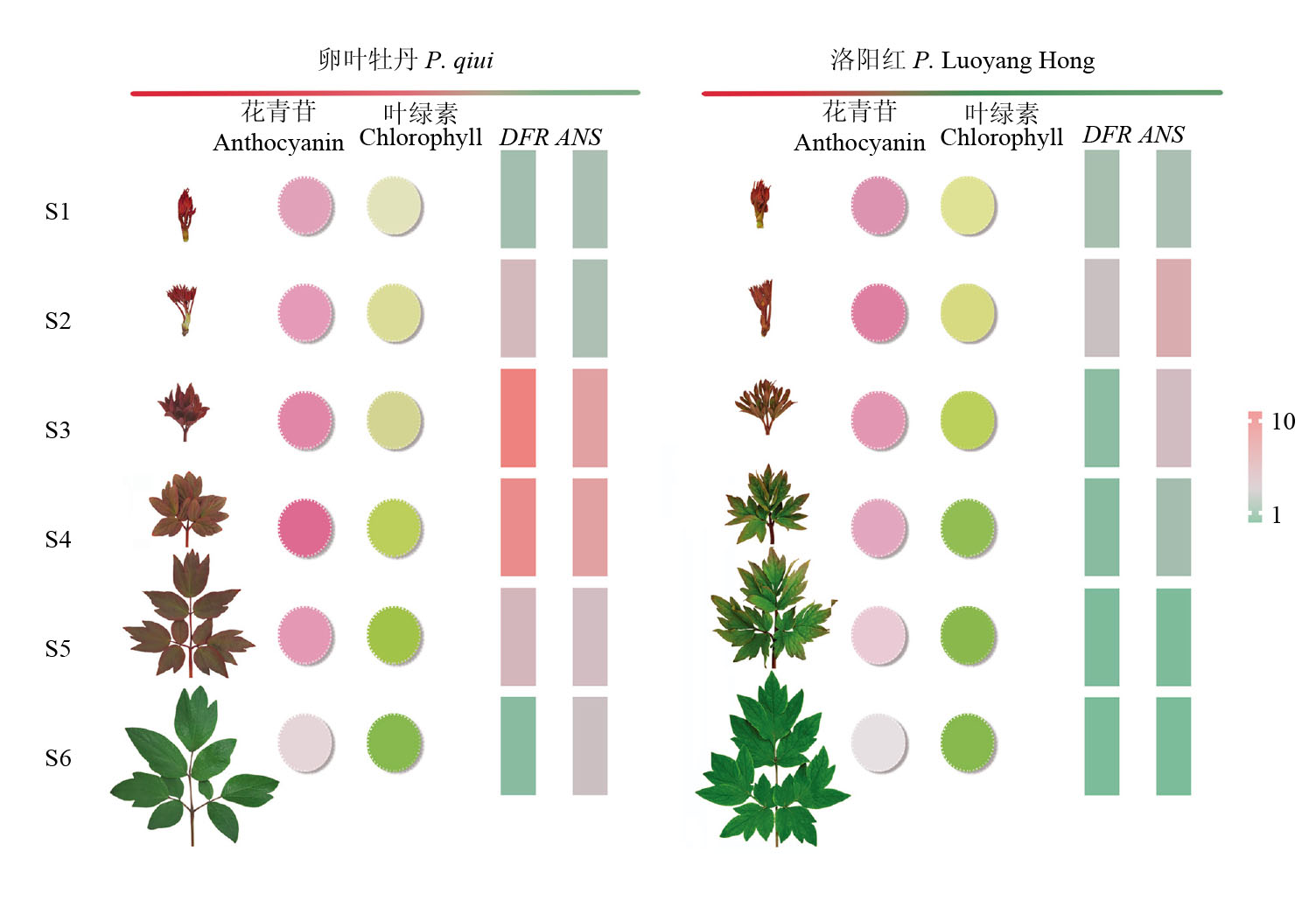
图7
牡丹春季红色叶片形成的模式简图"
| [1] |
段晶晶, 罗建让, 李想, 张庆雨, 张延龙. 牡丹叶片红色消退过程中色素变化及相关基因表达分析. 西北植物学报, 2018, 38(10): 1885-1894.
|
|
|
|
| [2] |
裴颜龙, 洪德元. 卵叶牡丹: 芍药属一新种. 植物分类学报, 1995, 33(1): 91-93.
|
|
|
|
| [3] |
韩欣. 牡丹杂交亲本选择及F1代遗传表现[D]. 北京: 北京林业大学, 2014.
|
|
|
|
| [4] |
李春雷, 崔国新, 许志茹, 李玉花. 植物二氢黄酮醇4-还原酶基因的研究进展. 生物技术通讯, 2009, 20(3): 442-445.
|
|
|
|
| [5] |
doi: 10.1023/A:1013713905833 |
| [6] |
doi: 10.1111/j.1365-313X.2008.03447.x pmid: 18476875 |
| [7] |
doi: 10.1093/treephys/26.5.613 |
| [8] |
段晶晶. 卵叶牡丹叶片花青苷合成相关MYB筛选、克隆与功能验证[D]. 杨凌: 西北农林科技大学, 2019.
|
|
|
|
| [9] |
李琴琴, 董山榕, 罗建让, 张延龙. 卵叶牡丹PqDFR和PqANS及启动子克隆与功能分析. 园艺学报, 2024, 51(6): 1256-1272.
|
|
|
|
| [10] |
毕蒙蒙, 曹雨薇, 宋蒙, 唐玉超, 何国仁, 杨悦, 杨盼盼, 徐雷锋, 明军. 百合花色研究进展. 园艺学报, 2021, 48(10): 2073-2086.
doi: 10.16420/j.issn.0513-353x.2021-0532 |
|
|
|
| [11] |
戴思兰, 洪艳. 基于花青素苷合成和呈色机理的观赏植物花色改良分子育种. 中国农业科学, 2016, 49(3): 529-542. doi: 10.3864/j.issn.0578-1752.2016.03.011.
|
|
|
|
| [12] |
|
| [13] |
doi: 10.1016/j.plantsci.2005.10.009 |
| [14] |
史倩倩. 基于转录组测序滇牡丹花色形成分子调控机理研究[D]. 北京: 中国林业科学研究院, 2015.
|
|
|
|
| [15] |
doi: 10.1007/s13205-020-2063-3 |
| [16] |
张洁, 王亮生, 高锦明, 李圣波, 徐彦军, 李崇晖, 杨瑞珍. 贴梗海棠花青苷组成及其与花色的关系. 园艺学报, 2011, 38(3): 527-534.
|
|
|
|
| [17] |
doi: 10.1007/s10265-003-0130-6 |
| [18] |
于梦, 赵蕊, 王崇章, 郭太君. 牡丹物候期观测及温湿度相关性分析. 北方园艺, 2017(1): 70-75.
|
|
|
|
| [19] |
林启芳, 刘婷婷, 刘洁茹, 蔡明, 程堂仁, 王佳, 张启翔, 潘会堂. 紫薇属与黄薇属植物花瓣类黄酮组成及含量分析. 园艺学报, 2021, 48(10): 1956-1968.
doi: 10.16420/j.issn.0513-353x.2021-0408 |
|
|
|
| [20] |
吴思惠, 朱欢欢, 张俊卫, 包满珠, 张杰. 梅花不同花色品种及开花阶段类黄酮代谢物测定与分析. 中国农业科学, 2023, 56(9): 1760-1774. doi: 10.3864/j.issn.0578-1752.2023.09.012.
|
|
|
|
| [21] |
doi: 10.3390/ijms21165878 |
| [22] |
doi: 10.3390/f14020328 |
| [23] |
doi: 10.1016/j.hpj.2023.02.016 |
| [24] |
吴华玲, 何玉媚, 李家贤, 陈栋, 黄华林, 乔小燕, 刘军. 11个红紫芽茶树新品系的芽叶特性和生化成分研究. 植物遗传资源学报, 2012, 13(1): 42-47.
doi: 10.13430/j.cnki.jpgr.2012.01.007 |
|
doi: 10.13430/j.cnki.jpgr.2012.01.007 |
|
| [25] |
doi: 10.1016/j.bbrc.2015.02.126 pmid: 25748574 |
| [26] |
doi: 10.3390/horticulturae8040349 |
| [27] |
doi: 10.1016/j.scienta.2008.03.016 |
| [28] |
doi: 10.1039/b800165k pmid: 19554240 |
| [29] |
doi: 10.1016/j.plantsci.2005.01.009 |
| [30] |
doi: 10.3389/fpls.2022.955590 |
| [31] |
|
| [32] |
doi: 10.1016/S0168-9452(00)00425-8 |
| [1] | 许朵朵, 杜倩倩, 赵理想, 栗燕, 黄淦, 李永华, 逯久幸. 牡丹AP2/ERF转录因子的全基因组分析[J]. 中国农业科学, 2025, 58(23): 5031-5045. |
| [2] | 贾文庆, 和亚琳, 段慧琳, 于迎月, 王政, 赵国栋, 郭英姿, 王二强, 穆金艳, 张焱, 王艳丽, 何松林. 基于转录组和代谢组分析‘凤丹’×大花黄牡丹远缘杂交受精前障碍发生机制[J]. 中国农业科学, 2025, 58(23): 5013-5030. |
| [3] | 关紫恒, 季润泽, 荣琪, 徐雨杰, 钟原, 成仿云. 分子核型分析揭示芍药属组间杂种新倍性及其产生机制[J]. 中国农业科学, 2025, 58(23): 4998-5012. |
| [4] | 罗钦, 毛方华, 陈谢勇, 陈静, 黄彪, 叶乃兴, 郑德勇, 韦航, 姚清华. 不同生境白牡丹茶叶香气特征分析及产地判别[J]. 中国农业科学, 2024, 57(23): 4774-4793. |
| [5] | 徐献斌,耿晓月,李慧,孙丽娟,郑焕,陶建敏. 基于转录组分析ABA促进葡萄花青苷积累相关基因[J]. 中国农业科学, 2022, 55(1): 134-151. |
| [6] | 袁景丽,郑红丽,梁先利,梅俊,余东亮,孙玉强,柯丽萍. 花青素代谢对陆地棉叶片和纤维色泽呈现的影响[J]. 中国农业科学, 2021, 54(9): 1846-1855. |
| [7] | 叶迪,施江,高双成,王占营,史国安. 乙烯促进牡丹‘洛阳红’切花花瓣脱落与内源生长素的关联性分析[J]. 中国农业科学, 2021, 54(23): 5097-5109. |
| [8] | 崔虎亮,贺霞,张前. 不同牡丹品种开花期间花瓣花青素和类黄酮组成的动态变化[J]. 中国农业科学, 2021, 54(13): 2858-2869. |
| [9] | 贺丹,谢栋博,张佼蕊,何松林,李朝梅,郑云冰,王政,刘艺平,栗燕,逯久幸. 利用iTRAQ技术和转录组筛选芍药属远缘杂交不亲和基因[J]. 中国农业科学, 2020, 53(6): 1234-1246. |
| [10] | 李辛雷,殷恒福,范正琪,李纪元. 山茶芽变花色与花青苷的关系[J]. 中国农业科学, 2019, 52(11): 1961-1969. |
| [11] | 安建平,宋来庆,赵玲玲,由春香,王小非,郝玉金. 苹果生长素响应因子MdARF5的克隆与功能鉴定[J]. 中国农业科学, 2018, 51(7): 1345-1352. |
| [12] | 张涛, 司福会, 张玉喜, 盖树鹏. 外源GA3影响牡丹花芽DNA甲基化水平和 相关酶基因的表达分析[J]. 中国农业科学, 2018, 51(18): 3561-3569. |
| [13] | 凌启鸿,王绍华,丁艳锋,李刚华 . 关于用水稻“顶3顶4叶叶色差”作为高产群体叶色诊断统一指标的再论证[J]. 中国农业科学, 2017, 50(24): 4705-4713. |
| [14] | 徐建强,平忠良,刘莹,马世闯,许道超,杨岚,郑伟,刘圣明,夏彦飞,林晓民. 咯菌腈对四种牡丹叶片病原真菌的抑制活性[J]. 中国农业科学, 2017, 50(20): 4036-4045. |
| [15] | 安建平,宋来庆,赵玲玲,由春香,王小非,郝玉金. 超表达苹果细胞分裂素响应基因MdCRF6影响花青苷积累和盐胁迫抗性[J]. 中国农业科学, 2017, 50(16): 3196-3204. |
|
||
