






中国农业科学 ›› 2026, Vol. 59 ›› Issue (19): 4358-4373.doi: 10.3864/j.issn.0578-1752.2026.19.014
• 专题:基于自然的解决方案:绿色农业转型的研究范式与中国实践 • 上一篇 下一篇
宁明皓1( ), 路馨丹2, 高芳2, 徐上3, 贾相平1()
收稿日期:2025-09-07
接受日期:2026-01-09
出版日期:2026-10-01
发布日期:2026-10-10
通信作者:
联系方式:
宁明皓,E-mail:ningminghao_caas@163.com。
基金资助:
NING MingHao1(), LU XinDan2, GAO Fang2, XU Shang3, JIA XiangPing1()
Received:2025-09-07
Accepted:2026-01-09
Published:2026-10-01
Online:2026-10-10
摘要:
在全球农业可持续发展面临高产需求与生态约束的双重挑战背景下,如何调和国际食品法典(Codex Alimentarius,Codex)以风险排除为核心的刚性治理逻辑与基于自然的解决方案(nature-based solutions,NbS)多目标系统优化的柔性实践之间的结构性差异,成为提升农业综合治理效能的关键议题。本文系统回顾了Codex与NbS的发展历程、核心特征和治理挑战,创新性提出“NbS视角下深化Codex韧性转型”的核心理念,基于国际制度光谱模型,揭示Codex作为成员国政府主导的“委托-代理”机制特征及NbS依托多元主体形成的“协调-中介”治理弹性格局。为克服治理碎片化,本文提出了Codex本位模式、NbS本位模式及双重心协同模式3种静态融合模式,并建立政府/市场双驱动的动态循环机制,关键阈值智能切换实现治理主体在“指令-协调”角色间的周期化动态转换结合我国国情,在四元简化治理范式下,研究提出了分层次治理战略,以实现“政策引导→技术转化→区域实施→反馈优化”的闭环循环。动态循环试点将在多元共治区内开展,该区域作为系统集成与动态调控的核心平台,协调Codex的统一性要求与NbS的本地适应性。同时,为应对主体角色高频转换和社区参与流于形式化的挑战,本文同步建立了渐进式风险防控机制。该机制确保当生态绩效和社会效益连续低于预警阈值时,系统将自动从柔性协调模式切换为政府强制干预模式,确保刚性底线合规。本文为调和Codex与NbS的结构性差异提供了理论范式,通过本土化治理结构重构,实现了NbS的柔性目标与Codex刚性基准的有机结合。该融合路径不仅为提升农业治理的韧性和可持续性提供了操作性方案,也为中国积极参与国际食品法典委员会及全球农业治理规则体系改革铺垫了实践路径。
宁明皓, 路馨丹, 高芳, 徐上, 贾相平. 基于自然的解决方案视角下强化国际食品法典标准体系:治理模型和实践路径[J]. 中国农业科学, 2026, 59(19): 4358-4373.
NING MingHao, LU XinDan, GAO Fang, XU Shang, JIA XiangPing. Strengthening the Codex Alimentarius System from a Nature-Based Solution Perspective: Governance Models and Practical Approaches[J]. Scientia Agricultura Sinica, 2026, 59(19): 4358-4373.

表1
“委托-代理”模式与“协调-中介”模式的对比"
| 比较维度 Dimension of comparison | 委托-代理模式 Principal-agent (P-A) model | 协调-中介模式 Orchestrator-intermediary (O-I) model |
|---|---|---|
| 间接治理模式 Indirect governance mode | 授权:有条件授权 Delegation: Conditional grant of authority | 协调:自愿性遵从 Orchestration: Voluntary enlistment |
| 管理者 Governor | 委托人:硬控制 Principal: Hard control | 协调者:软激励/助推 Orchestrator: Soft inducements/nudging |
| 第三方 Third party | 代理人:外在补偿 Agent: Extrinsic compensation | 中介:内在动机 Intermediary: Intrinsic motivation |
| 主要问题 Primary limitation | 代理松弛现象:代理人有能力但无主动性 Agency slack: Agent capable but unwilling | 中介无能现象:中介有主动性但无能力 Intermediary incapacity: Intermediary willing but incapable |
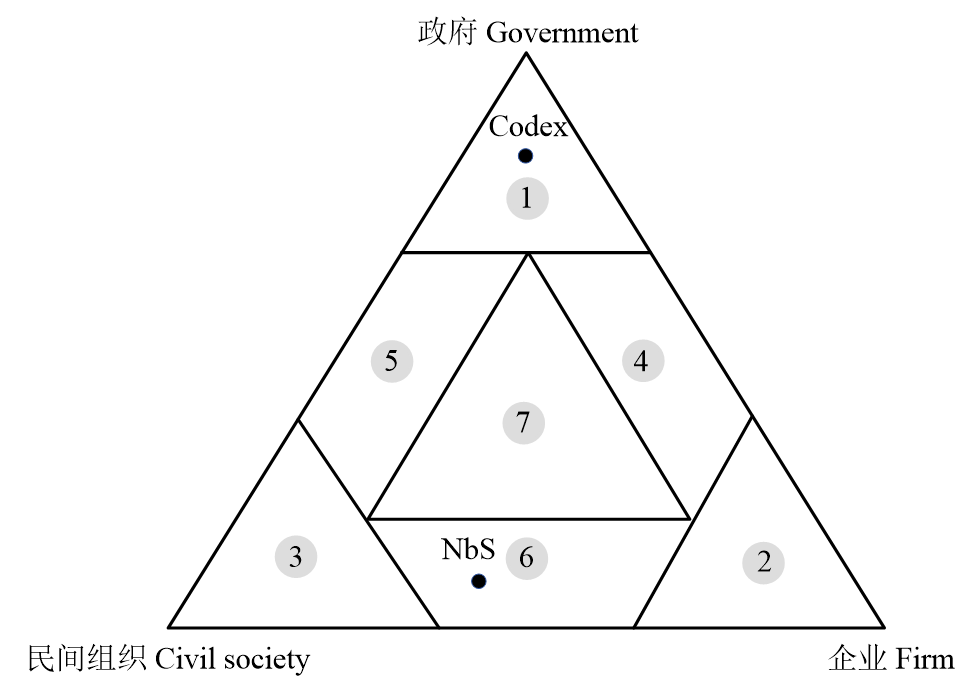
图1
Codex和NbS在治理三角模型中的定位"
表2
Codex与NbS的间接治理模式的对比"
| 比较维度 Dimension of comparison | 国际食品法典 Codex | 基于自然的解决方案 NbS |
|---|---|---|
| 类型Type | 委托-代理Principal-Agent | 协调-中介Orchestrator-Intermediary |
| 控制度 Degree of control | 高(硬法约束):标准具法律强制力,违约面临制裁 High (hard law constraints): Standards possess legal force; non-compliance faces sanctions | 低(软法引导):依靠道德承诺与声誉机制,无强制纠偏手段 Low (soft law guidance): Relies on moral commitments and reputational mechanisms; lacks mandatory corrective measures |
| 驱动力来源 Source of driving force | 主权授权驱动:FAO/WHO理事会中成员国投票决定议程 Sovereign-grant driven: Agendas determined by member state voting within FAO/WHO governing bodies | 多源压力驱动:社区诉求、市场偏好与民间倡导共同推动 Multi-source pressure driven: Collectively driven by community demands, market preferences, and civil advocacy |
| 规则适应性 Rule adaptability | 较低:技术更新周期长 Low: Long technical update cycles | 较高:支持本土方案动态调整 High: Supports dynamic adjustment of localized solutions |
| 问责有效性 Effectiveness of accountability | 较强:委托人对代理人的双重监控 Strong: Dual monitoring of agents by principals | 较弱:缺乏有效的问责机制 Weak: Lacks effective accountability mechanisms |
| SDG目标整合 Integration of sustainable development goals | 单一维度聚焦:以食品安全为核心 Single-dimension focus: Centers on food safety as the core mandate | 多维度协同:嵌套生态、经济与社会议题 Multi-dimensional synergy: Nests ecological, economic, and social issues |
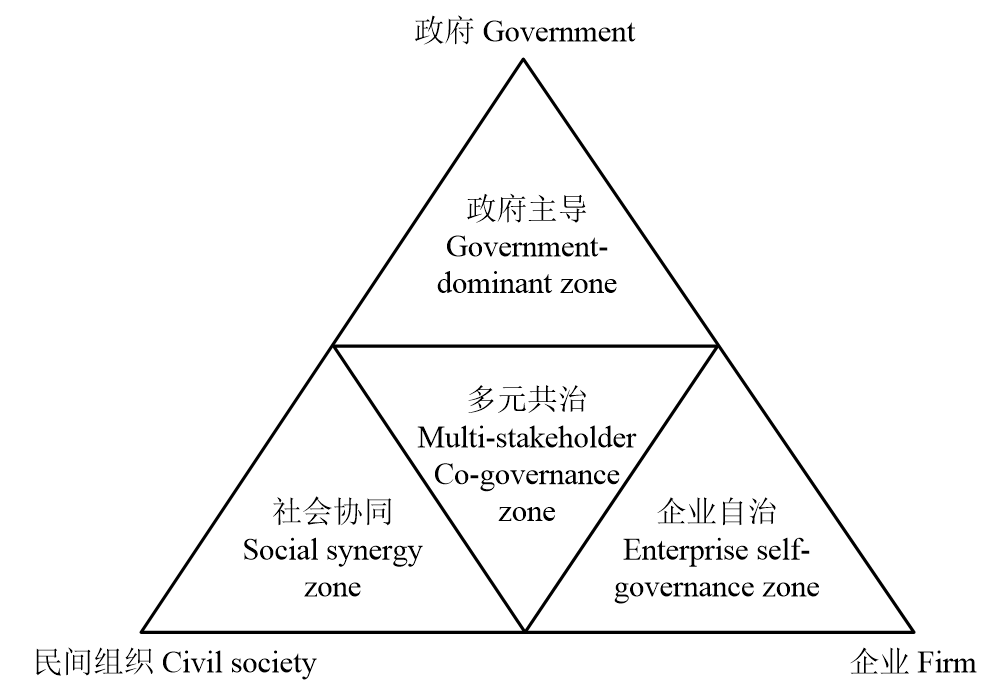
图2
四元简化治理三角模型"
表3
四元治理模型各区域权责边界与运作机制"
| 治理区域 Governance zone | 核心主体 Core actors | 核心权责 Core rights and responsibility | 角色定位 Role positioning | 运作与决策逻辑 Operation and decision logic |
|---|---|---|---|---|
| 政府主导区 Government- dominant zone | 中央/地方政府、监管部门Central/Local governments, regulatory departments | 战略规划、强制性底线标准设定、财政引导 Strategic planning, mandatory baselines, and financial guidance | Codex刚性执行者与NbS宏观驱动者 Rigid Codex enforcer and NbS macro-driver | 垂直“委托-代理”逻辑:通过行政指令与财政手段确保法典底线合规 Vertical P-A Logic: Ensuring baseline compliance via administrative orders and funding |
| 企业自治区 Enterprise self- governance zone | 农食企业、行业协会 Agri-food enterprises, associations | 技术创新、供应链管理、企业标准设定 Technical innovation, supply chain management, and private standard setting | NbS实践者与合规升级者 NbS practitioner and compliance upgrader | 市场激励机制:依托行业自律与私有标准驱动技术创新 Market incentives: Driving technical innovation via self-regulation and private standards |
| 社会协同区 Social synergy zone | 科研机构、消费者团体 Research institutions, consumer groups | 提供在地知识、政策倡议、评估权衡 Providing local knowledge, policy advocacy, and trade-off evaluation | 平衡权衡的倡导者与数据贡献者 Advocates for balance and data contributors | 水平“协调-中介”逻辑:机构间的制度化对话,保障公民参与和地方适应性 Horizontal O-I Logic: Institutionalized dialogue between organizations, ensuring citizen participation and local adaptability |
| 多元共治区 Multi-stakeholder Co-governance zone | 跨部门/跨层级联合平台 Cross-sectoral/level joint platforms | 解决跨界冲突、政策协调、系统集成 Resolving transboundary issues, policy coordination, and systemic integration | 系统集成与动态调控的平台 Platform for systemic integration and dynamic regulation | 集体共识机制:协调标准一致性与适应性 Collective consensus mechanism: Coordinating the consistency and adaptability of standards |
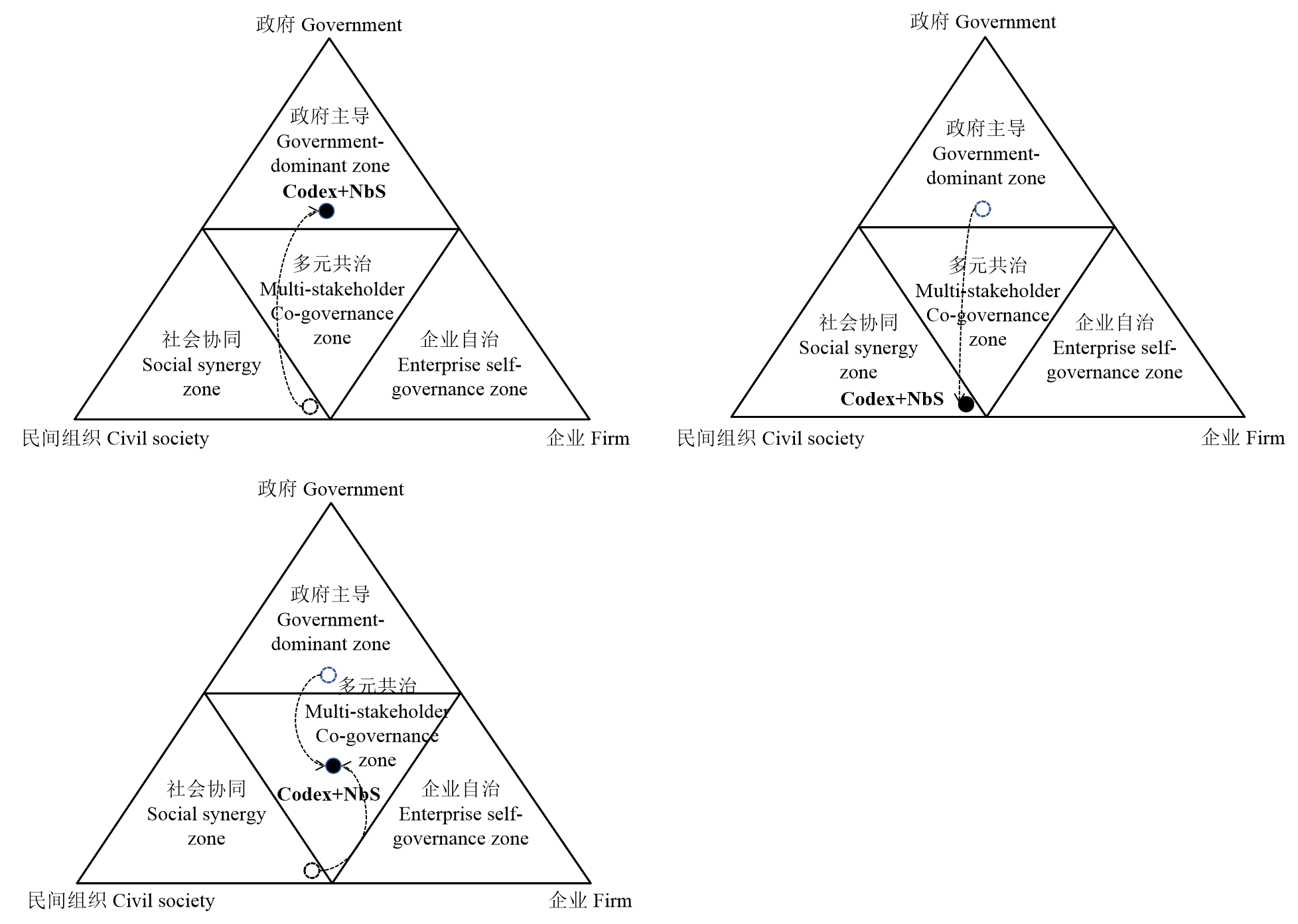
图3
四元简化治理三角模型中Codex、NbS三种静态融合模式"
表4
三种静态融合模式的间接治理模式的对比"
| 静态融合类型 Static fusion type | Codex本位模式 Codex-centric mode | NbS本位模式 NbS-centric mode | 双重心协同模式 Dual-centered synergy mode |
|---|---|---|---|
| 上层管理模式 Upper-level mode | 委托-代理 Principal-Agent | 协调-中介 Orchestrator-Intermediary | 委托-代理 Principal-Agent |
| 下层管理模式 Lower-level mode | 委托-代理 Principal-Agent | 协调-中介 Orchestrator-Intermediary | 协调-中介 Orchestrator-Intermediary |
| 核心优势 Core advantages | 政策执行力度强,标准覆盖率高,监管成本低;适用于需要硬控制和高效率的场景 Strong policy enforcement, high standard coverage, and low regulatory costs; Suitable for scenarios requiring hard control and high efficiency | 创新活力强,本地适应性高,社会接受度好;适用于发挥内在动机和柔性治理优势 Strong innovation vitality, high local adaptability, and good social acceptance; Suitable for leveraging intrinsic motivation and flexible governance advantages | 兼具政策统一性与地方灵活性,系统韧性高;在刚性框架下引入适应性管理 Balancing policy uniformity and local flexibility, with high system resilience; Introduces adaptive management within a rigid framework |
| 适用场景 Applicable scenarios | 食品安全管理、强制性公共产品供给 Food safety management and mandatory public goods supply | 地域特色明显的农业生态系统、社区主导的生态修复 Agricultural ecosystems with distinct regional characteristics and community-led ecological restoration | 跨区域生态敏感区 Trans-regional ecologically sensitive areas |
表5
监控阈值类型和监控要求"
| 阈值层级 Threshold level | 目标 Objective | 内容和标准 Content and standard |
|---|---|---|
| 基础阈值 Basic threshold | 不可逆生态效益 Irreversible ecological benefits | 强制性底线:涉及生态系统的健康和完整性,确保长期可持续性。基础阈值的设定应与NbS的核心原则相符,即在应对社会挑战的同时,必须带来生物多样性净增益 Mandatory baseline: Pertains to ecosystem health and integrity to ensure long-term sustainability. The setting of basic thresholds must align with the core principles of NbS, which require delivering net gains in biodiversity while simultaneously addressing societal challenges |
| 中间阈值 Intermediate threshold | 区域特性及经济合规性 Regional characteristics and economic compliance | 区域特征差异化设定:与地区农产品质量安全和农户生计直接挂钩。农产品质量合规性直接呼应Codex以风险分析为基础的刚性标准要求 Differentiated regional settings: Directly linked to local agri-product quality safety and farmer livelihoods. Compliance with agri-product quality directly echoes the rigid standard requirements of Codex based on risk analysis |
| 弹性阈值 Elastic threshold | 地方适应性及社会参与度 Local adaptability and social participation | 根据实际情况动态调整:旨在激发地方主体的内生动力和创新活力 Dynamic adjustments based on actual conditions: Aimed at stimulating the endogenous motivation and innovative vitality of local actors |
表6
智能切换机制的设定方式"
| 预警颜色Warning color | 状态 Status | 触发条件 Trigger condition | 治理模式 Governance mode |
|---|---|---|---|
| 绿色 Green | 正常运行 Normal operation | 关键指标维持在阈值100%及以上,并持 续一个季度 Key indicators maintained at or above 100% of the threshold for one quarter | 保持协调-中介模式:市场和社区享有高度自主权,政府提供支持和引导 Maintain O-I mode: Market and community enjoy high autonomy; government provides support and guidance |
| 黄色 Yellow | 预警/观察 Warning/Observation | 关键指标降至阈值80%—100% Key indicators drop to between 80% and 100% of the threshold | 保持协调-中介模式,但政府增强软性干预 Maintain O-I mode, but with enhanced soft intervention |
| 红色 Red | 失效/紧急干预 Failure/ Emergency intervention | 关键指标连续两个季度低于阈值80% Key indicators fall below 80% of the threshold for two consecutive quarters | 切换至委托-代理模式:政府收回部分或全部自主权,启动强制性干预 Switch to P-A mode: Government reclaims partial or total autonomy and launches mandatory interventions |
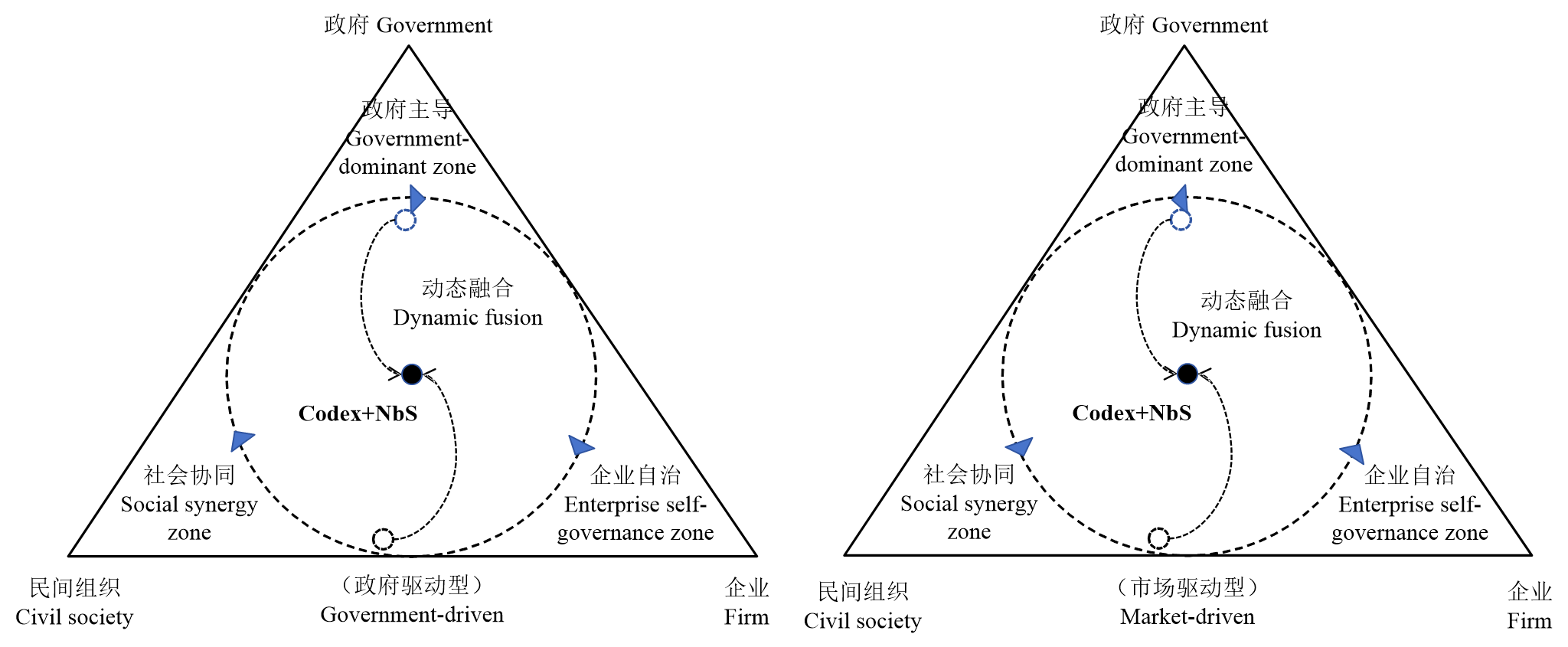
图4
四元简化治理三角模型中Codex、NbS两种动态融合模式"
表7
两种动态融合模式间接治理的对比"
| 动态融合类型Dynamic fusion type | 政府驱动型Government-driven | 市场驱动型Market-driven |
|---|---|---|
| 项目设计阶段Project design stage | 委托-代理Principal-Agent | 协调-中介Orchestrator-Intermediary |
| 常态化运行阶段Routine operation stage | 协调-中介Orchestrator-Intermediary | 协调-中介Orchestrator-Intermediary |
| 纠偏核查阶段Correction and verification stage | 委托-代理Principal-Agent | 委托-代理Principal-Agent |
| [1] |
doi: 10.1038/s41558-018-0230-x |
| [2] |
|
| [3] |
doi: 10.1016/j.crm.2022.100473 |
| [4] |
IPCC Intergovernmental Panel on Climate Change. Climate Change 2022 - Mitigation of Climate Change: Working group iii Contribution to the Sixth Assessment Report of the Intergovernmental Panel on Climate Change[M]. Cambridge: Cambridge University Press, 2023.
|
| [5] |
doi: 10.1038/s43016-024-01009-7 pmid: 38977923 |
| [6] |
|
| [7] |
United Nations Forum on Sustainability Standards. Voluntary Sustainability Standards, Sustainability Agenda and Developing Countries: Opportunities and Challenges[R]. Geneva: UNFSS, 2022.
|
| [8] |
doi: 10.1016/j.nbsj.2024.100176 |
| [9] |
doi: 10.1126/science.abn9668 |
| [10] |
|
| [11] |
doi: 10.1017/S0007123414000593 |
| [12] |
doi: 10.1017/S1368980018003786 pmid: 30816085 |
| [13] |
doi: 10.1186/s12889-024-18488-9 pmid: 38627643 |
| [14] |
|
| [15] |
|
| [16] |
doi: 10.1007/s10068-021-00943-7 |
| [17] |
|
| [18] |
高芳. 国际食品法典标准概述[J]. 世界农业, 2025(5): 145-148.
|
|
|
|
| [19] |
|
| [20] |
林静, 韩秀丽. 国际食品安全标准的合法性之思[J]. 东南学术, 2014(6): 209-215.
|
|
|
|
| [21] |
Guideline: Sugars Intake for Adults and Children[M]. Geneva: World Health Organization, 2015.
|
| [22] |
傅伯杰, 王军. 基于自然的解决方案理论内涵与中国实践[J]. 中国科学院院刊, 2025, 40(7): 1157-1167.
|
|
doi: 10.3724/j.issn.1000-3045.20250513005 |
|
| [23] |
|
| [24] |
doi: 10.1111/conl.2017.10.issue-1 |
| [25] |
|
| [26] |
世界自然保护联盟. IUCN基于自然的解决方案全球标准使用指南:基于自然的解决方案的审核、设计和推广框架[M]. 格兰德: 世界自然保护联盟, 2020.
|
|
International Union for Conservation of Nature. Guidance for using the IUCN global standard for nature-based solutions: a user-friendly framework for the verification, design and scaling up of nature-based solutions[M]. Gland: IUCN, 2020, (in Chinese)
|
|
| [27] |
世界自然保护联盟. IUCN 基于自然的解决方案全球标准[EB/OL]. [2025-11-15]. https://portals.iucn.org/library/node/49505.
|
|
International Union for Conservation of Nature. Guidance for using the IUCN global standard for Nature-based Solutions[EB/OL]. [2025- 11-15]. https://portals.iucn.org/library/node/49505. (in Chinese)
|
|
| [28] |
|
| [29] |
doi: 10.3390/su13010001 |
| [30] |
|
| [31] |
|
| [32] |
|
| [33] |
doi: 10.1177/03091325221133808 |
| [34] |
|
| [35] |
丁婧祎, 赵文武, 王军, 房学宁. 降水和植被变化对径流影响的尺度效应: 以陕北黄土丘陵沟壑区为例[J]. 地理科学进展, 2015, 34(8): 1039-1051.
doi: 10.18306/dlkxjz.2015.08.011 |
|
|
|
| [36] |
|
| [37] |
|
| [38] |
唐丽云. 流域协调机制的功能定位与制度完善[J]. 水利经济, 2025, 43(2):108-116.
|
|
|
|
| [39] |
|
| [40] |
|
| [41] |
欧阳志云,
|
|
|
|
| [42] |
国际食品法典委员会. 食典委观察员[EB/OL]. [2025-11-15]. https://www.fao.org/fao-who-codexalimentarius/about-codex/observers/observers/about/zh/.
|
|
|
|
| [43] |
|
| [44] |
|
| [45] |
doi: 10.1088/2515-7620/add241 |
| [46] |
康燕, 干靓, 俞霖琳, 何晨静, 张理卿, 吴婧彬. 基于NbS的城市小微栖息地营造与网络构建模式: 以上海市长宁区生境花园为例[J]. 生物多样性, 2025, 33(5): 181-194.
|
|
|
|
| [47] |
doi: 10.1093/jopart/mux030 |
| [48] |
|
| [49] |
doi: 10.3390/ijerph17051778 |
| [1] | 肖云泽, 张宇, 成功, 练子柔, 周厚熹. 基于自然解决方案视角下的农业文化遗产研究范式探析[J]. 中国农业科学, 2026, 59(19): 4374-4390. |
| [2] | 孔维丽, 王立杰, 郑靖康, 高芳, 李涛, 张珂珂, 张玉亭. 基于自然解决方案的秸秆综合利用关键技术和模式—粮菇定区轮作[J]. 中国农业科学, 2026, 59(19): 4349-4357. |
| [3] | 罗宁, 李兆磊, 徐彩龙, 牛娜, 王璞, 孟庆锋. 基于自然解决方案的作物高产可持续转型[J]. 中国农业科学, 2026, 59(19): 4335-4348. |
| [4] | 梁晓贺, 王琦, 雷洁, 周加加, 吴俣, 周爱莲. 全球基于自然的解决方案在农业研究中的演进脉络、驱动机制与中国路径[J]. 中国农业科学, 2026, 59(19): 4323-4334. |
| [5] | 韩明会,李保国,张丹,李颖. 再生农业——基于土地保护性利用的可持续农业[J]. 中国农业科学, 2021, 54(5): 1003-1016. |
|
||
