






中国农业科学 ›› 2026, Vol. 59 ›› Issue (19): 4374-4390.doi: 10.3864/j.issn.0578-1752.2026.19.015
• 专题:基于自然的解决方案:绿色农业转型的研究范式与中国实践 • 上一篇 下一篇
肖云泽1,2( ), 张宇3, 成功4(), 练子柔1, 周厚熹5()
收稿日期:2025-08-27
接受日期:2025-12-31
出版日期:2026-10-01
发布日期:2026-10-10
通信作者:
联系方式:
肖云泽,E-mail:xyze@zjut.edu.cn。
基金资助:
XIAO YunZe1,2(), ZHANG Yu3, CHENG Gong4(), LIAN ZiRou1, ZHOU HouXi5()
Received:2025-08-27
Accepted:2025-12-31
Published:2026-10-01
Online:2026-10-10
摘要:
【背景】农业文化遗产是人类与自然协同演化的农业生态系统和知识体系,在当前全球粮食系统面临气候变化冲击、土地退化和生态系统服务功能下降的背景下,作为保障粮食安全和实现农业可持续发展的关键资源,其多功能价值得到广泛关注。自2023年起,中央一号文件开始将“农业文化遗产保护利用”纳入国家战略,为其制度化发展奠定了政策基础。与此同时,国际自然保护联盟提出的“基于自然的解决方案”(nature-based solutions,NbS)理念也在农业与生态治理领域快速发展,强调利用生态过程解决社会挑战。【目的】将NbS作为一种分析框架,可以深入、系统、全面地研究农业文化遗产,建立跨学科的研究范式,并为农业文化遗产的保护、监督、管理、评估、利用和研究提供国际通用的指标体系。【方法】本文以概念比较分析为工具,提出农业文化遗产是NbS的一种典型形态,能够有效应对粮食安全、生态系统退化与乡村社会脆弱性等问题。结合IUCN NbS全球标准中的8项准则与28项评估指标,采用指标评价法,对全球重要农业文化遗产(Globally Important Agricultural Heritage Systems,GIAHS)和中国重要农业文化遗产名录中的代表性案例进行系统实证分析。【结果】在NbS的8项准则的每个类别之内,以全球农业文化遗产和中国农业文化遗产各3个案例,尽可能涉及更广泛的地域,更多样的生态系统,更异质的生计类型,共计16个全球农业文化遗产和18个中国农业文化遗产。这些案例支撑了28项指标的所有相关内容,显示出农业文化遗产在生态系统服务、生物多样性保育、农田治理、气候韧性、社区参与等方面高度契合NbS标准,且NbS指标体系具有适用于农业文化遗产评估与政策规划的可行性。【结论】从概念结构、价值目标和系统属性来看,农业文化遗产与NbS之间具有高度契合性,农业文化遗产是NbS的子集。因此,可以采用NbS的原则、准则和指标体系对农业文化遗产进行分析与讨论,从而为农业文化遗产的保护、监督、管理、利用和评估提供全球适用的分析框架。该研究为农业文化遗产融入全球NbS政策体系与农业绿色转型提供了研究范式与实证路径。
肖云泽, 张宇, 成功, 练子柔, 周厚熹. 基于自然解决方案视角下的农业文化遗产研究范式探析[J]. 中国农业科学, 2026, 59(19): 4374-4390.
XIAO YunZe, ZHANG Yu, CHENG Gong, LIAN ZiRou, ZHOU HouXi. Exploring Research Paradigms for Agricultural Heritage from the Perspective of Nature-Based Solutions[J]. Scientia Agricultura Sinica, 2026, 59(19): 4374-4390.
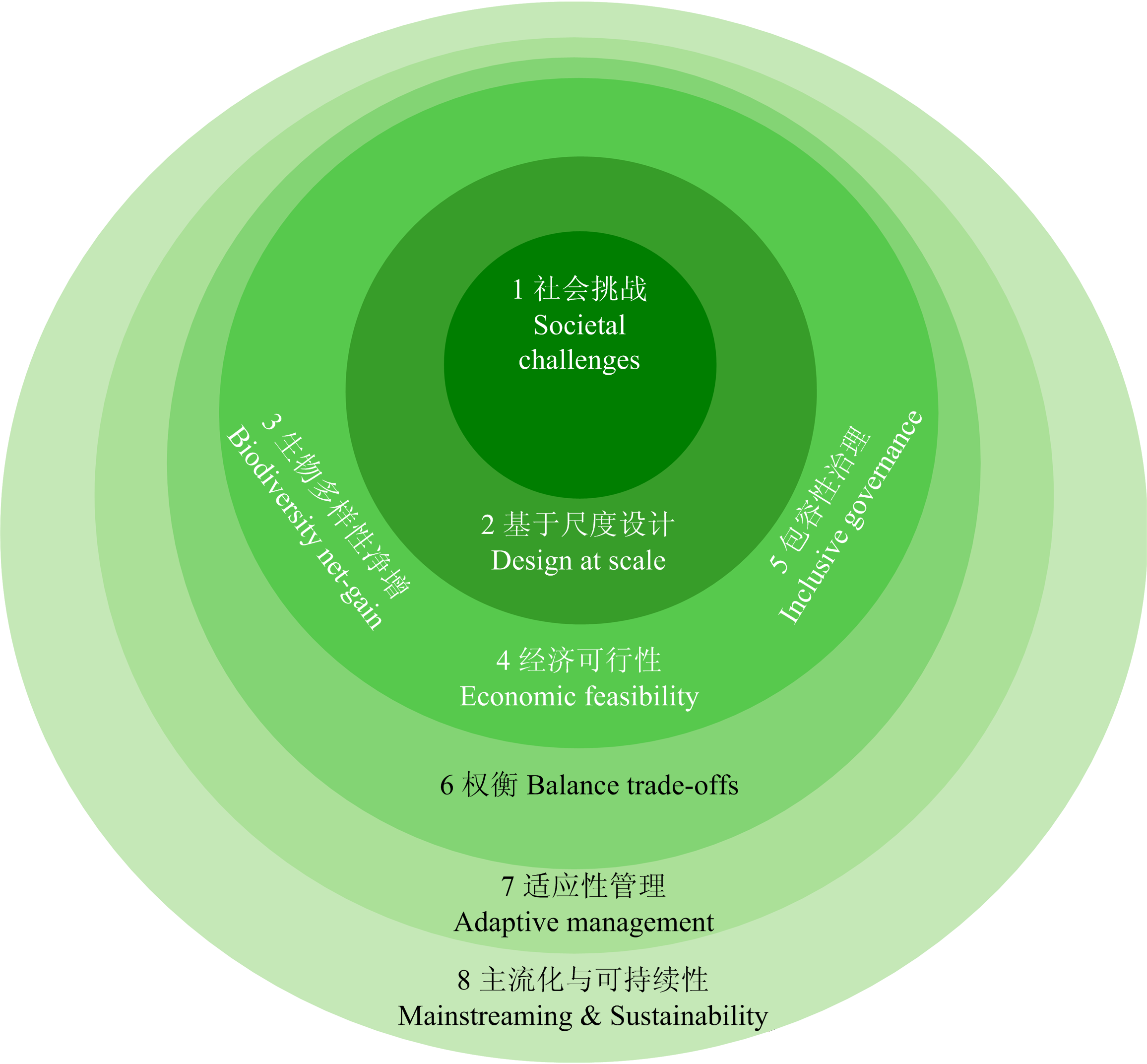
图1
NbS全球标准8项核心准则的结构关系图(改自IUCN)[14]"

表1
NbS应有效应对人类社会挑战的3项具体指标"
| 指标Indicator | 国际案例International case | 中国案例Chinese case | |
|---|---|---|---|
| C-1.1 | 优先考虑权利持有者和受益者最迫切的社会挑战 Prioritize the most pressing societal challenges faced by rights-holders and beneficiaries | 伊朗喀山坎儿井灌溉系统 Qanat irrigated agricultural heritage systems, Kashan, Iran | 云南红河哈尼稻作梯田系统 Honghe Hani Rice Terraces system |
| C-1.2 | 清楚地理解和记录所应对的社会挑战 Clearly identify, understand, and document the societal challenges being addressed | 伊朗喀山坎儿井灌溉系统;日本能登半岛里山-里海 系统 Qanat irrigated agricultural heritage systems, Kashan, Iran; Noto’s Satoyama and Satoumi, Japan | 湖南新化紫鹊界梯田 Xinhua Ziquejie Terraces |
| C-1.3 | 识别、设立基准并定期评估NbS所产生的人类福祉 Identify and establish baselines and regularly assess the human well-being outcomes generated by the NbS | 日本能登半岛里山-里海系统;葡萄牙巴罗索农林牧 业系统 Noto’s Satoyama and Satoumi, Japan; Barroso Agro- Sylvo-Pastoral system, Portugal | 内蒙古敖汉旱作农业系统 Aohan dryland farming system |
表2
应在生态系统尺度上设计NbS的3项具体指标"
| 指标Indicator | 国际案例International cases | 中国案例Chinese case | |
|---|---|---|---|
| C-2.1 | NbS的设计应认识到经济、社会和生态系统之间的相互作用并做出响应 The design of NbS should recognize and respond to interactions among economic, social, and ecological systems | 菲律宾伊富高水稻梯田 Ifugao Rice Terraces, Philippines | 浙江仙居古杨梅群复合种养系统 Xianju Ancient Chinese Waxberry composite system in Zhejiang Province |
| C-2.2 | NbS应与其他相关措施互补,并联合不同部门产生协同作用 The design of NbS should be complementary to other relevant measures and generate cross-sectoral synergies | 意大利索阿韦传统葡萄园 Soave traditional vineyards, Italy | 福建福鼎白茶文化系统 Fuding White tea culture system in Fujian Province |
| C-2.3 | NbS的设计应纳入干预场地以外区域的风险识别和风险管理 The design of NbS should incorporate risk identification and management for areas beyond the intervention site | 摩洛哥菲吉格农牧一体古老绿洲系统 The ksour of Figuig: Oasis and pastoral culture around the social management of water and land, Morocco | 浙江吴兴溇港圩田农业系统 Wuxing Lougang Weir field agriculture system |
表3
NbS应带来生物多样性净增长和生态系统完整性的4项具体指标"
| 指标Indicator | 国际案例International case | 中国案例Chinese case | |
|---|---|---|---|
| C-3.1 | NbS行动必须基于生态现状和退化驱动力的评估 NbS actions must be based on an assessment of current ecological conditions and the drivers of degradation | 摩洛哥的阿尔甘林业农业系统 Argan-based agro-sylvo-pastoral system within the area of Ait Souab-Ait Mansour, Morocco | 贵州从江侗乡稻鱼鸭复合系统 Congjiang Dong’s rice-fish-duck system |
| C-3.2 | 建立生物多样性保护的可测量目标与阶段性评估 机制 Establish measurable biodiversity conservation targets and mechanisms for periodic evaluation | 摩洛哥的阿尔甘林业农业系统;日本新潟县佐渡岛朱鹮共生系统 Argan-based agro-sylvo-pastoral system within the area of Ait Souab-Ait Mansour, Morocco; Sado’s Satoyama in Harmony with the Japanese Crested Ibis, Japan | 贵州从江侗乡稻鱼鸭复合系统;浙江青田稻鱼共生系统 Congjiang Dong’s rice-fish-duck system; Qingtian rice-fish culture system |
| C-3.3 | 监测潜在负面影响 Monitor potential adverse impacts | 日本新潟县佐渡岛朱鹮共生系统 Sado’s Satoyama in Harmony with the Japanese Crested Ibis, Japan | 江苏兴化垛田传统农业系统 Xinghua Duotian agrosystem |
| C-3.4 | 提升生态连通性并整合相关策略 Enhance ecological connectivity and integrate relevant strategies | 韩国济州岛石垣农业系统 Jeju Batdam Agricultural system, Republic of Korea | 浙江青田稻鱼共生系统;江苏兴化垛田传统农业系统 Qingtian rice-fish culture system; Xinghua Duotian agrosystem |
表4
NbS应具有经济可行性与适应性的4项具体指标"
| 指标Indicator | 国际案例International case | 中国案例Chinese case | |
|---|---|---|---|
| C-4.1 | 确认和记录NbS项目的直接与间接成本及受益群体 Identify and document the direct and indirect costs of NbS projects and their beneficiary groups | 墨西哥奇南帕浮园农业系统 Chinampas agricultural system in Mexico City, Mexico | 浙江缙云茭白-麻鸭共生系统 Jinyun water bamboo-duck symbiosis system |
| C-4.2 | 采用成本-效益研究支撑决策,并分析政策与补贴影响 Use cost-benefit analyses to support decision-making and assess the impacts of relevant policies and subsidies | 墨西哥奇南帕浮园农业系统;日本静冈茶草场系统 Chinampas agricultural system in Mexico City, Mexico; traditional tea-grass integrated system in Shizuoka, Japan | 浙江云和梯田农业系统 Yunhe Rice Terraces system |
| C-4.3 | 评估方案的外部性与可比替代方案 Evaluate the project’s externalities and comparable alternative options | 西班牙莱昂山脉农林牧复合系统 Agro-Silvo-Pastoral system Mountains of León, Spain | 浙江云和梯田农业系统 Yunhe Rice Terraces system |
| C-4.4 | 多元化融资机制确保资金合规使用 Employ diversified financing mechanisms to ensure the compliant use of funds | 日本静冈茶草场系统;西班牙莱昂山脉农林牧复合系统 Traditional tea-grass integrated system in Shizuoka, Japan; Agro-Silvo-Pastoral system Mountains of León, Spain | 湖南安化黑茶文化系统 Hunan Anhua Dark tea cultural system |
表5
NbS应基于包容、透明和赋权的治理过程的5个评估指标"
| 指标Indicator | 国际案例International case | 中国案例Chinese case | |
|---|---|---|---|
| C-5.1 | 所有利益相关方需就反馈与申诉机制达成共识 Ensure consensus among all stakeholders on feedback and grievance mechanisms | 菲律宾伊富高水稻梯田系统 Ifugao rice terraces, Philippines | 贵州从江侗乡稻鱼鸭系统 Congjiang Dong’s rice-fish-duck system |
| C-5.2 | 保障广泛而平等的参与,特别重视弱势群体与原住民的知情同意权 Guarantee broad and equitable participation, with particular emphasis on the right to informed consent of vulnerable groups and indigenous peoples | 墨西哥奇南帕浮园农业系统 Chinampas agricultural system in Mexico City, Mexico | 河北涉县王金庄旱作石堰梯田系统 Shexian dryland stone terraced system |
| C-5.3 | 明确识别所有直接和间接受影响群体,并全程参与决策 Clearly identify all directly and indirectly affected groups, and engage them throughout the decisionmaking process | 墨西哥奇南帕浮园农业系统 Chinampas agricultural system in Mexico City, Mexico | 贵州从江侗乡稻鱼鸭系统 Congjiang Dong’s rice-fish-duck system |
| C-5.4 | 记录决策路径并回应各方诉求 Document decisionmaking pathways and respond to stakeholders’ concerns | 菲律宾伊富高水稻梯田系统 Ifugao rice terraces, Philippines | 河北涉县王金庄旱作石堰梯田系统 Shexian dryland stone terraced system |
| C-5.5 | 跨区域治理中应建立联合决策机制 Establish joint decisionmaking mechanisms in cross-regional governance | 意大利阿西西与斯波莱托之间的山坡橄榄园 Olive Groves of the slopes between Assisi and Spoleto, Italy | 内蒙古阿鲁科尔沁草原游牧系统 Ar Horqin Grassland Nomadic system in Inner Mongolia |
表6
NbS应在首要目标和其他多种效益间公正地权衡的3个评价指标"
| 指标Indicator | 国际案例International case | 中国案例Chinese case | |
|---|---|---|---|
| C-6.1 | 明确NbS方案中的权衡与潜在外部性影响,并设定保障与补救机制 Clarify the trade-offs and potential externality impacts within the NbS intervention and establish appropriate safeguards and remediation mechanisms | 秘鲁安第斯高原农业系统 Andean agriculture, Peru | 浙江青田稻鱼共生系统 Qingtian rice-fish culture system |
| C-6.2 | 尊重利益相关方的自然资源权利 Respect stakeholders’ rights to natural resources | 伊朗喀山坎儿井灌溉系统 Qanat irrigated agricultural heritage systems, Kashan, Iran | 湖南安化黑茶文化系统 Hunan Anhua Dark tea cultural system |
| C-6.3 | 定期回顾保障机制,避免权衡失衡引发生态或社会损害 Periodically review and update safeguards to prevent imbalanced trade-offs from causing ecological or social harm | 突尼斯加夫萨绿洲农业系统 Gafsa Oases, Tunisia | 广西龙胜梯田 Longsheng Longji Terraces |
表7
NbS应基于证据进行适应性管理的3个具体指标"
| 指标Indicator | 国际案例International case | 中国案例Chinese case | |
|---|---|---|---|
| C-7.1 | 制定NbS干预策略并开展监测与评估 Develop NbS intervention strategies and implement monitoring and evaluation | 日本能登半岛里山-里海系统;韩国花开传统河东茶农业系统 Noto’s Satoyama and Satoumi, Japan; Traditional Hadong tea agrosystem in Hwagae-myeon, Republic of Korea | 云南红河哈尼稻作梯田系统 Honghe Hani Rice Terraces system |
| C-7.2 | 建立全过程的评估机制并跟踪调整实施路径 Establish end-to-end evaluation mechanisms and track adjustments to the implementation pathway | 日本能登半岛里山-里海系统;摩洛哥阿尔甘林业农业系统 Noto’s Satoyama and Satoumi, Japan; Argan-based agro- sylvo-pastoral system within the area of Ait Souab-Ait Mansour, Morocco | 福建安溪铁观音茶文化系统 Anxi Tieguanyin tea culture system |
| C-7.3 | 构建迭代学习框架,使实施方案在实践中不断优化 Construct an iterative learning framework to continuously refine and optimize the NbS in practice | 摩洛哥阿尔甘林业农业系统;韩国花开传统河东茶农业系统 Argan-based agro-sylvo-pastoral system within the area of Ait Souab-Ait Mansour, Morocco; Traditional Hadong tea agro-system in Hwagae myeon, Republic of Korea | 湖南新化紫鹊界梯田 Xinhua Ziquejie Terraces |
表8
NbS应具可持续性并在适当的辖区内主流化的3个评价指标"
| 指标 Indicator | 国际案例International case | 中国案例Chinese case | |
|---|---|---|---|
| C-8.1 | 总结与分享实施过程的经验教训 Summarize and disseminate lessons learned from the implementation process | 韩国花开传统河东茶农业系统;秘鲁安第斯高山农业系统 Traditional Hadong Tea Agro-system in Hwagae myeon, Republic of Korea; Andean agriculture, Peru | 浙江湖州桑基鱼塘系统 Zhejiang Huzhou mulberry-dyke & Fish-pond system |
| C-8.2 | 倡导并嵌入有利于NbS落地的政策与制度 Advocate for and embed policies and institutional arrangements that facilitate the uptake of NbS | 日本新潟县佐渡岛朱鹮共生系统;韩国花开传统河东茶农业系统 Sado’s Satoyama in Harmony with the Japanese Crested Ibis, Japan; Traditional Hadong tea Agro- system in Hwagae myeon, Republic of Korea | 绍兴会稽山古香榧群;河北涉县王金庄旱作石堰梯田系统 Kuaijishan ancient Chinese torreya; Shexian dryland stone terraced system |
| C-8.3 | 协同实现全球与国家层面在人类福祉、生物多样性、气候韧性与人权保障等方面的目标 Collaborate to align and advance global- and national-level objectives for human wellbeing, biodiversity conservation, climate resilience, and human rights | 日本新潟县佐渡岛朱鹮共生系统;秘鲁安第斯高山农业系统 Sado’s Satoyama in Harmony with the Japanese Crested Ibis, Japan; Andean agriculture, Peru | 浙江湖州桑基鱼塘系统;河北涉县王金庄旱作石堰梯田系统 Zhejiang Huzhou mulberry-dyke & fish-pond system; Shexian dryland stone terraced system |
| [1] |
|
| [2] |
焦雯珺, 崔文超, 闵庆文, 张永勋. 农业文化遗产及其保护研究综述[J]. 资源科学, 2021, 43(4): 823-837.
doi: 10.18402/resci.2021.04.16 |
|
doi: 10.18402/resci.2021.04.16 |
|
| [3] |
闵庆文, 骆世明, 曹幸穗, 苑利, 成升魁, 杨庆文, 孙庆忠, 李先德, 孙业红, 赵立军, 张红榛, 吴敏芳. 农业文化遗产: 连接过去与未来的桥梁[J]. 农业资源与环境学报, 2022, 39(5): 856-868.
|
|
|
|
| [4] |
李文华, 刘某承, 闵庆文. 农业文化遗产保护: 生态农业发展的新契机[J]. 中国生态农业学报, 2012, 20(6): 663-667.
|
|
doi: 10.3724/SP.J.1011.2012.00663 |
|
| [5] |
卢成仁. 乡土中国的命运与农业文化遗产的未来[J]. 思想战线, 2023, 49(4): 67-73.
|
|
|
|
| [6] |
伽红凯, 卢勇. 农业文化遗产供给侧改革: 矛盾表征、肇因分析与策略选择[J]. 中国农业大学学报(社会科学版), 2023, 40(5): 189-202.
|
|
|
|
| [7] |
王思明, 李明. 中国农业文化遗产-第一卷-中国农业文化遗产研究[M]. 北京: 中国农业科学技术出版社, 2015.
|
|
|
|
| [8] |
孙庆忠, 张金垚. 农业文化遗产研究的核心议题与保护实践: 孙庆忠教授访谈录[J]. 中国农业大学学报(社会科学版), 2025, 42(2): 95-109.
|
|
|
|
| [9] |
肖云泽. 农业文化遗产保护作为社会干预: 浙江经验[J]. 中国农业大学学报(社会科学版), 2025, 42(2): 140-154.
|
|
|
|
| [10] |
刘某承, 苏伯儒, 闵庆文, 李文华. 农业文化遗产助力乡村振兴: 运行机制与实施路径[J]. 农业现代化研究, 2022, 43(4): 551-558.
|
|
|
|
| [11] |
IUCN. WCC-2016-Res-069-EN:Defining Nature-based Solutions[EB/OL]. (2016) [2025-02-24]. https://portals.iucn.org/library/sites/library/files/resrecfiles/WCC_2016_RES_069_EN.pdf.
|
| [12] |
|
| [13] |
何思源, 焦雯珺, 闵庆文. 自然受益目标下食物系统转型研究: 基于全球重要农业文化遗产(GIAHS)的解决方案[J]. 生态与农村环境学报, 2022, 38(10): 1249-1257.
|
|
|
|
| [14] |
IUCN. IUCN Global Standard for Nature-based Solutions: A User-Friendly Framework for the verification, Design and Scaling up of NbS: first edition (Hindi version)[M]. IUCN, International Union for Conservation of Nature, 2024.
|
| [15] |
李正元, 张鹏远. 资质、关怀和权利: 农业文化遗产保护中的公正研究[J]. 中国农业大学学报(社会科学版), 2025, 42(2): 110-124.
|
|
|
|
| [16] |
|
| [17] |
Noto Regional Association for GIAHS Promotion and Cooperation. Noto’s Satoyama and Satoumi[EB/OL]. (2011) [2025-05-13]. https://openknowledge.fao.org/server/api/core/bitstreams/b24e1d8c-a63f-46a1-9d45-1f9d21bf00ed/content.
|
| [18] |
doi: 10.3390/su14169958 |
| [19] |
闵庆文, 田密. 云南红河哈尼稻作梯田系统[M]. 北京: 中国农业出版社, 2015: 23, 56-58.
|
|
|
|
| [20] |
白艳莹, 闵庆文, 左志锋. 湖南新化紫鹊界梯田[M]. 北京: 中国农业出版社, 2017: 49-54.
|
|
|
|
| [21] |
白艳莹, 闵庆文. 内蒙古敖汉旱作农业系统[M]. 北京: 中国农业出版社, 2015: 105.
|
|
|
|
| [22] |
麻雪彬, 王井东. 内蒙古敖汉旗旱作高标准农田建设(“坡改梯”)的经验分享[J]. 中国农业综合开发, 2024(9): 30-33.
|
|
|
|
| [23] |
侯惠珺, 罗丹, 赵鸣. 基于生态恢复和文化回归的梯田景观格局重建: 以菲律宾科迪勒拉高山水稻梯田景观复兴为例[J]. 生态学报, 2016, 36(1): 148-155.
|
|
|
|
| [24] |
doi: 10.1017/S0022463412000367 |
| [25] |
FAO. Twenty years of Globally Important Agricultural Heritage Systems: Success stories of dynamic conservation for sustainable rural development[R]. Rome: FAO, 2022: 20.
|
| [26] |
Agence Nationale pour le Développement des Zones Oasiennes et de l’Arganier. Les ksour de Figuig: Cultures oasiennes et pastorales autour de la gestion sociale de l’eau et des terres: Dossier d’inscription du site Figuig comme Système Ingénieux du Patrimoine Agricole Mondial (SIPAM)[EB/OL]. (2021) [2025-05-24]. https://openknowledge.fao.org/server/api/core/bitstreams/cd882b68-f095-4c64-89b1-c6000747d159/content.
|
| [27] |
卢勇, 张凤岐, 冯培. 浙江仙居杨梅栽培系统[M]. 北京: 中国农业出版社, 2019.
|
|
|
|
| [28] |
朱世桂, 陈兴华. 福建福鼎白茶文化系统[M]. 北京: 中国农业出版社, 2019: 64, 76-77.
|
|
|
|
| [29] |
吴兴区水利局. 吴兴溇港文化史[M]. 上海: 同济大学出版社, 2013.
|
|
Wuxing District Water Resources Bureau. Cultural History of Xing wu gang[M]. Shanghai: Tongji University Press, 2013. (in Chinese)
|
|
| [30] |
金瑛迪. 湖州溇港圩田复合空间体系及其对时代需求适应性研究[D]. 杭州: 浙江大学, 2019.
|
|
|
|
| [31] |
doi: 10.3390/f11080860 |
| [32] |
卢勇, 王思明. 引进与重构: 全球农业文化遗产“日本佐渡岛朱鹮-稻田共生系统”的经验与启示[J]. 云南师范大学学报(哲学社会科学版), 2016, 48(2): 132-138.
|
|
|
|
| [33] |
伽红凯, 陈晖. GIAHS农业文明互鉴的理论逻辑、实践探索与路径思考[J]. 中国农业大学学报(社会科学版), 2022, 39(3): 88-99.
|
|
|
|
| [34] |
Jeju Special Self-governing Province, Republic of Korea. Jeju Batdam agricultural system. [EB/OL]. (2013) [2025-07-20]. https://openknowledge.fao.org/server/api/core/bitstreams/3befd33a-f103-4788-9552-b32ff69b587e/content.
|
| [35] |
张丹, 闵庆文. 贵州从江侗乡稻-鱼-鸭系统[M]. 北京: 中国农业出版社, 2015: 39-57.
|
|
|
|
| [36] |
|
| [37] |
浙江财政新闻联播, 浙江: 青田稻鱼共生系统修复项目显成效[EB/OL]. (2025-08-07) [2025-05-06]. https://www.mof.gov.cn/zhengwuxinxi/xinwenlianbo/zhejiangcaizhengxinxilianbo/202507/t20250731_3969049.htm.
|
|
Zhejiang finance news, Zhejiang: qingtian rice-fish symbiotic system restoration project shows results[EB/OL]. (2025-08-07) [2025-05-06]. https://www.mof.gov.cn/zhengwuxinxi/xinwenlianbo/zhejiangcaizhengxinxilianbo/202507/t20250731_3969049.htm. (in Chinese)
|
|
| [38] |
doi: 10.5814/j.issn.1674-764x.2014.04.006 |
| [39] |
李禾尧, 何思源, 闵庆文, 朱会林, 吴连勇. 重要农业文化遗产价值体系构建及评估(Ⅱ): 江苏兴化垛田传统农业系统价值评估[J]. 中国生态农业学报(中英文), 2020, 28(9): 1370-1381.
|
|
|
|
| [40] |
doi: 10.3390/su152216078 |
| [41] |
陶艳红, 张健. 日本静冈茶文化生态式旅游资源的开发及启示[J]. 世界农业, 2017(2): 44-47.
|
|
|
|
| [42] |
|
| [43] |
丽水市自然资源和规划局. 缙云县以“茭鸭共生”推动富民产业高质量发展[EB/OL]. (2022-10-24)[2025-08-03]. https://www.lishui.gov.cn/art/2022/10/24/art_1229679470_57339756.html.
|
|
Lishui Municipal Bureau of Natural Resources and Planning. Jinyun county promotes high-quality development of prosperity-boosting industries through “Reed-Duck Symbiosis”[EB/OL]. (2022-10-24) [2025-08-03]. https://www.lishui.gov.cn/art/2022/10/24/art_1229679470_57339756.html. (in Chinese)
|
|
| [44] |
丽水市人民政府. 云和梯田创建国家5A级旅游景区工作总结[EB/OL]. (2023-11-14) [2025-08-03]. https://www.lishui.gov.cn/art/2023/11/14/art_1229738350_57351895.html.
|
|
Lishui Municipal People’s Government. Summary of efforts to establish yunhe terraces as a national 5a-level tourist attraction[EB/OL]. (2023-11-14) [2025-08-03]. https://www.lishui.gov.cn/art/2023/11/14/art_1229738350_57351895.html. (in Chinese)
|
|
| [45] |
中国经济周刊. 湖南安化: 让黑茶从“隐藏”变“热搜”[EB/OL]. (2024-04-15) [2025-08-03]. https://paper.people.com.cn/zgjjzk/html/2024-04/15/nw.zgjjzk_20240415_7-01.htm.
|
|
China Economic Weekly. Anhua, Hunan: turning black tea from an “Underrated” to a “Trending” product[EB/OL]. (2024-04-15) [2025-08-03]. https://paper.people.com.cn/zgjjzk/html/2024-04/15/nw.zgjjzk_20240415_7-01.htm. (in Chinese)
|
|
| [46] |
doi: 10.1017/trn.2016.7 |
| [47] |
Government of Mexico City, Authority of the World Natural and Cultural Heritage Zone in Xochimilco, Tláhuac and Milpa Alta. Chinampas system in Mexico: A proposal for designation as Globally Important Agricultural Heritage Systems (GIAHS)[EB/OL]. (2016) [2025-08-03]. https://openknowledge.fao.org/server/api/core/bitstreams/cd882b68-f095-4c64-89b1-c6000747d159/content.
|
| [48] |
doi: 10.3390/su12041611 |
| [49] |
龙初凡, 孔蓓. 侗族糯禾种植的传统知识研究: 以贵州省从江县高仟侗寨糯禾种植为例[J]. 原生态民族文化学刊, 2012, 4(4): 121-125.
|
|
|
|
| [50] |
孙庆忠. 石街邻里: 河北涉县旱作石堰梯田村落文化志[M]. 上海: 同济大学出版社, 2023: 303-315.
|
|
|
|
| [51] |
The people’s government of ar horqin banner, Inner Mongolia autonomous region. GIAHS Proposal: Ar Horqin Grassland Nomadic System in Inner Mongolial[EB/OL]. (2022) [2025-08-03]. https://openknowledge.fao.org/server/api/core/bitstreams/d1c7cb77-3414-46ff-8aad-30f1b3cd6442/content.
|
| [52] |
Profonanpe,
|
| [53] |
|
| [54] |
最高人民检察院网上发布厅. 检察公益诉讼服务乡村振兴典型案例[EB/OL]. (2025-03-27) [2025-08-03]. https://www.news.cn/20250327/90533fba98c145c4a4e160985623bc88/c.html.
|
|
Online Press Center of the Supreme PEOple’s Procuratorate. “Typical cases of procuratorial public interest litigation in support of rural revitalization” [EB/OL]. (2025-03-27) [2025-08-03]. https://www.news.cn/20250327/90533fba98c145c4a4e160985623bc88/c.html. (in Chinese)
|
|
| [55] |
益阳市人民政府. 数智赋能安化黑茶传统产业的“三链融合”跃迁之路[EB/OL]. (2025-06-14) [2025-08-03]. https://www.yiyang.gov.cn/yiyang/2/134/14114/43371/43387/content_2081146.html.
|
|
Yiyang Municipal PEople’s Government.
|
|
| [56] |
doi: 10.3390/land10111146 |
| [57] |
|
| [58] |
杨伦, 闵庆文, 刘某承, 焦雯珺. 韩国农业文化遗产的保护与发展经验[J]. 世界农业, 2017(2): 4-8, 218.
|
|
|
|
| [59] |
泉州市农业农村局. 安溪: 做好“三茶”统筹推进茶产业高质量发展[EB/OL]. (2022-09-21) [2025-08-24]. https://www.news.cn/food/20230411/87ef7fcf3dc3407fbcbafd33abfb9778/c.html.
|
|
Quanzhou Municipal Bureau of Agriculture and Rural Affairs. Anxi: promoting the high-quality development of the tea industry through the coordinated advancement of the “Three Teas” [EB/OL]. (2022-09-21) [2025-08-24]. https://www.news.cn/food/20230411/87ef7fcf3dc3407fbcbafd33abfb9778/c.html. (in Chinese)
|
|
| [60] |
赵洁, 丁伶俐, 高玥. 南南合作谱新篇共绘农遗新愿景—2024联合国粮农组织-中国南南合作全球重要农业文化遗产高级别能力建设活动一览[N]. 农民日报, 2024-11-12. https://www.farmer.com.cn/2024/11/12/99969629.html.
|
|
|
|
| [61] |
湖州市人民代表大会常务委员会. 湖州市桑基鱼塘系统保护规定[EB/OL]. (2023-12-25) [2025-10-29]. https://renda.huzhou.gov.cn/lzgk/lfgj/20231225/i3688527.html.
|
|
Standing Committee of the Huzhou Municipal People’s Congress. Regulations on the protection of the mulberry-based fish pond system in Huzhou city[EB/OL]. (2023-12-25) [2025-10-29]. https://renda.huzhou.gov.cn/lzgk/lfgj/20231225/i3688527.html. (in Chinese)
|
|
| [62] |
农业部乡镇企业局. 浙江绍兴会稽山古香榧群[EB/OL]. (2013-06- 13) [2025-10-29]. https://www.moa.gov.cn/ztzl/zywhycsl/dypzgzywhyc/201306/t20130613_3490404.htm.
|
|
Bureau of Township Enterprises, Ministry of agriculture. Ancient Ginkgo Grove on Mount Kuaiji, Shaoxing, Zhejiang[EB/OL]. (2013-06-13) [2025-10-29]. https://www.moa.gov.cn/ztzl/zywhycsl/dypzgzywhyc/201306/t20130613_3490404.htm. (in Chinese)
|
|
| [63] |
绍兴日报. 解读丨《绍兴会稽山古香榧群保护规定》为市树撑起法律保护伞[EB/OL]. (2018-12-11) [2025-10-29]. https://sxrd.sx.gov.cn/art/2018/12/11/art_1488384_27042992.html.
|
|
|
|
| [64] |
王斌, 闵庆文. 浙江绍兴会稽山古香榧群[M]. 北京: 中国农业出版社, 2015, 10: 127-128.
|
|
|
| [1] | 黄国勤. 中国南方粮食产能提升的战略路径[J]. 中国农业科学, 2026, 59(9): 2029-2041. |
| [2] | 张渝萌,李晶,曾莉,杨晓楠,刘婧雅,周自翔. 基于OWA多属性决策的生态系统服务最优保护区选择研究——以渭河流域(关天段)为例[J]. 中国农业科学, 2019, 52(12): 2114-2127. |
| [3] | 李婷,李晶,王彦泽,曾莉. 关中-天水经济区生态系统固碳服务空间流动及格局优化[J]. 中国农业科学, 2017, 50(20): 3953-3969. |
| [4] | 程琨,岳骞,徐向瑞,闫明,潘根兴. 土壤生态系统服务功能表征与计量[J]. 中国农业科学, 2015, 48(23): 4621-4629. |
| [5] | 潘根兴,程琨,陆海飞,李恋卿,刘晓雨,卞荣军,张旭辉,郑聚峰,郑金伟. 可持续土壤管理:土壤学服务社会发展的挑战[J]. 中国农业科学, 2015, 48(23): 4607-4620. |
| [6] | 陈温福, 张伟明, 孟军. 农用生物炭研究进展与前景[J]. 中国农业科学, 2013, 46(16): 3324-3333. |
| [7] | 邱龙, 马崇烈, 刘博林, 章旺根. 耐除草剂转基因作物研究现状及发展前景[J]. 中国农业科学, 2012, 45(12): 2357-2363. |
| [8] | 刘 琦,任志远,李 晶. 区域土地利用变化图谱分析及其生态效应评价 ——以太原市城区及近郊区为例[J]. 中国农业科学, 2007, 40(10): 2259-2266 . |
| [9] | 王小彬,蔡典雄,华 珞,Hoogmoed W B,Oenema O,Perdok U D. 土壤保持耕作--全球农业可持续发展优先领域[J]. 中国农业科学, 2006, 39(04): 741-749 . |
| [10] | 张美文,郭聪,王勇,李波,陈安国. 鼠害对长江中下游可持续农业发展的影响及防治对策[J]. 中国农业科学, 2003, 36(2): 223-227 . |
|
||
