






中国农业科学 ›› 2026, Vol. 59 ›› Issue (17): 3842-3852.doi: 10.3864/j.issn.0578-1752.2026.17.010
罗星媛1( ), 朱品1(), 王艺1, 周妍1, 刘头明1(), 王延周2(), 高松1()
收稿日期:2026-04-01
接受日期:2026-05-30
出版日期:2026-09-03
发布日期:2026-09-03
通信作者:
联系方式:
罗星媛,E-mail:1400242917@qq.com。朱品,E-mail:1662505351@qq.com。罗星媛和朱品为同等贡献作者。
基金资助:
LUO XingYuan1(), ZHU Pin1(), WANG Yi1, ZHOU Yan1, LIU TouMing1(), WANG YanZhou2(), GAO Song1()
Received:2026-04-01
Accepted:2026-05-30
Published:2026-09-03
Online:2026-09-03
摘要:
【目的】为突破大蒜无性繁殖带来的种质改良瓶颈,开展EMS化学诱变育种试验,为大蒜早薹性状的基因定位、功能解析和分子育种提供重要材料支撑,也为大蒜诱变育种的亲本选择提供直接依据。【方法】选取生产上主栽的2个早熟大蒜品种‘二水早’(ESZ)和‘正月早’(ZYZ)为诱变材料,采用EMS化学诱变技术处理材料,系统性构建早薹大蒜EMS诱变突变体库。在统一田间栽培管理条件下,连续2年对诱变群体无性系二代(M2)、无性系三代(M3)植株开展田间定点调查,测定假茎高、假茎粗、叶长、叶宽、叶片数、花茎长、花苞长、蒜薹粗、单薹重、鳞茎重量、鳞茎横径等11项核心农艺性状,通过统计分析各性状变异系数、群体变异特征和年度间性状差异,系统探究EMS诱变群体的性状变异规律、遗传分离特点和年度遗传稳定性,结合性状变异优劣和遗传稳定性,定向筛选具备高产、熟期改良和特殊育种价值的优异突变体材料。【结果】EMS诱变可有效诱导大蒜产生丰富性状变异,假茎高、单薹重、鳞茎重量等产量相关性状变异系数均超过25%,属于高频变异性状。叶片数、鳞茎横径等保守形态性状变异系数低于15%,性状遗传更为稳定。突变体库整体以负向变异为主,且M3代植株、蒜薹、鳞茎相关性状的群体稳定性较M2代显著提升。试验筛选获得早抽薹、晚抽薹等质量性状稳定突变单株,包含7株早抽薹、12株晚抽薹突变材料,同时创制出叶片缺蜡质发黄(‘J二046’)、心叶折叠(‘J正053’)等特异性突变体。年度稳定性分析表明,‘正月早’整体遗传稳定性优于‘二水早’,假茎高、单薹重、鳞茎重量为诱变不稳定性状,鳞茎横径为稳定性最优性状。诱变关键突变体多集中于产量相关性状,且劣变突变占比更高,经品种对比,发现‘正月早’EMS诱变耐受性更强,更易创制优异突变材料。【结论】证实了EMS诱变可使早熟大蒜产生显著的农艺性状变异,且不同性状对EMS诱变的响应存在明显差异。通过M2、M3代群体连续鉴定与筛选,获得了遗传稳定突变体。
罗星媛, 朱品, 王艺, 周妍, 刘头明, 王延周, 高松. EMS诱变大蒜突变体库构建及主要农艺性状评价[J]. 中国农业科学, 2026, 59(17): 3842-3852.
LUO XingYuan, ZHU Pin, WANG Yi, ZHOU Yan, LIU TouMing, WANG YanZhou, GAO Song. Construction of An EMS-Induced Garlic Mutant Library and Evaluation of Major Agronomic Traits[J]. Scientia Agricultura Sinica, 2026, 59(17): 3842-3852.
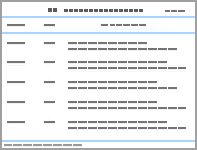
表1
突变体库抽薹前植株性状变异情况"
| 性状 Characteristics | 品种-年份 Variety-year | 样本数 Number of samples | 平均值 Mean | 变异系数 Coefficient of variation (%) | 最小值 Minimum | 最大值 Maximum | 母本值 Parent value |
|---|---|---|---|---|---|---|---|
| 假茎高 Pseudostem height (cm) | ESZ-2024 | 47 | 19.54 | 30.99 | 8.80 | 31.51 | 20.72 |
| ZYZ-2024 | 43 | 23.64 | 26.81 | 1075 | 40.33 | 24.65 | |
| ESZ-2025 | 59 | 12.86 | 30.30 | 3.20 | 21.21 | 14.90 | |
| ZYZ-2025 | 51 | 17.12 | 30.67 | 6.40 | 29.01 | 18.21 | |
| 假茎粗 Pseudostem diameter (mm) | ESZ-2024 | 47 | 13.15 | 17.24 | 8.31 | 18.12 | 14.30 |
| ZYZ-2024 | 43 | 13.77 | 12.66 | 10.58 | 17.83 | 14.25 | |
| ESZ-2025 | 59 | 15.58 | 13.00 | 10.23 | 19.70 | 15.76 | |
| ZYZ-2025 | 51 | 17.14 | 10.99 | 11.59 | 20.54 | 17.85 | |
| 叶长 Leaf length (cm) | ESZ-2024 | 47 | 45.78 | 12.69 | 33.81 | 58.59 | 46.80 |
| ZYZ-2024 | 43 | 47.74 | 14.98 | 34.76 | 63.22 | 48.70 | |
| ESZ-2025 | 59 | 36.89 | 10.90 | 27.39 | 43.81 | 39.40 | |
| ZYZ-2025 | 51 | 41.68 | 11.67 | 28.41 | 53.78 | 43.20 | |
| 叶宽 Leaf width (cm) | ESZ-2024 | 47 | 2.91 | 20.57 | 1.82 | 4.03 | 2.93 |
| ZYZ-2024 | 43 | 3.00 | 15.44 | 2.20 | 3.93 | 3.30 | |
| ESZ-2025 | 59 | 3.35 | 11.93 | 2.47 | 4.23 | 3.42 | |
| ZYZ-2025 | 51 | 3.58 | 9.99 | 2.67 | 4.29 | 3.62 | |
| 叶片数 Number of leaves | ESZ-2024 | 47 | 7.13 | 10.71 | 5.40 | 8.60 | 7.50 |
| ZYZ-2024 | 43 | 7.25 | 10.40 | 5.00 | 8.70 | 7.60 | |
| ESZ-2025 | 59 | 8.39 | 13.12 | 5.82 | 10.61 | 8.62 | |
| ZYZ-2025 | 51 | 9.24 | 9.71 | 6.40 | 10.75 | 9.41 |
表2
突变体库蒜薹性状变异情况"
| 性状 Characteristics | 品种-年份 Variety-year | 样本数 Number of samples | 平均值 Mean | 变异系数 Coefficient of variation (%) | 最小值 Minimum | 最大值 Maximum | 母本值 Parent value |
|---|---|---|---|---|---|---|---|
| 花茎长 Flower stem length (cm) | ESZ-2024 | 47 | 31.66 | 16.01 | 22.49 | 46.63 | 32.62 |
| ZYZ-2024 | 48 | 32.79 | 16.94 | 21.01 | 47.42 | 35.91 | |
| ESZ-2025 | 55 | 39.99 | 13.30 | 20.22 | 50.92 | 43.90 | |
| ZYZ-2025 | 50 | 44.05 | 11.50 | 30.13 | 54.00 | 44.65 | |
| 花苞长 Flower bud length (cm) | ESZ-2024 | 47 | 21.75 | 15.87 | 15.51 | 28.67 | 22.49 |
| ZYZ-2024 | 48 | 21.82 | 17.92 | 15.50 | 34.25 | 21.83 | |
| ESZ-2025 | 55 | 19.45 | 12.57 | 14.46 | 24.50 | 21.49 | |
| ZYZ-2025 | 50 | 20.37 | 12.79 | 16.15 | 28.67 | 21.82 | |
| 蒜薹粗 Flower stem diameter (mm) | ESZ-2024 | 47 | 6.05 | 16.29 | 4.23 | 8.38 | 6.22 |
| ZYZ-2024 | 48 | 6.17 | 14.00 | 4.00 | 8.11 | 6.36 | |
| ESZ-2025 | 55 | 6.71 | 13.09 | 4.96 | 9.40 | 7.21 | |
| ZYZ-2025 | 50 | 7.17 | 9.16 | 5.72 | 8.88 | 7.37 | |
| 单薹重 Flower stem weight (g) | ESZ-2024 | 47 | 10.61 | 38.72 | 4.23 | 27.22 | 11.67 |
| ZYZ-2024 | 48 | 11.36 | 37.14 | 4.14 | 25.71 | 13.10 | |
| ESZ-2025 | 55 | 14.22 | 30.13 | 5.36 | 27.12 | 17.40 | |
| ZYZ-2025 | 50 | 17.25 | 23.97 | 9.20 | 27.30 | 18.13 |
表3
突变体库鳞茎性状变异情况"
| 性状 Characteristics | 品种-年份 Variety-year | 样本数 Number of samples | 平均值 Mean | 变异系数 Coefficient of variation (%) | 最小值 Minimum | 最大值 Maximum | 母本值 Parent value | ||||||
|---|---|---|---|---|---|---|---|---|---|---|---|---|---|
| 鳞茎重量 Bulb weight (g) | ESZ-2024 | 59 | 24.35 | 36.99 | 6.10 | 46.19 | 28.87 | ||||||
| ZYZ-2024 | 51 | 28.02 | 38.12 | 12.23 | 61.00 | 31.42 | |||||||
| ESZ-2025 | 59 | 33.35 | 26.48 | 16.14 | 57.57 | 38.37 | |||||||
| ZYZ-2025 | 51 | 38.88 | 24.23 | 19.48 | 85.61 | 43.28 | |||||||
| 鳞茎横径 Bulb diameter (mm) | ESZ-2024 | 59 | 43.57 | 14.56 | 25.78 | 55.38 | 46.01 | ||||||
| ZYZ-2024 | 51 | 45.61 | 13.59 | 32.76 | 64.70 | 46.71 | |||||||
| ESZ-2025 | 59 | 49.26 | 9.19 | 40.22 | 59.06 | 51.42 | |||||||
| ZYZ-2025 | 51 | 51.58 | 7.21 | 41.28 | 61.44 | 52.09 | |||||||
表4
突变体库质量性状明显变异且2年稳定突变体数目统计"
| 品种 Characteristics | 早抽薹 Early bolting | 晚抽薹 Late bolting | 叶片发黄 Yellowing leaves | 二次发芽严重 Severe secondary sprouting | 无薹植株 No bolting | 极端变异 Extreme mutations |
|---|---|---|---|---|---|---|
| ESZ | 2 | 8 | 6 | 4 | 4 | 1 |
| ZYZ | 5 | 4 | 3 | 4 | 1 | 1 |
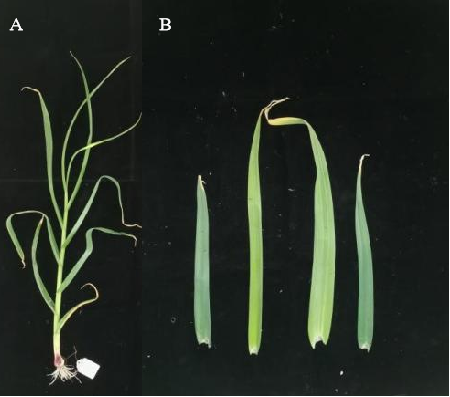
图1
突变体‘J二046’叶片缺蜡质黄化表型特征 A:整株表型;B:叶片表型。从左到右分别为深绿-缺蜡质发黄-黄-深绿"

图2
突变体‘J正053’心叶折叠表型特征 A:2024年田间表型;B:2025年表型;C:2025年去除外层叶片后,植株内部心叶折叠表型"
表5
突变体植株性状指标相关性(2024 vs 2025)"
| 品种 Variety | 假茎高 Pseudostem height | 叶长 Leaf length | 叶片数 Number of leaves | 假茎粗 Pseudostem diameter | 叶宽 Leaf width | 花茎长 Flower stem length | 花苞长 Flower bud length | 蒜薹粗 Flower stem diameter | 单薹重 Flower stem weight | 鳞茎重量 Bulb weight | 鳞茎横径 Bulb diameter |
|---|---|---|---|---|---|---|---|---|---|---|---|
| ESZ | 0.635 | 0.499 | -0.043 | 0.517 | 0.493 | 0.449 | 0.770 | 0.728 | 0.710 | 0.635 | 0.679 |
| *** | *** | *** | *** | ** | *** | *** | *** | *** | *** | ||
| ZYZ | 0.732 | 0.692 | 0.450 | 0.404 | 0.463 | 0.381 | 0.617 | 0.475 | 0.528 | 0.738 | 0.589 |
| *** | *** | ** | ** | ** | ** | *** | *** | *** | *** | *** |
表6
突变体库性状关键突变数量统计"
| 品种 Variety | 性状 Characteristics | 2024年优异 Outstanding in 2024 | 2024年劣变 Deterioration in 2024 | 2025年优异 Outstanding in 2025 | 2025年劣变 Deterioration in 2025 | 2年优异 Two years of outstanding mutation | 2年劣变 Two years of deterioration | |||||||
|---|---|---|---|---|---|---|---|---|---|---|---|---|---|---|
| ESZ | 假茎高Pseudostem height | 7 | 11 | 2 | 15 | 2 | 8 | |||||||
| 叶长Leaf length | 0 | 0 | 0 | 1 | 0 | 0 | ||||||||
| 叶片数Number of leaves | 0 | 0 | 0 | 2 | 0 | 0 | ||||||||
| 假茎粗Pseudostem diameter | 0 | 4 | 0 | 2 | 0 | 1 | ||||||||
| 叶宽Leaf width | 4 | 2 | 0 | 0 | 0 | 0 | ||||||||
| 花茎长Flower stem length | 2 | 2 | 0 | 1 | 0 | 1 | ||||||||
| 花苞长Flower bud length | 0 | 1 | 0 | 1 | 0 | 1 | ||||||||
| 蒜薹粗Flower stem diameter | 1 | 1 | 1 | 2 | 0 | 0 | ||||||||
| 单薹重Flower stem weight | 6 | 13 | 3 | 18 | 2 | 15 | ||||||||
| 鳞茎重量Bulb weight | 6 | 20 | 1 | 15 | 3 | 16 | ||||||||
| 鳞茎横径Bulb diameter | 0 | 1 | 0 | 0 | 0 | 1 | ||||||||
| ZYZ | 假茎高Pseudostem height | 3 | 4 | 9 | 11 | 3 | 5 | |||||||
| 叶长Leaf length | 0 | 0 | 0 | 1 | 0 | 1 | ||||||||
| 叶片数Number of leaves | 0 | 1 | 0 | 1 | 0 | 0 | ||||||||
| 假茎粗Pseudostem diameter | 0 | 0 | 0 | 2 | 0 | 0 | ||||||||
| 叶宽Leaf width | 0 | 3 | 0 | 0 | 0 | 0 | ||||||||
| 花茎长Flower stem length | 1 | 2 | 0 | 1 | 0 | 1 | ||||||||
| 花苞长Flower bud length | 4 | 0 | 1 | 0 | 1 | 0 | ||||||||
| 蒜薹粗Flower stem diameter | 0 | 1 | 0 | 0 | 0 | 0 | ||||||||
| 单薹重Flower stem weight | 4 | 14 | 4 | 5 | 5 | 7 | ||||||||
| 鳞茎重量Bulb weight | 6 | 17 | 1 | 7 | 2 | 10 | ||||||||
| 鳞茎横径Bulb diameter | 1 | 0 | 0 | 0 | 0 | 0 | ||||||||
表7
突变体性状关键突变数量统计"
| 品种 Variety | 年份 Year | 关键突变性状个数Number of key mutant traits | |||||
|---|---|---|---|---|---|---|---|
| 1 | 2 | 3 | 4 | 5 | ≥6 | ||
| ESZ | 2024 | 22 | 16 | 4 | 0 | 3 | 0 |
| 2025 | 20 | 11 | 1 | 3 | 0 | 1 | |
| 2年2 years | 17 | 10 | 3 | 1 | 0 | 0 | |
| ZYZ | 2024 | 18 | 10 | 5 | 2 | 0 | 0 |
| 2025 | 20 | 6 | 0 | 1 | 0 | 1 | |
| 2年2 years | 17 | 6 | 2 | 0 | 0 | 0 | |
表8
突变体性状的2年稳定性统计"
| 品种 Variety | 性状 Characteristics | 假茎高 Pseudostem height | 叶长 Leaf length | 叶片数 Number of leaves | 假茎粗 Pseudostem diameter | 叶宽 Leaf width | 花茎长 Flower stem length | 花苞长 Flower bud length | 蒜薹粗 Flower stem diameter | 单薹重 Flower stem weight | 鳞茎重量 Bulb weight | 鳞茎横径 Bulb diameter |
|---|---|---|---|---|---|---|---|---|---|---|---|---|
| ESZ | 平均值Mean | 17.57 | 9.29 | 13.94 | 14.11 | 14.96 | 12.60 | 9.85 | 9.87 | 20.76 | 19.00 | 7.43 |
| 高稳定占比Highly stable | 38.30 | 61.70 | 38.30 | 38.30 | 36.17 | 55.32 | 65.96 | 59.57 | 34.04 | 33.90 | 74.58 | |
| 稳定占比Stable | 63.83 | 89.36 | 80.85 | 76.60 | 76.60 | 80.85 | 89.36 | 85.11 | 53.19 | 61.02 | 93.22 | |
| ZYZ | 平均值Mean | 17.47 | 8.81 | 8.55 | 9.17 | 12.27 | 14.36 | 11.50 | 8.98 | 21.91 | 16.84 | 8.30 |
| 高稳定占比Highly stable | 23.26 | 62.79 | 62.79 | 62.79 | 51.16 | 35.42 | 56.25 | 66.67 | 31.25 | 37.25 | 60.78 | |
| 稳定占比Stable | 67.44 | 95.35 | 95.35 | 90.70 | 81.40 | 79.17 | 87.50 | 91.67 | 54.17 | 66.67 | 96.08 |
| [1] |
王子天, 范硕, 林榕姗, 谢亚铭, 魏海雷, 高淼, 林敏. 我国大蒜产业发展现状与展望[J]. 生物技术进展, 2025, 15(2): 179-188.
doi: 10.19586/j.2095-2341.2024.0173 |
|
doi: 10.19586/j.2095-2341.2024.0173 |
|
| [2] |
彭丹, 齐传东, 赵晴晴, 周洁, 杨文杰, 吴金平, 郭凤领. 大蒜种质资源适应性的综合评价与筛选[J]. 中国蔬菜, 2025(5): 59-69.
|
|
|
|
| [3] |
|
| [4] |
|
| [5] |
何巧芸. 大蒜种质资源农艺性状评价及抽薹相关FT基因功能分析[D]. 北京: 中国农业科学院, 2022.
|
|
|
|
| [6] |
吕厚军, 马静芝, 徐国启. 早薹蒜高产栽培技术[J]. 河南农业科学, 1994, 23(8): 41.
|
|
|
|
| [7] |
薛艳, 席彦军, 蒋建华, 黄重. 汉中地区早薹蒜品种比较试验[J]. 长江蔬菜, 2011(2): 40-42.
|
|
|
|
| [8] |
|
| [9] |
doi: 10.1038/nbt.3188 pmid: 25798936 |
| [10] |
|
| [11] |
范昕琦, 王海燕, 陈静, 张晓娟, 郭琦, 梁笃, 周福平, 聂萌恩, 张一中, 柳青山. EMS诱变对高粱成苗及M1主要农艺性状的影响[J]. 生物技术通报, 2023, 39(7): 173-184.
doi: 10.13560/j.cnki.biotech.bull.1985.2022-1499 |
|
|
|
| [12] |
|
| [13] |
罗洪发, 查仁明, 杨洪海, 田永航, 薛建蜂, 张鹏. 水稻突变体的创制[J]. 中国农学通报, 2011, 27(27): 45-49.
|
|
|
|
| [14] |
doi: 10.1186/1746-4811-10-5 pmid: 24475756 |
| [15] |
张纪元, 张平平, 姚金保, 杨丹, 杨学明, 马鸿翔. 以EMS诱变创制软质小麦宁麦9号高分子量谷蛋白亚基突变体[J]. 作物学报, 2014, 40(9): 1579-1584.
|
|
|
|
| [16] |
黄永娟, 张凤启, 杨甜甜, 刘葛山, 蒋守华, 陈健美, 管荣展. EMS诱变甘蓝型油菜获得高油酸突变体[J]. 分子植物育种, 2011, 9(5): 611-616.
|
|
|
|
| [17] |
|
| [18] |
吴美骞. EMS诱导大蒜抗叶枯病突变体的筛选与鉴定[D]. 杨凌: 西北农林科技大学, 2021.
|
|
|
|
| [19] |
Hassan Hamza Abdel-halim Mostafa. 大蒜种质资源评价与愈伤组织的物理化学诱变技术研究[D]. 北京: 中国农业科学院, 2014.
|
|
|
|
| [20] |
刘头明, 何巧芸, 王延周, 李富. 一种诱导大蒜多倍体或突变体的方法: CN202110518694.8[P]. 2022-07-19.
|
|
|
|
| [21] |
臧辉, 任卫波. EMS诱变在植物育种中的研究与应用[J]. 分子植物育种, 2018, 16(17): 5782-5788.
|
|
|
|
| [22] |
陈天龙, 王彦荣, 王宇, 张吉宇, 刘志鹏. 蒺藜苜蓿EMS诱变突变体库的构建及突变体表型的分析[J]. 草业科学, 2015, 32(1): 71-77.
|
|
|
|
| [23] |
陈洋, 高兰英, 邵艳军, 张增艳. EMS诱导小麦易位系YW642突变体的鉴定与分子标记分析[J]. 核农学报, 2011, 25(4): 617-621, 651.
|
|
|
|
| [24] |
刘翔. EMS诱变技术在植物育种中的研究进展[J]. 激光生物学报, 2014, 23(3): 197-201.
|
|
|
|
| [25] |
陈碧云, 吕培军, 张天瑶, 许鲲, 伍晓明. EMS诱变后甘蓝型油菜植株性状、种子粒重与含油量变异分析[J]. 中国油料作物学报, 2016, 38(6): 705-712.
doi: 10.7505/j.issn.1007-9084.2016.06.001 |
|
|
|
| [26] |
豆飞飞, 任毓昭, 王石磊, 刘春颖, 王晓东, 王昭懿, 刘彩霞, 刘凤楼, 王掌军, 李清峰. 宁春4号小麦EMS突变体库的构建及表型变异分析[J]. 生物技术通报, 2025, 41(8): 92-101.
doi: 10.13560/j.cnki.biotech.bull.1985.2025-0027 |
|
|
|
| [27] |
|
| [28] |
|
| [29] |
石海春, 陈超杰, 夏伟, 余学杰, 柯永培. EMS对三个玉米自交系的诱变效应分析[J]. 广西植物, 2016, 36(8): 906-914.
|
|
|
|
| [30] |
杨一之, 邵明宇, 张嘉敏, 陈昌强, 邢虎成. 亚麻EMS诱变体系研究[J]. 中国麻业科学, 2025, 47(5): 255-260.
|
|
|
| [1] | 叶美金, 吴雷, Lohani Md Nahibuzzaman, 尹丽, 胡欣荣, 刘亚西, 蒋云峰, 陈国跃, 蒲至恩, 李阳, 李婷, 邹亚亚, 吴佳怡, 马建. 基于GWAS的中国地方小麦成熟胚大小位点的鉴定及其遗传效应解析[J]. 中国农业科学, 2026, 59(6): 1157-1171. |
| [2] | 崔士友, 陈澎军, 缪源卿, 韩继军, 沈俊明. EMS诱变抗草甘膦小麦新种质的创制与大田评价[J]. 中国农业科学, 2026, 59(4): 723-733. |
| [3] | 叶美金, 王同著, 陈斌, LOHANI Md Nahibuzzaman, 陈家婷, 胡欣荣, 尹丽, 王超, 张昊芃, 杨夏, 王佳琳, 姚琦馥, 丁浦洋, 王凤, 李小雨, 马建. 基于全基因组关联分析解析小麦茎节间长度的遗传基础及其效应[J]. 中国农业科学, 2026, 59(12): 2551-2562. |
| [4] | 张天宇, 刘丽君, 杨刚, 武军艳, 蒲媛媛, 马骊, 王旺田, 路晓明, 马愿强, 孙万仓. 2006—2022年北方白菜型冬油菜农艺性状遗传增益分析[J]. 中国农业科学, 2025, 58(11): 2081-2095. |
| [5] | 张紫慧, 张艳菲, 李龙, 李超男, 王景一, 杨德龙, 毛新国, 景蕊莲. 小麦烯醇化酶基因TaENO1-5B在多种环境下对株高与穗粒数的调控[J]. 中国农业科学, 2024, 57(14): 2717-2731. |
| [6] | 段惠敏, 刘玲玲, 夏露露, 袁剑龙, 程李香, 陈爱荣, 张峰. 低升糖型马铃薯品种的筛选[J]. 中国农业科学, 2024, 57(12): 2295-2308. |
| [7] | 南瑞, 杨玉存, 石芳慧, 张礼宁, 米彤茜, 张立强, 李春艳, 孙风丽, 奚亚军, 张超. 小麦源库优异种质的鉴定与源库类型的划分[J]. 中国农业科学, 2023, 56(6): 1019-1034. |
| [8] | 刘树森,孙华,石洁,郭宁,马红霞,张海剑. 基于地上部症状的玉米根腐病分级及严重度与农艺性状的关系[J]. 中国农业科学, 2022, 55(20): 3939-3947. |
| [9] | 范涛,李治,蒋庆,陈姝霖,欧霞,陈永艳,任天恒. 小麦单位面积穗数和粒长主效QTL紧密连锁KASP标记的开发及其效应评价[J]. 中国农业科学, 2021, 54(14): 2941-2951. |
| [10] | 胡文静,张春梅,吴迪,陆成彬,董亚超,程晓明,张勇,高德荣. 长江中下游小麦抗赤霉病品种的筛选与部分农艺性状分析[J]. 中国农业科学, 2020, 53(21): 4313-4321. |
| [11] | 曹小东,刘自刚,米文博,徐春梅,邹娅,徐明霞,郑国强,方新玲,崔小茹,董小云,米超,陈其鲜. 甘蓝型冬油菜北移种植的适应性分析[J]. 中国农业科学, 2020, 53(20): 4164-4176. |
| [12] | 吴曹阳,梁诗涵,邱军,高金锋,高小丽,王鹏科,冯佰利,杨璞. 基于连续12年国家苦荞区域试验的中国苦荞品种选育现状分析[J]. 中国农业科学, 2020, 53(19): 3878-3892. |
| [13] | 王海莲,王润丰,刘宾,张华文. 不同生长时期收获对甜高粱农艺性状及营养品质的影响[J]. 中国农业科学, 2020, 53(14): 2804-2813. |
| [14] | 刘思辰,曹晓宁,温琪汾,王海岗,田翔,王君杰,陈凌,秦慧彬,王纶,乔治军. 山西谷子地方品种农艺性状和品质性状的综合评价[J]. 中国农业科学, 2020, 53(11): 2137-2148. |
| [15] | 张文强,陈青君,张国庆,石世达,曹娜,阿布来提·托合提热结甫,果禹鑫,林文才. 蛋白添加剂对双孢蘑菇农艺性状及品质的影响[J]. 中国农业科学, 2020, 53(10): 2091-2100. |
|
||
