






中国农业科学 ›› 2026, Vol. 59 ›› Issue (13): 2906-2918.doi: 10.3864/j.issn.0578-1752.2026.13.012
王广升( ), 达娃普尺, 次旺, 普穷, 尼玛桑珠
收稿日期:2026-02-09
接受日期:2026-04-07
出版日期:2026-07-01
发布日期:2026-07-01
联系方式:
王广升,Tel:17789920317;E-mail:1606193757@qq.com
基金资助:
WANG GuangSheng(), DAWAPUCHI, CIWANG, PUQIONG, NIMASANGZHU
Received:2026-02-09
Accepted:2026-04-07
Published:2026-07-01
Online:2026-07-01
摘要:
【目的】高原日光温室条件下,分析不同辣椒品种根、茎、叶和果实的农艺性状,探究各性状与辣椒单株产量之间的关系并进行综合评价,为改良栽培技术,引育优良品种(系),丰富本土资源提供理论和实践参考。【方法】运用描述性统计、熵权法、通径、相关性等多元分析方法进行判断,采用隶属函数法和聚类分析进行综合评价,明确影响单株产量的主要性状及适宜区域生态条件的辣椒品种。【结果】各品种不同器官存在一定差异,根的4个性状的变异系数为7.70%—16.20%,茎的5个性状的变异系数为6.99%—16.50%,叶的3个性状的变异系数为11.50%—15.90%,果的4个性状的变异系数为15.90%—26.50%,单果质量、单株结果数和单株产量的变异系数分别为39.60%、44.20%和19.50%。熵权法结合通径分析显示,影响单株产量的直接效应从大到小排序为叶>果>茎>根。相关性分析表明,根中,根的数量与单株产量呈显著正相关;叶中,叶长、叶宽、叶柄长与单株产量均呈极显著正相关。主成分分析将19个农艺性状简化为6个主成分,累计贡献率为81.631%,建立了综合评价模型D=0.435μ1+0.222μ2+0.112μ3+0.092μ4+0.072μ5+0.066μ6,筛选出综合得分优异的3个品种中椒506、中椒Y213和中椒Y216,在进行品种推广时,应考虑本地偏爱螺丝椒的饮食习惯,将中椒129、美螺28和中椒209列为推广应用对象。基于各器官性状和D值,将30份辣椒分为5个类群,各类别间叶和果的差异显著,第Ⅰ类株型紧凑,果实紧实,结果数多;第Ⅱ类叶片、叶柄偏短,整体株高较矮,单株产量较低;第Ⅲ类果实短粗,单果质量最高;第Ⅳ类果实短粗,单果质量低于第Ⅲ类;第Ⅴ类数量最多,D值处于居中位置,表现较为均衡。【结论】引种资源类型较为丰富。在高原日光温室条件下,叶片性状和根的数量是影响辣椒单株产量的直接要素。综合各器官性状,可以通过主成分分析和隶属函数法对引育的辣椒品种进行综合评价并筛选出优异品种。叶和果实性状可以作为区分类群的主要依据,强化对不同资源的利用。
王广升, 达娃普尺, 次旺, 普穷, 尼玛桑珠. 高原日光温室不同辣椒品种的性状分析与评价[J]. 中国农业科学, 2026, 59(13): 2906-2918.
WANG GuangSheng, DAWAPUCHI, CIWANG, PUQIONG, NIMASANGZHU. Character Analysis and Evaluation of Different Pepper Varieties in Plateau Solar Greenhouses[J]. Scientia Agricultura Sinica, 2026, 59(13): 2906-2918.
表1
试验材料信息"
| 编号 Number | 品种 Variety | 编号 Number | 品种 Variety | |
|---|---|---|---|---|
| 1 | 苏椒5号 Sujiao No. 5 | 16 | 中椒139 Zhongjiao 139 | |
| 2 | 苏椒618号Sujiao No.618 | 17 | 中椒209 Zhongjiao 209 | |
| 3 | 苏椒9号Sujiao No. 9 | 18 | 中椒Y213 Zhongjiao Y213 | |
| 4 | 苏椒616号Sujiao No. 616 | 19 | 中椒Y216 Zhongjiao Y216 | |
| 5 | 皱辣2号Zhoula No. 2 | 20 | 中椒229 Zhongjiao 229 | |
| 6 | 青香2号Qingxiang No. 2 | 21 | 中椒329 Zhongjiao 329 | |
| 7 | 皱辣4号Zhoula No. 4 | 22 | 中椒409 Zhongjiao 409 | |
| 8 | 皱辣3号Zhoula No. 3 | 23 | 中椒506 Zhongjiao 506 | |
| 9 | 曲美2号Qumei No. 2 | 24 | 中椒509 Zhongjiao 509 | |
| 10 | 兴蔬208 Xingshu 208 | 25 | 中椒1209 Zhongjiao 1209 | |
| 11 | 皱皮辣Zhoupila | 26 | 早辣王Zaolawang | |
| 12 | 兴蔬211 Xingshu 211 | 27 | 湘十五号Xiang No.15 | |
| 13 | 中椒L13 Zhongjiao L13 | 28 | 湘五号Xiang No.5 | |
| 14 | 中椒L14 Zhongjiao L14 | 29 | 美螺28 Meiluo No. 28 | |
| 15 | 中椒129 Zhongjiao 129 | 30 | 高原之星Highland Star |
表2
引进辣椒品种农艺性状的统计"
| 性状 Trait | 最大值 Maximum | 最小值 Minimum | 平均值 Average | 最大值品种 Maximum variety | 最小值品种 Minimum variety | 标准差Standard deviation | 变异系数Coefficient of variation (%) |
|---|---|---|---|---|---|---|---|
| 叶长 Leaf length (cm) | 29.90 | 16.20 | 23.20 | 中椒Y216 Zhongjiao Y216 | 曲美2号 Qumei No. 2 | 3.30 | 14.20 |
| 叶宽 Leaf width (cm) | 9.70 | 5.30 | 7.20 | 中椒Y213 Zhongjiao Y213 | 早辣王 Zaolawang | 1.10 | 15.90 |
| 叶柄长 Petiole length (cm) | 8.90 | 5.10 | 7.30 | 中椒Y216 Zhongjiao Y216 | 曲美2号 Qumei No. 2 | 0.80 | 11.50 |
| 果纵径 Fruit longitudinal diameter (cm) | 32.70 | 9.10 | 21.70 | 青香2号 Qingxiang No. 2 | 曲美2号 Qumei No. 2 | 5.80 | 26.50 |
| 果横径 Fruit transverse diameter (mm) | 32.92 | 11.89 | 22.33 | 苏椒616号 Sujiao No. 616 | 早辣王 Zaolawang | 5.65 | 25.30 |
| 果梗长 Fruit stem length (cm) | 6.70 | 3.50 | 5.20 | 中椒329 Zhongjiao 329 | 曲美2号 Qumei No. 2 | 0.80 | 15.90 |
| 果肉厚 Pulp thickness (mm) | 2.61 | 1.09 | 1.93 | 中椒Y213 Zhongjiao Y213 | 曲美2号 Qumei No. 2 | 0.36 | 18.60 |
| 根长 Root length (cm) | 14.30 | 10.70 | 12.10 | 中椒509 Zhongjiao 509 | 早辣王 Zaolawang | 0.90 | 7.70 |
| 根幅 Root spread (cm) | 30.70 | 17.50 | 22.40 | 皱皮辣 Zhoupila | 中椒209 Zhongjiao 209 | 2.90 | 12.80 |
| 根横径 Root transverse diameter (mm) | 7.79 | 4.29 | 6.07 | 苏椒5号 Sujiao No. 5 | 早辣王 Zaolawang | 0.81 | 13.35 |
| 根数量 Root quantity | 23.00 | 10.00 | 16.90 | 高原之星 Highland Star | 曲美2号 Qumei No. 2 | 2.74 | 16.20 |
| 主茎粗 Main stem diameter (mm) | 16.64 | 11.68 | 14.40 | 中椒Y213 Zhongjiao Y213 | 曲美2号 Qumei No. 2 | 1.01 | 6.99 |
| 主茎长 Main stem length (cm) | 32.30 | 14.00 | 22.80 | 美螺28 Meiluo No. 28 | 曲美2号 Qumei No. 2 | 3.50 | 15.50 |
| 一次分枝粗 The first branch diameter (mm) | 13.45 | 8.97 | 10.63 | 中椒229 Zhongjiao 229 | 曲美2号 Qumei No. 2 | 0.90 | 8.43 |
| 一次分枝长 The first branch length (cm) | 7.30 | 3.90 | 5.50 | 中椒Y216 Zhongjiao Y216 | 兴蔬208 Xingshu 208 | 0.90 | 16.50 |
| 株高 Plant height (cm) | 94.80 | 58.60 | 73.30 | 中椒Y216 Zhongjiao Y216 | 兴蔬208 Xingshu 208 | 10.20 | 13.90 |
| 单果质量 Single fruit weight (g) | 40.38 | 9.13 | 23.30 | 中椒506 Zhongjiao 506 | 皱皮辣 Zhoupila | 9.20 | 39.60 |
| 单株结果数 Number of fruits per plant | 132.00 | 29.00 | 59.70 | 中椒L14 Zhongjiao L14 | 中椒229 Zhongjiao 229 | 26.37 | 44.20 |
| 单株产量 Single-plant yield (g) | 1727.90 | 826.50 | 1184.60 | 苏椒616号 Sujiao No. 616 | 中椒229 Zhongjiao 229 | 231.50 | 19.50 |
表3
30个辣椒品种的16个性状权重"
| 性状 Trait | 信息熵值 Information entropy value | 权重 Weight coefficient (%) | 性状 Trait | 信息熵值 Information entropy value | 权重 Weight coefficient (%) | |
|---|---|---|---|---|---|---|
| 叶长Leaf length | 0.963736 | 5.3555 | 根幅Root spread | 0.976960 | 3.4026 | |
| 叶宽Leaf width | 0.939121 | 8.9906 | 根横径root transverse diameter | 0.963701 | 5.3607 | |
| 叶柄长Petiole length | 0.972516 | 4.0588 | 根数量Root quantity | 0.971262 | 4.2441 | |
| 果纵径Fruit longitudinal diameter | 0.952870 | 6.9603 | 主茎粗Main stem diameter | 0.975225 | 3.6588 | |
| 果横径Fruit transverse diameter | 0.954173 | 6.7678 | 主茎长Main stem length | 0.971713 | 4.1775 | |
| 果梗长Fruit stem length | 0.957359 | 6.2974 | 一次分枝粗The first branch diameter | 0.956515 | 6.4219 | |
| 果肉厚Pulp thickness | 0.969247 | 4.5416 | 一次分枝长The first branch length | 0.956015 | 6.4958 | |
| 根长Root length | 0.923579 | 11.2860 | 株高Plant height | 0.918875 | 11.9806 |
表4
30个辣椒品种器官的归一化值"
| 编号 Number | 叶 Leaf | 果 Fruit | 根 Root | 茎 Stem | 单果质量 Single fruit weight | 单株结果数 Number of fruits per plant | 单株重量 Single-plant yield |
|---|---|---|---|---|---|---|---|
| 1 | 0.003725 | 0.005863 | 0.011988 | 0.017821 | 0.008285 | 0.015701 | 0.038178 |
| 2 | 0.008211 | 0.012377 | 0.008869 | 0.007860 | 0.067933 | 0.042403 | 0.064367 |
| 3 | 0.007517 | 0.011994 | 0.003426 | 0.009364 | 0.066662 | 0.045626 | 0.038033 |
| 4 | 0.009912 | 0.013105 | 0.007274 | 0.013762 | 0.070992 | 0.040561 | 0.083781 |
| 5 | 0.009106 | 0.007070 | 0.009276 | 0.010173 | 0.028427 | 0.030893 | 0.051172 |
| 6 | 0.005791 | 0.006749 | 0.010518 | 0.011266 | 0.052944 | 0.042863 | 0.037773 |
| 7 | 0.005816 | 0.004309 | 0.006229 | 0.009227 | 0.035109 | 0.033656 | 0.054931 |
| 8 | 0.007050 | 0.005944 | 0.009734 | 0.012906 | 0.031227 | 0.030893 | 0.058355 |
| 9 | 0.000481 | 0.009380 | 0.003115 | 0.003587 | 0.037886 | 0.042403 | 0.016937 |
| 10 | 0.003001 | 0.007839 | 0.010449 | 0.006907 | 0.012944 | 0.031354 | 0.010103 |
| 11 | 0.003893 | 0.005975 | 0.007667 | 0.008842 | 0.000074 | 0.013859 | 0.009811 |
| 12 | 0.002284 | 0.007310 | 0.004440 | 0.006532 | 0.007932 | 0.022606 | 0.019445 |
| 13 | 0.002431 | 0.003564 | 0.011722 | 0.014362 | 0.001438 | 0.010176 | 0.022517 |
| 14 | 0.003555 | 0.003579 | 0.006460 | 0.014505 | 0.002968 | 0.000047 | 0.050320 |
| 15 | 0.008752 | 0.009176 | 0.010352 | 0.012412 | 0.037015 | 0.041022 | 0.022479 |
| 16 | 0.006029 | 0.005094 | 0.007573 | 0.007891 | 0.020191 | 0.034116 | 0.018556 |
| 17 | 0.004670 | 0.008437 | 0.007265 | 0.008260 | 0.036262 | 0.044244 | 0.005271 |
| 18 | 0.012236 | 0.012124 | 0.011456 | 0.016156 | 0.059533 | 0.038259 | 0.079855 |
| 19 | 0.011504 | 0.011462 | 0.006362 | 0.016249 | 0.040709 | 0.041022 | 0.028748 |
| 20 | 0.007025 | 0.009225 | 0.005306 | 0.014833 | 0.045650 | 0.047467 | 0.000084 |
| 21 | 0.005104 | 0.008718 | 0.004634 | 0.008181 | 0.042027 | 0.042863 | 0.020970 |
| 22 | 0.007082 | 0.007009 | 0.009450 | 0.008689 | 0.041533 | 0.042863 | 0.020210 |
| 23 | 0.009745 | 0.014766 | 0.008375 | 0.014077 | 0.073603 | 0.047467 | 0.032074 |
| 24 | 0.007839 | 0.011331 | 0.015133 | 0.012030 | 0.043391 | 0.037339 | 0.053758 |
| 25 | 0.009690 | 0.006591 | 0.008958 | 0.011424 | 0.045415 | 0.041943 | 0.031459 |
| 26 | 0.001972 | 0.004759 | 0.002148 | 0.008414 | 0.007462 | 0.014319 | 0.038411 |
| 27 | 0.002224 | 0.007551 | 0.011808 | 0.007718 | 0.009415 | 0.027671 | 0.010920 |
| 28 | 0.003657 | 0.008932 | 0.006539 | 0.007912 | 0.003768 | 0.022146 | 0.006797 |
| 29 | 0.005927 | 0.007924 | 0.005458 | 0.011863 | 0.033956 | 0.040101 | 0.021659 |
| 30 | 0.007821 | 0.007516 | 0.010949 | 0.014126 | 0.035250 | 0.034116 | 0.053024 |
表5
辣椒器官与单株产量的通径分析"
| 因子 Factor | 直接系数 Direct coefficient | 间接系数 Indirect coefficient | |||||
|---|---|---|---|---|---|---|---|
| 叶 Leaf | 果 Fruit | 根 Root | 茎 Stem | 单果质量 Single fruit weight | 单株结果数 Number of fruits per plant | ||
| 叶Leaf | 0.405 | 0.2337 | 0.1061 | 0.2179 | 0.2932 | 0.2272 | |
| 果Fruit | 0.243 | 0.1402 | 0.0022 | 0.0279 | 0.1866 | 0.1616 | |
| 根Root | 0.172 | 0.0451 | 0.0015 | 0.0683 | -0.0009 | -0.0088 | |
| 茎Stem | 0.224 | 0.1205 | 0.0258 | 0.0889 | 0.0399 | -0.0186 | |
| 单果质量Single fruit weight | 1.484 | 1.0744 | 1.1397 | -0.0074 | 0.2642 | 1.2480 | |
| 单株结果数Number of fruits per plant | 1.304 | 0.7315 | 0.8672 | -0.0665 | -0.1082 | 1.0967 | |
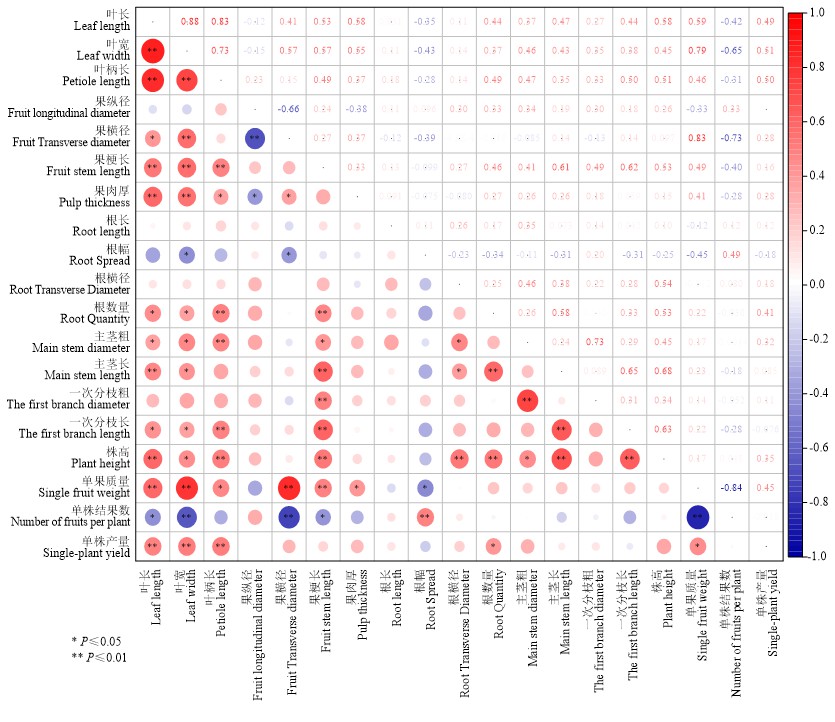
图1
辣椒各性状间相关性热图"
表6
辣椒性状主成分分析及各主成分的特征值和贡献率"
| 性状 Trait | 主成分Principal component | ||||||
|---|---|---|---|---|---|---|---|
| 1 | 2 | 3 | 4 | 5 | 6 | ||
| 叶长Leaf length | 0.398 | 0.436 | 0.605 | 0.220 | 0.309 | -0.049 | |
| 叶宽Leaf width | 0.627 | 0.315 | 0.523 | 0.328 | 0.204 | 0.040 | |
| 叶柄长Petiole length | 0.178 | 0.390 | 0.676 | 0.372 | 0.089 | -0.084 | |
| 果纵径Fruit longitudinal diameter | -0.588 | 0.287 | 0.185 | 0.372 | -0.496 | -0.055 | |
| 果横径Fruit transverse diameter | 0.911 | 0.036 | 0.062 | -0.150 | 0.182 | 0.062 | |
| 果梗长Fruit stem length | 0.257 | 0.672 | 0.098 | 0.468 | 0.149 | 0.001 | |
| 果肉厚Pulp thickness | 0.291 | 0.159 | 0.306 | 0.089 | 0.751 | 0.063 | |
| 根长Root length | -0.160 | 0.022 | 0.072 | 0.148 | 0.258 | 0.697 | |
| 根幅Root spread | -0.551 | -0.290 | -0.298 | 0.267 | 0.431 | -0.067 | |
| 根横径Root transverse diameter | 0.024 | 0.343 | 0.069 | 0.133 | -0.395 | 0.723 | |
| 根数量Root quantity | -0.109 | 0.598 | 0.598 | -0.115 | 0.009 | 0.081 | |
| 主茎粗Main stem diameter | 0.006 | 0.171 | 0.315 | 0.719 | -0.048 | 0.431 | |
| 主茎长Main stem length | 0.090 | 0.898 | 0.108 | -0.059 | 0.069 | 0.144 | |
| 一次分枝粗The first branch diameter | -0.021 | 0.124 | 0.035 | 0.924 | 0.061 | 0.099 | |
| 一次分枝长The first branch length | 0.182 | 0.829 | -0.076 | 0.256 | -0.094 | -0.028 | |
| 株高Plant height | -0.003 | 0.719 | 0.347 | 0.168 | -0.075 | 0.284 | |
| 单果质量Single fruit weight | 0.860 | 0.115 | 0.346 | 0.156 | 0.076 | -0.112 | |
| 单株结果数Number of fruits per plant | -0.890 | -0.145 | 0.011 | -0.127 | -0.001 | 0.206 | |
| 单株产量Single-plant yield | 0.159 | -0.100 | 0.860 | 0.045 | 0.028 | 0.205 | |
| 特征值Eigenvalue | 6.741 | 3.446 | 1.744 | 1.426 | 1.123 | 1.030 | |
| 贡献率Contribution rate (%) | 35.478 | 18.137 | 9.180 | 7.506 | 5.911 | 5.419 | |
| 累计贡献率Cumulative contribution rate (%) | 35.478 | 53.615 | 62.795 | 70.301 | 76.212 | 81.631 | |
表7
辣椒品种隶属函数值及排名"
| 品种名 Variety name | 隶属函数值 Membership function value | 排名 Rank | 品种名 Variety name | 隶属函数值 Membership function value | 排名 Rank | |
|---|---|---|---|---|---|---|
| 中椒506 Zhongjiao 506 | 0.776 | 1 | 中椒329 Zhongjiao 329 | 0.513 | 16 | |
| 中椒Y213 Zhongjiao Y213 | 0.706 | 2 | 皱辣3号Zhoula No. 3 | 0.491 | 17 | |
| 中椒Y216 Zhongjiao Y216 | 0.691 | 3 | 皱辣2号Zhoula No. 2 | 0.483 | 18 | |
| 中椒509 Zhongjiao 509 | 0.659 | 4 | 曲美2号Qumei No. 2 | 0.476 | 19 | |
| 苏椒616号Sujiao No. 616 | 0.644 | 5 | 苏椒5号Sujiao No. 5 | 0.419 | 20 | |
| 苏椒9号Sujiao No. 9 | 0.623 | 6 | 湘十五号Xiang No.15 | 0.414 | 21 | |
| 苏椒618号Sujiao No.618 | 0.616 | 7 | 湘五号Xiang No.5 | 0.411 | 22 | |
| 中椒129 Zhongjiao 129 | 0.597 | 8 | 皱辣4号Zhou la No. 4 | 0.397 | 23 | |
| 美螺28 Meiluo No. 28 | 0.578 | 9 | 中椒139 Zhongjiao 139 | 0.394 | 24 | |
| 中椒209 Zhongjiao 209 | 0.570 | 10 | 兴蔬208 Xingshu 208 | 0.369 | 25 | |
| 中椒229 Zhongjiao 229 | 0.560 | 11 | 兴蔬211 Xingshu 211 | 0.347 | 26 | |
| 中椒1209 Zhongjiao 1209 | 0.557 | 12 | 中椒L13 Zhongjiao L13 | 0.334 | 27 | |
| 高原之星Highland Star | 0.529 | 13 | 皱皮辣Zhoupila | 0.301 | 28 | |
| 中椒409 Zhongjiao 409 | 0.528 | 14 | 中椒L14 Zhongjiao L14 | 0.271 | 29 | |
| 青香2号Qingxiang No. 2 | 0.521 | 15 | 早辣王Zaolawang | 0.225 | 30 |
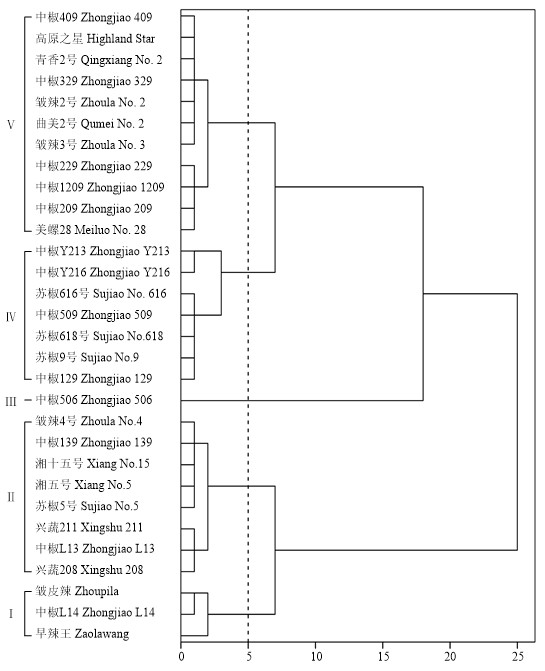
图2
基于隶属函数值的系统聚类"
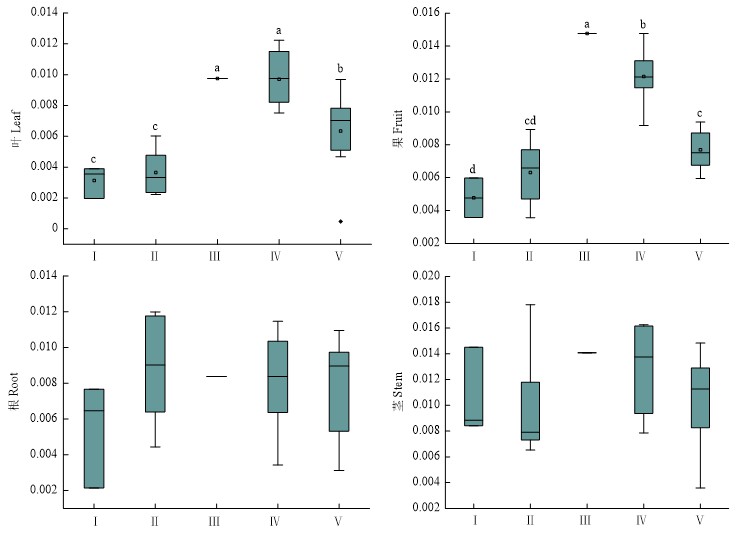
图3
五类辣椒器官归一值箱线图 不同小写字母表示各类群的不同器官在0.05水平差异显著"
| [1] |
张子峰. 我国辣椒产业发展现状、主要挑战与应对之策[J]. 北方园艺, 2023(14): 153-158.
|
|
|
|
| [2] |
西藏自治区统计局国家统计局, 西藏调查总队. 2024年西藏自治区国民经济和社会发展统计公报[EB/OL]. ( 2025-04-05) [2026-02-09].
|
|
Tibet Autonomous Region Bureau of Statistics, National Bureau of Statistics, Tibet Survey Corps. Bulletin of the National Economic and Social Development of the Tibet Autonomous Region in 2024[EB/OL]. ( 2025-04-05) [2026-02-09]. in Chinese)
|
|
| [3] |
吴慧琴, 王静, 阳宜, 刘雪晴, 张凯旋, 王麓尧, 路佳伟, 翟源, 成妍. 96份辣椒种质资源的果实质地品质分析及评价[J]. 中国农业科学, 2025, 58(14): 2854-2868. DOI: 10.3864/j.issn.0578-1752.2025.14.011.
|
|
|
|
| [4] |
王永平, 王岩, 涂德辉, 邢丹. 不同辣椒新品种产量品质的综合分析[J]. 种子, 2025, 44(3): 183-189.
|
|
|
|
| [5] |
彭泽, 胡明文, 白立伟, 朱文超, 廖芳芳. 不同辣椒品种的农艺性状与品质指标综合评价[J]. 北方园艺, 2023(1): 1-10.
|
|
|
|
| [6] |
|
| [7] |
王丹丹, 师建华, 李燕, 张庆银, 齐连芬, 董灵迪. 基于主成分与聚类分析的辣椒主要农艺性状评价[J]. 中国瓜菜, 2021, 34(2): 47-53.
|
|
|
|
| [8] |
何娜, 杨创创, 张正海, 于海龙, 吴华茂, 王海平, 白锐琴, 宋义前, 王丽乔, 康香辉, 黄俊轩, 曹亚从, 王立浩. 辣椒资源抗病性鉴定与主要农艺性状评价[J]. 中国蔬菜, 2025(12): 43-55.
|
|
|
|
| [9] |
刘志新, 杨硕, 徐绳武, 尹延旭, 郑丽, 夏文娟, 邱首哲, 施仕胜, 姚培杰, 彭晶, 郑凡. 95份辣椒种质资源重要农艺性状的遗传多样性分析[J]. 种子, 2025, 44(6): 75-85.
|
|
|
|
| [10] |
洪成, 赵建荣, 程春园, 郑婉婉, 耿三省, 陈斌, 杜和山, 张晓芬. 辣椒种质资源农艺性状综合评价[J]. 中国蔬菜, 2024(7): 33-41.
|
|
|
|
| [11] |
梁成亮, 李雪峰, 李东平, 喻莹, 苏龙江, 邹高峰, 银晓, 周晓波. 西藏山南市辣椒引种比较试验[J]. 辣椒杂志, 2023, 21(4): 25-29, 50.
|
|
|
|
| [12] |
蒋兵涛, 赵艳宁, 王陆州. 西藏本地辣椒设施高产栽培技术及病虫害防控[J]. 农村实用技术, 2022(3): 85-86, 88.
|
|
|
|
| [13] |
赵艳宁, 蒋兵涛. 西藏朗县辣椒在不同生态区种植的品质性状分析[J]. 农业与技术, 2021, 41(21): 25-28.
|
|
|
|
| [14] |
王世彬, 李宝海, 朱荣杰, 杨斌. 拉萨地区日光温室不同辣椒品种比较试验[J]. 北方园艺, 2017(4): 36-38.
|
|
|
|
| [15] |
李锡香, 张宝玺. 辣椒种质资源描述规范和数据标准[M]. 北京: 中国农业出版社, 2006.
|
|
|
|
| [16] |
刘俊芳, 解慧芳, 邢璐, 王淑君, 李龙, 张扬, 韩明格, 程永振, 刘海萍, 闫宏山, 王素英, 宋慧. 华北夏谷区谷子品种综合评价[J]. 江苏农业科学, 2025, 53(11): 79-85.
|
|
|
|
| [17] |
苏小雨, 李磊, 鲁丹丹, 王利娜, 曹艺雯, 谭政委, 李春明, 余永亮, 孙瑶, 梁慧珍. 基于主成分分析与隶属函数法的不同黄精种质种子萌发性能综合评价[J]. 山东农业科学, 2026, 58(2): 60-68.
|
|
|
|
| [18] |
丁映风, 李盈青, 尹学辉, 叶小凤, 胡紫妍, 王悦, 丁玉梅. 基于隶属函数法和主成分分析的滇西食用百合品质综合评价[J]. 种子, 2025, 44(11): 128-137, 148.
|
|
|
|
| [19] |
谢永春, 刘国一, 侯亚红, 普布贵吉, 万运帆, 马瑞萍. 西藏拉萨河谷地区栽培措施对青稞的影响[J]. 中国农业气象, 2022, 43(12): 1002-1014.
|
|
|
|
| [20] |
卓嘎, 伦珠朗杰, 张旭辉, 旺姆, 扎桑, 普布卓玛, 高利云, 达瓦顿珠, 汪妤. 西藏青稞地方品种主要农艺性状的遗传多样性[J]. 西北农林科技大学学报(自然科学版), 2023, 51(6): 48-57, 65.
|
|
|
|
| [21] |
吴昊, 苏万龙, 石美娟, 薛晓芳, 任海燕, 王永康, 赵爱玲, 李登科. 枣种质果实性状多样性分析与综合评价[J]. 植物遗传资源学报, 2022, 23(6): 1613-1625.
|
|
|
|
| [22] |
端瑞薇, 张向展, 李博, 王梦茹, 解亚荣, 李配, 王磊, 杨健, 薛华柏. 梨296份种质资源果点性状综合评价[J]. 园艺学报, 2023, 50(11): 2305-2322.
|
|
|
|
| [23] |
孟亚轩, 刘瑶, 孙颖琦, 袁进成, 瓮巧云, 刘颖慧. 青贮玉米不同器官与产量和品质的相关性分析[J]. 黑龙江畜牧兽医, 2022(7): 86-91.
|
|
|
|
| [24] |
李全辉, 侯全刚. 线辣椒主要农艺性状的评价与分析[J]. 北方园艺, 2018(23): 9-15.
|
|
|
|
| [25] |
|
| [26] |
吴迪, 付文婷, 吴康云, 王楠艺, 邱甜, 何建文. 275份辣椒种质资源表型性状的遗传多样性分析[J]. 中国瓜菜, 2024, 37(9): 47-53.
|
|
|
|
| [27] |
裴红霞, 武旭霞, 冯海萍, 高晶霞. 1000份辣椒种质形态学性状的遗传多样性分析[J]. 江苏农业科学, 2024, 52(6): 173-190.
|
|
|
|
| [28] |
彭菁菁, 陈明, 汪家凯, 李妹娟, 刘彦卓, 胡香玉, 胡锐, 梁开明, 傅友强, 康子硕, 欧阳凤仔, 潘俊峰. 长江中下游短生育期甘蓝型冬油菜引种至华南种植的适应性研究[J]. 中国农业大学学报, 2025, 30(12): 228-240.
|
|
|
|
| [29] |
陈彩霞, 文生辉, 宋薇, 马泉芳, 黄元玲, 王彦彪. 引进辣椒品种主要农艺性状鉴定与筛选[J]. 江苏农业科学, 2023, 51(22): 162-172.
|
|
|
|
| [30] |
杨硕, 马晓娟, 郑璇, 侯艺, 叶林, 程国新. 100份辣椒种质资源遗传多样性分析及抗病性评价[J]. 作物杂志, 2025(6): 73-82.
|
|
|
|
| [31] |
申林, 胡海军, 吴亚男, 袁洪义, 粟柴静, 潘雨莎. 不同辣椒品种对干旱胁迫的生理响应[J]. 福建农业科技, 2022, 53(4): 34-39.
|
|
|
|
| [32] |
广业兰, 费丹, 谢敏, 邹宾玲, 杜志明, 李道捷, 周瑶敏. 不同类型辣椒果实品质评价和综合分析[J/OL]. 食品与发酵工业, 2026-01-07. DOI:10.13995/j.cnki.11-1802/ts.045077.
|
|
|
| [1] | 刘冬丽, 吕魏, 张祥, 戴雄泽, 邹学校, 徐昊. 低磷胁迫对辣椒株型、根系构型及磷利用效率的影响[J]. 中国农业科学, 2026, 59(9): 1955-1974. |
| [2] | 罗海琴, 罗仁林, 刘廷辉, 郭伟龙, 曾子贤, 朱博. 禾本科作物抗倒伏研究进展、瓶颈与应对策略[J]. 中国农业科学, 2026, 59(8): 1587-1607. |
| [3] | 王小玮, 杜佛力, 闫红财, 郎正东, 党志娟, 李葆春, 汪军成, 马小乐, 王化俊, 张宏, 姚立蓉. 396份春小麦灌浆期和成熟期抗旱性评价[J]. 中国农业科学, 2026, 59(8): 1608-1621. |
| [4] | 葛玉彬, 贺春贵, 王宁, 张国琴, 张正英, 吕鑫. 基于表型性状的热带高粱种质资源遗传多样性分析与创新利用[J]. 中国农业科学, 2026, 59(8): 1622-1638. |
| [5] | 彭廷燊, 陆久焱, 吴美林, 严雨欣, 刘宏周, 南文斌, 秦小健, 李明, 龚俊义, 梁永书. 多年生水稻黄糯2号和长白7号产量相关性状的QTL分析[J]. 中国农业科学, 2026, 59(7): 1361-1379. |
| [6] | 崔节浩, 张萌, 王沁, 于佳妍, 林琨, 李尚泽, 兰恒, 耿艳秋, 张强, 郭丽颖, 邵玺文. 粳稻资源抗倒伏性评价与生理机制[J]. 中国农业科学, 2026, 59(7): 1420-1438. |
| [7] | 叶美金, 吴雷, Lohani Md Nahibuzzaman, 尹丽, 胡欣荣, 刘亚西, 蒋云峰, 陈国跃, 蒲至恩, 李阳, 李婷, 邹亚亚, 吴佳怡, 马建. 基于GWAS的中国地方小麦成熟胚大小位点的鉴定及其遗传效应解析[J]. 中国农业科学, 2026, 59(6): 1157-1171. |
| [8] | 张志林, 刘荣, 宗绪晓, 郝晓鹏, 杨涛. 蚕豆多时期耐盐性综合评价与衣康酸缓解萌发期盐胁迫研究[J]. 中国农业科学, 2026, 59(6): 1172-1188. |
| [9] | 陈敏氡, 裘波音, 黄昊, 李永平, 温庆放. 松花菜种质花球质地品质的评价[J]. 中国农业科学, 2026, 59(6): 1302-1316. |
| [10] | 吴媛媛, 吕书文, 张子君, 王涛, 张逸鸣, 卜令超, 邹庆道, 姜晶. 番茄果实果脐大小性状主基因+多基因遗传分析[J]. 中国农业科学, 2026, 59(5): 1060-1069. |
| [11] | 张利东, 郭一聪, 黄洪宇, 聂静, 王兵, 李梦雨, 李加旺, 眭晓蕾, 李愚鹤. 基于感官评价结合营养品质特征与风味物质特性关联分析黄瓜果实品质[J]. 中国农业科学, 2026, 59(5): 1087-1100. |
| [12] | 郝琨, 陈洪德, 张威, 钟韵, 党美荣, 朱士江, 黄志坤, 金英. 基于柑橘产量、品质及水氮利用的涌泉根灌水氮综合评价[J]. 中国农业科学, 2026, 59(4): 862-873. |
| [13] | 宁若云, 银煜祺, 沈建国, 章淑玲, 龚梅芳, 高芳銮. 辣椒轻斑驳病毒的谱系地理历史[J]. 中国农业科学, 2026, 59(3): 543-555. |
| [14] | 裴红霞, 汪露瑶, 蒋雅苹, 李生梅, 高晶霞. 基于BSA-Seq和蛋白组学筛选辣椒核雄性不育基因[J]. 中国农业科学, 2026, 59(3): 637-654. |
| [15] | 侯普兴, 王勇, 冯俊涛, 马志卿, 吴华. 75种植物乙醇提取物对两种土传病原菌的抑制活性[J]. 中国农业科学, 2026, 59(2): 322-335. |
|
||
