






中国农业科学 ›› 2026, Vol. 59 ›› Issue (13): 2919-2932.doi: 10.3864/j.issn.0578-1752.2026.13.013
黄梦池( ), 陈利娜, 高登涛, 刘丽, 韩静熠, 段书云, 刘钊宁, 李好先, 鲁振华()
收稿日期:2026-02-10
接受日期:2026-05-09
出版日期:2026-07-01
发布日期:2026-07-01
通信作者:
联系方式:
黄梦池,E-mail:huangmengchi@126.com。
基金资助:
HUANG MengChi(), CHEN LiNa, GAO DengTao, LIU Li, HAN JingYi, DUAN ShuYun, LIU ZhaoNing, LI HaoXian, LU ZhenHua()
Received:2026-02-10
Accepted:2026-05-09
Published:2026-07-01
Online:2026-07-01
摘要:
【目的】明确我国目前生产中不同熟期且口感差异明显的14个蓝莓主栽品种在3个关键发育阶段糖酸组分含量的动态变化,揭示PEPC与蓝莓有机酸代谢之间的关系,为蓝莓的生产和风味改良提供支持。【方法】以14个蓝莓品种的青果期、粉果期和蓝果期3个关键成熟期的果实为试材,采用HPLC测定可溶性糖与有机酸组分含量,并利用qRT-PCR分析PEPC表达模式。【结果】在果实成熟过程中,不同蓝莓品种TA与TSS的积累动态存在差异,可归纳为持续下降、平稳-下降和先升后降3种酸类型;以及持续上升、平稳-上升和先降后升3种糖类型。蓝莓果实可溶性糖的主要组分是葡萄糖与果糖,有机酸的主要组分是柠檬酸、奎宁酸和苹果酸,其中,奎宁酸变异系数较高。依据糖酸组分特征的聚类分析,将14个品种划分为4个类群,其中,4个品种有机酸以柠檬酸、奎宁酸和苹果酸为主;7个品种以柠檬酸和苹果酸为主;1个品种以柠檬酸和奎宁酸为主,上述12个品种的葡萄糖和果糖比例均衡,另有2个品种的奎宁酸占绝对优势,果糖含量显著高于葡萄糖。蓝莓果实总糖含量与葡萄糖和果糖含量显著正相关;总有机酸含量与柠檬酸、奎宁酸、草酸和乳酸含量极显著正相关。不同酸类型的3种蓝莓在青果期到粉果期PEPC表达量上升,而在粉果期到蓝果期PEPC表达量下调,此时,果实中苹果酸和柠檬酸含量同样下降。【结论】在蓝莓果实发育过程中,TA、TSS含量变化模式与品种密切相关。其可溶性糖的主要组分是葡萄糖和果糖,有机酸主要组分是柠檬酸、奎宁酸和苹果酸,可分为高柠檬酸型和高奎宁酸型两类。在粉果期到蓝果期,3种不同酸类型的蓝莓果实PEPC表达量下调,与苹果酸和柠檬酸含量下降趋势一致,参与了蓝莓有机酸的代谢。
黄梦池, 陈利娜, 高登涛, 刘丽, 韩静熠, 段书云, 刘钊宁, 李好先, 鲁振华. 14个蓝莓品种不同成熟期果实糖酸组分测定及代谢基因表达分析[J]. 中国农业科学, 2026, 59(13): 2919-2932.
HUANG MengChi, CHEN LiNa, GAO DengTao, LIU Li, HAN JingYi, DUAN ShuYun, LIU ZhaoNing, LI HaoXian, LU ZhenHua. Analysis of Sugar and Organic Acid Components and Related Metabolic Gene Expression During Fruit Development in 14 Blueberry Cultivars[J]. Scientia Agricultura Sinica, 2026, 59(13): 2919-2932.
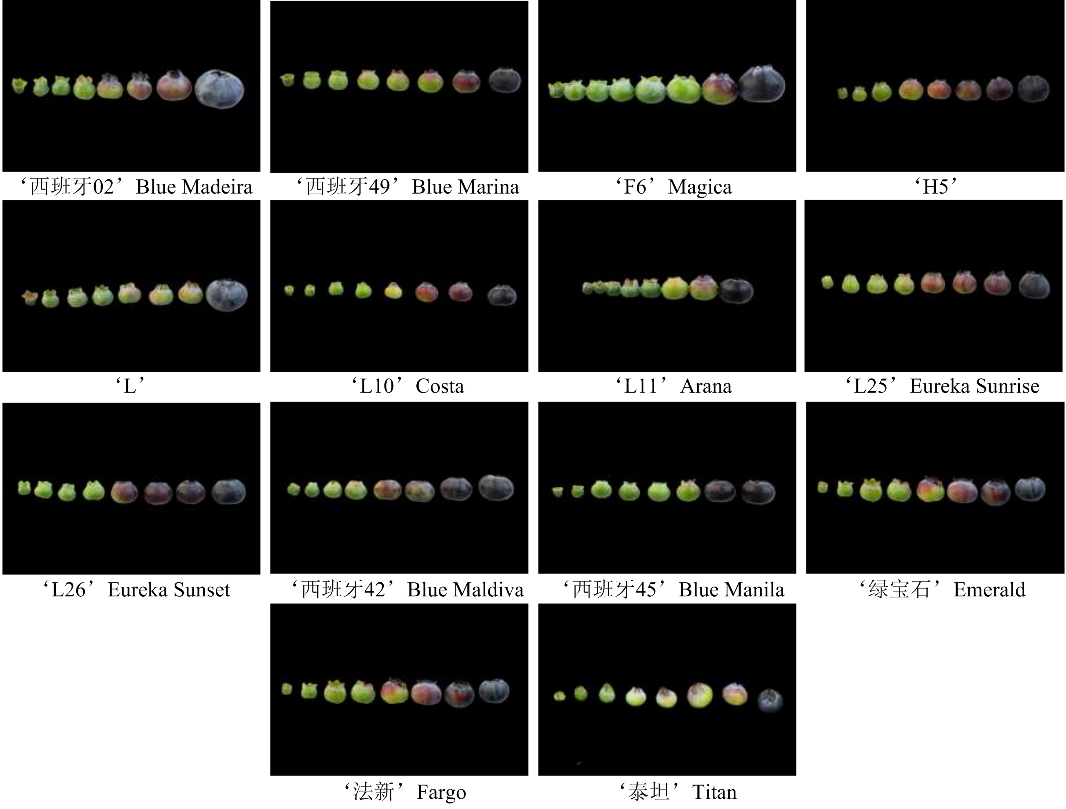
图1
14个蓝莓品种果实不同发育阶段的表型"

表1
糖酸组分的线性相关性"
| 组分 Components | 回归方程 Regression equation | 相关系数 R2 | 线性范围 Linear range (g·kg-1) |
|---|---|---|---|
| 果糖Fructose | y=151709x-27135 | 0.996 | 0.010—20 |
| 葡萄糖Glucose | y=134296x-1781.1 | 0.999 | 0.010—20 |
| 蔗糖Sucrose | y=136951x-6747.4 | 0.999 | 0.005—20 |
| 柠檬酸Citarate | y=651989x-73438 | 1.000 | 0.060—60 |
| 奎宁酸Quinic | y=276651x-3371.1 | 1.000 | 0.030—3 |
| 苹果酸Malate | y=473139x-29753 | 0.999 | 0.020—20 |
| 草酸Oxalate | y=7×10⁶x-3036.4 | 0.999 | 0.004—2 |
| 莽草酸Shikimate | y=3×10⁷x-339060 | 0.999 | 0.002—1 |
| 乳酸Lactate | y=497673x-12516 | 1.000 | 0.020—20 |
表2
实时荧光定量PCR引物信息"
| 基因Gene | 正向引物Forward prime (5′-3′) | 反向引物Reverse prime (5′-3′) |
|---|---|---|
| GAPDH | ACTACCATCCACTCTATCACCG | AACACCTTACCAACAGCCTTG |
| PEPC | CATTGAGAGTCGTTCCATTGTTTGA | AATCTGAGTACCCAATCATCACCTC |
表3
不同成熟期14个蓝莓品种果实总酸和总可溶性固形物含量"
| 品种 Cultivars | 总酸Total acid (Acid%) | 总可溶性固形物Total soluble solids (Brix%) | ||||
|---|---|---|---|---|---|---|
| 青果期Green | 粉果期Pink | 蓝果期Blue | 青果期Green | 粉果期Pink | 蓝果期Blue | |
| H5 | 5.00±0.17a | 3.46±1.96b | 0.90±0.07c | 7.60±0.46b | 7.60±0.20b | 15.53±1.00a |
| L25 Eureka Sunrise | 2.88±0.36a | 2.87±0.29a | 0.94±0.13b | 6.63±0.21b | 6.60±0.17b | 9.33±0.06a |
| L | 3.14±0.18b | 4.57±0.33a | 1.15±0.01c | 8.80±0.10b | 8.33±0.29b | 15.87±0.42a |
| 西班牙49 Blue Marina | 2.43±0.33a | 2.03±0.64ab | 1.42±0.16b | 8.43±0.15b | 7.50±0.26c | 17.57±0.23a |
| 绿宝石Emerald | 3.21±0.58a | 2.44±0.78ab | 0.77±0.44b | 8.30±0.10b | 8.47±0.15b | 11.93±0.64a |
| F6 Magica | 3.23±0.37a | 3.10±0.06a | 1.09±0.09b | 7.37±0.55b | 7.37±0.23b | 13.17±0.40a |
| L11 Arana | 4.45±0.15a | 4.22±0.03a | 1.84±0.67b | 7.40±0.44c | 7.77±0.23b | 12.60±1.35a |
| 西班牙45 Blue Manila | 3.61±0.14a | 2.50±0.72b | 1.20±0.06c | 6.70±0.10c | 8.23±0.38b | 10.73±1.46a |
| L26 Eureka Sunset | 3.22±0.29a | 2.99±0.28a | 0.97±0.09b | 6.43±0.45c | 9.33±0.38b | 13.97±1.46a |
| L10 Costa | 5.57±0.95a | 1.25±0.03b | 0.91±0.09b | 7.90±0.36c | 10.77±0.90b | 12.33±0.32a |
| 西班牙02 Blue Madeira | 4.30±0.64a | 2.79±0.28b | 0.88±0.02c | 9.47±0.76c | 14.77±1.03b | 17.20±0.70a |
| 西班牙42 Blue Maldiva | 4.32±0.31a | 2.28±0.03b | 0.82±0.03c | 7.43±0.15c | 10.47±0.06b | 12.47±0.32a |
| 法新Fargo | 5.37±0.13a | 2.76±0.07b | 1.08±0.03c | 7.40±0.61c | 10.97±0.40b | 13.60±0.62a |
| 泰坦Titan | 5.33±0.19a | 4.73±0.13a | 2.53±0.38b | 8.50±0.62b | 10.80±1.13a | 13.33±0.74a |
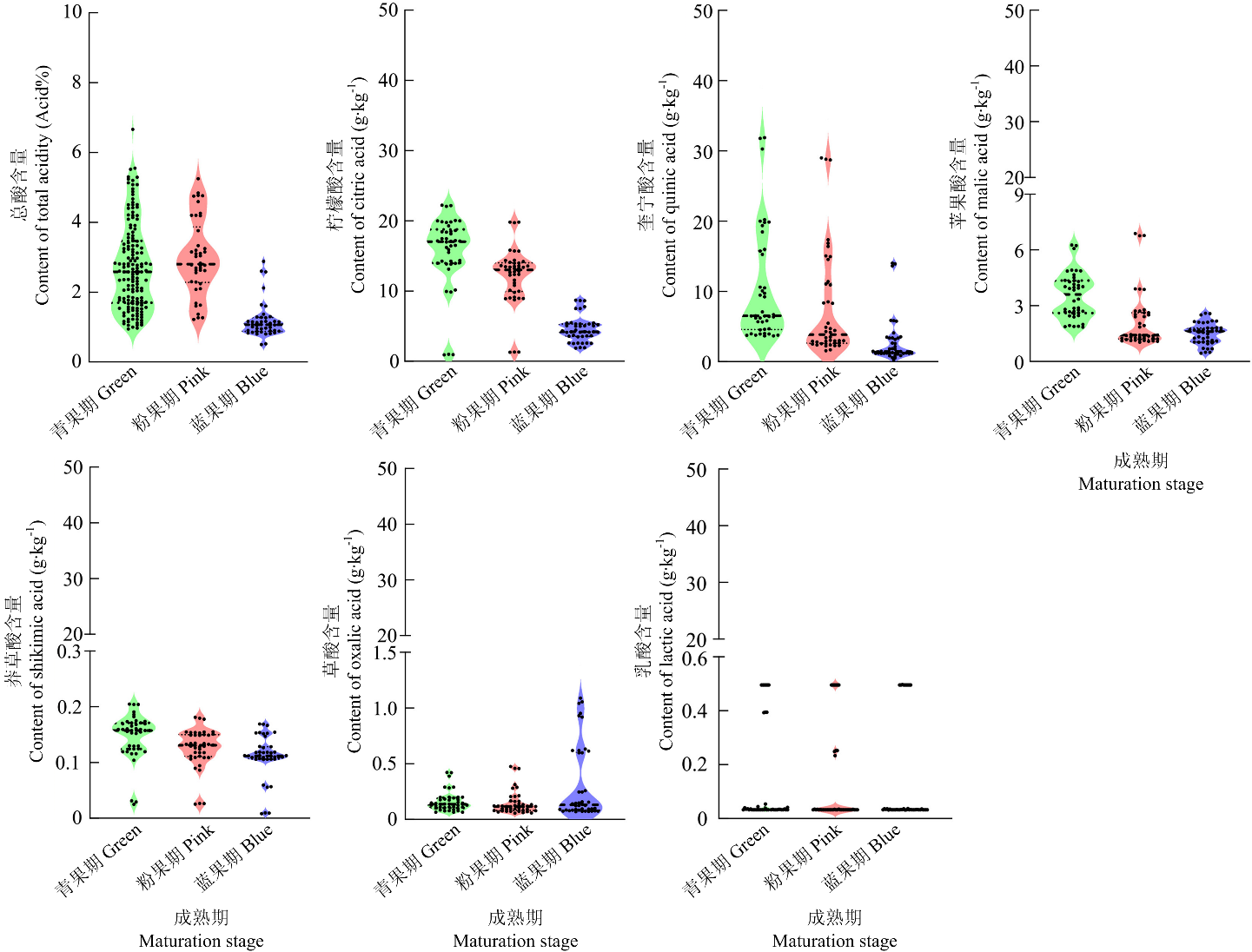
图2
14个蓝莓品种不同成熟期果实有机酸类型及其含量分布"
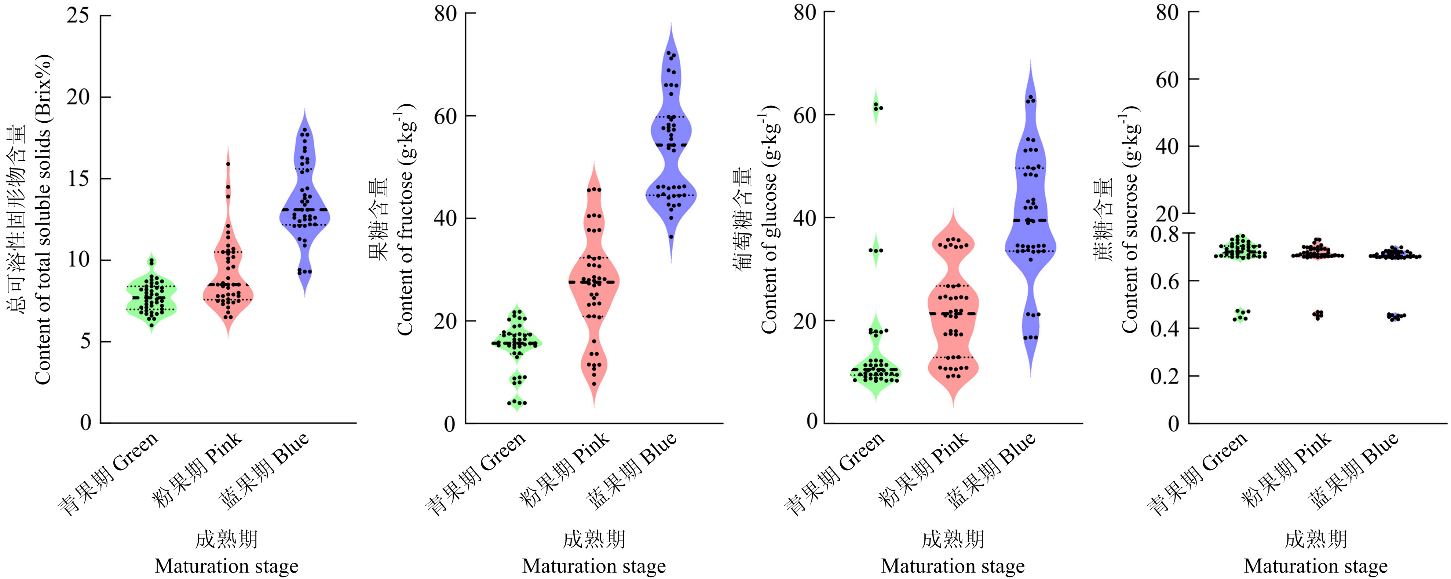
图3
14个蓝莓品种不同成熟期果实可溶性糖类型及其含量分布"
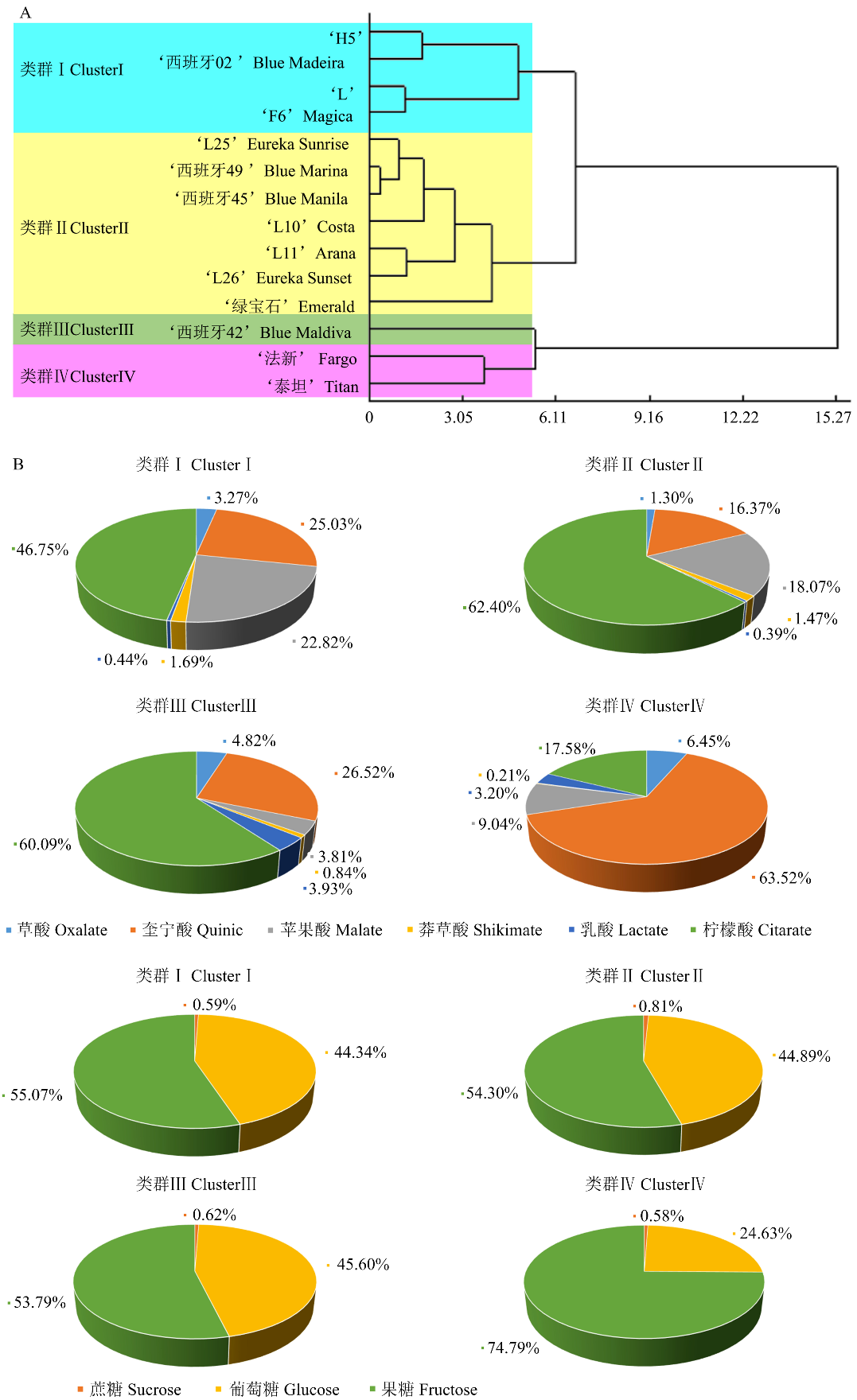
图4
14个蓝莓品种有机酸和可溶性糖的聚类关系 A:14个蓝莓品种有机酸与和可溶性糖聚类图;B:ClusterⅠ—ClusterⅣ中各有机酸与和可溶性糖含量相对比例"
表4
蓝莓蓝果期果实糖酸组分相关性分析"
| 组分 Components | 总糖 Total soluble sugars | 蔗糖 Sucrose | 葡萄糖 Glucose | 果糖 Fructose | 总有机酸 Total organic acids | 奎宁酸 Quinic | 草酸 Oxalate | 苹果酸 Malate | 柠檬酸 Citrate | 莽草酸 Shikimate | 乳酸 Lactate |
|---|---|---|---|---|---|---|---|---|---|---|---|
| 总糖 Total soluble sugars | 1.00 | ||||||||||
| 蔗糖Sucrose | 0.08 | 1.00 | |||||||||
| 葡萄糖Glucose | 0.68* | 0.04 | 1.00 | ||||||||
| 果糖Fructose | 0.73* | 0.10 | 0.87** | 1.00 | |||||||
| 总有机酸 Total organic acids | -0.37 | -0.14 | -0.12 | -0.30 | 1.00 | ||||||
| 奎宁酸Quinic | -0.05 | -0.08 | -0.01 | 0.02 | 0.90** | 1.00 | |||||
| 草酸Oxalate | -0.34 | -0.06 | -0.35 | -0.42 | 0.91** | 0.70** | 1.00 | ||||
| 苹果酸Malate | -0.26 | -0.01 | -0.18 | -0.16 | 0.47 | 0.10 | 0.30 | 1.00 | |||
| 柠檬酸Citarate | 0.02 | -0.19 | 0.28 | 0.20 | 0.65* | 0.45 | 0.35 | -0.29 | 1.00 | ||
| 莽草酸Shikimate | -0.29 | 0.05 | -0.23 | -0.24 | 0.28 | -0.10 | 0.10 | 0.78** | -0.63* | 1.00 | |
| 乳酸Lactate | -0.34 | -0.06 | -0.38 | -0.43 | 0.92** | 0.73** | 0.99** | 0.29 | 0.36 | 0.10 | 1.00 |
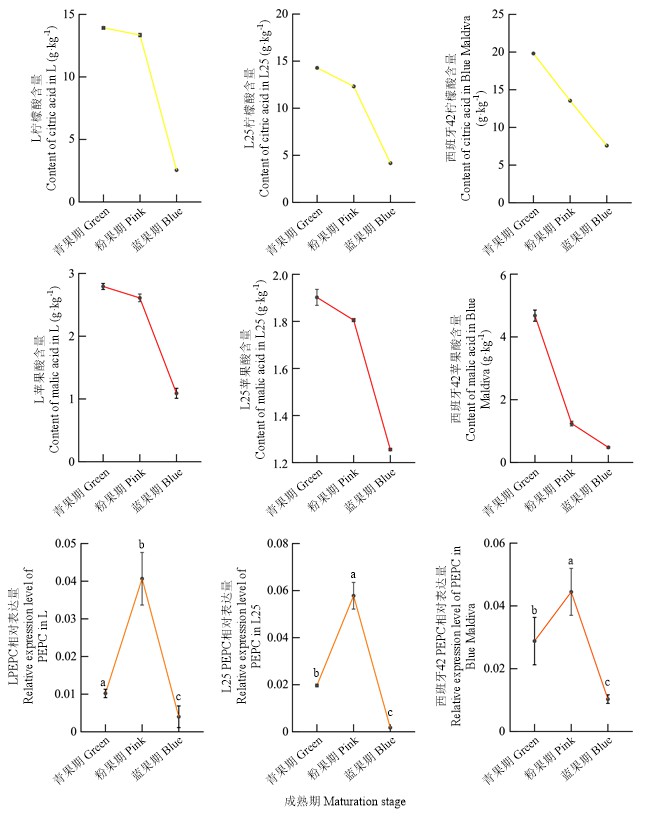
图5
不同成熟期蓝莓果实中柠檬酸、苹果酸含量及PEPC的表达分析"
| [1] |
余莹, 杨燕林, 和建平, 王宇萍, 吴永斌, 杨正松. 不同发育阶段喷施外源激素对蓝莓果实品质的影响[J/OL]. 果树学报, 2025:1-25. DOI: 10.13925/j.cnki.gsxb.20250590.
|
|
|
|
| [2] |
|
| [3] |
宋江涛, 谌丹丹, 公旭晨, 商祥明, 李春龙, 蔡永喜, 岳建平, 王帅玲, 张卜芬, 谢宗周, 刘继红. 人工疏果对'爱媛28'橘橙果实糖酸含量及代谢基因表达的影响[J]. 中国农业科学, 2022, 55(23): 4688-4701. DOI:10.3864/j.issn.0578-1752.2022.23.010.
|
|
|
|
| [4] |
|
| [5] |
王鹏飞, 薛晓芳, 穆晓鹏, 张建成, 曹琴, 杜俊杰. 不同酸度欧李果实有机酸积累特性与相关代谢酶活性分析[J]. 中国农业科学, 2013, 46(19): 4101-4109. DOI: 10.3864/j.issn.0578-1752.2013.19.016.
|
|
|
|
| [6] |
|
| [7] |
|
| [8] |
|
| [9] |
|
| [10] |
刘硕, 刘有春, 刘宁, 张玉萍, 章秋平, 徐铭, 张玉君, 刘威生. 李属(Prunus)果树品种资源果实糖和酸的组分及其构成差异[J]. 中国农业科学, 2016, 49(16): 3188-3198. DOI: 10.3864/j.issn.0578-1752.2016.16.012.
|
|
|
|
| [11] |
|
| [12] |
|
| [13] |
|
| [14] |
|
| [15] |
|
| [16] |
刘晓荣, 刘有春, 刘成, 陆晓春, 陶承光. 越橘果实发育过程中糖酸积累及抗氧化性形成的动态变化[J]. 沈阳农业大学学报, 2020, 51(4): 462-469.
|
|
|
|
| [17] |
|
| [18] |
|
| [19] |
|
| [20] |
|
| [21] |
|
| [22] |
陈发兴, 刘星辉, 陈立松. 果实有机酸代谢研究进展[J]. 果树学报, 2005, 22(5): 526-531.
|
|
|
|
| [23] |
覃红梅, 杨国顺, 梁晓文, 罗飞雄, 何建军. 野酿2号毛葡萄果实发育进程中苹果酸代谢规律及相关基因表达分析[J]. 南方农业学报, 2024, 55(8): 2332-2341.
|
|
|
|
| [24] |
廖香娇, 张王妮, 赵凌吉, 刘勇, 杨莉. 桃溪蜜柚果实发育期有机酸含量变化及柠檬酸代谢相关基因表达分析[J]. 江苏农业科学, 2025, 53(12): 183-188.
|
|
|
|
| [25] |
邵姁, 王月, 应炎标, 朱友银, 刘向蕾, 葛凡, 郭卫东. 蓝莓磷酸烯醇式丙酮酸羧化酶基因cDNA克隆及表达分析[J]. 基因组学与应用生物学, 2016, 35(1): 166-171.
|
|
|
|
| [26] |
蒋际谋, 陈秀萍, 胡文舜, 姜帆, 邓朝军, 郑少泉. 枇杷种质资源果实糖组分及含量特征[J]. 园艺学报, 2015, 42(9): 1781-1788.
|
|
|
|
| [27] |
董畅, 覃杨, 曾琪琪, 霍珏璇. 不同蓝莓品种果实发育过程中的品质指标变化趋势研究[J]. 现代农业科技, 2025(9): 43-47.
|
|
|
|
| [28] |
陈招芳, 李恒刚, 许轲, 黄金秋, 汪志辉, 吴林, 王迅. 四川主栽蓝莓品种果实生长发育过程中的品质变化规律[J]. 食品与发酵工业, 2020, 46(12): 244-250.
|
|
|
|
| [29] |
陈凯莉. 蓝莓果实发育中果实主要品质变化及果胶分解关键酶活性及表达量分析[D]. 雅安: 四川农业大学, 2018.
|
|
|
|
| [30] |
李明瑞. 蓝莓果实发育中色素及糖酸含量变化研究[D]. 沈阳: 沈阳农业大学, 2024.
|
|
|
|
| [31] |
徐玉涛, 李珂珂, 王贺新, 陈丽荣, 弓晓杰. 高效液相色谱法对蓝莓果实中8个有机酸含量的测定[J]. 食品科学, 2015, 36(18): 127-131.
|
|
|
|
| [32] |
吴林, 张强, 臧慧明, 徐振彪, 徐德冰. 云南丽江和吉林靖宇蓝莓糖酸组分差异化分析[J]. 中国果树, 2019(6): 54-58, 64.
|
|
|
|
| [33] |
王瑜, 杨浩博, 仲帅, 刘鑫, 盛煜钧, 李彤, 宗成文. HPLC-ELSD法测定长白山笃斯越桔果实中可溶性糖含量[J]. 食品工业科技, 2020, 41(2): 238-243.
|
|
|
|
| [34] |
张素敏, 杨巍, 魏鑫, 高文民, 刘成. 蓝莓果实外观与糖、酸、酚组成特征[J]. 食品研究与开发, 2023, 44(10): 53-61.
|
|
|
|
| [35] |
|
| [36] |
霍宏亮, 任伟春, 许伟华, 叶芳, 林娅沁, 王金燕, 杜媛媛, 凌益春, 杨晓乐, 曹玉芬. 云和雪梨主要营养素分析[J]. 中国南方果树, 2024, 53(6): 187-193.
|
|
|
|
| [37] |
于淼, 阮成江, 李贺, 张少凤, 徐弘灏, 刘向前. HPLC法测定10个引自北美蓝莓品种果实中的糖酸组分及含量[J]. 食品工业科技, 2016, 37(10): 77-81.
|
|
|
|
| [38] |
|
| [39] |
|
| [40] |
|
| [41] |
游鸿瑞, 武运, 马文瑞, 杨华峰, 白晓雪, 张利利, 唐江北, 黄文书. 微量元素对马瑟兰葡萄果实糖酸代谢及基因表达的影响[J]. 食品与发酵工业, 2026, 52(8): 170-180.
|
|
|
|
| [42] |
杨文渊, 谢红江, 陶炼, 宦云敏, 陈善波, 林立金, 廖明安. '金冠'苹果及其优系(SGP-1) 果实发育期间有机酸代谢特征比较[J]. 西北植物学报, 2022, 42(5): 829-836.
|
|
|
| [1] | 吴新亮, 吴慧玲, 张绥林, 曹漫, 冯欣, 周冰洁, 侯智霞. 蓝莓VcTPS/VcTPP基因家族鉴定及VcTPS24对花诱导的功能分析[J]. 中国农业科学, 2025, 58(13): 2663-2681. |
| [2] | 张玉梅, 丁文涛, 蓝新隆, 李清华, 胡润芳, 郭娜, 林国强, 赵晋铭. 大豆地方种质资源鲜籽粒可溶性糖含量的全基因组关联分析[J]. 中国农业科学, 2024, 57(11): 2079-2091. |
| [3] | 张英强,张水勤,李燕婷,赵秉强,袁亮. 不同含羧基有机酸改性尿素在石灰性潮土中的转化特征[J]. 中国农业科学, 2022, 55(17): 3355-3364. |
| [4] | 沈升法,项超,吴列洪,李兵,罗志高. 甘薯块根可溶性糖组分特征及其与食味的关联分析[J]. 中国农业科学, 2021, 54(1): 34-45. |
| [5] | 段应策,胡姿仪,杨帆,李金涛,邬向丽,张瑞颖. pH和缓冲作用对香菇菌丝生长的影响[J]. 中国农业科学, 2020, 53(22): 4683-4690. |
| [6] | 赵绪生,齐永志,闫翠梅,甄文超. 小麦、玉米两熟秸秆还田土壤中6种有机酸对小麦纹枯病的化感作用[J]. 中国农业科学, 2020, 53(15): 3095-3107. |
| [7] | 刘世尧,冉慧,毛运芝,陈欣瑜. 綦江皱皮木瓜果实有机酸特征性成分鉴定与 不同发育期变化规律[J]. 中国农业科学, 2019, 52(1): 111-128. |
| [8] | 任胜茂,邓榆川,文凤君,Sajad Hussain,蒲全明,于晓波,刘卫国,杨文钰. 套作对大豆苗期茎秆纤维素合成相关糖类物质转化的影响及其与叶片光合的关系[J]. 中国农业科学, 2018, 51(7): 1272-1282. |
| [9] | 李法计,徐学欣,何中虎,肖永贵,陈新民,王志敏. 三种限水灌溉水平下中麦175干物质积累与水分利用特性解析[J]. 中国农业科学, 2018, 51(2): 374-385. |
| [10] | 李晓英,薛梅,樊汶樵,罗洁. 不同干燥方式对蓝莓叶中酚类物质及其抗氧化活性的影响[J]. 中国农业科学, 2018, 51(13): 2570-2578. |
| [11] | 谢丽雪,郑 姗,张立杰,张小艳,李 韬. 蓝莓休克病毒IC-RT-nested PCR检测技术[J]. 中国农业科学, 2016, 49(22): 4366-4374. |
| [12] | 郑惠文,张秋云,李文慧,章世奎,席万鹏. 新疆杏果实发育过程中可溶性糖和有机酸的变化[J]. 中国农业科学, 2016, 49(20): 3981-3992. |
| [13] | 薄晓培,王梦馨,崔 林,王金和,韩宝瑜. 茶树3类渗透调节物质与冬春低温相关性及其品种间的差异评价[J]. 中国农业科学, 2016, 49(19): 3807-3817. |
| [14] | 刘 硕,刘有春,刘 宁,张玉萍,章秋平,徐 铭,张玉君,刘威生. 李属(Prunus)果树品种资源果实糖和酸的组分及其构成差异[J]. 中国农业科学, 2016, 49(16): 3188-3198. |
| [15] | 胡梦芸,李辉,庞建周,刘茜,张颖君,孙丽静. 过量表达蔗糖转运蛋白基因增强转基因小麦的耐旱性[J]. 中国农业科学, 2015, 48(8): 1473-1483. |
|
||
