






中国农业科学 ›› 2026, Vol. 59 ›› Issue (12): 2712-2725.doi: 10.3864/j.issn.0578-1752.2026.12.013
李晓颖1( ), 陈鑫鹏2, 葛航1, 陈俊伟1, 王晨2, 徐红霞1()
收稿日期:2026-01-09
接受日期:2026-04-07
出版日期:2026-06-16
发布日期:2026-06-16
通信作者:
联系方式:
李晓颖,E-mail:lixy@zaas.ac.cn。
基金资助:
LI XiaoYing1(), CHEN XinPeng2, GE Hang1, CHEN JunWei1, WANG Chen2, XU HongXia1()
Received:2026-01-09
Accepted:2026-04-07
Published:2026-06-16
Online:2026-06-16
摘要:
【目的】枇杷(Eriobotrya japonica)是我国南方重要的经济果树,其果实成熟期正值高温强光季节,极易发生日灼伤害,表现为果皮褐变、组织坏死及风味劣变,严重削弱果实商品率与经济价值。WRKY转录因子作为植物特有的逆境响应调控因子,在高温、干旱等非生物胁迫中发挥关键作用,解析EjWRKY15在日灼胁迫中的功能及作用机制,为揭示枇杷日灼响应的调控通路和创制抗日灼新种质提供理论依据与候选基因资源。【方法】以枇杷果实为材料,利用SMART技术构建日灼胁迫诱导的枇杷果实酵母双杂交cDNA文库,通过涂布筛选与序列回测鉴定文库的库容、滴度和重组率。以EjWRKY15为诱饵蛋白,通过酵母双杂交系统(Y2H)从文库中筛选其潜在的互作蛋白。利用NCBI、Swiss-Prot等数据库对筛选到的互作蛋白进行功能注释,并重点关注高温及逆境相关蛋白。采用酵母双杂交点对点试验(Y2H)和双分子荧光互补技术(BiFC)分别从体外和体内水平验证EjWRKY15与候选蛋白EjLHP1.2(like heterochromatin protein 1)的物理互作真实性。基于转录组数据和关联分析,构建以EjWRKY15为核心节点的枇杷日灼应答分子互作网络。【结果】成功构建了库容量大、重组率高的枇杷果实cDNA文库。通过诱饵载体自激活检测排除背景干扰后,酵母双杂交筛选获得12个与EjWRKY15互作的候选蛋白,功能涉及表观遗传调控、胁迫信号转导和物质代谢等。其中,鉴定到一个与高温响应密切相关的基因EjLHP1.2。点对点验证与BiFC试验证实EjWRKY15与EjLHP1.2在体内和体外均存在互作。表达分析显示,在日灼胁迫下,EjWRKY15及其12个互作候选蛋白基因均呈现显著的差异表达模式。基于上述互作关系和表达关联,初步构建了EjWRKY15介导的日灼应答网络,表明EjWRKY15可能通过招募EjLHP1.2等因子共同调节下游热响应基因的表达。【结论】阐明了核心转录因子EjWRKY15通过与表观遗传调节因子EjLHP1.2发生蛋白互作,进而精准调控下游响应网络并介导枇杷果实日灼应答的分子机制,揭示了枇杷在遭遇高温强光胁迫时,通过“转录因子-染色质重塑蛋白”协同模式进行逆境调控的新路径。
李晓颖, 陈鑫鹏, 葛航, 陈俊伟, 王晨, 徐红霞. 枇杷日灼响应因子EjWRKY15互作蛋白的筛选及其调控网络解析[J]. 中国农业科学, 2026, 59(12): 2712-2725.
LI XiaoYing, CHEN XinPeng, GE Hang, CHEN JunWei, WANG Chen, XU HongXia. Screening of Interacting Proteins for the Loquat Sunburn-Responsive Factor EjWRKY15 and Analysis of Its Regulatory Network[J]. Scientia Agricultura Sinica, 2026, 59(12): 2712-2725.
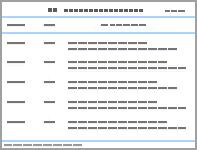
表1
酵母双杂点对点载体构建及BiFC载体构建的引物序列"
| 基因 Gene | 正向引物 Forward primer (5′-3′) | 反向引物 Reverse primer (5′-3′) | 用途 Application |
|---|---|---|---|
| EjWRKY15 | GCATATGGCCATGGAGGCCGAATTC ATGGAGAACTGGGATTTGCAAGCTG | GCGGCCGCTGCAGGTCGACGGATCC GCAAGCACCGTTTACAGTATGAGAG | 酵母双杂交载体构建 Yeast two-hybrid vector construction |
| EjLHP1 | TATGGCCATGGAGGCCAGTGAATTC ATGAGAACCAAGGTGGGAAGAAGGG | TCTGCAGCTCGAGCTCGATGGATCC AAATGTAGGATTGTATCGGAGATGT | 酵母双杂交载体构建 Yeast two-hybrid vector construction |
| pGADT7 | TAATACGACTCACTATAGGGC | AGATGGTGCACGATGCACAG | AD载体引物 AD vector primers |
| pGBKT7 | TAATACGACTCACTATAGGGC | CCCGGAATTAGCTTGGCTGCAAGC | BD载体引物 BD vector primers |
| EjWRKY15 | GAGAACACGGGGGACTCTAGA ATGGAGAACTGGGATTTGCAAGCTG (XbaⅠ) | GACAGTACTATCGATGGATCC GCAAGCACCGTTTACAGTATGAGAG (BamHⅠ) | BiFC载体构建 BiFC vector construction |
| EjLHP1.2 | GAGAACACGGGGGACTCTAGA ATGAGAACCAAGGTGGGAAGAAGGG (XbaⅠ) | GACAGTACTATCGATGGATCC AAATGTAGGATTGTATCGGAGATGT (BamHⅠ) | BiFC载体构建 BiFC vector construction |
| pSPYCE | GACGTAAGGGATGACGCAC | GATGCCGTTCTTCTGCTTGT | BiFC载体引物 BiFC vector primers |
| PSPYNE | GACGTAAGGGATGACGCAC | CGCCCTTGCTCACCATAA | BiFC载体引物 BiFC vector primers |
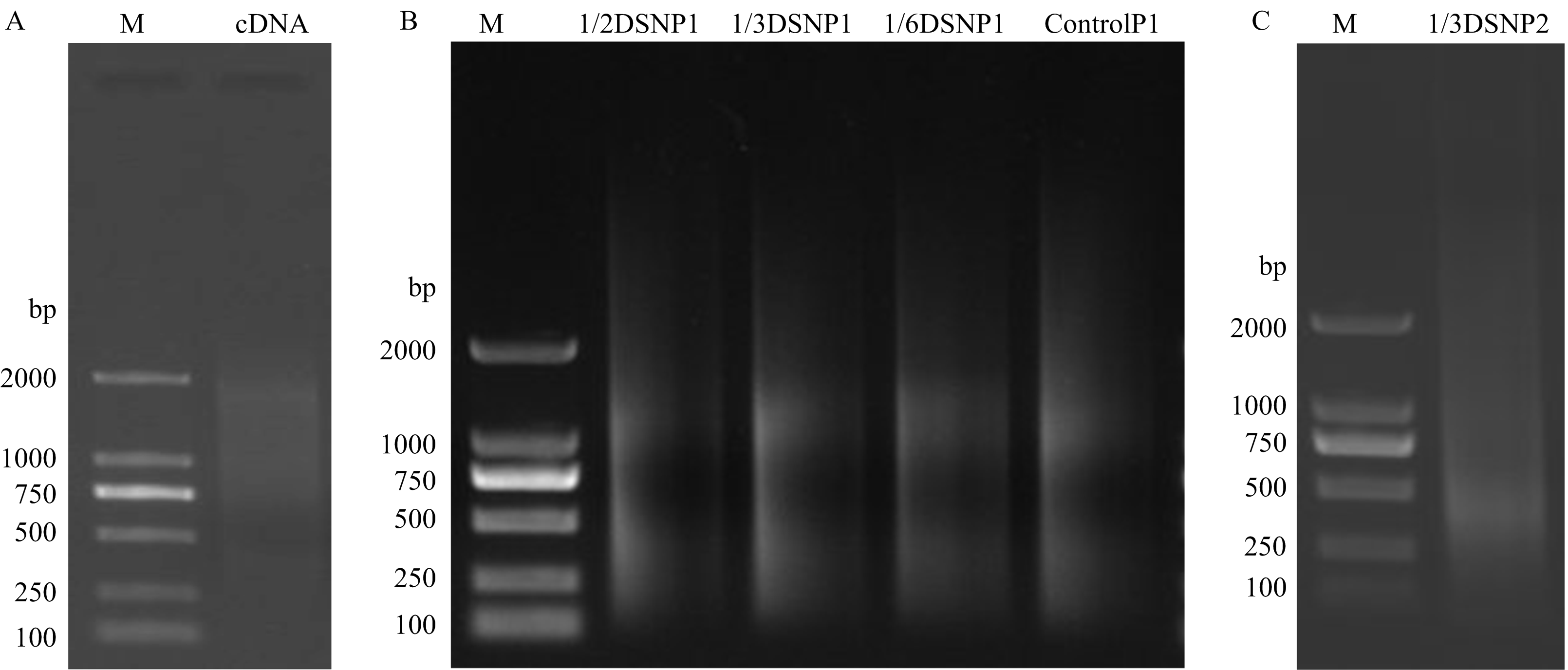
图1
cDNA合成及DNS均一化检测 A:cDNA合成;B:均一化后一次放大检测结果;C:均一化后二次放大检测结果。M:Marker"

图2
cDNA文库的构建及质量鉴定 A:文库库容量鉴定;B:文库插入片段大小鉴定;c:均一化效率,N:均一化模板,UN:未均一化模板,c:循环数;D:文库滴度鉴定;E:酵母克隆鉴定。M:Marker"

图3
EjWRKY15的自激活检测 A:阳性与阴性对照生长情况;B:EjWRKY15自激活检测"

图4
酵母双杂交筛库及互作网络 A:酵母双杂交筛库点板;B:EjWRKY15互作网络"
表2
EjWRKY15互作蛋白的功能注释"
| 基因ID Gene ID | 基因长度 Gene length (bp) | 基因功能注释 Gene annotation | 生物过程注释 Biological process annotation |
|---|---|---|---|
| LOC103951827 | 4418 | 预测:假定蛋白LOC103951827(白梨) PREDICTED: Uncharacterized protein LOC103951827 (Pyrus bretschneideri) | GO:0045859(蛋白激酶活性的调控);GO:0004860(蛋白激酶抑制剂活性);GO:0005515(蛋白结合) GO:0045859 (Regulation of protein kinase activity); GO:0004860 (Protein kinase inhibitor activity); GO:0005515 (Protein binding) |
| EjCOP9 | 1748 | 预测:COP9信号体复合体第5a亚基类似物(苹果) PREDICTED: COP9 signalosome complex subunit 5a-like (Malus domestica) | GO:0005515(蛋白结合) GO:0005515 (Protein binding) |
| EjLHP1.1 | 2043 | 预测:顶端花2蛋白(苹果) PREDICTED: Terminal flower 2 protein (Malus domestica) | GO:0008017(微管结合);GO:0045298(微管蛋白复合体);GO:0005634(细胞核) GO:0008017 (Microtubule binding); GO:0045298 (Tubulin complex); GO:0005634 (Nucleus) |
| EjTFIID | 2757 | 预测:转录起始因子TFIID 15b亚基类似物变体X2(白梨) PREDICTED: Transcription initiation factor TFIID subunit 15b-like isoform X2 (Pyrus bretschneideri) | GO:0003676(核酸结合);GO:0008270(锌离子结合) GO:0003676 (Nucleic acid binding); GO:0008270 (Zinc ion binding) |
| EjR-B1 | 888 | 预测:铁氧还蛋白根部R-B1型 PREDICTED: Ferredoxin, root R-B1 (Malus domestica) | GO:0006118(电子传递);GO:0009055(电子载体活性);GO:0051536(铁硫簇结合)GO:0006118 (Electron transport, obsolete); GO:0009055 (Electron carrier activity); GO:0051536 (Iron-sulfur cluster binding) |
| LOC103439518 | 6025 | 预测:未表征蛋白 LOC103926653(白梨) PREDICTED: Uncharacterized protein LOC103926653 (Pyrus bretschneideri) | GO:0003676(核酸结合) GO:0003676 (Nucleic acid binding) |
| LOC103962645 | 1745 | 预测:未表征蛋白 LOC103962645(白梨) PREDICTED: Uncharacterized protein LOC103962645 (Pyrus bretschneideri) | GO:0009405(致病机制);GO:0019865(免疫球蛋白结合);GO:0019814(免疫球蛋白复合体) GO:0009405 (Pathogenesis); GO:0019865 (Immunoglobulin binding); GO:0019814 (Immunoglobulin complex) |
| EjLHP1.2 | 263 | 预测:染色质结合蛋白/类异染色质蛋白1(LHP1),PRC1复合物核心组分,参与表观遗传调控、发育阶段转变和热胁迫(苹果)PREDICTED: Chromatin-binding protein/LIKE HETEROCHROMATIN PROTEIN 1 (LHP1), core component of PRC1 complex, involved in epigenetic regulation, developmental phase transition, and heat stress (Malus domestica) | GO:0005634(细胞核);GO:0009408(热响应);GO:0006355(转录调控,DNA模板依赖型) GO:0005634 (Nucleus); GO:0009408 (Response to heat); GO:0006355 (Regulation of transcription, DNA-templated) |
| LOC103928535 | 1976 | 预测:未表征蛋白 LOC103928535(白梨) PREDICTED: Uncharacterized protein LOC103928535 (Pyrus bretschneideri) | GO:0005975(碳水化合物代谢过程);GO:0007155(细胞黏附);GO:0004553(水解酶活性,水解O-糖基化合物);GO:0030248(纤维素结合);GO:0005576(细胞外区域)GO:0005975 (Carbohydrate metabolic process); GO:0007155 (Cell adhesion); GO:0004553 (Hydrolase activity, hydrolyzing O-glycosyl compounds); GO:0030248 (Cellulose binding); GO:0005576 (Extracellular region) |
| LOC103454870 | 903 | 预测:未表征蛋白 LOC103962645(白梨) PREDICTED: Uncharacterized protein LOC103962645 (Pyrus bretschneideri) | — |
| EjTTL | 1439 | 预测:尿酸降解双功能蛋白TTL 变体X1(苹果) PREDICTED: uric acid degradation bifunctional protein TTL isoform X1 (Malus domestica) | GO:0005634(细胞核) GO:0005634 (Nucleus) |
| EjPTRG | 1609 | 预测蛋白:PTRG(苹果) PREDICTED: Pyrenophora tritici-repentis Pt-1C-BFP conserved hypothetical protein, mRNA (Malus domestica) | — |
| EjWRKY15 | 1303 | 预测:WRKY转录因子15(苹果) PREDICTED: Probable WRKY transcription factor 15 (Malus domestica) | GO:0006355(转录调控,DNA模板依赖型);GO:0003700(DNA结合转录因子活性);GO:0043565(序列特异性DNA结合);GO:0005667(转录调控复合体) GO:0006355 (regulation of transcription, DNA-templated); GO:0003700 (DNA-binding transcription factor activity); GO:0043565 (sequence-specific DNA binding); GO:0005667 (transcription regulator complex) |

图5
酵母双杂交验证及荧光双分子互补试验验证 A:酵母双杂交;B:BiFC"
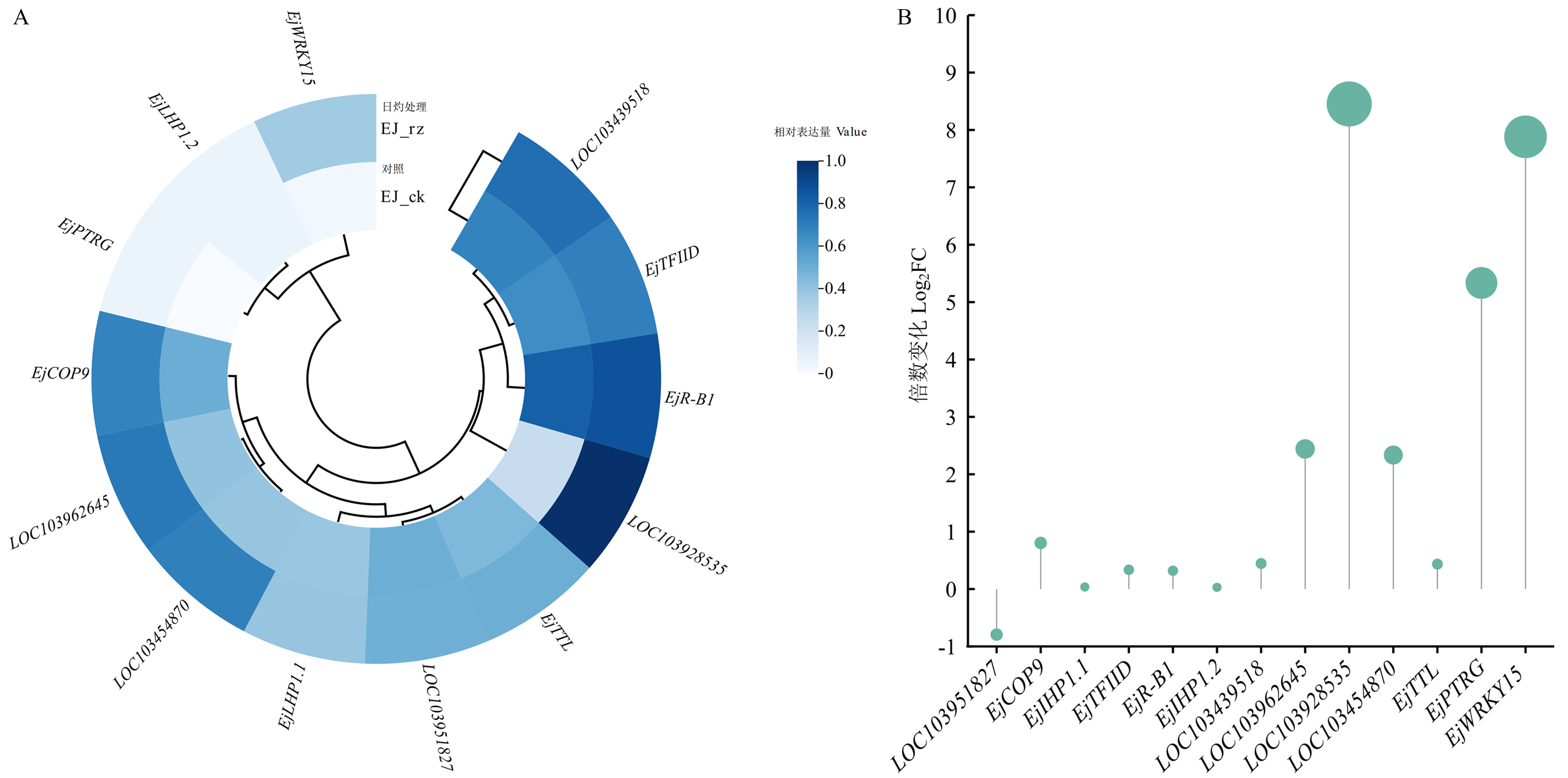
图6
EjWRKY15及其互作蛋白基因响应枇杷日灼的表达图谱(A)和响应强度差异分析(B)"

图7
EjWRKY15及其互作蛋白响应枇杷日灼的作用网络"
| [1] |
邱武陵, 章恢志. 中国果树志-龙眼枇杷卷. 北京: 中国林业出版社, 1996.
|
|
|
|
| [2] |
蒋际谋, 邓朝军, 林永祥, 龚慧文, 许奇志, 郑少泉, 陈伟. 枇杷果皮响应高温强光胁迫的蛋白质组分析. 热带亚热带植物学报, 2014, 22(4): 383-390.
|
|
|
|
| [3] |
doi: 10.21273/JASHS.133.1.27 |
| [4] |
|
| [5] |
doi: 10.1111/ppl.2008.134.issue-2 |
| [6] |
doi: 10.1016/j.plaphy.2010.08.016 pmid: 20870416 |
| [7] |
doi: 10.1093/jxb/erp289 |
| [8] |
doi: 10.1016/j.foodchem.2014.12.076 |
| [9] |
|
| [10] |
doi: 10.1016/j.gene.2015.09.076 |
| [11] |
doi: 10.1016/j.plaphy.2024.108353 |
| [12] |
doi: 10.1007/s12355-024-01400-5 |
| [13] |
doi: 10.1016/j.bbrc.2013.01.104 |
| [14] |
doi: 10.1016/j.molp.2023.09.013 |
| [15] |
邓朝军, 蒋际谋, 张小艳, 许奇志, 章希娟, 魏秀清, 郑少泉. 枇杷果皮热伤害发生影响因子研究. 福建农业学报, 2012, 27(10): 1081-1086.
|
|
|
|
| [16] |
邓朝军, 蒋际谋, 龚慧文, 许奇志, 陈义勇, 林永祥, 郑少泉, 邢建宏. 2个枇杷品种果皮日灼伤害差异蛋白质组分析. 福建农业学报, 2012, 27(12): 1313-1317.
|
|
|
|
| [17] |
桑荣生, 吴宝玉. 枇杷果实日灼等非侵染性病害调查与分析. 农业科技通讯, 2020(2): 173-177.
|
|
|
|
| [18] |
邓朝军, 许奇志, 蒋际谋, 魏秀清, 章希娟, 郑少泉. 高温胁迫对枇杷果皮热伤害的抗氧化特性影响. 热带亚热带植物学报, 2012, 20(5): 439-444.
|
|
|
|
| [19] |
张小艳, 许奇志, 李韬, 郑少泉. 枇杷种质资源果实抗逆性初步调查评价. 福建果树, 2011(1): 11-22.
|
|
|
|
| [20] |
潘德灼, 邓朝军, 吕晓杰, 宋晓敏, 邱智敏, 龚慧文, 蒋际谋, 陈伟. 日灼胁迫对枇杷果皮蛋白质组的影响. 西北植物学报, 2016, 36(9): 1801-1812.
|
|
|
|
| [21] |
高雨薇, 邓朝军, 许奇志, 李浩伟, 项于倩, 马翠兰, 蒋际谋. 外源褪黑素对新白8号枇杷果实日灼和果皮解剖结构的影响. 果树学报, 2024, 41(7): 1387-1400.
|
|
|
|
| [22] |
doi: 10.1016/j.tig.2023.07.001 |
| [23] |
doi: 10.1007/s00425-011-1375-2 |
| [24] |
doi: 10.1007/s10059-010-0059-2 |
| [25] |
doi: 10.1111/mpp.2017.18.issue-5 |
| [26] |
|
| [27] |
doi: 10.1242/dev.128.23.4847 |
| [28] |
doi: 10.1111/tpj.v120.1 |
| [29] |
doi: 10.1111/tpj.v100.6 |
| [30] |
doi: 10.1038/s42003-021-01907-7 |
| [31] |
张建光, 刘玉芳, 孙建设, 施瑞德. 苹果果实日灼人工诱导技术及阈值温度研究. 园艺学报, 2003, 30(4): 446-448.
|
|
|
|
| [32] |
|
| [33] |
doi: 10.1080/17429145.2021.1981471 |
| [34] |
张洁, 姜长岳, 王跃进. 中国野生毛葡萄转录因子Vq WRKY6与Vqb ZIP1互作调控抗白粉病功能分析. 中国农业科学, 2022, 55(23): 4626-4639. doi: 10.3864/j.issn.0578-1752.2022.23.005.
|
|
|
|
| [35] |
doi: 10.1016/j.foodchem.2023.135573 |
| [36] |
doi: 10.1111/nph.v237.5 |
| [37] |
doi: 10.1016/j.plantsci.2018.07.010 |
| [38] |
doi: 10.1111/tpj.v108.3 |
| [39] |
doi: 10.3390/ijms22115593 |
| [40] |
doi: 10.1016/j.jplph.2022.153741 |
| [41] |
doi: 10.3390/ijms232113418 |
| [42] |
doi: 10.1186/s12864-023-09469-0 |
| [43] |
doi: 10.1186/s12870-024-05320-0 |
| [44] |
邢丽南, 张艳芳, 葛明然, 赵令敏, 陈妍, 霍秀文. 山药DoWRKY40基因表达特征分析及互作蛋白筛选. 生物技术通报, 2024, 40(8): 118-128.
doi: 10.13560/j.cnki.biotech.bull.1985.2024-0177 |
|
|
|
| [45] |
熊子墨. 一种高通量酵母双杂交系统的建立及其初步应用[D]. 武汉: 华中农业大学, 2020.
|
|
|
|
| [46] |
doi: 10.1093/plcell/koae171 pmid: 38865439 |
| [47] |
李晓颖, 徐红霞, 陈俊伟. 枇杷WRKY转录因子鉴定与表达分析. 园艺学报, 2019, 46(5): 939-954.
doi: 10.16420/j.issn.0513-353x.2018-0671 |
|
|
|
| [48] |
李晓颖, 徐红霞, 陈俊伟. 枇杷EjWRKY15基因克隆与蛋白特性分析. 果树学报, 2020, 37(12): 1811-1820.
|
|
|
|
| [49] |
|
| [50] |
doi: 10.1111/pbi.2018.16.issue-4 |
| [51] |
颜妙玲. TFL2/LHP1在高温响应通路中的功能初探[D]. 福州: 福建农林大学, 2019.
|
|
|
|
| [52] |
doi: 10.1016/j.celrep.2024.114758 |
| [53] |
doi: 10.3389/fpls.2017.02041 pmid: 29234344 |
| [54] |
doi: 10.1093/plcell/koaa026 |
| [55] |
doi: 10.1016/j.tplants.2021.03.003 pmid: 33744161 |
| [56] |
doi: 10.1016/j.tig.2014.01.002 pmid: 24555990 |
| [57] |
doi: 10.1016/j.jprot.2014.03.016 |
| [58] |
doi: 10.1016/j.bbrc.2005.04.016 pmid: 15882967 |
| [59] |
doi: 10.1016/j.tplants.2010.02.006 pmid: 20304701 |
| [60] |
doi: 10.1016/j.tibs.2022.08.003 |
| [61] |
doi: 10.3390/biom9120805 |
| [62] |
doi: 10.1038/s44319-025-00376-x |
| [63] |
doi: 10.3389/fcell.2021.635723 |
| [64] |
doi: 10.1111/tpj.v112.4 |
| [1] | 柯丹霞, 侯仕博, 周兆源, 林佳诺, 宋晓莉, 张可馨. GmBI-1互作蛋白的筛选及GmNod44在大豆结瘤固氮过程中的功能[J]. 中国农业科学, 2026, 59(11): 2314-2324. |
| [2] | 郑雅琴, 刘雪晴, 吴思文, 唐小燕, 杨丹妮, 汪永康, Ahmad Aftab, Khna Afrsyab, 汪承刚, 陈国户. 乌菜BcDET2的克隆及其抽薹开花调控功能[J]. 中国农业科学, 2025, 58(5): 991-1003. |
| [3] | 齐梦楠, 赵玎玲, 张雪妍, 张玉洁, 王荣纳, 刘兵强, 闫龙, 张洁, 王冬梅. GmSZFP互作蛋白的筛选及GmERF7在大豆抵抗SMV侵染过程中的功能分析[J]. 中国农业科学, 2025, 58(14): 2739-2750. |
| [4] | 刁志娟, 陈立喆, 王勋, 鲁玲, 刘燕, 张静, 夏娜, 唐定中, 李生平. 胱硫醚-β-合成酶OsCBSX4调控水稻稻瘟病抗性的机理[J]. 中国农业科学, 2024, 57(23): 4593-4606. |
| [5] | 朱艳婷, 党浩, 牛思杰, 林婧怡, 杨华, 杨强, 张冲, 蔡铁城, 庄伟建, 陈华. 利用酵母双杂交系统筛选花生AhSAP1的互作蛋白[J]. 中国农业科学, 2024, 57(21): 4376-4390. |
| [6] | 何勇, 范晓珠, 陈新月, 段书静, 胡婷婷, 谢如雪, 王宇晴, 陈静. 利用酵母双杂交系统筛选与辣椒轻斑驳病毒126 kDa蛋白互作的辣椒寄主因子[J]. 中国农业科学, 2024, 57(15): 2986-2996. |
| [7] | 宾羽, 张琦, 王春庆, 赵晓春, 宋震, 周常勇. 利用酵母双杂交系统筛选与柑橘黄化脉明病毒CP互作的寄主因子[J]. 中国农业科学, 2023, 56(10): 1881-1892. |
| [8] | 李雨泽,朱嘉伟,林蔚,蓝茉莹,夏黎明,张艺粒,罗聪,黄桂香,何新华. 香水柠檬RHF2A的克隆与互作蛋白的筛选[J]. 中国农业科学, 2022, 55(24): 4912-4926. |
| [9] | 李天聪,朱行,魏宁,龙凤,武建颖,张燕,董金皋,申珅,郝志敏. 玉米大斑病菌SC35同源基因表达规律与互作分析[J]. 中国农业科学, 2021, 54(4): 733-743. |
| [10] | 马琳,温红雨,王学敏,高洪文,庞永珍. 紫花苜蓿MsMAX2的克隆及功能研究[J]. 中国农业科学, 2021, 54(19): 4061-4069. |
| [11] | 孙雨晨,贾瑞璞,范阔海,孙娜,孙耀贵,孙盼盼,李宏全,尹伟. 猪I型补体受体与C3b活性片段相互结合的体外检测[J]. 中国农业科学, 2021, 54(19): 4243-4254. |
| [12] | 刘超,王玲利,吴頔,党江波,尚维,郭启高,梁国鲁. 枇杷叶片发育基因EjGRF5与启动子克隆及其在不同倍性枇杷中的表达[J]. 中国农业科学, 2018, 51(8): 1598-1606. |
| [13] | 许海峰,杨官显,张静,邹琦,王意程,曲常志,姜生辉,王楠,陈学森. 苹果MdWRKY18和MdWRKY40参与盐胁迫途径分子机理研究[J]. 中国农业科学, 2018, 51(23): 4514-4521. |
| [14] | 王玉奎,白晓璟,廉小平,张贺翠,罗绍兰,蒲敏,左同鸿,刘倩莹,朱利泉. 甘蓝BoSPx的克隆与表达分析[J]. 中国农业科学, 2018, 51(22): 4328-4338. |
| [15] | 赵青青,李俊平,梁立滨,黄山雨,周陈陈,赵玉辉,王倩,周圆,姜丽,陈化兰,李呈军. 流感病毒PA蛋白与宿主蛋白PCBP1的相互作用[J]. 中国农业科学, 2018, 51(17): 3389-3396. |
|
||
