






中国农业科学 ›› 2026, Vol. 59 ›› Issue (5): 996-1007.doi: 10.3864/j.issn.0578-1752.2026.05.006
董钰( ), 吴千, 冯萱, 郑银英, 崔百明()
收稿日期:2025-11-10
接受日期:2025-12-21
出版日期:2026-03-01
发布日期:2026-03-06
通信作者:
联系方式:
董钰,E-mail:dongyu2589@163.com。
基金资助:
DONG Yu(), WU Qian, FENG Xuan, ZHENG YinYing, CUI BaiMing()
Received:2025-11-10
Accepted:2025-12-21
Published:2026-03-01
Online:2026-03-06
摘要:
【背景】 火疫病严重威胁新疆库尔勒香梨产业发展,其病原菌解淀粉欧文氏菌(Erwinia amylovora)常携带多样化的质粒,是导致菌株表型(如致病力、抗生素抗性)差异的关键。近期,从解淀粉欧文氏菌的新疆库尔勒香梨分离株Ea102中鉴定出一个新质粒pEA60。【目的】 探究解淀粉欧文氏菌pEA60质粒的起源、功能及其对病原菌致病力的影响。【方法】 采用PacBio和Illumina进行解淀粉欧文氏菌Ea102基因组测序,利用SPAdes进行基因组组装,通过PAGP等工具进行功能注释,使用BLASTN比较基因组,MLST分类质粒;利用质粒不相容性鉴定其复制区,并构建pEA60质粒消除突变体;利用接合转移试验评估其自主转移能力。在功能验证方面,通过胞外多糖定量测定以及香梨未成熟果实和离体枝条试验,系统评估该质粒对菌株致病力的影响。【结果】 pEA60是可接合转移的质粒,大小为61 198 bp,共有65个预测的CDS,主要涉及复制与稳定、菌毛形成及接合转移三大功能模块。未鉴定到已知的抗生素耐药性基因或毒力相关基因。比较分析结果表明,pEA60的菌毛形成和接合转移功能区与解淀粉欧文氏菌质粒pEA68高度相似(平均核苷酸一致性为97.04%),而其质粒复制和稳定性的区域与蚜虫欧文氏菌(Erwinia aphidicola)质粒p1B06c相似,提示pEA60起源于某个重组事件。pEA60属IncFII型质粒,其包含复制蛋白基因和复制起始点的2 610 bp片段足以维持质粒生存。pEA60质粒影响解淀粉欧文氏菌胞外多糖的合成和病原菌的致病力,消除pEA60质粒导致菌株的梨火疫病菌素含量和果聚糖蔗糖合成酶活性下降,纤维素含量增加,在香梨枝条和未成熟果实上引发的病症减轻。【结论】 pEA60是一种新的解淀粉欧文氏菌质粒,属IncFII型质粒,具有接合转移能力;pEA60影响解淀粉欧文氏菌胞外多糖的合成,提高宿主菌的致病力。研究结果可为深入解析解淀粉欧文氏菌的致病机制及质粒介导的毒力进化提供新线索。
董钰, 吴千, 冯萱, 郑银英, 崔百明. 解淀粉欧文氏菌新质粒pEA60通过调节毒力因子的合成增强菌株的致病力[J]. 中国农业科学, 2026, 59(5): 996-1007.
DONG Yu, WU Qian, FENG Xuan, ZHENG YinYing, CUI BaiMing. A Novel Plasmid pEA60 of Erwinia amylovora Enhances the Pathogenicity of Strains by Regulating the Synthesis of Virulence Factors[J]. Scientia Agricultura Sinica, 2026, 59(5): 996-1007.

表1
本研究所用引物"
| 引物名称 Primer name | 引物序列 Sequence of primers (5′-3′) | 用途 Usage |
|---|---|---|
| EaU_F | ACCAGTTGCACCGAAAAGT | 检测解淀粉欧文氏菌染色体 Detection of E. amylovora chromosome |
| EaU_R | ATGTAAACTGGTGCGCAGAC | |
| p60_F | AAGTGATGCTTCCGGTCGAA | 检测pEA60质粒的复制起点 Detection of the origin of replication of the plasmid pEA60 |
| p60_R | GACGACCCAGCGCTTTATTT | |
| p29_F | CGTTTGCTGAACCTTGCTCT | 检测pEA29质粒 Detection of the plasmid pEA29 |
| p29_R | CATCCAGTCAAGTGCCAGTG | |
| p60ori_F | ACTTCTCTGGCCGGGCT | 扩增pEA60质粒的复制调控区 Amplification of the replication regulatory region of the plasmid pEA60 |
| p60ori_R | CCCCTGAATGTCTAACGGGG | |
| COLONY_F | CGGCTCGTATGTTGTGTGGA | 检测p60MD2质粒 Detection of the plasmid p60MD2 |
| COLONY_R | GTAACGCCAGGGTTTTCCCA | |
| p60C6_F | ATCTGGCAAAGGGGGTGTTC | 检测pEA60质粒 Detection of the plasmid pEA60 |
| p60C6_R | GAGGGTGGTTTCCTCACTGG | |
| kanori_F | ATCAGGAAGTCGGCATCAGAGCAGATTG | 扩增pET28a(+)载体的卡那霉素抗性基因和复制起点 Amplification of the kanamycin resistance gene and ori of the vector pET28a(+) |
| kanori_R | TCCTGTGTGATTCAGGTGGCACTTTTCG | |
| 19MCS_F | GCCACCTGAATCACACAGGAAACAGCTATG | 扩增pMD19载体的多克隆位点 Amplification of the multiple cloning site of the vector pMD19 |
| 19MCS_R | GAATGATCAGCCAGTCACGACGTTGTAAAAC | |
| 29ori_F | TCGTGACTGGCTGATCATTCCTCTTTTGTG | 扩增pEA29质粒的复制起始区 Amplification of the replication origin region of the plasmid pEA29 |
| 29ori_R | TCTGATGCCGACTTCCTGATGATCGTGC |

图1
pEA60质粒基因组图谱 圆圈内侧以kb为单位显示位置,圆圈外侧箭头表示CDS。紫色表示复制相关蛋白,浅绿色表示IV型伴侣蛋白,深绿色表示IV型分泌系统主要蛋白,黄色表示松弛酶,棕色表示菌毛蛋白"
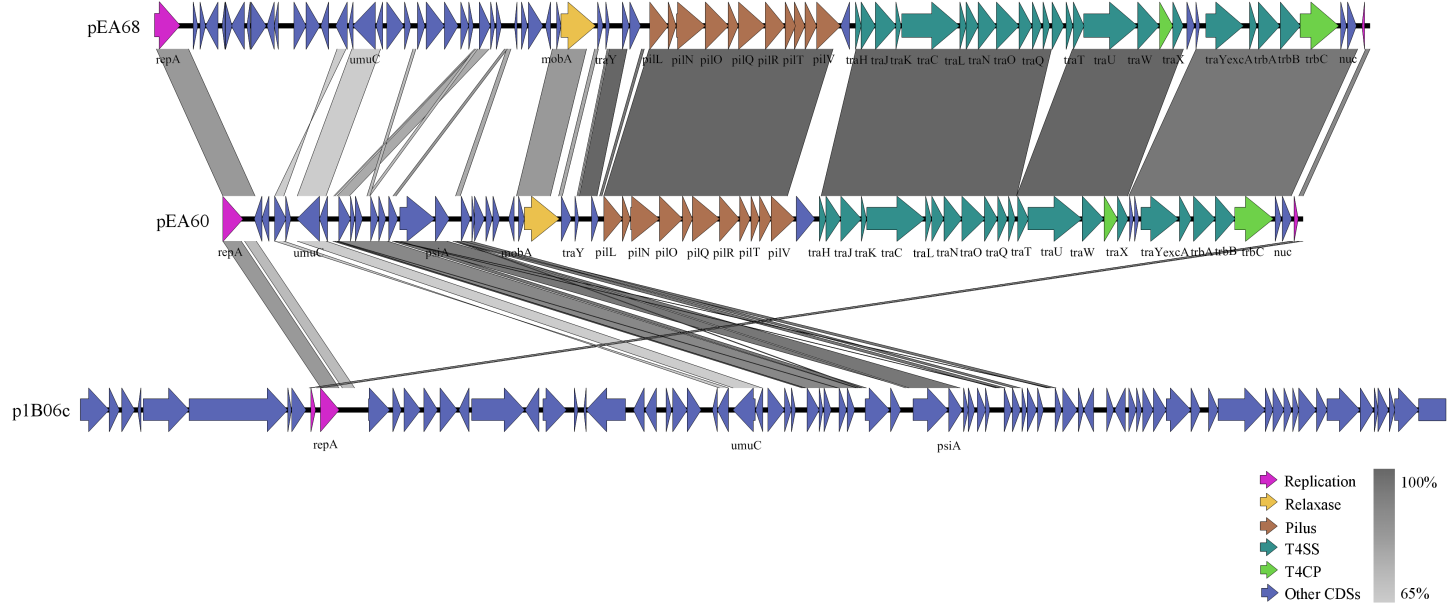
图2
pEA60质粒序列比较 箭头表示预测的CDS,灰色阴影为核苷酸相似性,阴影越深,表明相似性越高"
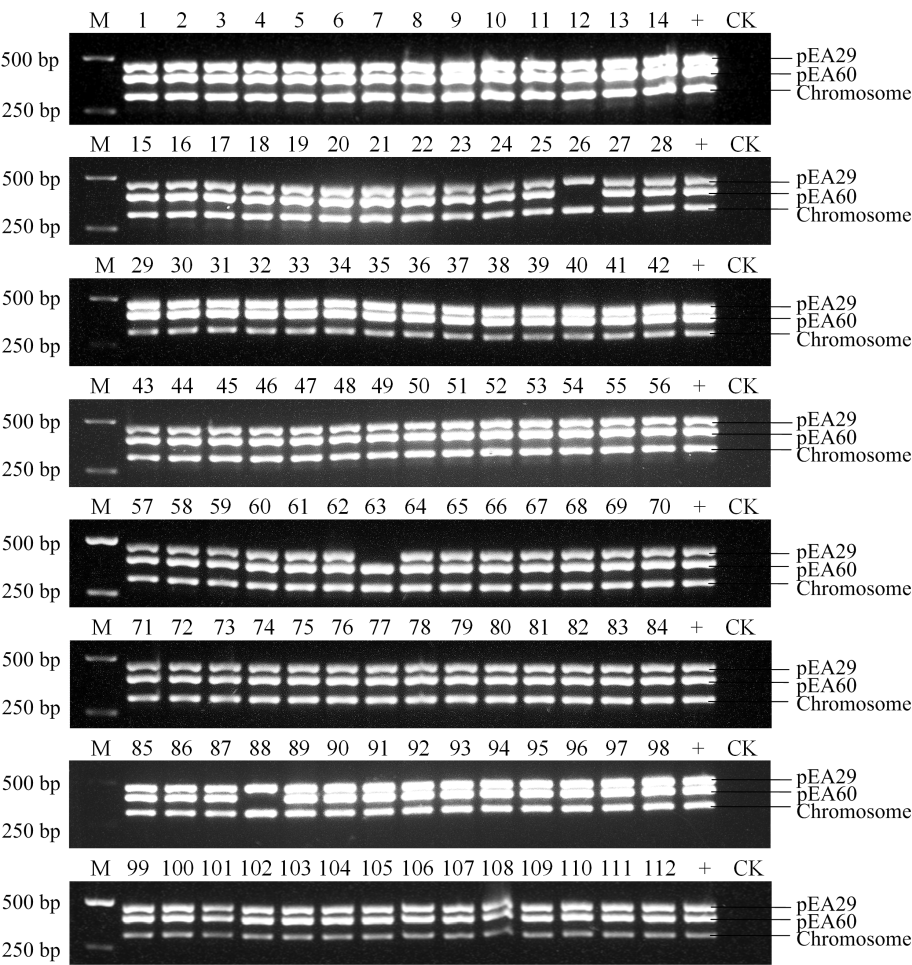
图3
pEA60质粒稳定性检测 M:DL 2000 DNA marker;1—112:连续传代20 d后的单菌落Single colony after 20 days of serial passage;+:Ea102;CK:H2O"
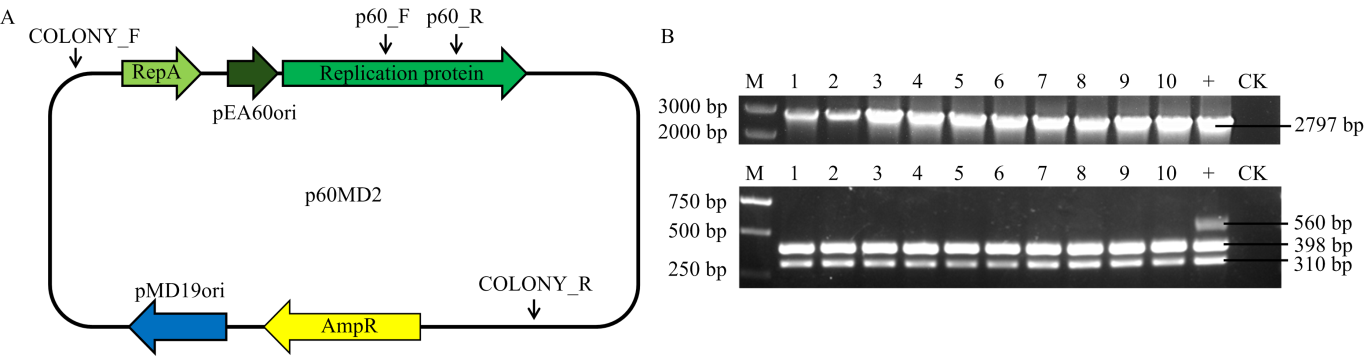
图4
pEA60质粒复制调控区的鉴定 A:p60MD2载体,黑色箭头表示引物位置Vector p60MD2, the black arrows represent the primers position;B:p60MD2载体转化Ea102的菌落PCR鉴定Colony PCR of Ea102 transformed with the p60MD2 vector。上图Top figure(M:DL 5000 DNA marker;1—10:转化子Tansformant;+:p60MD2;CK:Ea102);下图Bottom figure(M:DL 2000 DNA marker;1—10:转化子Tansformant;+:Ea102;CK:H2O)"

图5
pEA60质粒接合检测 M:DL 2000 DNA marker;1—112:检测的接合转移受体菌Conjugative transfer receptor for test;+:Ea102(供体菌)Ea102 (Donor);-:Ea102ΔpEA60ΔpEA29 p29orik(受体菌)Ea102ΔpEA60ΔpEA29 p29orik (Recipient);CK:H2O"

图6
胞外多糖产量测定 A:梨火疫病菌素产量测定Determination of amylovoran production;B:果聚糖蔗糖酶活性测定Determination of levansurase activity;C:纤维素产量测定Determination of cellulose production。***:P<0.001,单因素方差分析One-way ANOVA"
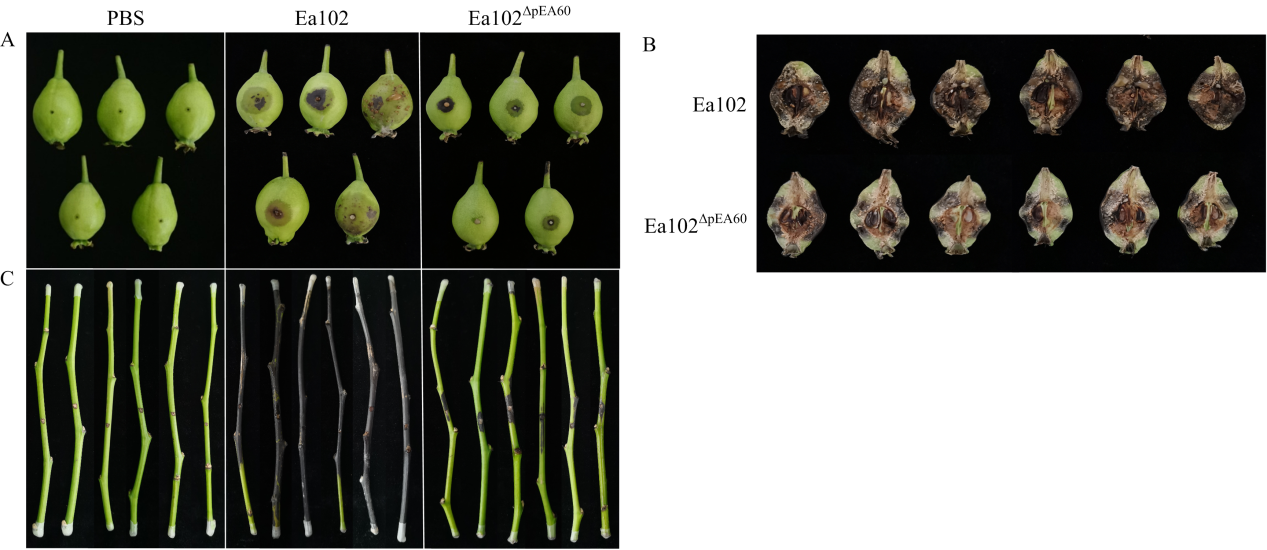
图7
库尔勒香梨未成熟果实及离体枝条接种情况 A:完整果实接种后5 d Whole fruits after 5 days post-inoculation;B:半果接种后5 d Half fruits after 5 days post-inoculation;C:离体枝条接种后10 d Detached shoots after 10 days post-inoculation"
| [1] |
doi: 10.1094/PHYTO-05-23-0170-RVW pmid: 37505073 |
| [2] |
|
| [3] |
doi: 10.1046/j.1462-2920.2002.00277.x |
| [4] |
|
| [5] |
|
| [6] |
|
| [7] |
|
| [8] |
|
| [9] |
|
| [10] |
doi: 10.1099/00221287-147-11-2951 |
| [11] |
doi: 10.3390/ijms160612836 |
| [12] |
杨金花, 徐叶挺, 张校立. 梨火疫病研究进展. 分子植物育种, 2022, 20(3): 1003-1013.
|
|
|
|
| [13] |
doi: 10.1094/MPMI-04-21-0095-R |
| [14] |
|
| [15] |
doi: 10.1016/j.ygeno.2020.04.001 |
| [16] |
doi: 10.1111/mpp.2018.19.issue-7 |
| [17] |
|
| [18] |
doi: 10.1128/aem.61.7.2636-2642.1995 |
| [19] |
doi: 10.1094/PHYTO-06-23-0190-SA |
| [20] |
黄伟, 盛强, 罗明, 马德英, 张春竹. 新疆库尔勒香梨火疫病的发生特点及防控建议. 植物保护, 2022, 48(6): 207-213, 231.
|
|
|
|
| [21] |
李洪涛, 张静文, 盛强, 唐章虎, 张祥林, 张春竹, 罗明. 我国20个梨品种(种质)对国外梨火疫病菌的抗病性评价. 果树学报, 2019, 36(5): 629-637.
|
|
|
|
| [22] |
doi: 10.1093/nar/gky066 pmid: 29401301 |
| [23] |
doi: 10.1089/cmb.2012.0021 pmid: 22506599 |
| [24] |
doi: 10.1093/bioinformatics/btr655 pmid: 22130594 |
| [25] |
|
| [26] |
|
| [27] |
doi: 10.1093/bioinformatics/btv681 pmid: 26576653 |
| [28] |
doi: 10.1093/bioinformatics/btr039 pmid: 21278367 |
| [29] |
doi: 10.1128/AEM.70.12.7539-7544.2004 |
| [30] |
doi: 10.1007/s00203-014-1028-5 |
| [31] |
doi: 10.1038/nprot.2010.181 pmid: 21293463 |
| [32] |
|
| [33] |
doi: 10.1111/mpp.2009.10.issue-2 |
| [34] |
doi: 10.1007/s00438-005-0085-5 |
| [35] |
doi: 10.1111/mpp.2018.19.issue-1 |
| [36] |
doi: 10.1007/978-1-4939-9877-7_22 pmid: 31584172 |
| [37] |
doi: 10.1111/mmi.v115.3 |
| [38] |
doi: 10.1093/femsre/fuv027 pmid: 26109597 |
| [39] |
|
| [40] |
doi: 10.1038/s41564-024-01844-1 |
| [41] |
贾雅婷, 胡慧慧, 翟亚军, 赵冰, 何坤, 潘玉善, 胡功政, 苑丽. 核蛋白H-NS调控多重耐药鸡大肠埃希菌IncFII质粒接合转移的分子机制. 中国农业科学, 2022, 55(18): 3675-3684. doi: 10.3864/j.issn.0578-1752.2022.18.016.
|
|
|
|
| [42] |
|
| [43] |
doi: 10.1016/j.ebiom.2025.105627 |
| [44] |
doi: 10.1111/emi.v24.10 |
| [45] |
doi: 10.1016/j.tim.2020.02.004 |
| [46] |
|
| [1] | 从琪琪, 张静怡, 孟祥龙, 戴蓬博, 李波, 胡同乐, 王树桐, 曹克强, 王亚南. 我国苹果轮纹病弱毒菌株中病毒的鉴定及其携带情况的检测[J]. 中国农业科学, 2025, 58(3): 478-492. |
| [2] | 童朝阳, 刘文华, 张国欣, 董春燕, 张燕霞, 徐晓伟, 何东, 刘何春, 李杨, 王凤涛, 冯晶, 姚小波, 刘梅金, 蔺瑞明. 青稞穗腐病发生与穗螨群体迁移的关系[J]. 中国农业科学, 2025, 58(3): 493-506. |
| [3] | 林彦, 郑玲玲, 田嘉, 温玥, 陈晨, 王磊. 基于转录组和蛋白质组揭示库尔勒香梨萼片脱落的分子机制[J]. 中国农业科学, 2025, 58(18): 3744-3765. |
| [4] | 王龙, 王军, 蒋静, 刘浩, 刘德召, 李久生. 滴灌不同用量的氮钾肥对土壤盐分及南疆香梨产量、品质的影响[J]. 中国农业科学, 2025, 58(17): 3473-3487. |
| [5] | 杨文娟, 高嘉诚, 王艳婷, 李妍, 郭铭, 汪军成, 孟亚雄, 王化俊, 司二静. 条纹病菌效应蛋白Pg00778调控对大麦致病力的作用[J]. 中国农业科学, 2025, 58(15): 3020-3035. |
| [6] | 董在芳, 丁腾腾, 单艺轩, 李洪连, 陈琳琳, 邢小萍. 自噬相关基因FpAtg3参与假禾谷镰孢的生长和致病[J]. 中国农业科学, 2024, 57(6): 1080-1090. |
| [7] | 兖攀, 王振东, 邓永辉, 陈奇凌, 郑强卿. 库尔勒香梨的光能截获率及冠层结构优化[J]. 中国农业科学, 2024, 57(5): 965-979. |
| [8] | 陈妞, 余成敏, 崔百明, 任彩霞, 杨丽颖, 董钰, 刘琳, 郑银英. 解淀粉欧文氏菌噬菌体Kuerle的分离、基因组测定及其裂解功能分析[J]. 中国农业科学, 2024, 57(2): 295-305. |
| [9] | 张健, 赵彬森, 冯浩, 黄丽丽. Vm-milRN7调控苹果树腐烂病菌致病的功能及机理[J]. 中国农业科学, 2024, 57(10): 1930-1942. |
| [10] | 宫安东, 雷银玉, 吴楠楠, 刘景榕, 宋梦鸽, 张艺美, 杨光, 杨鹏. 氧酰基载体蛋白还原酶基因FgOAR1对禾谷镰孢生长、发育和致病的影响[J]. 中国农业科学, 2023, 56(24): 4854-4865. |
| [11] | 黄家权,李莉,吴丰年,郑正,邓晓玲. 携带不同原噬菌体的黄龙病菌在柑橘木虱体内的增殖及致病力[J]. 中国农业科学, 2022, 55(4): 719-728. |
| [12] | 张晋龙,赵志博,刘巍,黄丽丽. 猕猴桃细菌性溃疡病菌T3SS关键效应蛋白基因致病功能[J]. 中国农业科学, 2022, 55(3): 503-513. |
| [13] | 张承启,廖露露,齐永霞,丁克坚,陈莉. 禾谷镰孢核孔蛋白基因FgNup42的功能分析[J]. 中国农业科学, 2021, 54(9): 1894-1903. |
| [14] | 曹钰晗,李紫腾,张静怡,张静娜,胡同乐,王树桐,王亚南,曹克强. 我国苹果斑点落叶病菌携带dsRNA分析及一种dsRNA病毒的鉴定[J]. 中国农业科学, 2021, 54(22): 4787-4799. |
| [15] | 赵静雅,夏荟清,彭梦雅,凡卓,殷悦,徐赛博,张楠,陈文波,陈琳琳. 假禾谷镰孢转录因子FpAPSES的鉴定与功能分析[J]. 中国农业科学, 2021, 54(16): 3428-3439. |
|
||
