






中国农业科学 ›› 2026, Vol. 59 ›› Issue (5): 985-995.doi: 10.3864/j.issn.0578-1752.2026.05.005
董金龙1,2( ), 赵莹2, 余海兵1, 吕建晔2, 秦佳琦2, 梁晨2, 明博2, 李少昆1,2()
收稿日期:2025-07-21
接受日期:2026-02-02
出版日期:2026-03-01
发布日期:2026-03-06
通信作者:
联系方式:
董金龙,E-mail:19565982502@163.com。
基金资助:
DONG JinLong1,2(), ZHAO Ying2, YU HaiBing1, LÜ JianYe2, QIN JiaQi2, LIANG Chen2, MING Bo2, LI ShaoKun1,2()
Received:2025-07-21
Accepted:2026-02-02
Published:2026-03-01
Online:2026-03-06
摘要:
【目的】 系统解析玉米籽粒容重形成过程中蛋白质、淀粉及脂肪三大营养组分的贡献率与空间分异规律,深入探究品种遗传背景、生态区域及栽培密度三者的交互作用对营养品质与容重形成的影响机制,以期为不同生态区玉米品质的定向调控提供理论依据,推动“高产-优质-高效”协同生产模式的发展。【方法】 研究覆盖我国四大玉米主产区,共采集718份代表性样品,涵盖77个主推品种以及24个种植密度梯度(37 500—127 500株/hm2)。所有样品经自然风干至标准水分后进行统一测定。采用近红外分析仪测定蛋白质、淀粉与脂肪含量,并使用容重仪测定籽粒容重。通过构建“线性效应—非线性交互—因果路径”全链条分析框架,综合运用多元线性回归、随机森林模型与结构方程模型解析各组分贡献及其因果路径,并采用三因素方差分析评估基因型、环境与栽培措施的互作效应。【结果】 蛋白质与淀粉是容重提升的核心驱动因子,其标准化路径系数分别为β=8.406和β=6.413,均达到极显著水平(P<0.001)。随机森林模型显示二者贡献率分别为28%与45%,结构方程模型进一步验证其路径系数具有高度稳健性;与之相反,脂肪贡献率仅为2%,未通过显著性检验。三因素方差分析表明,品种、生态区域与栽培密度对容重及营养品质均存在极显著主效应与交互作用。东北春玉米区以蛋白质贡献为主导(43.9%),蛋白质-淀粉协同贡献占随机森林模型总解释力的81.0%;而黄淮海夏玉米区则以淀粉贡献为主(52.9%),蛋白质-淀粉协同贡献占随机森林模型总解释力的85.0%。结构方程模型(SEM)结果显示,蛋白质对容重具有直接正向贡献,但同时通过碳氮代谢流的分配权衡对淀粉积累产生了补偿性削减,进而表现出间接负效应。这说明在籽粒发育过程中,容重的最终形成是蛋白质与淀粉在资源限制下博弈的结果,而非单一组分的线性叠加。【结论】 玉米容重形成是由蛋白质与淀粉协同驱动的生物学过程,脂肪贡献不显著。品种、生态区域与密度之间存在显著互作,同一品种在不同生态与栽培条件下调控路径各异。因此,东北产区应注重高蛋白品种选育与氮肥精准调控,黄淮海产区需强化碳同化效率与淀粉合成关键酶调控,各生态区应通过“品种-区域-措施”的精准匹配,实现玉米产量与品质的协同提升。
董金龙, 赵莹, 余海兵, 吕建晔, 秦佳琦, 梁晨, 明博, 李少昆. 多模型解析玉米籽粒容重的营养品质贡献度与区域异质性[J]. 中国农业科学, 2026, 59(5): 985-995.
DONG JinLong, ZHAO Ying, YU HaiBing, LÜ JianYe, QIN JiaQi, LIANG Chen, MING Bo, LI ShaoKun. Multi-Model Elucidating of Nutritional Quality Contributions to Maize Kernel Test Weight and Regional Heterogeneity[J]. Scientia Agricultura Sinica, 2026, 59(5): 985-995.

表1
全国玉米取样地区概览"
| 玉米产区 Maize production region | 省份 Province | 样品数量 Number of samples | 取样地区 Sampling region | 播种密度 Sowing density (plants/hm2) |
|---|---|---|---|---|
| 黄淮海夏玉米区 Huang-Huai-Hai summer maize region | 安徽 Anhui | 34 | 阜阳Fuyang(17)、宿州Suzhou(7)、淮北Huaibei(3)、亳州Bozhou(4)、蚌埠Bengbu(3) | 82500、85500、90000、97500、105000 |
| 河北 Hebei | 34 | 石家庄Shijiazhuang(25)、邯郸Handan(4)、邢台Xingtai(5) | 60000、67500、75000、82500 | |
| 河南 Henan | 47 | 焦作Jiaozuo(4)、商丘Shangqiu(4)、许昌Xuchang(4)、驻马店Zhumadian(3)、开封Kaifeng(4)、新乡Xinxiang(4)、三门峡Sanmenxia(3)、安阳Anyang(3)、鹤壁Hebi(2)、平顶山Pingdingshan(5)、周口Zhoukou(8)、洛阳Luoyang(3) | 66000、67500、75000、82500、90000、105000 | |
| 江苏 Jiangsu | 17 | 盐城Yancheng(5)、徐州Xuzhou(8)、连云港Lianyungang(4) | 55500、64500、67500、75000、82500、90000 | |
| 山东 Shandong | 108 | 青岛Qingdao(10)、烟台Yantai(10)、潍坊Weifang(10)、济宁Jining(22)、枣庄Zaozhuang(5)、菏泽Heze(5)、聊城Liaocheng(21)、德州Dezhou(20)、淄博Zibo(5) | 63000、67500、72000、75000、82500、85500、87000、90000、93000、97500 | |
| 陕西 Shaanxi | 50 | 榆林Yulin(25)、西安Xi'an(6)、渭南Weinan(6)、宝鸡Baoji(7)、咸阳Xianyang(6) | 63000、67500、72000、75000、82500、87000、90000 | |
| 西北春玉米区 Northwest spring maize region | 甘肃Gansu | 15 | 平凉Pingliang(10)、白银Baiyin(5) | 60000、64500、67500、75000 |
| 内蒙古 Inner Mongolia | 16 | 呼和浩特Hohhot(5)、巴彦淖尔Bayannur(5)、包头Baotou(3)、鄂尔多斯Ordos(3) | 67500、75000、82500、85500 | |
| 新疆Xinjiang | 15 | 昌吉Changji(5)、博乐Bole(5)、乌鲁木齐Urumqi(5) | 112500、120000、127500 | |
| 山西Shanxi | 22 | 长治Changzhi(18)、晋城Jincheng(4) | 67500、75000 | |
| 西南夏玉米区 Southwest summer maize region | 广西 Guangxi | 20 | 崇左Chongzuo(5)、南宁Nanning(5)、贵港Guigang(4)、河池Hechi(4)、百色Baise(2) | 42000、45000、52500 |
| 湖北Hubei | 16 | 恩施Enshi(12)、宜昌Yichang(4) | 37500、40500、45000、75000 | |
| 四川Sichuan | 10 | 绵阳Mianyang(5)、德阳Deyang(5) | 52500、57000、63000、90000 | |
| 东北春玉米区 Northeast spring maize region | 黑龙江 Heilongjiang | 162 | 黑河Heihe(37)、齐齐哈尔Qiqihar(44)、鹤岗Hegang(2)、双鸭山Shuangyashan(6)、绥化Suihua(19)、伊春Yichun(6)、哈尔滨Harbin(8)、佳木斯Jiamusi(8)、大庆Daqing(32) | 60000、67500、75000、82500、90000、97500、105000 |
| 吉林 Jilin | 69 | 长春Changchun(4)、四平Siping(2)、白城Baicheng(8)、松原Songyuan(12)、吉林Jilin(40)、敦化Dunhua(3) | 52500、55500、60000、67500、72000、75000、82500、90000 | |
| 内蒙古 Inner Mongolia | 29 | 通辽Tongliao(14)、赤峰Chifeng(15) | 60000、72000、75000、82500、90000、97500、112500 | |
| 辽宁 Liaoning | 60 | 大连Dalian(5)、丹东Dandong(7)、营口Yingkou(5)、阜新Fuxin(22)、沈阳Shenyang(10)、铁岭Tieling(11) | 60000、67500、75000、82500、97500 |
表2
四大玉米产区主要指标"
| 产区 Region | 蛋白质 Protein (%) | 脂肪 Fat (%) | 淀粉 Starch (%) | 容重 Test weight (g·L-1) | 平均种植密度 Average planting density (plants/hm2) |
|---|---|---|---|---|---|
| 东北春玉米区 Northeast spring maize | 10.08±0.83a | 3.80±0.43c | 74.37±1.13b | 775.06±25.98a | 77944 |
| 西北春玉米区 Northwest spring maize | 9.17±0.84b | 3.98±0.34b | 74.55±0.85a | 771.23±22.69a | 83077 |
| 西南夏玉米区 Southwest summer maize | 9.66±0.84ab | 4.80±0.39a | 73.68±0.78c | 756.27±23.64c | 54545 |
| 黄淮海夏玉米区 Huang-Huai-Hai summer maize | 9.35±0.81b | 3.97±0.69b | 75.43±3.82a | 769.42±22.36b | 79382 |
表3
全国玉米多元线性回归系数表"
| 变量 Variables | 非标准化回归系数 β (Coefficient) | 标准化回归系数 β (Standardized) | 标准误 SE | t值 t value | P值 P value | 95%置信区间 95% CI |
|---|---|---|---|---|---|---|
| 蛋白质Protein | 6.41 | 0.33 | 1.61 | 3.99 | P<0.001 | 3.25-9.57 |
| 脂肪Fat | 5.93 | 0.12 | 3.51 | 1.69 | P =0.09 | -0.95-12.81 |
| 淀粉Starch | 8.41 | 0.31 | 2.22 | 3.78 | P<0.001 | 4.06-12.76 |

图1
玉米SEM模型路径图 A:全国玉米结构方程模型路径图;B:东北春玉米区结构方程模型路径图;C:黄淮海夏玉米区结构方程模型路径图"
表4
全国玉米结构方程模型路径系数统计检验结果"
| 路径关系 Pathway relationship | 非标准化系数 Unstandardized coefficient | 标准化系数 Standardized coefficient | 标准误 SE | t值 t value | P值 P value |
|---|---|---|---|---|---|
| 蛋白质→容重 Protein→test weight | 8.41 | 0.62 | 1.40 | 6.02 | P<0.001 |
| 淀粉→容重 Starch→test weigh | 6.41 | 0.54 | 1.09 | 5.87 | P<0.001 |
| 蛋白质→淀粉 Protein→starch | -0.10 | -0.18 | 0.05 | -2.11 | P=0.035 |
表5
全国玉米容重模型参数优化"
| 参数组合 Parameter combination | 决定系数 R2 | 均方根误差 RMSE (g·L-1) | 平均绝对误差 MAE (g·L-1) | 调整后决定系数Adjusted R2 | 性能变化 Performance change |
|---|---|---|---|---|---|
| ntree=500, mtry=1, max_depth=6 | 0.589 | 7.128 | 5.812 | 0.587 | 欠拟合Underfitting |
| ntree=500, mtry=1, max_depth=8 | 0.604 | 6.981 | 5.642 | 0.602 | 优化中Optimizing |
| ntree=500, mtry=1, max_depth=10 | 0.597 | 7.051 | 5.735 | 0.595 | 基准模型Benchmark |
| ntree=800, mtry=1, max_depth=6 | 0.633 | 6.712 | 5.423 | 0.631 | - |
| ntree=800, mtry=1, max_depth=8 | 0.648 | 6.573 | 5.281 | 0.646 | +8.5%▲ |
| ntree=800, mtry=1, max_depth=10 | 0.642 | 6.650 | 5.432 | 0.640 | 区域最佳候选Regional best candidate |
| ntree=1100, mtry=1, max_depth=6 | 0.638 | 6.682 | 5.301 | 0.636 | - |
| ntree=1100, mtry=1, max_depth=8 | 0.659 | 6.501 | 5.152 | 0.657 | +10.4%▲ |
| ntree=1100, mtry=1, max_depth=10 | 0.645 | 6.619 | 5.231 | 0.643 | 全国最优模型National optimal |
表6
三种模型对营养组分贡献的标准化值比较"
| 模型类型 Model type | 淀粉贡献 Starch contribution | 蛋白质贡献 Protein contribution | 脂肪贡献 Fat contribution |
|---|---|---|---|
| 多元线性回归 Multiple linear regression | 0.31 | 0.33 | 0.12 |
| 随机森林模型 Random forest model | 0.45 | 0.28 | 0.02 |
| 结构方程模型 Structural equation model | 0.64 | 0.84 | 0.03 |
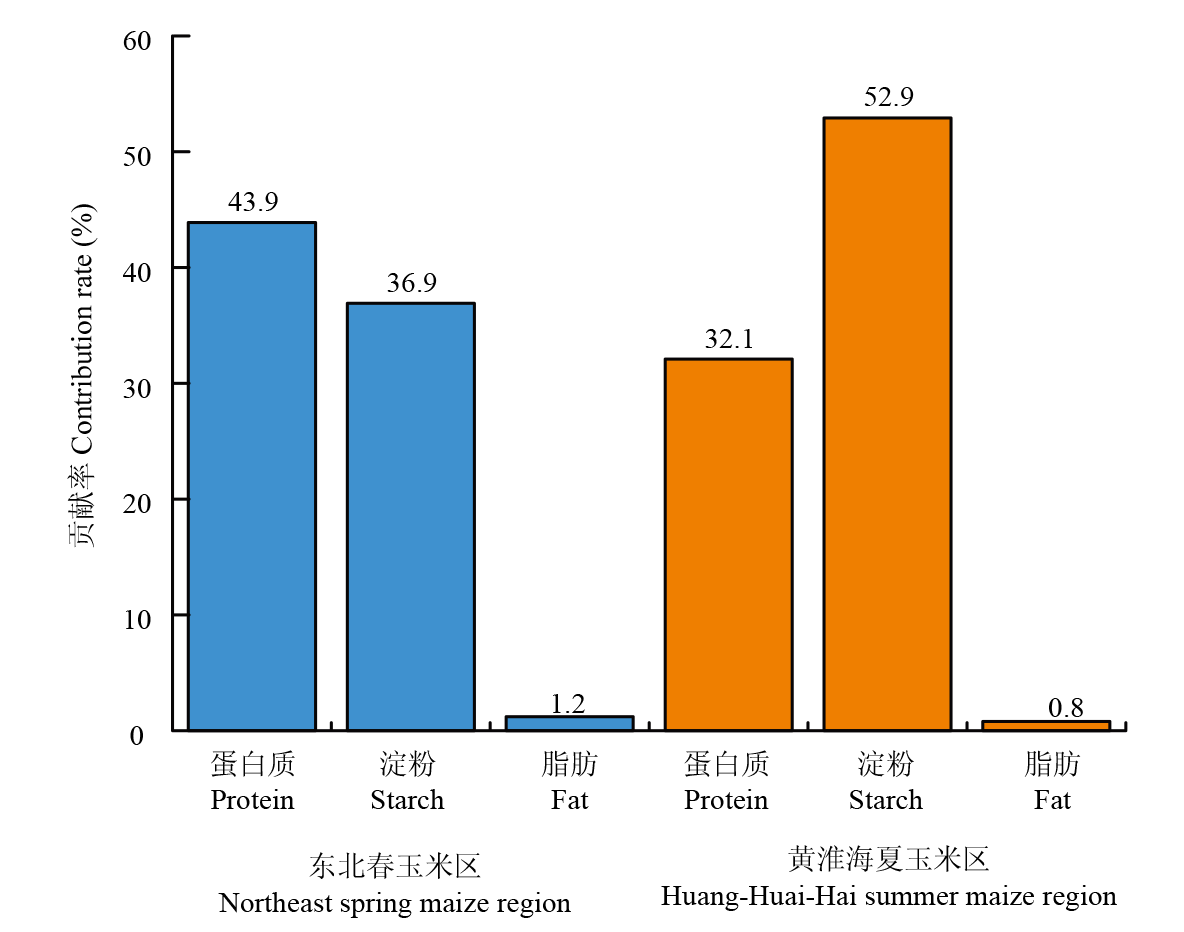
图2
两大玉米产区玉米营养品质随机森林模型变量对比图"
表7
两大玉米产区多元线性回归系数表"
| 玉米产区 Maize production region | 变量 Variables | 非标准化回归系数 β (Coefficient) | 标准化回归系数 β (Standardized) | 标准误 SE | t值 t value | P值 P value | 95%置信区间 95% CI |
|---|---|---|---|---|---|---|---|
| 黄淮海夏玉米区 Huang-Huai-Hai summer maize region | 蛋白质Protein | 12.67 | 0.19 | 6.41 | 1.98 | 0.05 | 0.11-25.23 |
| 脂肪Fat | 1.60 | 0.02 | 6.52 | 0.25 | 0.81 | -11.18-14.38 | |
| 淀粉Starch | 8.92 | 0.26 | 3.36 | 2.66 | 0.01 | 2.33-15.51 | |
| 东北春玉米区 Northeast spring maize region | 蛋白质Protein | 18.85 | 0.44 | 3.21 | 5.87 | 0.00 | 12.56-25.14 |
| 脂肪Fat | 6.31 | 0.08 | 4.95 | 1.27 | 0.20 | -3.38-16.00 | |
| 淀粉Starch | 11.36 | 0.37 | 2.35 | 4.82 | 0.00 | 6.75-15.97 |
表8
品种、区域及种植密度对玉米籽粒容重与营养品质影响的三因素方差分析结果"
| 分析因素 Analysis of factors | 容重 Test weight | 蛋白质 Protein | 淀粉 Starch |
|---|---|---|---|
| F值 F value | P值 P value | F值 F value | |
| 品种 Variety | 38.2 | P<0.001 | 35.6 |
| 区域 Region | 42.5 | P<0.001 | 28.9 |
| 密度 Density | 6.9 | P<0.05 | 3.2 |
| 品种×区域 Variety×region | 15.3 | P<0.001 | 12.8 |
| 品种×密度 Variety×density | 3.1 | P<0.05 | 2.8 |
| 区域×密度 Region×density | 7.2 | P<0.01 | 5.6 |
| 品种×区域×密度 Variety×region×density | 4.2 | P<0.05 | 3.3 |
| [1] | |
|
|
|
| [2] |
赵久然, 王荣焕. 中国玉米生产发展历程、存在问题及对策. 中国农业科技导报, 2013, 15(3): 1-6.
|
|
doi: 10.3969/j.issn.1008-0864.2013.03.01 |
|
| [3] |
刘劼武, 冯锡仲. 国内外玉米标准的分析探讨. 粮食储藏, 2010, 39(4): 55-56.
|
|
|
|
| [4] |
李依依, 田汉钊, 朱良佳, 刘美, 赵永锋. 玉米粒重杂交当代杂种优势分析. 种子, 2020, 39(4): 22-28.
|
|
|
|
| [5] |
刘松柏, 谭会泽, 魏师, 赵江涛, 彭运智, 尹玉港, 陈永均. 玉米容重差异形成机制及其营养价值探析. 饲料工业, 2014, 35(19): 62-64.
|
|
|
|
| [6] |
doi: 10.3390/applmicrobiol4040118 |
| [7] |
王晓燕, 高荣岐, 董树亭. 玉米胚乳发育研究进展. 中国农学通报, 2005, 21(6): 107-109.
|
|
doi: 10.11924/j.issn.1000-6850.0506107 |
|
| [8] |
doi: 10.1016/j.compag.2025.110417 |
| [9] |
doi: 10.1016/j.cj.2024.12.002 |
| [10] |
|
| [11] |
doi: 10.1073/pnas.1613721113 |
| [12] |
薛民杰, 李永胜, 张乃建, 唐开梁, 白俊飞, 司武剑, 周恺琳. 水分对玉米容重的影响. 粮食储藏, 2016, 45(6): 36-38.
|
|
|
|
| [13] |
车海先, 李海玉. 玉米容重影响因素浅析. 粮食与食品工业, 2011, 18(1): 56-58, 61.
|
|
|
|
| [14] |
doi: 10.1093/plphys/kiad410 pmid: 37440713 |
| [15] |
doi: 10.1016/j.jcs.2025.104187 |
| [16] |
杨张钰, 陈小央, 李燕, 李欣泽, 白康杰, 骆遥, 赵光武, 施俊生, 韩庆辉. 517份玉米种质容重与其他品质性状相关性分析及候选基因挖掘. 浙江农林大学学报, 2024, 41(4): 669-678.
|
|
|
|
| [17] |
张丽, 董树亭, 刘存辉, 王空军, 张吉旺, 刘鹏. 玉米籽粒容重与产量和品质的相关分析. 中国农业科学, 2007, 40(2): 405-411.
|
|
|
|
| [18] |
张静, 王彩红, 赵永锋, 祝丽英, 黄亚群, 郭晋杰, 陈景堂. 玉米种质资源子粒容重和品质性状差异性分析. 植物遗传资源学报, 2016, 17(5): 832-839.
doi: 10.13430/j.cnki.jpgr.2016.05.006 |
|
|
|
| [19] |
郭益洋, 郭书磊, 张君, 史喜飞, 赵海军, 陈盛, 韩赞平. 429份玉米种质籽粒物理及品质性状综合评价. 干旱地区农业研究, 2024, 42(5): 25-33.
|
|
|
|
| [20] |
常莉, 钱承敬, 史晓梅, 张巍巍, 高曼, 吕朝政, 罗云敬, 翟晨. 基于近红外光谱技术的主产区玉米品质分析. 中国粮油学报, 2024, 39(6): 36-42.
|
|
|
|
| [21] |
|
| [22] |
杨加豹, 陈瑾. 玉米淀粉渣: 猪饲料中玉米、豆粕的优选替代原料. 四川畜牧兽医, 2024, 51(2): 2-4.
|
|
|
|
| [23] |
赵秀兰, 吕厚荃. 近60年黄淮海夏玉米光温水资源适宜度及灾害风险演变特征. 干旱地区农业研究, 2025, 43(3): 210-219, 232.
|
|
|
|
| [24] |
宋洋. 玉米多元深加工关键技术创新与高附加值产品开发研究. 中外食品工业, 2025(4): 4-6.
|
|
|
|
| [25] |
褚超, 雷俊, 阳仁贵, 齐月, 李强, 杨庆怡, 姚玉璧, 施磊. 西北干旱区气候变化对灌溉春玉米生产的影响. 中国农业气象, 2024, 45(7): 745-755.
|
|
doi: 10.3969/j.issn.1000-6362.2024.07.005 |
|
| [26] |
|
| [27] |
陈传永, 赵久然, 吴珊珊, 张春原, 毛振武, 杨海涛, 李瑞媛, 王元东. 黄淮海夏玉米区南北部产量及相关性状差异分析. 耕作与栽培, 2022, 42(5): 42-46.
|
|
|
|
| [28] |
高翔, 周先林, 杨惠, 周新明, 张席军, 相富超. 不同玉米品种(系)在东北早熟春播区丰产、稳产及适应性分析. 中国农学通报, 2020, 36(24): 7-13.
doi: 10.11924/j.issn.1000-6850.casb20190700478 |
|
doi: 10.11924/j.issn.1000-6850.casb20190700478 |
|
| [29] |
何革命. 黄淮海地区夏玉米新品种考察研究与利用. 种子科技, 2025, 43(17): 69-71.
|
|
|
|
| [30] |
奉杰, 刘鹏飞, 涂亮, 高媛, 郭向阳, 王安贵, 祝云芳, 吴迅, 陈泽辉. 玉米籽粒相关性状的QTL定位与候选基因分析. 种子, 2023, 42(1): 18-24.
|
|
|
|
| [31] |
doi: 10.1007/s13353-025-00944-w |
| [32] |
张蕾, 陈学文, 梁爱珍, 黄文智, 柳亚彤, 叶雯昕, 魏步青. 基于文献计量学的黑土微生物研究现状及热点分析. 微生物学报, 2025, 65(8): 3447-3467.
|
|
|
|
| [33] |
史良国. 不同胚乳类型玉米的转录组分析. 园艺与种苗, 2025, 45(3): 83-84, 102.
|
|
|
|
| [34] |
王以胜. 现代农业技术在玉米科学种植过程中的有效应用与发展策略探讨. 种子世界, 2025(1): 90-92.
|
|
|
| [1] | 王亚菲, 闫鹏, 薛金涛, 董学瑞, 孟凡琦, 郭丽娜, 罗艺, 张娟, 董志强, 卢霖. 乙烯利-甜菜碱-水杨酸合剂对高温胁迫下玉米根系建构、生理功能和产量的影响[J]. 中国农业科学, 2026, 59(7): 1439-1455. |
| [2] | 王佳诺, 陈桂平, 李盼, 王丽萍, 南运有, 何蔚, 樊志龙, 胡发龙, 柴强, 殷文, 赵连豪. 免耕地膜两年覆盖提高绿洲灌区玉米产量的灌浆期光合生理机制[J]. 中国农业科学, 2026, 59(6): 1189-1202. |
| [3] | 周新杰, 任昊, 陈应龙, 张吉旺, 赵斌, 任佰朝, 刘鹏, 王洪章. 过氧化钙对渍涝农田夏玉米根系形态及产量形成的影响[J]. 中国农业科学, 2026, 59(6): 1203-1216. |
| [4] | 何继航, 张擎, 吕相月, 薛吉全, 徐淑兔, 刘建超. 不同保绿型玉米杂交种氮效率评价[J]. 中国农业科学, 2026, 59(6): 1217-1230. |
| [5] | 李永娟, 张悦彤, 王艺博, 赵长江, 宋洁, 陈雪丽, 姚钦. 生物炭施用对大豆轮连作系统土壤固氮微生物nifH基因丰度及群落组成的影响[J]. 中国农业科学, 2026, 59(6): 1272-1285. |
| [6] | 岳丽昕, 王清华, 王振宝, 尼玛琼吉, 刘泽洲, 孔素萍, 张立峰, 高莉敏. 基于广靶代谢组学分析藏葱和细香葱营养品质及黄酮类代谢产物差异[J]. 中国农业科学, 2026, 59(5): 1070-1086. |
| [7] | 张利东, 郭一聪, 黄洪宇, 聂静, 王兵, 李梦雨, 李加旺, 眭晓蕾, 李愚鹤. 基于感官评价结合营养品质特征与风味物质特性关联分析黄瓜果实品质[J]. 中国农业科学, 2026, 59(5): 1087-1100. |
| [8] | 李思源, 李鸿萍, 常洪庆, 张森焱, 栗思佳, 崔欣飞, 乔泼, 曾波, 刘桂珍, 刘天学, 汤继华, 李潮海. 增密对不同株高玉米品种产量和农艺性状动态变化的影响[J]. 中国农业科学, 2026, 59(5): 967-984. |
| [9] | 陈桂平, 韦金贵, 郭瑶, 李盼, 王菲儿, 仇海龙, 冯福学, 殷文. 宽窄行与增密对绿洲灌区玉米光合特性及资源利用的协同效应[J]. 中国农业科学, 2026, 59(2): 278-291. |
| [10] | 张志勇, 谭世超, 熊淑萍, 马新明, 韦一昊, 王小纯. 水氮周年优化对豫北灌区小麦玉米轮作系统产量和氮迁移的影响[J]. 中国农业科学, 2026, 59(2): 336-353. |
| [11] | 季圣阳, 陆柏益, 李培武. 关于现代农产品品质学的若干思考[J]. 中国农业科学, 2025, 58(9): 1830-1844. |
| [12] | 韦文华, 李盼, 邵冠贵, 樊志龙, 胡发龙, 范虹, 何蔚, 柴强, 殷文, 赵连豪. 西北灌区青贮玉米产量及品质对减量灌水与有机无机肥配施的响应[J]. 中国农业科学, 2025, 58(8): 1521-1534. |
| [13] | 薛钰琦, 赵继玉, 孙旺胜, 任佰朝, 赵斌, 刘鹏, 张吉旺. 不同氮素形态对夏玉米产量和品质的影响[J]. 中国农业科学, 2025, 58(8): 1535-1549. |
| [14] | 陈桂平, 李盼, 邵冠贵, 吴霞玉, 殷文, 赵连豪, 樊志龙, 胡发龙. 减量灌水与有机无机肥配施对青贮玉米吐丝期后叶片持绿特性的调控作用[J]. 中国农业科学, 2025, 58(7): 1381-1396. |
| [15] | 岳润清, 李文兰, 丁照华, 孟昭东. 转基因复合抗虫耐除草剂玉米LD05的分子特征及抗性评价[J]. 中国农业科学, 2025, 58(7): 1269-1283. |
|
||
