






中国农业科学 ›› 2026, Vol. 59 ›› Issue (4): 705-722.doi: 10.3864/j.issn.0578-1752.2026.04.001
陈敏( ), 焦紫岚, 乔承彬, 许昊, 张碧, 马东花, 孔维儒, 王敬文, 宋佳伟, 罗成科, 李培富, 田蕾()
收稿日期:2025-08-04
出版日期:2026-02-10
发布日期:2026-02-10
通信作者:
联系方式:
陈敏,E-mail:19899079269@163.com。
基金资助:
CHEN Min(), JIAO ZiLan, QIAO ChengBin, XU Hao, ZHANG Bi, MA DongHua, KONG WeiRu, WANG JingWen, SONG JiaWei, LUO ChengKe, LI PeiFu, TIAN Lei()
Received:2025-08-04
Published:2026-02-10
Online:2026-02-10
摘要:
【目的】土壤盐渍化严重威胁着水稻生产的发展。综合评价水稻核心种质苗期耐盐性,明确不同亚种水稻响应盐胁迫的形态、生理差异,归纳总结其应对策略,为筛选和培育耐盐水稻品种提供理论依据。【方法】于125 mmol·L-1 NaCl胁迫6 d时测定276份水稻核心种质的耐盐级别(STS)、株高、根长、地上部鲜重、地上部干重、根干重和SPAD,计算地上部含水量(SWC)和除耐盐级别、地上部鲜重外各性状的相对值。通过t检验、差异显著性和相关性分析探索不同亚种水稻响应盐胁迫的形态生理差异;利用主成分分析和逐步线性回归筛选耐盐关键指标;计算综合评价D值,获得典型耐(敏)盐种质,解析不同亚种水稻盐胁迫响应策略与调控模式。【结果】盐胁迫影响了3个亚种水稻幼苗生长。与粳稻相比,籼稻和AUS受盐胁迫的抑制作用较轻,AUS具有更丰富的表型变异。3个亚种水稻种质的STS、相对株高(RSH)、相对根长(RRL)、相对根干重(RRDW)、相对SPAD(RSPAD)和SWC差异不显著,仅籼稻的相对地上部干重(RSDW)显著高于粳稻和AUS,且温带粳稻苗期耐盐性显著高于热带粳稻和混合型粳稻。不同亚种间7个耐盐相关性状的相关性存在一定差异。分别在粳稻、籼稻、AUS中提取到3个主成分,累计贡献率分别为82.587%、80.117%、88.700%。基于此,分别计算各种质的耐盐综合评价D值,筛选耐盐关键参数,发现RSDW是影响水稻苗期耐盐性的共性关键指标,RSH、RRDW为粳稻和AUS所共有,STS是籼稻和AUS共同的关键参数。在3个亚种中分别选取高D值种质和低D值种质分析盐胁迫下的根系特征、离子平衡、活性氧积累和渗透调节物质含量。3类高D值种质的根总数量(RTN)、根尖数量(RN)、根总长度(TRL)和根总表面积(RSA)显著高于3类低D值种质。在3类高D值种质中,籼稻的RTN和RN显著高于粳稻和AUS,籼稻和AUS的根平均直径(RAD)显著高于粳稻,AUS在0.5—1 mm径级根系表面积和体积上显著高于粳稻和籼稻,粳稻的0—0.5 mm径级根系体积显著高于籼稻和AUS。在离子平衡方面,3类高D值种质的地上部Na+含量(SNC)显著低于3类低D值种质;在3类高D值种质之间,AUS的SNC和地上部Na+/K+(SNK)显著低于粳稻,粳稻的根系Na+含量(RNC)显著低于AUS,籼稻的根系K+含量(RKC)显著高于AUS,粳稻和籼稻的根系Na+/K+(RNK)显著低于AUS。在活性氧含量方面,3类高D值种质之间,粳稻的过氧化氢含量显著低于籼稻和AUS。在渗透调节物质含量方面,在3类高D值种质中,籼稻和AUS的可溶性糖含量显著高于粳稻,籼稻的脯氨酸含量显著高于粳稻。【结论】盐胁迫下不同亚种水稻种质的形态生理特性存在较大的差异,RSDW是影响水稻苗期耐盐性的共性关键指标。在应对盐胁迫时,粳稻、籼稻和AUS的耐盐种质在根系特征、离子平衡、活性氧清除和渗透调节4个方面表现出不同的侧重点和差异化的调控策略。
陈敏, 焦紫岚, 乔承彬, 许昊, 张碧, 马东花, 孔维儒, 王敬文, 宋佳伟, 罗成科, 李培富, 田蕾. 不同亚种水稻种质资源对盐胁迫的形态生理响应及适应策略[J]. 中国农业科学, 2026, 59(4): 705-722.
CHEN Min, JIAO ZiLan, QIAO ChengBin, XU Hao, ZHANG Bi, MA DongHua, KONG WeiRu, WANG JingWen, SONG JiaWei, LUO ChengKe, LI PeiFu, TIAN Lei. Morpho-Physiological Responses and Adaptive Strategies of Rice Germplasm Accessions from Different Subspecies Under Salt Stress[J]. Scientia Agricultura Sinica, 2026, 59(4): 705-722.
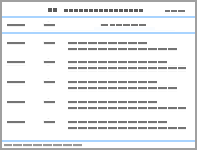
表1
不同亚种水稻种质资源盐胁迫条件下苗期各评价指标的参数统计"
| 亚种 Subspecies | 性状 Trait | 分布范围 Range | 中值 Median | 变异系数 CV (%) | t值 t-value |
|---|---|---|---|---|---|
| 粳稻 Japonica | 耐盐级别STS | 1.65-7.20 | 4.33 | 34.16 | - |
| 相对株高RSH | 0.50-1.12 | 0.76 | 14.18 | -12.504** | |
| 相对根长RRL | 0.54-1.31 | 0.92 | 16.97 | -4.386* | |
| 相对地上部干重RSDW | 0.33-2.63 | 0.83 | 36.84 | -4.376* | |
| 相对根干重RRDW | 0.28-1.90 | 0.68 | 37.63 | -9.476** | |
| 地上部含水量SWC % | 57.15-80.42 | 75.52 | 3.60 | - | |
| 相对SPAD RSPAD | 0.12-1.20 | 0.89 | 23.25 | -8.746** | |
| 籼稻 Indica | 耐盐级别STS | 2.25-7.10 | 4.78 | 29.89 | - |
| 相对株高RSH | 0.49-1.05 | 0.77 | 12.75 | -6.210** | |
| 相对根长RRL | 0.46-1.27 | 0.93 | 18.02 | -3.363* | |
| 相对地上部干重RSDW | 0.42-1.88 | 0.85 | 31.77 | -2.217 | |
| 相对根干重RRDW | 0.28-1.36 | 0.68 | 32.12 | -5.752** | |
| 地上部含水量SWC % | 69.83-78.36 | 75.28 | 2.39 | - | |
| 相对SPAD RSPAD | 0.50-1.12 | 0.93 | 14.38 | -4.981* | |
| AUS | 耐盐级别STS | 1.45-7.35 | 3.90 | 39.50 | - |
| 相对株高RSH | 0.57-1.02 | 0.71 | 16.16 | -7.813** | |
| 相对根长RRL | 0.55-1.36 | 0.89 | 20.20 | -2.807 | |
| 相对地上部干重RSDW | 0.35-2.08 | 0.74 | 48.50 | -1.878 | |
| 相对根干重RRDW | 0.34-1.40 | 0.58 | 39.10 | -5.882** | |
| 地上部含水量SWC % | 67.12-78.88 | 75.10 | 4.02 | - | |
| 相对SPAD RSPAD | 0.15-1.15 | 0.87 | 28.34 | -5.414** |
表2
不同亚种水稻种质苗期耐盐相关性状的差异显著性分析"
| 亚种 Subspecies | 耐盐级别 STS | 相对株高 RSH | 相对根长 RRL | 相对地上部干重 RSDW | 相对根干重 RRDW | 地上部含水量 SWC (%) | 相对SPAD RSPAD |
|---|---|---|---|---|---|---|---|
| 粳稻 Japonica | 4.559±1.557a | 0.762±0.108a | 0.916±0.155a | 0.832±0.194b | 0.753±0.023a | 75.158±2.696a | 0.723±0.254a |
| 籼稻 Indica | 4.878±1.458a | 0.762±0.097a | 0.897±0.162a | 0.898±0.129a | 0.751±0.018a | 75.088±1.852a | 0.748±0.240a |
| AUS | 4.380±1.731a | 0.743±0.120a | 0.891±0.177a | 0.811±0.230b | 0.747±0.027a | 74.692±2.599a | 0.665±0.258a |
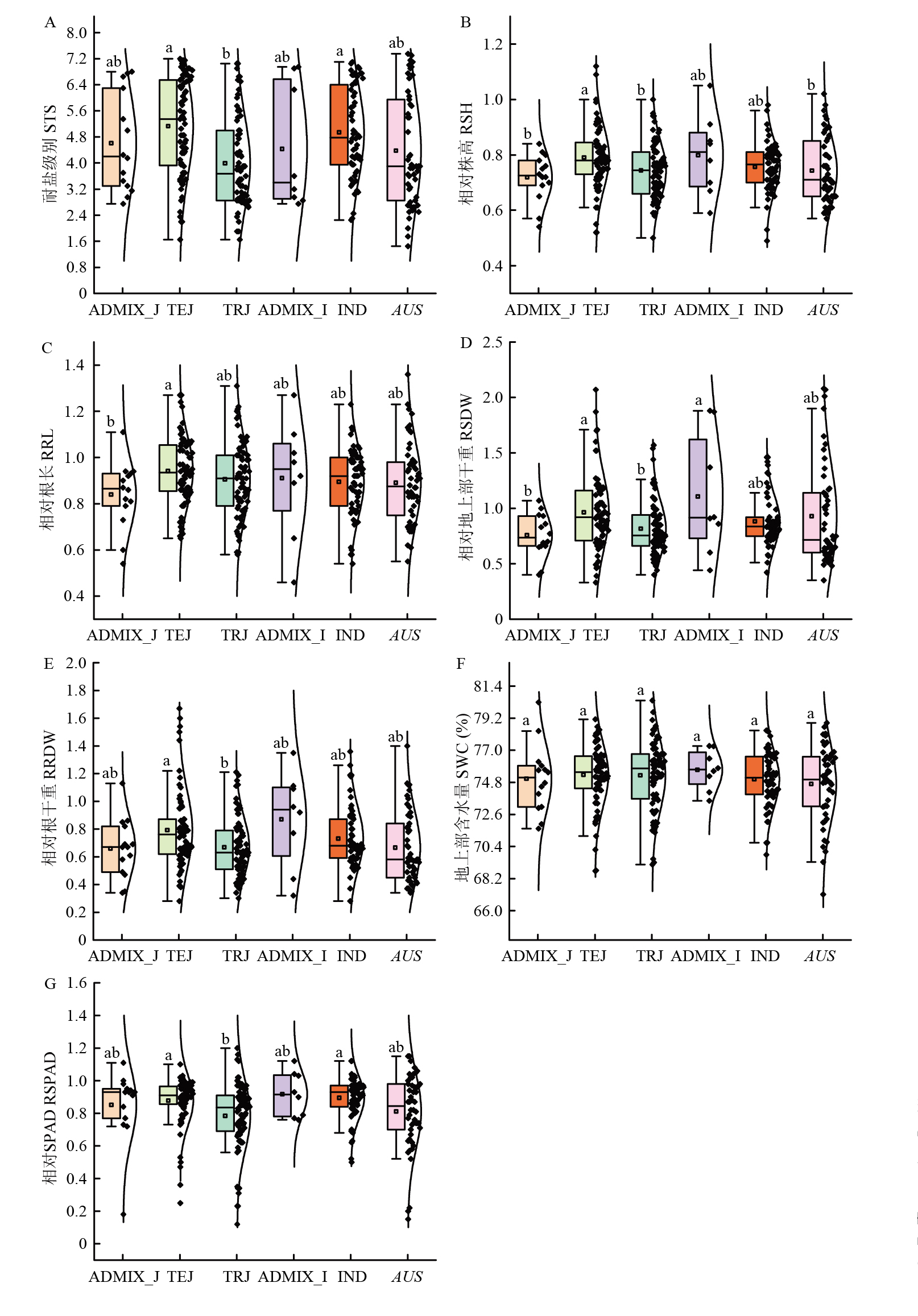
图1
6个亚群水稻种质耐盐相关性状的差异显著性分析 A:耐盐级别;B:相对株高;C:相对根长;D:相对地上部干重;E:相对根干重;F:地上部含水量;G:相对SPAD。ADMIX_J:混合型粳稻,TEJ:温带粳稻,TRJ:热带粳稻,ADMIX_I:混合型籼稻,IND:普通型籼稻"

图2
不同亚种水稻种质苗期耐盐相关性状的相关性分析 *:在P<0.05水平显著相关;**:在P<0.01水平极显著相关;***:在P<0.001水平极显著相关"
表3
不同亚种水稻种质各耐盐相关指标的主成分分析"
| 性状 Trait | 粳稻 Japonica | 籼稻 Indica | AUS | ||||||
|---|---|---|---|---|---|---|---|---|---|
| CI1 | CI2 | CI3 | CI1 | CI2 | CI3 | CI1 | CI2 | CI3 | |
| 耐盐级别STS | 0.726 | 0.243 | -0.506 | 0.629 | 0.550 | -0.386 | 0.905 | 0.083 | -0.230 |
| 相对株高RSH | 0.874 | -0.225 | 0.056 | 0.857 | -0.182 | -0.028 | 0.877 | 0.031 | -0.065 |
| 相对根长RRL | 0.681 | -0.249 | 0.277 | 0.627 | -0.399 | -0.241 | 0.606 | -0.682 | 0.258 |
| 相对地上部干重RSDW | 0.903 | -0.247 | 0.024 | 0.896 | -0.177 | 0.212 | 0.910 | -0.184 | -0.001 |
| 相对根干重RRDW | 0.869 | -0.183 | 0.214 | 0.805 | -0.296 | 0.380 | 0.918 | -0.148 | 0.160 |
| 地上部含水量SWC | 0.324 | 0.782 | 0.514 | 0.166 | 0.720 | 0.565 | 0.526 | 0.660 | 0.525 |
| 相对SPAD RSPAD | 0.709 | 0.450 | -0.348 | 0.631 | 0.535 | -0.272 | 0.813 | 0.329 | -0.385 |
| 特征值 Eigenvalue | 3.935 | 1.081 | 0.767 | 3.401 | 1.418 | 0.789 | 4.563 | 1.072 | 0.573 |
| 贡献率 Contribution ratio (%) | 56.180 | 15.445 | 10.962 | 48.581 | 20.258 | 11.278 | 65.186 | 15.321 | 8.193 |
| 累计贡献率 Cumulative contribution rate (%) | 56.180 | 71.625 | 82.587 | 48.581 | 68.839 | 80.117 | 65.186 | 80.507 | 88.700 |

图3
不同亚种水稻7个耐盐相关性状与综合性评价D值的线性回归分析"

图4
CK和125 mmol·L-1 NaCl胁迫6 d时3个亚种水稻部分典型耐盐种质的表型 CK:对照;SST:盐胁迫。标尺=6 cm"
表4
不同亚种水稻典型耐、敏盐种质根系形态特征的差异显著性分析"
| 指标 Indexes | 粳稻高D值 Japonica rice with high D-value | 粳稻低D值 Japonica rice with low D-value | 籼稻高D值 Indica rice with high D-value | 籼稻低D值 Indica rice with low D-value | AUS高D值 AUS rice with high D-value | AUS低D值 AUS rice with low D-value |
|---|---|---|---|---|---|---|
| 根总数量RTN | 80.67±12.18b | 62.25±14.48c | 95.96±27.83a | 50.13±8.55d | 81.17±23.31b | 42.25±15.35d |
| 根尖数量RN | 69.21±12.02b | 57.96±15.75c | 82.96±21.88a | 44.46±9.13d | 70.71±20.39b | 42.25±12.85d |
| 根总长度TRL (cm) | 84.60±16.00a | 55.59±7.52b | 77.40±17.72a | 45.08±8.85c | 76.65±31.19a | 50.98±13.39bc |
| 根平均直径RAD (mm) | 0.55±0.04c | 0.56±0.03bc | 0.58±0.04ab | 0.56±0.04bc | 0.58±0.04ab | 0.60±0.05a |
| 根总表面积RSA (mm2) | 1805.91±649.13a | 1193.30±276.76b | 1749.46±416.34a | 799.93±130.96c | 1815.12±762.71a | 1236.25±429.34b |
| 根总体积RV (mm3) | 541.16±487.82ab | 298.14±182.11cd | 555.64±278.96ab | 152.76±73.81d | 618.84±394.47a | 404.58±329.55bc |
| 0.5—1 mm直径根总长度 TL_0.5-1 mm (cm) | 14.08±8.00a | 10.24±6.57bc | 13.21±4.75ab | 8.07±3.91cd | 16.00±9.18a | 5.55±3.15d |
| 0.5—1 mm直径根总表面积 SA_0.5-1 mm (mm2) | 226.10±152.97b | 169.46±123.95bc | 209.14±76.81b | 131.48±75.65cd | 290.39±175.48a | 74.61±51.04d |
| 0.5—1 mm直径根总体积 V_0.5-1 mm (mm3) | 29.85±23.33b | 23.39±19.26bc | 28.40±13.36b | 18.11±12.94cd | 43.36±27.91a | 8.28±6.90d |
| 0—0.5 mm直径根总长度 TL_0-0.5 mm (cm) | 16.57±13.64a | 10.49±6.96bc | 12.41±7.61abc | 10.32±7.92c | 15.08±8.23ab | 3.74±3.68d |
| 0—0.5 mm直径根总表面积 SA_0-0.5 mm (mm2) | 241.65±177.72a | 149.21±84.44bc | 183.34±94.56abc | 144.17±97.08c | 205.75±108.52ab | 65.91±50.66d |
| 0—0.5 mm直径根总体积 V_0-0.5 mm (mm3) | 29.02±18.03a | 17.70±8.13bc | 22.51±10.27bc | 16.60±9.27c | 22.82±11.49b | 9.70±6.18d |
表5
不同亚种水稻典型耐、敏盐种质离子平衡相关性状的差异显著性分析"
| 指标 Indexes | 粳稻高D值 Japonica rice with high D-value | 粳稻低D值 Japonica rice with low D-value | 籼稻高D值 Indica rice with high D-value | 籼稻低D值 Indica rice with low D-value | AUS高D值 AUS rice with high D-value | AUS低D值 AUS rice with low D-value |
|---|---|---|---|---|---|---|
| 地上部Na+含量SNC (mg·g-1) | 24.66±6.18c | 49.47±5.80ab | 20.20±3.64cd | 44.16±12.86b | 15.68±4.85d | 56.86±10.31a |
| 根系Na+含量RNC (mg·g-1) | 17.48±2.89cd | 23.30±4.11ab | 20.11±3.09bc | 15.85±5.84d | 21.47±3.46b | 26.52±4.18a |
| 地上部K+含量SKC (mg·g-1) | 19.83±2.90b | 22.67±3.92b | 20.11±2.84b | 31.20±8.12a | 20.71±3.93b | 30.56±6.93a |
| 根系K+含量RKC (mg·g-1) | 4.31±1.44bc | 7.61±2.65a | 5.80±1.96ab | 5.75±2.06ab | 3.72±2.51c | 6.12±2.05ab |
| 地上部Na+/K+ SNK | 1.17±0.23cd | 2.06±0.28a | 0.98±0.23de | 1.44±0.51bc | 0.67±0.11e | 1.81±0.28ab |
| 根系Na+/K+ RNK | 4.61±1.81b | 3.35±0.91b | 3.89±1.82b | 3.04±1.16b | 9.18±6.98a | 4.04±1.70b |
表6
不同亚种水稻典型耐、敏盐种质活性氧含量的差异显著性分析"
| 指标 Indexes | 粳稻高D值 Japonica rice with high D-value | 粳稻低D值 Japonica rice with low D-value | 籼稻高D值 Indica rice with high D-value | 籼稻低D值 Indica rice with low D-value | AUS高D值 AUS rice with high D-value | AUS低D值 AUS rice with low D-value |
|---|---|---|---|---|---|---|
| 过氧化氢含量 Hydrogen peroxide content (μmol·g-1) | 5.46±2.41c | 6.38±1.53abc | 8.14±1.61ab | 5.89±1.45bc | 8.68±3.28a | 7.43±0.98abc |
| 超氧阴离子含量 Superoxide anion content (μmol·g-1) | 0.65±0.47d | 3.21±1.24a | 1.17±0.50cd | 1.92±0.56bc | 1.21±0.19cd | 2.39±1.12ab |
| 丙二醛含量 MDA content (nmol·g-1) | 30.32±21.02a | 46.13±15.97a | 32.10±5.43a | 30.81±19.63a | 28.23±14.83a | 46.45±29.20a |
表7
不同亚种水稻典型耐、敏盐种质渗透调节物质含量的差异显著性分析"
| 指标 Indexes | 粳稻高D值 Japonica rice with high D-value | 粳稻低D值 Japonica rice with low D-value | 籼稻高D值 Indica rice with high D-value | 籼稻低D值 Indica rice with low D-value | AUS高D值 AUS rice with high D-value | AUS低D值 AUS rice with low D-value |
|---|---|---|---|---|---|---|
| 可溶性糖含量 Soluble sugar content (mg·g-1) | 10.42±2.61b | 9.98±1.91b | 17.27±5.92a | 8.37±5.24b | 17.70±5.74a | 8.83±2.33b |
| 脯氨酸含量 Proline content (μg·g-1) | 609.87±192.35c | 632.20±78.34c | 863.43±205.61ab | 1003.67±380.04a | 655.35±125.82bc | 862.93±146.73ab |
| 可溶性蛋白含量Soluble protein content (mg·g-1) | 13.72±8.88ab | 6.08±2.92b | 7.46±4.81b | 8.52±3.48b | 13.56±3.77ab | 21.90±15.14a |
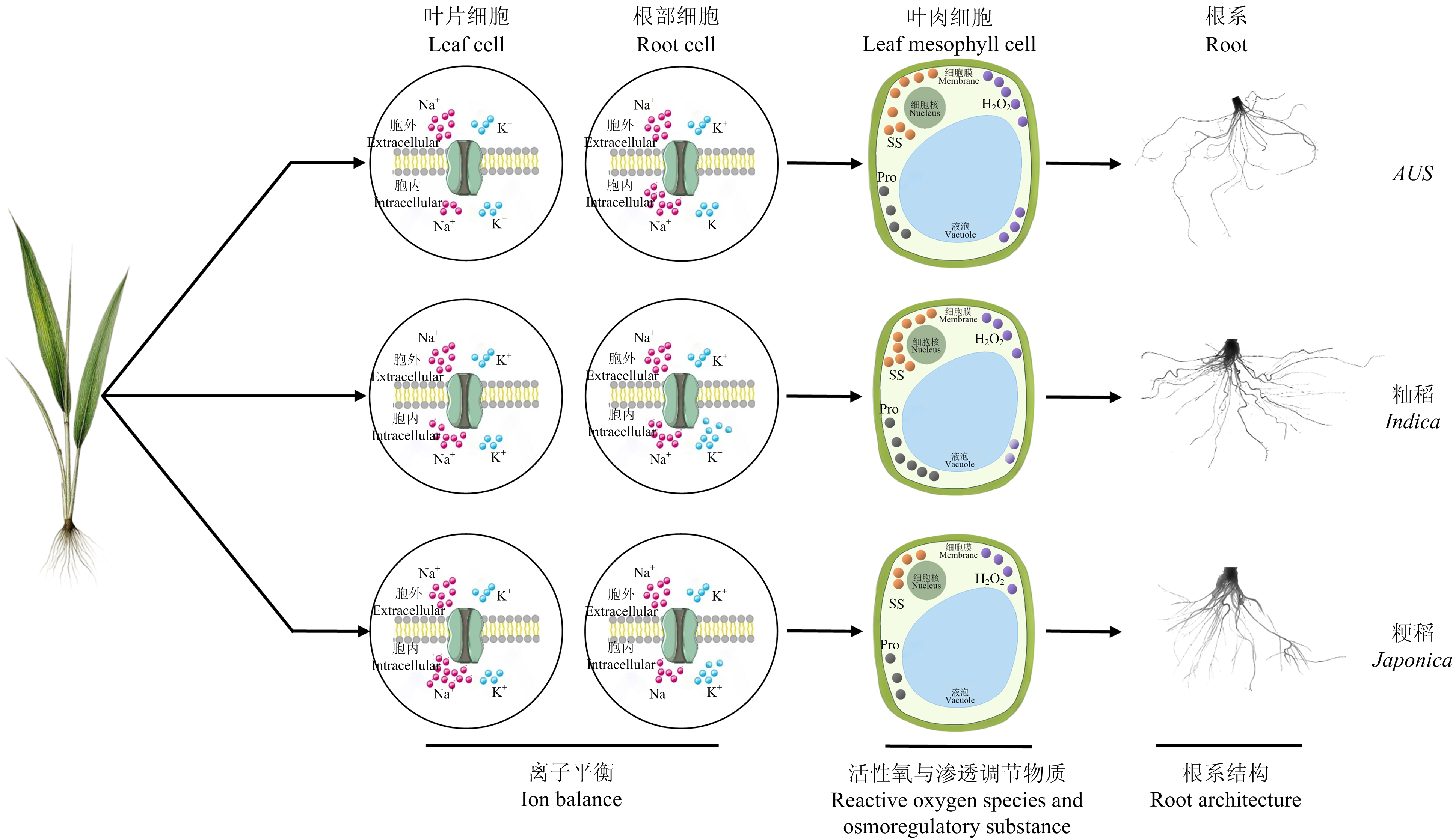
图5
不同亚种水稻典型耐盐种质响应盐胁迫的策略模型 SS:可溶性糖,Pro:脯氨酸,H2O2:过氧化氢"
| [1] |
doi: 10.1038/s41467-023-39167-0 pmid: 37321989 |
| [2] |
doi: 10.1016/j.molp.2021.05.003 pmid: 33962061 |
| [3] |
doi: 10.1146/annurev.arplant.59.032607.092911 pmid: 18444910 |
| [4] |
|
| [5] |
马帅国, 田蓉蓉, 胡慧, 吕建东, 田蕾, 罗成科, 张银霞, 李培富. 粳稻种质资源苗期耐盐性综合评价与筛选. 植物遗传资源学报, 2020, 21(5): 1089-1101.
doi: 10.13430/j.cnki.jpgr.20200115001 |
|
doi: 10.13430/j.cnki.jpgr.20200115001 |
|
| [6] |
谢留杰, 段敏, 潘晓飚, 唐兴国, 朱长志, 黄善军. 不同类型水稻品系苗期和全生育期耐盐性鉴定与分析. 江西农业大学学报, 2015, 37(3): 404-410.
|
|
|
|
| [7] |
陈志德, 仲维功, 杨杰, 黄转运. 水稻新种质资源的耐盐性鉴定评价. 植物遗传资源学报, 2004, 5(4): 351-355.
|
|
|
|
| [8] |
吴其褒, 胡国成, 柯登寿, 栾维江, 杨巍, 孙宗修, 陈惠哲. 俄罗斯水稻种质资源的苗期耐盐鉴定. 植物遗传资源学报, 2008, 9(1): 32-35.
|
|
|
|
| [9] |
doi: 10.1186/s12284-019-0347-1 pmid: 31802312 |
| [10] |
doi: 10.1007/s00122-012-1873-z pmid: 22678666 |
| [11] |
王洋, 张瑞, 刘永昊, 李荣凯, 葛建飞, 邓仕文, 张徐彬, 陈英龙, 韦还和, 戴其根. 水稻对盐胁迫的响应及耐盐机理研究进展. 中国水稻科学, 2022, 36(2): 105-117.
doi: 10.16819/j.1001-7216.2022.210609 |
|
doi: 10.16819/j.1001-7216.2022.210609 |
|
| [12] |
吴家富, 杨博文, 向珣朝, 许亮, 颜李梅. 不同水稻种质在不同生育期耐盐鉴定的差异. 植物学报, 2017, 52(1): 77-88.
|
|
|
|
| [13] |
赵杰, 王晓风, 张余良, 王立艳, 李梦琦, 肖辉. 不同水稻品种萌发期与幼苗期耐盐性鉴定. 江苏农业科学, 2024, 52(23): 55-59.
|
|
|
|
| [14] |
夏秀忠, 张宗琼, 杨行海, 农保选, 曾宇, 刘开强, 邓国富, 荘洁, 李丹婷. 广西地方稻种资源核心种质的耐盐性鉴定评价. 南方农业学报, 2017, 48(6): 979-984.
|
|
|
|
| [15] |
doi: 10.1111/pbi.v20.3 |
| [16] |
doi: 10.1016/j.xinn.2020.100017 |
| [17] |
doi: 10.1101/gad.1812409 |
| [18] |
朱春艳, 宋佳伟, 白天亮, 王娜, 马帅国, 普正菲, 董艳, 吕建东, 李杰, 田蓉蓉, 等. NaCl胁迫对不同耐盐性粳稻种质幼苗叶绿素荧光特性的影响. 中国农业科学, 2022, 55(13): 2509-2525. doi: 10.3864/j.issn.0578-1752.2022.13.003.
|
|
|
|
| [19] |
doi: 10.1016/j.cj.2021.02.010 |
| [20] |
doi: 10.1007/s11032-020-1100-6 |
| [21] |
doi: 10.3389/fpls.2021.680131 |
| [22] |
|
| [23] |
doi: 10.1111/pce.2010.33.issue-4 |
| [24] |
doi: 10.1007/s00425-019-03194-3 pmid: 31119363 |
| [25] |
刘梦霜, 郭海峰, 陈观秀, 莫俊杰, 许江环, 杨善, 周鸿凯. 不同水稻品种对NaCl胁迫的生理响应及耐盐性评价. 热带作物学报, 2023, 44(2): 326-336.
doi: 10.3969/j.issn.1000-2561.2023.02.012 |
|
|
|
| [26] |
张治振, 李稳, 周起先, 孙伟, 郑崇珂, 谢先芝. 不同水稻品种幼苗期耐盐性评价. 作物杂志, 2020, (3): 92-101.
|
|
|
|
| [27] |
doi: 10.1007/s00344-020-10235-9 |
| [28] |
doi: 10.1016/j.jgg.2011.11.005 |
| [29] |
耿雷跃, 马小定, 崔迪, 张启星, 韩冰, 韩龙植. 水稻全生育期耐盐性鉴定评价方法研究. 植物遗传资源学报, 2019, 20(2): 267-275.
doi: 10.13430/j.cnki.jpgr.20180815003 |
|
doi: 10.13430/j.cnki.jpgr.20180815003 |
|
| [30] |
田蕾, 王彬, 张雪艳, 王娜, 普正菲, 董艳, 许兴. 脱硫石膏改良盐碱土对水稻秧苗素质、根系特征及质膜透性的影响. 广东农业科学, 2014, 41(21): 1-6.
|
|
|
|
| [31] |
doi: 10.1016/j.fcr.2004.08.004 |
| [32] |
邹琦. 植物生理学实验指导. 北京: 中国农业出版社, 2000.
|
|
|
|
| [33] |
doi: 10.1093/jexbot/52.365.2375 |
| [34] |
doi: 10.3389/fpls.2017.01580 |
| [35] |
|
| [36] |
|
| [37] |
doi: 10.1111/ppl.v172.3 |
| [38] |
doi: 10.1007/s00425-002-0958-3 |
| [39] |
doi: 10.1186/s12284-019-0349-z pmid: 31792643 |
| [40] |
袁杰, 王学强, 张燕红, 赵志强, 贾春平, 王奉斌, 李自超. 水稻种质资源苗期耐盐性鉴定. 分子植物育种, 2020, 18(20): 6808-6814.
|
|
|
|
| [41] |
doi: 10.1186/s12284-018-0202-9 pmid: 29423779 |
| [42] |
doi: 10.1111/pce.v45.3 |
| [43] |
谷娇娇, 胡博文, 贾琰, 沙汉景, 李经纬, 马超, 赵宏伟. 盐胁迫对水稻根系相关性状及产量的影响. 作物杂志, 2019(4): 176-182.
|
|
|
|
| [44] |
doi: 10.3389/fpls.2024.1459121 |
| [45] |
doi: 10.1007/s00344-024-11349-0 |
| [1] | 鲁雪莉, Syeda Wajeeha Gillani, 孟晨, 李晓彬, 宋奕汝, 柏雨, 王菊英, 冯晓菲, 刘晨晨, 李义强, 徐宗昌. 不同类型盐胁迫对狼尾草种子萌发的影响及钠调控转录组研究[J]. 中国农业科学, 2026, 59(7): 1400-1419. |
| [2] | 张志林, 刘荣, 宗绪晓, 郝晓鹏, 杨涛. 蚕豆多时期耐盐性综合评价与衣康酸缓解萌发期盐胁迫研究[J]. 中国农业科学, 2026, 59(6): 1172-1188. |
| [3] | 陈敏氡, 裘波音, 黄昊, 李永平, 温庆放. 松花菜种质花球质地品质的评价[J]. 中国农业科学, 2026, 59(6): 1302-1316. |
| [4] | 何治霖, 孙翠霞, 岳红丽, 谈月霞, 张耀海, 王福生, 刘思涛, 江东. 基于重测序枸橼、柠檬类种质资源的遗传多样性分析和别罗勒烯的全基因组关联分析[J]. 中国农业科学, 2026, 59(2): 386-401. |
| [5] | 吕涛, 孙国清, 郭栋材, 陈全家, 蔡永生, 樊标星, 曲延英, 郑凯. 海岛棉纤维强度QTL紧密连锁InDel分子标记开发及效应评价[J]. 中国农业科学, 2025, 58(9): 1684-1701. |
| [6] | 滕梦鑫, 徐亚, 何静, 汪奇, 乔飞, 李敬阳, 李新国. 香蕉Ca2+-ATPase基因家族的鉴定及功能分析[J]. 中国农业科学, 2025, 58(7): 1418-1433. |
| [7] | 陈彩锦, 马琳, 蒋庆雪, 刘金晖, 苗童, 张志鹏, 孟翔, 马晓冉, 周昕越, 张建, 刘文辉, 王学敏. 244份饲用燕麦种质资源表型性状遗传多样性分析[J]. 中国农业科学, 2025, 58(23): 4825-4836. |
| [8] | 吕缓缓, 李如月, 刘青松, 许蕾, 徐嫣然, 于浩洁, 郭长虹, 龙瑞才. 紫花苜蓿MsKTI3基因克隆及耐盐功能分析[J]. 中国农业科学, 2025, 58(21): 4497-4511. |
| [9] | 陈天晓, 曹榕, 宋倩楠, 胡亮亮, 王素华, 王丽侠, 程须珍, 陈红霖. 小豆种质资源苗期耐盐性综合评价及耐盐种质筛选[J]. 中国农业科学, 2025, 58(21): 4317-4332. |
| [10] | 张帆, 杨青川. 紫花苜蓿育种历史、现状与展望[J]. 中国农业科学, 2025, 58(21): 4471-4481. |
| [11] | 陈永先, 陈瑞江, 都艺芝, 术钧捷, 陈晚霞, 赵梓含, 王季春, 杜康, 张凯. 耐旱甘薯种质资源的筛选与鉴定[J]. 中国农业科学, 2025, 58(2): 214-237. |
| [12] | 包明芳, 秦燕, 陈彩锦, 张尚沛, 张国辉, 沙晓弟. 111份紫花苜蓿种质资源苗期表型抗旱性鉴定评价[J]. 中国农业科学, 2025, 58(19): 3825-3836. |
| [13] | 孟姿诺, 付长青, 张玲玉, 高顺娟, 常金华, 崔江慧. 高粱芽苗期耐盐性评价及耐盐种质筛选[J]. 中国农业科学, 2025, 58(16): 3317-3326. |
| [14] | 郑敏华, 陈洛, 邢甲乐, 谢月兰, 姜先芽, 聂帅, 蔡甫格, 巫浩翔, 陆展华, 孙伟, 霍兴, 白嵩, 赵均良, 杨武. 华南籼稻稻瘟病抗性QTL鉴定与候选基因挖掘[J]. 中国农业科学, 2025, 58(14): 2707-2719. |
| [15] | 吴慧琴, 王静, 阳宜, 刘雪晴, 张凯旋, 王麓尧, 路佳伟, 翟源, 成妍. 96份辣椒种质资源的果实质地品质分析及评价[J]. 中国农业科学, 2025, 58(14): 2854-2868. |
|
||
