






中国农业科学 ›› 2026, Vol. 59 ›› Issue (22): 4990-5005.doi: 10.3864/j.issn.0578-1752.2026.22.004
毛娟1( ), 李雯1, 曾凡荣1, 覃元1(), 巫小建2()
收稿日期:2026-06-12
接受日期:2026-08-17
出版日期:2026-11-16
发布日期:2026-11-19
通信作者:
联系方式:
毛娟,E-mail:2024720923@yangtzeu.edu.cn。
基金资助:
MAO Juan1(), LI Wen1, ZENG FanRong1, QIN Yuan1(), WU XiaoJian2()
Received:2026-06-12
Accepted:2026-08-17
Published:2026-11-16
Online:2026-11-19
摘要:
【目的】涝渍胁迫是影响大麦生产的主要非生物胁迫之一,可导致产量平均降低23%。广泛收集全球不同生态区的大麦种质资源并开展耐涝性评估,筛选耐涝种质,可为应对极端天气频发引发的涝渍风险、保障大麦稳产提供种质基础与理论依据。【方法】以全球来源的240份大麦种质(含132份栽培种和108份野生种)为材料,于苗期进行涝渍处理,测定各材料的地上部黄叶率、死叶率、叶片受损率、干物质积累量、叶绿素含量、叶绿素荧光参数及不定根指数等多维度指标。采用描述性统计、主成分分析、聚类分析等方法,对供试种质的耐涝性进行综合评价。【结果】涝渍胁迫下,栽培种与野生种的7个苗期耐涝性状指标均表现出不同程度的变异,且多数性状在群体内不符合正态分布。总体而言,栽培种的耐涝性普遍弱于野生种。相关性分析表明,叶片损伤相关指标间呈高度正相关,而生理耐受指标与形态适应指标内部较为独立;两类指标之间则以负相关为主。主成分分析将7个性状综合为3个主成分,累计贡献率达69.547%。鉴于各评价指标间偏相关性较弱(KMO=0.411<0.5),采用不依赖变量相关矩阵的熵权法-模糊隶属函数法,以各指标自身数值分布为基础进行标准化和客观赋权,构建综合评价值(D值)。其中,6个连续分布性状用于计算隶属函数值与综合D值,呈等级分布的不定根指数则作为极端材料筛选的辅助参考指标。基于D值的聚类分析,将240份种质划分为强耐涝型、低耐涝型、中等型、低敏感型和强敏感型5类,其中,强耐涝型群体中野生种占比高于栽培种,而强敏感型群体中则以栽培种为主。【结论】以D值聚类分析结果为综合评价依据,并结合不定根等级作为根系适应维度的独立验证指标,通过交叉筛选与表型鉴定,最终筛选出苗期极端耐涝大麦种质5份(Hv30、Hv115、Hv145、Hv204、Hv229)和极端敏感大麦种质5份(Hv25、Hv26、Hv27、Hv66、Hv93)。
毛娟, 李雯, 曾凡荣, 覃元, 巫小建. 240份大麦种质资源耐涝性筛选[J]. 中国农业科学, 2026, 59(22): 4990-5005.
MAO Juan, LI Wen, ZENG FanRong, QIN Yuan, WU XiaoJian. Screening of 240 Barley Accessions for Waterlogging Tolerance[J]. Scientia Agricultura Sinica, 2026, 59(22): 4990-5005.
表1
240份大麦苗期涝害胁迫的统计分析"
| 指标 Indicator | 平均值 Average | 最小值 Minimum | 中位值 Median | 最大值 Maximum | 柯尔莫哥洛夫Kolmogorov | 标准差 SD | 变异系数CV(%) | ||
| 柯尔莫哥洛夫检验Kolmogorov- Smirnov test | P值 P value | ||||||||
| 黄叶率 YLR | 栽培种Cultivated barley | 0.168 | 0.011 | 0.167 | 0.406 | 0.048 | 0.200 | 0.082 | 49.47 |
| 野生种Wild barley | 0.147 | 0.014 | 0.129 | 0.455 | 0.114 | 0.002 | 0.082 | 55.37 | |
| 死叶率 NLR | 栽培种Cultivated barley | 0.275 | 0.133 | 0.259 | 0.541 | 0.085 | 0.022 | 0.095 | 34.64 |
| 野生种Wild barley | 0.255 | 0.105 | 0.248 | 0.614 | 0.124 | 0.000 | 0.077 | 30.36 | |
| 叶片受损率 DLR | 栽培种Cultivated | 0.442 | 0.162 | 0.413 | 0.846 | 0.086 | 0.019 | 0.153 | 34.62 |
| 野生种Wild barley | 0.402 | 0.172 | 0.382 | 0.854 | 0.091 | 0.029 | 0.127 | 31.70 | |
| 相对干重 RDW | 栽培种Cultivated barley | -0.303 | -0.773 | -0.372 | 1.319 | 0.113 | 0.000 | 0.296 | -97.88 |
| 野生种Wild barley | -0.127 | -0.857 | -0.237 | 4.344 | 0.171 | 0.000 | 0.629 | -494.64 | |
| 相对SPAD值 RSPAD | 栽培种Cultivated barley | -0.199 | -0.685 | -0.203 | 0.218 | 0.065 | 0.200 | 0.141 | -70.67 |
| 野生种Wild barley | -0.199 | -0.573 | -0.208 | 0.161 | 0.053 | 0.200 | 0.133 | -66.87 | |
| 相对Fv/Fm RFv/Fm | 栽培种Cultivated barley | -0.136 | -0.245 | -0.137 | -0.041 | 0.080 | 0.036 | 0.034 | -24.61 |
| 野生种Wild barley | -0.100 | -0.194 | -0.095 | -0.042 | 0.097 | 0.015 | 0.029 | -29.05 | |
| 不定根指数 AR | 栽培种Cultivated barley | 1.470 | 1.000 | 1.000 | 3.000 | 0.365 | 0.000 | 0.585 | 39.83 |
| 野生种Wild barley | 1.660 | 1.000 | 2.000 | 3.000 | 0.338 | 0.000 | 0.566 | 34.17 | |
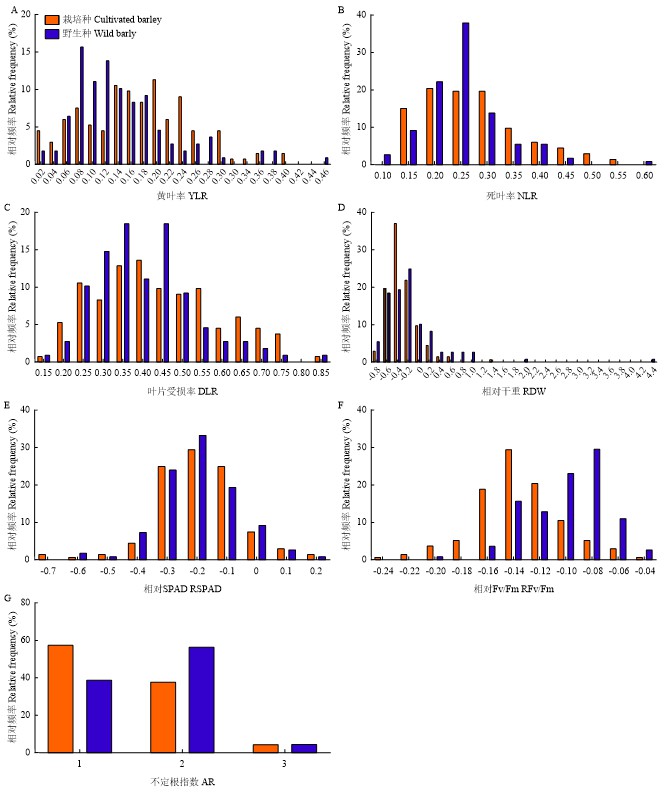
图1
栽培种和野生种大麦耐涝相关性状的频率分布"
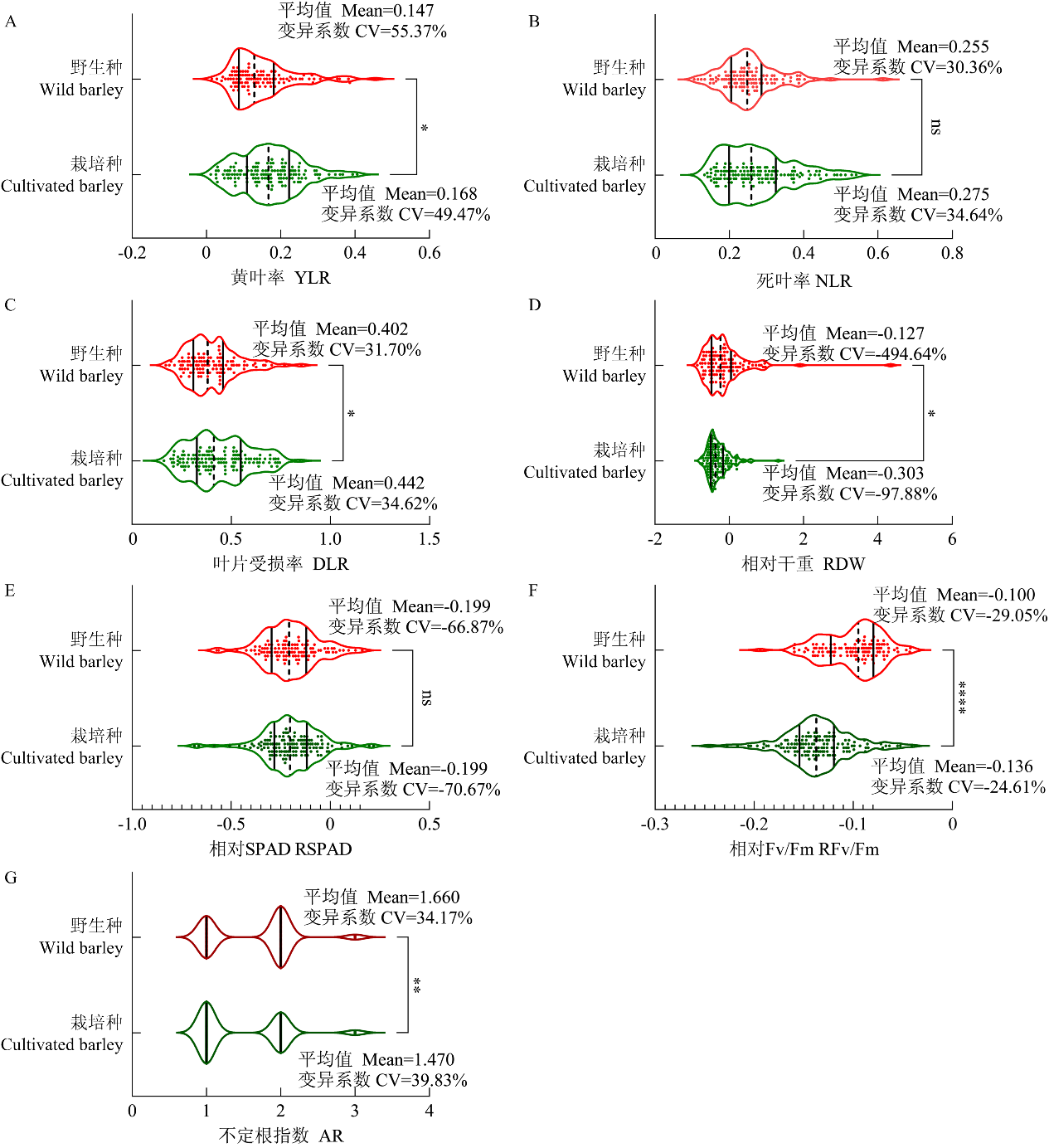
图2
栽培种和野生种大麦耐涝相关性状的群体间差异 *:P<0.05;**:P<0.01;***:P<0.001;****:<0.0001。下同"
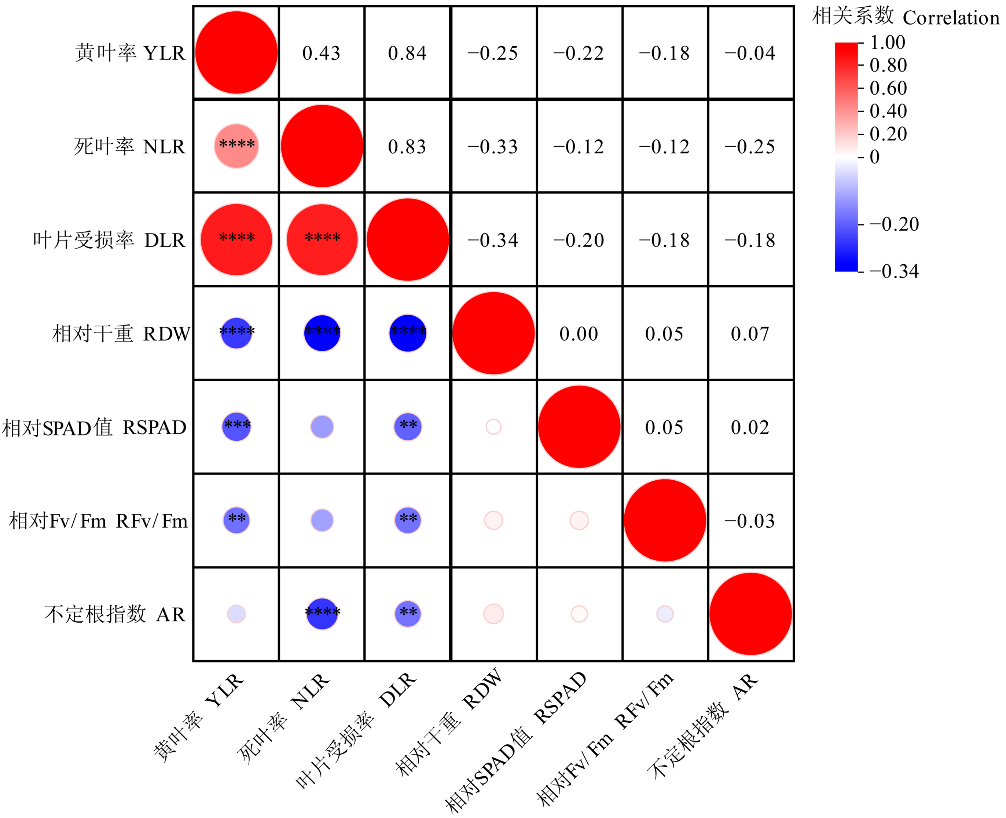
图3
240份大麦苗期耐涝性状的Spearman秩相关分析 上三角矩阵标注Spearman秩相关系数(rs);下三角以色圈大小和颜色深浅表示相关强度"
表2
240份大麦苗期耐涝性状的因子结构分析"
| 总方差解释Total variance explained | 旋转后的成分矩阵Rotated component matrix | ||||||
|---|---|---|---|---|---|---|---|
| 成分 Components | 旋转载荷平方和Rotation sums of squared loadings | 性状 Trait | 成分Components | ||||
| 总计 Total | 方差百分比 Explained variance (%) | 累积 Cumulative (%) | PC1 | PC2 | PC3 | ||
| PC1 | 2.519 | 35.980 | 35.980 | 叶片受损率DLR | 0.935 | 0.229 | 0.139 |
| PC 2 | 1.236 | 17.656 | 53.636 | 黄叶率YLR | 0.843 | 0.032 | -0.102 |
| PC 3 | 1.114 | 15.911 | 69.547 | 死叶率NLR | 0.724 | 0.342 | 0.321 |
| 相对SPAD值RSPAD | 0.561 | -0.437 | -0.090 | ||||
| 相对干重RDW | 0.110 | 0.775 | 0.070 | ||||
| 不定根指数AR | 0.145 | 0.111 | 0.838 | ||||
| 相对Fv/Fm RFv/Fm | 0.248 | 0.511 | -0.515 | ||||
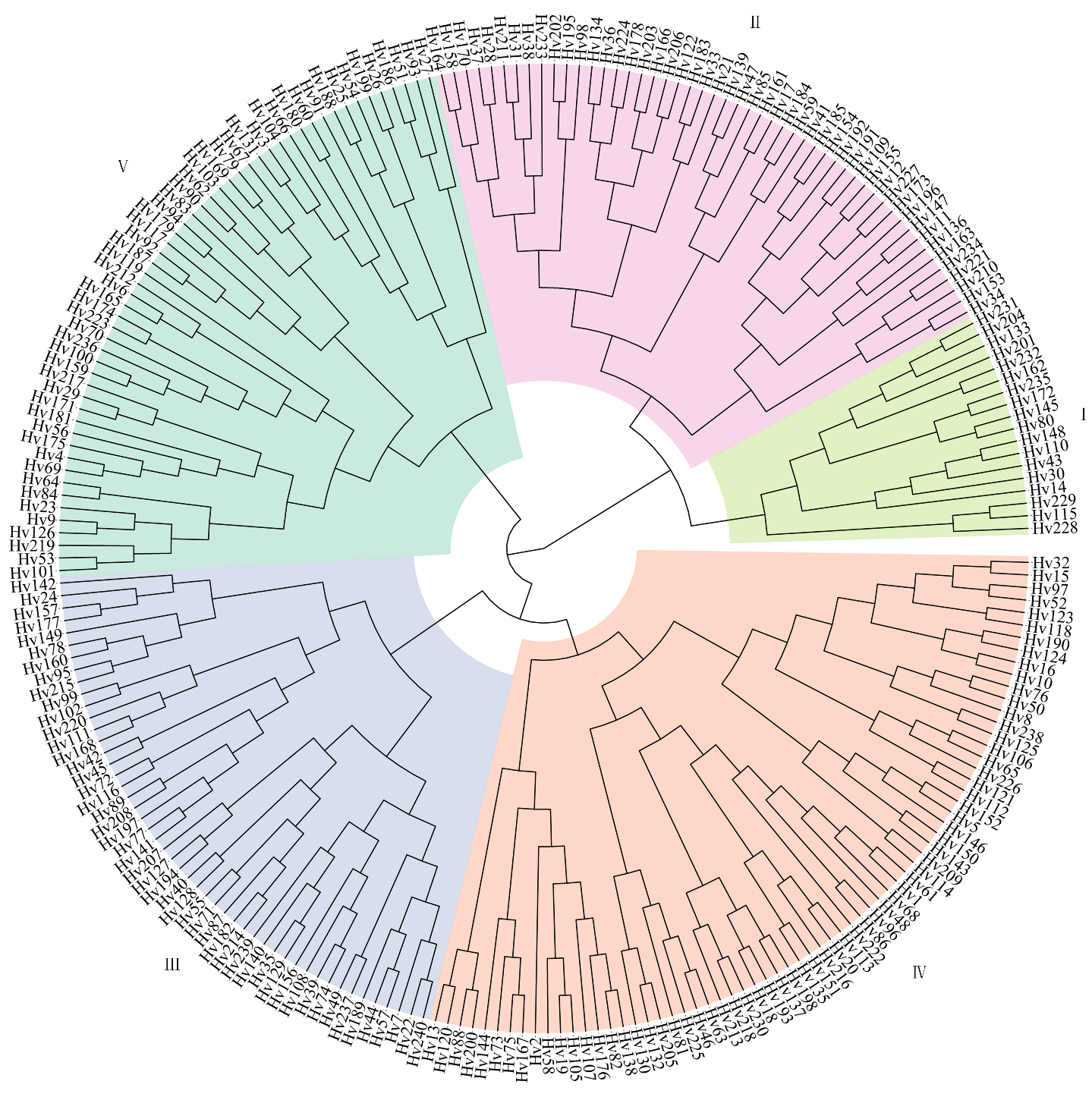
图4
240份大麦苗期耐涝性聚类图 Ⅰ:强耐涝型;Ⅱ:低耐涝型;Ⅲ:中等型;Ⅳ:低敏感型;Ⅴ:强敏感型"
表3
极端耐涝大麦材料的基本信息及其淹水胁迫下的生理表型"
| 编号 Accession number | 品种名 Variety name | 产地 Origin | 栽培/野生 Cultivated /Wild barley | 黄叶率 YLR | 死叶率 NLR | 叶片受损率 DLR | 相对SPAD RSPAD | 相对 干重 RDW | 相对Fv/Fm RFv/Fm | 不定根指数 AR | D值 得分 D value | 排名 Rank |
|---|---|---|---|---|---|---|---|---|---|---|---|---|
| Hv229 | HOR 13751 | 以色列Israel | 野生Wild barley | 0.084 | 0.164 | 0.247 | -0.216 | 1.908 | -0.084 | 1 | 0.892 | 1 |
| Hv115 | 阿卡迪 Accad | 约旦 Jordan | 栽培 Cultivated barley | 0.032 | 0.170 | 0.202 | -0.181 | 1.319 | -0.145 | 2 | 0.885 | 2 |
| Hv228 | HOR 11183 | 伊拉克Iraq | 野生Wild barley | 0.073 | 0.264 | 0.337 | -0.121 | 0.977 | -0.055 | 1 | 0.832 | 3 |
| Hv232 | HOR 13787 | 以色列Israel | 野生Wild barley | 0.086 | 0.210 | 0.296 | -0.177 | 0.805 | -0.064 | 2 | 0.792 | 4 |
| Hv162 | XZ19 | 中国西藏 Xizang, China | 野生 Wild barley | 0.069 | 0.191 | 0.260 | -0.260 | 0.915 | -0.141 | 2 | 0.788 | 5 |
| Hv133 | ECI-station2- ge17 | 进化谷 Evolution Canyon (Israel) | 野生 Wild barley | 0.353 | 0.228 | 0.581 | -0.230 | 4.344 | -0.042 | 2 | 0.774 | 6 |
| Hv231 | HOR 13784 | 以色列Israel | 野生Wild barley | 0.073 | 0.264 | 0.337 | -0.236 | 0.860 | -0.096 | 2 | 0.771 | 7 |
| Hv204 | XZ178 | 中国西藏 Xizang, China | 野生 Wild barley | 0.073 | 0.116 | 0.189 | 0.014 | 0.512 | -0.085 | 2 | 0.768 | 8 |
| Hv201 | XZ153 | 中国西藏 Xizang, China | 野生 Wild barley | 0.098 | 0.215 | 0.312 | -0.193 | 0.721 | -0.083 | 2 | 0.754 | 9 |
| Hv235 | HOR 14021 | 以色列Israel | 野生Wild barley | 0.082 | 0.226 | 0.308 | -0.140 | 0.627 | -0.085 | 2 | 0.738 | 10 |
表4
极端敏感大麦材料的基本信息及其淹水胁迫下的生理表型"
| 编号 Accession number | 品种名 Variety name | 产地 Origin | 栽培/野生Cultivated /Wild barley | 黄叶率 YLR | 死叶率 NLR | 叶片受损率 DLR | 相对SPAD RSPAD | 相对 干重 RDW | 相对Fv/Fm RFv/Fm | 不定根指数 AR | D值 得分 D value | 排名 Rank |
|---|---|---|---|---|---|---|---|---|---|---|---|---|
| Hv27 | 拉皮德 Rapid | 捷克斯洛伐克 Czechoslovakia | 栽培 Cultivated barley | 0.237 | 0.461 | 0.697 | -0.685 | -0.718 | -0.245 | 2 | 0.117 | 240 |
| Hv93 | 970339 | 中国青海 Qinghai, China | 栽培 Cultivated barley | 0.305 | 0.541 | 0.846 | -0.431 | -0.467 | -0.227 | 1 | 0.158 | 239 |
| Hv186 | XZ95 | 中国西藏Xizang, China | 野生Wild barley | 0.455 | 0.251 | 0.705 | -0.134 | -0.780 | -0.155 | 1 | 0.189 | 238 |
| Hv51 | 驻大麦7号 Zhudamai 7 | 中国河南 Henan, China | 栽培 Cultivated barley | 0.299 | 0.418 | 0.716 | -0.395 | -0.704 | -0.139 | 1 | 0.191 | 237 |
| Hv66 | Clipper/ Volla/Arr /Esp | 国际玉米小麦改良中心 CIMMYT (International Maize and Wheat Improvement Center) | 栽培 Cultivated barley | 0.263 | 0.434 | 0.697 | -0.203 | -0.598 | -0.157 | 1 | 0.239 | 236 |
| Hv3 | 希霍德-鲁登 Schiho-Dolden | 日本 Japan | 栽培 Cultivated barley | 0.192 | 0.441 | 0.633 | -0.047 | -0.773 | -0.153 | 1 | 0.241 | 235 |
| Hv131 | ICARDA 41 E | 叙利亚 Syria | 栽培 Cultivated barley | 0.360 | 0.373 | 0.733 | -0.212 | -0.604 | -0.107 | 2 | 0.241 | 234 |
| Hv104 | 扬农啤6号 Yangnongpi 6 | 中国江苏 Jiangsu, China | 栽培 Cultivated barley | 0.394 | 0.237 | 0.631 | -0.301 | -0.631 | -0.139 | 2 | 0.244 | 233 |
| Hv60 | Victoria/ Mal1-4-3094-2 | 国际玉米小麦改良中心 CIMMYT (International Maize and Wheat Improvement Center) | 栽培 Cultivated barley | 0.303 | 0.368 | 0.671 | -0.508 | -0.458 | -0.160 | 1 | 0.247 | 232 |
| Hv180 | XZ72 | 中国西藏Xizang, China | 野生Wild barley | 0.386 | 0.180 | 0.566 | -0.325 | -0.689 | -0.146 | 2 | 0.247 | 231 |
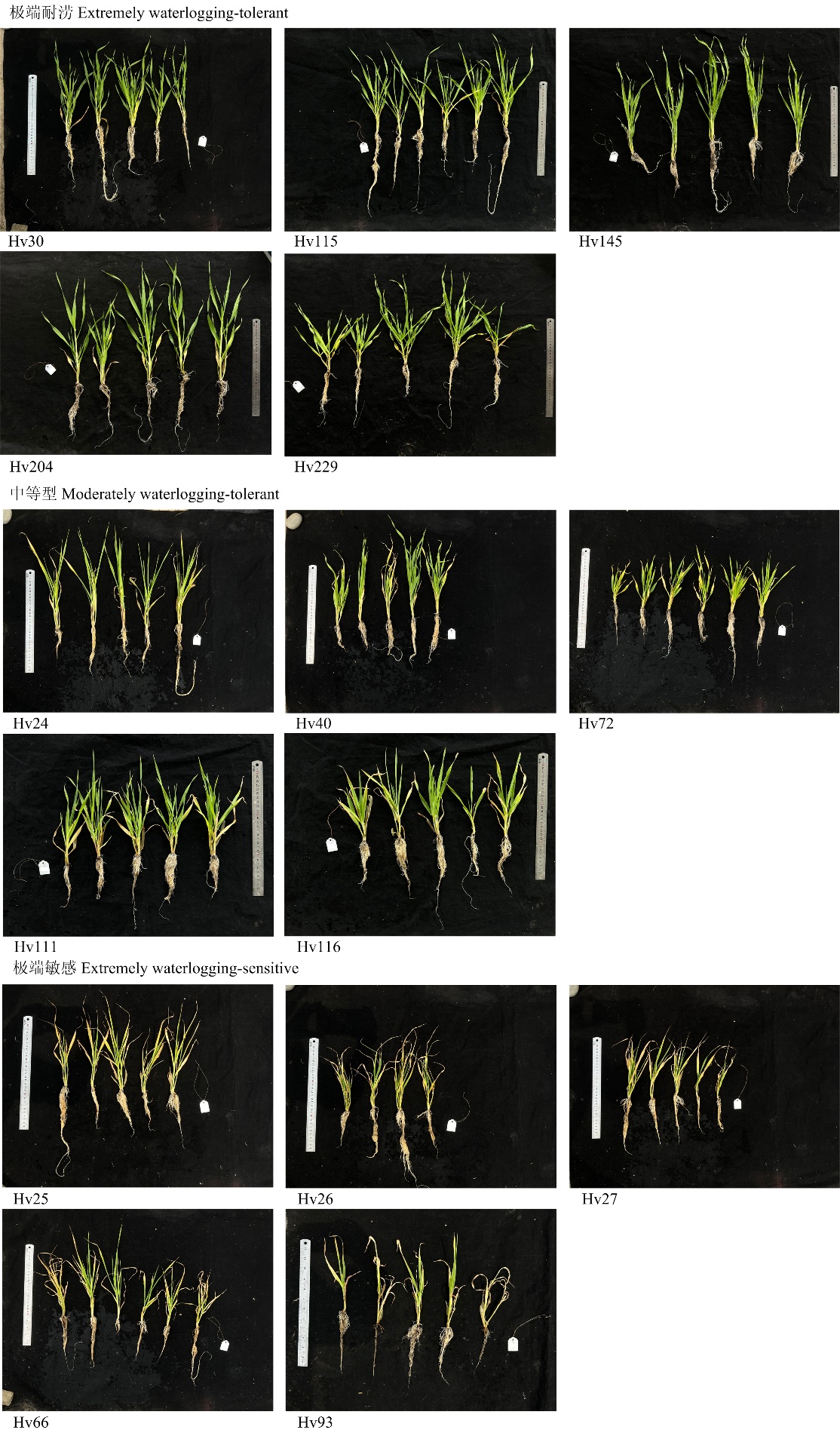
图5
涝害胁迫下极端耐涝、中等型与极端敏感大麦种质资源表型"
| [1] |
|
| [2] |
|
| [3] |
|
| [4] |
|
| [5] |
|
| [6] |
|
| [7] |
|
| [8] |
|
| [9] |
|
| [10] |
|
| [11] |
|
| [12] |
|
| [13] |
|
| [14] |
|
| [15] |
|
| [16] |
|
| [17] |
|
| [18] |
|
| [19] |
|
| [20] |
|
| [21] |
|
| [22] |
|
| [23] |
|
| [24] |
|
| [25] |
|
| [26] |
|
| [27] |
|
| [28] |
|
| [29] |
刘瑞, 曾源, 加央, 许甫超, 徐晴, 彭严春, 董国清, 董静, 秦丹丹. 大麦种质资源芽期耐渍性遗传多样性分析及耐渍种质筛选[J]. 大麦与谷类科学, 2023, 40(3): 1-10.
|
|
|
|
| [30] |
|
| [31] |
|
| [32] |
|
| [33] |
周元成, 曹永立, 王镇, 贾志荣, 姚勇, 陈爱萍. 不同大麦品种抗旱性鉴定指标的筛选与评价[J]. 中国农业科技导报, 2022, 24(2): 86-92.
|
|
|
|
| [34] |
宋智豪, 高景阳, 赵众欢, 于忠良, 侯鑫, 赵博文, 周子键, 陈甲法, 景沛, 孙豆豆, 吴建宇. 玉米耐淹性鉴定体系建立与优异种质筛选[J]. 玉米科学, 2026, 34(3): 10-18.
|
|
|
|
| [35] |
高旭, 张志仙, 朱长志, 檀国印, 何道根. 青花菜种质资源苗期耐涝性综合鉴定及评价[J]. 西北农林科技大学学报(自然科学版), 2018, 46(4): 117-127.
|
|
|
|
| [36] |
佟汉文, 刘易科, 朱展望, 陈泠, 邹娟, 张宇庆, 高春保, 焦春海. 作物耐渍鉴定与评价方法的研究进展[J]. 作物杂志, 2015(6): 10-15.
|
|
|
|
| [37] |
高珅奥, 田仁美, 贾惠宁, 王脉, 刘德政, 路秋梅, 卢山, 高志鹏, 万富旗, 张旭斌, 黄艳菊, 陈亮, 胡银岗. 236份小麦种质苗期耐盐性鉴定及耐盐指标筛选[J]. 麦类作物学报, 2024, 44(9): 1115-1124.
|
|
|
|
| [38] |
张育哲, 王博华, 孙娜, 程宇坤, 王兆强, 耿洪伟, 任毅. 冬小麦苗期抗旱性综合评价与指标筛选[J]. 麦类作物学报, 2025, 45(12): 1647-1654.
|
|
|
|
| [39] |
谭志新, 谢留伟, 李洪戈, 李芳军, 田晓莉, 李召虎. 基于AHP-隶属函数法的棉花子叶期耐低钾能力鉴定[J]. 作物学报, 2024, 50(1): 199-208.
|
|
|
|
| [40] |
谢锐, 韩志刚, 张向前, 金晓蕾, 程玉臣, 任永峰, 魏淑丽, 郭斌煜, 方静, 郭景山, 赵小庆, 路战远. 阴山沿麓马铃薯氮效率综合评价及高产氮高效品种筛选[J]. 植物营养与肥料学报, 2025, 31(11): 2266-2279.
|
|
|
|
| [41] |
|
| [42] |
|
| [43] |
|
| [44] |
|
| [45] |
|
| [46] |
|
| [47] |
|
| [48] |
|
| [1] | 李志威, 王子琪, 高亚蒙, 高润红, 陈雪, 杨铸, 阚文杰, 蹇双灵, 严胜男, 汤才国, 吴丽芳. 不同光质对大麦加速生长和光合特性的影响[J]. 中国农业科学, 2026, 59(8): 1639-1652. |
| [2] | 陈敏氡, 裘波音, 黄昊, 李永平, 温庆放. 松花菜种质花球质地品质的评价[J]. 中国农业科学, 2026, 59(6): 1302-1316. |
| [3] | 陈敏, 焦紫岚, 乔承彬, 许昊, 张碧, 马东花, 孔维儒, 王敬文, 宋佳伟, 罗成科, 李培富, 田蕾. 不同亚种水稻种质资源对盐胁迫的形态生理响应及适应策略[J]. 中国农业科学, 2026, 59(4): 705-722. |
| [4] | 张华耀, 唐阳军, 陈建军, 吕艳, 徐荣, 曾柳, 易建平, 罗丹, 刘胜毅, 程勇, 张园园, 邹锡玲. 甘蓝型油菜萌发期耐渍性综合评价体系构建与优异种质筛选[J]. 中国农业科学, 2026, 59(22): 4962-4975. |
| [5] | 郭晓江, 孙超琳, 耿宇婧, 张淼, 李阳, 李伟, 王际睿, 陈国跃, 魏育明, 蒲至恩. 小麦萌发期耐湿性遗传解析及优异种质发掘[J]. 中国农业科学, 2026, 59(22): 4976-4989. |
| [6] | 汤伟华, 张志林, 颜志明, 刘同坤, 侯喜林. 二倍体、四倍体不结球白菜耐盐碱性的分阶段综合评价与四倍化效应[J]. 中国农业科学, 2026, 59(21): 4904-4923. |
| [7] | 蔡廷阳, 朱玉鹏, 李瑞东, 吴宗声, 徐一帆, 宋雯雯, 徐彩龙, 吴存祥. 苗期叶损伤对黄淮海夏大豆光合特性、荚果分布及产量形成的影响[J]. 中国农业科学, 2026, 59(2): 292-304. |
| [8] | 何治霖, 孙翠霞, 岳红丽, 谈月霞, 张耀海, 王福生, 刘思涛, 江东. 基于重测序枸橼、柠檬类种质资源的遗传多样性分析和别罗勒烯的全基因组关联分析[J]. 中国农业科学, 2026, 59(2): 386-401. |
| [9] | 普新援, 马云飞, 赵俊, 赵丽萍, 赵兴东, 胡鑫, 昝逢刚, 刘家勇, 杨丽华, 夏红明, 陆鑫, 饶席兵, 唐思琪, 白亚东, 张静, 任生林, 赵培方. 291份甘蔗种质资源黑穗病抗性评价及抗病种质发掘[J]. 中国农业科学, 2026, 59(19): 4221-4234. |
| [10] | 贾亚雄, 杨卫芳, 刘涛, 王迪, 刘孟超, 陈天金, 侯水生. 我国畜禽种质资源国际交流安全面临的挑战和风险[J]. 中国农业科学, 2026, 59(17): 3907-3919. |
| [11] | 冯亚青, 孙亚涵, 周巧慧, 林芃, 李佳翌, 王惠申, 刘涛, 刘占德, 王南南. 猕猴桃种质资源对缺铁渍水复合胁迫的耐性筛选评价及生理差异分析[J]. 中国农业科学, 2026, 59(15): 3387-3399. |
| [12] | 马亚珺, 严雅军, 杨炜迪, 杨天辉, 王川, 高婷. 饲用小黑麦种质资源创新与综合利用研究进展[J]. 中国农业科学, 2026, 59(14): 2993-3005. |
| [13] | 谢永祥, 潘怡敏, 黄蕊, 秦慧彬, 侯森, 贺强, 凌亮, 穆志新, 王海岗. 山西谷子种质资源耐瘠性鉴定及综合评价[J]. 中国农业科学, 2026, 59(11): 2325-2339. |
| [14] | 张悦青, 张玉亭, 薛晨飞, 韩秦宇, 贺一容, 徐紫娟, 范秀梅, 王军娥, 罗丹, 冯雪, 孙胜. 364份樱桃番茄种质资源表型性状的遗传多样性分析及综合评价[J]. 中国农业科学, 2026, 59(11): 2468-2483. |
| [15] | 吕涛, 孙国清, 郭栋材, 陈全家, 蔡永生, 樊标星, 曲延英, 郑凯. 海岛棉纤维强度QTL紧密连锁InDel分子标记开发及效应评价[J]. 中国农业科学, 2025, 58(9): 1684-1701. |
|
||
