






中国农业科学 ›› 2026, Vol. 59 ›› Issue (19): 4221-4234.doi: 10.3864/j.issn.0578-1752.2026.19.003
普新援1,2( ), 马云飞3, 赵俊1,2, 赵丽萍1,2, 赵兴东3, 胡鑫1,2, 昝逢刚1,2, 刘家勇1,2, 杨丽华3, 夏红明1,2, 陆鑫1,2, 饶席兵1,2, 唐思琪1,2, 白亚东3, 张静1,2, 任生林1,2, 赵培方1,2()
收稿日期:2026-02-06
接受日期:2026-04-07
出版日期:2026-10-01
发布日期:2026-10-10
通信作者:
联系方式:
普新援,E-mail:puxinyuan1231@163.com。
基金资助:
PU XinYuan1,2(), MA YunFei3, ZHAO Jun1,2, ZHAO LiPing1,2, ZHAO XingDong3, HU Xin1,2, ZAN FengGang1,2, LIU JiaYong1,2, YANG LiHua3, XIA HongMing1,2, LU Xin1,2, RAO XiBing1,2, TANG SiQi1,2, BAI YaDong3, ZHANG Jing1,2, REN ShengLin1,2, ZHAO PeiFang1,2()
Received:2026-02-06
Accepted:2026-04-07
Published:2026-10-01
Online:2026-10-10
摘要:
【目的】黑穗病是影响全球甘蔗生产的主要病害,筛选抗病种质对甘蔗抗病育种至关重要。系统评价不同来源甘蔗种质对黑穗病的抗性水平,筛选高抗黑穗病种质,为抗病机制解析提供研究材料,为抗病育种提供优异亲本资源。【方法】以291份国内外甘蔗种质为材料,于2020—2021年在云南蔗区黑穗病发生最为普遍的蔗区元江哈尼族彝族傣族自治县,以1年新植和1年宿根(“作物类型”)进行田间试验,以田间收集的黑穗病混合冬孢子(浓度5×106个/mL)为接种菌株,设置人工接种和自然感病区(“处理”),调查各种质发病情况并进行统计分析,根据发病率评价抗性并分级,筛选高抗及抗病种质,并对比不同来源甘蔗种质对黑穗病的抗性水平。【结果】从291份种质中共筛选出20份抗黑穗病种质,占比6.87%,其中包含4份高抗种质(占1.37%),CP72-3709表现免疫,CP96-1252、FR93-910和云蔗02-2332表现高抗;在其余的种质中,14份(4.81%)表现中抗(MR)、74份(25.43%)表现中感(MS)、134份(46.05%)表现感病(S)、49份(16.84%)表现高感(HS)。统计分析表明,发病率在“处理”间、“作物类型”间、基因型间、“处理”与基因型互作间差异极显著(P<0.001),人工接种发病率(32.16%)极显著高于自然感病(18.29%),宿根发病率(35.29%)极显著高于新植(15.24%),表明甘蔗黑穗病发病率受处理方式、作物类型和基因型的显著影响;广义遗传力为0.812,表明发病率变异主要受遗传因素影响;不同来源种质的发病率存在差异,其中,法国种质的发病率最低。【结论】在云南黑穗病高发的元江蔗区,从291份甘蔗抗黑穗病种质中筛选出20份抗病种质构成一个有价值的抗性基因库。其中,免疫种质CP72-3709可作为优异抗源用于黑穗病抗病分子机制解析、抗性基因挖掘和抗黑穗病甘蔗品种的改良;高抗及抗病种质CP96-1252、FR93-910、云蔗02-2332、CP89-2143、POJ2878等可作为抗病育种的核心亲本。
普新援, 马云飞, 赵俊, 赵丽萍, 赵兴东, 胡鑫, 昝逢刚, 刘家勇, 杨丽华, 夏红明, 陆鑫, 饶席兵, 唐思琪, 白亚东, 张静, 任生林, 赵培方. 291份甘蔗种质资源黑穗病抗性评价及抗病种质发掘[J]. 中国农业科学, 2026, 59(19): 4221-4234.
PU XinYuan, MA YunFei, ZHAO Jun, ZHAO LiPing, ZHAO XingDong, HU Xin, ZAN FengGang, LIU JiaYong, YANG LiHua, XIA HongMing, LU Xin, RAO XiBing, TANG SiQi, BAI YaDong, ZHANG Jing, REN ShengLin, ZHAO PeiFang. Evaluation of Smut Resistance and Screening of Resistant Germplasm in 291 Sugarcane Accessions[J]. Scientia Agricultura Sinica, 2026, 59(19): 4221-4234.

表1
不同处理方式和作物类型的黑穗病发病率统计"
| 来源 Source | 处理及类型 Treatment and type | 发病率 Incidence (%) |
|---|---|---|
| 处理方式 Treatment method | 人工接种Artificial | 32.16±27.14a |
| 自然感病Natural | 18.29±22.70b | |
| 作物类型 Crop type | 新植Plant | 15.24±18.16b |
| 宿根Ratoon | 35.29±28.62a |
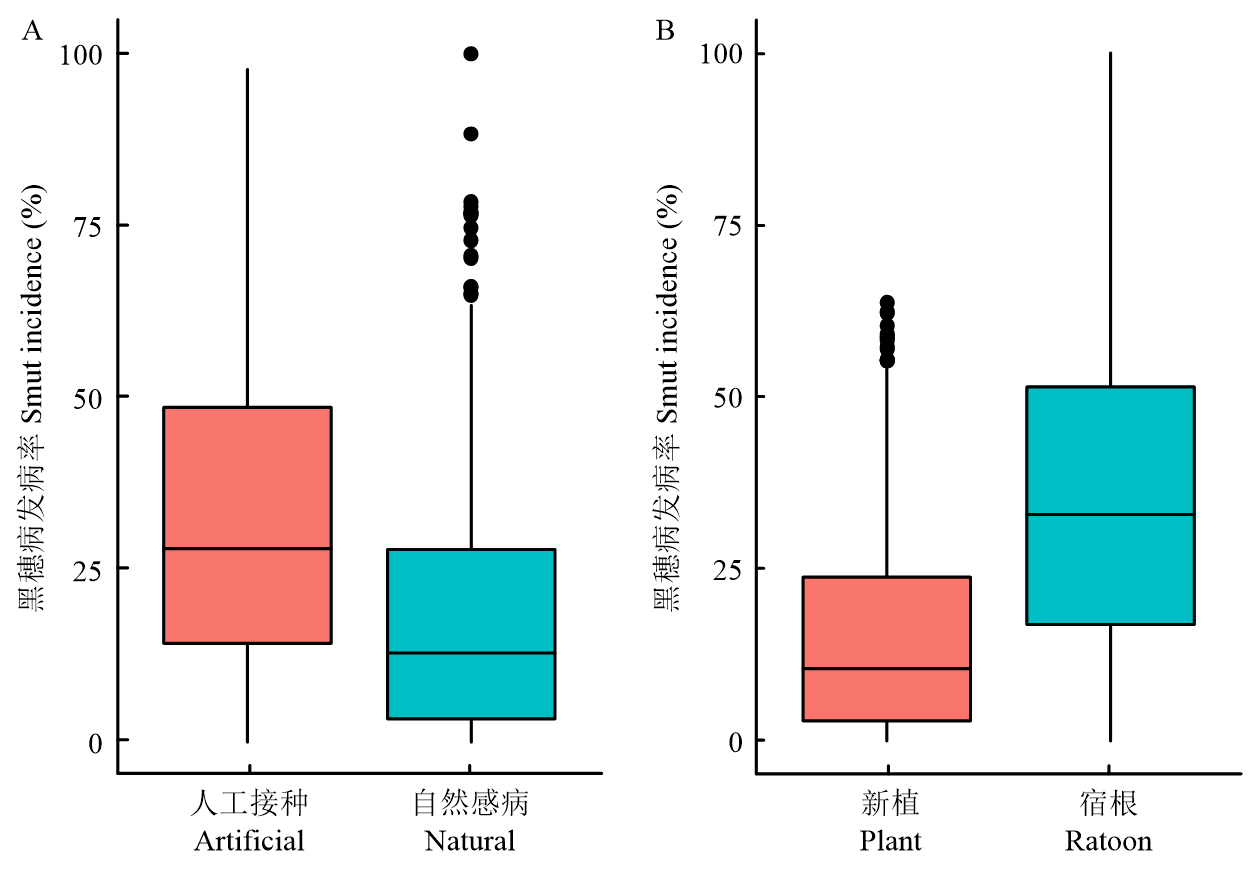
图1
不同处理方式和作物类型甘蔗黑穗病发病率的差异分析 A:不同处理方式的发病率分布;B:不同作物类型的发病率分布"
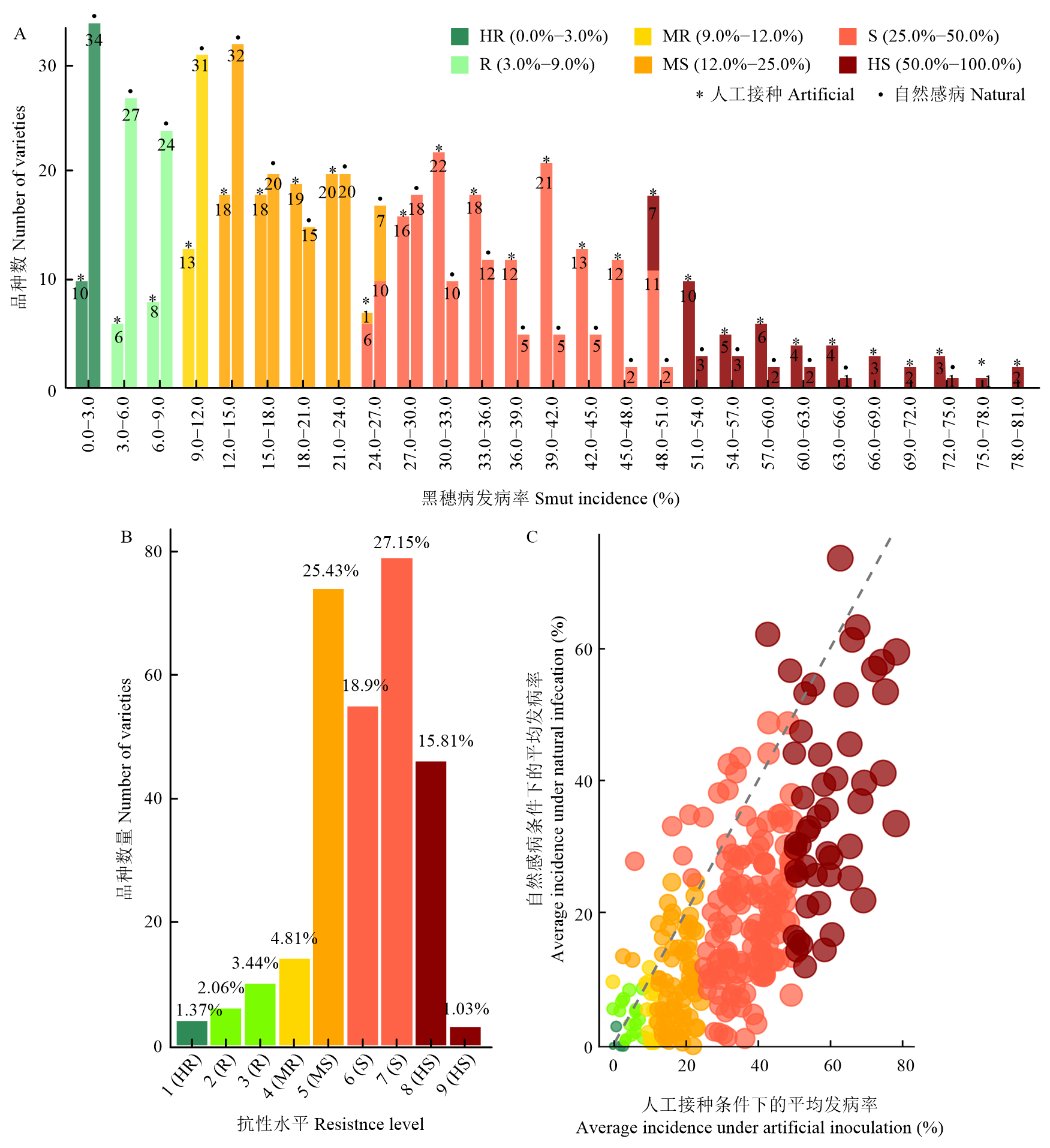
图2
291份甘蔗种质的黑穗病抗性水平频率分布 A:人工接种和自然感病条件下的发病率频率分布;B:综合抗性水平频率分布;C:291份种质在人工接种和自然感病条件下的发病率比较。HR:高抗;R:抗;MR:中抗;MS:中感;S:感;HS:高感。下同"
表2
甘蔗种质黑穗病发病率方差分析"
| 来源 Source | 均方 Mean squares | 自由度 DF | F | P | 广义遗传力 Heritability (H2) |
|---|---|---|---|---|---|
| 处理方式Treatment (T) | 3.262 | 1 | 101.20 | <0.001*** | 0.812 |
| 作物类型Crop-type (C) | 34.526 | 1 | 1071.06 | <0.001*** | |
| 品种Variety (G) | 0.256 | 290 | 7.96 | <0.001*** | |
| 处理方式×作物类型T×C | 0.081 | 1 | 2.53 | 0.112 | |
| 处理方式×品种T×G | 0.048 | 290 | 1.48 | <0.001*** |
表3
不同来源种质黑穗病发病率的差异分析"
| 品种来源 Variety origin | 数量 Count | 处理方式 Treatment | 极小值 Mix (%) | 极大值 Max (%) | 均值 Mean (%) | 标准差 SD | 变异系数 CV (%) | 偏度 Skewness | 峰度 Kurtosis |
|---|---|---|---|---|---|---|---|---|---|
| 法国 France | 17 | 人工接种Artificial | 2.14 | 39.77 | 19.35c | 11.33 | 58.54 | 0.44 | -0.49 |
| 自然感病Natural | 0.00 | 33.14 | 9.99c | 10.61 | 106.19 | 1.36 | 0.84 | ||
| 巴西 Brazil | 18 | 人工接种Artificial | 0.00 | 38.53 | 22.99bc | 10.70 | 46.53 | -0.46 | -0.54 |
| 自然感病Natural | 1.23 | 30.53 | 11.37bc | 9.23 | 81.16 | 1.00 | -0.31 | ||
| 美国 America | 56 | 人工接种Artificial | 0.00 | 62.74 | 28.11abc | 16.45 | 58.50 | 0.06 | -0.82 |
| 自然感病Natural | 0.00 | 73.55 | 14.54abc | 12.88 | 88.60 | 2.06 | 6.89 | ||
| 印度尼西亚 Indonesia | 4 | 人工接种Artificial | 6.34 | 56.87 | 26.89abc | 22.23 | 82.67 | 0.99 | 0.27 |
| 自然感病Natural | 0.88 | 21.54 | 10.69bc | 10.13 | 94.74 | 0.12 | -4.75 | ||
| 菲律宾 Philippines | 24 | 人工接种Artificial | 2.81 | 75.21 | 29.96abc | 19.19 | 64.07 | 0.66 | -0.11 |
| 自然感病Natural | 0.67 | 56.59 | 17.01abc | 17.03 | 100.09 | 1.41 | 1.04 | ||
| 中国大陆 Mainland China | 98 | 人工接种Artificial | 2.89 | 74.58 | 35.37ab | 17.86 | 50.48 | 0.13 | -0.75 |
| 自然感病Natural | 0.00 | 62.07 | 21.51ab | 14.47 | 67.26 | 0.70 | 0.09 | ||
| 中国台湾 Taiwan, China | 23 | 人工接种Artificial | 12.17 | 68.31 | 32.88abc | 14.46 | 43.99 | 0.64 | 0.22 |
| 自然感病Natural | 2.44 | 42.48 | 18.95abc | 10.05 | 53.02 | 0.71 | 0.18 | ||
| 印度 India | 7 | 人工接种Artificial | 13.57 | 49.30 | 33.87abc | 14.29 | 42.20 | -0.58 | -1.38 |
| 自然感病Natural | 5.08 | 33.89 | 16.12abc | 9.06 | 56.23 | 1.27 | 2.59 | ||
| 澳大利亚 Australia | 37 | 人工接种Artificial | 6.01 | 78.25 | 38.53a | 19.60 | 50.87 | 0.16 | -0.52 |
| 自然感病Natural | 1.28 | 63.14 | 23.63a | 16.54 | 69.99 | 0.89 | 0.17 | ||
| 其他 Others | 7 | 人工接种Artificial | 14.96 | 65.52 | 42.16a | 17.58 | 41.69 | -0.55 | -0.52 |
| 自然感病Natural | 8.52 | 47.44 | 25.50a | 12.58 | 49.35 | 0.49 | 0.86 | ||
| 变异品种来源Variety origin | 处理Treatment | 自由度DF | 平方和SS | 均方MS | F | P | |||
| 人工接种Artificial | 9 | 0.86887 | 0.09654 | 3.33824 | 0.000*** | ||||
| 自然感病Natural | 9 | 0.55652 | 0.06184 | 3.26754 | 0.000*** | ||||
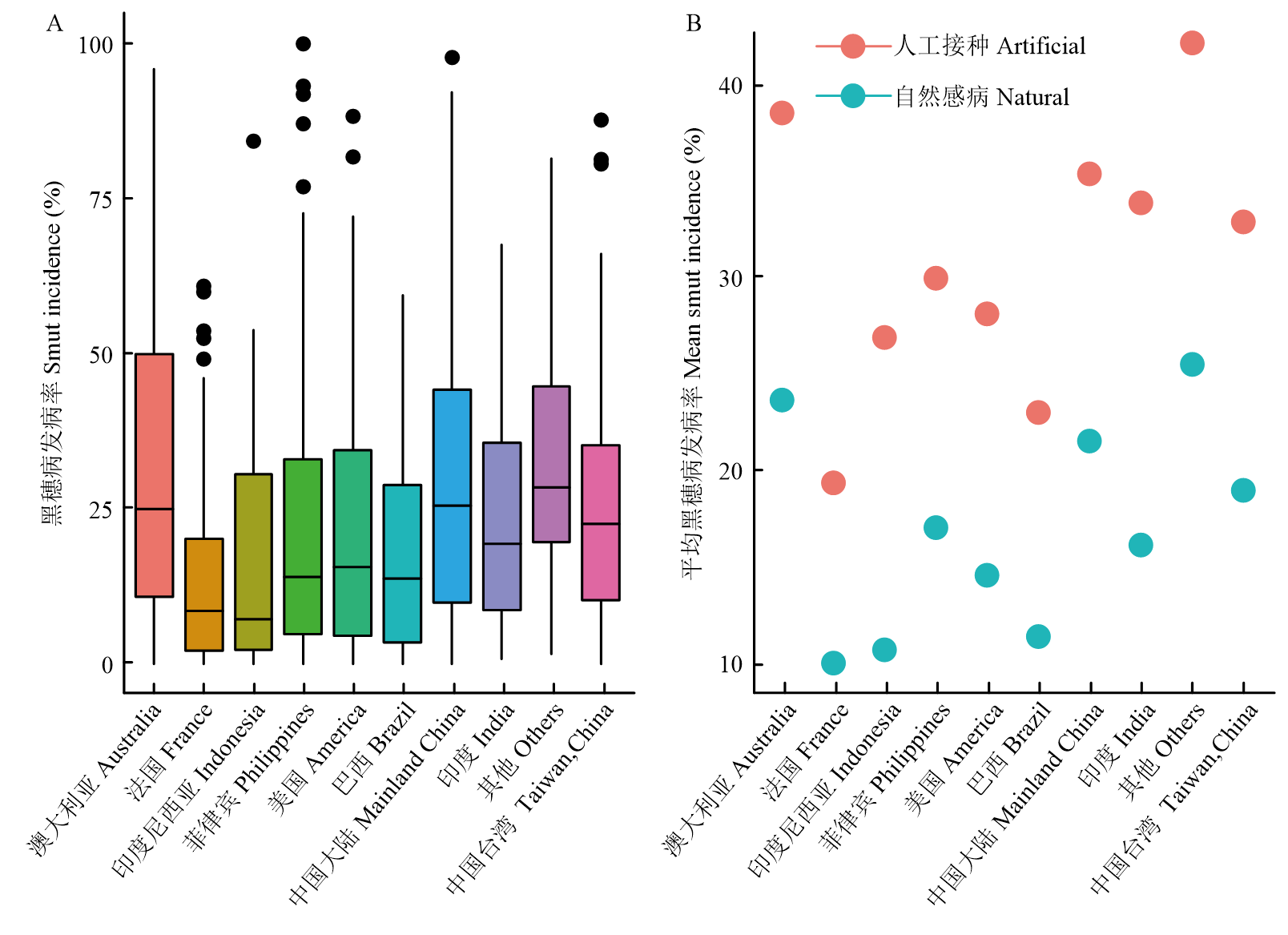
图3
不同来源甘蔗种质的黑穗病发病率 A:不同来源种质的发病率分布;B:不同来源种质不同处理的平均发病率分布"
表4
不同来源甘蔗品种抗性分布情况"
| 品种来源 Variety origin | 品种数量 Number of varieties | |||||
|---|---|---|---|---|---|---|
| HR | R | MR | MS | S | HS | |
| 美国America | 2 | 6 | 2 | 13 | 27 | 6 |
| 中国大陆Mainland China | 1 | 4 | 4 | 23 | 45 | 21 |
| 法国France | 1 | 1 | 2 | 8 | 5 | |
| 澳大利亚Australia | 2 | 1 | 5 | 18 | 11 | |
| 菲律宾The Philippines | 2 | 1 | 7 | 9 | 5 | |
| 印度尼西亚Indonesia | 1 | 1 | 1 | 1 | ||
| 巴西Brazil | 4 | 5 | 9 | |||
| 印度India | 2 | 5 | ||||
| 其他Others | 2 | 3 | 2 | |||
| 中国台湾Taiwan, China | 8 | 12 | 3 | |||
| 合计Total | 4 | 16 | 14 | 74 | 134 | 49 |
表5
20份抗黑穗病种质来源、发病率及其亲本信息"
| 品种名 Variety | 品种来源 Variety origin | 杂交组合 Hybridized combination | 平均发病率 Average incidence (%) | 综合抗病等级 Disease resistance grade | 综合抗病性 Disease resistance | |
|---|---|---|---|---|---|---|
| 人工接种 Artificial | 自然感病 Natural | |||||
| CP72-3709 | 美国America | — | 0.00 | 0.00 | 1 | HR |
| CP96-1252 | 美国America | CP90-1533×CP84-1198 | 0.93 | 2.94 | 1 | HR |
| FR93-910 | 法国France | — | 2.14 | 0.00 | 1 | HR |
| YZ02-2332 | 中国大陆Mainland China | CP70-321×XTT10 | 2.89 | 0.00 | 1 | HR |
| CP89-2143 | 美国America | CP81-1254×CP72-2086 | 0.00 | 5.61 | 2 | R |
| CP85-1308 | 美国America | R567×CP74-2013 | 1.92 | 3.54 | 2 | R |
| CP67-412 | 美国America | CP44-155×CP53-10 | 3.42 | 0.85 | 2 | R |
| VMC95-09 | 菲律宾The Philippines | Q90×PolyCross | 3.60 | 1.04 | 2 | R |
| FN91-21 | 中国大陆Mainland China | CP72-1210×ZZ74-141 | 4.53 | 8.43 | 2 | R |
| YZ89-151 | 中国大陆Mainland China | GZ64-137×NJ57-416 | 4.54 | 3.25 | 2 | R |
| VMC87-95 | 菲律宾The Philippines | VMC70-150×COK30 | 5.20 | 1.61 | 2 | R |
| Q124 | 法国France | NCO310×QN54-7096 | 2.46 | 6.67 | 3 | R |
| YZ06-80 | 中国大陆Mainland China | XTT25×CP72-3591 | 2.94 | 7.12 | 3 | R |
| YZ89-351 | 中国大陆Mainland China | YC82-96×GT11 | 6.28 | 2.08 | 3 | R |
| Q90 | 澳大利亚Australia | TROJAN×CO475 | 6.29 | 5.22 | 3 | R |
| POJ2878 | 印度尼西亚Indonesia | POJ2364×EK28 | 6.34 | 3.35 | 3 | R |
| HoCP96-540 | 美国America | LCP86-454×LCP85-384 | 6.42 | 5.53 | 3 | R |
| CP44-101 | 美国America | Co281×CP1165 | 7.21 | 4.04 | 3 | R |
| CP63-88 | 美国America | CP65-357×CP56-63 | 8.30 | 8.71 | 3 | R |
| Q75 | 澳大利亚Australia | CO475×POJ2878 | 8.53 | 1.28 | 3 | R |
| [1] |
Food and Agriculture Organization of the United Nations. FAOSTAT[EB/OL]. (2025-12-30)[2026-04-07]. http://www.fao.org/faostat/en/#data/QCL.
|
| [2] |
doi: 10.1371/journal.pone.0268781 |
| [3] |
张靖, 尤垂淮, 曹月, 崔天真, 杨靖涛, 罗俊. 甘蔗根际微生态及其与黑穗病防治之间的关系[J]. 生物技术通报, 2022, 38(11): 21-31.
doi: 10.13560/j.cnki.biotech.bull.1985.2022-0303 |
|
doi: 10.13560/j.cnki.biotech.bull.1985.2022-0303 |
|
| [4] |
doi: 10.3390/jof7121095 |
| [5] |
黄鸿能, 许玉娘. 在我国大陆开展甘蔗抗病育种初探[J]. 甘蔗糖业, 1994, 23(4): 5-10.
|
|
|
|
| [6] |
梁强, 刘晓燕, 李毅杰, 林丽, 王泽平, 李翔, 宋修鹏, 周会, 林善海, 李杨瑞. 2008—2017年甘蔗品种‘新台糖22号’在广西蔗区的消长分析[J]. 热带作物学报, 2021, 42(4): 982-990.
doi: 10.3969/j.issn.1000-2561.2021.04.011 |
|
|
|
| [7] |
doi: 10.1038/s41598-024-64810-1 |
| [8] |
DB45/T 2173-2020 甘蔗黑穗病综合防治技术规程[S/OL]. https://std.samr.gov.cn/db/search/stdDBDetailed?id=B44A19A5C24697B8E05397BE0A0AD002.
|
|
DB45/T 2173-2020 Technical code for integrated control of sugarcane smut[S/OL]. https://std.samr.gov.cn/db/search/stdDBDetailed?id=B44A19A5C24697B8E05397BE0A0AD002. (in Chinese)
|
|
| [9] |
|
| [10] |
doi: 10.1016/S0261-2194(02)00096-0 |
| [11] |
doi: 10.1590/S1982-56762014000500003 |
| [12] |
doi: 10.3389/fpls.2016.01133 pmid: 27516769 |
| [13] |
龚得明, 陈如凯, 林彦铨. 甘蔗抗黑穗病育种研究的进展[J]. 福建农学院学报, 1993, 22(4): 404-409.
|
|
|
|
| [14] |
许莉萍, 陈如凯. 甘蔗黑穗病及其抗病育种的现状与展望[J]. 福建农业学报, 2000, 15(2): 26-31.
|
|
|
|
| [15] |
王建南, 薛其清, 陈如凯, 许莉萍, 陈云水. 甘蔗抗黑穗病育种技术的研究——Ⅰ.品种抗病性鉴定技术的研究[J]. 甘蔗, 1994(3): 1-7.
|
|
|
|
| [16] |
夏红明, 胡鑫, 姚丽, 赵俊, 昝逢刚, 刘家勇, 赵丽萍, 吴才文, 杨昆, 覃伟, 赵勇, 陈学宽, 吴转娣, 赵培方. 新台糖系列品种后代实生苗甘蔗黑穗病抗性研究[J]. 中国糖料, 2019, 41(3): 19-22.
|
|
|
|
| [17] |
经艳, 周会, 刘昔辉, 谭芳, 张小秋, 张荣华, 宋修鹏, 李杨瑞, 颜梅新, 雷敬超, 覃振强, 罗亚伟, 李冬梅, 韦金菊. 桂糖甘蔗新品系黑穗病抗性鉴定及结果分析[J]. 热带作物学报, 2020, 41(2): 333-338.
doi: 10.3969/j.issn.1000-2561.2020.02.017 |
|
doi: 10.3969/j.issn.1000-2561.2020.02.017 |
|
| [18] |
沈万宽, 邓海华. 引进甘蔗品种黑穗病抗性鉴定及结果分析[J]. 中国农学通报, 2011, 27(19): 234-238.
|
|
|
|
| [19] |
郭强, 张木清, 黎正英, 唐利球, 秦昌鲜, 蒋洪涛, 马文清. 甘蔗优良品系对黑穗病的抗性鉴定与评价[J]. 植物保护, 2025, 51(2): 277-287.
|
|
|
|
| [20] |
陈双, 曾泽鉴, 沈万宽, 徐刚红, 吴夏明, 罗明珠, 陈培寿. 甘蔗亲本黑穗病抗性鉴定与评价[J]. 华北农学报, 2016, 31(增刊1): 432-437.
doi: 10.7668/hbnxb.2016.S1.073 |
|
doi: 10.7668/hbnxb.2016.S1.073 |
|
| [21] |
蔡文伟, 熊国如, 曾军, 彭李顺, 曹峥英, 杨本鹏. 10个甘蔗新品种在海南临高的丰产性及黑穗病抗性鉴定[J]. 种子, 2019, 38(8): 86-88.
|
|
|
|
| [22] |
陈庭俊, 林一心. 抗黑穗病甘蔗优异育种材料的鉴定[J]. 甘蔗糖业, 2001, 30(4): 9-11, 17.
|
|
|
|
| [23] |
胡鑫, 罗正英, 赵培方, 陆鑫, 赵丽萍, 刘洪博, 吴转娣, 赵勇, 张静, 任生林, 吴才文, 刘家勇. 甘蔗野生种割手密和大茎野生种的黑穗病抗性鉴定与评价[J]. 中国糖料, 2022, 44(3): 54-59.
|
|
|
|
| [24] |
胡鑫, 夏红明, 杨丽华, 吴转娣, 赵培方, 赵俊, 昝逢刚, 刘家勇, 赵丽萍, 覃伟, 赵勇, 姚丽, 陈学宽, 吴才文. 甘蔗新亲本材料的黑穗病抗性鉴定与评价[J]. 中国糖料, 2021, 43(1): 45-50.
|
|
|
|
| [25] |
王维赞, 何红, 朱秋珍, 黄冬发, 罗亚伟, 谢金兰, 梁阗. 引进甘蔗新品种对黑穗病抗性的鉴定[J]. 中国农学通报, 2010, 26(16): 285-288.
|
|
doi: 10.11924/j.issn.1000-6850.2010-0654 |
|
| [26] |
沈万宽, 杨湛端, 刘福业. 甘蔗品种(品系)对黑穗病的抗性鉴定与评价[J]. 华中农业大学学报, 2014, 33(5): 40-44.
|
|
|
|
| [27] |
段维兴, 张保青, 周珊, 黄玉新, 王泽平, 高轶静, 杨翠芳, 林善海, 张革民. 甘蔗与河八王杂交BC1对黑穗病的抗性鉴定与初步评价[J]. 中国农业大学学报, 2018, 23(3): 29-37.
|
|
|
|
| [28] |
李毅杰, 段维兴, 黄志, 王泽平, 李文教, 韦开军, 陆文娟, 林善海. 广西甘蔗生长中期主要病虫害发生与抗病性评价[J]. 广东农业科学, 2016, 43(6): 127-131.
|
|
|
|
| [29] |
熊国如, 蔡文伟, 王文治, 伍苏然, 杨本鹏, 张树珍. 23个甘蔗品种对甘蔗黑穗病的抗性测定[J]. 中国糖料, 2016, 38(1): 13-14, 18.
|
|
|
|
| [30] |
秦昌鲜, 闭德金, 彭崇, 郭强, 唐利球, 马文清, 施泽升. 广西区试甘蔗品种(系)的自然抗性评价[J]. 广西糖业, 2020, 40(4): 22-25.
|
|
|
|
| [31] |
林善海, 黄海荣, 梁文燊, 梁强, 高轶静, 叶权, 李毅杰, 黄诚华, 谭宏伟, 宋修鹏. 黑穗病菌1号生理小种致病力及甘蔗杂交材料的抗性评价[J]. 广西糖业, 2020, 40(5): 7-15.
|
|
|
|
| [32] |
|
| [33] |
|
| [34] |
|
| [35] |
韦金菊, 宋修鹏, 魏春燕, 张小秋, 黄伟华, 颜梅新. 甘蔗黑穗病及其防治研究进展[J]. 广东农业科学, 2019, 46(4): 81-88.
|
|
|
|
| [36] |
杨荣仲, 周会, 李文教, 黄赞斌, 唐仕云, 雷敬超, 刘昔辉, 梁强, 黄海荣. 甘蔗重要亲本田间自然抗黑穗病测定[J]. 中国糖料, 2022, 44(2): 51-57.
|
|
|
|
| [37] |
沈万宽, 姜子德, 邓海华, 刘睿. 甘蔗黑穗病及其病原菌研究进展[J]. 热带作物学报, 2013, 34(10): 2063-2068.
|
|
|
|
| [38] |
唐亮东. 广西甘蔗糖业高质量发展新途径探讨[J]. 甘蔗糖业, 2023, 52(6): 63-68.
|
|
|
|
| [39] |
吴才文, 武晋宇, 赵培方, 昝逢刚, 赵俊, 刘家勇, 姚丽, 任生林, 张跃彬. 云南甘蔗品种培育应用及对产业的贡献[J]. 中国糖料, 2025, 47(3): 84-94.
|
|
|
|
| [40] |
刘晓, 蓝艳华, 蔡裕洋, 安玉兴. 从传统杂交到智能设计: 中国甘蔗育种的路径演进与技术革新[J]. 中国糖料, 2026, 48(1): 16-23.
|
|
|
|
| [41] |
赵婷婷, 孙婷婷, 王俊刚, 王文治, 冯翠莲, 刘新龙, 甘仪梅, 赵培方, 徐超华, 林继山, 曹峥英, 张树珍. 甘蔗育种研究进展[J]. 中国科学: 生命科学, 2024, 54(10): 1814-1832.
|
|
|
|
| [42] |
吴才文, 赵培方, 夏红明. 现代甘蔗杂交育种及选择技术[M]. 北京: 科学出版社, 2014.
|
|
|
|
| [43] |
王勤南, 陈俊吕, 张伟, 常海龙, 吉家乐, 邱永生, 刘少谋. 甘蔗细茎野生种质资源叶绿素荧光特性比较及聚类分析[J]. 广东农业科学, 2017, 44(5): 19-25.
|
|
|
|
| [44] |
柴进, 余凡, 谢树伟, 黄飞, 邓祖湖, 杨永庆. 甘蔗割手密高贵化育种中分子细胞遗传学研究进展[J]. 华北农学报, 2019, 34(增刊1): 386-393.
|
|
|
|
| [45] |
刘家勇, 邓祖湖, 吴才文, 桃联安, 陆鑫, 赵培方, 张跃彬. 甘蔗属野生种割手密的育种利用进展与探讨[J]. 植物遗传资源学报, 2021, 22(6): 1491-1497.
doi: 10.13430/j.cnki.jpgr. 20210428002 |
|
|
|
| [46] |
doi: 10.2135/cropsci1983.0011183X002300010016x |
| [47] |
doi: 10.1007/BF00265601 |
| [48] |
|
| [49] |
|
| [50] |
刘家勇, 昝逢刚, 赵培方, 赵丽萍, 姚丽, 赵俊, 赵勇, 胡鑫, 夏红明, 覃伟, 吴才文, 张跃彬, 杨昆. 甘蔗种质资源蔗糖分性状遗传变异分析及高糖种质发掘[J]. 植物遗传资源学报, 2022, 23(3): 746-754.
doi: 10.13430/j.cnki.jpgr.20211109002 |
|
|
|
| [51] |
doi: 10.3389/fpls.2022.1035266 |
| [52] |
doi: 10.3390/life12081201 |
| [53] |
doi: 10.3389/fpls.2021.796189 |
| [54] |
doi: 10.1111/pbi.70084 pmid: 40203189 |
| [55] |
doi: 10.1007/s00299-025-03555-1 |
| [56] |
doi: 10.1186/s12870-023-04446-x |
| [57] |
doi: 10.3390/plants12040810 |
| [58] |
doi: 10.1016/j.ijbiomac.2022.11.300 |
| [59] |
doi: 10.3389/fmicb.2025.1586720 |
| [60] |
doi: 10.1016/j.plaphy.2025.109630 |
| [1] | 陈敏氡, 裘波音, 黄昊, 李永平, 温庆放. 松花菜种质花球质地品质的评价[J]. 中国农业科学, 2026, 59(6): 1302-1316. |
| [2] | 陈敏, 焦紫岚, 乔承彬, 许昊, 张碧, 马东花, 孔维儒, 王敬文, 宋佳伟, 罗成科, 李培富, 田蕾. 不同亚种水稻种质资源对盐胁迫的形态生理响应及适应策略[J]. 中国农业科学, 2026, 59(4): 705-722. |
| [3] | 何治霖, 孙翠霞, 岳红丽, 谈月霞, 张耀海, 王福生, 刘思涛, 江东. 基于重测序枸橼、柠檬类种质资源的遗传多样性分析和别罗勒烯的全基因组关联分析[J]. 中国农业科学, 2026, 59(2): 386-401. |
| [4] | 贾亚雄, 杨卫芳, 刘涛, 王迪, 刘孟超, 陈天金, 侯水生. 我国畜禽种质资源国际交流安全面临的挑战和风险[J]. 中国农业科学, 2026, 59(17): 3907-3919. |
| [5] | 邓军, 艾静, 王禹童, 刀静梅, 赵勇, 叶松, 邓燕, 张福锁. 长期连作蔗地土壤养分时空分异特征的产量限制因子识别[J]. 中国农业科学, 2026, 59(16): 3541-3555. |
| [6] | 丁倩, 何丽莲, 钱禛锋, 吴期滨, 赵昌祖, 林佩霞, 农韦优, 王誉洁, 张媛媛, 阙友雄, 李富生. 不同甘蔗品种/系脱叶性综合评价及叶鞘离区细胞形态和生理差异分析[J]. 中国农业科学, 2026, 59(15): 3315-3327. |
| [7] | 冯亚青, 孙亚涵, 周巧慧, 林芃, 李佳翌, 王惠申, 刘涛, 刘占德, 王南南. 猕猴桃种质资源对缺铁渍水复合胁迫的耐性筛选评价及生理差异分析[J]. 中国农业科学, 2026, 59(15): 3387-3399. |
| [8] | 马亚珺, 严雅军, 杨炜迪, 杨天辉, 王川, 高婷. 饲用小黑麦种质资源创新与综合利用研究进展[J]. 中国农业科学, 2026, 59(14): 2993-3005. |
| [9] | 谢永祥, 潘怡敏, 黄蕊, 秦慧彬, 侯森, 贺强, 凌亮, 穆志新, 王海岗. 山西谷子种质资源耐瘠性鉴定及综合评价[J]. 中国农业科学, 2026, 59(11): 2325-2339. |
| [10] | 张悦青, 张玉亭, 薛晨飞, 韩秦宇, 贺一容, 徐紫娟, 范秀梅, 王军娥, 罗丹, 冯雪, 孙胜. 364份樱桃番茄种质资源表型性状的遗传多样性分析及综合评价[J]. 中国农业科学, 2026, 59(11): 2468-2483. |
| [11] | 吕涛, 孙国清, 郭栋材, 陈全家, 蔡永生, 樊标星, 曲延英, 郑凯. 海岛棉纤维强度QTL紧密连锁InDel分子标记开发及效应评价[J]. 中国农业科学, 2025, 58(9): 1684-1701. |
| [12] | 岳润清, 李文兰, 丁照华, 孟昭东. 转基因复合抗虫耐除草剂玉米LD05的分子特征及抗性评价[J]. 中国农业科学, 2025, 58(7): 1269-1283. |
| [13] | 陈彩锦, 马琳, 蒋庆雪, 刘金晖, 苗童, 张志鹏, 孟翔, 马晓冉, 周昕越, 张建, 刘文辉, 王学敏. 244份饲用燕麦种质资源表型性状遗传多样性分析[J]. 中国农业科学, 2025, 58(23): 4825-4836. |
| [14] | 陈天晓, 曹榕, 宋倩楠, 胡亮亮, 王素华, 王丽侠, 程须珍, 陈红霖. 小豆种质资源苗期耐盐性综合评价及耐盐种质筛选[J]. 中国农业科学, 2025, 58(21): 4317-4332. |
| [15] | 张帆, 杨青川. 紫花苜蓿育种历史、现状与展望[J]. 中国农业科学, 2025, 58(21): 4471-4481. |
|
||
