






中国农业科学 ›› 2026, Vol. 59 ›› Issue (20): 4570-4587.doi: 10.3864/j.issn.0578-1752.2026.20.010
李红旭1( ), 唐佳欣1, 王玮1, 张芳2, 曹刚1, 曹素芳1
收稿日期:2026-02-14
接受日期:2026-04-17
出版日期:2026-10-16
发布日期:2026-10-21
联系方式:
李红旭,E-mail:281512817@qq.com
基金资助:
LI HongXu1(), TANG JiaXin1, WANG Wei1, ZHANG Fang2, CAO Gang1, CAO SuFang1
Received:2026-02-14
Accepted:2026-04-17
Published:2026-10-16
Online:2026-10-21
摘要:
【目的】系统解析甘肃特色秋子梨品种后熟过程中香气物质的变化规律及其与果实软化的关联,筛选品种特征标志香气成分,为采后品质调控提供理论依据。【方法】以5个品种秋子梨(‘临洮麻软儿’‘武山香水梨’‘兰州软儿梨’‘东乡黄软儿’‘临洮黄软儿’)采后0、4、8、12、16和20 d共6个后熟阶段的果实为材料(每品种、每阶段3次重复),采用顶空固相微萃取(45 ℃萃取60 min)结合气相色谱-质谱联用(HS-SPME-GC-MS)技术定量分析挥发性香气物质种类及含量;通过主成分分析(PCA)、偏最小二乘判别分析(PLS-DA)及香气活性值(OAV)等方法探明各品种香气物质代谢差异,并筛选关键标志香气;同步测定果实硬度、可溶性固形物含量及色差参数。【结果】共鉴定出161种挥发性组分,包括酯类(68种)、醇类(23种)、烯类(15种)等9大类。总香气含量排序为:‘临洮麻软儿’>‘兰州软儿梨’>‘东乡黄软儿’>‘临洮黄软儿’>‘武山香水梨’,前4个品种的香气以酯类为主,占比78.88%—85.36%,己酸乙酯为核心标志物;‘武山香水梨’则以醛类(正己醛为主)和烯类(紫罗烯为主)为主,占比达30.02%,酯类仅21.94%,呈现独特的“青草”风味。后熟过程中,酯类含量呈先升后降趋势,峰值集中于后熟中期(采后8—12 d);‘武山香水梨’酯类持续维持低位,而烯和醛类在后熟后期激增。己酸乙酯、丁酸乙酯、2-甲基丁酸乙酯、紫罗烯、己醛和β-大马酮的香气活性值(OAV)在部分品种中高于100,是甘肃秋子梨中的关键香气成分。后熟20 d内,5个品种单果重下降4.47%—7.60%,硬度显著降低,‘武山香水梨’保持最高硬度,为2.45 kg·cm-2;‘临洮黄软儿’最低,为1.15 kg·cm-2。可溶性固形物含量均值最高的是‘东乡黄软儿’,为14.89%;最低的是‘兰州软儿梨’,为11.66%。随后熟时间延长,‘武山香水梨’失重率最高,但硬度最大,‘临洮黄软儿’硬度最小;果皮颜色向黄色调转变,明度除‘临洮黄软儿’外均上升,‘武山香水梨’色调变化最显著。【结论】后熟中期(采后8—12 d)是酯类合成积累的关键阶段。甘肃秋子梨可分为以己酸乙酯为标志的“酯类主导型”和以正己醛、紫罗烯为特征的“醛烯主导型”两种香气代谢模式,‘武山香水梨’代谢通路显著区别于其他品种。明确了己酸乙酯、丁酸乙酯、2-甲基丁酸乙酯、紫罗烯、己醛和β-大马酮为甘肃秋子梨标志性香气物质。
李红旭, 唐佳欣, 王玮, 张芳, 曹刚, 曹素芳. 甘肃秋子梨后熟过程香气代谢分型与品质特征[J]. 中国农业科学, 2026, 59(20): 4570-4587.
LI HongXu, TANG JiaXin, WANG Wei, ZHANG Fang, CAO Gang, CAO SuFang. Aroma Metabolic Typing and Quality Characteristic of Gansu Pyrus ussuriensis During Postharvest Ripening[J]. Scientia Agricultura Sinica, 2026, 59(20): 4570-4587.
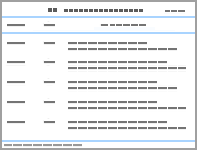
表1
5个品种梨不同后熟期产生挥发性香气物质种类和含量"
| 品种 Cultivar | 后熟期 Post- ripening stage | 酯类Esters | 醇类Alcohols | 烯类Alkenes | 醛类Aldehydes | 酮类Ketones | 酚类Phenols | 烷烃类Hydrocarbons | 酸类Acids | 其他类Others | |||||||||
|---|---|---|---|---|---|---|---|---|---|---|---|---|---|---|---|---|---|---|---|
| 含量 Contents (μg·kg-1) | 种类 Types | 含量 Contents (μg·kg-1) | 种类 Types | 含量 Contents (μg·kg-1) | 种类 Types | 含量 Contents (μg·kg-1) | 种类 Types | 含量 Contents (μg·kg-1) | 种类 Types | 含量 Contents (μg·kg-1) | 种类 Types | 含量 Contents (μg·kg-1) | 种类 Types | 含量 Contents (μg·kg-1) | 种类 Types | 含量 Contents (μg·kg-1) | 种类 Types | ||
| 临洮麻软儿 Lintao Maruaner | 0 d | 1325.6 | 20 | 227.7 | 8 | 65.6 | 4 | 212.8 | 3 | 25.9 | 3 | 49.7 | 4 | - | - | 11.8 | 2 | 1.8 | 1 |
| 4 d | 4835.9 | 29 | 292.3 | 9 | 120.3 | 5 | 67.4 | 4 | 26.5 | 2 | 39.4 | 4 | - | - | - | - | 162.4 | 8 | |
| 8 d | 5686.3 | 34 | 233.6 | 6 | 164.6 | 5 | 96.1 | 3 | 24.4 | 2 | 34.0 | 5 | - | - | - | - | 121.4 | 6 | |
| 12 d | 3753.6 | 32 | 188.9 | 6 | 35.3 | 3 | 213.1 | 5 | 3.0 | 1 | 17.2 | 4 | 26.5 | 1 | - | - | 187.8 | 7 | |
| 16 d | 1997.3 | 30 | 171.7 | 6 | 215.4 | 4 | 91.8 | 3 | 690.6 | 3 | 5.9 | 1 | 236.5 | 4 | - | - | 106.4 | 6 | |
| 20 d | 2597.2 | 28 | 167.8 | 4 | 82.0 | 4 | 81.3 | 3 | 472.7 | 2 | 1.7 | 1 | 256.8 | 4 | - | - | 19.1 | 5 | |
| 东乡黄软儿 Dongxiang Huangruaner | 0 d | 930.6 | 18 | 205.7 | 7 | 71.3 | 2 | 178.0 | 4 | 6.0 | 1 | 32.4 | 3 | - | - | - | - | 6.5 | 1 |
| 4 d | 2822.3 | 21 | 303.2 | 8 | 84.4 | 2 | 93.7 | 2 | 3.8 | 1 | 13.2 | 3 | - | - | - | - | 82.2 | 3 | |
| 8 d | 4652.7 | 34 | 266.1 | 6 | 91.8 | 2 | 59.3 | 3 | - | - | 12.1 | 3 | 4.0 | 1 | - | - | 177.5 | 5 | |
| 12 d | 5119.1 | 34 | 377.5 | 7 | 172.9 | 2 | 67.3 | 3 | - | - | 13.3 | 3 | 10.5 | 2 | - | - | 213.5 | 5 | |
| 16 d | 4789.1 | 33 | 197.0 | 7 | 160.5 | 3 | 79.2 | 3 | 12.0 | 3 | 26.8 | 2 | 6.4 | 1 | - | - | 44.4 | 4 | |
| 20 d | 1977.2 | 28 | 169.2 | 6 | 100.1 | 2 | 64.3 | 3 | 4.1 | 2 | 10.2 | 2 | - | - | - | - | 60.5 | 3 | |
| 临洮黄软儿 Lintao Huangruaner | 0 d | 2160.6 | 21 | 343.4 | 7 | 108.7 | 4 | 173.0 | 3 | 7.6 | 2 | 26.8 | 4 | - | - | - | - | 71.7 | 7 |
| 4 d | 4033.6 | 30 | 286.8 | 7 | 160.9 | 5 | 132.2 | 3 | 5.7 | 1 | 30.6 | 6 | - | - | - | - | 30.2 | 8 | |
| 8 d | 4663.3 | 39 | 276.7 | 7 | 93.2 | 3 | 55.6 | 3 | 1.4 | 1 | 23.7 | 4 | 2.5 | 1 | - | - | 292.6 | 6 | |
| 12 d | 3193.9 | 19 | 229.0 | 4 | 79.7 | 1 | 27.5 | 1 | - | - | 6.4 | 1 | - | - | - | - | 67.5 | 1 | |
| 16 d | 2949.4 | 17 | 178.6 | 4 | 120.4 | 1 | 48.3 | 2 | - | - | 4.5 | 1 | - | - | - | - | 66.2 | 2 | |
| 20 d | 1687.8 | 15 | 130.0 | 3 | 56.2 | 1 | 113.7 | 3 | - | - | 35.4 | 3 | - | - | - | - | 78.6 | 2 | |
| 武山香水梨 Wushan Xiangshuili | 0 d | 829.3 | 17 | 144.9 | 5 | 54.6 | 4 | 280.7 | 3 | 67.1 | 1 | 18.6 | 2 | 466.8 | 2 | - | - | 176.5 | 5 |
| 4 d | 421.9 | 12 | 154.9 | 6 | 27.0 | 3 | 95.6 | 4 | 112.7 | 2 | 12.5 | 2 | 240.8 | 3 | - | - | 186.2 | 7 | |
| 8 d | 397.8 | 14 | 98.9 | 6 | 646.7 | 5 | 662.5 | 2 | 74.8 | 2 | 14.1 | 3 | 34.7 | 3 | - | - | 348.5 | 4 | |
| 12 d | 468.3 | 13 | 87.5 | 5 | 769.9 | 4 | 909.9 | 4 | 77.4 | 2 | 12.1 | 2 | 23.5 | 2 | - | - | 275.6 | 8 | |
| 16 d | 441.4 | 13 | 312.7 | 7 | 410.1 | 6 | 605.6 | 2 | 78.2 | 3 | 12.8 | 2 | 18.7 | 3 | - | - | 822.6 | 9 | |
| 20 d | 619.1 | 16 | 364.1 | 6 | 1259.5 | 6 | 878.5 | 2 | 126.1 | 4 | 17.6 | 2 | 27.1 | 2 | - | - | 239.6 | 9 | |
| 兰州 软儿梨 Lanzhou Ruanerli | 0 d | 815.0 | 12 | 250.1 | 8 | 191.3 | 4 | 337.8 | 2 | 22.2 | 2 | 10.3 | 1 | - | - | 16.3 | 1 | 106.3 | 7 |
| 4 d | 2158.8 | 16 | 295.4 | 6 | 59.9 | 3 | 167.8 | 3 | 16.3 | 2 | 10.7 | 2 | - | - | - | - | 75.2 | 3 | |
| 8 d | 4266.0 | 26 | 253.2 | 6 | 74.7 | 5 | 85.1 | 3 | 23.8 | 3 | 13.7 | 3 | 18.4 | 1 | - | - | 85.1 | 6 | |
| 12 d | 3994.5 | 27 | 223.6 | 8 | 260.0 | 5 | 75.1 | 2 | 7.1 | 2 | 15.5 | 2 | 45.5 | 2 | - | - | 108.3 | 5 | |
| 16 d | 4300.9 | 28 | 230.5 | 8 | 75.6 | 4 | 261.8 | 3 | 33.1 | 4 | 9.3 | 1 | 361.6 | 1 | - | - | 75.2 | 3 | |
| 20 d | 3842.5 | 25 | 231.4 | 8 | 350.7 | 3 | 191.8 | 2 | 22.3 | 2 | 12.6 | 2 | 20.4 | 1 | - | - | 99.2 | 6 | |

图1
5个品种梨在后熟期产生挥发性香气物质总含量(a)、种类(b)和不同后熟期挥发性香气物质含量(c) A:‘临洮麻软儿梨’;G:‘武山香水梨’;H:‘兰州软儿梨’;B:‘东乡黄软儿梨’;C:‘临洮黄软儿梨’。下同"
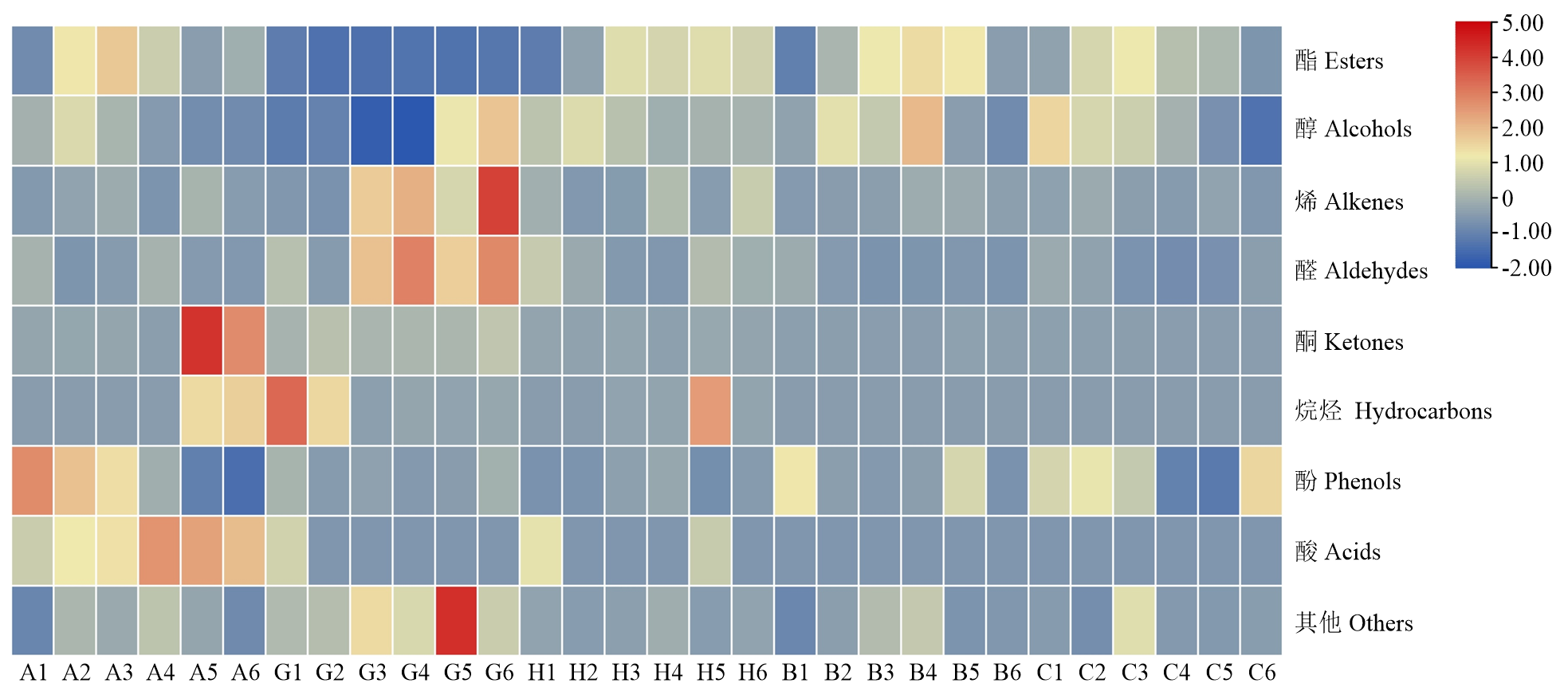
图2
5个品种梨不同后熟期产生挥发性香气物质种类和含量变化 A1—A6分别代表品种A后熟期0、4、8、12、16和20 d共6个阶段,其他品种依此类推。下同"

图3
5个梨品种在不同后熟期产生共有挥发性香气物质含量变化热图 *Ethyl 2-(5-methyl-5-vinyltetrahydrofuran-2-yl) propan-2-yl carbonate,无正式中文译名,PubChem CID:91694113"

图4
5个梨品种不同后熟期产生的全部挥发性香气物质"

图5
5个梨品种中挥发性香气物质的PCA分析(a)、PLS-DA分析(b)、模型交叉验证(c)和置换检验(d)结果"
表2
甘肃秋子梨10种挥发性香气物质的OAV和气味描述"
| CAS号 CAS | 挥发性香气 物质 VOCs | 气味 阈值[ Odor threshold (μg·kg-1) | 气味描述 Odor description | OAV值 OAV value | ||||||||||||||||||||||||||||||||||||||
|---|---|---|---|---|---|---|---|---|---|---|---|---|---|---|---|---|---|---|---|---|---|---|---|---|---|---|---|---|---|---|---|---|---|---|---|---|---|---|---|---|---|---|
| 东乡黄软儿 Dongxiang Huangruaner | 平均 Average | 临洮黄软儿 Lintao Huangruaner | 平均 Average | 兰州软儿梨 Lanzhou Ruanerli | 平均 Average | |||||||||||||||||||||||||||||||||||||
| 后熟前期 Early stage | 后熟中期 Mid-stage | 后熟后期 Late stage | 后熟前期 Early stage | 后熟中期 Mid-stage | 后熟后期 Late stage | 后熟前期 Early stage | 后熟中期 Mid-stage | 后熟后期 Late stage | ||||||||||||||||||||||||||||||||||
| B1 | B2 | B3 | B4 | B5 | B6 | C1 | C2 | C3 | C4 | C5 | C6 | H1 | H2 | H3 | H4 | H5 | H6 | |||||||||||||||||||||||||
| 123-66-0 | 己酸乙酯 Ethyl hexanoate | 5 | 甜香,果香,菠萝 Sweet, fruity, pineapple | 47.89 | 111.27 | 289.99 | 287.71 | 280.87 | 73.07 | 181.80 | 99.01 | 179.77 | 259.77 | 179.77 | 170.27 | 68.03 | 159.44 | 22.94 | 72.46 | 238.87 | 215.91 | 269.37 | 219.11 | 173.11 | ||||||||||||||||||
| 105-54-4 | 丁酸乙酯 Ethyl butyrate | 0.5 | 多汁,果香,干邑白兰地 Fruity, juicy, cognac | 219.13 | 1284.62 | 2208.18 | 2170.17 | 1535.46 | 725.92 | 1357.25 | 526.39 | 1835.71 | 1676.09 | 1470.85 | 1176.30 | 657.51 | 1223.81 | 233.05 | 613.12 | 1009.09 | 1015.36 | 1396.21 | 1016.10 | 880.49 | ||||||||||||||||||
| 7452- 79-1 | 2-甲基丁酸乙酯 Ethyl 2-methyl butyrate | 0.013 | 浓郁甜香, 青苹果果香 Sharp sweet, green apple | 1387.64 | 2293.89 | 6724.25 | 6454.22 | 3439.74 | 3519.90 | 3969.94 | 1705.14 | 3872.48 | 5145.52 | 4994.57 | 4527.95 | 3967.02 | 4035.45 | - | 452.75 | 1975.48 | 1774.75 | 2225.92 | 2406.77 | 1472.61 | ||||||||||||||||||
| 123-92-2 | 乙酸异戊酯 Isoamyl acetate | 2 | 甜香,果香,香蕉 Sweet, fruity, banana | - | - | 3.80 | 17.85 | 14.15 | 12.59 | 8.07 | - | - | 9.62 | 13.28 | 14.02 | 5.14 | 7.01 | - | - | - | - | 5.70 | - | 0.95 | ||||||||||||||||||
| 868-57-5 | 2-甲基丁酸甲酯 Methyl 2- methyl butyrate | 0.25 | 青草香,苹果,脂香 Green, apple, fatty | - | - | 99.56 | 105.51 | - | 52.88 | 42.99 | - | 50.02 | 129.21 | - | - | - | 29.87 | - | - | - | - | - | - | - | ||||||||||||||||||
| 78-70-6 | 芳樟醇 Linalool | 0.22 | 柑橘,花香,青草香 Citrus, floral, green | 54.39 | 55.10 | 73.23 | 51.44 | 70.11 | 43.13 | 57.90 | 80.34 | 77.33 | 67.18 | 66.05 | 72.72 | 55.54 | 69.86 | 53.60 | 64.95 | 43.59 | 66.76 | 55.07 | 53.74 | 56.29 | ||||||||||||||||||
| 475-03-6 | 紫罗烯 α-ionene | 2 | 果香 Fruity | 9.95 | 23.18 | 40.07 | 82.07 | 74.35 | 47.21 | 46.14 | 28.60 | 57.27 | 41.04 | 39.86 | 60.19 | 28.12 | 42.52 | 38.73 | 1.51 | - | 116.70 | 7.91 | 151.01 | 52.64 | ||||||||||||||||||
| 66-25-1 | 己醛 Hexanal | 5 | 青草香,叶香,果香 Green, leafy, fruity | 17.49 | 16.22 | 6.77 | 7.10 | 12.16 | 6.66 | 11.07 | 23.10 | 22.19 | 6.38 | 5.50 | 6.82 | 7.56 | 11.92 | 52.36 | 29.02 | 12.94 | 12.55 | 21.64 | 36.09 | 27.43 | ||||||||||||||||||
| 23726-93-4 | β-大马酮 β-damascenone | 0.002 | 苹果,玫瑰,甜香 Apple, rose, sweet | - | - | - | - | - | - | - | - | - | - | - | - | - | - | 8932.82 | 5811.51 | 8535.51 | - | 9208.10 | 8325.19 | 6802.19 | ||||||||||||||||||
| 97-53-0 | 丁香酚 Eugenol | 0.71 | 甜香,木质 Sweet, woody | 5.61 | 3.95 | - | - | - | - | 1.59 | 6.60 | 2.44 | - | - | - | - | 1.51 | - | - | - | - | - | - | - | ||||||||||||||||||
| CAS号 CAS | 挥发性香气 物质 VOCs | 气味阈值 Odor threshold (μg·kg-1) | 气味描述 Odor descriptions | OAV值 OAV value | ||||||||||||||||||||||||||||||||||||||
| 临洮麻软儿 Lintao Maruaner | 平均Average | 武山香水梨 Wushan Xiangshuili | 平均Average | |||||||||||||||||||||||||||||||||||||||
| 后熟前期 Early stage | 后熟中期 Mid-stage | 后熟后期 Late stage | 后熟前期 Early stage | 后熟中期 Mid-stage | 后熟后期 Late stage | |||||||||||||||||||||||||||||||||||||
| A1 | A2 | A3 | A4 | A5 | A6 | G1 | G2 | G3 | G4 | G5 | G6 | |||||||||||||||||||||||||||||||
| 123-66-0 | 己酸乙酯 Ethyl hexanoate | 5 | 甜香,果香,菠萝 Sweet, fruity, pineapple | 52.16 | 276.38 | 361.09 | 172.48 | - | - | 143.68 | - | - | 8.45 | 12.05 | 9.91 | 12.51 | 7.15 | |||||||||||||||||||||||||
| 105-54-4 | 丁酸乙酯 Ethyl butyrate | 0.5 | 多汁,果香,干邑白 兰地 Fruity, juicy, cognac | 223.51 | 2573.79 | 2069.33 | 1565.95 | 1011.01 | 1147.47 | 1431.84 | 18.98 | 29.41 | 48.38 | 121.61 | 64.15 | 68.81 | 58.56 | |||||||||||||||||||||||||
| 7452- 79-1 | 2-甲基丁酸 乙酯 Ethyl 2-methyl butyrate | 0.013 | 浓郁甜香,青苹果果香 Sharp sweet, green apple | 1655.91 | 5435.25 | 5684.23 | 5851.25 | 4175.79 | 3793.80 | 4432.70 | 320.00 | 349.44 | 462.84 | 412.05 | 460.81 | 432.45 | 406.27 | |||||||||||||||||||||||||
| 123-92-2 | 乙酸异戊酯 Isoamyl acetate | 2 | 甜香,果香,香蕉 Sweet, fruity, banana | - | 8.93 | 9.77 | 16.10 | 14.94 | 12.71 | 10.41 | 6.39 | - | - | - | - | - | 1.07 | |||||||||||||||||||||||||
| 868-57-5 | 2-甲基丁酸 甲酯 Methyl 2- methyl butyrate | 0.25 | 青草香,苹果,脂香 Green, apple, fatty | - | - | - | - | - | - | - | - | - | - | - | - | - | - | |||||||||||||||||||||||||
| 78-70-6 | 芳樟醇 Linalool | 0.22 | 柑橘,花香,青草香 Citrus, floral, green | 57.46 | 69.27 | 64.51 | 40.69 | - | - | 38.66 | - | 11.90 | - | - | 22.75 | - | 5.77 | |||||||||||||||||||||||||
| 475-03-6 | 紫罗烯 Alpha-ionene | 2 | 果香 Fruity | 11.41 | 44.80 | 70.55 | 4.07 | 7.59 | 5.10 | 23.92 | 2.49 | 2.65 | 180.34 | 213.30 | 50.65 | 466.14 | 152.60 | |||||||||||||||||||||||||
| 66-25-1 | 己醛 Hexanal | 5 | 青草香,叶香,果香 Green, leafy, fruity | 12.87 | 9.15 | 10.97 | 5.29 | 5.94 | 5.21 | 8.24 | 53.14 | 8.13 | 127.93 | 176.27 | 117.20 | 174.71 | 109.56 | |||||||||||||||||||||||||
| 23726-93-4 | β-大马酮 β-damascenone | 0.002 | 苹果,玫瑰,甜香 Apple, rose, sweet | 8716.44 | - | 10947.18 | - | 1186.61 | - | 3475.04 | - | 2395.49 | 35125.26 | 35813.42 | 34797.76 | 43000.70 | 25188.77 | |||||||||||||||||||||||||
| 97-53-0 | 丁香酚 Eugenol | 0.71 | 甜香,木质 Sweet, woody | 11.56 | 8.29 | 5.92 | 8.54 | - | - | 5.72 | - | - | 8.54 | - | - | - | 1.42 | |||||||||||||||||||||||||
表3
后熟期间5个梨品种果实质地变化"
| 基础指标 Basic indicator | 品种 Cultivar | 后熟期 Post-ripening stage (d) | |||||
|---|---|---|---|---|---|---|---|
| 0 | 4 | 8 | 12 | 16 | 20 | ||
| 单果重 Weight (g) | 临洮麻软儿Lintao Maruaner | 189.03±14.57a | 187.05±14.33a | 184.43±13.94a | 182.10±13.65a | 180.55±13.95a | 178.95±14.09a |
| 东乡黄软儿Dongxiang Huangruaner | 194.40±12.30a | 192.45±11.97a | 190.08±11.60a | 188.15±11.25a | 186.70±11.33a | 185.05±11.29a | |
| 临洮黄软儿Lintao Huangruaner | 198.08±19.74a | 196.38±19.38a | 194.25±19.04a | 192.53±19.00a | 190.88±18.52a | 189.23±18.26a | |
| 武山香水梨Wushan Xiangshuili | 206.45±33.07a | 203.20±32.62a | 199.18±32.04a | 195.88±31.52a | 193.20±31.27a | 190.75±30.88a | |
| 兰州软儿梨Lanzhou Ruanerli | 201.50±22.42a | 199.63±22.36a | 197.43±22.12a | 195.15±21.64a | 193.45±21.45a | 191.73±21.26a | |
| 硬度 Hardness (kg·cm-2) | 临洮麻软儿Lintao Maruaner | 10.20±0.64bc | 3.70±1.51b | 1.79±0.58bc | 1.65±0.37b | 1.28±0.55b | 1.45±0.19bc |
| 东乡黄软儿Dongxiang Huangruaner | 11.05±1.41b | 7.05±1.36a | 1.95±0.25bc | 1.58±0.29b | 1.40±0.32b | 1.33±0.13c | |
| 临洮黄软儿Lintao Huangruaner | 9.28±0.32c | 3.30±1.22b | 1.55±0.19c | 1.58±0.57b | 1.28±0.22b | 1.15±0.31c | |
| 武山香水梨Wushan Xiangshuili | 9.18±0.46c | 7.70±0.73a | 5.35±0.56a | 2.73±0.24a | 2.25±0.31a | 2.45±0.38a | |
| 兰州软儿梨Lanzhou Ruanerli | 12.85±1.60a | 6.20±1.61a | 2.23±0.17b | 2.28±0.33a | 1.55±0.29b | 1.78±0.29b | |
| 可溶性固 形物含量 SSC (%) | 临洮麻软儿Lintao Maruaner | 14.90±0.35bc | 14.30±0.14a | 15.00±0.22a | 15.78±0.90a | 14.40±0.53a | 13.75±0.60b |
| 东乡黄软儿Dongxiang Huangruaner | 16.7±0.58a | 14.15±0.71ab | 15.05±0.10a | 14.63±0.41b | 14.38±0.74a | 14.45±0.39a | |
| 临洮黄软儿Lintao Huangruaner | 14.23±0.37c | 13.70±0.36b | 13.95±0.31b | 14.25±1.30b | 13.60±0.16ab | 13.75±0.79b | |
| 武山香水梨Wushan Xiangshuili | 15.20±0.71b | 12.30±0.47c | 13.88±0.39b | 14.25±0.44b | 13.25±0.87b | 14.25±0.29ab | |
| 兰州软儿梨Lanzhou Ruanerli | 11.93±0.87d | 11.68±0.05d | 11.88±0.13c | 11.30±0.29c | 11.93±0.10c | 11.28±0.24c | |
表4
后熟期间5个梨品种果实色泽变化"
| 色差 Color indicator | 品种 Cultivar | 后熟期 Post-ripening stage(d) | |||||
|---|---|---|---|---|---|---|---|
| 0 | 4 | 8 | 12 | 16 | 20 | ||
| 色差度 ΔE | 临洮麻软儿Lintao Maruaner | 45.86±0.56a | 45.69±0.49ab | 45.49±0.45abc | 45.34±0.35bc | 45.15±0.30c | 45.08±0.17c |
| 东乡黄软儿Dongxiang Huangruaner | 46.51±0.34a | 46.24±0.34a | 45.83±0.40b | 45.41±0.28c | 45.24±0.28c | 45.16±0.25c | |
| 临洮黄软儿Lintao Huangruaner | 45.67±0.24a | 45.55±0.12b | 45.28±0.12c | 45.16±0.10d | 45.02±0.02e | 45.01±0.01e | |
| 武山香水梨Wushan Xiangshuili | 46.73±0.77a | 46.72±0.39a | 46.50±0.27a | 46.08±0.30b | 45.68±0.26c | 45.46±0.23c | |
| 兰州软儿梨Lanzhou Ruanerli | 46.08±0.31a | 45.82±0.30b | 45.28±0.17c | 45.12±0.08cd | 45.04±0.04d | 45.04±0.07d | |
| 明度 L* | 临洮麻软儿Lintao Maruaner | 66.82±2.94a | 67.33±3.71a | 68.24±3.37a | 68.22±2.72a | 67.29±4.13a | 67.88±3.52a |
| 东乡黄软儿Dongxiang Huangruaner | 66.31±1.30b | 66.24±2.13b | 68.33±2.07a | 69.58±1.98a | 70.03±1.47a | 69.11±1.99a | |
| 临洮黄软儿Lintao Huangruaner | 68.93±4.09a | 70.47±2.21a | 69.97±1.90a | 68.86±2.58a | 67.91±3.47a | 67.23±3.63a | |
| 武山香水梨Wushan Xiangshuili | 66.23±4.86c | 67.86±2.08bc | 68.36±2.64bc | 70.11±2.89ab | 70.79±2.19ab | 72.14±2.40a | |
| 兰州软儿梨Lanzhou Ruanerli | 68.61±1.91b | 68.48±1.41b | 71.57±1.85a | 71.81±2.48a | 71.18±2.65a | 69.71±3.02ab | |
| 红绿值 a* | 临洮麻软儿Lintao Maruaner | -10.60±3.61d | -9.43±3.05d | -7.61±3.29cd | -5.57±4.28bc | -2.59±3.91ab | -1.55±3.02a |
| 东乡黄软儿Dongxiang Huangruaner | -14.34±1.56d | -13.13±1.79d | -10.57±2.57c | -7.30±2.48b | -5.36±2.67ab | -3.08±3.79a | |
| 临洮黄软儿Lintao Huangruaner | -9.30±5.45c | -9.56±1.06c | -6.54±1.34b | -4.66±1.69b | -1.38±1.16a | -0.39±1.00a | |
| 武山香水梨Wushan Xiangshuili | -13.99±7.21c | -15.78±2.16c | -14.68±1.47c | -12.40±1.71bc | -9.90±2.11ab | -8.21±2.05a | |
| 兰州软儿梨Lanzhou Ruanerli | -12.31±1.98e | -10.99±2.11e | -6.44±1.88d | -4.15±1.56c | -2.28±1.16b | -0.46±2.48a | |
| 黄蓝值 b* | 临洮麻软儿Lintao Maruaner | 44.79±2.35a | 45.24±2.44a | 45.32±2.85a | 45.53±2.12a | 43.81±2.20a | 45.01±1.69a |
| 东乡黄软儿Dongxiang Huangruaner | 43.32±1.95b | 44.06±0.93ab | 44.49±0.87ab | 45.36±1.05a | 45.55±1.14a | 44.85±1.71a | |
| 临洮黄软儿Lintao Huangruaner | 47.18±4.06a | 48.48±1.36a | 47.36±1.57a | 47.28±1.33a | 46.22±2.92a | 46.09±3.06a | |
| 武山香水梨Wushan Xiangshuili | 42.10±2.97c | 44.42±1.07b | 44.30±1.14b | 44.84±1.55b | 45.60±1.65ab | 46.89±1.51a | |
| 兰州软儿梨Lanzhou Ruanerli | 44.40±0.95b | 45.92±0.97a | 47.12±1.04a | 47.27±1.28a | 46.97±1.19a | 46.34±2.37a | |
| 饱和度 C | 临洮麻软儿Lintao Maruaner | 46.15±2.28a | 46.32±2.09a | 46.07±2.47a | 46.05±1.82a | 44.04±2.16a | 45.13±1.62a |
| 东乡黄软儿Dongxiang Huangruaner | 45.66±1.81a | 46.01±0.85a | 45.79±0.65a | 46.00±0.92a | 45.94±0.99a | 45.09±1.65a | |
| 临洮黄软儿Lintao Huangruaner | 48.33±4.43a | 49.43±1.36a | 47.83±1.54a | 47.53±1.31a | 46.25±2.92a | 46.10±3.06a | |
| 武山香水梨Wushan Xiangshuili | 44.80±4.06b | 47.17±1.42ab | 46.69±1.23ab | 46.55±1.51ab | 46.70±1.72ab | 47.64±1.30a | |
| 兰州软儿梨Lanzhou Ruanerli | 46.10±1.07a | 47.26±1.02a | 47.59±1.12a | 47.48±1.27a | 47.04±1.14a | 46.40±2.30a | |
| 色调 h | 临洮麻软儿Lintao Maruaner | 103.28±4.60a | 101.83±4.17a | 99.65±4.50ab | 97.03±5.58bc | 93.32±5.18cd | 91.96±3.92d |
| 东乡黄软儿Dongxiang Huangruaner | 108.35±2.17a | 106.59±2.28a | 103.36±3.32b | 99.14±3.17c | 96.73±3.41cd | 93.93±4.86d | |
| 临洮黄软儿Lintao Huangruaner | 100.60±6.83ab | 101.16±1.21a | 97.87±1.65bc | 95.64±2.07c | 91.67±1.44d | 90.51±1.23d | |
| 武山香水梨Wushan Xiangshuili | 107.60±9.45a | 109.52±2.38a | 108.32±1.74a | 105.46±2.16ab | 102.23±2.52bc | 99.96±2.63c | |
| 兰州软儿梨Lanzhou Ruanerli | 105.48±2.38a | 103.45±2.52a | 97.76±2.21b | 95.01±1.91c | 92.79±1.48d | 90.45±3.27e | |

图6
SSC与各类别挥发性香气物质含量的相关性分析"
| [1] |
doi: 10.1016/j.foodchem.2012.04.053 |
| [2] |
doi: 10.3390/foods11233778 |
| [3] |
doi: 10.1016/j.scienta.2018.06.014 |
| [4] |
doi: 10.3390/foods13121870 |
| [5] |
doi: 10.1016/j.scienta.2016.04.019 |
| [6] |
肖作兵, 蒋新一, 牛云蔚. 水果香气物质分析研究进展[J]. 食品科学技术学报, 2021, 39(2): 14-22.
|
|
|
|
| [7] |
卜庆状, 纪淑娟, 李江阔, 张平. 冷藏后南果梨常温后熟期香气成分变化[J]. 食品科学, 2013, 34(2): 273-276.
|
|
|
|
| [8] |
王阳, 王文辉, 佟伟, 贾晓辉, 杜艳民. 基于色香味与质地的冻梨品质分析[J]. 中国农业科学, 2021, 54(9): 1981-1992. DOI: 10.3864/j.issn.0578-1752.2021.09.014.
|
|
|
|
| [9] |
doi: 10.3390/foods13182869 |
| [10] |
朱孝扬, 李秋棉, 罗均, 陈维信, 陆旺金, 李雪萍. 粉蕉后熟过程中香气品质变化及其关键基因表达特性[J]. 食品科学, 2019, 40(17): 96-103.
doi: 10.7506/spkx1002-6630-20190101-007 |
|
|
|
| [11] |
苏百童, 高登涛. 后熟过程对红外干燥猕猴桃理化特性、香气成分及感官特性的影响[J]. 食品科技, 2024, 49(6): 47-55.
|
|
|
|
| [12] |
郝璐瑜, 于泽源, 李兴国. 薄皮甜瓜后熟过程中香气成分的动态分析[J]. 中国蔬菜, 2011(16): 79-85.
|
|
|
|
| [13] |
张鑫楠, 贾晓辉, 杜艳民, 王文辉, 舒群. 3个红皮砂梨品种果实品质和香气成分比较分析[J]. 果树学报, 2022, 39(3): 366-375.
|
|
|
|
| [14] |
陈芳, 张晓旭, 杨晓, 刘翠平, 杨丽丽, 高尚文, 李景明. 威代尔葡萄成熟及后熟过程中游离态萜烯类香气的变化[J]. 中国食品学报, 2010, 10(6): 187-192.
|
|
|
|
| [15] |
李国鹏, 贾惠娟, 王强, 张茂君, 滕元文. 油红梨(Pyrus ussuriensis)果实后熟过程中香气成分的变化[J]. 果树学报, 2012, 29(1): 11-16.
|
|
|
|
| [16] |
doi: 10.1016/j.foodchem.2005.03.044 |
| [17] |
|
| [18] |
doi: 10.3390/foods12234224 |
| [19] |
胡哲辉, 刘园, 王江波, 张红艳, 吴翠云, 徐娟. 3个品种梨香气感官品质与挥发性物质关联分析[J]. 华中农业大学学报, 2022, 41(4): 217-225.
|
|
|
|
| [20] |
doi: 10.1007/s11947-020-02469-y |
| [21] |
doi: 10.1016/j.foodchem.2018.05.024 |
| [22] |
doi: 10.3390/life12101494 |
| [23] |
林育钊, 罗振宇, 陈东晓, 汪莹, 陈莲, 陈洪彬, 张珅. 新琼寡糖延缓西番莲果实采后衰老及其与呼吸代谢的关系[J]. 果树学报, 2025, 42(2): 401-411.
|
|
|
|
| [24] |
doi: 10.1104/pp.18.00068 |
| [25] |
doi: 10.1016/j.postharvbio.2024.113173 |
| [26] |
贾晓辉, 张鑫楠, 刘佰霖, 马风丽, 杜艳民, 王文辉. 低O2/高CO2气调结合1-MCP对‘玉露香’梨贮藏品质的影响[J]. 中国农业科学, 2022, 55(23): 4717-4727. DOI: 10.3864/j.issn.0578-1752.2022.23.012.
|
|
|
|
| [27] |
田长平, 王延玲, 刘遵春, 王传增, 孙家正, 王娜, 陈学森. 1-MCP和NO处理对黄金梨主要贮藏品质指标及脂肪酸代谢酶活性的影响[J]. 中国农业科学, 2010, 43(14): 2962-2972. DOI: 10.3864/j.issn.0578-1752.2010.14.015.
|
|
|
|
| [28] |
张莎莎, 王鑫, 郭盼, 张竞, 马德新, 邵远志, 李雯. 茉莉酸甲酯促进采后杧果成熟软化及其关键基因表达调控[J]. 果树学报, 2025, 42(7): 1442-1454.
|
|
|
|
| [29] |
doi: 10.1016/j.foodchem.2020.127846 |
| [30] |
doi: 10.1186/s12870-025-06714-4 pmid: 40405110 |
| [31] |
|
| [32] |
doi: 10.1111/tpj.2015.82.issue-6 |
| [33] |
雷璐, 王靖冉, 霍瑞鑫, 宋洋, 李英丽. 乙烯对货架期‘阿巴特’梨果实品质和香气的影响[J]. 北方园艺, 2025(2): 44-49.
|
|
|
|
| [34] |
doi: 10.1016/j.scienta.2016.12.008 |
| [1] | 钟荣阳, 魏守辉, 王晓珊, 史对宏, 闵磊国, 王文华, 王江波, 肖雪梅. GC-MS和E-Nose联合解析芫荽不同生长阶段芳香物质变化规律[J]. 中国农业科学, 2026, 59(7): 1552-1563. |
| [2] | 张义茹, 韩雪, 姚鑫杰, 冯军, 魏爱丽, 李文超, 张彬, 韩渊怀, 李红英. 基于多组学解析谷子后熟米色变化的分子机制[J]. 中国农业科学, 2025, 58(9): 1702-1718. |
| [3] | 李少辉, 赵巍, 刘松雁, 李朋亮, 张爱霞, 刘敬科. SDE-GC-MS结合OPLS-DA分析不同生态区谷子品种香气特征[J]. 中国农业科学, 2023, 56(13): 2586-2596. |
| [4] | 郭绍雷, 许建兰, 王晓俊, 宿子文, 张斌斌, 马瑞娟, 俞明亮. 桃XTH家族基因鉴定及其在桃果实贮藏过程中的表达特性[J]. 中国农业科学, 2022, 55(23): 4702-4716. |
| [5] | 冯新,赖瑞联,高敏霞,陈文光,吴如健,陈义挺. Adβgal-1和Adβgal-2克隆及其在猕猴桃果实软化中的作用[J]. 中国农业科学, 2019, 52(2): 312-326. |
| [6] | 刘耀娜,王毅,毕阳,李生娥,姜红,朱艳,王斌. 采前乙酰水杨酸处理对厚皮甜瓜果实后熟及软化的影响[J]. 中国农业科学, 2017, 50(10): 1862-1872. |
| [7] | 温小红,姜永华,亢键,王豪杰,任小林. 苹果HD-ZipⅠ家族基因序列特征及其在果实中的激素响应[J]. 中国农业科学, 2015, 48(21): 4314-4322. |
| [8] | 齐秀东,魏建梅,赵美微,彭红丽,张海娥. ‘京白梨’果实后熟软化与糖、淀粉代谢及其基因表达的关系[J]. 中国农业科学, 2015, 48(13): 2591-2599. |
| [9] | 王海波,龚家建,苏新国,张昭其. MaCaM在采后香蕉果实温度胁迫及后熟中的作用[J]. 中国农业科学, 2015, 48(12): 2401-2407. |
| [10] | 魏建梅,马锋旺,关军锋,袁军伟,朱向秋 . 京白梨果实后熟软化过程中细胞壁代谢及其调控[J]. 中国农业科学, 2009, 42(8): 2987-2996 . |
| [11] | 许文平,陈昆松,徐昌杰,张上隆. 猕猴桃采后果实冷藏与货架期脂氧合酶活性和乙烯生成的变化[J]. 中国农业科学, 2003, 36(10): 1196-1201 . |
| [12] | 顾采琴,关军锋,席玙芳,李广敏. 草莓和番茄果实采后NAD激酶、NADP磷酸酶活性变化的研究[J]. 中国农业科学, 2002, 35(11): 1381-1384 . |
| [13] | 陈昆松,张上隆,吕均良,陈青俊. 脱落酸、吲哚乙酸和乙烯在猕猴桃果实后熟软化进程中的变化[J]. 中国农业科学, 1997, 30(02): 54-57 . |
|
||
