






中国农业科学 ›› 2026, Vol. 59 ›› Issue (2): 413-426.doi: 10.3864/j.issn.0578-1752.2026.02.014
张梦博1( ), 谭鸿冰1, 沈甜2, 徐美隆2, 周新明1, 房玉林1, 鞠延仑1,3()
收稿日期:2025-07-07
接受日期:2025-11-21
出版日期:2026-01-16
发布日期:2026-01-22
通信作者:
联系方式:
张梦博,E-mail:2023056363@nwafu.edu.cn。
基金资助:
ZHANG MengBo1(), TAN HongBing1, SHEN Tian2, XU MeiLong2, ZHOU XinMing1, FANG YuLin1, JU YanLun1,3()
Received:2025-07-07
Accepted:2025-11-21
Published:2026-01-16
Online:2026-01-22
摘要:
【背景】 我国葡萄干旱产区夏季高温且降水稀少,葡萄植株易因长期水分亏缺遭受热胁迫,导致果实成熟过快、糖分偏高而酸度偏低,进而影响葡萄酒的风味与品质。在这种水分匮乏条件下,如何兼顾灌溉节水和原料品质提升成为生产的关键问题。 【目的】 探讨调亏灌溉(regulated deficit irrigation,RDI)与抗蒸腾剂(anti-transpirant,AT)联合使用对‘赤霞珠’葡萄果实基础指标及葡萄酒品质的影响,探寻节水与提升葡萄酒品质的最佳组合方案。 【方法】 于2024年在宁夏银川市西夏区龙谕酒庄进行,以‘赤霞珠’葡萄为材料,7月初(浆果膨大期)实施调亏灌溉处理(RDI-1:40%蒸腾量(evapotranspiration,ETc),RDI-2:60% ETc,RDI-3:80% ETc),并在8月份两次喷洒抗蒸腾剂。自7月底开始每隔两周左右采摘葡萄测定基础理化指标。9月12日采收葡萄并酿造‘赤霞珠’干红葡萄酒。发酵终止后测定葡萄酒的理化指标以及各种酚类物质含量。 【结果】 调亏灌溉与抗蒸腾剂的协同应用可显著提升葡萄可溶性固形物及总酸含量,同时显著抑制果实还原糖的积累,有利于降低葡萄酒酒精度,RDI-2联合AT处理组(RDI-2-AT)酒精度最低,仅为11.94% vol;RDI-1组总有机酸含量最低(5.01 g·L-1),RDI-2-AT组相较RDI-2组酒石酸含量提升12.40%;总酚含量随缺水程度加剧呈梯度上升趋势,各抗蒸腾剂处理组较CK组含量显著下降(P<0.05),分别下降14.83%、21.33%、22.59%和32.45%;RDI-1-AT组的酚酸类单体酚较RDI-1组显著降低26.89%;RDI-3组单体酚总量为163.74 mg·L-1,较CK组高3.54%。单体酚总含量最低的是RDI-2-AT组,仅115.4 mg·L-1,显著低于CK组(P<0.05);CK组单体花色苷总量最低,仅23.38 mg·L-1,RDI-1组含量最高,达到34.82 mg·L-1。RDI-1-AT组和RDI-3-AT组的单体花色苷含量均显著低于其对应的未喷施抗蒸腾剂组(RDI-1组和RDI-3组)。 【结论】 60% ETc水平调亏灌溉处理与抗蒸腾剂联用能提高葡萄酒总酸及酚类物质含量,降低挥发酸与酒精度,从而提升其口感及稳定性,对葡萄酒品质提升效果最好。
张梦博, 谭鸿冰, 沈甜, 徐美隆, 周新明, 房玉林, 鞠延仑. 不同灌溉量与抗蒸腾剂处理对葡萄酒品质的影响[J]. 中国农业科学, 2026, 59(2): 413-426.
ZHANG MengBo, TAN HongBing, SHEN Tian, XU MeiLong, ZHOU XinMing, FANG YuLin, JU YanLun. Effects of Different Irrigation Amounts and Anti-transpirant Treatments on Wine Quality[J]. Scientia Agricultura Sinica, 2026, 59(2): 413-426.
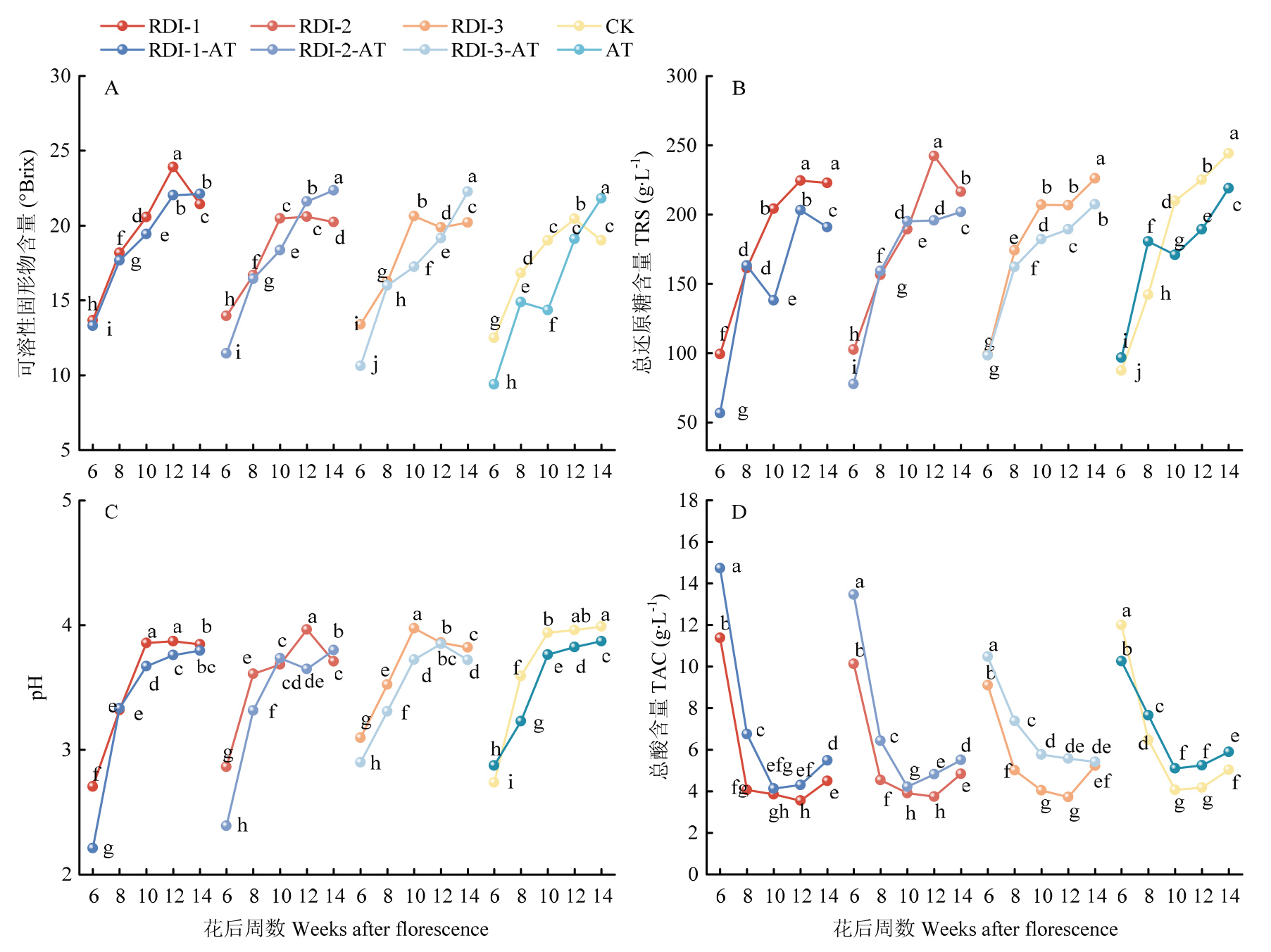
图1
调亏灌溉与抗蒸腾剂对葡萄°Brix(A)、总还原糖含量(B)、pH(C)、总酸(D)的影响 RDI-1:40%调亏灌溉;RDI-2:60%调亏灌溉理;RDI-3:80%调亏灌溉;CK:对照组;RDI-1-AT:40%调亏灌溉+抗蒸腾剂;RDI-2-AT:60%调亏灌溉+抗蒸腾剂;RDI-3-AT:80%调亏灌溉+抗蒸腾剂;AT:对照+抗蒸腾剂。不同小写字母表示差异显著(P<0.05)。下同"
表1
调亏灌溉与抗蒸腾剂对葡萄酒pH、总酸、挥发酸、酒精度的影响"
| 基本理化指标 Basic physicochemical property | 处理 Treatment | |||||
|---|---|---|---|---|---|---|
| RDI-1 | RDI-2 | RDI-3 | CK | RDI-1-AT | ||
| pH | 3.86±0.02a | 3.88±0.01a | 3.8±0.01b | 3.79±0.01bc | 3.88±0.01a | |
| 总酸 Total acid (g·L-1) | 7.59±0.04f | 8.56±0.03e | 8.98±0.03abc | 8.86±0.07ab | 8.69±0.02de | |
| 挥发酸 Volatile acid (g·L-1) | 0.74±0.01a | 0.65±0.04b | 0.7±0.01ab | 0.68±0.01ab | 0.69±0.01ab | |
| 酒精度 Alcohol content (% vol) | 12.32±0.03c | 12.76±0.02b | 12.78±0.05b | 12.59±0.04b | 13.24±0.07a | |
表2
调亏灌溉与抗蒸腾剂对葡萄酒有机酸含量的影响"
| 有机酸种类 Type of organic acid | 葡萄酒有机酸含量 Organic acid content of wine (g·L-1) | |||||||
|---|---|---|---|---|---|---|---|---|
| RDI-1 | RDI-2 | RDI-3 | CK | RDI-1-AT | RDI-2-AT | RDI-3-AT | AT | |
| 柠檬酸 Citric acid | 0.39±0.01ef | 0.47±0.02de | 0.45±0.01ef | 0.39±0.00f | 0.53±0.02cd | 0.58±0.02bc | 0.65±0.01ab | 0.70±0.01a |
| 酒石酸 Tartaric acid | 2.07±0.016e | 2.17±0.01de | 2.40±0.04c | 2.33±0.07cd | 2.65±0.02ab | 2.44±0.05c | 2.64±0.02b | 2.84±0.01a |
| 苹果酸 Malic acid | 1.37±0.01e | 1.42±0.02de | 1.49±0.03cd | 1.53±0.00c | 1.71±0.01b | 1.71±0.00b | 1.86±0.02a | 1.92±0.01a |
| 琥珀酸 Succinic acid | 0.38±0.01d | 0.39±0.00d | 0.39±0.00d | 0.41±0.01cd | 0.45±0.01bc | 0.48±0.01ab | 0.47±0.01ab | 0.52±0.01a |
| 乳酸 Lactic acid | 0.34±0.01c | 0.40±0.04c | 0.48±0.04c | 0.72±0.05b | 0.67±0.02b | 0.82±0.03ab | 0.83±0.00ab | 0.89±0.00a |
| 醋酸 Acetic acid | 0.56±0.00cd | 0.54±0.01de | 0.57±0.01cd | 0.72±0.01ab | 0.46±0.03e | 0.64±0.02bc | 0.69±0.01ab | 0.73±0.02a |
| 总计 Total | 5.10±0.01e | 5.37±0.08e | 5.78±0.08d | 6.09±0.12d | 6.47±0.04c | 6.66±0.06c | 7.14±0.01b | 7.61±0.03a |

图2
调亏灌溉与抗蒸腾剂对葡萄酒黄烷-3-醇(A)、总花色苷(B)、总单宁(C)、类黄酮(D)、总酚(E)含量的影响"
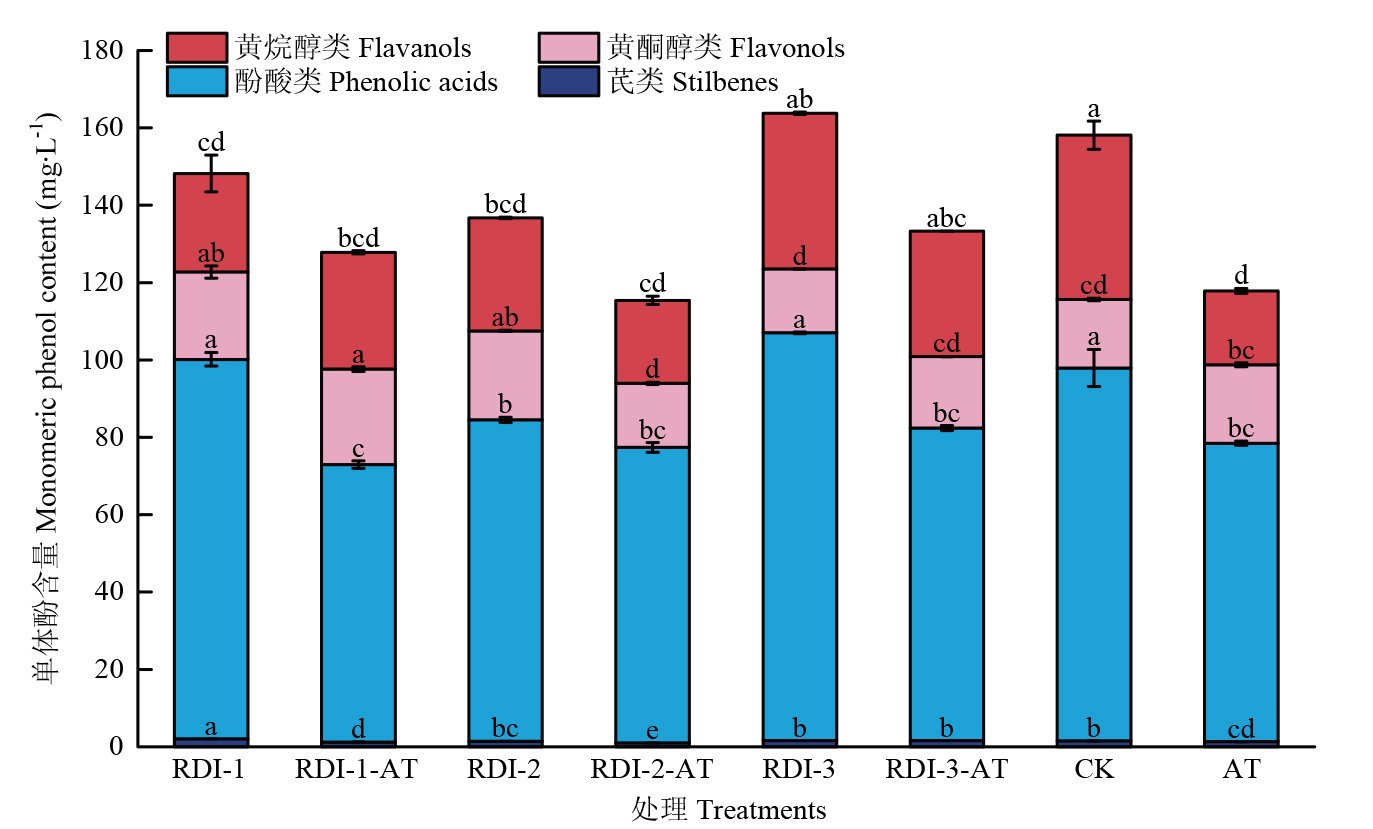
图3
调亏灌溉与抗蒸腾剂对葡萄酒单体酚含量的影响 同种类物质不同字母表示处理间在0.05水平存在显著性差异。下同"
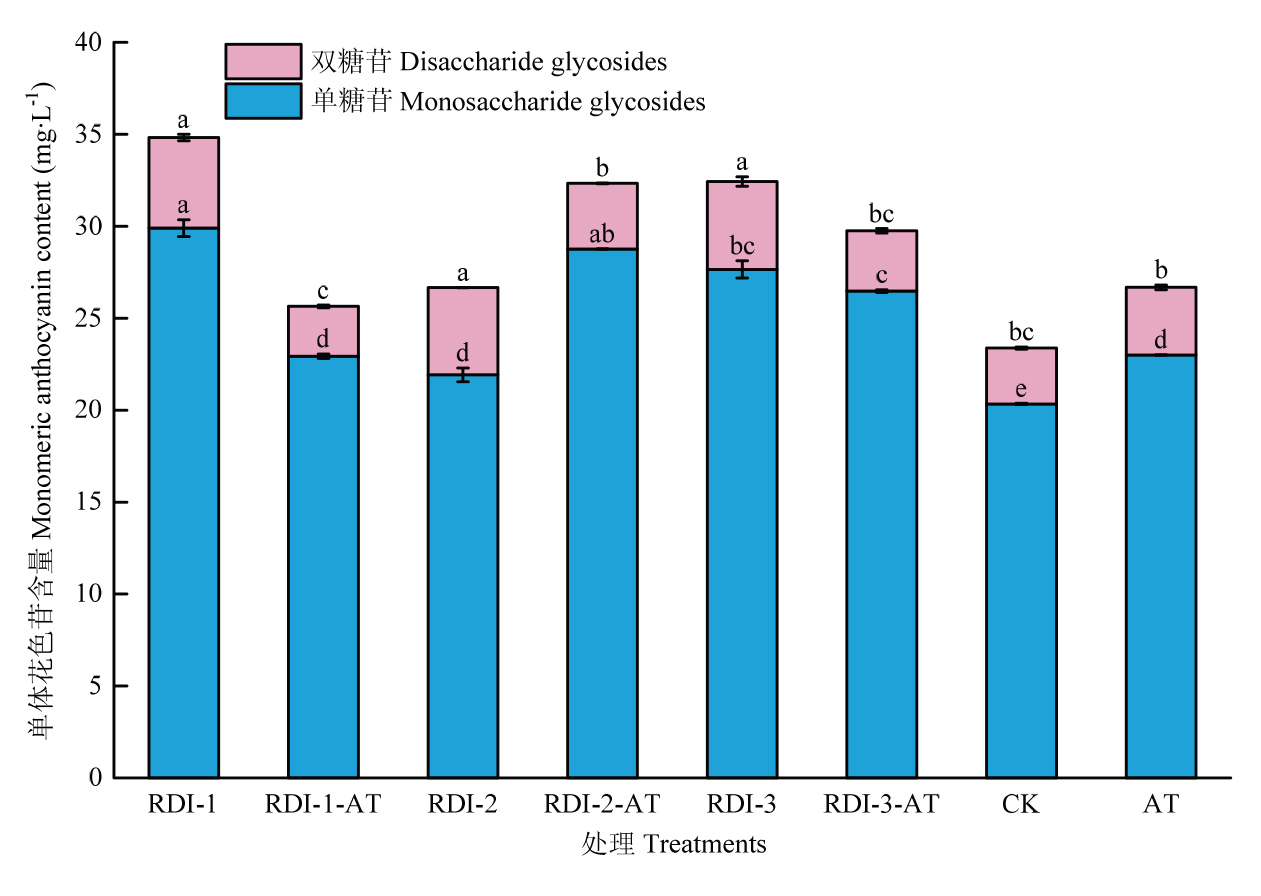
图4
调亏灌溉与抗蒸腾剂对葡萄酒单体花色苷含量的影响"
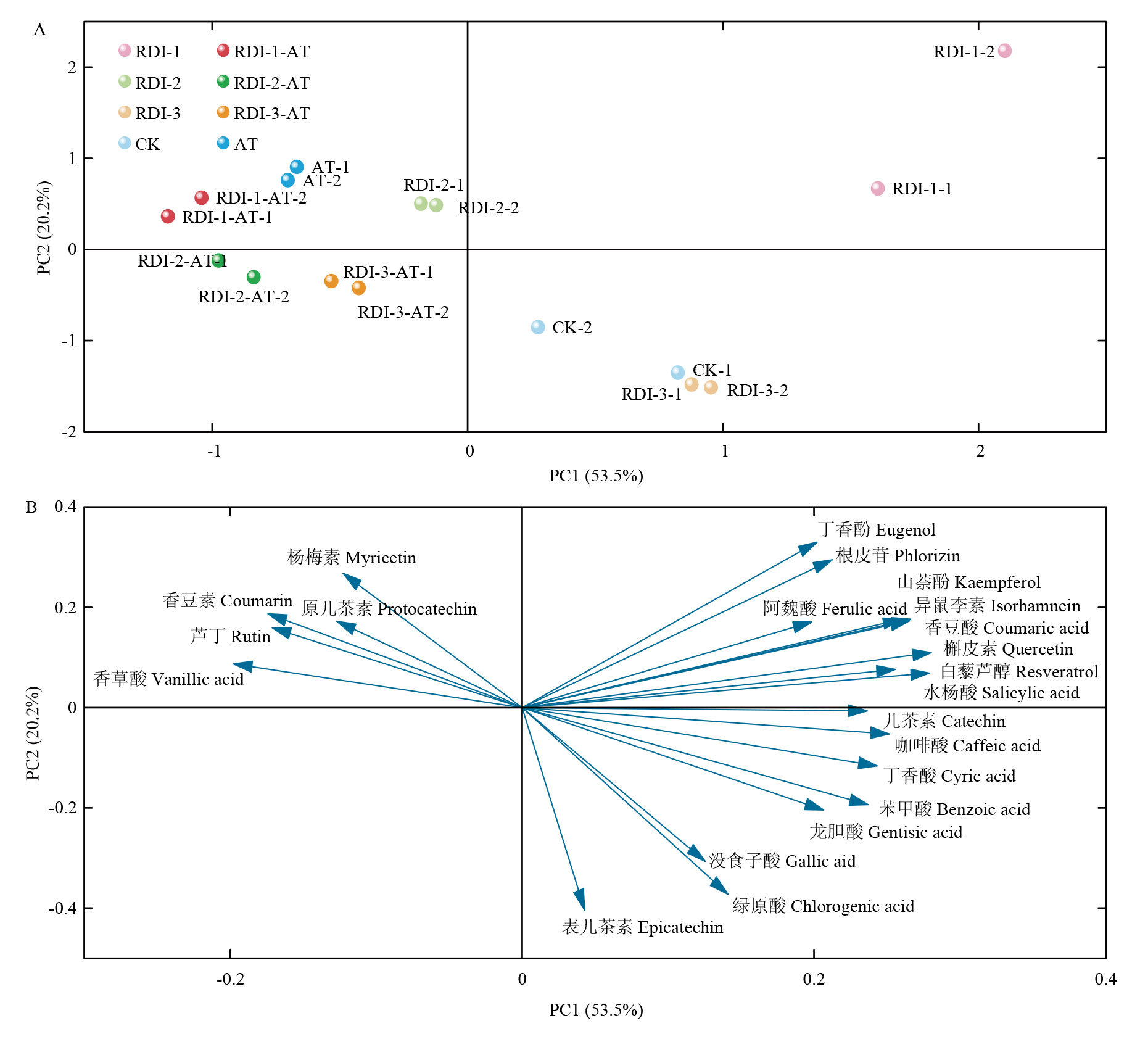
图5
葡萄酒单体酚主成分分析 A:得分图;B:负载图 A: Score Plot; B: Loading Plot"
| [1] |
白洁洁. 两种抗蒸腾剂产品对‘美乐’葡萄叶片逆境相关指标及果实品质的影响[D]. 银川: 宁夏大学, 2018.
|
|
|
|
| [2] |
王翠梅, 孙义东, 孔维府. 中国酿酒葡萄栽培生产历史、现状和发展展望. 中国果菜, 2007, 27(6): 6-7.
|
|
|
|
| [3] |
吕名礼, 孟祥侦, 李鸣, 朱登平, 左光燕, 李银华. 调亏灌溉技术在葡萄种植中的应用. 中外葡萄与葡萄酒, 2017(4): 77-79.
|
|
|
|
| [4] |
doi: 10.3389/fpls.2017.01124 |
| [5] |
王超萍, 冯伟晴, 费腾, 谢兆森, 韩燕, 李秀杰, 刘利, 李勃. 不同灌溉处理对葡萄新梢生长与叶片生理特性的影响. 中外葡萄与葡萄酒, 2025(1): 24-30.
|
|
|
|
| [6] |
杨嘉鹏, 董荣. 调亏灌溉技术对葡萄果实品质的影响. 农业工程, 2024, 14(4): 114-120.
|
|
|
|
| [7] |
于海燕, 文颖强. 调亏灌溉对‘阳光玫瑰’葡萄产量品质和水分利用率的影响. 陕西农业科学, 2024, 70(4): 49-54.
|
|
|
|
| [8] |
张梅花, 刘静霞, 张芮, 成自勇. 不同生育期调亏灌溉对酿酒葡萄耗水及产量和品质的影响. 甘肃农业大学学报, 2019, 54(4): 53-59.
|
|
|
|
| [9] |
|
| [10] |
doi: 10.1016/j.agee.2004.10.005 |
| [11] |
房玉林, 孙伟, 万力, 惠竹梅, 刘旭, 张振文. 调亏灌溉对酿酒葡萄生长及果实品质的影响. 中国农业科学, 2013, 46(13): 2730-2738. doi:10.3864/j.issn.0578-1752.2013.13.011.
|
|
|
|
| [12] |
李婉平, 刘敏, 王皆行, 姚衡, 成正龙, 窦俊霞, 周晓明, 房玉林, 孙翔宇. 炎热气候条件下抗蒸腾剂对酿酒葡萄光合特性与葡萄酒品质的影响. 中国农业科学, 2019, 52(17): 3008-3019. doi:10.3864/j.issn.0578-1752.2019.17.009.
|
|
|
|
| [13] |
郭相平, 郭枫, 刘展鹏, 郝树荣. 水分胁迫及复水对玉米光合速率及可溶性糖的影响. 玉米科学, 2008, 16(6): 68-70.
|
|
|
|
| [14] |
黄伊琦, 梁冠威, 吴友炉, 李银, 易慧琳, 刘晓洲, 陈笙, 谭广文. 干旱胁迫下6种抗蒸腾剂对角茎野牡丹的荧光调节作用. 浙江农业科学, 2022, 63(4): 748-750, 810.
doi: 10.16178/j.issn.0528-9017.20212817 |
|
|
|
| [15] |
冯建灿, 张玉洁, 张秋娟, 李淑玲, 胡湛. 干旱胁迫与抗蒸腾剂对喜树几项生理指标及喜树碱含量的影响. 河南农业大学学报, 2002, 36(2): 138-142, 154.
|
|
|
|
| [16] |
张小雨, 张喜英. 抗蒸腾剂研究及其在农业中的应用. 中国生态农业学报, 2014, 22(8): 938-944.
|
|
|
|
| [17] |
朴春红, 宝音巴特, 郭占全, 胡文河. 抗蒸腾剂对玉米主要叶片光合特性及生理特性的影响. 分子植物育种, 2017, 15(10): 4289-4293.
|
|
|
|
| [18] |
李茂松, 李森, 张述义, 池宝亮. 灌浆期喷施新型FA抗蒸腾剂对冬小麦的生理调节作用研究. 中国农业科学, 2005, 38(4): 703-708.
|
|
|
|
| [19] |
阴鹏. 反射型抗蒸腾剂喷洒浓度对大豆水分利用效率的影响研究[D]. 西安: 西安理工大学, 2021.
|
|
|
|
| [20] |
石岩, 刘冰雁, 曲柏宏. 抗蒸腾剂和光合产物积累对苹果梨叶片净光合速率日变化的影响. 延边大学农学学报, 2013, 35(2): 98-102.
|
|
|
|
| [21] |
doi: 10.1016/j.agwat.2014.07.031 |
| [22] |
doi: 10.1016/j.foodres.2022.111917 |
| [23] |
李华, 王华, 袁春龙, 王树生. 葡萄酒工艺学. 北京: 科学出版社, 2007.
|
|
|
|
| [24] |
doi: 10.1016/j.foodres.2020.109566 |
| [25] |
张星星, 郭安鹊, 韩富亮, 张予林. UPLC快速测定葡萄酒中酚类物质的方法. 食品科学, 2016, 37(10): 128-133.
doi: 10.7506/spkx1002-6630-201610022 |
|
doi: 10.7506/spkx1002-6630-201610022 |
|
| [26] |
doi: 10.1016/j.fbio.2022.101644 |
| [27] |
|
| [28] |
李继东, 毕会涛, 王一涵, 王哲, 武应霞, 尚霄丽, 冯建灿. 薄膜型抗蒸腾剂对常温贮藏红富士苹果品质与生理的影响. 河南农业大学学报, 2010, 44(3): 286-289.
|
|
|
|
| [29] |
doi: 10.1111/ppl.v174.4 |
| [30] |
doi: 10.1016/j.scienta.2018.03.005 |
| [31] |
|
| [32] |
周晓明, 卢春生, 樊丁宇, 谢辉, 薛素琳. 新疆不同葡萄品种果实成熟期酸成分分析. 果树学报, 2012, 29(2): 188-192.
|
|
|
|
| [33] |
|
| [34] |
doi: 10.1016/j.phytochem.2009.08.006 |
| [35] |
张世杰. 甘肃省嘉峪关地区酿酒葡萄成熟度多酚参数的确定研究[D]. 杨凌: 西北农林科技大学, 2014.
|
|
|
|
| [36] |
李凯, 商佳胤, 黄建全, 张娜, 王丹, 田淑芬. 调亏灌溉对玫瑰香葡萄与葡萄酒酚类物质的影响. 华北农学报, 2015, 30(S1): 500-506.
doi: 10.7668/hbnxb.2015.S1.090 |
|
doi: 10.7668/hbnxb.2015.S1.090 |
|
| [37] |
杨腊. 刺葡萄果实和葡萄酒品质分析及缩合单宁涩感研究[D]. 杨凌: 西北农林科技大学, 2019.
|
|
|
|
| [38] |
张振文, 宁鹏飞, 张军贤, 艾丽丽, 王丽娜, 张小转, 惠竹梅. 葡萄酒缩合单宁测定方法的比较研究. 食品科学, 2012, 33(20): 233-237.
|
|
|
|
| [39] |
|
| [40] |
李婉平. 炎热气候条件下抗蒸腾剂对酿酒葡萄与葡萄酒质量的影响分析[D]. 杨凌: 西北农林科技大学, 2019.
|
|
|
|
| [41] |
鞠延仑, 王童孟, 赵现方, 刘敏, 闵卓, 张军翔, 房玉林. 调亏灌溉对赤霞珠果实发育和籽中酚类的影响. 中外葡萄与葡萄酒, 2017(4): 18-24.
|
|
|
|
| [42] |
胡宏远, 王振平. 干旱胁迫对赤霞珠葡萄叶片水分及叶绿素荧光参数的影响. 干旱区资源与环境, 2017, 31(4): 124-130.
|
|
|
|
| [43] |
刘桂林, 杜鸿云, 王艳, 娄丽娜. 美国红栌叶片呈色差异的研究. 西北林学院学报, 2008, 23(4): 42-44, 51.
|
|
|
|
| [44] |
聂庆娟, 史宝胜, 孟朝, 刘冬云, 娄丽娜. 不同叶色红栌叶片中色素含量、酶活性及内含物差异的研究. 植物研究, 2008, 28(5): 599-602.
doi: 10.7525/j.issn.1673-5102.2008.05.020 |
|
|
|
| [45] |
韩伟伟, 韩宁, 姜凯凯, 杨沫, 赵新节. 成膜型抗蒸腾剂对‘赤霞珠’葡萄成熟进程的影响. 园艺学报, 2018, 45(3): 447-456.
doi: 10.16420/j.issn.0513-353x.2017-0575 |
|
|
|
| [46] |
doi: 10.1016/j.plaphy.2023.108258 |
| [47] |
doi: 10.1016/j.tplants.2013.06.003 pmid: 23870661 |
| [48] |
王超群. 调亏灌溉与遮光处理对焉耆盆地梅鹿辄葡萄果实及葡萄酒品质的影响[D]. 乌鲁木齐: 新疆农业大学, 2019.
|
|
|
|
| [49] |
白洁洁, 杨文莉, 王振平. 抗蒸腾剂对‘美乐’葡萄叶片生理指标及果实品质的影响. 中外葡萄与葡萄酒, 2018(5): 12-16, 21.
|
|
|
| [1] | 褚添硕, 陈晓安, 朱瑾瑾, 王策, 娄伟. 关键生育期调亏灌溉对赣南脐橙果实生长与产量品质的影响[J]. 中国农业科学, 2025, 58(24): 5247-5258. |
| [2] | 侯帅, 张祎佳, 周丹丹, 马飞洋, 王大鹏, 赵思琪, 丁超, 刘强. 基于介质阻挡放电低温等离子体分析储藏稻谷高温胁迫下酚类代谢规律[J]. 中国农业科学, 2024, 57(6): 1180-1190. |
| [3] | 张柯楠, 尹海宁, 王家逵, 曹建宏, 惠竹梅. 云南香格里拉不同海拔葡萄果皮酚类物质差异及成因分析[J]. 中国农业科学, 2023, 56(19): 3879-3893. |
| [4] | 罗牡康,贾栩超,张瑞芬,刘磊,董丽红,池建伟,白亚娟,张名位. 杨桃的酚类成分含量及其生物可及性与抗氧化活性[J]. 中国农业科学, 2020, 53(7): 1459-1472. |
| [5] | 李婉平,刘敏,王皆行,姚衡,成正龙,窦俊霞,周晓明,房玉林,孙翔宇. 炎热气候条件下抗蒸腾剂对酿酒葡萄光合特性与葡萄酒品质的影响[J]. 中国农业科学, 2019, 52(17): 3008-3019. |
| [6] | 李晓英,薛梅,樊汶樵,罗洁. 不同干燥方式对蓝莓叶中酚类物质及其抗氧化活性的影响[J]. 中国农业科学, 2018, 51(13): 2570-2578. |
| [7] | 童 鑫,张瑞芬,邓媛元,肖 娟,刘 磊,张 雁,魏振承,张名位. 米糠酚类物质的大孔树脂分离纯化工艺[J]. 中国农业科学, 2016, 49(19): 3818-3830. |
| [8] | 张桂伟,张秋云,江东,席万鹏,周志钦. 中国主栽葡萄柚果肉酚类物质组成及其抗氧化活性[J]. 中国农业科学, 2015, 48(9): 1785-1794. |
| [9] | 张娟,王晓宇,田呈瑞,赵旗峰,马小河,唐晓萍,马婷婷,马锦锦. 基于酚类物质的酿酒红葡萄品种特性分析[J]. 中国农业科学, 2015, 48(7): 1370-1382. |
| [10] | 李雅善1, 李华1, 2, 3, 王华1, 2, 3, 南立军1. 设施栽培下不同灌溉处理对‘希姆劳特’植株生长及果实的影响[J]. 中国农业科学, 2014, 47(9): 1784-1792. |
| [11] | 葛少彬, 刘敏, 蔡昆争, 蔡一霞, 骆世明. 硅介导稻瘟病抗性的生理机理[J]. 中国农业科学, 2014, 47(2): 240-251. |
| [12] | 付晓燕1, 吴茜2, 李书艺2, 肖娟2, 谢笔钧2, 孙智达2. 燕麦发芽前后酚类物质的组成变化及结构鉴定[J]. 中国农业科学, 2013, 46(17): 3669-3679. |
| [13] | 房玉林, 孙伟, 万力, 惠竹梅, 刘旭, 张振文. 调亏灌溉对酿酒葡萄生长及果实品质的影响[J]. 中国农业科学, 2013, 46(13): 2730-2738. |
| [14] | 李青, 张名位, 张瑞芬, 魏振承, 邓媛元, 唐小俊, 张业辉, 李武, 马永轩. 5种籼稻品种谷壳中游离态和结合态酚类物质含量及其抗氧化活性比较[J]. 中国农业科学, 2012, 45(6): 1150-1158. |
| [15] | 张亚伟,陈义伦. 不同品种梨汁酶促褐变因子及相关性[J]. 中国农业科学, 2011, 44(9): 1880-1887. |
|
||
