






中国农业科学 ›› 2026, Vol. 59 ›› Issue (18): 4007-4020.doi: 10.3864/j.issn.0578-1752.2026.18.005
• 专题:面向农业害虫精准防控的机制解析、技术优化与决策支撑 • 上一篇 下一篇
王覃丽1( ), 谭顺阳1, 夏根1, 刘文庆2, 杨玉婷1(), 田丽霞2()
收稿日期:2025-12-29
接受日期:2026-02-08
出版日期:2026-09-16
发布日期:2026-09-20
通信作者:
联系方式:
王覃丽,E-mail:13477866904@163.com。
基金资助:
WANG QinLi1(), TAN ShunYang1, XIA Gen1, LIU WenQing2, YANG YuTing1(), TIAN LiXia2()
Received:2025-12-29
Accepted:2026-02-08
Published:2026-09-16
Online:2026-09-20
摘要:
【目的】明确韭菜迟眼蕈蚊(Bradysia odoriphaga)成虫触角高表达的气味结合蛋白BodoOBP11的分子特征,解析其在寄主定位中的嗅觉功能。【方法】利用生物信息学工具分析BodoOBP11的基本特征和进化关系;使用实时荧光定量PCR技术分析BodoOBP11在韭菜迟眼蕈蚊不同发育阶段和组织中的表达模式;通过大肠杆菌原核表达、镍柱亲和层析纯化和重组肠激酶酶切获得BodoOBP11蛋白;以1-NPN为荧光探针利用荧光竞争结合试验分析该蛋白与寄主植物韭菜的22种挥发性化合物和1种假定的性信息素化合物的结合能力;通过蛋白质结构预测、分子对接和定点突变揭示BodoOBP11蛋白与配体化合物的关键结合位点。【结果】BodoOBP11开放阅读框全长426 bp,编码141个氨基酸残基,在其氨基端有一段20个氨基酸残基组成的信号肽,且序列中具有Classic-C OBP的典型特征,即6个保守的半胱氨酸残基;其成熟蛋白预测分子量为13.53 kDa,等电点为7.71。实时荧光定量PCR结果表明,在不同发育阶段中,BodoOBP11在雄成虫中表达量最高,其次为雌成虫和蛹期。在不同组织中,BodoOBP11在雌、雄成虫的触角中均呈现显著高表达,且在雄虫触角中的表达量最高。荧光竞争结合试验显示,BodoOBP11仅与二丙基三硫醚、2-十三烷酮、二丙基二硫、2-十一烷酮、异硫氰酸苯乙酯及α-紫罗酮6种挥发物具有结合能力,其中与二丙基三硫醚结合能力最强。蛋白质结构预测与分子对接结果显示,BodoOBP11与上述6种配体的结合主要通过氢键与疏水相互作用,其中Thr74残基与2-十三烷酮、2-十一烷酮和α-紫罗酮形成氢键,而Val76、Ile107、Leu127、Met131、Phe138和Phe140等残基则主要介导疏水相互作用。定点突变后的荧光竞争结合试验显示,Ile107、Phe138和Phe140残基分别被突变成丙氨酸(Ala)后均会显著降低BodoOBP11与上述6种配体的结合能力,表明其为关键的结合位点。【结论】BodoOBP11对二丙基三硫醚、2-十三烷酮、二丙基二硫等6种韭菜挥发物表现出较强的结合亲和力,Ile107、Phe138和Phe140残基是其结合上述配体的关键残基。研究结果揭示了韭菜迟眼蕈蚊成虫利用BodoOBP11识别寄主植物挥发物的分子机制,可为基于嗅觉干扰的绿色防控技术研发提供依据。
王覃丽, 谭顺阳, 夏根, 刘文庆, 杨玉婷, 田丽霞. 韭菜迟眼蕈蚊气味结合蛋白OBP11的配体结合能力及关键氨基酸分析[J]. 中国农业科学, 2026, 59(18): 4007-4020.
WANG QinLi, TAN ShunYang, XIA Gen, LIU WenQing, YANG YuTing, TIAN LiXia. Ligand Binding Property and Key Amino Acid Analysis of Odorant- Binding Protein OBP11 in Bradysia odoriphaga[J]. Scientia Agricultura Sinica, 2026, 59(18): 4007-4020.

表1
BodoOBP11引物信息"
| 引物名称Primer name | 引物序列Primer sequence |
|---|---|
| 用于克隆 For cloning | F: CGCGGATCCGGTGTAACGATGGAGCAAAT |
| R: GGGAAGCTTTTAAGCAAACGTGAACTTTTTAT | |
| 用于实时荧光定量分析 For qPCR analysis | F: AACTATGAGGCATCTCTGAA |
| R: TTACTCCATTAGCAGCATCT | |
| 内参基因 Reference gene | RPS15-F: ATCGTGGCGTCGATTTGGAT |
| RPS15-R: CTCATTTGGTGGGGCTTCCT | |
| RPL18-F: TTCCCTTATCCATCAAACATT | |
| RPL18-R: CTTAGAATAACTTCAGGTAATGC | |
| 用于原核表达 For heterologous expression | F: CGCGGATCCGGTGTAACGATGGAGCAAAT |
| R: GGGAAGCTTTTAAGCAAACGTGAACTTTTTAT | |
| 基因定点突变 Site-directed mutant | T74A-F: GCCGGAGTCATGAAGAAAAACAAACT |
| T74A-R: CATTTCCAACACACATTGCATGT | |
| V76A-F: GCCATGAAGAAAAACAAACT | |
| V76A-R: TCCTGTCATTTCCAACACACAT | |
| I107A-F: GCCACGCAGTGCAAAGATGC | |
| I107A-R: ACCATTTTTATTTTCTTCCACAATGTCGT | |
| L127A-F: GCCCTTCCTAATAAGAT | |
| L127A-R: TATGTATGCTGCTTCGCAGGCAT | |
| M131A-F: GCCTACAAAAACAATAAAAAGTTCACGT | |
| M131A-R: GCATTGAACTAATATGTATGCTGCT | |
| P138A-F: CGCGGATCCGGTGTAACGATGGAGCAAAT | |
| P138A-R: GGGAAGCTTTTAAGCAAACGTGGCCTTTT | |
| P140A-F: CGCGGATCCGGTGTAACGATGGAGCAAAT | |
| P140A-R: GGGAAGCTTTTAAGCGGCCGTGAACT |

图1
BodoOBP11序列和进化分析 A:BodoOBP11的核苷酸和氨基酸序列。起始密码子用方框表示,信号肽部分用下划线表示,保守的半胱氨酸位点用红色圈标记,“*”表示终止密码子The nucleotide and amino acid sequences of BodoOBP11. The start codon is boxed, the signal peptide part is underlined, conservative cysteine sites are circled, “*” stands for the stop codon。B:BodoOBP11与其他双翅目OBP的系统发育关系。红色代表BodoOBP11,Dmel为黑腹果蝇,Aaeg为埃及伊蚊,Agam为冈比亚按蚊Phylogenetic relationship between BodoOBP11 and other Diptera OBPs. The red represents BodoOBP11. Bodo is Bradysia odoriphaga, Dmel is Drosophila melanogaster, Aaeg is Aedes aegypti, Agam is Anopheles gambiae"
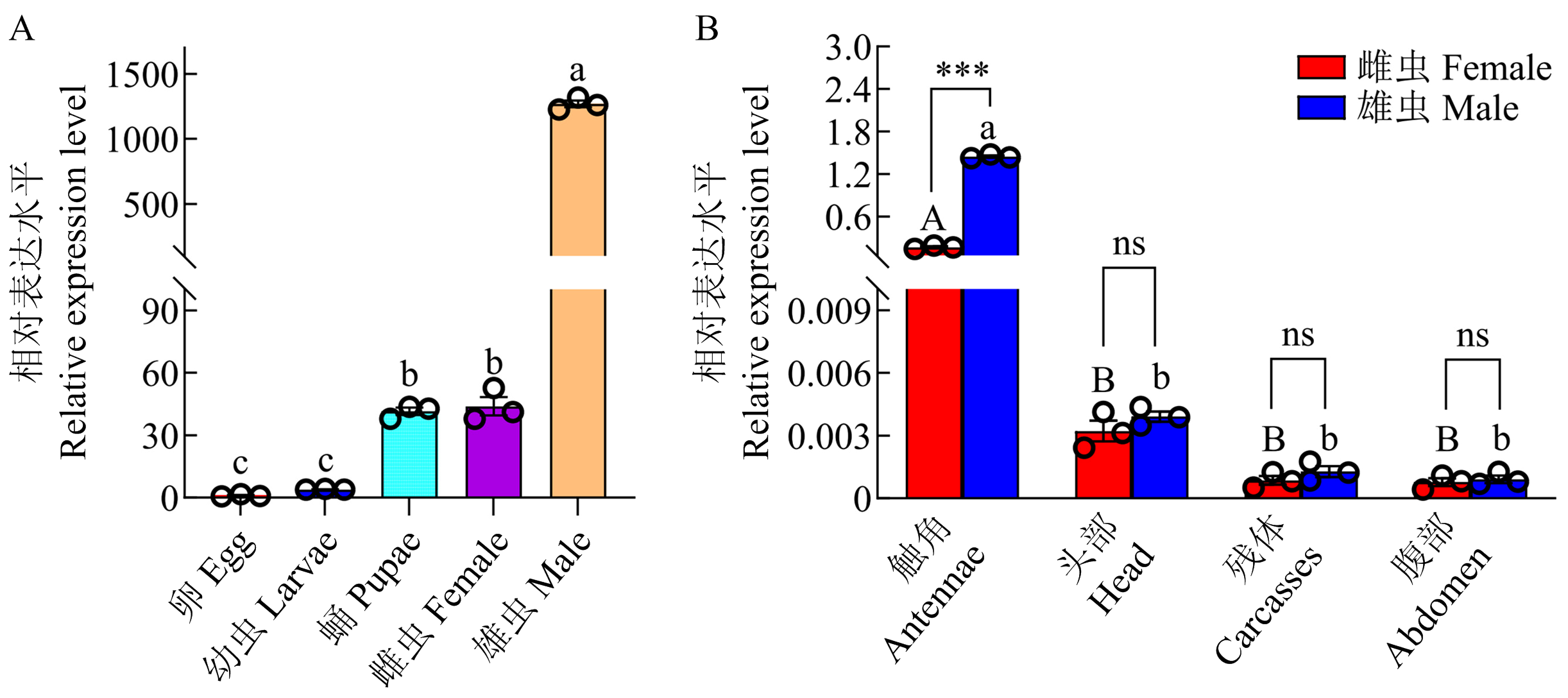
图2
BodoOBP11的时空表达模式 不同发育阶段和同一性别不同组织的表达水平采用单因素方差分析,不同字母表示差异显著(P<0.05,Tukey’s HSD test);同一组织不同性别的表达水平分析采用t检验,*P<0.05,** P<0.01,*** P<0.001,ns:无显著差异"

图3
重组蛋白BodoOBP11与配体化合物结合特性 A:SDS-PAGE检测表达和纯化的BodoOBP11 Expression and purification of BodoOBP11 detected by SDS-PAGE。1:未诱导表达的pET32a/ BodoOBP11 pET32a/BodoOBP11 without induced expression;2:诱导表达的pET32a/BodoOBP11 pET32a/BodoOBP11 with induced expression;3:上清Supernatant;4:包涵体Inclusion body;5:His-tag纯化后的重组pET32a/BodoOBP11蛋白Recombinant pET32a/BodoOBP11 protein after purification with His-tag;6:切除His标签的目标蛋白Target proteins without His-tag。B:荧光探针1-NPN与BodoOBP11的结合曲线Binding curve of 1-NPN to BodoOBP11。C:荧光探针1-NPN对BodoOBP11的Scatchard图Scatchard plot of 1-NPN to BodoOBP11。D—F:22种挥发性化合物和1种假定的性信息素化合物与BodoOBP11的竞争结合曲线,虚线表示50%的相对荧光强度Competitive binding curves of 22 volatile compounds from Chinese chives and one putative sex pheromone compound to BodoOBP11. The dotted line in the plot represents 50% relative fluorescence intensity"
表2
重组蛋白BodoOBP11与不同挥发性化合物的结合力"
| 化合物名称 Compound name | 分子式 Molecular formula | 分子量 Molecular weight | CAS号 CAS number | BodoOBP11 (pH 7.4) | |
|---|---|---|---|---|---|
| IC50 (μmol·L-1) | Ki (μmol·L-1) | ||||
| 假定的性信息素Putative sex pheromone | |||||
| 正十七烷Heptadecane | C17H36 | 240.47 | 629-78-7 | — | — |
| 韭菜挥发物Chinese chives’ volatile | |||||
| 酮类Ketones | |||||
| 2-十一烷酮2-Undecanone | C11H22O | 170.29 | 112-12-9 | 21.12±7.38 | 19.15±6.69 |
| 2-十三烷酮2-Tridecanone | C13H26O | 198.34 | 593-08-8 | 15.58±2.95 | 14.13±2.67 |
| α-紫罗酮α-Ionone | C13H20O | 192.30 | 127-41-3 | 26.38±0.86 | 23.91±0.79 |
| 醇类Alcohols | |||||
| 3-甲基-2-丁烯-1-醇3-Methyl-2-buten-1-ol | C5H10O | 86.13 | 556-82-1 | — | — |
| 芳樟醇Linalool | C10H18O | 154.25 | 78-70-6 | — | — |
| 香茅醇Citronellol | C10H20O | 156.27 | 106-22-9 | — | — |
| 醛类Aldehydes | |||||
| 苯甲醛Benzaldehyde | C7H6O | 106.12 | 100-52-7 | — | — |
| 壬醛1-Nonanal | C9H18O | 142.24 | 124-19-6 | — | — |
| 庚醛Heptaldehyde | C7H14O | 114.19 | 111-71-7 | — | — |
| 挥发性硫类化合物Volatile sulfur compounds | |||||
| 二丙基二硫Propyl disulfide | C6H14S2 | 150.31 | 629-19-6 | 18.33±2.80 | 16.62±2.54 |
| 二丙基三硫醚Dipropyl trisulfide | C6H14S3 | 182.37 | 6028-61-1 | 5.25±0.47 | 4.76±0.43 |
| 二甲基三硫Dimethyl trisulfide | C2H6S3 | 126.26 | 3658-80-8 | — | — |
| 二烯丙基二硫Diallyl disulfide | C6H10S2 | 146.27 | 2179-57-9 | — | — |
| 甲基丙基二硫Methyl propyl disulfide | C4H10S2 | 122.25 | 2179-60-4 | — | — |
| 不饱和烃类Unsaturated hydrocarbons | |||||
| 1-庚烯1-Heptene | C7H14 | 98.18 | 1161-13-3 | — | — |
| 石竹烯Caryophyllene | C55H24 | 204.36 | 87-44-5 | — | — |
| β-蒎烯β-Pinene | C10H16 | 136.23 | 127-91-3 | — | — |
| 酯类Esters | |||||
| 异硫氰酸苯乙酯Phenylethyl isothiocyanate | C9H9NS | 163.24 | 2257-09-2 | 21.67±1.66 | 19.64±1.51 |
| 3-(甲硫基)丙基异硫酸酯 3-(methyl thioyl) propyl isosulfate | C5H9NS2 | 147.26 | 505-79-3 | — | — |
| 水杨酸甲酯Methyl salicylate | C8H8O3 | 152.15 | 119-36-8 | — | — |
| 烯丙基硫氢酸酯Allyl thiocyanate | C4H5NS | 99.15 | 764-49-8 | — | — |
| 月桂酸乙酯Ethyl dodecanoate | C14H28O2 | 228.37 | 106-33-2 | — | — |

图4
BodoOBP11的三维结构及其与6个配体的分子对接 A:利用AlphaFold 2.0预测的BodoOBP11结构Structure of BodoOBP11 predicted using AlphaFold 2.0。B:对目标蛋白BodoOBP11结合袋的预测The prediction of the binding pocket of the target protein BodoOBP11。C—H:BodoOBP11与6个配体的分子对接Molecular docking of BodoOBP11 with six ligands。C:2-十三烷酮2-Tridecanone;D:2-十一烷酮2-Undecanone;E:α-紫罗酮α-Ionone;F:二丙基二硫Propyl disulfide;G:二丙基三硫醚Dipropyl trisulfide;H:异硫氰酸苯乙酯Phenylethyl isothiocyanate"
表3
BodoOBP11与6个配体对接结果"
| 配体名称 Ligand name | 结合能 Binding energy (kJ·mol-1) | 氢键 Conventional hydrogen bond | 疏水相互作用 Hydrophobic interaction |
|---|---|---|---|
| 二丙基二硫Propyl disulfide | -15.23 | — | Lys81, Leu82, Ala114, Leu127 |
| 二丙基三硫醚Dipropyl trisulfide | -16.61 | — | Val76, Leu82, Ile107, Phe138, Phe140 |
| 2-十三烷酮2-Tridecanone | -21.67 | Thr74 | Leu71, Val76, Leu82, Gln90, Ile107, Leu127, Met131, Phe138, Phe140 |
| 2-十一烷酮2-Undecanone | -20.71 | Thr74 | Leu71, Val76, Gln90, Ile107, Leu127, Val128, Met131, Phe138, Phe140 |
| α-紫罗酮α-Ionone | -26.02 | Thr74 | Val76, Gln90, Leu94, Ile107, Met131, Phe138, Phe140 |
| 异硫氰酸苯乙酯Phenylethyl isothiocyanate | -21.46 | — | Leu71, Ile107, Leu127, Val128, Met131, Phe138, Phe140 |

图5
BodoOBP11的7个突变体结合特性 A:荧光探针1-NPN与7个BodoOBP11突变体的结合曲线(Scatchard图)Binding curves of 1-NPN to seven mutants of BodoOBP11 (Scatchard plot);B—H:6种植物挥发物与7个BodoOBP11突变体的竞争结合曲线,虚线表示50%的相对荧光强度Competitive binding curves of six plant volatiles to seven mutants of BodoOBP11. The dotted line in the plot represents 50% relative fluorescence intensity"

图6
BodoOBP11野生型和7个突变体对6种配体的结合活性 星号表示野生型和突变体之间具有统计学显著差异(t检验)Asterisks indicate statistically significant differences between WT and mutants (Student t-test)。*P<0.05,** P<0.01,*** P<0.001,ns:无显著差异No significant difference"
| [1] |
杨集昆, 张学敏. 韭菜蛆的鉴定迟眼蕈蚊属二新种(双翅目: 眼蕈蚊科)[J]. 北京农业大学学报, 1985, 11(2): 153-157.
|
|
|
|
| [2] |
王覃丽, 王福, 华登科, 杨玉婷. 韭菜迟眼蕈蚊气味受体BodoOR71和BodoOR72基因时空表达分析[J]. 中国蔬菜, 2024(6): 55-64.
|
|
|
|
| [3] |
吴青君, 于毅, 谷希树, 刘峰, 宋敦伦, 魏国树, 贺敏, 刘长仲, 许国庆, 张友军. 韭菜根蛆的发生危害及综合防治技术研究——公益性行业(农业)科研专项“作物根蛆类害虫综合防治技术研究与示范”进展[J]. 应用昆虫学报, 2016, 53(6): 1165-1173.
|
|
|
|
| [4] |
杨玉婷, 梁玲, 史彩华, 谢文, 张友军. 不同温度下韭菜迟眼蕈蚊年龄-阶段两性实验种群生命表的构建[J]. 植物保护, 2019, 45(1): 51-57.
|
|
|
|
| [5] |
杨玉婷, 史彩华, 程佳旭, 张友军. 不同寄主植物对韭菜迟眼蕈蚊生长发育、繁殖和保护酶活力的影响[J]. 植物保护, 2017, 43(5): 119-123.
|
|
|
|
| [6] |
doi: 10.1016/S2095-3119(19)62663-8 |
| [7] |
doi: 10.1016/j.ijbiomac.2023.123227 |
| [8] |
doi: 10.1002/ps.v77.4 |
| [9] |
doi: 10.1002/ps.v82.3 |
| [10] |
doi: 10.1111/pce.v44.11 |
| [11] |
doi: 10.2987/20-6974.1 pmid: 33857316 |
| [12] |
doi: 10.1093/jee/toz057 |
| [13] |
doi: 10.1007/s00018-005-5607-0 pmid: 16786224 |
| [14] |
|
| [15] |
doi: 10.1016/S0014-5793(99)01683-X |
| [16] |
doi: S0022-1910(16)30108-1 pmid: 27639942 |
| [17] |
doi: 10.3389/fphys.2017.00735 |
| [18] |
doi: 10.1002/ps.v77.7 |
| [19] |
doi: 10.1016/j.ibmb.2021.103528 |
| [20] |
doi: 10.1016/j.ijbiomac.2023.124744 |
| [21] |
doi: 10.3389/fphys.2018.00107 |
| [22] |
doi: 10.1021/acs.jafc.9b00568 |
| [23] |
doi: 10.1093/jee/toab095 |
| [24] |
doi: 10.1016/j.ijbiomac.2024.138179 |
| [25] |
doi: 10.3390/insects12100879 |
| [26] |
|
| [27] |
王鸿梅, 冯静. 韭菜挥发油中化学成分的研究[J]. 天津医科大学学报, 2002, 8(2): 191-192.
|
|
|
|
| [28] |
doi: 10.3954/1523-5475-24.1.27 |
| [29] |
doi: 10.1093/nar/gkv997 |
| [30] |
doi: 10.1093/nar/29.9.e45 pmid: 11328886 |
| [31] |
doi: 10.3390/insects12100895 |
| [32] |
doi: 10.1016/j.pestbp.2025.106578 |
| [33] |
doi: 10.1016/j.pestbp.2024.106005 |
| [34] |
doi: 10.1038/s41467-023-39469-3 pmid: 37433781 |
| [35] |
doi: 10.1038/s41598-017-15893-6 |
| [36] |
doi: 10.1021/acs.jafc.0c02456 |
| [37] |
赵云贺. 韭菜迟眼蕈蚊化学感受基因的鉴定、克隆及功能研究[D]. 泰安: 山东农业大学, 2019.
|
|
|
|
| [38] |
doi: 10.1303/aez.18.161 |
| [39] |
doi: 10.1021/acs.jafc.9b03235 |
| [40] |
doi: 10.3390/ijms23158456 |
| [41] |
doi: 10.1016/j.ijbiomac.2019.11.189 |
| [42] |
doi: 10.1038/s41586-021-03794-8 |
| [43] |
doi: 10.1016/j.ijbiomac.2023.125152 |
| [44] |
付淑慧, 张鹤, 赵婉清, 梁志刚. 小菜蛾气味结合蛋白PxylOBP33与其相关信息化学物质的分子对接[J]. 环境昆虫学报, 2023, 45(5): 1291-1305.
|
|
|
|
| [45] |
doi: 10.3390/ijms262110502 |
| [46] |
doi: 10.1016/j.pestbp.2023.105348 |
| [1] | 姚宏, 施寿荣, 赵茹茜. 基于网络药理学和分子对接探究绿原酸缓解鸡肠道炎症的作用机制[J]. 中国农业科学, 2025, 58(3): 600-616. |
| [2] | 王梦云, 邓力元, 余洋, 杨宇衡, 方安菲, 田斌年, 王静, 毕朝位. 稻瘟病菌琥珀酸脱氢酶不同位点氨基酸替换对苯并烯氟菌唑敏感性的影响[J]. 中国农业科学, 2025, 58(24): 5175-5189. |
| [3] | 刘文龙, 常译方, 李文宇, 孙丽娟, 郑长英. 蛹期干旱胁迫对韭菜迟眼蕈蚊交配及虱螨脲敏感性的影响[J]. 中国农业科学, 2025, 58(14): 2793-2804. |
| [4] | 刘卓琳, 刘红云. 基于网络药理学和分子对接探究芹菜素缓解奶牛热应激及低氧应激的潜力与机制[J]. 中国农业科学, 2024, 57(5): 1010-1022. |
| [5] | 汪志雄, 许冬, 田晓丽, 万鹏, 夏根, 宋旭荣, 王福莲, 桂连友, 张国辉. 柑橘大实蝇BminMinusOBP1和BminPlusOBP1的克隆、原核表达及其配体结合特性[J]. 中国农业科学, 2024, 57(24): 4894-4906. |
| [6] | 徐重新, 金嘉凤, 孙晓明, 沈成, 张霄, 陈澄宇, 刘贤金, 刘媛. 基于Bt毒素的杀虫蛋白理性设计与创新应用策略[J]. 中国农业科学, 2024, 57(1): 96-125. |
| [7] | 杨岭, 田晓丽, 桂连友, 王福莲, 张国辉. 柑橘大实蝇气味结合蛋白BminOBP6与其气味配体的互作机制[J]. 中国农业科学, 2023, 56(7): 1311-1321. |
| [8] | 年和粉, 张钰析, 李伯辽, 陈秀琳, 罗坤, 李广伟. 李小食心虫GfunOBP2的原核表达及气味配体结合特性[J]. 中国农业科学, 2023, 56(12): 2302-2316. |
| [9] | 李桂香,李秀环,郝新昌,李智文,刘峰,刘西莉. 山东省多主棒孢对三种常用杀菌剂的敏感性监测及对氟吡菌酰胺的抗性[J]. 中国农业科学, 2022, 55(7): 1359-1370. |
| [10] | 赵慧婷,彭竹,姜玉锁,赵淑果,黄丽,杜亚丽,郭丽娜. 中华蜜蜂气味结合蛋白AcerOBP7的表达及结合特性[J]. 中国农业科学, 2022, 55(3): 613-624. |
| [11] | 刘孝贺,仇贵生,佟兆国,张怀江,闫文涛,岳强,孙丽娜. 桃小食心虫化学感受蛋白CSP16配体结合特性[J]. 中国农业科学, 2021, 54(5): 945-958. |
| [12] | 秦健辉,李金桥,赵旭,李克斌,曹雅忠,尹姣. 铜绿丽金龟气味结合蛋白AcorOBP11的表达纯化及功能分析[J]. 中国农业科学, 2021, 54(14): 3017-3028. |
| [13] | 李祖任,罗丁峰,柏浩东,徐晶晶,韩进财,徐强,王若仲,柏连阳. 小飞蓬捕光叶绿素结合蛋白基因CcLhca-J9克隆及表达分析[J]. 中国农业科学, 2021, 54(1): 86-94. |
| [14] | 李玲,谭瑶,周晓榕,庞保平. 沙葱萤叶甲气味结合蛋白GdauOBP20的基因克隆、 原核表达及其结合特性[J]. 中国农业科学, 2019, 52(20): 3705-3712. |
| [15] | 李都, 牛长缨, 李峰奇, 罗晨. 斑翅果蝇气味结合蛋白OBP56h与小分子化合物的结合特征[J]. 中国农业科学, 2019, 52(15): 2616-2623. |
|
||
